Page 1 :
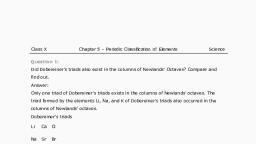
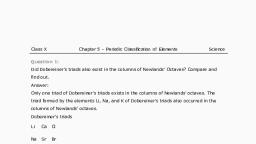
Models of Periodic Table, Dobereiner’s Triads, Dobereiner arranged a group of three elements with similar properties in the, order of increasing atomic masses and called it a triad. He showed that the, atomic mass of the middle element is approximately the arithmetic mean of, the other two. But, Dobereiner could identify only the following three triads, from the elements known at that time., , Newlands’ Law of Octaves, sa (do), , re (re), , ga (mi), , ma (fa), , pa (so), , da (la), , ni (ti), , H, , Li, , Be, , B, , C, , N, , O, , F, , Na, , Mg, , Al, , Si, , P, , F, , Cl, , K, , Ca, , Cr, , Ti, , Mn, , Fe, , Co and Ni, , Cu, , Zn, , Y, , In, , As, , Se
Page 2 :
Br, , Rb, , Sr, , Ce and La, , Zr, , ______, , _____, , When the elements are arranged according to increasing atomic masses, the, physical and chemical properties of every eighth element are similar to that of, the first., Newlands compared these octaves to the series of eight notes of a musical, scale., , Assumptions and Limitations:, 1. The law was applicable for elements with atomic masses up to 40., 2. Properties of new elements discovered did not fit into the law of octaves., 3. In a few cases, Newlands placed two elements in the same slot to fit, elements in the table., 4. He also grouped unlike elements under the same slot., , Mendeleev’s Periodic Table and Law, The physical and chemical properties of elements are periodic functions of, their atomic weights., , Features of Mendeleev’s Periodic Table, ● Twelve horizontal rows, which were condensed to 7, known as periods., ● Eight vertical columns known as groups., ● Groups I to VII subdivided into A and B subgroups., ● Group VIII doesn’t have any subgroups and contains three elements in each, row., ● Elements in the same group exhibit similar properties., , Achievements of Mendeleev’s Periodic Table, 1. A systematic study of elements: Elements with similar properties were, grouped together, that made the study of their chemical and physical, properties easier., 2. Correction of atomic masses: Placement of elements in Mendeleev’s, periodic table helped in correcting the atomic masses of certain elements. For, example, the atomic mass of beryllium was corrected from 13.5 to 9., Similarly, atomic masses of indium, gold, platinum etc., were also corrected.
Page 3 :
3. Prediction of properties of yet to be discovered elements: Eka-boron, ekaaluminium and eka-silicon were the names given to yet to be discovered, elements. The properties of these elements could be predicted accurately, from the elements that belonged to the same group. These elements, when, discovered were named scandium, gallium, and germanium, respectively., 4. Placement of noble gases: When discovered, they were placed easily in a, new group called zero group of Mendeleev’s table, without disturbing the, existing order., , Limitations of Mendeleev’s Periodic Table, 1. Position of hydrogen: Hydrogen resembles both, the alkali metals (IA) and, the halogens (VIIA) in properties, so, Mendeleev could not justify its position., 2. Position of isotopes: Atomic weight of isotopes differ, but, they were not, placed in different positions in Mendeleev’s periodic table., 3. Anomalous pairs of elements: Cobalt (Co) has higher atomic weights but, was placed before Nickel (Ni) in the periodic table., 4. Placement of like elements in different groups: Platinum (Pt) and Gold, (Au) have similar properties but were placed in different groups., 5. Cause of periodicity: He could not explain the cause of periodicity among, the elements, , Modern Periodic Table, Modern Periodic Law, The physical and chemical properties of elements are the periodic function of, their atomic numbers., Cause of periodicity – It is due to the repetition of the same outer shell, electronic configuration at a certain regular interval., , Periods in Modern Periodic Table, Elements present in the same period have the same number of shells which is, equal to the period number., On moving from left to right in a given period, the number of electrons in the, valence shell increases from one to eight while the number of shells remains, the same.
Page 4 :
Number of Elements in a Period, The first period contains only two elements 1Hand2He and is known as, the shortest period., The second period (3Li to 10Ne) and the third period (11Na to 18Ar) contain 8, elements each and are known as short periods., The fourth period (19K to 36Kr) and the fifth period (37Rb to 54Xe) contain 18, elements each and are called long periods., The sixth period contains 32 elements (55Cs and 86Rn) and is also known as the, longest period., The seventh period is an incomplete period., (After the recent discoveries of the new elements and their addition to the, periodic table, the seventh period is officially complete), , Groups in Modern Periodic Table, The modern periodic table contains 18 vertical columns known as groups., Group 1 elements are known as alkali metals., Group 2 elements are known as alkaline earth metals., Group 15 elements are known as pnicogens., Group 16 elements are known as chalcogens., Group 17 elements are known as halogens., Group 18 elements are known as noble gases., , Alkali Metals, The elements in the first group, lithium (Li), sodium (Na), potassium (K),, rubidium (Rb), caesium (Cs), and francium (Fr) are called alkali metals., They were given the name because they all react with water to form alkalis., The alkali metals are all shiny, soft, highly reactive solids at standard, temperature and pressure and readily lose their outermost electron to form, cations with charge +1., Number of valence electrons = 1
Page 5 :
Alkali Earth Metals, The elements in the second group, beryllium(Be), magnesium (Mg), calcium, (Ca), strontium (Sr), barium (Ba), and radium (Ra) are called alkaline earth, metals., They were given the name because their oxides are alkaline in nature., They are all shiny, silvery-white, somewhat reactive hard solids at standard, temperature and pressure. They lose two electrons from their outermost shell, to form cations with charge +2., Number of valence electrons = 2, , Halogens, The elements in the seventeenth group (F, Cl, Br, I and As) are called halogens, and exist as diatomic molecules. The symbol ‘X’ is often used generically to, refer to any halogen., They were given the name halogen, from the Greek words, Hal (“salt”) and gen, (“to produce”), because they all produce a wide range of salts on reacting with, metals., The halogens exist at room temperature in all three states of matter: Solid –, Iodine, Astatine. Liquid – Bromine. Gas – Fluorine, Chlorine., Number of valence electrons = 7, , Noble Gases, The elements in the eighteenth group, helium (He), neon (Ne), argon (Ar),, krypton (Kr), xenon (Xe), and the radioactive radon (Rn) are called noble, gases., They are all odourless, colourless and monatomic gases with very low, chemical reactivity., Since their valence shell is considered to be “full”, they have little tendency to, participate in chemical reactions.
Page 6 :
When discovered and identified, scientists thought they are exceedingly rare,, as well as chemically inert, and therefore these gases were also given the, names ‘rare’ or ‘inert’ gases., Number of valence electrons = 8, , Classification of Modern Periodic Table, The modern periodic table is also classified into metals, non-metals and, metalloids., , Metals, Metals are electropositive as they form bonds by losing electrons., In general cases, oxides of metals are basic in nature., , Non-metals, Nonmetals are electronegative as they form bonds by gaining electrons., In general cases, oxides of non-metals are acidic in nature., , Metalloids, The elements which show the properties of both metals and nonmetals are, called metalloids or semimetals., For example – Boron, silicon, germanium, arsenic, antimony, tellurium and, polonium., To know more about Modern Periodic Table and Its Significance, visit here., , Trends in the Modern Periodic Table, Trends in Modern Periodic Table, In a group – Elements have the same number of valence electrons., Down the group – number of shells increases., In a period – Elements have the same number of shells., Along the period – valence shell electrons increase by one unit.
Page 7 :
Variation of Valency, Valency of an element can be calculated from the electronic configuration in, two ways –, Valency = number of valence electrons (if they are 1, 2, 3 or 4)., Valency = 8 number of valence electrons (if they are 5, 6, 7 or 8)., All the elements of a group have the same number of valence electrons., Therefore, they all have the same valency., , Variation of Atomic Size, Atomic size or radii: It is defined as the distance from the centre of the, nucleus to the valence shell of the atom., Along the period – Atomic radius decreases because effective nuclear charge, increases by one unit and it pulls valence electrons or the electron cloud, closer to the nucleus., Down the group – Atomic radius increases because new shells are added,, hence, the distance between the nucleus and valence electrons or the electron, cloud increases., , Variation of Metallic Properties, Along the period – Metallic character decreases because the tendency to lose, valence electrons decreases due to increasing nuclear charge., Down the group – As the distance between the nucleus and outermost, electron increases, nuclear pull decreases. This increases the tendency of an, atom to lose valence electron/s, hence metallic character increases., , Variation of Nonmetallic Properties, Along the period – Non-metallic character increases as the tendency to gain, electrons in the valence shell increases due to increasing nuclear charge., Down the group – As the distance between the nucleus and valence shell, increases, nuclear pull decreases. This decreases the tendency of an atom to, gain an electron its valence shell, hence non-metallic character decreases.
Page 8 :
Variation of Electronegativity, Along the period – Electronegativity increases as the tendency to gain, electrons in the valence shell increases due to increasing nuclear charge., Down the group – As the distance between the nucleus and valence shell, increases, nuclear pull decreases. This decreases the tendency of an atom to, gain an electron, hence electronegativity, , ANOTHER NOTES, Periodicity of Properties: The repetition of properties of elements after certain regular, intervals is known as Periodicity of Properties., Merits of Mendeleev’s Periodic Table, •, •, •, •, , Mendeleev’s left vacant places in his table which provided an idea for the, discovery of new elements. Example: Eka-boron, Eka-aluminium and Eka-silicon., Mendeleev’s periodic table was predicted properties of several undiscovered, elements on the basis of their position in Mendeleev’s periodic table., It is useful in correcting the doubtful atomic masses of some elements., Noble gases could accommodate in the Mendeleev’s periodic table without, disturbing the periodic table after discovery., , Limitations of Mendeleev’s Periodic Table, (a) No fixed position for hydrogen: No correct position of the hydrogen atom was in, Mendeleev’s periodic table., Example: Position of hydrogen with alkali metals and halogens (17th group).
Page 9 :
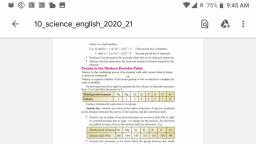
(b) No place for isotopes:, Periodicity of Properties: The repetition of properties of elements after certain regular, intervals is known as Periodicity of Properties., Merits of Mendeleev’s Periodic Table, •, •, •, •, , Mendeleev’s left vacant places in his table which provided an idea for the, discovery of new elements. Example: Eka-boron, Eka-aluminium and Eka-silicon., Mendeleev’s periodic table was predicted properties of several undiscovered, elements on the basis of their position in Mendeleev’s periodic table., It is useful in correcting the doubtful atomic masses of some elements., Noble gases could accommodate in the Mendeleev’s periodic table without, disturbing the periodic table after discovery., , Limitations of Mendeleev’s Periodic Table, (a) No fixed position for hydrogen: No correct position of the hydrogen atom was in, Mendeleev’s periodic table., Example: Position of hydrogen with alkali metals and halogens (17th group)., (b) No place for isotopes:, Need for classification of elements:, Increase in the discovery of different elements made it difficult to organise all that was, known about the elements. To study a large number of elements with ease, various, attempts were made. The attempts resulted in the classification of elements into, metals and non-metals., 2. Dobereiner’s triads:, Johann Wolfgang Dobereiner, a German chemist, classified the known elements in, groups of three elements on the basis of similarities in their properties. These groups, were called triads., (i) Characteristics of Triads:, •, •, , Properties of elements in each triad were similar., Atomic mass of the middle element was roughly the average of the atomic, masses of the other two elements.
Page 10 :
(ii) Examples of Triads:, , (iii) Limitations: Dobereiner could identify only three triads. He was not able to prepare, triads of all the known elements., 3. Newlands’ Law of Octaves:, John Newlands’, an English scientist, arranged the known elements in the order of, increasing atomic masses and called it the ‘Law of Octaves’. It is known as ‘Newlands’, Law of Octaves’., (i) Characteristics of Newlands’ Law of Octaves:, •, •, , It contained the elements from hydrogen, , Need for classification of elements:, Increase in the discovery of different elements made it difficult to organise all, that was known about the elements. To study a large number of elements with, ease, various attempts were made. The attempts resulted in the classification of, elements into metals and non-metals., , 2. Dobereiner’s triads:, Johann Wolfgang Dobereiner, a German chemist, classified the known elements in, groups of three elements on the basis of similarities in their properties. These groups, were called triads., (i) Characteristics of Triads:, •, •, , Properties of elements in each triad were similar., Atomic mass of the middle element was roughly the average of the atomic, masses of the other two elements., , Limitations of Newlands’ law of Octaves:, •, •, •, , The law was applicable to elements up to calcium (Ca)., It contained only 56 elements., In order to fit elements into the table, Newlands’ adjusted two elements like cobalt, and nickel in die the same slot and also put some unlike elements under the same, note.
Page 11 :
4. Mendeleev’s Periodic Table: Dmitri Ivanovich – 5 ’ Mendeleev, a Russian demist, was, the most important contributor to the early development of a periodic table of elements, wherein the elements were arranged on the basis of their atomic mass and chemical, properties., •, , •, •, , •, , Characteristics of Mendeleev’s Periodic Table:, o Mendeleev arranged all the 63 known elements in increasing order, of their atomic masses., o The table contained vertical columns called ‘groups’ and horizontal, rows called ‘periods’., o The elements with similar physical and chemical properties came, under the same groups., Mendeleev’s Periodic Law: The properties of elements are the periodic function of, their atomic masses., Achievements of Mendeleev’s Periodic Table:, o Through this table, it was very easy to study the physical and, chemical properties of various elements., o Mendeleev adjusted few elements with a slightly greater atomic, mass before the elements with slightly lower atomic mass, so that, elements with similar properties could be grouped together. For, example, aluminium appeared before silicon, cobalt appeared before, nickel., o Mendeleev left some gaps in his periodic table., He predicted the existence of some elements that had not been, discovered at that time. His predictions were quite true as elements, like scandium, gallium and germanium were discovered later., o The gases like helium, neon and argon, which were discovered later,, were placed in a new group without disturbing the existing order., Limitations:, o No fixed positions were given to hydrogen in the Mendeleev’s, periodic table., o Positions of Isotopes of all elements was not certain according to, Mendeleev’s periodic table., o Atomic masses did not increase in a regular manner in going from, one element to the next., , 5. Modern Periodic Table: Henry Moseley, gave a new ! property of elements, ‘atomic, number’ and this was I adopted as the basis of Modem Periodic Table., (i) Modern Periodic Law: Properties of elements are a periodic function of i their atomic, number., (ii) The position of elements in Moder Periodic Table:, •, •, , The moder periodic table consists of 18 groups and 7 periods., Elements present in any one group have the same number of valence electrons., Also, the number of shells increases as we go down the group.
Page 12 :
•, , •, , Elements present in any one period, contain the same number of shells. Also, with, increase in atomic number by one unit on moving from left to right, the valence, shell electrons increases by one unit., Each period marks a new electronic shell getting filled., , (iii) Table showing Electronic Configuration of First 20 Elements:, , Trends in the Modern Periodic Table:
Page 13 :
•, , •, , Valance: Valance of an element is determined by the number of valence electrons, present in the outermost shell of its atom., o Valence of elements in a particular group is same., o Valence of elements in a period first increases from one to four and, then decreases to zero., Atomic Size: Atomic size refers to the radius of an atom., o In a period, atomic size and radii decreases from left to right., o In a group, atomic size and radii increases from top to bottom., , Metallic and Non-metallic Properties:, •, o, , •, o, o, , o, , The tendency to lose electrons from the outermost shell of an atom,, is called metallic character of an element, , The tendency to lose electrons from the outermost shell of an atom,, is called metallic character of an element., The tendency to gain electrons from the outermost shell of an atom,, is called non-metallic character of an element.