Page 1 :
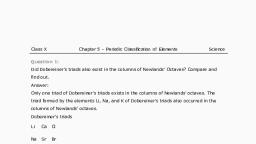
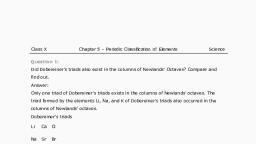
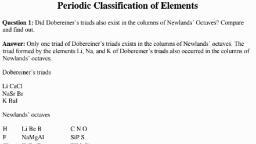
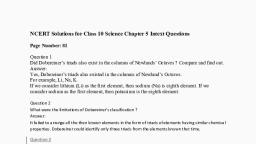
Class X Chapter 5 - Periodic Classification of Elements Science, , 1, Did Dobereiner's triads also exist in the columns of Newlands’ Octaves? Compare and, find out., Answer:, Only one tried of Dobereiner’s triads exists in the columns of Newlands’ octaves. The, triad formed by the elements Li, Na, and K of Dobereiner’s triads also occurred in the, columns of Newlands’ octaves., Dobereiner’s triads, , i ao, Na Sr 8r, , K Be I, , Newlands’ octaves, , , , Ui | Be, , , , Ne | Mg, , , , a Ca Ti, , , , , , Co and Ni | Cu | Zn In, , , , Br Rb | Sr | Ce and La | Zr, , , , , , , , , , , , , , , , What were the limitations of Dobereiner’s classification?, Answer:, Limitation of Dobereiner’s classification:, All known elements could not be classified into Groups of triads on the basis of their, properties., estion, What were the limitations of Newlands’ Law of Octaves?, Answer:, Limitations of Newlands’ law of octaves:, , Poge Loo
Page 2 :
Class x Chapter 5 - Periodic Classification of Elements Science, , , , (i) It was not applicable throughout the arrangements. It was applicable up to calcium, only. The properties of the elements listed after calcium showed no resemblance to the, Properties of the elements above them, , (li) Those elements thet were discovered after Newlands’ octaves did not follow the law, of octaves., , (iit) The position of cobalt and nickel in the group of the elements (F, Cl) of different, Properties could not be explained., , (iv) Placing of iran far away from cobalt and nickel, which have similar Properties as iron,, could also not be explained, , , , Page 2019
Page 3 :
SS, |, , , , Class X Chapter 5 - Periodic Classification of Elements Science, Question 1, , Use Mendeleev’s Periodic Table to predict the formulae for the oxides of the following, elements:, , K, C, Al, Si, Ba., , Answer:, , K is in group 1. Therefore, the oxide will be K,O., , C is in group 4. Therefore, the oxide will be CO)., , Al is in group 3. Therefore, the oxide will be Al,Os., , Si is in group 4. Therefore, the oxide will be SiO,, , Ba is in group 2. Therefore, the oxide will be Ba0,, , Question 2, , Besides gallium, which other elements have since been discovered that were left by, Mendeleev in his Periodic Table? (any two), , Answer:, , Scandium and germanium, , Question 3, , What were the criteria used by Mendeleev in creating his Periodic Table?, , Answer:, , Mendeleev’s periodic table was based on the observation that the properties of elernents, ere a periodic function of their atomic masses. This rneans that if elements ere arranged, in the increasing order of their atomic masses, then their properties get repeated after, regular intervals., , Question 4, , Why do you think the noble gases are placed in a separate group?, , Answer:, , Noble gases are inert elements. Their properties are different from the all other, elements. Therefore, the noble gases are placed in a separate group., , Page 3 of 9
Page 4 :
Ciass X Chapter 5 - Periodic Classification of Elements Science, , , , Question 1, , How could the Modern Periodic Table remove various anomalies of Mendeleev’s Periodic, Table?, , Answer:, , Mendeleev was unable to give fixed position to hydrogen and isotopes in the periodic, table. In Mendeleev’s periodic table, the increasing manner of atomic mass of the, elements is not always regular from one to its next. It was believed that a more, fundamental property than atomic mass could explain periodic properties in a better, manner., , It was Henry Moseley who demonstrated that atomic number of an element could, explain periodic properties in a better way than atomic mass of an element and arranged, the elements in increasing order of their atomic numbers. Then it was found that the, various anomalies of Mendeleev's periodic table were removed by the modern periodic, table., , Question 2, , Name two elements you would expect to show chemical reactions similar to magnesium, What is the basis for your choice?, , Answer:, , Calcium (Ca) and strontium (Sr) are expected to show chemical reactions similar to, magnesium (Mg). This is because the number of valence electrons (2) is same in all, these three elements. And since chemical properties are due to valence electrons, they, show same chemical reactions., , Question 3, , Name, , (a) three elements that have a single electron in their outermost shells., , (b) two elements that have two electrons in their outermost shells., , (c) three elements with filled outermost shells., , Answer:, , (a) Lithium (Li), sodium (Na), and potassium (K) have a single electron in their, outermost shells., , (b) Magnesium (Mg) and caicium (Ca) have two electrons in their outermost shells., , (c) Neon (Ne), argon (Ar), and xenon (Xe) have filled outermost shells., , , , Page 40f9
Page 5 :
Class X Chapter 5 ~ Periodic Classification of Elements Science, , , , Question 4:, , (a) Lithium, sodium, potassium are all metals that react with water to liberate hydrogen, gas. Is there any simiarity in the atoms of these elements?, , (b) Helium is an unreactive gas and neon is & gas of extremely low reactivity. What, if, anything, do their atoms have in common?, , Answer:, , (#) Yes. The atoms of all the three elements lithium, sodium, and potassium have one, electron in their outermost shells., , (b) Both helium (He) and neon (Ne) have filled outermost shells. Helium has a dupiet in, its K shell, while neon has an octet in its L shell., , Question 5:, , In the Modern Periodic Table, which are the metals among the first ten elements?, Answer:, , Among the first ten elements, lithium (Li) and beryllium (Be) are metals., , Question 6:, , By considering their position in the Periodic Table, which one of the following elements, would you expect to have maximum metallic characteristic?, , Answer:, , Since Be lies to the extreme left hand side of the periodic table, Be is the most metalic, among the given elements., , , , Page Soto