Page 1 :
PDF download, , JAB SAARA INDIA, VEDANTU PE ONLINE PADHEGA, , Scholarship Admission Test, , , WIN an assured Scholarship upto 100%, , , , Take the Online Test from the comfort of your home, , , , It’s Absolutely FREE, , , , For, , Class 6-12, , Register NOW, Limited Seats!, , CBSE | ICSE | JEE | NEET, , W W W.V E D A N T U . C O M
Page 3 :
Intext Exercise 1, Question 1:, Give an example of a metal which, (i) is a liquid at room temperature., (ii) can be easily cut with a knife., (iii) is the best conductor of heat., (iv) is a poor conductor of heat., Solution 1:, (i) Metal that exists in liquid state at room temperature → Mercury, (ii) Metal that can be easily cut with a knife → Potassium, (iii) Metal that is the best conductor of heat → Copper and silver, (iv) Metals that are poor conductors of heat → Mercury, Question 2:, Explain the meanings of malleable and ductile., Solution 2:, Malleable: Metals can be beaten into thin sheets are called malleable due to the eleastic nature of, metals. For example, most of the metals are malleable except zinc., Ductile: Metals can be drawn into thin wires or chains are called ductile due to the eleastic nature, of metals. For example, most of the metals are ductile except zinc, , Intext Exercise 2, Question 1:
Page 4 :
Define the following terms., (i) Mineral (ii) Ore (iii) Gangue, Solution 1:, (i) Mineral: The mineral which are present as mixture of metallic compounds and extractable, impurities are known as ores and the compound of a metal found in nature is called mineral., (ii) Ore: The minerals from which the metals can be conveniently and economically extracted are, known as ores., (iii) Gangue: The ore contains some impurities like sand, clay and rocky material. These, impurities are called gangue or matrix. Gangue is removed before the metallurigical process, starts., Question 2:, Write equations for the reactions of, (i) iron with steam, (ii) calcium and potassium with water, Solution 2:, (i), (ii), , Question 3:, Samples of four metals A, B, C and D were taken and added to the following solution one by, one. The results obtained have been tabulated as follows., Metal Iron (II) sulphate Cooper (II) sulphate Zinc sulphate, Silver nitrate, A., No reaction, Displacement, B., Displacement, No reaction, C., No reaction, No reaction, No reaction, Displacement, D., No reaction, No reaction, No reaction, No reaction, Use the Table above to answer the following questions about metals A, B, C and D., (i) Which is the most reactive metal?, (ii) What would you observe if B is added to a solution of copper (II) sulphate?, (iii) Arrange the metals A, B, C and D in the order of decreasing reactivity., Solution 3:, According to the activity series the most reactive metal displaces the least reactive metal., according to the given table we can say that:
Page 5 :
A is less reactive than iron but more reactive with copper., A + FeSO4 → No reaction, A + CuSO4 → Single Displacement, B is more reactive than iron but less reactive than zinc., B + FeSO4 → Single Displacement, B + ZnSO4 → No reaction, C is less reactive than iron, copper and zinc but more reactive with silver, C + FeSO4 → No reaction, C + CuSO4 → No reaction, C + ZnSO4 → No reaction, C + AgNO3 → Single Displacement, D is less reactive than iron, copper,zinc, and silver, D + FeSO4 → No reaction, D + CuSO4 → No reaction, D + ZnSO4 → No reaction, D + AgNO3 → No Reaction, (i) B is the most reactive metal., B + FeSO4 → Single Displacement, (ii) When B is added to a solution of copper (II) sulphate then it shows the single displacement, because B is more reactive than iron., B + CuSO4 →Single Displacement, (iii) The order of decreasing reactivity of the given metals are:, B>A>C>D, Question 4:, Which gas is produced when dilute hydrochloric acid is added to a reactive metal? Write the, chemical reaction when iron reacts with dilute H2SO4., Solution 4:, According to the activity series, iron is more reactive than hydrogen so it can displace the, hydrogen. when iron reacts with sulphuric acid it evolves the hydrogen gas., , Question 5:, What would you observe when zinc is added to a solution of iron (II) sulphate? Write the, chemical reaction that takes place., Solution 5:, Accroding to the activity series, zinc is more reactive than iron so it can displace the iron from its, salt solution. Iron sulphate is green in colour, its changes into brown.
Page 6 :
Intext Exercise 3, Question 1:, (i) Write the electron-dot structures for sodium, oxygen and magnesium., (ii) Show the formation of Na2O and MgO by the transfer of electrons., (iii) What are the ions present in these compounds?, Solution 1:, (i) Sodium, oxygen and magnesium atomic numbers are 11, 8 and 12.The electron dot structures, are below., , (ii) Both compounds will form an ionic bond., , (iii) In the Na2O, the ions 2Na+ and O2− and in MgO are Mg2+ and O2−., Question 2:, Why do ionic compounds have high melting points?, Solution 2:
Page 7 :
Ionic compounds have high melting and boiling points due to strong electrostatic force of, attraction, the constituent ions have rigid packing which resuls in high meleting and boiling, points., , Intext Exercise 4, Question 1:, Define the following terms: i) mineral ii) ore, iii) gangue, Solution 1:, (i) Mineral: The mineral which are present as mixture of metallic compounds and extractable, impurities are known as ores and the compound of a metal found in nature is called mineral., (ii) Ore: The minerals from which the metals can be conveniently and economically extracted are, known as ores., (iii) Gangue: The ore contains some impurities like sand, clay and rocky material. These, impurities are called gangue or matrix. Gangue is removed before the metallurigical process, starts., Question 2:, Name two metals which are found in nature in the free state., Solution 2:, The least reactive metals are found in nature in the free state., For example: Silver(Ag), Gold (Au), and Platinum(Pt)., Question 3:, What chemical process is used for obtaining a metal from its oxide?, Solution 3:, More reactive metals are reduced by the electrolysis process. moderate reactive metals can be, reduced by either carbon or carbon monoxide. metal oxides are reduced by using suitable, reducing agents such as carbon or by highly reactive metals to displace the metals from their, oxides., For example, zinc oxide is reduced to metallic zinc by heating with carbon., Or, , ZnO + CO → Zn + CO2, Thermite process: Chromium oxides is reduced to chromium by treating it with aluminium, powder. In this case, aluminium displaces manganese from its oxide., Cr2O3 + 2Al → Al2O3 + 2Cr + heat
Page 8 :
Intext Exercise 5, Question 1:, Metallic oxides of zinc, magnesium and copper were heated with the following metals., , In which cases will you find displacement reactions taking place?, Solution 1:, Metal, Zinc, Magnesium, Copper, Zinc oxide, No reaction, Displacement, No reaction, Magnesium oxide No reaction, No reaction, No reaction, Copper oxide, Displacement, Displacement, No reaction, Question 2:, Which metals do not corrode easily?, Solution 2:, The slow eating up of metals by the action of air, moisture or a chemical on their surface is, called corrosion. Most reactive metals corrode readly due to the action of moisture and air., hence, less reactive metals are less likely to get corroded., Question 3:, What are alloys?, Solution 3:
Page 9 :
An alloys is a homogenous mixture of two or more metals or a metal and non-metal. Alloys are, formed by mixing two or more metals by melting them and cooling them finally. on cooling, the, mixture solidifies and is called an alloy. the constituents are mixed homogenously. For example,, Bronze is an alloy of copper and tin., , NCERT Exercise 5, Question 1:, Which of the following pairs will give displacement reactions?, (a) NaCl solution and copper metal, (b) MgCl2 solution and aluminium metal, (c) FeSO4 solution and silver metal, (d) AgNO3 solution and copper metal., Solution 1:, (d) AgNO3 solution and copper metal, Question 2:, Which of the following methods is suitable for preventing an iron frying pan from rusting?, (a) Applying grease, (b) Applying paint, (c) Applying a coating of zinc, (d) all of the above., Solution 2:, (c) Applying a coating of zinc, , Question 3:, An element reacts with oxygen to give a compound with a high melting point. This compound is, also soluble in water. The element is likely to be, (a) calcium, (b) carbon, (c) silicon, (d) iron, Solution 3:, (a) The element is likely to be calcium., Question 4:
Page 10 :
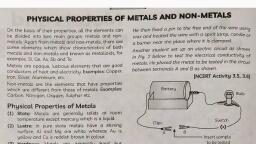
Food cans are coated with tin and not with zinc because, (a) zinc is costlier than tin., (b) zinc has a higher melting point than tin., (c) zinc is more reactive than tin., (d) zinc is less reactive than tin., Solution 4: (c) Zinc is more reactive than tin., Question 5:, You are given a hammer, a battery, a bulb, wires and a switch., (a) How could you use them to distinguish between samples of metals and non-metals?, (b) Assess the usefulness of these tests in distinguishing between metals and nonmetals., Solution 5:, (a) Metals are malleable in nature. with the help of hammer, we can beat the given sample. If its, converts into its thin sheets, then that sample is metal otherwise nonmetal., When we will use the battery, a bulb, wires and a switch to set up a circuit, then metals conduct, electricity. If the bulb glow it represent the metallic nature of the sample due to free electrons. If, the bulb will not glow, it represent the non-metallic nature of the sample., (b) These test represent the physical properties of the metals and non- metals. we can, differentiate easily by the physical properties., Question 6:, What are amphoteric oxides? Give two examples of amphoteric oxides., Solution 6:, Amphoteric oxides are those oxides which can reacts with acid as well as base., Examples: Zinc oxide(ZnO) and Aluminum oxide (Al2O3)., Question 7:, Name two metals which will displace hydrogen from dilute acids, and two metals which will not., Solution 7:, More reactive metals will displace hydrogen from its dilute acids. for example : Iron and Zinc., Fe + 2HCl → FeCl2 + H 2, , Zn + 2HCl → ZnCl2 + H 2, Least reactive metals will not displace hydrogen from its dilute acids. for example : copper and, silver, Cu + HCl → No Reaction, , Ag + HCl → No Reaction, Question 8:, In the electrolytic refining of a metal M, what would you take as the anode, the cathode and the, electrolyte?, Solution 8:
Page 11 :
In the electrolytic refining of a metal M:, Cathode → Pure metal M, Anode → Impure metal M, Electrolyte → Salt Solution of the metal M, Question 9:, Pratyush took sulphur powder on a spatula and heated it. He collected the gas evolved by, inverting a test tube over it, as shown in figure below., , (a) What will be the action of gas on, (i) dry litmus paper?, (ii) moist litmus paper?, (b) Write a balanced chemical equation for the reaction taking place., Solution 9:, (a) (i) No action on dry litmus paper., (ii) Moist blue litmus turns to red due to the formation of sulphur dioxide. sulphur dioxide is, acidic oxide when it will react with water converts into sulphurous acid., (b)
Page 12 :
Question 10:, State two ways to prevent the rusting of iron., Solution 10:, Rusting is defined as a process where the substance will degrade usually metals. Metal converts, into its hydrated oxides. Ex: Fe , Cu , Ag, Two ways to prevent the rusting of iron are:, (i) Painting, Oiling : Iron articles gets corrode easily in the presence of moisture and air. For the, prevention of rusting, we have to paint the iron articles. When we apply the paint on iron articles, the supply of moisture and air will stop., (ii) Galvanization: An iron article is coated with a layer of zinc metal, which prevents the iron to, come in contact with moisture and oxygen., Question 11:, What type of oxides is formed when non-metals combine with oxygen?, Solution 11:, When non-metals combine with oxygen to form acidic oxides. These oxides when react with, water for form acids., For example:, , Question 12:, Give reasons, (a) Platinum, gold and silver are used to make jewellery., (b) Sodium, potassium and lithium are stored under oil., (c) Aluminium is a highly reactive metal, yet it is used to make utensils for cooking., (d) Carbonate and sulphide ores are usually converted into oxides during the process of, extraction., Solution 12:, (a) Platinum, gold and silver are used to make jewellery because they are least reactive metals, and do not corrode easily. they are lustrous., (b) Sodium, potassium and lithium are stored under oil because they are very reactive metals and, vigorously reacts with air as well as water with lots of energy. Therefore, they are kept immersed, in kerosene oil., (c) Aluminium is a highly reactive metal, yet it is used to make utensils for cooking because, resist to corrosion and good conductor of heat. Aluminium reacts with oxygen present in air to, form a thin white layer of aluminium oxide (Al2O3). This oxide layer prevents further reaction of, aluminum due to stability of this oxide.
Page 13 :
(d) Carbonate and sulphide ores are usually converted into oxides because metals can be easily, extracted from their oxides (by using the calcination and roasting process)rather than from their, carbonates and sulphides., Question 13:, You must have seen tarnished copper vessels being cleaned with lemon or tamarind juice., Explain why these sour substances are effective in cleaning the vessels., Solution 13:, Copper reacts with moist carbon dioxide in air to form basic copper carbonate (CuCO3., Cu(OH)2). It is green in colour and copper vessel loses its shiny brown surface. When we apply, the lemon or tamarind neutralizes the basic copper carbonate due to the presence of citric acid, and dissolves the layer., Question 14:, Differentiate between metal and non-metal on the basis of their chemical properties., Solution 14:, Metal, , Non-metal, , Metals are electropositive., , Non-metals are electronegative., , They react with water to form oxides and, hydroxides., Some metals react with cold water, some with hot, water, and some with steam., 2Na + 2H2O → 2NaOH + H2 , They react with oxygen to form basic oxides, 4Na + O2 → 2Na2O, These have ionic bonds., , They do not react with water., , They react with dilute acids to form a salt and, evolve hydrogen gas. However, Cu, Ag, Au, Pt, Hg, do not react., 2Na + 2HCl → 2NaCl + H2 , They react with the salt solution of metals., Depending on their reactivity, displacement, reaction can occur., CuSO4 +Zn → ZnSO4 +Cu, They act as reducing agents., Na → Na+ + e–, , They react with oxygen to form, acidic or neutral oxides., C + O2 → CO2, These have covalent bonds, They do not react with dilute, acids. These are not capable of, replacing hydrogen., These react with the salt, solution of non-metals, , These act as oxidising agents., Cl2 +2e– → >2Cl–
Page 14 :
Question 15:, A man went door to door posing as a goldsmith. He promised to bring back the glitter of old and, dull gold ornaments. An unsuspecting lady gave a set of gold bangles to him which he dipped in, a particular solution. The bangles sparkled like new but their weight was reduced drastically. The, lady was upset but after a futile argument the man beat a hasty retreat. Can you play the detective, to find out the nature of the solution he had used?, Solution 15: According to the activity series, gold is least reactive metal. It will not react with, any acid or base. when we keep the gold in aqua regia than gold dissolve in it. The outer layer of, gold gets dissolved, so the weight of ornaments reduced and inner layer appears. Aqua regia is a, mixture of 3 parts of HCl and 1 parts of HNO3., Question 16:, Give reasons why copper is used to make hot water tanks and not steel (an alloy of, iron)., Solution 16:, According to the activity series, copper is least reactive than hydrogen, it will not displace, hydrogen. However, iron reacts with steam. If the hot water tanks are made of steel then iron, would react vigorously with the steam and will corrode easily.
Page 15 :
Exercise 6, Question 1:Why is sodium kept immersed in kerosene oil?, Answer: Sodium, potassium and lithium are stored under oil because they are very reactive, metals and vigorously reacts with air as well as water with lots of energy. Therefore, they are, kept immersed in kerosene oil., Question 2:Why do ionic compounds have high melting points?, Answer: Ionic compounds have strong electrostatic forces of attraction between the ions., Therefore, it requires a lot of energy to overcome these forces. That is why ionic compounds, have high melting points.
Page 16 :
screen, , Access of Full, Syllabus Course, , Crash Course to Revise, Entire Syllabus, , Test Series and, Assignment, , Chapter Wise Course to, help you master One chapter, , Notes & Recordings, of every class, , Unlimited In-class, Doubt Solving, , Use VPROP & Get Extra 20% OFF, , Subscribe Now, https://vdnt.in/VPROPDF, , GRADES 6-12 | CBSE | ICSE | JEE | NEET
Page 17 :
Download, , Vedantu Learning APP, Free LIVE, MasterClasses, Unlimited Access, to Study Materials, Specially Designed, Tests, , Best of 2019 Winner, , USER’S CHOICE, APP AWARD 2019, Category, , Everyday Essentials, W W W.V E D A N T U . C O M, , DOWNLOAD, THE APP
Page 18 :
, , Thank You, , for downloading the PDF, , Samajh Aayega toh, Maza Aayega!!, , FREE MASTER CLASS SERIES, , , For Grades 6-12th targeting JEE, NEET, CBSE, ICSE & many more, , , , Free 60 Minutes LIVE Interactive classes everyday, , , , Learn from India’s Best Master Teachers, , W W W.V E D A N T U . C O M, , Register for FREE, Limited Seats!