Page 1 :
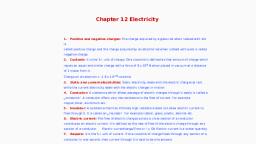
Science Notes Chapter 12 Electricity, , Electricity: Electric current, electric circuit, voltage or electric potential,, resistance and (Ohm’s law)., , Electric Current: The flow of electric charge is known as Electric Current,, Electric current is carried by moving electrons through a conductor., By convention, electric current flows in the opposite direction to the, movement of electrons., , Electric Circuit: Electric circuit is a continuous and closed path of electric, current.., , Expression of Electric Current: Electric current is denoted by the letter ‘I’., Electric current is expressed by the rate of flow of electric charges. Rate of
Page 2 :
flow means, the amount of charge flowing through a particular area in unit, time., , If a net electric charge (Q) flows through a cross-section of a conductor in, time t, then,, , Where I is electric current, Q is a net charge and t is a time in second., S.I. Unit of Electric Charge and Current: S.I. unit of electric charge is, coulomb (C)., One coulomb is nearly equal to 6 × 10¹⁸ electrons. S.I. unit of electric, current is ampere (A). Ampere is the flow of electric charge through a, surface at the rate of one coulomb per second. This means, if 1 coulomb of, electric charge flows through a cross section for 1 second, it would be equal, to 1 ampere., Therefore, 1 A = 1 C/1 s, , Small Quantity of Electric Current: Small quantity of electric current is, expressed in milliampere and microampere. Milliampere is written as mA, and microampere as pA., 1 mA (milliampere) = 10-3 A, 1 pA (microampere) = 10-6 A, , Ammeter: An apparatus to measure electric current in a circuit.,, , Charge: Like mass, the charge is the fundamental property of matter. There, are two types of charge, (i) Positive charge., (ii) Negative charge.
Page 3 :
Positive and Negative Charge: The charge acquired by a glass rod when, rubbed with silk is called a positive charge and the charge acquired by an, ebonite rod when rubbed with wool is called negative charge., * Unlike charges attract each other and like charges repel each other., S.I. unit of charge is coulomb (C)., 1 coulomb = 1 ampere × 1 second., 1C = 1A × 1s, Thus, the quantity of charge which flows through a circuit when one ampere, of current flows through it in one second is known as a 1-coulomb charge., , Electric Potential: The amount of electric potential energy at a point is, called electric potential., , Potential Difference: The difference in the amount of electric potential, energy between two points in an electric circuit is called electric potential, difference., Electric potential difference is known as voltage, which is equal to the, amount of work done to move the unit charge between two points against, static electric field., Therefore, Voltage =, Voltage or electric potential difference is denoted by V’. Therefore, V =, Where, W = Work done and Q = Charge, S.I. Unit of Electric Potential Difference (Voltage), S.I. unit of electric potential difference is volt and denoted by ‘V’., Since joule is the unit of work and Coulomb is the unit of charge, 1 volt of, electric potential difference is equal to the 1 joule of work to be done to, move a charge of 1 coulomb from one point to another in an electric circuit., Therefore, 1V = 1Joule/1Coulomb = 1J/1C, 1V = 1JC-1, , Voltmeter: An apparatus to measure the potential difference or electric, potential difference between two points in an electric circuit.
Page 4 :
Galvanometer: It is a device to detect current in an electric circuit., , Ohm’s Law: Ohm’s Law states that the potential difference between two, points is directly proportional to the electric current, at a constant, temperature., This means potential difference V varies as electric current., V∝I, V = RI, I=, R=, Where, R is constant for the given conductor at a given temperature and is, called resistance., , Resistance: Resistance is the property of conductor which resists the flow of, electric current through it., S.I. unit of resistance is ohm. Ohm is denoted by Greek letter ‘Q’, , 1 Ohm: 1 ohm (Q) of resistance (R) is equal to the flow 1A of current, through a conductor between two points having a potential difference equal, to 1V., This means; 1Ω =, From the expression of Ohm’s Law, it is obvious that electric current, through a resistor is inversely proportional to resistance. This means electric, current will decrease with an increase in resistance and vice versa. The, graph of V (potential difference) versus I (electric current) is always a, straight line., , Graph of Potential Difference (V) Vs Electric Current (I), Voltage, i.e. Potential difference (V) = ?, We know, from Ohm’s Law that,
Page 5 :
R=, , Resistance: Resistance is a property of conductor due to which it resists the, flow of electric current through it. A component that is used to resist the, flow of electric current in a circuit is called a resistor., In practical application, resistors are used to increase or decrease the, electric current., , Variable Resistance: The component of an electric circuit which is used to, regulate the current, without changing the voltage from the source, is called, variable resistance., , Rheostat: This is a device which is used in a circuit to provide variable, resistance., , Cause of Resistance in a Conductor: Flow of electrons in a conductor is, electric current. The positive particles of conductor create hindrance to flow, of electrons, because of attraction between them, this hindrance is the cause, of resistance in the flow of electricity., Factors on Which Resistance of a Conductor Depends: Resistance in a, conductor depends on nature, length and area of cross section of the, conductor., , (i) Nature of Material: Some materials create least hindrance and hence, are, called good conductors. Silver is the best conductor of electricity. While some, other materials create more hindrance in the flow of electric current, i.e., flow of electrons through them. Such materials are called bad conductors., Bad conductors are also known as insulators. Hard plastic is the one of the, best insulators of electricity., , (ii) Length of Conductor: Resistance (R) is directly proportional to the length, of the conductor. This means, resistance increases with increase in length of, the conductor. This is the cause that long electric wires create more, resistance to the electric current. Thus, Resistance (R) ∝ length of, conductor (l), or, R ∝ l …(i)
Page 6 :
(iii) Area of Cross Section: Resistance R is inversely proportional to the area, of cross section (A) of the conductor. This means R will decrease with an, increase in the area of conductor and vice versa. More area of conductor, facilitates the flow of electric current through more area and thus,, decreases the resistance. This is the cause that thick copper wire creates less, resistance to the electric current., Thus, resistance (R) ∝ 1/Area of cross section of conductor (A), or, R ∝, , ….(ii), , From equations (i) and (ii), R∝, R=ρ, Where, ρ (rho) is the proportionality constant. It is called the electrical, resistivity of the material of conductor., From equation (iii) RA = ρl ⇒ ρ =, , ..(iv), , The S.I. of Resistivity: Since, the S.I. unit of R is Q, S.I. unit of area is m2 and, S.I. unit of length is m. Hence, unit of resistivity (ρ) =, , = Ωm, , Thus, S.I. unit of resistivity (ρ) is Ωm., , Resistivity: It is defined as the resistance offered by a cube of a material of, side 1m when current flows perpendicular to its opposite faces. It’s S.I. unit, is ohm-meter (Ωm)., Resistivity, ρ =, Resistivity is also known as specific resistance., Resistivity depends on the nature of the material of the conductor., Materials having a resistivity in the range of 10-8 Ωm to 10-6 Ωm are, considered as very good conductors. Silver has resistivity equal to 1.60 ×, 10-8 Ωm and copper has resistivity equal to 1.62 × 10⁻⁸ Ωm., Rubber and glass are very good insulators. They have a resistivity in the, order of 10-12 Ωm to 10-8 Ωm., The resistivity of materials varies with temperature., Combination of resistors (Series and Parallel combination), the heating, effect of electric current and electric power.
Page 7 :
Combination of Resistors, (i) Series combination, (ii) Parallel combination., , 1. Resistors in Series: When resistors are joined from end to end, it is called, in series. In this case, the total resistance of the system is equal to the sum, of the resistance of all the resistors in the system., , Let, three resistors R1, R2, and R3 get connected in series., Potential difference across A and B = V, Potential difference across R1, R2 and R3 = V1, V2 and V3, Current flowing through the combination = I, We, know that, V= V1 + V2 + V3 …. (i), According to Ohm’s Law :, V1 = IR1, V2 = IR2 and V3 = IR3 ….. (ii), Let, total resistance = Rs, Then, V = IRs …(iii), From equations (i) and (ii) and (iii), IRs = IR1 + IR2 + IR3, Rs = R1 + R2 + R3, When the resistors are connected in series, the current flowing through each, resistor is the same and is equal to the total current., , 2. Resistors in Parallel: When resistors are joined in parallel, the reciprocal, of the total resistance of the system is equal to the sum of reciprocal of the, resistance of resistors.
Page 8 :
Let three resistors R1, R2 and R3 connected in parallel., Potential difference across point A and B = V, Total current flowing between point A and B = I, Currents flowing through resistors R1, R2 and R3 = I1, I2 and I3 respectively., We, know that,, I = I1 + I2 + I3 …….(i), Since, the potential difference across R1, R2, and R3 is the same = V, According to Ohm’s Law,, , In parallel combination, the potential difference across each resistor is the, same and is equal to the total potential difference., , Heating Effect of Electric Current: When electric current is supplied to a, purely resistive conductor, the energy of electric current is dissipated, entirely in the form of heat and as a result, resistor gets heated. The heating, of resistor because of dissipation of electrical energy is commonly known as, Heating Effect of Electric Current. Some examples are as follows : When, electric energy is supplied to an electric bulb, the filament gets heated, because of which, it gives light. The heating of electric bulb happens because, of heating effect of electric current., , Cause of Heating Effect of Electric Current: Electric current generates heat, to overcome the resistance offered by the conductor through which it passes.
Page 9 :
Higher the resistance, the electric current will generate higher amount of, heat. Thus, generation of heat by electric current while passing through a, conductor is an inevitable consequence. This heating effect is used in many, appliances, such as electric iron, electric heater, electric geyser, etc., , Joule’s Law Of Heating: Let, an electric current, I is flowing through a, resistor having resistance = R., The potential difference through the resistor is = V., The charge, Q flows through the circuit for the time, t, Thus, work done in moving of charge (Q) of potential difference (V),, W=V ×Q, Since this charge, Q flows through the circuit for time t, Therefore, power input (P) to the circuit can be given by the following, equation :, P=, P=V×, , …..(i), , We know, electric current, I =, Substituting, , = I in equation (i), we get,, , P = VI …(ii), i.e., P = VI, Since, the electric energy is supplied for time ?, thus, after multiplying both, sides of equation (ii) by time t, we get,, P × t = VI × t = VIt ……(iii), i.e., P = VIt, Thus, for steady current I, the heat produced (H) in time t is equal to VIt, H = VIt i.e., H = VIt, We know, according to Ohm’s Law,, V = IR, By substituting this value of V in equation (iii), we get,, H = IR × It, H = I2Rt ……(iv)
Page 10 :
The expression (iv) is known as Joule’s Law of Heating, which states that, heat produced in a resistor is directly proportional to the square of current, given to the resistor, directly proportional to the resistance for a given, current and directly proportional to the time for which the current is, flowing through the resistor., , Electric Bulb: In an electric bulb, the filament of bulb gives light because of, the heating effect of electricity. The filament of bulb is generally, made of, tungsten metal, having melting point equal to 3380°C., , Electric Iron: The element of electric iron is made of alloys having high, melting point Electric heater and geyser work on the same mechanism., , Electric Fuse: Electric fuse is used to protect the electric appliances from, high voltage if any. Electric fuse is made of metal or alloy of metals, such as, aluminum, copper, iron, lead, etc. In the case of flow of higher voltage than, specified, fuse wire melts and protect the electric appliances., Then electric current in circuit, I=, , Electric Power, S.I. unit of electric power is watt (W)., 1W = 1 volt × 1 ampere = 1V × 1A, I kilowatt or 1kW = 1000 W, Consumption of electricity (electric energy) is generally measured in, kilowatt., Unit of electric energy is kilowatt-hour (kWh)., 1 kWh = 1000 watt × 1 hour = 1 unit = 1000 W × 3600 s, 1 kWh = 3.6 x 10⁶ watt second = 3.6 × 10⁶ J, , Conductor: The material which can allow the flow of electrons through itself, is called the conductor. It has a large number of free electrons. It offers low, opposition in the flow of current., , Insulator: The material which does not allow the flow of electrons through, itself is called insulator. It has less or no free electrons. It offers high, opposition in the flow of current.
Page 11 :
Electric Current: The amount of flow charge through any cross-sectional, area of a conductor in unity time is called Electric Current., It is represented by ‘I’, I=, , Unit of Electric Current: It is (coulomb per second) or Ampere (A). Electric, Current is a scalar quantity. It is measured by an ammeter., , Direction: The direction of conventional current (or practical current) is, opposite to the flow of electrons., , Electric potential: Electric Potential at any point in the electric field is, defined as the amount of work done to bring the unit positive charge from, infinity (from outside the electric field) to that point., V = , S.I. unit of Electric Potential is JC-1 or volt (V). It is a scalar quantity., The +ve charge flows from higher to lower potential. The -ve charge flows, from lower to a higher potential. The difference of electric potential, between any two points in the electric field is called Electric Potential, difference. It is known as a voltage which is equal to the work done per unit, charge between two points against the static electric field., VAB = VA – VB =, Electric Potential difference is measured by a voltmeter., , Ohm’s Law: According to this law “Under the constant physical condition, , the potential difference across the conductor is directly proportional to the, current flowing through the conductor.”, V∝I, V = IR …[Where R is proportionality constant called resistance of conductor], ⇒I =, R depends upon nature, geometry and physical condition of the conductor., , The heat generated by electric current: The potential difference between, two points in an electrical field is equal to the work done in moving a unit, charge from one point to another., Then, work is done, W = VQ and Q = I × t, W=V ×I ×t
Page 12 :
From Ohm’s Law, we know that, V = IR, W = IR × I × t = I2.Rt, Since heat produced by the electric current is equal to work done, W, H=W, ⇒ H (heat) = I2Rt Joule., , Resistance: Ratio of the applied voltage to the current flowing in the, conductor is called resistance of the conductor., ⇒R=, S.I. Unit of resistance is VA-1 or ohm (Ω)., Resistance is the opposition offered by the conductor in the flow of current., Practically it is, R ∝ L (L is the length of a conductor), R ∝ 1/A (A is the area of a conductor), So, R ∝ L/A, R = ρL/A …[Where p is proportionality constant called specific resistance of, conductor, It only depends upon nature (material) and temperature of conductor., Specific resistance or Resistivity = ρ = RA /L, It’s S.I. Unit is ohm metre., Combination of resistance:, , In this combination the current across every component is same but, potential across every component is different., If resistance R1, R2 and R3 are connected in series with a battery of, Potential V, then equivalent resistance of the combination, R = R1 + R2 + R3, The parallel combination of resistance:, In this combination the current across every component is different. But, potential across every component is the same.
Page 13 :
If resistance R1, R2 and R3 are connected in parallel with a battery of, Potential V, then equivalent resistance of combination, Electric Energy is the amount of work done to maintain the continuous flow, of electric current in the circuit., It's S.I. unit is joule (J)., , Electric power (P): The electric work done per unit time is called electric, power., Electric Power =, or P =, Electric power is also defined as the electric energy consumed per unit time., P=, S.I. unit of electric power is Watt. When one joule of energy is used for one, second, electric power is equal to one watt., Derivation of formula for electric power:, , We know that electric work done, W = V × I × t or P =, P = VI, Electric power in watts = Volts × ampere, Also V = IR …[According to Ohm’s Law], So P = IR × I, P = I2R, We know that I =, P = ( )2 × R =, , Watt, , The maximum value of electric current that can pass through an electric, appliance without damaging electric appliance is called current rating of, electric appliance.