Page 1 :
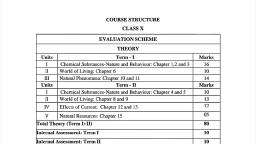
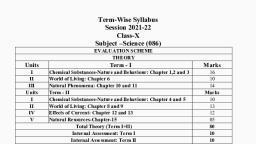
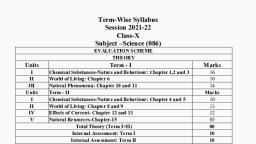
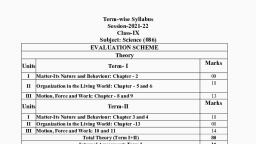
Term-Wise Syllabus, Session 2021-22, Class-X, Subject –Science (086), EVALUATION SCHEME, THEORY, , Units, , Term - I, , Marks, , I, II, III, Units, I, II, IV, V, , Chemical Substances-Nature and Behaviour: Chapter 1,2 and 3, World of Living: Chapter 6, Natural Phenomena: Chapter 10 and 11, Term - II, Chemical Substances-Nature and Behaviour: Chapter 4 and 5, World of Living: Chapter 8 and 9, Effects of Current: Chapter 12 and 13, Natural Resources-Chapter-15, Total Theory (Term I+II), Internal Assessment: Term I, Internal Assessment: Term II, Grand Total, , 16, 10, 14, Marks, 10, 13, 12, 05, 80, 10, 10, 100, , TERM-I, Content, THEME: MATERIALS, Unit –I Chemical Substances – Nature and Behaviour, CHAPTER-1: CHEMICAL REACTIONS AND EQUATIONS- Chemical equation, Balanced chemical, equation, implications of a balanced chemical equation, Types of chemical reactions: combination,, decomposition, displacement, double displacement, precipitation, neutralization, Oxidation and Reduction., SUGGESTIVE PRACTICAL: Performing and observing the following reactions and classifying them, into:, a) Combination reaction, b) Decomposition reaction, c) Displacement reaction, d) Double displacement reaction, (i) Action of water on Quick lime, (ii) Action of heat on Ferrous sulphate crystals, (iii) Iron nails kept in Copper sulphate solution, (iv) Reaction between aqueous Sodium sulphate and Barium chloride solutions, (S.no.2 as per the List of Experiments from CBSE.), CHAPTER-2: ACIDS, BASES AND SALTS-Their definitions in terms of furnishing of H+ and OH- ions,, General properties (physical and chemical properties), examples and uses, concept of pH scale (Definition, relating to logarithm not required), importance of pH in everyday life; preparation and uses of Sodium, hydroxide, Bleaching powder, Baking soda, Washing soda and Plaster of Paris., SUGGESTIVE PRACTICAL:, A) Finding the pH of the following samples by using pH paper / Universal Indicator:, a) Dilute Hydrochloric acid, b) Dilute NaOH solution, c) Dilute Ethanoic Acid Solution, d) Lemon juice, e) Water, f) Dilute Hydrogen Carbonate solution, 1
Page 2 :
B) Studying the properties of acids and bases (HCl & NaOH) by their reaction with:, a) Litmus solution (Blue/Red), b) Zinc metal, c) Solid Sodium carbonate, (S.no.1 as per the List of Experiments from CBSE.), CHAPTER-3: METALS AND NON-METALS- Properties of metals and non-metals, reactivity series,, formation and properties of ionic compounds., SUGGESTIVE PRACTICAL:, A. Observing the action of Zn, Fe, Cu and Al metals on the following salt solutions:, a) ZnSO4 (aq), (b) FeSO4 (aq), (c) CuSO4 (aq), (d) Al2(SO4)3 (aq), B. Arranging Zn, Fe, Cu and Al (metals) in the decreasing order of reactivity based on the above result., (S.no.3 as per the List of Experiments from CBSE.), THEME :THE WORLD OF THE LIVING, Unit II: World of Living, CHAPTER-6: LIFE PROCESSES - "Living Being". Basic concept of Nutrition, Respiration, Transport, and Excretion in plants and animals., SUGGESTIVE PRACTICAL: Experimentally show that carbon dioxide is given out during respiration., (S.no. 4 as per the List of Experiments from CBSE), THEME: HOW THINGS WORK, Unit III: Natural Phenomena, CHAPTER-10: LIGHT- REFLECTION AND REFRACTION, Reflection of light by curved surfaces, Images formed by spherical mirrors, centre of curvature, principal, axis, principal focus, focal length, mirror formula (Derivation not required), magnification., Refraction: Laws of Refraction, refractive index,, Refraction of light by spherical lens, Image formed by spherical lenses, Lens formula (Derivation not, required),Magnification. Power of a lens., SUGGESTIVE PRACTICAL : . Determination of the focal length of i) Concave mirror and ii) Convex, lens by obtaining the image of a distant object., (S.no.5 as per the List of Experiments from CBSE.), SUGGESTIVE PRACTICAL : Tracing the path of a ray of light passing through a rectangular glass slab, for different angles of incidence. Measure the angle of incidence, angle of refraction, angle of emergence, and interpret the result., (S.no.6 as per the List of Experiments from CBSE), CHAPTER-11: THE HUMAN EYE AND THE COLOURFUL WORLD, Refraction of light through a Prism, dispersion of light, scattering of light , applications in daily life., SUGGESTIVE PRACTICAL: Tracing the path of the rays of light through a glass prism., (S.no.7 as per the List of Experiments from CBSE.), , 2
Page 3 :
TERM-II, THEME MATERIAL, Unit –I Chemical Substances – Nature and Behaviour, CHAPTER-4: CARBON AND ITS COMPOUNDS - Covalent bonding in carbon compounds, Versatile, nature of carbon, Homologous series., CHAPTER-5: PERIODIC CLASSIFICATION OF ELEMENTS- Need for classification, Early attempts, at classification of elements (Dobereiner’s Triads, Newland’s Law of Octaves, Mendeleev’s Periodic table),, Modern periodic table, gradation in properties, valency, atomic number, metallic and non-metallic, properties., THEME :THE WORLD OF THE LIVING, Unit II: World of Living, CHAPTER -8: HOW DO ORGANISMS REPRODUCE, Reproduction: Reproduction in animals and plants (asexual and sexual) reproductive health-need and, methods of family planning, safe sex vs HIV/AIDS. Child bearing and women's health., Suggestive Practical: Studying (a) binary fission in Amoeba, and (b) budding in yeast and hydra with the, help of prepared slides., (S.no.2 of TERM-II as per the List of Experiments from CBSE.), CHAPTER -9 HEREDITY AND EVOLUTION:, Heredity- Heredity, Mendel's contribution- Laws of inheritance of traits, Sex determination: brief, introduction., THEME – NATURAL PHENOMENA, Unit IV: Effects of Current, CHAPTER-12: ELECTRICITY- Ohm's law; Resistance, Resistivity, Factors on which the resistance of a, conductor depends. Series combination of resistors, parallel combination of resistors and its applications in, daily life. Heating effect of electric current and its applications in daily life. Electric power, Interrelation, between P, V, I and R., Suggestive Practical: Studying the dependence of potential difference (V) across a resistor on the current, (I) passing through it and determine its resistance. Also plotting a graph between V and I., (S.no. 1 of TERM-II as per the List of Experiments from CBSE), CHAPTER-13: MAGNETIC EFFECTS OF CURRENT- Magnetic field, field lines, field due to a, current carrying conductor, field due to current carrying coil or solenoid; Force on current carrying, conductor, Fleming's left hand rule, electric motor, electromagnetic induction, Induced potential difference,, Induced current. Fleming's Right Hand Rule., THEME: NATURAL RESOURCES, Unit V: Natural Resources, CHAPTER 15- OUR ENVIRONMENT: Eco system. Environmental problems, Ozone depletion, waste, production and their solutions. Biodegradable and non-biodegradable substances., , 3
Page 4 :
ONLY FOR INTERNAL ASSESSMENT, NOTE: Learners are assigned to read the below listed part of UNIT V. They can be encouraged to, prepare a brief write up on any one concept of this unit in their Portfolio. This may be an assessment, for Internal Assessment and credit may be given (Periodic assessment /Portfolio). This portion of the, Unit is not be assessed in the year-end examination., CH-16: MANAGEMENT OF NATURAL RESOURCES- Conservation and judicious use of, natural resources, Forest and wild life, Coal and Petroleum conservation, Examples of people’s participation, for conservation of natural resources, Big dams: advantages and limitations, alternatives, if any. Water, harvesting, Sustainability of natural resources., , PRESCRIBED BOOKS:, •, •, •, •, •, •, •, •, , •, •, •, •, •, •, •, •, , Science-Textbook for class IX-NCERT Publication, Science-Text book for class X- NCERT Publication, Assessment of Practical Skills in Science-Class IX - CBSE Publication, Assessment of Practical Skills in Science- Class X- CBSE Publication, Laboratory Manual-Science-Class IX, NCERT Publication, Laboratory Manual-Science-Class X, NCERT Publication, Exemplar Problems Class IX – NCERT Publication, Exemplar Problems Class X – NCERT Publication, , Assessment Areas (Theory) 2021-22, (Class X), Science (086), Theory, , Total Maximum Marks: 80, Competencies, Demonstrate Knowledge and Understanding, Application of Knowledge/Concepts, Analyze , Evaluate and Create, , Note:, • Internal choice would be provided., Internal Assessment – Term I and II (10 Marks each), •, •, •, •, , •, •, •, •, , Periodic Assessment - 03 marks, Multiple Assessment – 02 marks, Subject Enrichment (Practical Work) - 03 marks, Portfolio - 02 marks, , 4, , Marks, 46 %, 22%, 32%