Page 1 :
1. What is a good source of energy?, A: A good source of energy fulfils the following criteria:, a).It produces a lot of heat per unit mass., b).It does a huge amount of work per unit mass., c). It is easily accessible., d).It is easy to store and transport., e).It is economical., f).It produces less amount of smoke., 2. What is a good fuel?, A. A good fuel produces a huge amount of heat on burning, does not produce a lot of, smoke, and is easily available., 3. If you could use any source of energy for heating your food, which one would you use and why?, A . Natural gas can be used for heating and cooking food because it is a clean source of, energy. It does not produce huge amount of smoke on burning. Although it is highly, inflammable, it is easy to use, transport, and it produces a huge amount of heat on, burning., 1. What are the disadvantages of fossil fuels?, A. The disadvantages of fossil fuels are as follows:, (a) Burning of coal and petroleum produces a lot of pollutants causing air pollution., (b) Fossil fuels release oxides of carbon, nitrogen, sulphur, etc. that cause acid rain,, which affects the soil fertility and potable water., (c) Burning of fossil fuels produce gases such as carbon dioxide that causes global, warming., 2. Why are we looking at alternate sources of energy?, A . The reason why we are looking at alternative sources of energy because the fossil fuels are non, renewable source of energy that is they are not available in large quantity and it can be depleted., Fossil fuels will get exhausted if their consumption is not controlled. Therefore, it is better to switch, to alternative sources of energy., 3. How has the traditional use of wind and water energy been modified for, our convenience?, A. Traditionally, waterfalls were used as a source of potential energy which was converted to, electricity with the help of turbines. Since waterfalls are few in number, water dams have been, constructed in large numbers. Nowadays, hydro-dams are used in order to harness potential, energy of stored water. In water dams, water falls from a height on the turbine, which produces, electricity., Earlier, the windmills were used to harness wind energy to do mechanical work such as, lifting/drawing water from a well. Today, windmills are used to generate electricity. In windmills,, the kinetic energy of wind is harnessed and converted into electricity. The rotatory motion of the, blades turns the turbine of the electric generator to generate electricity., 1. What kind of mirror – concave, convex or plain – would be best suited for use in a solar cooker?, Why?, A . A solar cooker uses heat of the sunlight to cook and heat food. A mirror is used in order to reflect, and focus sunlight at a point. A concave mirror is used in a solar cooker for this purpose. The mirror
Page 2 :
focuses all the incident sunlight at a point. The temperature at that point increases, thereby cooking, and heating the food placed at that point., 2. What are the limitations of the energy that can be obtained from the oceans?, A . The forms of energy that can be obtained from the ocean are tidal energy, wave energy, and ocean, thermal energy. There are several limitations in order to harness these energies., (i), Tidal energy depends on the relative positioning of the Earth, moon, and the Sun., (ii), High dams are required to be built to convert tidal energy into electricity., (iii), Very strong waves are required to obtain electricity from wave energy., (iv), To harness ocean thermal energy efficiently, the difference in the temperature of surface, water (hot) and the water at depth (cold) must be 20ºC or more., 3. What is geothermal energy?, A . Geothermal power plants use heat of the Earth to generate electricity. This heat energy of the, Earth is known as geothermal energy., When there are geological changes, the molten rocks present in the core of the earth are pushed, to the earth’s crust. This forms regions of hot spot. Steam is generated when the underground water, comes in contact with these hot spots forming hot springs. This trapped steam is used to generate, electricity in the geothermal power plants., 4. What are the advantages of nuclear energy?, A. The advantages of nuclear energy are as follows:, (a) Large amount of energy is produced per unit mass., (b) It does not produce smoke. It is a clean energy., (c) Fission of one atom of uranium produces 10 million times the energy released by, burning of one atom of carbon., (d) Fusion of four hydrogen atoms produces huge amount of energy approximately equal, to 27 MeV., 1. Can any source of energy be pollution-free? Why or why not?, A . No source of energy can be pollution-free. It is considered that solar cells are pollution free., However, even their making causes environmental damage indirectly., Also, in the case of nuclear energy, there is no waste produced after the fusion reactions. However, it, is not totally pollution-free. To start the fusion reactions, approximately 107 K temperature is, required, which is provided by fission reactions. The wastes released from fission reactions are very, hazardous. Hence, no source of energy is, pollution-free., 2. Hydrogen has been used as a rocket fuel. Would you consider it a cleaner, fuel than CNG? Why or why not?, A . Hydrogen gas is cleaner than CNG. CNG contains hydrocarbons. Therefore, it has carbon, contents. Carbon is a form of pollutant present in CNG. On the other hand, hydrogen is waste-free., The fusion of hydrogen does not produce any waste. Hence, hydrogen is cleaner than CNG., 1. Name two energy sources that you would consider to be renewable. Give reasons for your, choices., A . Two renewable sources of energy are as follows:, (a) Sun: The energy derived from the Sun is known as solar energy. Solar energy is, produced by the fusion of hydrogen into helium, fusion of helium into other heavy, elements, and so on. A large amount of hydrogen and helium is present in the Sun., Therefore, solar energy can replenish on its own. The Sun has 5 billion years more to
Page 3 :
burn. Hence, solar energy is a renewable source of energy., (b) Wind: Wind energy is derived from air blowing with high speed. Wind energy is, harnessed by windmills in order to generate electricity. Air blows because of uneven, heating of the Earth. Since the heating of the Earth will continue forever, wind energy, will also be available forever., 2. Give the names of two energy sources that you would consider to be exhaustible. Give reasons, for your choices., A . Two exhaustible energy sources are as follows:, (a) Coal: It is produced from dead remains of plants and animals that remain buried, under the earth’s crust for millions of years. It takes millions of years to produce coal., Industrialization has increased the demand of coal. However, coal cannot replenish, within a short period of time. Hence, it is a non-renewable or exhaustible source of, energy., (b) Wood: It is obtained from forests. Deforestation at a faster rate has caused a, reduction in the number of forests on the Earth. It takes hundreds of years to grow a, forest. If deforestation is continued at this rate, then there would be no wood left on the, Earth. Hence, wood is an exhaustible source of energy., Exercise:1. A solar water heater cannot be used to get hot water on, (a) a sunny day., (b) a cloudy day., (c) a hot day., (d) a windy day., A. (b) A solar water heater uses solar energy to heat water. It requires bright and intense, sunlight to function properly. On a cloudy day, the sunlight reflects back in the sky from, the clouds and is unable to reach the ground. Therefore, solar energy is not available for, the solar heater to work properly. Hence, solar water heater does not function on a, cloudy day., 2. Which of the following is not an example of a bio-mass energy source?, (a) wood., (b) gobar-gas., (c) nuclear energy., (d) coal., A. (c) Bio-mass is a source of energy that is obtained from plant materials and animal, wastes. Nuclear energy is released during nuclear fission and fusion. In nuclear fission,, uranium atom is bombarded with low-energy neutrons. Hence, uranium atom splits into, two relatively lighter nuclei. This reaction produces huge amount of energy. In nuclear, fusion reaction, lighter nuclei are fused together to form a relatively heavier nuclei. This, reaction produces tremendous amount of energy. Hence, nuclear energy is not an, example of bio-mass energy source., Wood is a plant material, gobar gas is formed from animal dung, and coal is a fossil fuel, obtained from the buried remains of plants and animals. Hence, these are bio-mass products., 3. Most of the sources of energy we use represent stored solar energy. Which of the, following is not ultimately derived from the Sun’s energy?, (a) geothermal energy., (b) wind energy., (c) nuclear energy., (d) bio-mass., A . (c) Nuclear energy, 4.Compare and contrast fossil fuels and the Sun as direct sources of energy., A . Fossil fuels are energy sources, such as coal and petroleum, obtained from underneath the Earth’s, crust. They are directly available to human beings for use. Hence, fossil fuels are the direct source of
Page 4 :
energy. These are limited in amount. These are non-renewable sources of energy because these, cannot be replenished in nature. Fossil fuels take millions of years for their formation. If the present, fossil fuel of the Earth gets, exhausted, its formation will take several years. Fossil fuels are also very costly., On the other hand, solar energy is a renewable and direct source of energy. The Sun has been, shining for several years and will do so for the next five billion years. Solar energy is available free of, cost to all in unlimited amount. It replenishes in the Sun itself., 5.Compare and contrast bio-mass and hydro electricity as sources of energy., A . Bio-mass and hydro-electricity both are renewable sources of energy. Bio-mass is, derived from dead plants and animal wastes. Hence, it is naturally replenished. It is the, result of natural processes. Wood, gobar gas, etc. are some of the examples of biomass., Hydro-electricity, on the other hand, is obtained from the potential energy stored in water at a, height. Energy from it can be produced again and again. It is harnessed from water and obtained from, mechanical processes., 6. What are the limitations of extracting energy from—, (a) the wind? (b) waves? (c) tides?, A . Limitations of wind energy:a)Wind energy farms cannot be established everywhere. The wind energy farms can be established, only in those places, where wind blows for most part of the year., b)The wind required for generating electricity should be strong and study to maintain the desired level, of generation. The minimum wind speed necessary for satisfactory working of the wind generator is, about 15 km/h. This is not always so., c) The wind energy forms required a large area of land., d)The setting up of wind energy farms is very expensive., Limitations of wave energy:a)The harnessing of sea waves would be a viable position only at those places where sea-waves are, very strong. This has constraints of time and location., Limitations of tidal energy:a)There are few sites around the world which are suitable for building tidal dams., b)The rise and fall of the sea water during high and low tides is not enough to generate the electricity, in a large scale., 7. On what basis would you classify energy sources as, (a) renewable and non-renewable?, (b) exhaustible and inexhaustible?, Are the options given in (a) and (b) the same?, A . (a) The source of energy that replenishes in nature is known as renewable source of, energy. Sun, wind, moving water, bio-mass, etc. are some of the examples of renewable, sources of energy., The source of energy that does not replenish in nature is known as non-renewable, source of energy. Coal, petroleum, natural gas, etc. are some of the examples of non- renewable, sources of energy., (b) Exhaustible sources are those sources of energy, which will deplete and exhaust after, a few hundred years. Coal, petroleum, etc. are the exhaustible sources of energy., Inexhaustible resources of energy are those sources, which will not exhaust in future. These are, unlimited. Bio-mass is one of the inexhaustible sources of energy., Yes. The options given in (a) and (b) are the same., 8. What are the qualities of an ideal source of energy?
Page 5 :
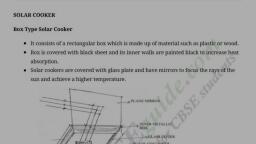
A . An ideal source of energy must be:, a). Economical ., b). Easily accessible., c). Smoke/pollution free ., d). Easy to store and transport., e).Able to produce huge amount of heat and energy on burning., 9. What are the advantages and disadvantages of using a solar cooker? Are there places where solar, cookers would have limited utility?, A. The advantages of solar cooker are:a)The use of solar cooker for cooking food save fuel., b) The use of solar cooker does not produce smoke due to which the environment also does not get, polluted., c) When food is cooked in solar cooker, its nutrients don’t get destroyed. This is because in a solar, cooker, food is cooked at comparatively lower temperature., d) In a solar cooker, up to 4 food items can be cooked at the same time., The disadvantages of solar cooker are:a).It is very expensive., b). It does not work without sunlight. Hence on cloudy-day, it becomes useless., The limited utility of solar cooker is:a)Solar cooker cannot be used to cook the food during the night time., b)If the day-sky is covered with clouds, even then the solar cookers cannot be used to the food., c)The direction of reflectors of solar cookers has to be changed from time to time to keep it facing the, sun., 10. What are the environmental consequences of the increasing demand for energy? What steps, would you suggest to reduce energy consumption?, A. Exploiting any source of energy disturbs the environment in some way or the other. The source we, would choose depends on factors such as the ease of extracting energy from that source, the, economics of extracting energy from the source, the efficiency of the technology available and the, environmental damage that will be caused by using that source., We cannot depend on fossil fuels for much longer, if we manage biomass by replacing the, trees cutting down for firewood. We can be assured of a constant supply of energy at a particular rate., Renewable energy is available in our natural environment, in the form of some continuing or, repetitive current of energy or stored in such a large underground reservoirs that the rate of depletion, of reservoirs because of extraction of usable energy is practically negligible.