Notes of Class 10th New ID, Physics Magnetism Study Notes.pdf - Study Material
Page 1 :
1, , Magnetism Notes, Magnet : It is a substance which can attract pieces of iron, steel, cobalt and nickel. This, property of attraction is called magnetism., Artificial magnets come in a variety of shapes. Some common magnets are bar magnet, horse-shoe magnet, ring magnet, round magnet, cylindrical magnet, etc., Properties of a magnet :, 1. Any magnet has two poles - a North pole and a South pole, irrespective of its shape., 2. A freely suspended magnet always points in the north-south direction. This is the, directive property of a magnet., 3. A magnet always attracts substances like iron, steel, cobalt, nickel. This is the, attractive property of a magnet., Magnetic Field : it is the space surrounding a magnet in which the magnetic force is exerted., Compass : it is a very light needle-shaped magnet being pivoted at its, centre and free to rotate about the pivot in a horizontal plane., It works based on the directive property of a magnet. So, the compass, needle always points in the south-north direction. And the direction of, the needle from its south pole to north pole gives the direction of, the magnetic field of a magnet., Uses of compass :, 1. In navigation, it can be used to find direction., 2. It can be used to find the direction of magnetic field at a point., Q. Why does the bulb of iron filings stick to the ends of a bar magnet and not its centre?, (2015, 1m), Ans. The strength of magnetic field is stronger near the poles of the magnet which are located, at the ends of the bar magnet. So the bulk of iron filings sticks to the ends of a bar magnet, and not its centre., Q. What is the directive property of a magnet? (2020, 1m), Ans. A freely suspended magnet always points in the north-south direction. This is the, directive property of a magnet., , Prepared by Jkmangang, Asst Teacher, KMBHSS Block (A), , ☎️ 9555985815
Page 2 :
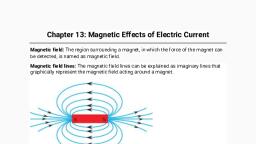
2, , Magnetic Field Lines (or, Magnetic Lines of Force) : A magnetic field line is a path along, which a hypothetical free north pole would tend to move in a magnetic field. It is also known, as the magnetic line of force., Magnetic lines of force around a magnet are used to represent the magnetic field around the, magnet., Properties of Magnetic Field Lines (2011, 2017) :, 1. A magnetic field line is a closed and, continuous path., 2. Magnetic field lines emerge from the north, pole and merge at the south pole of the, magnet., 3. Magnetic field lines never intersect each, other., 4. Magnetic field lines are closer near the poles, where the magnetic field is strong and farther apart where the magnetic field is weak., Note, The direction of a magnetic field at a point is determined by placing a small compass needle., The N - pole of the compass indicates the direction of the magnetic field at that point., , Uniform Magnetic Field, A uniform magnetic field is represented by parallel straight, lines and equidistant to one another., , Q. Draw sketches to show the magnetic lines of force produced by a bar magnet. (2014), Q. When a magnet is brought close to a compass needle, the needle deflects. Give, reasons. (2013, 1m), Ans. The compass needle gets deflected due to the forces acting on its poles due to the, magnetic field of the magnet., Q. Two magnetic field lines never intersect each other. Explain it. (2020, 3m), Ans. No two magnetic field lines are found to cross each other. If they cross, the compass, needle would point towards two directions at the point of crossing each other – which is not, possible., , Prepared by Jkmangang, Asst Teacher, KMBHSS Block (A), , ☎️ 9555985815
Page 3 :
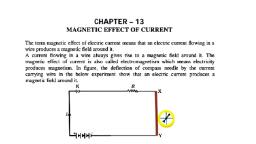
3, , Q. Magnetic lines of force of two bar magnets are shown as follows. Name the poles of, the magnet facing each other. (2018, 1m), , Ans. The end facing each other are both north poles., Q. Two magnets are lying side by side as shown below. Draw magnetic field line between, poles P and Q., , Ans., , MAGNETIC EFFECT OF ELECTRIC CURRENT, Magnetic effect of electric current : A current carrying conductor produces a magnetic field, around it. This effect of electric current is called the magnetic effect of electric current (or, electromagnetism)., Hans Oersted, a Danish Physicist, discovered the magnetic effect of current in 1820., Q. Describe an activity to show the magnetic effect of electric current produced by a, current carrying conductor., Ans. Let's take a magnetic compass kept, horizontally on the surface. A straight copper, wire XY is set parallel to the needle of the, compass and set up an electric circuit as, shown in the figure., When the electric current passes through the, circuit by inserting the plug key, the compass needle deflects and then returns to the original, position when current stops. This shows that a current carrying conductor produces a, magnetic field around it., , Prepared by Jkmangang, Asst Teacher, KMBHSS Block (A), , ☎️ 9555985815
Page 4 :
4, , MAGNETIC FIELD DUE TO A STRAIGHT CONDUCTOR CARRYING CURRENT, The magnetic field lines produced by a straight, conductor carrying current are concentric circles, whose centres lie on the wire., The magnetic field strength produced by a straight, conductor carrying current is, a) directly proportional to the current passing, through it, and, b) inversely proportional to the perpendicular, distance from the wire., The direction of magnetic field lines produced around a current carrying straight conductor, can be determined by Maxwell's Right Hand Thumb Rule (or, Maxwell's Corkscrew, Rule)., RIGHT HAND THUMB RULE, If we hold the current carrying conductor in the, right hand such that the thumb points in the, direction of the flow of current, then the fingers, encircle the wire in the direction of the magnetic, field lines. This is known as the right hand thumb, rule., , MAXWELL'S CORKSCREW RULE, If we consider ourselves driving a corkscrew using a, screwdriver, in the direction of advancing current, then the, direction of rotation of corkscrew gives the direction of the, magnetic field., , Q. A small magnetic compass needle is held close above a straight horizontal wire, carrying current towards the south. How the N-pole will deflect? (BOSEM '14), Ans. The N-pole of the needle will deflect towards the west., Q. If current flows along a horizontal conductor in west to east direction, show the, direction of magnetic field at points (i) directly above (ii) directly below and (iii) directly, north of it. (BOSEM '16), Ans. i) From the north to south, ii) From the south to north & iii) Vertically upward, , Prepared by Jkmangang, Asst Teacher, KMBHSS Block (A), , ☎️ 9555985815
Page 5 :
5, , MAGNETIC FIELD DUE TO A CURRENT CARRYING CIRCULAR LOOP, The magnetic field lines are circular near the current, carrying loop of wire. At the centre of the circular loop, the, field lines become straight and parallel., The strength of magnetic field at the centre of the current, carrying circular loop is, a) directly proportional to the current passing, through it, and, b) inversely proportional to the radius of the circular, loop., Factors affecting the strength of magnetic field produced by a current carrying circular, coil, The strength of magnetic field produced by a circular coil of wire depends on a) number of turns, (greater the number of turns, stronger is the magnetic field), b) current passing through it, (greater the current, stronger is the magnetic field), and, c) radius of the coil, (smaller the radius, stronger is the magnetic field)., Q. How can you increase the strength of the magnetic field produced by a circular coil, of wire carrying current?, Ans. i) By increasing the number of turns of the coil, ii) By increasing the current passing through it, and, iii) By decreasing the radius of the coil., Note, A current carrying circular wire (or loop) behaves like a thin disc-shaped magnet whose one, face is north pole and the other face is south pole. The polarity of the face can be determined, by clock face rule., , Prepared by Jkmangang, Asst Teacher, KMBHSS Block (A), , ☎️ 9555985815
Page 6 :
6, , CLOCK FACE RULE, According to Clock face rule, look at one face of a circular wire (or coil) through which a, current is passing :, a) if the current around the face of circular wire (or coil) flows in the Clockwise, direction, then that face of the circular wire (or coil) will be South pole (S-pole)., b) if the current around the face of circular wire (or coil) flows in the Anticlockwise, direction, then that face of circular wire (or coil) will be a North pole (N-pole), , MAGNETIC FIELD DUE TO A CURRENT CARRYING SOLENOID, Solenoid : It is a long coil of many circular turns of insulated copper wire, wrapped closely in, the shape of a cylinder whose radius is very small in comparison with the length of the, winding., Nature of magnetic field produced by a current, carrying solenoid, The magnetic field produced by a current carrying, solenoid is similar to the magnetic field produced, by a bar magnet. The field lines inside the solenoid, are in the form of parallel straight lines which, shows that the strength of the magnetic field is, uniform inside the solenoid. And one end of the, solenoid behaves as a magnetic north-pole and the, other end behaves as the south-pole., Factors affecting the strength of magnetic field of a current carrying solenoid, The strength of magnetic field produced by a current carrying solenoid depends on a) number of turns per unit length, (larger the number of turns, stronger is the field strength), b) strength of current, (larger the current, stronger is the magnetic field), Note, The strength of the magnetic field produced by a current carrying solenoid is strongest inside, the solenoid as well as its field strength is uniform inside the solenoid. Outside the solenoid,, the field strength is stronger near the two ends of the solenoid., , Prepared by Jkmangang, Asst Teacher, KMBHSS Block (A), , ☎️ 9555985815
Page 7 :
7, , Q. Draw sketches to show the magnetic lines of force produced by a current carrying, solenoid. (2014), Q. Distinguish between a current carrying solenoid and a bar magnet by giving two, points. (2016, 2m), Ans. 1. The strength of magnetic field produced by a current carrying solenoid can be, changed by changing the strength of current flow while the strength of magnetic field, produced by a bar magnet cannot be changed., 2. The polarity of a current carrying solenoid can be changed while the polarity of the bar, magnet cannot be changed., Q. A current carrying solenoid can be compared to a bar magnet. Give any two, corresponding points. The field lines inside a solenoid are parallel. What can be said, about the nature of the field there? (2011, 3m), Ans. Comparison between a current carrying solenoid and a bar magnet :, 1. The magnetic field produced by a current carrying solenoid is similar to the magnetic, field produced by a bar magnet, and, 2. One end of the solenoid behaves as a magnetic north-pole and the other end behaves, as the south-pole, just like that of a bar magnet, Since the field lines are parallel, the field strength inside the solenoid is uniform., Q. State the factors on which the strength of the magnetic field of a solenoid depends., The magnetic line of forces inside a solenoid are in the form of a parallel straight line., What does it indicate about the nature of the field inside? (2012, 2+1 = 3m), Ans. The strength of magnetic field produced by a current carrying solenoid depends on c) number of turns per unit length, (larger the number of turns, stronger is the field strength), d) strength of current, (larger the current, stronger is the magnetic field), Since the field lines are parallel, the field strength inside the solenoid is uniform., , Electromagnet : The strong magnetic field produced inside, a current carrying solenoid can be used to magnetise a piece, of magnetic material like soft iron rod, when placed inside, the solenoid. The magnet so formed is called an, electromagnet., , Prepared by Jkmangang, Asst Teacher, KMBHSS Block (A), , ☎️ 9555985815
Page 8 :
8, , Factors affecting the strength of an electromagnet, The strength of an electromagnet depends on a) the current flowing through the coil., If the current is increased, the strength of electromagnet increases., b) the number of turns in the coil., If the number of turns in the coil is increased, the strength of electromagnet increases., Q. How can a solenoid be converted into an electromagnet? (2020, 1m), Ans. The strong magnetic field produced inside a current carrying solenoid can be used to, magnetise a piece of magnetic material like soft iron rod, when placed inside the solenoid., The magnet so formed is an electromagnet., Q. How can you increase the strength of an electromagnet?, Ans. We can increase the strength of an electromagnet by increasing the current passing, through its coil or by increasing the number of turns in the coil., Q. State three advantages of an electromagnet over a permanent magnet. (2015, 2018,, 3m), Ans. The advantages of an electromagnet over a permanent magnet are 1. The magnetism of an electromagnet can be switched OFF or ON as desired., 2. The strength of the magnetic field of an electromagnet can be controlled by changing, the strength of current passing through the coil., 3. The polarity of an electromagnet can be changed by changing the direction of current, in its coil., Q. How does an electromagnet differ from a bar magnet (or a permanent magnet) ?, Give three points., Ans., Bar magnet (or permanent magnet), 1. Its magnetism cannot be switched, OFF or ON as desired., 2. Its strength cannot be changed., , 3. Its polarity cannot be changed., , Electromagnet, 1. Its magnetism can be switched OFF, or ON as desired., 2. Its strength can be changed by, changing the current passing through, the coil or changing the number of, turns in its coil., 3. Its polarity can be changed by, changing the direction of current, passing through the coil., , Prepared by Jkmangang, Asst Teacher, KMBHSS Block (A), , ☎️ 9555985815
Page 9 :
9, , Q. Why is a soft iron rod used for making the core of an electromagnet? (NCERT), Ans. The soft iron rod loses all of its magnetism when the current in the coil is switched off., , FORCE ON A CURRENT CARRYING CONDUCTOR PLACED IN A, MAGNETIC FIELD, A current carrying conductor experiences a force when it is placed in a magnetic field except, when it is placed in parallel to the direction of the magnetic field., The force experienced by the conductor is due to the interaction between the magnetic force, produced by the conductor itself and the external magnetic field., The force experienced by the current carrying conductor is maximum when the direction of, current passing through the conductor is perpendicular to the direction of the external, magnetic field., When a current carrying conductor is placed in a magnetic field, the conductor experiences a, force perpendicular to both the direction of current flow and to the direction of the external, magnetic field., The direction of the force exerted on the conductor can be determined by Fleming's Left, Hand Rule., Fleming's Left Hand Rule (2017, 2m), If we stretch the thumb, the middle finger, and the, forefinger of the left hand mutually perpendicular to, each other in such a way that the forefinger points, towards the direction of the magnetic field and the, middle fingers points towards the direction of current,, then the thumb points towards the direction of the, magnetic force., Easier way to remember, F orefinger : F ield (Magnetic Field), C entre finger : C urrent, Thu M b : M otion (Force), Q. Name the rule to determine the direction of force exerted on a current carrying, conductor placed in a magnetic field., Ans. Fleming's Left Hand Rule., Q. What will happen when a current carrying conductor is placed in a magnetic field?, (2012, 2m), , Prepared by Jkmangang, Asst Teacher, KMBHSS Block (A), , ☎️ 9555985815
Page 10 :
10, , Ans. When a current carrying conductor is placed in a magnetic field, a force is exerted on, the conductor and the direction of the force acting on the conductor depends on the direction, of current and the external magnetic field., Q. When will the force on a current carrying conductor be maximum in a magnetic, field? (2014, 1m), Ans. The force on a carrying conductor in a magnetic field will be maximum when the, direction of current passing through the conductor is perpendicular to the direction of the, external magnetic field., Q. Determine the direction of the force acting on the proton, if the proton moves, towards the east by entering a uniform magnetic field in the downward direction., (NCERT), Ans. Towards the north., (Explanation : The proton moves towards the east, so the direction of current is towards the, east. Since the magnetic field is towards downward, according to Fleming's Left Hand Rule,, the direction of the force acting is towards the north.), Q. Find the direction of the magnetic field, if an electron is moving vertically upwards, and gets deflected towards the south due to a uniform magnetic field. (NCERT), Ans. Towards the east., (Explanation : We know electrons carry negative charges and the direction of electric current, is opposite to the direction of the motion of the electron. Since the electron moves vertically, upward, the direction of current is vertically downward. Since the force acting on the electron, is towards the south, according to Fleming's Left Hand Rule, the direction of magnetic field is, towards the east.), , ELECTRIC MOTOR, Electric motor : It is a rotating device which can convert electrical energy into mechanical, energy., Uses of electric motors : Electric motors are commonly used in fans, washing machines,, grinders, computers, etc., Principle of an electric motor : Electric motor works on the principle that a current carrying, conductor placed in a magnetic field experiences a mechanical force., Q. State the function of an electric motor. (2013, 1m), Ans. To convert electrical energy into mechanical energy, , Prepared by Jkmangang, Asst Teacher, KMBHSS Block (A), , ☎️ 9555985815
Page 11 :
11, , Construction of an electric motor, 1. An electric motor consists of a rectangular coil ABCD of insulated copper wire., 2. The coil is placed between the two poles of a magnetic field such that the arms AB, and CD are placed perpendicular to the direction of the magnetic field., 3. The ends of the coil are connected to two halves P and Q of a split ring. The inner, sides of these halves are insulated and attached to the shaft., 4. Two stationary brushes X and Y are kept pressing above the two halves of the split, ring. The brushes are connected to the terminal of the battery., Working of an electric motor, 1. Current in the rectangular coil ABCD enters from the source battery through, conducting brush X and flows back to the battery through brush Y., 2. The direction of current flows along ABCD. The current along arms AB and CD are, perpendicular to the magnetic field so forces are exerted on the arms. According to, Fleming's Left Hand Rule, the arm AB is pushed downward while the arm CD is, pushed upward. Thus, the shaft along with the coil starts rotating anticlockwise., 3. After half turn, the brush P is in contact with split ring Y and Q with X. So, the, current in the coil is reversed, thus it flows along DCBA., 4. Now, the arm DC is pushed downward and arm AB is pushed upward according to, Fleming's Left Hand Rule., 5. The reversing of current in the coil is repeated after every half rotation due to which, the coil and its shaft continue to rotate as long as current from the battery is passed, through it., , Prepared by Jkmangang, Asst Teacher, KMBHSS Block (A), , ☎️ 9555985815
Page 12 :
12, , Q. What is a commutator?, Ans. It is a device to reverse the current in an electric circuit., Q. How do the halves of the split ring in an electric motor act as a commutator?, Ans. The halves of the split ring reverses the current flowing through the coil of the motor by, alternately touching the brushes for every half rotation. Thus, it acts as a commutator., Q. State the function of the split ring in an electric motor., Ans. To reverse the direction of current passing through the coil of the motor, Q. State the function of the brushes in an electric motor., Ans. To supply current in the coil of the motor, Q. How can the power of an electric motor be increased?, Ans. The power of an electric motor can be increased, 1. by using an electromagnet instead of permanent magnets, 2. by using a soft iron core on which the coil is wound, 3. by increasing the number of turns in the coil, Q. Draw an illustrative diagram of an electric motor. Describe its construction and, working. (2010, 1+4 = 5m), Q. Describe the working of an electric motor by indicating the roles played by different, parts used to construct the same. (2019, 5m), , THE END, , Prepared by Jkmangang, Asst Teacher, KMBHSS Block (A), , ☎️ 9555985815



 Learn better on this topic