Page 1 :
Human Eye and The, Colourful World, , Quick Revision, , 1. Refraction of Light through a Prism, , ¢ Prism is a transparent refracting medium, bounded by two plane surfaces, inclined to, each other at a certain angle. It has one, triangular base and three rectangular lateral, surfaces., The angle between two lateral surfaces is called, angle of prism., , Angle of prism (A), , , , Refraction of light through a triangular glass prism, , 2. Dispersion of White Light by a Glass Prism, e The phenomenon of splitting of white light by, , prism into its constituent colours is called, , dispersion of white light., , The group of different colours of light rays, , produced by the prism due to dispersion is, , called spectrum., , Issac Newton was the first one to use a glass, , prism to obtain the spectrum of light., , °, , ¢ For red colour deviation is minimum and for, violet colour deviation is maximum., , , , , , aay ct oie!, , , , 1 (indigo), “eV Violet), , , , Cc, Dispersion of white light by a prism, , ¢ For violet colour, wavelength is minimum and, for red colour wavelength is maximum, i.e., frequency for violet colour is maximum and, for red colour frequency is minimum., , « Recombination of White Light Newton, obtained while light by using similar prism in, inverted position, , , , , White light, , of, , Py, First prism, , Recombination of the soectrum of white light, , A, Second prism
Page 2 :
Human Eye and the Colourful World, , © Rainbow It is a natural spectrum appearing, in the sky after a rain shower. It is caused by, dispersion of sunlight by tiny water droplets,, present in the atmosphere., , * Conditions for the formation of rainbow are, , (i) The formation of rainbow involves a, series of physical phenomena refraction,, dispersion and internal i.e., reflection., , (ii) Rainbow is always formed in a direction, opposite to that of the sun, i.e. sun is, always behind the observer., , Raindrop, , , , Sunlight’, , Rainbow formation, , 3. Atmospheric Refraction, , The earth’s atmosphere is not uniform, throughout, its density goes on changing as, we move up or down. It can be considered, to be consisted of layers of different densities,, which act as rarer or denser medium with, respect to each other. The refraction of light, due to these layers is called atmospheric, refraction., , Some phenomena based on atmospheric, refraction are, , (i) Twinkling of stars is due to atmospheric, refraction of star's light. As the light from, the star enters the earth’s atmosphere, it, undergoes refraction due to varying, optical densities of air at various altitudes., The continuously changing atmosphere, refracts the light by different amounts. In, this way, the star light reaching our eyes, increases and decreases continuously and, the star’s appears to twinkle at night., , (ii) Advance sunrise and delayed, sunset This is because of atmospheric, refraction. When the sun is slightly below, the horizon, the sun’s light coming from, less dense to more dense air, is refracted, downwards. Because of this, the sun, appears to be raised above the horizon, , 99, , and so the rising sun can be seen about 2 min, before actual sunrise., , Similarly, due to atmospheric refraction the, sun can be seen for about 2 min even after, the sun has set below horizon., , . Scattering of Light, , The reflection of light from an object in all, directions is called scattering of light. The colour, of scattered light depends on the size of scattering, particles. Very fine particles scatter mainly blue, light while particles of larger size scatter light of, longer wavelengths. Some phenomena based on, scattering of light are given below, (i) Tyndall effect The path of a beam of light, through a true solution is not visible., However, its path becomes visible when it, passes through a colloidal solution, where the, size of the particles is relatively larger., , This scattering of light when it passes through, a colloidal solution is called Tyndall effect., The earth’s atmosphere is a heterogeneous, mixture of minute particles of smoke, tiny, water droplets due to suspended particles of, dust and molecules of air. Tyndall effect, becomes visible due to scattering of light., , (ii) Colour of the sky During the day time, sky, appears blue. This is because the size of the, particles in the atmosphere is smaller than the, wavelength of visible light, so they scatter the, light of shorter wavelengths (blue end of, spectrum) and hence, the sky appears blue., It should be noted that the sky appears black, to the passengers flying at higher altitudes, because scattering of light is not, prominent at such height due to the absence, of particles., , (ii) Colour of sun at sunrise and sunset At, sunrise and sunset, the sun appear reds. Light, from the sun near the horizon passes through, thicker layers of air and covers larger, distance in the atmosphere before reaching, our eyes., , Near the horizon most of the blue light and, shorter wavelength is scattered away by the, particles. Therefore, the light that reaches our, eyes is of longer wavelength. This give rise to, the reddish appearance of the sun and the, sky.
Page 3 :
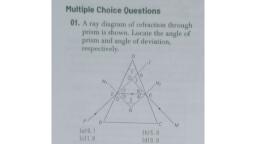
Objective Questions, , Multiple Choice Questions dispersion, the third colour from the top, an : sky?, 01. A ray diagram of refraction through sorregponde'to the colour a ne any, , prism is shown. Locate the angle of, , ie, prism and angle of deviation, A & 8 c, respectively. A, re A, Ait 8 S ‘ ip OR, (a) (b) © (d), , 05. Splitting of white light into seven colours, on passing through a glass prism is due, , , , to, , (a) dispersion (b) refraction, (a)9.1 (b)5,8 (c) scattering (d) reflection, (c) 1,9 (dg, 8, , 06. The colour of the white light deviated, 02. Prism is a homogeneous transparent through the largest angle by a prism is, medium consisting of two rectangular sree, , and three triangular faces. (a) Red (b) Yellow, , (a) True (b) False (c) Violet (d) Green, c) Can't s d) Partially true/false, le)Bal(teay (alRatttellytienalee 07. Which of the following statements is, 03. In given figure, a light ray AB is correct regarding the propagation of, incident normally on one face PQ of an light of different colours of white light in, equilateral glass prism. air? (NCERT Exemplar), Find out the angle at face PR. (a) Red light moves fastest, P (b) Blue light moves faster than green light, A a (c) All the colours of the white light move with, , the same speed, (d) Yellow light moves with the mean speed as, that of the red and the violet light, , A CN 08, When white light is incident on a thin, Q R E, ~ walled hollow glass prism, the colour of, (a) 8° (a) 30F the emergent light will be, (c) 45° (d) 90° e oan, (a)red (b) green, 04. A prism ABC (with BCas base) is (c) yellow (d) white, , placed in different orientations. A, narrow beam of white light is incident, on the prism as shown in figure. In, which of the following cases, after, , 09. To recombine the spectrum to obtain, white light, the dispersive prism and, recombination prism should be in same, position.
Page 4 :
Human Eye and the Colourful World, , 101, , , , (b} False, (d) Partially true/false, , (a) True, (c)Can’t say, , 10. Which of the following phenomena of, light are involved in the formation of a, rainbow?, , (a) Reflection, refraction and dispersion, , (b) Refraction, dispersion and outer reflection, , (c) Refraction, dispersion and internal, reflection, , (d) Dispersion, scattering and total internal, reflection, , 11. Light rays are deviated by a prism, , , , , The deviation angle d is measured for, light rays of different frequencies,, including blue light and red light., , , , , , , , , , Which graph is correct?, d \ d XS, blue red red blue, Frequency Frequency, (a) (b), , / : /, blue red red blue, Frequency Frequency, (©) {¢), , 12. Twinkling of stars is due to atmospheric, (NCERT Exemplar), (a) dispersion of light by water droplets, (b) refraction of light by different layers of, varying refractive indices, (c) scattering of light by dust particles, (d) internal reflection of light by clouds, , 13. Is it really true or a myth that stars, appear higher than they actually are? If, yes, then which phenomenon is, responsible for it?, , (a) Myth, , (b) Yes, refraction of light, , (c) Yes, atmospheric refraction of lignt, (d) Yes, dispersion of light, , 14. Which phenomenon is depicted in the, diagram given below?, , , , Almosphere, , (a) Early sunrise and late sunset, , (b) Change in shape of the sun during sunrise, and at moon, , {c) Both [a) and (b), (d) Neither (a)nor{b), , 15. Stars near the horizon twinkle more, than those that are overhead., (a) True (b) False, (c) Can't say (d) Partially true/false, , 16. At noon the sun appears white as, , (a) itslightisleast scattered (NCERT Exemplar), , (b) all the colours of the white light are, scattered away, , (c) blue colour is scattered the most, , (cd) red colour is scattered the most, , 17. Emergency signals and danger signals, are red because red can travel long, distance without being scattered., , (a) True, (b) False, (c) Can't say, (d) Partially true/false
Page 5 :
102, , CBSE New Pattern ~ Science X (Term-D), , , , 18. The clear sky appears blue, because, (NCERT Exemplar), , (a) blue light gets absorbed in the, atmosphere, , (b) ultraviolet radiations are absorbed in the, atmosphere, , (c) violet and blue lights get scattered more, than lights of all other colours by the, atmosphere, , (d) light of all other coloursis scattered more, than the violet and blue colour lights by the, atmosphere, , 19. Match Column I with Column II and, choose the most appropriate option, from the codes given below, , Column I Column I, A. Twinkling of stars p. Dispersion, B. Rainbow formation gq. Internal, reflection, C. White colour of r. Atmospheric, clouds refraction, D. Glittering of s. Scattering, diamond, Codes, , (a)JAs, B>r,C3q,D3p, (b)A>p,Bs,Cr,0q, (c)A>r, B>p,C>s,03q, (dJA>p,B>q,C>r,D>s, , 20. The orange-reddish appearance of the, sun during sunrise and sunset is, because of ......... (NCERT Exemplar), (a) dispersion of light, (b) scattering of light, (c) total internal reflection of light, (d) reflection of light from the earth, , 21. The bluish colour of water in deep sea, is due to (NCERT Exemplar), (a) less the presence of algae and other plants, found in water, (b) reflection of sky in water, (c) scattering of light, (d) absorption of light by the sea, , 22. The colour of head lights suitable for, vehicle in foggy weather is, (a) yellow, {b) red, (c) green, (d) violet, 23. To observe Tyndall effect, the size of the, scatterer must be smaller than the, wavelength of light., (a) True, (b) False, (c) Can't say, (d) Partially true/false, , 24. The sky appears dark to passengers, flying at very high altitudes mainly, , because (CBSE 2020), (a) scattering of light is not enough at such, heights, , (b) there isno atmosphere at great heights, , (c) the size of molecules is smaller than the, wavelength of visible light, (d) the light gets scattered tawards the earth, , Assertion-Reasoning MCQs, , Direction (Q.Nos. 25-29) For given, questions two statements are given-one, labeled Assertion (A) and the other labeled, Reason (R). Select the correct answer to, these questions from the codes (a), (b), (¢), and (d) as given below., (a) Both Aand Rare true and Ris correct, explanation of the A., (b) Both Aand Rare true but Ris not the correct, explanation of the A., (c) Ais true but Ris false., (d) Ais false but Ris true., , 25. Assertion Higher the refractive index, of prism, lower will be the angle of, deviation., , Reason The angle of deviation is, inversely proportional to the angle of, prism., , 26. Assertion Refraction of white light, through prism gives rise to dispersion.