Page 1 :
Kjbdbdh, Welcome To Digital and Effective Learning., Science Formative assessment 1, Ch-03 , CURRENT ELECTRICITY, Course Entitle For : CBSE Class X Students , Subject : Physics , , , Course and Presented by:, Ms. Asma Zehra , Experienced Faculty of SR Global School, Lucknow
Page 3 :
Contents, , What is Charge ?, Properties of Charge, How charge is Developed in Body , What is Electricity ?, Electric Current , Electric Field, Electric Potential & Potential Difference, Ohm’s Law, Resistance, Electric Circuit and components, Current and Voltage Measurements, Combination of Resistances, Series vs. Parallel , Electric Power and Concepts , Heating Effect of Electric Current ( Joule’s Law of Heating ), , , , �, NOTE-Direction of CONVENTIONAL Current is opposite to direction of flow of electrons.
Page 4 :
What is :, Charge ?, and , How it is produced?, 1.
Page 5 :
Develop A Curiosity And Ask Yourself : Why ?� How ?� When ?, What makes eletric bulb to glow ?, What makes fan to rotate at such high speed ?, Why plates of electric iron gets heat up when connect, to switch ?, What causes sparking and production of flash of light by clouds when it rains ?, , How does electric heater rods get hot when connected , to switch and makes us feel comfortable from chilly weather ?, , After learning this course you will able to justify yourself with mechanism involved in all....
Page 6 :
What is a Charge ?, Charge is the inherent property of matter that feels force of attraction out repulsion due to excess or deficiency of electrons., Charge can be on particles like electron, proton and also it can be on body., , It is of 2 types :, Positive Charge (Due to electron deficiency), Negative Charge (Due to excess of electrons), , Its S.I. unit is Coulomb denoted by ‘C’., , It is detected and measured using a device called Electroscope.
Page 8 :
Similarly, Let’s Understand How Charge is Developed in Body :, When body loses electron then body gets positive charge on it like atom ., Key points :, Charge is present on fundamental particles like proton ( positively charges particle ) , electron ( negatively charged particle etc., When body gains electron then it gets negative charge on it.
Page 9 :
Properties, Of Charge
Page 10 :
Properties of Charge, Total charge is always conserved i.e. Constant, ( conservati.ge ), , Like Charges attract each other and unlike charges repel each other, , Charges are additive in nature. Net charge can be added algebrically, , Charges are always quantized i.e. Q = n x e, where q = charge,, n = no. of electrons, e = charge on one electron i.e. 1.67 x 10⁻¹⁹ C;
Page 11 :
Methods, of, Charging
Page 12 :
Methods of Charging, Charging by Conduction, , When an uncharged body is brought into contact (touched) with an charged body then the charge or electrons are transferred from the charged body to the uncharged body. This charges the uncharged body.
Page 13 :
Methods of Charging, Charging by Induction, In the induction process, a charged object is brought near but not touched to a neutral conducting object. The presence of a charged object near a neutral conductor will polarize the charge within the conductor.
Page 14 :
What is, Electricity ?, 4.
Page 15 :
What is Electricity ?, Electricity is a form of a energy that can be easily changed to many other forms., It can also be defined as flow of electrons in a circuit.
Page 16 :
Electric, Current
Page 17 :
Electric Current, It is the rate of flow of electric charge (or electrons) through a conductor i.e., I = Q/t = ne/t where I stands for current, It is a scalar quantity, Its S.I. unit is coulomb per second or amperes (A), It is measured by a device called Ammeter, Its direction is taken opposite to the flow of electrons, It flows as a result of potential difference across the ends of a conductor
Page 18 :
Electric Potential, and, 7., Potential Difference
Page 19 :
Electric Potential, It is the amount of work done in bringing a unit positive charge from infinity to a given point in the electric field., It is a scalar quantity, Its S.I. unit is joules per coulomb or volts (V)
Page 20 :
Potential Difference, It is the amount of work done in bringing a unit positive charge from one point to another point in an electric field., It is a scalar quantity, Its S.I. unit is joules per coulomb or volts (V), It is responsible for the flow of current in a conductor., Measured by a device called Voltmeter., . ∞ � , B. A.
Page 21 :
Ohm’s, Law
Page 22 :
Ohm’s Law, It was stated by Georg Simon Ohm, It states that at constant physical conditions like temperature are kept constant then the amount of current flowing through a conductor is directly proportional to the potential difference across its ends i.e. , I α V, V = IR where R is constant called Resistance, According to this law conductors are divide into -, Ohmic conductors (follow ohm’s law) , Non- ohmic conductors (do not follow ohm’s law)
Page 23 :
I-V Graphs for Conductors
Page 24 :
Resistance, and, Resistivity
Page 25 :
Resistance, It is defined as the hindrance to the flow of current, , It is the ratio of potential difference to current i.e., R = V/I, , Its S.I. unit is volts per ampere or Ohm (denoted by Ω), , Reciprocal or resistance is called Conductance (C) . S.I. unit Ohm-1 i.e. Ω-1
Page 26 :
Factors affecting Resistance, R α Length (l) ……(i), R α 1/Area of cross section of conductor (A) ………(ii), , From (i), (ii) and (iii) we get, R α l/A, R = ρl/A where constant “ρ” is the specific resistance of the conductor
Page 27 :
Specific Resistance, Specific resistance is the resistance of a conductor of unit length and unit cross sectional area i.e., , if l = 1 m and A = 1 m2 then R = ρ, , It depends on material of the conductor, Denoted by rho i.e. “ρ”, S.I. unit is Ohm metre (Ωm) , Ρ α Temperature of the conductor, Also known as Resistivity
Page 28 :
Resistivity Table
Page 29 :
Fixed Resistors, Variable resistance or Rheostat, Types of Resistances, Fixed Resistances: Their value does not change under constant physical conditions. They are set at a particular value, Variable Resistances: Their resistance can be easily changed by changing area of cross section and length
Page 30 :
Electric Circuit, and, 10., Its Components
Page 31 :
Electric Circuit, A closed path in which electric current can flow is called an electric circuit, There are 2 types of circuits –, 1. Open Circuit: No current flows, 2. Closed Circuit: Current flows continuously, Open circuit, Closed circuit
Page 33 :
Measuring, Devices
Page 34 :
Ammeter, It must be connected in series in the circuit., , Positive side of ammeter must be connected nearest to the positive terminal of the battery (electric cell), and vice versa.
Page 35 :
Voltmeter, Voltmeters must be connected in parallel to the circuit., The positive side of voltmeter is connected to the positive terminal of the cell, and vice versa.
Page 36 :
Combination, of, Resistances
Page 37 :
Combination of Resistances, There are 2 ways of joining resistors together, , Series Combination , Parallel Combination
Page 38 :
Resistance in Series, When two (or more) resistors are connected end to end consecutively, they are said to be connected in series., , When a number of resistors connected in series are joined to the terminal of a battery, then each resistance has a different potential difference across its ends (which depends on the value of resistance). But the total potential difference across all the ends of all the resistors in series is equal., , When a number of resistors are connected in series, then the same current flows through each resistance
Page 40 :
Resistance in Parallel, When two (or more) resistors are connected between the same points, they are said to be connected in parallel., , When a number of resistance are connected in parallel, then the potential difference across each resistance is same which is equal to the voltage of battery applied., , Different amounts of current flows through each resistance (which depend on the value of resistance). But the current flowing through each parallel resistance, taken together, is equal to the current flowing in the circuit as a whole. Thus, when a number of resistance are connected in parallel, then the sum of current flowing through all the resistances is equal to the total current flowing in the circuit.
Page 42 :
Series, Vs., 13., Parallel
Page 43 :
Series vs. Parallel
Page 44 :
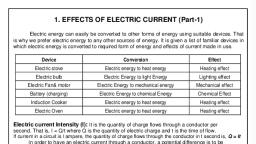
Electrical Energy: We know that energy exist in various forms such as mechanical energy , electric energy heat energy light energy nuclear energy etc. According to law of conservation of energy energy can be transferred from one form to other but it can neither be created nor destroyed, In our daily life we use various devices in which electric energy is used by converting it into other forms such as heat energy, mechanical energy chemical energy, sound energy , magnetic energy etc, Examples :, On passing electric current through heating element of an electric heater, oven or geyser , it gets heated up due to its resistance and electric energy is converted into heat energy which is used for heating purposes., On passing electric current through an electric lamp the filament of the bulb gets heated and thus it glows. The electric energy changes into heat energy and light energy., on passing electric current in a coil round around a soft iron bar the bar get magnetize and becomes electromagnet. We use this electromagnet our daily life.... example electric bell in our houses.
Page 45 :
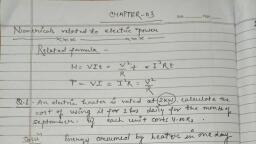
Note : Electric energy is calculated in terms of electric power., Electric Power : Rate at which electric energy is supplied by source is called electric power ., Denoted by P, SI unit : Joule / second or watt., Formula , , P = W / t, Where W is electric workdone in joules, t is time in seconds for which energy is supplied., Other formula of power in terms of charge, potential difference, current, resistance :
Page 46 :
Heating Effect of Electric Current : (Joule’s Law), We have noticed that when an ordinary electric bulb glows over a period of time thennits outer glass shield becomes hot., Similarly..., When we plug in room heater then after some times the nichrome rods of room heater gets hot., Same with electric water boiler rods, and many more appliances., Actually, it has been practically observed that when an electric current passes through conductor, then conductor gets heated. This application of current producing heat in conductors is called Heating Effect of Electric Current.
Page 47 :
Note: The amount of heat generated in conductor due to flow of electric current in conductor was given by Sir James Prescott Joule formulated Joules law. It establishes a relationship between heat, voltage, current, and time., Mathematically ..., If H is amount of heat produced when electric current flows I flows through a conductor for time t sec, where R is resistance of conductor when connected across battery.
Page 48 :
Note:�The amount of heat produced in a conductor on passing current through it depends on the following three factors:, The amount of current passing through the conductor, The resistance of conductor , The time for which current is passed in conductor , It follows above relation as :, , (a) It is directly proportional to square of current, H∝I , , (b) It is directly proportional to resistance for a given current, H∝R, (c) It is directly proportional to time for which current flows through the conductor, H∝t, So,
Page 49 :
THANK YOU