Notes of Class X, Math & Science Chapter 13 Magnetic Effects of Electric Current.pdf - Study Material
Page 1 :
Chapter 13 Magnetic Effects of Electric Current, Magnet: Magnetic field and magnetic field lines, Magnetic field due to a current, , carrying conductor, Right hand thumb rule, Magnetic field due to current through a, circular loop. Magnetic field due to current in a solenoid., Magnet is an object that attracts objects made of iron, cobalt and nickle. Magnet, comes to rest in North – South direction, when suspended freely., Use of Magnets: Magnets are used in, Refrigerators., , Radio and stereo speakers., , Audio and video cassette players., children’s toys and;, , On hard discs and floppies of computers., , Properties of Magnet, A free suspended magnet always points towards the north and south direction., , The pole of a magnet which points toward north direction is called north pole or, , north-seeking., , The pole of a magnet which points toward south direction is called south pole, , or south seeking., , Like poles of magnets repel each other while unlike poles of magnets attract, , each other., , Magnetic field: The area around a magnet where a magnetic force is experienced is, called the magnetic field. It is a quantity that has both direction and magnitude, (i.e.,, Vector, , quantity).
Page 2 :
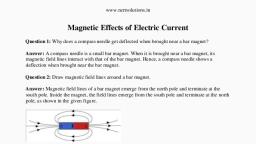
Magnetic field and field lines: The influence of force surrounding a magnet is called, magnetic field. In the magnetic field, the force exerted by a magnet can be detected, using a compass or any other magnet., , The magnetic field is represented by magnetic field lines., , The imaginary lines of magnetic field around a magnet are called field line or field, line of magnet. When iron fillings are allowed to settle around a bar magnet, they get, , arranged in a pattern which mimics the magnetic field lines. Field line of a magnet, can also be detected using a compass. Magnetic field is a vector quantity, i.e. it has, both direction and magnitude., Direction of field line: Outside the magnet, the direction of magnetic field line is taken, , from North pole to South Pole. Inside the magnet, the direction of magnetic field line, is taken from South pole to North pole.
Page 3 :
Strength of magnetic field: The closeness of field lines shows the relative strength of, , magnetic field, i.e. closer lines show stronger magnetic field and vice – versa. Crowded, field lines near the poles of magnet show more strength., Properties of magnetic field lines, (i) They do not intersect each other., (ii) It is taken by convention that magnetic field lines emerge from North pole and, , merge at the South pole. Inside the magnet, their direction is from South pole to North, pole. Therefore magnetic field lines are closed curves.
Page 4 :
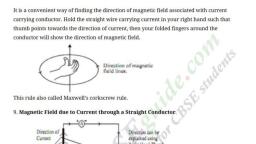
Magnetic field lines due to current a current carrying straight conductor, A current carrying straight conductor has magnetic field in the form of concentric, , circles, around it. Magnetic field of current carrying straight conductor can be shown by, magnetic field lines., The direction of magnetic field through a current carrying conductor depends upon, the direction of flow electric current., , Let a current carrying conductor be suspended vertically and the electric current is, , flowing from south to north. In this case, the direction of magnetic field will be, anticlockwise. If the current is flowing from north to south, the direction of magnetic, field will be clockwise., The, , direction, , of, , magnetic, , field,, , in, , relation, , to, , direction, , of, , electric, , current through a straight conductor can be depicted by using the Right Hand Thumb, Rule. It is also known as Maxwell’s Corkscrew Rule., Right-Hand Thumb Rule: If a current carrying conductor is held by right hand, keeping, , the thumb straight and if the direction of electric current is in the direction of thumb,
Page 5 :
then the direction of wrapping of other fingers will show the direction of magnetic field., , Maxwell’s Corkscrew rule: As per Maxwell’s Corkscrew Rule, if the direction of, forward movement of screw shows the direction of the current, then the direction of, rotation, , of, , screw, , shows, , the, , direction, , of, , magnetic, , field., , Properties of magnetic field, The magnitude of magnetic field increases with increase in electric current and, , decreases with decrease in electric current., , The magnitude of magnetic field produced by electric current decreases with, , increase in distance and vice – versa. The size of concentric circles of magnetic, field lines increases with distance from the conductor, which shows that, magnetic field decreases with distance., , Magnetic field lines are always parallel to each other., No two field lines cross each other.
Page 6 :
Magnetic field lines due to a current through a circular loop, In case of a circular current carrying conductor, the magnetic field is produced in the, same manner as it is in case of a straight current carrying conductor., , In case of a circular current carrying conductor, the magnetic field lines would be in, the form of iron concentric circles around every part of the FllmSs periphery of the, , conductor. Since, magnetic field lines tend to remain closer when near to the, , conductor, so the magnetic field would be stronger near the periphery of the loop. On, the other hand, the magnetic field lines would be distant from each other when we, , move towards the centre of the current carrying loop. Finally, at the centre, the arcs of, big circles would appear as a straight line.
Page 7 :
The direction of the magnetic field can be identified using Right Hand Thumb’s Rule., , Let us assume that the current is moving in anti-clockwise direction in the loop. In that, , case, the magnetic field would be in clockwise direction, at the top of the loop., Moreover, it would be in an anti-clockwise direction at the bottom of the loop., Clock Face Rule: A current carrying loop works like a disc magnet. The polarity of, , this magnet can be easily understood with the help of Clock Face Rule. If the current, , is flowing in anti – clockwise direction, then the face of the loop shows North Pole. On, the other hand, if the current is flowing in clockwise direction, then the face of the, loop shows South Pole., , Magnetic field and number of turns of coil: Magnitude of magnetic field gets summed, up with increase in the number of turns of coil. If there are ‘n’ turns of coil, magnitude, of magnetic field will be ‘n’ times of magnetic field in case of a single turn of coil., The strength of the magnetic field at the centre of the loop(coil) depends on :, , (i) The radius of the coil: The strength of the magnetic field is inversely proportional, to the radius of the coil. If the radius increases, the magnetic strength at the centre, decreases, , (ii) The number of turns in the coil : As the number of turns in the coil increase, the, magnetic strength at the centre increases, because the current in each circular turn is, having, , the, , same, , direction,, , thus,, , the, , field, , due, , to, , each, , turn, , adds, , up., , (iii) The strength of the current flowing in the coil: As the strength of the current, increases, the strength of three magnetic fields also increases., Solenoid:-A solenoid is a device comprised of a coil of wire, the housing and a, , moveable plunger (armature). When an electrical current is introduced, a magnetic field
Page 8 :
forms around the coil which draws the plunger in. More simply, a solenoid converts, electrical energy into mechanical work., , Use: - The main use of solenoid is as a switch for power. They are used in inductors, valves,, antennas, etc. Its application is in varied fields like medical, industrial use, locking systems,, automotive, etc. It is used to control a valve electrically., Magnetic field due to a current in a Solenoid: Solenoid is the coil with many circular, turns of insulated copper wire wrapped closely in the shape of a cylinder. A current, carrying solenoid produces similar pattern of magnetic field as a bar magnet. One end, , of solenoid behaves as the North Pole and another end behaves as the south pole.
Page 9 :
Magnetic field lines are parallel inside the solenoid, similar to a bar magnet, which, shows, , Magnetic, , that, , magnetic, , field, , field, , produced, , by, , is, , a, , same, , at, , solenoid, , all, , is, , points, , similar, , inside, to, , a, , the, , bar, , solenoid., magnet., , The strength of magnetic field is proportional to the number of turns and magnitude of, current., , By producing a strong magnetic field inside the solenoid, magnetic materials can be, , magnetized. Magnet formed by producing magnetic field inside a solenoid is called, electromagnet., Electromagnet, Fleming’s Left-Hand Rule, Electric motor, Electromagnetic induction,, Fleming’s right hand rule, Electric generator and domestic electic circuits.
Page 10 :
Electromagnet: An electromagnet consists of a long coil of insulated copper wire, wrapped on a soft iron., Magnet formed by producing magnetic field inside a solenoid is called electromagnet., , Force on a current carrying conductor in a magnetic field: A current carrying, conductor exerts a force when a magnet is placed in its vicinity. Similarly, a magnet, , also exerts equal and opposite force on the current carrying conductor. This was, , suggested by Marie Ampere, a French Physicist and considered as founder of science, of electromagnetism.
Page 11 :
The direction of force over the conductor gets reversed with the change in direction of, flow of electric current. It is observed that the magnitude of force is highest when the, direction of current is at right angles to the magnetic field., Fleming’s Left-Hand Rule: If the direction of electric current is perpendicular to the, magnetic field, the direction of force is also perpendicular to both of them. The, Fleming’s Left Hand Rule states that if the left hand is stretched in a way that the
Page 12 :
index finger, the middle finger and the thumb are in mutually perpendicular directions,, then the index finger and middle finger of a stretched left hand show the direction of, , magnetic field and direction of electric current respectively and the thumb shows the, direction of motion or force acting on the conductor. The directions of electric current,, magnetic field and force are similar to three mutually perpendicular axes, i.e. x, y, and, z-axes., , Many devices, such as electric motor, electric generator, loudspeaker, etc. work on, Fleming’s Left Hand Rule., , Electric motor: A device that converts electrical energy to mechanical energy. It is of, two types: AC and DC Motor.
Page 13 :
Electrical energy is converted into mechanical energy by using and electric motor., Electric motor works on the basis of rule suggested by Marie Ampere and Fleming’s, Left Hand Rule., Principle of Electric Motor: When a rectangular coil is placed in a magnetic field and, a current is passed through it, force acts on the coil, which rotates it continuously., With, , the, , rotation, , of, , the, , coil,, , the, , shaft, , attached, , to, , it, , also, , rotates.
Page 15 :
Construction: It consists of the following parts :, , , Armature: It is a rectangular coil (ABCD) which is suspended between the two, poles of a magnetic field., , The electric supply to the coil is connected with a commutator., , , Commutator or Split – ring: Commutator is a device which reverses the direction, of flow of electric current through a circuit. It is two halves of the same metallic, ring., , , , , , Magnet: Magnetic field is supplied by a permanent magnet NS., Sliding contacts or Brushes Q which are fixed., Battery: These are consists of few cells., , Working: When an electric current is supplied to the coil of the electric motor, it gets, , deflected because of magnetic field. As it reaches the halfway, the split ring which, , acts as commutator reverses the direction of flow of electric current. Reversal of, , direction of the current reverses the direction of forces acting on the coil. The change, in direction of force pushes the coil, and it moves another half turn. Thus, the coil, , completes one rotation around the axle. Continuation of this process keeps the motor, in rotation., In commercial motor, electromagnet instead of permanent magnet and armature is, used. Armature is a soft iron core with large number of conducting wire turns over it., , Large number of turns of conducting wire enhances the magnetic field produced by, armature., Uses of motors:, Used in electric fans., , Used for pumping water., Used in various toys.
Page 16 :
Electromagnetic Induction: Michael Faraday, an English Physicist is supposed to have, , studied the generation of electric current using a magnetic field and a conductor., Electricity, , production, , as, , a, , result, , of, , magnetism, , (induced, , current), , is, , called, , Electromagnetic Induction., , When a conductor is set to move inside a magnetic field or a magnetic field is set to, be changing around a conductor, electric current is induced in the conductor. This is
Page 17 :
just opposite to the exertion of force by a current carrying conductor inside a magnetic, , field. In other words, when a conductor is brought in relative motion vis – a – vis a, magnetic field, a potential difference is induced in it. This is known as electromagnetic, induction., Fleming’s Right-Hand Rule: Electromagnetic induction can be explained with the help, , of Fleming’s Right Hand Rule. If the right hand is structured in a way that the index, (fore ginger) finger, middle finger and thumb are in mutually perpendicular directions,, then the thumb shows direction of induced current in the conductor, in conductor The, , directions of movement of conductor, magnetic field and induced current can be, compared, , to, , three, , mutually, , perpendicular, , axes,, , i.e., , x,, , y, , and, , z, , axes.
Page 18 :
The mutually perpendicular directions also point to an important fact that when the, , magnetic field and movement of conductor are perpendicular, the magnitude of induced, current would be maximum., , Electromagnetic induction is used in the conversion of kinetic energy into electrical, energy., Electric Generator: A device that converts mechanical energy into electrical energy is, called an electric generator., Electric generators are of two types: AC generator and a DC generator. Principle of, electric generator: Electric motor works on the basis of electromagnetic induction.
Page 19 :
Construction and Working: The structure of an electric generator is similar to that of, an electric motor. In case of an electric generator, a rectangular armature is placed, , within the magnetic field of a permanent magnet. The armature is attached to wire and, , is positioned in a way that it can move around an axle. When the armature moves, within the magnetic field, an electric current is induced. The direction of induced, current changes, when the armature crosses the halfway mark of its rotation., Thus, the direction of current changes once in every rotation. Due to this, the, electric generator usually produces alternate current, i.e. A.C. To convert an A.C, , generator into a D.C generator, a split ring commutator is used. This helps in, producing direct current., Electrical generator is used to convert mechanical energy into electrical energy., A.C and D.C Current, A.C – Alternate Current: Current in which direction is changed periodically is called, Alternate Current. In India, most of the power stations generate alternate current. The, direction of current changes after every 1/100 second in India, i.e. the frequency of, , A.C in India is 50 Hz. A.C is transmitted upto a long distance without much loss of, energy is advantage of A.C over D.C.
Page 20 :
D.C – Direct Current: Current that flows in one direction only is called Direct current., Electrochemical cells produce direct current., , Advantages of A.C over D.C, Cost of generator of A.C is much less than that of D.C., A.C can be easily converted to D.C.
Page 21 :
A.C can be controlled by the use of choke which involves less loss of power, , whereas; D.C can be controlled using resistances which involves high energy, loss., , AC can be transmitted over long distances without much loss of energy., , AC machines are stout and durable and do not need much maintenance., , Disadvantages of AC, AC cannot be used for the electrolysis process or showing electromagnetism as, , it reverses its polarity., , AC is more dangerous than DC., , Domestic Electric Circuits: We receive electric supply through mains supported, , through the poles or cables. In our houses, we receive AC electric power of 220 V, with a frequency of 50 Hz., , The 3 wires are as follows, Live wire – (Red insulated, Positive), , Neutral wire – (Black insulated, Negative), , Earth wire – (Green insulated) for safety measure to ensure that any leakage of, , current to a metallic body does not give any serious shock to a user., , Short Circuit: Short-circuiting is caused by the touching of live wires and neutral wire, and sudden a large current flows.
Page 22 :
It happens due to, Damage pf insulation in power lines., A fault in an electrical appliance., , Overloading of an Electric Circuit: The overheating of electrical wire in any circuit due, to the flow of a large current through it is called overloading of the electrical circuit., , A sudden large amount of current flows through the wire, which causes overheating of, wire and may cause fire also., Electric Fuse: It is a protective device used for protecting the circuit from shortcircuiting and overloading. It is a piece of thin wire of material having a low melting, point and high resistance., Fuse is always connected to live wire., , Fuse is always connected in series to the electric circuit., , Fuse is always connected to the beginning of an electric circuit., Fuse works on the heating effect.
Page 23 :
Magnetic field: The area around a magnet in which other magnet feels force of, attraction or repulsion is called Magnetic field., , Magnetic field lines: The closed curved imaginary lines in the magnetic field which, , indicate the direction of motion of North Pole in the magnetic field if a magnet is free, to do so., Properties of magnetic field lines., Magnetic Field lines originate from the north pole of a magnet and end at its, , south pole.
Page 24 :
Magnetic Field lines are denser near the poles but rarer at other places., The Magnetic Field lines do not intersect one another., , In 1820, a Danish physicist, Hans Christian Oersted, discovered that there was, , a relationship between electricity and magnetism. By setting up a compass, , through a wire carrying an electric current, Oersted showed that moving, electrons can create a magnetic field., Oersted’s experiment: According to this experiment “A current carrying wire creates a, magnetic field around it. The direction of magnetic field depends on the direction of, current in conductor.”
Page 25 :
1. Lay the compass on a table, face upwards. Wait until it points north., 2. Lay the middle of the wire above the compass needle, also in the northsouth direction. You may lightly tape the wire to the table so that it stays, put., 3. Connect one end of the wire to each end of the battery. Observe the, compass. Did the needle move?, 4. Quickly disconnect the wire from the battery. (It is not good for the battery, to draw such a large current). What happens to the needle when you, disconnect the wire?, 5. Repeat with the connections of the battery reversed. In what direction does, the needle move this time?, , 6. Take a piece of paper (5×10 cm) and fold the longer side into pleats (like a, little accordion), about 1 cm high. Put the wire on the table, its middle in
Page 26 :
the North-South direction put the pleated paper above it so that the wire is, below one of the pleats, and place the compass on top of the pleats., 7. You can now repeat the experiment with the compass above the wire. What, direction does the compass move in this time?, , Magnetic field pattern due to straight current carrying conductor are concentric, , circles whose center lie on the wire., , The direction of magnetic field due to straight current carrying conductor can be, , determined by Right hand thumb rule., , Right hand thumb rule: According to this rule “if current carrying conductor is held in, the right hand in such a way that thumb indicate the direction of current, then the, curled finger indicates the direction of magnetic field lines around conductor.”, Magnetic field pattern due to current carrying loop: The Magnetic field lines are, circular near the current-carrying loop. As we move away from the loop, field lines, form bigger and bigger circles. At the center of the circular loop, the magnetic field, lines are straight., The solenoid is an insulated and tightly wound long circular wire having large number, of turns whose radius is small in comparison to its length. Magnetic field produced by, a solenoid is similar to the magnetic field produced by a bar magnet., Current carrying solenoid is called an electromagnet., Properties of magnetic lines of force or magnetic field lines., These lines originate from the North Pole and end at the South Pole., The magnetic field lines of a magnet form a continuous closed loop., Two magnetic lines of force do not intersect each other., , The tangent at any point on the magnetic line gives the direction of the, , magnetic field at the point.
Page 27 :
Fleming’s left hand rule: According to this rule, “if the thumb, forefinger and middle, , finger of the left hand are stretched perpendicular to each other and if the fore-finger, gives the direction of magnetic field, middle finger gives the direction of current, then, , the thumb will give the direction of motion or the force acting on the current-carrying, conductor.”, Principle of an electric motor: A motor works on the principle that when a rectangular, coil is placed in a magnetic field and current passes through it, a force acts on the, coil which rotates it continuously., , When the coil rotates, the shaft attached to it also rotates. In this way the electrical, energy supplied to the motor is converted into the mechanical energy of rotation., Principle of an electric generator: It is based on the principle of electromagnetic, , induction. It states that “an induced current is produced in a coil placed in a region, where the magnetic field changes with time.” The direction of induced current is given, , by Fleming’s right-hand rule. An electric generator converts mechanical energy into, electrical energy., Electromagnetic induction: The phenomenon of setting up of an electric current or an, induced e.mi. By changing the magnetic lines of force by a moving conductor is called, electromagnetic induction., Maxwell’s right hand thumb rule: The direction of the current is given by Maxwell’s, right-hand thumb rule, “If the current carrying conductor is gripped with the right hand, in such a way that the thumb gives the direction of the current, then the direction of, the fingers gives the direction of the magnetic field produced around the conductor., Fleming’s left-hand rule: The direction of motion of a conductor in a magnetic field is, , given by Fleming’s left-hand rule. According to this rule, if the thumb, forefinger and, , middle finger of the left hand are stretched perpendicular to each other and if forefinger gives the direction of the magnetic field and the middle finger gives the direction, , of current then, the thumb will give the direction of the motion of the conductor, carrying the current.
Page 28 :
Fleming’s right-hand rule: The direction of the induced current is given by Fleming’s, right-hand rule. According to this rule if the thumb, forefinger and middle finger of the, , right hand are stretched perpendicular to each other and if the fore-finger gives the, direction of the magnetic field and the thumb gives the direction of motion, then the, middle finger will give the direction of the induced current in the conductor.



 Learn better on this topic