Page 1 :
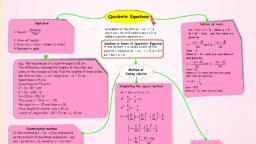
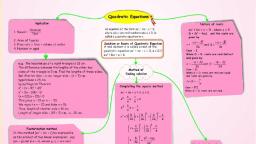
Key Notes, Chapter-04, Quadratic Equation, •, , Quadratic Polynomial: A polynomial of the form ax 2 + bx + c is called a quadratic expression, in the variable x. This is a polynomial of the second degree. In quadratic expression, ax 2 + bx + c , a is the coefficient of x 2 , b is the coefficient of x and c is the constant term (or, coefficient of x° .., , •, , Quadratic Equation: An equation of the form ax 2 + bx + c = 0 , a ≠ 0 , is called a quadratic, equation in one variable x, where a, b, c are constants., , •, , The equation ax 2 + bx + c = 0, a ≠ 0 is the standard form of a quadratic equation, where, a, b and c are real numbers., , •, , A real number α is said to be a root of the quadratic equation ax 2 + bx + c = 0, a ≠ 0 ., If aα 2 + bα + c = 0, the zeroes of quadratic polynomial ax 2 + bx + c and the roots of the, quadratic equation ax 2 + bx + c = 0 are the same., , •, , If we can factorise ax 2 + bx + c = 0, a ≠ 0 into product of two linear factors, then the, roots of the quadratic equation can be found by equating each factors to zero., , •, , The roots of a quadratic equation ax 2 + bx + c = 0, a ≠ 0 are given by, , −b ± b2 − 4ac, ,, 2a, , provided that b 2 – 4ac ≥ 0., •, , A quadratic equation ax 2 + bx + c = 0, a ≠ 0 has ___________, (a) Two distinct and real roots, if b 2 − 4ac > 0., (b) Two equal and real roots, if b 2 − 4ac = 0., (c) Two roots are not real, if b 2 − 4ac < 0., , •, , •, , A quadratic equation can also be solved by the method of completing the square., (i) a 2 + 2ab + b 2 =, , (a, , + b), , (ii) a 2 - 2ab + b 2 =, , ( a -b ), , 2, , 2, , Discriminant of the quadratic equation ax 2 + bx + c = 0, a ≠ 0 is given by D = b 2 − 4ac .