Page 1 :
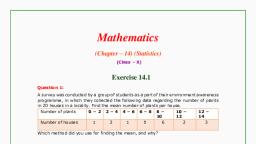
NCERT Solution for Class 10 Maths Chapter 14 – Statistics, , Exercise 14.1, , Page: 270, , 1. A survey was conducted by a group of students as a part of their environment awareness program, in, which they collected the following data regarding the number of plants in 20 houses in a locality. Find the, mean number of plants per house., Number of Plants, , 0-2, , 2-4, , 4-6, , 6-8, , 8-10, , 10-12, , 12-14, , Number of Houses, , 1, , 2, , 1, , 5, , 6, , 2, , 3, , Which method did you use for finding the mean, and why?, Solution:, In order to find the mean value, we will use direct method because the numerical value of fi and xi are small., Find the midpoint of the given interval using the formula., Midpoint (xi) = (upper limit + lower limit)/2, No. of plants, No. of houses, Mid-point (xi), fixi, (Class interval), Frequency (fi), 0-2, 1, 1, 1, 2-4, 2, 3, 6, 4-6, 1, 5, 5, 6-8, 5, 7, 35, 8-10, 6, 9, 54, 10-12, 2, 11, 22, 12-14, 3, 13, 39, Sum fi = 20, Sum fixi = 162, The formula to find the mean is:, Mean = x̄ = ∑fi xi /∑fi, = 162/20, = 8.1, Therefore, the mean number of plants per house is 8.1, 2. Consider the following distribution of daily wages of 50 workers of a factory., Daily wages (in Rs.) 100-120 120-140 140-160 160-180 180-200, Number of workers, 12, 14, 8, 6, 10, Find the mean daily wages of the workers of the factory by using an appropriate method., Solution:, Find the midpoint of the given interval using the formula., Midpoint (xi) = (upper limit + lower limit)/2, In this case, the value of mid-point (xi) is very large, so let us assume the mean value, A = 150 and class interval, is h = 20., So, ui = (xi - A)/h = ui = (xi - 150)/20, Substitute and find the values as follows:
Page 2 :
NCERT Solution for Class 10 Maths Chapter 14 – Statistics, , Daily wages Number of workers, Mid-point (xi) ui = (xi - 150)/20, fiui, (Class interval) frequency (fi), 100-120, 12, 110, -2, -24, 120-140, 14, 130, -1, -14, 140-160, 8, 150, 0, 0, 160-180, 6, 170, 1, 6, 180-200, 10, 190, 2, 20, Total, Sum fi = 50, Sum fiui = -12, So, the formula to find out the mean is:, Mean = x̄ = A + h∑fiui /∑fi =150 + (20 × -12/50) = 150 - 4.8 = 145.20, Thus, mean daily wage of the workers = Rs. 145.20, 3. The following distribution shows the daily pocket allowance of children of a locality. The mean pocket, allowance is Rs 18. Find the missing frequency f., Daily Pocket, 11-13 13-15, 15-17, 17-19, 19-21, 21-23, 23-35, Allowance(in c), Number of, 7, 6, 9, 13, f, 5, 4, children, Solution:, To find out the missing frequency, use the mean formula., Here, the value of mid-point (xi) mean x̄ = 18, Class interval Number of children (fi) Mid-point (xi) fixi, 11-13, 7, 12, 84, 13-15, 6, 14, 84, 15-17, 9, 16, 144, 17-19, 13, 18 = A, 234, 19-21, f, 20, 20f, 21-23, 5, 22, 110, 23-25, 4, 24, 96, Total, fi = 44+f, Sum fixi = 752+20f, The mean formula is, Mean = x̄ = ∑fixi /∑fi = (752+20f)/(44+f), Now substitute the values and equate to find the missing frequency (f), ⇒ 18 = (752+20f)/(44+f), ⇒ 18(44+f) = (752+20f), ⇒ 792+18f = 752+20f, ⇒ 792+18f = 752+20f, ⇒ 792 - 752 = 20f - 18f, ⇒ 40 = 2f, ⇒ f = 20, So, the missing frequency, f = 20.
Page 3 :
NCERT Solution for Class 10 Maths Chapter 14 – Statistics, 4. Thirty women were examined in a hospital by a doctor and the number of heart beats per minute were, recorded and summarized as follows. Find the mean heart beats per minute for these women, choosing a, suitable method., Number of, 65-68, 68-71, 71-74, 74-77, 77-80, 80-83, 83-86, heart beats, per minute, Number of, 2, 4, 3, 8, 7, 4, 2, women, Solution:, From the given data, let us assume the mean as A = 75.5, xi = (Upper limit + Lower limit)/2, Class size (h) = 3, Now, find the ui and fiui as follows:, Class Interval Number of women (fi) Mid-point (xi) ui = (xi - 75.5)/h, fiui, 65-68, 2, 66.5, -3, -6, 68-71, 4, 69.5, -2, -8, 71-74, 3, 72.5, -1, -3, 74-77, 8, 75.5, 0, 0, 77-80, 7, 78.5, 1, 7, 80-83, 4, 81.5, 3, 8, 83-86, 2, 84.5, 3, 6, Sum fi= 30, Sum fiui = 4, Mean = x̄ = A + h∑fiui /∑fi, = 75.5 + 3×(4/30), = 75.5 + 4/10, = 75.5 + 0.4, = 75.9, Therefore, the mean heart beats per minute for these women is 75.9, 5. In a retail market, fruit vendors were selling mangoes kept in packing boxes. These boxes contained, varying number of mangoes. The following was the distribution of mangoes according to the number of, boxes., Number of, 50-52, 53-55, 56-58, 59-61, 62-64, mangoes, Number of, 15, 110, 135, 115, 25, boxes, Find the mean number of mangoes kept in a packing box. Which method of finding the mean did you, choose?, Solution:, Since, the given data is not continuous so we add 0.5 to the upper limit and subtract 0.45 from the lower limit as, the gap between two intervals are 1, Here, assumed mean (A) = 57, Class size (h) = 3, Here, the step deviation is used because the frequency values are big.
Page 4 :
NCERT Solution for Class 10 Maths Chapter 14 – Statistics, Class Interval Number of boxes (fi) Mid-point (xi) di = xi - A, fidi, 49.5-52.5, 15, 51, -6, 90, 52.5-55.5, 110, 54, -3, -330, 55.5-58.5, 135, 57 = A, 0, 0, 58.5-61.5, 115, 60, 3, 345, 61.5-64.5, 25, 63, 6, 150, Sum fi = 400, Sum fidi = 75, The formula to find out the Mean is:, Mean = x̄ = A +h ∑fidi /∑fi, = 57 + 3(75/400), = 57 + 0.1875, = 57.19, Therefore, the mean number of mangoes kept in a packing box is 57.19, 6. The table below shows the daily expenditure on food of 25 households in a locality. Find the mean daily, expenditure on food by a suitable method., Daily, expenditure(in c), Number of, households, Solution:, , 100-150, , 150-200, , 200-250, , 250-300, , 300-350, , 4, , 5, , 12, , 2, , 2, , Find the midpoint of the given interval using the formula., Midpoint (xi) = (upper limit + lower limit)/2, Let is assume the mean (A) = 225, Class size (h) = 50, Class Interval Number of households (fi) Mid-point (xi) di = xi - A ui = di/50, fiui, 100-150, 4, 125, -100, -2, -8, 150-200, 5, 175, -50, -1, -5, 200-250, 12, 225, 0, 0, 0, 250-300, 2, 275, 50, 1, 2, 300-350, 2, 325, 100, 2, 4, Sum fi = 25, Sum fiui = -7, Mean = x̄ = A +h∑fiui /∑fi, = 225+50(-7/25), = 225-14, = 211, Therefore, the mean daily expenditure on food is 211, , 7. To find out the concentration of SO2 in the air (in parts per million, i.e., ppm), the data was collected for, 30 localities in a certain city and is presented below:
Page 5 :
NCERT Solution for Class 10 Maths Chapter 14 – Statistics, Concentration of SO2 ( in, ppm), 0.00 - 0.04, 0.04 - 0.08, 0.08 - 0.12, 0.12 - 0.16, 0.16 - 0.20, , Frequency, , 0.20 - 0.24, , 2, , 4, 9, 9, 2, 4, , Find the mean concentration of SO2 in the air., Solution:, To find out the mean, first find the midpoint of the given frequencies as follows:, Concentration of SO2 (in ppm) Frequency (fi), , Mid-point, (xi), 0.02, 0.06, 0.10, 0.14, 0.18, 0.20, , fixi, , 0.00-0.04, 4, 0.08, 0.04-0.08, 9, 0.54, 0.08-0.12, 9, 0.90, 0.12-0.16, 2, 0.28, 0.16-0.20, 4, 0.72, 0.20-0.24, 2, 0.40, Total, Sum fi = 30, Sum (fixi) = 2.96, The formula to find out the mean is, Mean = x̄ = ∑fixi /∑fi, = 2.96/30, = 0.099 ppm, Therefore, the mean concentration of SO2 in air is 0.099 ppm., 8. A class teacher has the following absentee record of 40 students of a class for the whole, term. Find the mean number of days a student was absent., Number of days, , 0-6, , 6-10, , 10-14, , 14-20, , 20-28, , 28-38, , 38-40, , Number of students, , 11, , 10, , 7, , 4, , 4, , 3, , 1, , Solution:, Find the midpoint of the given interval using the formula., Midpoint (xi) = (upper limit + lower limit)/2, , Class interval, , Frequency (fi), , Mid-point (xi), , fixi, , 0-6, , 11, , 3, , 33, , 6-10, , 10, , 8, , 80, , 10-14, , 7, , 12, , 84
Page 6 :
NCERT Solution for Class 10 Maths Chapter 14 – Statistics, , 14-20, , 4, , 17, , 68, , 20-28, , 4, , 24, , 96, , 28-38, , 3, , 33, , 99, , 38-40, , 1, , 39, , 39, , Sum fi = 40, , Sum fixi = 499, , The mean formula is,, Mean = x̄ = ∑fixi /∑fi, = 499/40, = 12.48 days, Therefore, the mean number of days a student was absent = 12.48., 9. The following table gives the literacy rate (in percentage) of 35 cities. Find the mean, literacy rate., Literacy rate (in %), , 45-55, , 55-65, , 65-75, , 75-85, , 85-98, , Number of cities, , 3, , 10, , 11, , 8, , 3, , Solution:, Find the midpoint of the given interval using the formula., Midpoint (xi) = (upper limit + lower limit)/2, In this case, the value of mid-point (xi) is very large, so let us assume the mean value, A = 70 and class interval is, h = 10., So, ui = (xi-A)/h = ui = (xi-70)/10, Substitute and find the values as follows:, Class Interval, , Frequency (fi), , (xi), , di = xi - a, , ui = di/h, , f i ui, , 45-55, , 3, , 50, , -20, , -2, , -6, , 55-65, , 10, , 60, , -10, , -1, , -10, , 65-75, , 11, , 70, , 0, , 0, , 0, , 75-85, , 8, , 80, , 10, , 1, , 8, , 85-95, , 3, , 90, , 20, , 2, , 6, , Sum fi = 35, So, Mean = x̄ = A+(∑fiui /∑fi)×h, = 70+(-2/35)×10, = 69.42, Therefore, the mean literacy part = 69.42, , Sum fiui = -2
Page 7 :
NCERT Solution for Class 10 Maths Chapter 14 – Statistics, , Exercise 14.2, , Page: 275, , 1. The following table shows the ages of the patients admitted in a hospital during a year:, Age (in years), 5-15 15-25 25-35 35-45 45-55 55-65, Number of patients, 6, 11, 21, 23, 14, 5, Find the mode and the mean of the data given above. Compare and interpret the two, measures of central tendency., Solution:, To find out the modal class, let us the consider the class interval with high frequency, Here, the greatest frequency = 23, so the modal class = 35 – 45,, l = 35,, class width (h) = 10,, fm = 23,, f1 = 21 and f2 = 14, The formula to find the mode is, Mode = l+ [(fm-f1)/(2fm-f1-f2)]×h, Substitute the values in the formula, we get, Mode = 35+[(23-21)/(46-21-14)]×10, Mode = 35+(20/11) = 35+1.8, Mode = 36.8 year, So the mode of the given data = 36.8 year, Calculation of Mean:, First find the midpoint using the formula, xi = (upper limit +lower limit)/2, Class Interval Frequency (fi) Mid-point (xi), fixi, 5-15, 6, 10, 60, 15-25, 11, 20, 220, 25-35, 21, 30, 630, 35-45, 23, 40, 920, 45-55, 14, 50, 700, 55-65, 5, 60, 300, Sum fi = 80, Sum fixi = 2830, The mean formula is, Mean = x̄ = ∑fixi /∑fi, = 2830/80, = 35.37 years, Therefore, the mean of the given data = 35.37 years, 2. The following data gives the information on the observed lifetimes (in hours) of 225, electrical components:, Lifetime (in hours) 0-20 20-40 40-60 60-80 80-100 100-120, Frequency, , 10, , 35, , 52, , 61, , 38, , 29
Page 8 :
NCERT Solution for Class 10 Maths Chapter 14 – Statistics, Determine the modal lifetimes of the components., Solution:, From the given data the modal class is 60–80., l = 60,, The frequencies are:, fm = 61, f1 = 52, f2 = 38 and h = 20, The formula to find the mode is, Mode = l+ [(fm-f1)/(2fm-f1-f2)]×h, Substitute the values in the formula, we get, Mode =60+[(61-52)/(122-52-38)]×20, Mode = 60+((9 x 20)/32), Mode = 60+(45/8) = 60+ 5.625, Therefore, modal lifetime of the components = 65.625 hours., 3. The following data gives the distribution of total monthly household expenditure of 200, families of a village. Find the modal monthly expenditure of the families. Also, find the, mean monthly expenditure:, Expenditure, , Number of families, , 1000-1500, , 24, , 1500-2000, , 40, , 2000-2500, , 33, , 2500-3000, , 28, , 3000-3500, 3500-4000, 4000-4500, , 30, 22, 16, , 4500-5000, , 7, , Solution:, Given data:, Modal class = 1500-2000,, l = 1500,, Frequencies:, fm = 40 f1 = 24, f2 = 33 and, h = 500, Mode formula:, Mode = l+ [(fm-f1)/(2fm-f1-f2)]×h, Substitute the values in the formula, we get, Mode =1500+[(40-24)/(80-24-33)]×500, Mode = 1500+((16×500)/23), Mode = 1500+(8000/23) = 1500 + 347.83, Therefore, modal monthly expenditure of the families = Rupees 1847.83
Page 9 :
NCERT Solution for Class 10 Maths Chapter 14 – Statistics, Calculation for mean:, First find the midpoint using the formula, xi =(upper limit +lower limit)/2, Let us assume a mean, A be 2750, Class Interval, fi, xi, di = xi - a, ui = di/h, fiui, 1000-1500, 24, 1250, -1500, -3, -72, 1500-2000, 40, 1750, -1000, -2, -80, 2000-2500, 33, 2250, -500, -1, -33, 2500-3000, 28, 2750, 0, 0, 0, 3000-3500, 30, 3250, 500, 1, 30, 3500-4000, 22, 3750, 1000, 2, 44, 4000-4500, 16, 4250, 1500, 3, 48, 4500-5000, 7, 4750, 2000, 4, 28, fi = 200, fiui = -35, The formula to calculate the mean,, Mean = x̄ = a +(∑fiui /∑fi)×h, Substitute the values in the given formula, = 2750+(-35/200)×500, = 2750-87.50, = 2662.50, So, the mean monthly expenditure of the families = Rupees 2662.50, 4. The following distribution gives the state-wise teacher-student ratio in higher secondary schools of India., Find the mode and mean of this data. Interpret the two measures, No of Students per teacher, , Number of states / U.T, , 15-20, , 3, , 20-25, , 8, , 25-30, 30-35, , 9, 10, , 35-40, , 3, , 40-45, , 0, , 45-50, , 0, , 50-55, , 2, , Solution:, Given data:, Modal class = 30 – 35,, l = 30,, Class width (h) = 5,, fm = 10, f1 = 9 and f2 = 3, Mode Formula:
Page 10 :
NCERT Solution for Class 10 Maths Chapter 14 – Statistics, Mode = l+ [(fm-f1)/(2fm-f1-f2)]×h, Substitute the values in the given formula, Mode = 30+((10-9)/(20-9-3))×5, Mode = 30+(5/8) = 30+0.625, Mode = 30.625, Therefore, the mode of the given data = 30.625, Calculation of mean:, Find the midpoint using the formula, xi =(upper limit +lower limit)/2, Class Interval Frequency (fi) Mid-point (xi), fixi, 15-20, 3, 17.5, 52.5, 20-25, 8, 22.5, 180.0, 25-30, 9, 27.5, 247.5, 30-35, 10, 32.5, 325.0, 35-40, 3, 37.5, 112.5, 40-45, 0, 42.5, 0, 45-50, 0, 47.5, 0, 50-55, 2, 52.5, 105.5, Sum fi = 35, Sum fixi = 1022.5, Mean = x̄ = ∑fixi /∑fi, = 1022.5/35, = 29.2, Therefore, mean = 29.2, 5. The given distribution shows the number of runs scored by some top batsmen of the world in one- day, international cricket matches., Run Scored, , Number of Batsman, , 3000-4000, , 4, , 4000-5000, 5000-6000, 6000-7000, , 18, 9, 7, , 7000-8000, , 6, , 8000-9000, , 3, , 9000-10000, , 1, , 10000-11000, , 1, , Find the mode of the data., Solution:, Given data:, Modal class = 4000 – 5000,
Page 11 :
NCERT Solution for Class 10 Maths Chapter 14 – Statistics, l = 4000,, class width (h) = 1000,, fm = 18, f1 = 4 and f2 = 9, Mode Formula:, Mode = l+ [(fm-f1)/(2fm-f1-f2)]×h, Substitute the values, Mode = 4000+((18-4)/(36-4-9))×1000, Mode = 4000+(14000/23) = 4000+608.695, Mode = 4608.695, Mode = 4608.7 (approximately), Thus, the mode of the given data is 4608.7 runs, 6. A student noted the number of cars passing through a spot on a road for 100 periods each of 3 minutes, and summarized it in the table given below. Find the mode of the data:, Number of cars, , Frequency, , 0-10, , 7, , 10-20, , 14, , 20-30, 30-40, , 13, 12, , 40-50, , 20, , 50-60, , 11, , 60-70, , 15, , 70-80, , 8, , Solution:, Given Data:, Modal class = 40 – 50, l = 40,, Class width (h) = 10, fm = 20, f1 = 12 and f2 = 11, Mode = l+ [(fm-f1)/(2fm-f1-f2)]×h, Substitute the values, Mode = 40+((20-12)/(40-12-11))×10, Mode = 40 + (80/17) = 40 + 4.7 = 44.7, Thus, the mode of the given data is 44.7 cars
Page 12 :
NCERT Solution for Class 10 Maths Chapter 14 – Statistics, , Exercise 14.3, , Page: 287, , 1. The following frequency distribution gives the monthly consumption of an electricity of 68 consumers in, a locality. Find the median, mean and mode of the data and compare them., Monthly, consumption(in, units), , No. of, customers, , 65-85, , 4, , 85-105, , 5, , 105-125, , 13, , 125-145, , 20, , 145-165, , 14, , 165-185, , 8, , 185-205, , 4, , Solution:, Find the cumulative frequency of the given data as follows:, Class, Interval, , Frequency, , Cumulative, frequency, , 65-85, , 4, , 4, , 85-105, , 5, , 9, , 105-125, , 13, , 22, , 125-145, , 20, , 42, , 145-165, , 14, , 56, , 165-185, , 8, , 64, , 185-205, , 4, , 68, , N=68, , From the table, it is observed that, n = 68 and hence n/2=34
Page 13 :
NCERT Solution for Class 10 Maths Chapter 14 – Statistics, Hence, the median class is 125-145 with cumulative frequency = 42, Where, l = 125, n = 68, Cf = 22, f = 20, h = 20, Median is calculated as follows:, , =125+((34−22)/20) × 20, =125+12 = 137, Therefore, median = 137, To calculate the mode:, Modal class = 125-145,, f1=20, f0=13, f2=14 & h = 20, Mode formula:, Mode = l+ [(f1-f0)/(2f1-f0-f2)]×h, Mode = 125 + ((20-13)/(40-13-14))×20, =125+(140/13), =125+10.77, =135.77, Therefore, mode = 135.77, Calculate the Mean:, Class Interval, , fi, , xi, , 65-85, , 4, , 75, , -60, , -3, , -12, , 85-105, , 5, , 95, , -40, , -2, , -10, , 105-125, , 13, , 115, , -20, , -1, , -13, , 125-145, , 20, , 135, , 0, , 0, , 0, , 145-165, , 14, , 155, , 20, , 1, , 14, , 165-185, , 8, , 175, , 40, , 2, , 16, , 185-205, , 4, , 195, , 60, , 3, , 12, , Sum fi= 68, , di=xi-a ui=di/h, , fiui, , Sum fiui= 7, , x̄ =a+h ∑fiui/∑fi =135+20(7/68), Mean=137.05, In this case, mean, median and mode are more/less equal in this distribution., 2. If the median of a distribution given below is 28.5 then, find the value of x & y.
Page 14 :
NCERT Solution for Class 10 Maths Chapter 14 – Statistics, Class Interval Frequency, 0-10, 5, 10-20, x, 20-30, 20, 30-40, 15, 40-50, y, 50-60, 5, Total, 60, Solution:, Given data, n = 60, Median of the given data = 28.5, Where, n/2 = 30, Median class is 20 – 30 with a cumulative frequency = 25+x, Lower limit of median class, l = 20,, Cf = 5+x,, f = 20 & h = 10, , Substitute the values, 28.5=20+((30−5−x)/20) × 10, 8.5 = (25 - x)/2, 17 = 25-x, Therefore, x =8, Now, from cumulative frequency, we can identify the value of x + y as follows:, Since,, 60=5+20+15+5+x+y, Now, substitute the value of x, to find y, 60 = 5+20+15+5+8+y, y = 60-53, y=7, Therefore, the value of x = 8 and y = 7., 3. The Life insurance agent found the following data for the distribution of ages of 100 policy holders., Calculate the median age, if policies are given only to the persons whose age is 18 years onwards but less, than the 60 years., Age (in years) Number of policy holder, Below 20, 2, Below 25, 6, Below 30, 24, Below 35, 45, Below 40, 78, Below 45, 89, Below 50, 92, Below 55, 98, Below 60, 100
Page 15 :
NCERT Solution for Class 10 Maths Chapter 14 – Statistics, Solution:, Class interval Frequency Cumulative frequency, 15-20, 2, 2, 20-25, 4, 6, 25-30, 18, 24, 30-35, 21, 45, 35-40, 33, 78, 40-45, 11, 89, 45-50, 3, 92, 50-55, 6, 98, 55-60, 2, 100, Given data: n = 100 and n/2 = 50, Median class = 35-45, Then, l = 35, cf = 45, f = 33 & h = 5, , Median = 35+((50-45)/33) × 5, = 35 + (5/33)5, = 35.75, Therefore, the median age = 35.75 years., 4. The lengths of 40 leaves in a plant are measured correctly to the nearest millimeter, and the data, obtained is represented as in the following table:, Length (in mm) Number of leaves, 118-126, 3, 127-135, 5, 136-144, 9, 145-153, 12, 154-162, 5, 163-171, 4, 172-180, 2, Find the median length of leaves., Solution:, Since the data are not continuous reduce 0.5 in the lower limit and add 0.5 in the upper limit., Class Interval Frequency Cumulative frequency, 117.5-126.5, 3, 3, 126.5-135.5, 5, 8, 135.5-144.5, 9, 17, 144.5-153.5, 12, 29, 153.5-162.5, 5, 34, 162.5-171.5, 4, 38, 171.5-180.5, 2, 40, So, the data obtained are:
Page 16 :
NCERT Solution for Class 10 Maths Chapter 14 – Statistics, n = 40 and n/2 = 20, Median class = 144.5-153.5, then, l = 144.5,, cf = 17, f = 12 & h = 9, , Median = 144.5+((20-17)/12)×9, = 144.5+(9/4), = 146.75 mm, Therefore, the median length of the leaves = 146.75 mm., 5. The following table gives the distribution of a life time of 400 neon lamps., Lifetime (in hours) Number of lamps, 1500-2000, 14, 2000-2500, 56, 2500-3000, 60, 3000-3500, 86, 3500-4000, 74, 4000-4500, 62, 4500-5000, 48, Find the median lifetime of a lamp., Solution:, Class Interval Frequency Cumulative, 1500-2000, 14, 14, 2000-2500, 56, 70, 2500-3000, 60, 130, 3000-3500, 86, 216, 3500-4000, 74, 290, 4000-4500, 62, 352, 4500-5000, 48, 400, Data:, n = 400 &n/2 = 200, Median class = 3000 – 3500, Therefore, l = 3000, Cf = 130,, f = 86 & h = 500, , Median = 3000 + ((200-130)/86) × 500, = 3000 + (35000/86), = 3000 + 406.97, = 3406.97, Therefore, the median life time of the lamps = 3406.97 hours
Page 17 :
NCERT Solution for Class 10 Maths Chapter 14 – Statistics, 6. In this 100 surnames were randomly picked up from a local telephone directory and the frequency, distribution of the number of letters in English alphabets in the surnames was obtained as follows:, Number of letters, 1-4 4-7 7-10 10-13 13-16 16-19, Number of surnames 6, 30, 40, 16, 4, 4, Determine the number of median letters in the surnames. Find the number of mean letters in the surnames, and also, find the size of modal in the surnames., Solution:, To calculate median:, Class Interval Frequency Cumulative Frequency, 1-4, 6, 6, 4-7, 30, 36, 7-10, 40, 76, 10-13, 16, 92, 13-16, 4, 96, 16-19, 4, 100, Given:, n = 100 &n/2 = 50, Median class = 7-10, Therefore, l = 7, Cf = 36, f = 40 & h = 3, , Median = 7+((50-36)/40) × 3, Median = 7+42/40, Median=8.05, Calculate the Mode:, Modal class = 7-10,, Where, l = 7, f1 = 40, f0 = 30, f2 = 16 & h = 3, , Mode = 7+((40-30)/(2×40-30-16)) × 3, = 7+(30/34), = 7.88, Therefore mode = 7.88, Calculate the Mean:, Class, Interval, 1-4, 4-7, 7-10, 10-13, , fi, , xi, , fixi, , 6, 30, 40, 16, , 2.5, 5.5, 8.5, 11.5, , 15, 165, 340, 184
Page 18 :
NCERT Solution for Class 10 Maths Chapter 14 – Statistics, 13-16, 16-19, , 4, 14.5, 51, 4, 17.5, 70, Sum fi = 100, Sum fixi = 825, , Mean = x̄ = ∑fi xi /∑fi, Mean = 825/100 = 8.25, Therefore, mean = 8.25, 7. The distributions of below give a weight of 30 students of a class. Find the median weight of a student., Weight(in kg), Number of, students, Solution:, Class, Interval, 40-45, 45-50, 50-55, 55-60, 60-65, 65-70, 70-75, , 40-45 45-50 50-55 55-60 60-65 65-70 70-75, 2, 3, 8, 6, 6, 3, 2, , Frequency Cumulative frequency, 2, 3, 8, 6, 6, 3, 2, , 2, 5, 13, 19, 25, 28, 30, , Given: n = 30 and n/2= 15, Median class = 55-60, l = 55, Cf = 13, f = 6 & h = 5, , Median = 55+((15-13)/6)×5, Median=55 + (10/6) = 55+1.666, Median =56.67, Therefore, the median weight of the students = 56.67
Page 19 :
NCERT Solution for Class 10 Maths Chapter 14 – Statistics, , Exercise 14.4, , Page: 293, , 1. The following distribution gives the daily income of 50 workers if a factory. Convert the distribution, above to a less than type cumulative frequency distribution and draw its ogive., Daily income in Rupees 100-120 120-140 140-160 160-180 180-200, Number of workers, , 12, , 14, , 8, , 6, , 10, , Solution, Convert the given distribution table to a less than type cumulative frequency distribution, and we get, Daily income Frequency Cumulative Frequency, Less than 120, 12, 12, Less than 140, 14, 26, Less than 160, 8, 34, Less than 180, 6, 40, Less than 200, 10, 50, From the table plot the points corresponding to the ordered pairs such as (120, 12), (140, 26), (160, 34), (180, 40), and (200, 50) on graph paper and the plotted points are joined to get a smooth curve and the obtained curve is, known as less than type ogive curve, , 2.During the medical check-up of 35 students of a class, their weights were recorded as follows:, Weight in kg Number of students, Less than 38, 0, Less than 40, 3, Less than 42, 5, Less than 44, 9, Less than 46, 14, Less than 48, 28, Less than 50, 32, Less than 52, 35
Page 20 :
NCERT Solution for Class 10 Maths Chapter 14 – Statistics, Draw a less than type ogive for the given data. Hence obtain the median weight from the graph and, verify the result by using the formula., Solution:, From the given data, to represent the table in the form of graph, choose the upper limits of the class intervals are, in x-axis and frequencies on y-axis by choosing the convenient scale. Now plot the points corresponding to the, ordered pairs given by (38, 0), (40, 3), (42, 5), (44, 9),(46, 14), (48, 28), (50, 32) and (52, 35) on a graph paper an, join them to get a smooth curve. The curve obtained is known as less than type ogive., , Locate the point 17.5 on the y-axis and draw a line parallel to the x-axis cutting the curve at a point. From the, point, draw a perpendicular line to the x-axis. The intersection point perpendicular to x-axis is the median of the, given data. Now, to find the mode by making a table., Class interval Number of students(Frequency) Cumulative Frequency, Less than 38, 0, 0, Less than 40, 3-0=3, 3, Less than 42, 5-3=2, 8, Less than 44, 9-5=4, 9, Less than 46, 14-9=5, 14, Less than 48, 28-14=14, 28, Less than 50, 32-28=4, 32, Less than 52, 35-22=3, 35, The class 46 – 48 has the maximum frequency, therefore, this is modal class, Here, l = 46, h = 2, f1= 14, f0= 5 and f2 = 4, The mode formula is given as:, Now, Mode =, , = 46 + 0.95 = 46.95, Thus, mode is verified., 3. The following tables gives production yield per hectare of wheat of 100 farms of a village.
Page 21 :
NCERT Solution for Class 10 Maths Chapter 14 – Statistics, Production Yield 50-55 55-60 60-65 65-70 70-75 75-80, Number of farms, , 2, , 8, , 12, , 24, , 38, , 16, , Change the distribution to a more than type distribution and draw its ogive., Solution:, Converting the given distribution to a more than type distribution, we get, Production Yield (kg/ha) Number of farms, More than or equal to 50, 100, More than or equal to 55, 100-2 = 98, More than or equal to 60, 98-8= 90, More than or equal to 65, 90-12=78, More than or equal to 70, 78-24=54, More than or equal to 75, 54-38 =16, From the table obtained draw the ogive by plotting the corresponding points where the upper limits in x-axis and, the frequencies obtained in the y-axis are (50, 100), (55, 98), (60, 90), (65, 78), (70, 54) and (75, 16) on, this graph paper. The graph obtained is known as more than type ogive curve.