Page 1 :
CHAPTER 6, , TRIANGLES, (A) Main Concepts and Results, Congruence and similarity, Conditions for similarity of two polygons, Similarity of, Triangles, Similarity and correspondence of vertices, Criteria for similarity of triangles;, (i) AAA or AA (ii) SSS (iii) SAS, , •, , If a line is drawn parallel to one side of a triangle to intersect the other two sides,, then these two sides are divided in the same ratio (Basic Proportionality Theorem) and its converse., , •, , Ratio of the areas of two similar triangles is equal to the ratio of the squares of, their corresponding sides., , •, , Perpendicular drawn from the vertex of the right angle of a right triangle to its, hypotenuse divides the triangle into two triangles which are similar to the whole, triangle and to each other., , •, , In a right triangle, the square on the hypotenuse is equal to the sum of the squares, on the other two sides (Pythagoras Theorem) and its converse., , (B) Multiple Choice Questions, Choose the correct answer from the given four options:, Sample Question 1: If in Fig 6.1, O is the point of intersection of two chords AB, and CD such that OB = OD, then triangles OAC and ODB are, , 03/05/18
Page 2 :
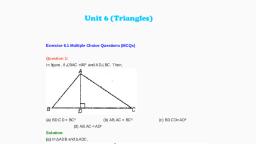
60, , EXEMPLAR PROBLEMS, , (A) equilateral but not similar, (B) isosceles but not similar, (C) equilateral and similar, (D) isosceles and similar, Solution : Answer (D), Sample Question 2: D and E are respectively the points on the sides AB and AC of, a triangle ABC such that AD = 2 cm, BD = 3 cm, BC = 7.5 cm and DE & BC. Then,, length of DE (in cm) is, (A) 2.5, , (B) 3, , (C) 5, , (D) 6, , Solution : Answer (B), , EXERCISE 6.1, Choose the correct answer from the given four options:, 1., , In Fig. 6.2, �BAC = 90° and AD A BC. Then,, , 03/05/18
Page 3 :
TRIANGLES, , 61, , (A) BD . CD = BC, (C), 2., , BD . CD = AD, , 4., , (B) AB . AC = BC, 2, , (B) 10 cm, , (C) 8 cm, , (D) 20 cm, , (A) BC . EF = A C. FD, , (B) AB . EF = AC . DE, , (C) BC . DE = AB . EF, , (D) BC . DE = AB . FD, , If in two triangles ABC and PQR,, , AB BC CA, =, =, , then, QR PR PQ, , (A), , (B) '�PQR ~ '�ABC, , '�PQR ~ '�CAB, , (D) '�BCA ~ '�PQR, , In Fig.6.3, two line segments AC and BD intersect each other at the point P, such that PA = 6 cm, PB = 3 cm, PC = 2.5 cm, PD = 5 cm, APB = 50°, and CDP = 30°. Then, PBA is equal to, , (A) 50°, 6., , 2, , (D) AB . AC = AD, , If ' A B C ~ ' E D F and ' A B C is not similar to ' D E F, then which of, the following is not true?, , (C) '�CBA ~ '�PQR, 5., , 2, , The lengths of the diagonals of a rhombus are 16 cm and 12 cm. Then, the, length of the side of the rhombus is, (A) 9 cm, , 3., , 2, , (B) 30°, , (C) 60°, , (D) 100°, , If in two triangles DEF and PQR, D = Q and R = E, then which of the, following is not true?, (A), , EF, PR, , DF, PQ, , (B), , DE, PQ, , EF, RP, , 03/05/18
Page 4 :
62, , EXEMPLAR PROBLEMS, , (C), 7., , 8., , DE, QR, , DF, PQ, , (D), , 10., , 11., , DE, QR, , In triangles ABC and DEF, B = E, F = C and AB = 3 DE. Then, the, two triangles are, (A) congruent but not similar, , (B) similar but not congruent, , (C) neither congruent nor similar, , (D) congruent as well as similar, , It is given that '�ABC ~ '�PQR, with, , (A) 9, 9., , EF, RP, , ar (PRQ), 1, . Then, ar (BCA) is equal to, 3, , BC, QR, , (B) 3, , (C), , 1, 3, , (D), , 1, 9, , It is given that '�ABC ~ '�DFE, A =30°, C = 50°, AB = 5 cm, AC = 8 cm, and DF= 7.5 cm. Then, the following is true:, (A) DE = 12 cm, F = 50°, , (B) DE = 12 cm, F = 100°, , (C) EF = 12 cm, D = 100°, , (D) EF = 12 cm, D = 30°, , If in triangles ABC and DEF,, , AB, DE, , BC, , then they will be similar, when, FD, , (A) B = �E, , (B) A = D, , (C) B = D, , (D) A = F, , ar (A BC), If ' ABC ~ ' QRP, ar (PQR), , 9, 4 , AB = 18 cm and BC = 15 cm, then PR, , is equal to, (A) 10 cm, 12., , (B) 12 cm, , 20, cm, 3, , (C), , (D) 8 cm, , If S is a point on side PQ of a ' PQR such that PS = QS = RS, then, (A) PR . QR = RS, 2, , 2, , 2, , 2, , 2, , 2, , 2, , 2, , (B) QS + RS = QR, 2, , (C) PR + QR = PQ, , (D) PS + RS = PR, , 2, , 03/05/18
Page 5 :
TRIANGLES, , 63, , (C) Short Answer Questions with Reasoning, Sample Question 1: In ' ABC, AB = 24 cm, BC = 10 cm and AC = 26 cm. Is this, triangle a right triangle? Give reasons for your answer., 2, , 2, , 2, , 2, , 2, , 2, , Solution : Here AB = 576, BC = 100 and AC = 676. So, AC = AB + BC, Hence, the given triangle is a right triangle., , Sample Question 2: P and Q are the points on the sides DE and DF of a triangle, DEF such that DP = 5 cm, DE = 15 cm, DQ= 6 cm and QF = 18 cm. Is PQ & EF?, Give reasons for your answer., , Solution : Here,, , As, , DP, PE, , 5, 15 � 5, , 1, DQ, and, 2, QF, , 6, 18, , 1, 3, , DP DQ, z, , therefore PQ is not parallel to EF.., PE QF, , Sample Question 3: It is given that ' FED ~ ' STU . Is it true to say that, , DE, ST, , EF, ?, TU, , Why?, Solution : No, because the correct correspondence is F l S, E l T, D l U., , With this correspondence,, , EF, ST, , DE, ., TU, EXERCISE 6.2, , 1., , Is the triangle with sides 25 cm, 5 cm and 24 cm a right triangle? Give reasons, for your answer., , 2., , It is given that ' DEF ~ ' RPQ. Is it true to say that D = R and, F = P? Why?, , 3., , A and B are respectively the points on the sides PQ and PR of a triangle PQR, , 03/05/18
Page 6 :
64, , EXEMPLAR PROBLEMS, , such that PQ = 12.5 cm, PA = 5 cm, BR= 6 cm and PB = 4 cm. Is AB & QR?, Give reasons for your answer., 4., , In Fig 6.4, BD and CE intersect each other at the point P. Is ' PBC ~ 'PDE?, Why?, , 5., , In triangles PQR and MST, P = 55°, Q = 25°, M = 100° and, S = 25°. Is ' QPR ~ ' TSM? Why?, , 6., , Is the following statement true? Why?, “Two quadrilaterals are similar, if their corresponding angles are equal”., , 7., , Two sides and the perimeter of one triangle are respectively three times the, corresponding sides and the perimeter of the other triangle. Are the two triangles similar? Why?, , 8., , If in two right triangles, one of the acute angles of one triangle is equal to an, acute angle of the other triangle, can you say that the two triangles will be, similar? Why?, , 9., , The ratio of the corresponding altitudes of two similar triangles is, correct to say that ratio of their areas is, , 3, . Is it, 5, , 6, ? Why?, 5, , 03/05/18
Page 7 :
TRIANGLES, , 65, , 10., , D is a point on side QR of 'PQR such that PD A QR. Will it be correct to say, that 'PQD ~ '�RPD? Why?, , 11., , In Fig. 6.5, if D = C, then is it true that, 'ADE ~ 'ACB? Why?, , 12., , Is it true to say that if in two triangles, an angle of, one triangle is equal to an angle of another triangle, and two sides of one triangle are proportional to the, two sides of the other triangle, then the triangles, are similar? Give reasons for your answer., , (D), , Short Answer Questions, , Sample Question 1: Legs (sides other than the hypotenuse) of a right triangle are of, lengths 16cm and 8 cm. Find the length of the side of the largest square that can be, inscribed in the triangle., Solution: Let ABC be a right triangle right angled at B with AB = 16 cm and BC =, 8 cm. Then, the largest square BRSP which can be inscribed in this triangle will be as, shown in Fig.6.6., Let PB = x cm. So., AP = (16–x) cm. In 'APS and 'ABC, A = A and, APS = ABC (Each 90°), So, 'APS ~ 'ABC (AA similarity), Therefore,, , or, , AP, AB, , 16 � x, 16, , PS, BC, x, 8, , or, , 128 – 8x = 16x, , or, , x=, , 128, 24, , 16, 3, , Thus, the side of the required square is of length, , 16, cm., 3, , 03/05/18
Page 8 :
66, , EXEMPLAR PROBLEMS, , Sample Question 2: Hypotenuse of a right triangle is 25 cm and out of the remaining, two sides, one is longer than the other by 5 cm. Find the lengths of the other two sides., Solution : Let one side be x cm. Then the other side will be (x + 5) cm., Therefore, from Pythagoras Theorem, 2, , 2, , 2, , x + (x + 5) = (25), 2, , 2, , or, , x + x + 10 x + 25 = 625, , or, , x + 5 x – 300 = 0, , or, , x + 20 x – 15 x –300 = 0, , or, , x (x+20) –15 (x +20) = 0, , or, , (x–15) (x +20) = 0, , So,, , x =15 or x= –20, , 2, 2, , Rejecting x = – 20, we have length of one side = 15 cm, and that of the other side = (15 + 5) cm = 20 cm, Sample Question 3: In Fig 6.7,, , AD AE, =, . Prove that BAC is an, DB EC, isosceles triangle., ∠D = ∠E and, , Solution :, , AD AE, =, (Given), DB EC, , Therefore, DE � BC (Converse of Basic Proportionality Theorem), So, ∠D = ∠B and ∠E = ∠C (Corresponding angles) (1), But ∠D = ∠E (Given), Therefore, ∠B = ∠C [ From (1)], So, AB = AC (Sides opposite to equal angles), i.e., BAC is an isosceles triangle., EXERCISE 6.3, 1., , 2, , 2, , 2, , In a ∆ PQR, PR –PQ = QR and M is a point on side PR such that QM ⊥ PR., Prove that, , 03/05/18
Page 9 :
TRIANGLES, , 67, 2, , QM = PM × MR., 2., , Find the value of x for which DE & AB in Fig. 6.8., , 3., , In Fig. 6.9, if 1 =2 and ' NSQ # ' MTR, then prove that, ' PTS ~ ' PRQ., , 4., , Diagonals of a trapezium PQRS intersect each other at the point O, PQ & RS, and PQ = 3 RS. Find the ratio of the areas of triangles POQ and ROS., , 5., , In Fig. 6.10, if AB & DC and AC and PQ intersect each other at the point O, prove, that OA . CQ = OC . AP., , 03/05/18
Page 10 :
68, , EXEMPLAR PROBLEMS, , 6., , Find the altitude of an equilateral triangle of side 8 cm., , 7., , If ∆ ABC ~ ∆ DEF, AB = 4 cm, DE = 6 cm, EF = 9 cm and FD = 12 cm,, find the perimeter of ∆ ABC., , 8., , In Fig. 6.11, if DE � BC, find the ratio of ar (ADE) and ar (DECB)., , 9., , ABCD is a trapezium in which AB � DC and P and Q are points on AD, and BC, respectively such that PQ � DC. If PD = 18 cm, BQ = 35 cm and, QC = 15 cm, find AD., , 10., , Corresponding sides of two similar triangles are in the ratio of 2 : 3. If the area, 2, of the smaller triangle is 48 cm , find the area of the larger triangle., , 11., , In a triangle PQR, N is a point on PR such that Q N ⊥ PR . If PN. NR = QN ,, prove that ∠PQR = 90° ., , 2, , 03/05/18
Page 11 :
TRIANGLES, , 69, , 12., , Areas of two similar triangles are 36 cm2 and 100 cm2. If the length of a side, of the larger triangle is 20 cm, find the length of the corresponding side of the, smaller triangle., , 13., , In Fig. 6.12, if ∠ACB = ∠CDA, AC = 8 cm and AD = 3 cm, find BD., , 14., , A 15 metres high tower casts a shadow 24 metres long at a certain time and, at the same time, a telephone pole casts a shadow 16 metres long. Find the, height of the telephone pole., , 15., , Foot of a 10 m long ladder leaning against a vertical wall is 6 m away from, the base of the wall. Find the height of the point on the wall where the top of, the ladder reaches., , (E) Long Answer Questions, Sample Question 1: In Fig 6.13, OB is the perpendicular bisector of the line, segment DE, FA ⊥ OB and F E intersects OB at the point C. Prove that, , 1, 1, 2, +, =, ., OA OB OC, Solution: In ∆ AOF and ∆ BOD., ∠O = ∠O (Same angle) and ∠A = ∠B (each 90°), Therefore, ∆ AOF ~ ∆ BOD (AA similarity), , So,, , OA FA, =, OB DB, , (1), , 03/05/18
Page 12 :
70, , EXEMPLAR PROBLEMS, , Also, in ∆ FAC and ∆ EBC, ∠A = ∠B (Each 90°), and ∠FCA = ∠ECB (Vertically opposite angles)., Therefore, ∆ FAC ~ ∆ EBC (AA similarity)., , So,, , FA AC, =, EB BC, , But EB = DB (B is mid-point of DE), , So,, , FA AC, =, DB BC, , (2), , Therefore, from (1) and (2), we have:, , AC OA, =, BC OB, , i.e.,, , OC–OA OA, =, OB–OC OB, , or, , OB . OC – OA . OB = OA . OB – OA . OC, , or, , OB . OC + OA . OC = 2 OA . OB, , or, , (OB + OA). OC = 2 OA . OB, , or, , 1, 1, 2, +, =, [ Dividing both the sides by OA . OB . OC], OA OB OC, , Sample Question 2: Prove that if in a triangle square on one side is equal to the sum, of the squares on the other two sides, then the angle opposite the first side is a right, angle., Solution: See proof of Theorem 6.9 of Mathematics Textbook for Class X., , 03/05/18
Page 13 :
TRIANGLES, , 71, , Sample Question 3: An aeroplane leaves an Airport and flies due North at, 300 km/h. At the same time, another aeroplane leaves the same Airport and flies due, West at 400 km/h. How far apart the two aeroplanes would be after 1, , Solution: Distance travelled by first aeroplane in 1, and that by second aeroplane =, , 1, hours?, 2, , 1, 3, hours = 300 × km = 450 km, 2, 2, , 400 × 3, km = 600 km, 2, , Position of the two aeroplanes after 1, , 1, hours would be A and B as shown in Fig. 6.14., 2, , That is, OA = 450 km and OB = 600 km., From ∆ AOB, we have, AB2 = OA2 + OB2, or, , AB 2, , = (450)2 + (600)2, = (150)2 × 32 + (150)2 × 42, = 1502 (32 + 42), = 1502 × 52, , or, , AB = 150 × 5 = 750, , Thus, the two aeroplanes will be 750 km apart after 1, , 1, hours., 2, , Sample Question 4: In Fig. 6.15, if ∆ ABC ~ ∆ DEF and their sides are of lengths, (in cm) as marked along them, then find the lengths of the sides of each triangle., , 03/05/18
Page 14 :
72, , EXEMPLAR PROBLEMS, , Solution: ∆ ABC ~ ∆ DEF (Given), , Therefore,, , So,, , AB BC CA, =, =, DE EF FD, , 2 x − 1 2 x + 2 3x, =, =, 18, 3x + 9 6 x, , Now, taking, , 2 x − 1 3x, =, , we have, 18, 6x, 2x −1 1, =, 18, 2, , or, or, , 4 x – 2 = 18, x=5, , Therefore, AB = 2 × 5 –1= 9, BC = 2 × 5 + 2 = 12,, CA = 3 × 5 = 15, DE = 18, EF = 3× 5 + 9 = 24 and FD = 6 × 5 = 30, Hence, AB = 9 cm, BC = 12 cm, CA = 15 cm,, DE = 18 cm, EF = 24 cm and FD = 30 cm., , 03/05/18
Page 15 :
TRIANGLES, , 73, , EXERCISE 6.4, 1., , In Fig. 6.16, if ∠A = ∠C, AB = 6 cm, BP = 15 cm,, AP = 12 cm and CP = 4 cm, then find the lengths of PD, and CD., , 2., , It is given that ∆ ABC ~ ∆ EDF such that AB = 5 cm,, AC = 7 cm, DF= 15 cm and DE = 12 cm. Find the lengths, of the remaining sides of the triangles., , 3., , Prove that if a line is drawn parallel to one side of a triangle to intersect the other, two sides, then the two sides are divided in the same ratio., , 4., , In Fig 6.17, if PQRS is a parallelogram and AB � PS, then prove that OC � SR., , 5., , A 5 m long ladder is placed leaning towards a vertical wall such that it reaches, the wall at a point 4 m high. If the foot of the ladder is moved 1.6 m towards the, wall, then find the distance by which the top of the ladder would slide upwards, on the wall., , 6., , For going to a city B from city A, there is a route via city C such that AC⊥CB,, AC = 2 x km and CB = 2 (x + 7) km. It is proposed to construct a 26 km highway, which directly connects the two cities A and B. Find how much distance will be, saved in reaching city B from city A after the construction of the highway., , 03/05/18
Page 16 :
74, , EXEMPLAR PROBLEMS, , 7., , A flag pole 18 m high casts a shadow 9.6 m long. Find the distance of the top of, the pole from the far end of the shadow., , 8., , A street light bulb is fixed on a pole 6 m above the level of the street. If a woman, of height 1.5 m casts a shadow of 3m, find how far she is away from the base, of the pole., , 9., , In Fig. 6.18, ABC is a triangle right angled at B and BD ⊥ AC. If AD = 4 cm,, and CD = 5 cm, find BD and AB., , 10., , In Fig. 6.19, PQR is a right triangle right angled at Q and QS ⊥ PR . If, PQ = 6 cm and PS = 4 cm, find QS, RS and QR., , 11., , In ∆ PQR, PD ⊥ QR such that D lies on QR . If PQ = a, PR = b, QD = c and, DR = d, prove that (a + b) (a – b) = (c + d) (c – d)., , 12., , In a quadrilateral ABCD, ∠A + ∠D = 90°. Prove that AC + BD = AD + BC, , 2, , 2, , 2, , [Hint: Produce AB and DC to meet at E.], , 03/05/18, , 2
Page 17 :
TRIANGLES, , 13., , In fig. 6.20, l � m and line segments AB, CD and EF are concurrent at point P., Prove that, , 14., , 75, , AE AC CE, =, =, ., BF BD FD, , In Fig. 6.21, PA, QB, RC and SD are all perpendiculars to a line l, AB = 6 cm,, BC = 9 cm, CD = 12 cm and SP = 36 cm. Find PQ, QR and RS., , 15., , O is the point of intersection of the diagonals AC and BD of a trapezium ABCD, with AB � DC. Through O, a line segment PQ is drawn parallel to AB meeting, AD in P and BC in Q. Prove that PO = QO., , 16., , In Fig. 6.22, line segment DF intersect the side AC of a triangle ABC at the, point E such that E is the mid-point of CA and ∠AEF = ∠AFE . Prove that, , BD BF, =, ., CD CE, [Hint: Take point G on AB such that CG � DF.], , 03/05/18
Page 18 :
76, , EXEMPLAR PROBLEMS, , 17., , Prove that the area of the semicircle drawn on the hypotenuse of a right angled, triangle is equal to the sum of the areas of the semicircles drawn on the other, two sides of the triangle., , 18., , Prove that the area of the equilateral triangle drawn on the hypotenuse of a right, angled triangle is equal to the sum of the areas of the equilateral triangles drawn, on the other two sides of the triangle., , 03/05/18