Page 1 :
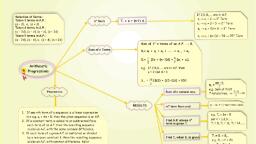
Key Notes, Chapter-05, Arithmetic Progression, •, , Sequence: A set of numbers arranged in some definite order and formed according to some, rules is called a sequence., , •, , Progression: The sequence that follows a certain pattern is called progression., , •, , Arithmetic Progression: A sequence in which the difference obtained by subtracting any, term from its preceding term is constant throughout, is called an arithmetic sequence or, arithmetic progression (A.P.). The general form of an A.P. is a, a + d, a + 2d, ... (a: first term, common difference)., , •, , General Term: If ‘a’ is the first term and ‘d’ is common difference in an A.P., then n th term, (general term) is given by an = a +, , •, , (n, , – 1) d ., , The formula an = a + (n − 1)d contains four quantities an , a, n and d. Three quantities being, given, the fourth can be find out by using the above relation., , •, , If only two quantities are given, two conditions (equations) in the problem should be given., Therefore, to determine these two unknowns, we have to solve both the conditions, (equations) linearly., , •, , Sum of n Terms of an A.P.: If ‘a’ is the first term and ‘d’ is the common difference of an A.P.,, , n, then sum of first n terms is given by Sn = {2a + (n − 1) d} If ‘l’ is the last term of a finite A.P., 2, n, then the sum is given by Sn = {a + l}, 2, •, , (i) If a n is given, then common difference d = a n − a n −1., (ii) If Sn is given, then n th term is given by a n = s n − s n −1, (iii) If a, b, c is in A.P., then 2b = a + c., (iv) If a sequence has n terms, its r th term from the end = (n − r + 1) th term from the, beginning.