Page 2 :
Sequences, Series and Progressions, A sequence is a finite or infinite list of numbers following a certain pattern., Example :- 1,2,3,4,5… is the sequence is infinite.Sequence of natural numbers., , A series is the sum of the elements in the corresponding sequence., Example :-1+2+3+4+5….is the series of natural numbers., Each number in a sequence or a series is called a term., A progression is a sequence in which the general term can be can be expressed, using a mathematical formula., , JK 9972397103
Page 3 :
Take a look,about number of deliveries faced by a team in 20-20 match. Here FIRST, TERM=6 & COMMON DIFFERENCE=6, , OVERS, , 1, , 2, , 3, , 4, , 5, , 6, , 7, , 8, , 9, , 10, , 11, , 12, , 13, , 14, , 15, , 16, , 17, , 18, , 19, , 20, , DELIVERIES, , 6, , 12, , 18, , 24, , 30, , 36, , 42, , 48, , 54, , 60, , 66, , 72, , 78, , 84, , 90, , 96, , 102, , 108, , 114, , 120, , JK 9972397103
Page 4 :
JK 9972397103, , Take a look, about Mondays in the month of June 2020, as 1+7=9,8+7=15..,Here FIRST, TERM=1 & COMMON DIFFERENCE=7.
Page 5 :
Raju standing on a ladder at a height of 12, feet from the ground to paint.After the work, was done, as he climbed down the ladder,, his distance from the ground reduces by 1.5, feet with every rung of the ladder. Here, FIRST, TERM=12, and, COMMON, DIFFERENCE=-1.5., , JK 9972397103
Page 6 :
Arithmetic Progression, An arithmetic progression (A.P) is a progression in which the difference between two, consecutive terms is constant., Example:- 2,5,8,11,14.... is an arithmetic progression., , Common Difference, The difference between two consecutive terms in an AP, (which is constant) is the, "common difference"(d) of an A.P. In the progression:- 2,5,8,11,14 ...the common, difference is 3., As it is the difference between any two consecutive terms. For any A.P, if the common, difference is:, ⊛ positive, the AP is increasing., ⊛ zero, the AP is constant., ⊛ negative, the A.P is decreasing., JK 9972397103
Page 7 :
Finite and Infinite AP, ⊛ A finite AP is an A.P in which the number of terms is finite., For example: the A.P : 2,5,8......32,35,38, , ⊛ An infinite AP is an A.P in which the number of terms is infinite., For example: 2,5,8,11....., ⊛ A finite AP will have the last term, whereas an infinite A.P won’t., , General form of an AP, The general form of an AP is: (a, a+d,a+2d,a+3d......) where a is the first term and d is, the common difference. Here, d=0, OR d>0, OR d<0, JK 9972397103
Page 8 :
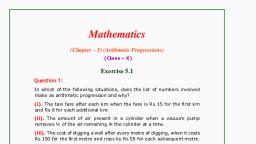
EXERCISE, , 5.1, , 1. In which of the following situations, does the list of numbers involved make as, arithmetic, progression, and, why?, (I) The taxi fare after each km when the fare is Rs 15 for the first km and Rs 8 for, each, additional, km., We can write the given condition as;, Taxi fare for 1 km = 15, Taxi fare for first 2 kms = 15+8 = 23, Taxi fare for first 3 kms = 23+8 = 31, Taxi fare for first 4 kms = 31+8 = 39, And so on……, Thus, 15, 23, 31, 39 … forms an A.P., because every next term is 8 more than the preceding term., JK 9972397103
Page 9 :
𝟏, 𝟒, , (II) The amount of air present in a cylinder when a vacuum pump removes of the air, remaining in the cylinder at a time., Let the volume of air in a cylinder, initially, be V liters., 𝟏, , In each stroke, the vacuum pump removes th of air remaining in the cylinder at a, 𝟒, time., 𝟏 𝟑, Or we can say, after every stroke, 1- = th part of air will remain., 𝟒, , Therefore, volumes will be V,, , 𝟑𝑽 𝟑𝑽 𝟐, ,, ,, 𝟒, 𝟒, , 𝟒, , 𝟑𝑽 𝟑, ...and, 𝟒, , so on, , Clearly, we can see here, the adjacent terms of this series do not have the common, difference between them., Therefore, this series is not an A.P., , JK 9972397103
Page 10 :
(III)The cost of digging a well after every meter of digging, when it costs Rs 150 for, the first meter and rises by Rs 50 for each subsequent meter., , We can write the given condition as;, Cost of digging a well for first meter = Rs.150, Cost of digging a well for first 2 meters = Rs.150+50 =Rs.200, Cost of digging a well for first 3 meters = Rs.200+50 =Rs.250, Cost of digging a well for first 4 meters =Rs.250+50 = Rs.300, And so on.., Clearly, 150, 200, 250, 300 … forms an A.P. with a common difference of 50 between, each term., , JK 9972397103
Page 11 :
(IV)The amount of money in the account every year, when Rs 10000 is deposited at, compound interest at 8% per annum., , We know that if Rs. P is deposited at r % compound interest per annum for n years,, the amount of money will be:P 𝟏, , 𝟏 𝐧, +, 𝟏𝟎𝟎, , Therefore, after each year, the amount of money will be;, 10000 𝟏 +, , 𝟖, 𝟏𝟎𝟎, , , 10000 𝟏, , 𝟖 𝟐, +, ,10000, 𝟏𝟎𝟎, , 𝟏, , 𝟖 𝟑, +, ,, 𝟏𝟎𝟎, , ......, , Clearly, the terms of this series do not have the common difference between them., Therefore, this is not an A.P., , JK 9972397103
Page 12 :
2. Write first four terms of the A.P. when the first term a and the common difference, are given as follows:, (I) a = 10, d = 10, Let us consider, the Arithmetic Progression series be a1, a2, a3, a4, a5 …, Then a1 = a = 10, a2 = a1+d = 10+10 = 20, , a3 = a2+d = 20+10 = 30, a4 = a3+d = 30+10 = 40, , a5 = a4+d = 40+10 = 50, And so on…, Therefore, the A.P. series will be 10, 20, 30, 40, 50 …, And First four terms of this A.P. will be 10, 20, 30, and 40., , JK 9972397103
Page 13 :
2. Write first four terms of the A.P. when the first term a and the common difference, are given as follows:, (II) a = - 2, d = 0, Let us consider, the Arithmetic Progression series be a1, a2, a3, a4, a5 …, Then a1 = a = -2, a2 = a1+d = -2+0 = -2, a3 = a2+d = -2+0 = -2, a4 = a3+d = -2+0 = -2, a5 = a4+d = -2+0 = -2, And so on…, Therefore, the A.P. series will be -2,-2,-2,-2,-2,…, And First four terms of this A.P. will be -2,-2,-2and -2., , JK 9972397103
Page 14 :
2. Write first four terms of the A.P. when the first term a and the common difference, are given as follows:, (III) a = 4, d = - 3, Let us consider, the Arithmetic Progression series be a1, a2, a3, a4, a5 …, Then a1 = a = 4, a2 = a1+d = 4-3=1, a3 = a2+d = 1-3=-2, a4 = a3+d = -2-3=-5, a5 = a4+d = -5-3=-8, And so on…, Therefore, the A.P. series will be 4,1,-2,-5,-8,…, And First four terms of this A.P. will be 4,1,-2 and -5., , JK 9972397103
Page 16 :
2. Write first four terms of the A.P. when the first term a and the common difference, are given as follows:, (V) a = - 1.25, d = - 0.25, Let us consider, the Arithmetic Progression series be a1, a2, a3, a4, a5 …, Then a1 = a = -1.25, a2 = a1+d = - 1.25-0.25 = - 1.50, a3 = a2+d = - 1.50-0.25 = - 1.75, a4 = a3+d = - 1.75-0.25 = - 2.00, And so on…, Therefore, the A.P. series will be 1.25, - 1.50, - 1.75, - 2.00 …….., And First four terms of this A.P. will be - 1.25, - 1.50, - 1.75 and - 2.00., , JK 9972397103
Page 17 :
3. For the following A.P.s, write the first term and the common difference., (I) 3, 1, - 1, - 3 …, First term, a = 3, Common difference, d = Second term - First term, ⇒ 1 - 3 = -2, ⇒ d = -2, , 3. For the following A.P.s, write the first term and the common difference., (II) - 5, - 1, 3, 7 …, First term, a = -5, Common difference, d = Second term - First term, ⇒ ( - 1)-( - 5) = - 1+5 = 4, , JK 9972397103
Page 18 :
3. For the following A.P.s, write the first term and the common difference., 𝟏 𝟓 𝟗 𝟏𝟑, (III) , , , … … …, 𝟑 𝟑 𝟑 𝟑, , 𝟏, , First term, a =, 𝟑, Common difference, d = Second term - First term, 𝟓, 𝟏 𝟒, ⇒ − =, 𝟑, , 𝟑, , 𝟑, , 3. For the following A.P.s, write the first term and the common difference., (IV) 0.6, 1.7, 2.8, 3.9 …, First term, a = 0.6, Common difference, d = Second term - First term, ⇒ 1.7 - 0.6, ⇒ 1.1, , JK 9972397103
Page 19 :
4. Which of the following are APs? If they form an A.P. find the common difference d, and write three more terms., (I) 2, 4, 8, 16 …, Here, the common difference is;, a2 - a1 = 4-2 = 2, a3 - a2 = 8-4 = 4, a4 - a3 = 16-8 = 8, Since, an+1 - an or the common difference is not the same every time., Therefore, the given series are not forming an A.P., , JK 9972397103
Page 21 :
4. Which of the following are APs? If they form an A.P. find the common difference d, and write three more terms., (III) -1.2, - 3.2, -5.2, -7.2 …, Here, the common difference is;, a2 - a1 = (-3.2)-(-1.2) = -2, a3 - a2 = (-5.2)-(-3.2) = -2, a4 - a3 = (-7.2)-(-5.2) = -2, Since, an+1 - an or the common difference is same every time., Therefore, d = -2and the given series are in A.P., The next three terms are;, a5 = - 7.2-2 = -9.2, a6 = - 9.2-2 = - 11.2, a7 = - 11.2-2 = - 13.2, , JK 9972397103
Page 22 :
4. Which of the following are APs? If they form an A.P. find the common difference d, and write three more terms., (IV) -10, - 6, - 2, 2 …, Here, the common difference is;, a2 - a1 = (-6)-(-10) = 4, a3 - a2 = (-2)-(-6) = 4, a4 - a3 = (2 -(-2) = 4, Since, an+1 - an or the common difference is same every time., Therefore, d = 4 and the given series are in A.P., , The next three terms are;, a5 = 2+4 = 6, a6 = 6+4 = 10, a7 =10+4 = 14, , JK 9972397103
Page 23 :
4. Which of the following are APs? If they form an A.P. find the common difference d, and write three more terms., (V) 3, 3+√2, 3+2√2, 3+3√2……., Here, the common difference is;, a2 - a1 = 3+√2-3 = √2, a3 - a2 = (3+2√2)-(3+√2) = √2, a4 - a3 = (3+3√2) - (3+2√2) = √2, Since, an+1 - an or the common difference is same every time., Therefore, d = √2 and the given series are in A.P., , The next three terms are;, a5 = (3+√2) +√2 = 3+4√2, a6 = (3+4√2)+√2 = 3+5√2, a7 =(3+5√2)+√2 = 3+6√2, , JK 9972397103
Page 24 :
4. Which of the following are APs? If they form an A.P. find the common difference d, and write three more terms., (VI) 0.2, 0.22, 0.222, 0.2222 …., Here, the common difference is;, a2 - a1 = 0.22-0.2 = 0.02, a3 - a2 = 0.22-0.2 = 0.02, a4 - a3 = 0.2222-0.222 = 0.0002, Since, an+1 - an or the common difference is not same every time., Therefore, and the given series doesn’t forms a A.P., , JK 9972397103
Page 25 :
4. Which of the following are APs? If they form an A.P. find the common difference d, and write three more terms., (VII) 0, -4, -8, -12 …, Here, the common difference is;, a2 - a1 = (-4)-0 = -4, a3 - a2 = (-8)-(-4) = -4, a4 - a3 = (-12)-(-8) = -4, Since, an+1 - an or the common difference is same every time., Therefore, d = -4 and the given series are in A.P., , The next three terms are;, a5 = -12-4 = -16, a6 = -16-4 = -20, A7=-20-7=-24, , JK 9972397103
Page 27 :
4. Which of the following are APs? If they form an A.P. find the common difference d, and write three more terms., (IX) 1, 3, 9, 27 …, Here, the common difference is;, a2 - a1 = 3-1=2, , a3 - a2 = 9-3=6, a4 - a3 = 27-9=18, , Since, an+1 - an or the common difference is not same every time., Therefore, and the given series doesn’t forms a A.P., , JK 9972397103
Page 32 :
4. Which of the following are APs? If they form an A.P. find the common difference d, and write three more terms., (XIV) 12, 32, 52, 72 ... Or, 1, 9, 25, 49 ….., Here, the common difference is;, a2 - a1 = 9-1=8, a3 - a2 = 25-9=16, a4 - a3 = 49-25=24, Since, an+1 - an or the common difference is not same every time., Therefore, and the given series doesn’t forms a A.P., , JK 9972397103
Page 33 :
4. Which of the following are APs? If they form an A.P. find the common difference d, and write three more terms., (XV) 12, 52, 72, 73 …Or 1, 25, 49, 73 …, Here, the common difference is;, a2 - a1 =25-1=24, a3 - a2 =49-25=24, a4 - a3 =73-49=24, Since, an+1 - an or the common difference is same every time., Therefore, d = 24 and the given series are in A.P., , The next three terms are;, a5 =73+24=97, a6 =97+24=121, a7=121+24=145, , JK 9972397103
Page 34 :
nth term of an AP, The nth term of an A.P is given by an = a + (n − 1)d, where a is the first term, d is the, common difference and n is the number of terms., , an is also called the general term of The AP.If there are m terms in the AP,then am, represents the last term which is sometimes also denoted by l., , JK 9972397103
Page 35 :
Exercise 5.2, 1. Fill in the blanks in the following table, given that a is the first term, d the common, difference and an the nth term of the A.P., (I), a, d, n, an, i, , 7, , 3, , 8, , …….., , ii, , -18, , …….., , 10, , 0, , iii, , ……., , -3, , 18, , -5, , iv, , -18.9, , 2.5, , …….., , 3.6, , v, , 3.5, , 0, , 105, , ………., , First term, a = 7, Common difference, d = 3, Number of terms, n = 8,, We have to find the, nth term, an = ?, As we know, for an A.P.,, an = a+(n−1)d, Putting the values,, 7+(8 −1) 3 ,then 7+(7) 3, 7+21 = 28,Hence, an = 28., , JK 9972397103
Page 36 :
1. Fill in the blanks in the following table, given that a is the first term, d the common, difference and an the nth term of the A.P., (II), a, d, n, an, i, , 7, , 3, , 8, , …….., , ii, , -18, , …….., , 10, , 0, , iii, , ……., , -3, , 18, , -5, , iv, , -18.9, , 2.5, , …….., , 3.6, , v, , 3.5, , 0, , 105, , ………., , First term, a = -18, We have to find the ,Common difference, d = ?, Number of terms, n = 10,, nth term, an = 0, As we know, for an A.P.,, an = a+(n−1)d, Putting the values,, 0=-18+(10 −1) d ,then 18=9d, 𝟏𝟖, d= =2, 𝟗, Hence, common difference ,d=2., , JK 9972397103
Page 37 :
1. Fill in the blanks in the following table, given that a is the first term, d the common, difference and an the nth term of the A.P., (III), a, d, n, an, i, , 7, , 3, , 8, , …….., , ii, , -18, , …….., , 10, , 0, , iii, , ……., , -3, , 18, , -5, , iv, , -18.9, , 2.5, , …….., , 3.6, , v, , 3.5, , 0, , 105, , ………., , We have to find the, First term, a = ?, Common difference, d = -3, Number of terms, n = 18,, nth term, an = -5, As we know, for an A.P.,, an = a+(n−1)d, Putting the values,, -5=a+(18 −1) (-3) ,then -5=a+(17)(-3), -5=a-51 then a=51-5=46, Hence, a=46., , JK 9972397103
Page 38 :
1. Fill in the blanks in the following table, given that a is the first term, d the common, difference and an the nth term of the A.P., (IV), a, d, n, an, i, , 7, , 3, , 8, , …….., , ii, , -18, , …….., , 10, , 0, , iii, , ……., , -3, , 18, , -5, , iv, , -18.9, , 2.5, , …….., , 3.6, , v, , 3.5, , 0, , 105, , ………., , First term, a = -18.9, Common difference, d = 2.5, We have to find the, Number of terms, n =?, nth term, an = 3.6, As we know, for an A.P.,, an = a+(n−1)d, Putting the values,, 3.6=-18.9+(n −1) 2.5 ,then 3.6+18.9=(n-1)2.5, 𝟐𝟐𝟓, 22.5=(n-1)2.5 then (n-1)= , then n-1=9, then n=10, 𝟐.𝟓, Hence, n=10., , JK 9972397103
Page 39 :
1. Fill in the blanks in the following table, given that a is the first term, d the common, difference and an the nth term of the A.P., (V), a, d, n, an, i, , 7, , 3, , 8, , …….., , ii, , -18, , …….., , 10, , 0, , iii, , ……., , -3, , 18, , -5, , iv, , -18.9, , 2.5, , …….., , 3.6, , v, , 3.5, , 0, , 105, , ………., , First term, a = 3.5, Common difference, d = 0, Number of terms, n = 105,, We have to find the, nth term, an = ?, As we know, for an A.P.,, an = a+(n−1)d, Putting the values,, an = 3.5+(105−1)0, an = 3.5+104×0, an = 3.5, Hence, an = 28., , JK 9972397103
Page 40 :
2.Choose the correct choice in the following and justify:, (I) 30th term of the A.P: 10,7, 4, …, is, (A) 97, (B) 77, (C) −77, (D) −87, Given here,, A.P. = 10, 7, 4, …, Therefore, we can find,, First term, a = 10, Common difference, d = a2 − a1 = 7−10 = −3, As we know, for an A.P.,, an = a +(n−1)d, Putting the values;, a30 = 10+(30−1)(−3), a30 = 10+(29)(−3), a30 = 10−87 = −77, Hence, the correct answer is option C., JK 9972397103
Page 42 :
3. In the following APs find the missing term in the boxes., , The first and third term are;, a=2, a3 = 26, As we know, for an A.P.,, an = a +(n−1)d, a3 = 2+(3-1)d, 26 = 2+2d, 24 = 2d, d = 12, a2 = 2+(2-1)12= 14, Therefore, 14 is the missing term., , JK 9972397103
Page 43 :
3. In the following APs find the missing term in the boxes., , a2 = 13 and a4 = 3, As we know, for an A.P.,, an = a+(n−1) d, Therefore, putting the values here,, a2 = a +(2-1)d and 13 = a+d → (1), a4 = a+(4-1)d and 3 = a+3d →(2), On subtracting equation (1) from (2), we get,, - 10 = 2d and d = - 5, From equation (i), putting the value of d,we get, 13 = a+(-5), a = 18, a3 = 18+(3-1)(-5), = 18+2(-5) = 18-10 = 8, Therefore, the missing terms are 18 and 8 respectively., JK 9972397103
Page 45 :
3. In the following APs find the missing term in the boxes., For the given A.P.,, a = −4 and, a6 = 6, As we know, for an A.P.,, an = a +(n−1) d, Therefore, putting the values here,, a6 = a+(6−1)d, 6 = − 4+5d, 10 = 5d, d=2, a2 = a+d = − 4+2 = −2, a3 = a+2d = − 4+2(2) = 0, a4 = a+3d = − 4+ 3(2) = 2, a5 = a+4d = − 4+4(2) = 4, Therefore, the missing terms are −2, 0, 2, and 4 respectively., , JK 9972397103
Page 46 :
3. In the following APs find the missing term in the boxes., , For the given A.P.,, a2 = 38, a6 = −22, As we know, for an A.P.,an = a+(n −1)d, Therefore, putting the values here,a2 = a+(2−1)d,then 38 = a+d →(1), a6 = a+(6−1)d,then −22 = a+5d →(2), On subtracting equation (1) from (2), we get, − 22 − 38 = 4d,then −60 = 4d, d = −15, a = a2 − d = 38 − (−15) = 53, a3 = a + 2d = 53 + 2 (−15) = 23, a4 = a + 3d = 53 + 3 (−15) = 8, a5 = a + 4d = 53 + 4 (−15) = −7, Therefore, the missing terms are 53, 23, 8, and −7 respectively., JK 9972397103
Page 47 :
4. Which term of the A.P. 3, 8, 13, 18, … is 78?, Given the A.P. series as3, 8, 13, 18, …, First term, a = 3, Common difference, d = a2 − a1 = 8 − 3 = 5, Let the nth term of given A.P. be 78. Now as we know,, an = a+(n−1)d, Therefore,, 78 = 3+(n −1)5, 75 = (n−1)5, (n−1) = 15, n = 16, Hence, 16th term of this A.P. is 78., , JK 9972397103
Page 48 :
5. Find the number of terms in each of the following A.P., (I) 7, 13, 19, …, 205, First term, a = 7 and Common difference, d = a2 − a1 = 13 − 7 = 6, Let there are n terms in this A.P,Then,an = 205, As we know, for an A.P.,an = a + (n − 1) d, Therefore, 205 = 7 + (n − 1) 6, 198 = (n − 1) 6, 33 = (n − 1).Hence,n = 34, Therefore, this given series has 34 terms in it., (𝟑𝟏−𝟑𝟔), 𝟓, First term, a = 18,Common difference, d = a2-a1 =d =, =𝟐, 𝟐, Let there are n terms in this A.P.an = 205, As we know, for an A.P.,an = a+(n−1)d, 𝟓, 𝟓, -47 = 18+(n-1) − ,Then -47-18 = (n-1) −, -65 = (n-1), , 𝟓, −, 𝟐, , 𝟐, , 𝟐, , (n-1) = -130/-5,Then (n-1) = 26.Hence,n = 27, Therefore, this given A.P. has 27 terms in it., , JK 9972397103
Page 49 :
5. Find the number of terms in each of the following A.P., 𝟏, (II) 18, 15 , 13, …, -47 is the A.P., 𝟐, , First term, a = 18, 𝟏, 𝟓, Common difference, d = a2 − a1 = 15 − 18 = 𝟐, 𝟐, Let there are n terms in this A.P,, Then,an = -47, As we know, for an A.P.,, an = a + (n − 1) d, 𝟓, -47 =18 + (n − 1) −, -65 = (n − 1), −𝟔𝟓×𝟐, 𝟐, , 𝟓, −, 𝟐, , 𝟐, , = (n − 1)., , Hence,n = 27, , Therefore, this given A.P. has 27 terms in it., , JK 9972397103
Page 50 :
6. Check whether -150 is a term of the A.P. 11, 8, 5, 2, …, For the given series, A.P. 11, 8, 5, 2.., First term, a = 11, Common difference, d = a2−a1 = 8−11 = −3, Let −150 be the nth term of this A.P., As we know, for an A.P.,, an = a+(n−1)d, -150 = 11+(n -1)(-3), -150 = 11-3n +3, -164 = -3n, 𝟏𝟔𝟒, n=, 𝟑, Clearly, n is not an integer but a fraction., Therefore, - 150 is not a term of this A.P., , JK 9972397103
Page 51 :
7. Find the 31st term of an A.P. whose 11th term is 38 and the 16th term is 73., Given that,11th term, a11 = 38, and 16th term, a16 = 73, We know that,, an = a+(n−1)d,Then a11 = a+(11−1)d, 38 = a+10d …………………………….... (i), In the same way,, a16 = a +(16−1)d, 73 = a+15d ................................................ (ii), On subtracting equation (i) from (ii), we get 35 = 5d,Then d = 7, From equation (i), we can write,, 38 = a+10×(7), 38 − 70 = a, a = −32, a31 = a +(31−1) d, = − 32 + 30 (7), = − 32 + 210, = 178.Hence, 31st term is 178., , JK 9972397103
Page 52 :
8. An A.P. consists of 50 terms of which 3rd term is 12 and the last term is 106. Find the, 29th term., Given that,3rd term, a3 = 12 and 50th term, a50 = 106, We know that,, an = a+(n−1)d,a3 = a+(3−1)d,12 = a+2d →(1), In the same way,, a50 = a+(50−1)d,106 = a+49d →(2), On subtracting equation (1) from (2), we get, 94 = 47d, d = 2 = common difference, From equation (1), we can write now,, 12 = a+2(2), a = 12−4 = 8, a29 = a+(29−1) d, a29 = 8+(28)2, a29 = 8+56 = 64, Therefore, 29th term is 64., JK 9972397103
Page 53 :
9. If the 3rd and the 9th terms of an A.P. are 4 and − 8 respectively. Which term of this, A.P. is zero., Given that,3rd term, a3 = 4 and 9th term, a9 = −8, We know that,, an = a+(n−1)d, Therefore,a3 = a+(3−1)d,4 = a+2d →(1), And a9 = a+(9−1)d,−8 = a+8d →(2), On subtracting equation (1) from (2), we will get here,−12 = 6d,d = −2, From equation (1), we can write,, 4 = a+2(−2), 4 = a−4, a=8, Let nth term of this A.P. be zero., an = a+(n−1)d, 0 = 8+(n−1)(−2), 0 = 8−2n+2, 2n = 10,n = 5, JK 9972397103, Hence, 5th term of this A.P. is 0.
Page 54 :
10. If 17th term of an A.P. exceeds its 10th term by 7. Find the common difference., We know that, for an A.P series;, an = a+(n−1)d, a17 = a+(17−1)d, a17 = a +16d, In the same way,, a10 = a+9d, As it is given in the question,, a17 − a10 = 7, Therefore,, (a +16d)−(a+9d) = 7, 7d = 7, d=1, Therefore, the common difference is 1., , JK 9972397103
Page 55 :
11. Which term of the A.P. 3, 15, 27, 39,.. will be 132 more than its 54th term?, Given A.P. is 3, 15, 27, 39, …then first term, a = 3, common difference, d = a2 − a1 = 15 − 3 = 12, We know that,, an = a+(n−1)d, Therefore,, a54 = a+(54−1)d, ⇒3+(53)(12), ⇒3+636 = 639, a54 = 639, We have to find the term of this A.P. which is 132 more than a54, i.e.771., Let nth term be 771., an = a+(n−1)d, 771 = 3+(n −1)12, 768 = (n−1)12, (n −1) = 64, n = 65, Therefore, 65th term was 132 more than 54th term., , JK 9972397103
Page 58 :
13. How many three digit numbers are divisible by 7?, First three-digit number that is divisible by 7 are;, First number = 105, Second number = 105+7 = 112, Third number = 112+7 =119, Therefore, 105, 112, 119, …, All are three digit numbers are divisible by 7 and thus, all these are terms of an A.P., having first term as, 105 and common difference as 7., As we know, the largest possible three-digit number is 999., When we divide 999 by 7, the remainder will be 5., Therefore, 999-5 = 994 is the maximum possible three-digit number that is divisible by, 7., Now the series is as follows., 105, 112, 119, …, 994, Let 994 be the nth term of this A.P., JK 9972397103
Page 59 :
first term, a = 105, common difference, d = 7, an = 994, n=?, As we know,, an = a+(n−1)d, 994 = 105+(n−1)7, 889 = (n−1)7, (n−1) = 127, n = 128, Therefore, 128 three-digit numbers are divisible by 7., , JK 9972397103
Page 60 :
14. How many multiples of 4 lie between 10 and 250?, The first multiple of 4 that is greater than 10 is 12., Next multiple will be 16., Therefore, the series formed as;12, 16, 20, 24, …, All these are divisible by 4 and thus, all these are terms of an A.P. with first term as 12 and, common difference as 4., When we divide 250 by 4, the remainder will be 2., Therefore, 250 − 2 = 248 is divisible by 4., The series is as follows, now;12, 16, 20, 24, …, 248, Let 248 be the nth term of this A.P., first term, a = 12, common difference, d = 4, an = 248, As we know,an = a+(n−1)d, 248 = 12+(n-1)×4, 𝟐𝟑𝟔, = n-1,then 59 = n-1, 𝟒, n = 60,Therefore, there are 60 multiples of 4 between 10 and 250., , JK 9972397103
Page 61 :
15. For what value of n, are the nth terms of two APs 63, 65, 67, and 3, 10, 17, … equal?, Given two APs as; 63, 65, 67,… and 3, 10, 17,…., Taking first AP,, 63, 65, 67, …, First term, a = 63,Common difference, d = a2−a1 = 65−63 = 2, We know, nth term of this A.P. = an = a+(n−1)d, an= 63+(n−1)2 = 63+2n−2,an = 61+2n →(1), Taking second AP,, 3, 10, 17, …, First term, a = 3,Common difference, d = a2 − a1 = 10 − 3 = 7, We know that,nth term of this A.P. = 3+(n−1)7, an = 3+7n−7,an = 7n−4 →(2), Given, nth term of these A.P.s are equal to each other., Equating both these equations, we get,, 61+2n = 7n−4, 61+4 = 5n, 5n = 65, JK 9972397103, n = 13,Therefore, 13th terms of both these A.P.s are equal to each other.
Page 62 :
16. Determine the A.P. whose third term is 16 and the 7th term exceeds the 5th term by 12., Given,, Third term, a3 = 16, As we know,, a +(3−1)d = 16, a+2d = 16 →(1), It is given that, 7th term exceeds the 5th term by 12., a7 − a5 = 12, [a+(7−1)d]−[a +(5−1)d]= 12, (a+6d)−(a+4d) = 12, 2d = 12, d=6, From equation (1), we get,, a+2(6) = 16, a+12 = 16, a=4, Therefore, A.P. will be 4, 10, 16, 22, …, JK 9972397103
Page 63 :
17. Find the 20th term from the last term of the A.P. 3, 8, 13, …, 253., Given A.P. is3, 8, 13, …, 253, Common difference, d= 5., Therefore, we can write the given AP in reverse order as;, 253, 248, 243, …, 13, 8, 5, Now for the new AP,, first term, a = 253, and common difference, d = 248 − 253 = −5, n = 20, Therefore, using nth term formula, we get,, a20 = a+(20−1)d, a20 = 253+(19)(−5), a20 = 253−95, a = 158, Therefore, 20th term from the last term of the AP 3, 8, 13, …, 253.is 158., , JK 9972397103
Page 65 :
a+7d = 22 →(2), On subtracting equation (1) from (2), we get,, 2d = 22 − 12, 2d = 10, d=5, From equation (i), we get,, a+5d = 12, a+5(5) = 12, a+25 = 12, a = −13, a2 = a+d = − 13+5 = −8, a3 = a2+d = − 8+5 = −3, Therefore, the first three terms of this A.P. are −13, −8, and −3., , JK 9972397103
Page 66 :
19. Subba Rao started work in 1995 at an annual salary of Rs 5000 and received an, increment of, Rs 200 each year. In which year did his income reach Rs 7000?, It can be seen from the given question, that the incomes of Subba Rao increases every year, by Rs.200 and hence, forms an AP., Therefore, after 1995, the salaries of each year are;, 5000, 5200, 5400, …, Here, first term, a = 5000, and common difference, d = 200, Let after nth year, his salary be Rs 7000., Therefore, by the nth term formula of AP,, an = a+(n−1) d, 7000 = 5000+(n−1)200, 200(n−1)= 2000, (n−1) = 10, n = 11, Therefore, in 11th year, his salary will be Rs 7000., JK 9972397103
Page 67 :
20. Ramkali saved Rs 5 in the first week of a year and then increased her weekly saving by, Rs1.75. If in the nth week, her weekly savings become Rs 20.75, find n., Given that, Ramkali saved Rs.5 in first week and then started saving each week by Rs.1.75., Hence,, First term, a = 5, and common difference, d = 1.75, Also given,, an = 20.75, Find, n = ?, As we know, by the nth term formula,, an = a+(n−1)d, Therefore,, 20.75 = 5+(n -1)×1.75, 15.75 = (n -1)×1.75, (n -1) = 15.75/1.75 = 1575/175, = 63/7 = 9, n -1 = 9, JK 9972397103, n = 10,Hence, n is 10.
Page 68 :
Sum of Terms in an AP, Formula for sum to n terms of an AP, The sum to n terms of an A.P is given by:, 𝐧, Sn = (2a + (n − 1)d), 𝟐, , Where a is the first term, d is the common difference and n is the number of terms., The sum of n terms of an A.P is also given by, 𝐧, Sn = (a + l), 𝟐, , Where a is the first term, l is the last term of the A.P. and n is the number of terms., , JK 9972397103
Page 69 :
Sum of first n natural numbers, The sum of first n natural numbers is given by:, 𝐧(𝐧+𝟏), Sn =, 𝟐, , This formula is derived by treating the sequence of natural numbers as an A.P where, the first term (a) = 1 and the common difference (d) = 1., , JK 9972397103
Page 70 :
EXERCISE, , 5.3, , 1. Find the sum of the following APs., (i) 2, 7, 12 ,…., to 10 terms., Given, 2, 7, 12 ,…, to 10 terms, For this A.P.,, first term, a = 2, And common difference, d = a2 − a1 = 7−2 = 5, n = 10, We know that, the formula for sum of nth term in AP series is,, 𝐧, Sn = [2a +(n-1)d], 𝟐, 𝟏𝟎, S10 =, 𝟐, , [2(2)+(10 -1)×5], = 5[4+(9)×(5)], = 5 × 49 = 245, JK 9972397103
Page 71 :
1. Find the sum of the following APs., (II) −37, −33, −29 ,…, to 12 terms, Given, −37, −33, −29 ,…, to 12 terms, For this A.P.,, first term, a = −37, And common difference, d = a2 − a1, d= (−33)−(−37), = − 33 + 37 = 4, n = 12, We know that, the formula for sum of nth term in AP series is,, 𝒏, Sn = [2a +(n-1)d], 𝟐, 𝟏𝟐, S12 =, 𝟐, , [2(-37)+(12 -1)×4], = 6[-74+11×4], = 6[-74+44], = 6(-30) = -180, , JK 9972397103
Page 72 :
1. Find the sum of the following APs., (III) 0.6, 1.7, 2.8 ,…, to 100 terms, Given, 0.6, 1.7, 2.8 ,…, to 100 terms, For this A.P.,, first term, a = 0.6, Common difference, d = a2 − a1 = 1.7 − 0.6 = 1.1, n = 100, We know that, the formula for sum of nth term in AP series is,, 𝒏, Sn = [2a +(n-1)d], 𝟐, 𝟓𝟎, S12 =, 𝟐, , [1.2+(99)×1.1], , = 50[1.2+108.9], = 50[110.1], = 5505, JK 9972397103
Page 75 :
2. Find the sums given below:, (II) 34 + 32 + 30 + ……….. + 10, For this given A.P…, 34 + 32 + 30 + ……….. + 10, First term, a = 34, nth term, an = 10, Common difference, d = a2 − a1 = 32-34=-2, Let 10 be the nth term of this A.P., then as per the nth term formula,, an = a(n-1)d, 10 = 34+(n−1)(−2), −24 = (n −1)(−2), 12 = n −1, n = 13, We know that, the formula for sum of n term is,, 𝒏, Sn = [a +l], Sn =, , 𝟐, 𝟏𝟑, 𝟐, , [34+10], , Sn = (13+, , 𝟒𝟒, )=286, 𝟐, , JK 9972397103
Page 76 :
2. Find the sums given below:, (III) (-5) + (-8) + (-11) + ……….. + (-230), For this given A.P…, (-5) + (-8) + (-11) + ……….. + (-230), First term, a = -5, nth term, an = -230, Common difference, d = a2 − a1 = (-8)-(-5)=-3, Let -230 be the nth term of this A.P., then as per the nth term formula,, an = a(n-1)d, -230= -5+(n−1)(−3), −225 = (n −1)(−3), 75 = n −1, n = 76, We know that, the formula for sum of n term is,, 𝒏, Sn = [a +l], 𝟐, 𝟕𝟔, 𝟐, , Sn = [(-5)+(-230)], Sn = 38(-235)=-8930, , JK 9972397103
Page 77 :
3. In an AP, (I) Given a = 5, d = 3, an = 50, find n and Sn., Given that,First term, a = 5, nth term, an =50, Common difference, d = 3, As we know, from the formula of the nth term in an AP,, an = a(n-1)d, Therefore, putting the given values, we get,, 50= 5+(n−1)(3), 3(n -1) = 45, n -1 = 15, n = 16, We know that, the formula for sum of n term is,, 𝒏, Sn = [a +l], 𝟐, 𝟏𝟔, 𝟐, , Sn = [(5)+(50)], Sn = 440., , JK 9972397103
Page 78 :
3. In an AP, (II) Given a = 7, a13 = 35, find d and S13., Given that,First term, a = 7, a13 =35, As we know, from the formula of the nth term in an AP,, an = a(n-1)d, Therefore, putting the given values, we get,, 35= 7+(13−1)(d), 12d = 28, 𝟐𝟖, d=, 𝟏𝟐, d = 2.33, We know that, the formula for sum of n term is,, 𝒏, Sn = [a +an], 𝟐, 𝟏𝟑, 𝟐, , Sn = [(7)+(35)], Sn = 273., , JK 9972397103
Page 79 :
3. In an AP, (III) Given a12 = 37,d=3 find a and S12., Given that,d = 3, a12 =37, As we know, from the formula of the nth term in an AP,, an = a(n-1)d, Therefore, putting the given values, we get,, 37= a+(12−1)(3), 37=a+33, a=4, We know that, the formula for sum of n term is,, 𝐧, Sn = [a +an], 𝟐, 𝟏𝟐, 𝟐, , Sn = [(4)+(37)], Sn = 246., JK 9972397103
Page 80 :
3. In an AP, (IV) Given a3 = 15, S10=125, find d and a10., Given that, S10 =125, a3 =15, As we know, from the formula of the nth term in an AP,, an = a(n-1)d, Therefore, putting the given values, we get,, 15= a+(3−1)(d), 15=a+2d→(1), We know that, the formula for sum of nth term is,, 𝐧, 𝟏𝟎, Sn = [2a +(n-1)d],then S10 = [2a+(10-1)d], 𝟐, 𝟐, 25=2a+9d →(2), On multiplying equation (1) by (2), we will get;, 30 = 2a+4d →(3), By subtracting equation (3) from (2), we get,, −5 = 5d,then d = −1, , JK 9972397103
Page 81 :
From equation (1),, 15 = a+2(−1), 15 = a−2, a = 17 = First term, a10 = a+(10−1)d, a10 = 17+(9)(−1), a10 = 17−9 = 8., , JK 9972397103
Page 84 :
3. In an AP, (VII) Given a= 8, an =62,Sn=210, find n and d., Given that, a=8 and an =62, Sn=210, We know that, the formula for sum of n term is,, 𝐧, Sn = [a +an], 𝟐, , 𝐧, 𝟐, , then 210 = [8+62], 35n = 210 = n(8n-4), So, n = 6, Now, 62 = 8+5d, 5d = 62-8 = 54, 𝟓𝟒, d = = 10.8, 𝟓, , JK 9972397103
Page 85 :
3. In an AP, (VIII) Given an =4,d=2,Sn=-14, find n and a., Given that, nth term, an = 4, common difference, d = 2, sum of n terms, Sn = −14., As we know, from the formula of the nth term in an AP,, an = a+(n −1)d,, Therefore, putting the given values, we get,, 4 = a+(n −1)2, 4 = a+2n−2, a+2n = 6, a = 6 − 2n →(1), As we know, the sum of n terms is;, 𝐧, Sn = (a+an), 𝟐, 𝐧, =, 𝟐, , -14, (a+4), −28 = n (a+4), −28 = n (6 −2n +4) {From equation (1)}, JK 9972397103
Page 86 :
−28 = n (− 2n +10), −28 = − 2n2+10n, 2n2 −10n − 28 = 0, n2 −5n −14 = 0, n2 −7n+2n −14 = 0, n (n−7)+2(n −7) = 0, (n −7)(n +2) = 0, Either n − 7 = 0 or n + 2 = 0, n = 7 or n = −2, However, n can neither be negative nor fractional., Therefore, n = 7, From equation (1), we get, a = 6−2n, a = 6−2(7), = 6−14, = −8., JK 9972397103
Page 87 :
3. In an AP, (XI) Given a=3,n=8,S=192, find d., Given that, nth term, a= 3,, Number of terms, n = 8, And sum of n terms, S = 192, As we know, the sum of n terms is;, 𝐧, Sn = [2a+(n-1)d], 𝟐, , 𝟖, 𝟐, , 192 = [2×3+(8 -1)d], 192 = 4[6 +7d], 48 = 6+7d, 42 = 7d, d=6, , JK 9972397103
Page 88 :
3. In an AP, (X) Given l=28,S=144and there are total 9 terms. Find a., Given that, l = 28,S = 144 and there are total of 9 terms., As we know, the sum of n terms is;, 𝐧, Sn = [a+l], 𝟐, , 𝟖, (a+28), 𝟐, , 144 =, (16)×(2) = a+28, 32 = a+28, a=4, , JK 9972397103
Page 89 :
4. How many terms of the AP. 9, 17, 25 … must be taken to give a sum of 636?, Let there be n terms of the AP. 9, 17, 25 …, For this A.P., First term, a = 9, Common difference, d = a2−a1 = 17−9 = 8, 𝐧, As, the sum of n terms, is;Sn = [2a+(n -1)d], 𝐧, 𝟐, 𝐧, 𝟐, , 𝟐, , 636 = [2×a+(8-1)×8], 636 = [18+(n-1)×8], 636 = n [9 +4n −4], 636 = n (4n +5), 4n2 +5n −636 = 0, 4n2 +53n −48n −636 = 0, n (4n + 53)−12 (4n + 53) = 0, (4n +53)(n −12) = 0, Either 4n+53 = 0 or n−12 = 0, −𝟓𝟑, n=(, ) or n = 12 but n cannot be negative or fraction, therefore, n = 12 only., 𝟒, , JK 9972397103
Page 90 :
5. The first term of an AP is 5, the last term is 45 and the sum is 400. Find the number, of terms and the common difference., Given that,first term, a = 5, last term, l = 45, Sum of the AP, Sn = 400, As we know, the sum of AP formula is;, 𝐧, Sn = (a+l), 𝟐, , 𝐧, 𝟐, 𝐧, 𝟐, , 400 = (5+45), 400 = (50), Number of terms, n =16, As we know, the last term of AP series can be written as;, l = a+(n −1)d, 45 = 5 +(16 −1)d, 40 = 15d, 𝟒𝟎 𝟖, Common difference, d = =, 𝟏𝟓, , 𝟑, , JK 9972397103
Page 91 :
6. The first and the last term of an AP are 17 and 350 respectively. If the common, difference is 9,how many terms are there and what is their sum?, Given that,First term, a = 17, Last term, l = 350, Common difference, d = 9, Let there be n terms in the A.P., thus the formula for last term can be written as;, l = a+(n −1)d, 350 = 17+(n −1)9, 333 = (n−1)9, (n−1) = 37, n = 38, 𝐧, Sn = (a+l), 𝟐, 𝟏𝟑, S38 =, 𝟐, , (17+350), = 19×367= 6973, Thus, this A.P. contains 38 terms and the sum of the terms of this A.P. is 6973., JK 9972397103
Page 92 :
7. Find the sum of first 22 terms of an AP in which d = 7 and 22nd term is 149., Given,Common difference, d = 7, 22nd term, a22 = 149, Sum of first 22 term, S22 = ?, By the formula of nth term,an = a+(n−1)d, a22 = a+(22−1)d, 149 = a+21×7, 149 = a+147, a = 2 = First term, 𝐧, Sum of n terms,Sn = (a+an), 𝟐𝟐, 𝟐, , 𝟐, , = (2+149), = 11×151, = 1661., , JK 9972397103
Page 93 :
8. Find the sum of first 51 terms of an AP whose second and third terms are 14 and 18, respectively., Given that,, Second term, a2 = 14, Third term, a3 = 18, Common difference, d = a3−a2 = 18−14 = 4, a2 = a+d, 14 = a+4, a = 10 = First term, Sum of n terms;, 𝐧, Sn = [2a + (n - 1)d], 𝟐, 𝟓𝟏, S51 = [2×10 (51-1), 𝟐, 𝟓𝟏, = [2+(20)×4], 𝟐, , = 51×220/2, = 51×110, = 5610., , 4], , JK 9972397103
Page 98 :
11. If the sum of the first n terms of an AP is 4n − n2, what is the first term (that is S1)?, What is the sum of first two terms? What is the second term? Similarly find the 3rd,, the10th and the nth terms., Given that,Sn = 4n−n2, First term, a = S1 = 4(1) − (1)2 = 4−1 = 3, Sum of first two terms = S2= 4(2)−(2)2 = 8−4 = 4, Second term, a2 = S2 − S1 = 4−3 = 1, Common difference, d = a2−a = 1−3 = −2, nth term, an = a+(n−1)d, = 3+(n −1)(−2), = 3−2n +2, = 5−2n, Therefore, a3 = 5−2(3) = 5-6 = −1, a10 = 5−2(10) = 5−20 = −15, Hence, the sum of first two terms is 4. The second term is 1., The 3rd, the 10th, and the nth terms are −1, −15, and 5 − 2n respectively., JK 9972397103
Page 99 :
12. Find the sum of first 40 positive integers divisible by 6., The positive integers that are divisible by 6 are 6, 12, 18, 24 …., We can see here, that this series forms an A.P. whose first term is 6 and common, difference is 6., a=6, d=6, S40 = ?, By the formula of sum of n terms, we know,, 𝐧, Sn = [2a +(n - 1)d], 𝟐, Therefore, putting n = 40, we get,, 𝟒𝟎, S40 = [2(6)+(40-1)6], 𝟐, = 20[12+(39)(6)], = 20(12+234), = 20×246, = 4920., JK 9972397103
Page 100 :
13. Find the sum of first 15 multiples of 8., The multiples of 8 are 8, 16, 24, 32…, The series is in the form of AP, having first term as 8 and common difference as 8., Therefore, a = 8, d=8, S15 = ?, By the formula of sum of nth term, we know,, 𝐧, Sn = [2a +(n - 1)d], 𝟐, , S15 =, =, =, , 𝟏𝟓, 𝟐, , [2(8) + (15-1)8], , 𝟏𝟓, [6 +(14)(8)], 𝟐, 𝟏𝟓, [16 +112], 𝟐, 𝟏𝟓(𝟏𝟐𝟖), 𝟐, , =, = 15 × 64, = 960., , JK 9972397103
Page 101 :
14. Find the sum of the odd numbers between 0 and 50., The odd numbers between 0 and 50 are 1, 3, 5, 7, 9 … 49., Therefore, we can see that these odd numbers are in the form of A.P., Hence,First term, a = 1, Common difference, d = 2 and Last term, l = 49, By the formula of last term, we know,, l = a+(n−1) d, 49 = 1+(n−1)2, 48 = 2(n − 1), n − 1 = 24, n = 25 = Number of terms, By the formula of sum of nth term, we know,, 𝐧, Sn = (a +l), 𝟐, 𝟐𝟓, S25 =, 𝟐, 𝟐𝟓(𝟓𝟎), =, 𝟐, , (1+49), , =(25)(25)= 625., , JK 9972397103
Page 102 :
15. A contract on construction job specifies a penalty for delay of completion beyond a, certain Date as follows: Rs. 200 for the first day, Rs. 250 for the second day, Rs. 300, for the third day, etc.,the penalty for each succeeding day being Rs. 50 more than for, the preceding day. How much money the contractor has to pay as penalty, if he has, delayed the work by 30 days., We can see, that the given penalties are in the form of A.P. having first term as 200, and common difference as 50., Therefore, a = 200 and d = 50, Penalty that has to be paid if contractor has delayed the work by 30 days = S30, 𝐧, By the formula of sum of nth term, we know,Sn = [2a+(n -1)d], 𝟐, Therefore,, 𝟑𝟎, S30= [2(200)+(30 - 1)50], 𝟐, = 15[400+1450], = 15(1850), = 27750, Therefore, the contractor has to pay Rs 27750 as penalty., JK 9972397103
Page 103 :
16. A sum of Rs 700 is to be used to give seven cash prizes to students of a school for, their overall academic performance. If each prize is Rs 20 less than its preceding, prize, find the value of each of the prizes., Let the cost of 1st prize be Rs.P., Cost of 2nd prize = Rs.P − 20 And cost of 3rd prize = Rs.P − 40, We can see that the cost of these prizes are in the form of A.P., having common, difference as −20 and first term as P., Thus, a = P and d = −20, Given that, S7 = 700, 𝐧, By the formula of sum of nth term, we know,Sn = [2a+(n -1)d], 𝟕, [2a + (7 - 1)d] =, 𝟐, [𝟐𝒂+ 𝟔 −𝟐𝟎 ], =100, 𝟐, , 𝟐, , 700, , a + 3(−20) = 100, a −60 = 100,then a = 160, Therefore, the value of each of the prizes was Rs 160, Rs 140, Rs 120, Rs 100, Rs 80,, JK 9972397103, Rs 60, and Rs 40.
Page 104 :
17. In a school, students thought of planting trees in and around the school to reduce, air pollution.It was decided that the number of trees, that each section of each class, will plant, will be the same as the class, in which they are studying, e.g., a section of, class I will plant 1 tree, a section of class II will plant 2 trees and so on till class XII., There are three sections of each class. How many trees will be planted by the, students?, It can be observed that the number of trees planted by the students is in an AP., Then,1, 2, 3, 4, 5………………..12, First term, a = 1, Common difference, d = 2−1 = 1, 𝐧, Sn = [2a+(n -1)d], 𝟐, 𝟏𝟐, S12 = [2(1)+(12-1)(1)], 𝟐, , = 6(2+11)= 6(13)= 78, Therefore, number of trees planted by 1 section of the classes = 78, Number of trees planted by 3 sections of the classes = 3×78 = 234, Therefore, 234 trees will be planted by the students., , JK 9972397103
Page 107 :
19. 200 logs are stacked in the following manner: 20 logs in the bottom row, 19 in the, next row, 18 in the row next to it and so on. In how many rows are the 200 logs placed, and how many logs are in the top row?, , We can see that the numbers of logs in rows are in the form of an A.P.20, 19, 18…, For the given A.P.,First term, a = 20 and common difference, d = a2−a1 = 19−20 = −1, Let a total of 200 logs be placed in n rows., Thus, Sn = 200, 𝐧, th, By the sum of n term formula,Sn = [2a+(n -1)d], 𝟏𝟐, [2(20)+(n, 𝟐, , S12 =, -1)(-1)], 400 = n (40−n+1), 400 = n (41-n), 400 = 41n−n2, , 𝟐, , JK 9972397103
Page 108 :
n2−41n + 400 = 0, n2−16n−25n+400 = 0, n(n −16)−25(n −16) = 0, (n −16)(n −25) = 0, Either (n −16) = 0 or n−25 = 0, n = 16 or n = 25, By the nth term formula,, an = a+(n−1)d, a16 = 20+(16−1)(−1), a16 = 20−15, a16 = 5, Similarly, the 25th term could be written as;, a25 = 20+(25−1)(−1), a25 = 20−24= −4, It can be seen, the number of logs in 16th row is 5 as the numbers cannot be negative., Therefore, 200 logs can be placed in 16 rows and the number of logs in the 16th row is, 5., JK 9972397103
Page 109 :
20. In a potato race, a bucket is placed at the starting point, which is 5 m from the first, potato and other potatoes are placed 3 m apart in a straight line. There are ten potatoes, in the line., , A competitor starts from the bucket, picks up the nearest potato, runs back with it,, drops it in the bucket, runs back to pick up the next potato, runs to the bucket to drop it, in, and she continues in the same way until all the potatoes are in the bucket. What is, the total distance the competitor has to run?, [Hint: to pick up the first potato and the second potato, the total distance (in meters), run by a competitor is 2×5+2×(5+3)], The distances of potatoes from the bucket are 5, 8, 11, 14…, which is in the form of AP., Given, the distance run by the competitor for collecting these potatoes are two times of, the distance at which the potatoes have been kept., JK 9972397103
Page 110 :
Therefore, distances to be run w.r.t distances of potatoes, could be written as;, 10, 16, 22, 28, 34,………., Hence, the first term, a = 10 and d = 16−10 = 6, S10 =?, 𝐧, By the formula of sum of n terms, we know, Sn = [2a+(n -1)d], 𝟏𝟐, , 𝟐, , S10 = [2(20)+(n -1)(-1)], 𝟐, = 5[20+54], = 5(74), = 370, Therefore, the competitor will run a total distance of 370 m., , JK 9972397103