Page 1 :
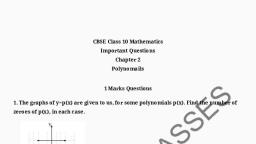
NCERT Solution For Class 10 Maths Chapter 2- Polynomials, , Exercise 2.1, 1. The graphs of y = p(x) are given in Fig. 2.10 below, for some polynomials p(x). Find the number of zeroes, of p(x), in each case., , Solutions:, Graphical method to find zeroes:Total number of zeroes in any polynomial equation = total number of times the curve intersects x-axis., , (i), (ii), (iii), (iv), (v), (vi), , In the given graph, the number of zeroes of p(x) is 0 because the graph is parallel to x-axis, does not cut it at any point., In the given graph, the number of zeroes of p(x) is 1 because the graph intersects the x-axis at, only one point., In the given graph, the number of zeroes of p(x) is 3 because the graph intersects the x-axis at, any three points., In the given graph, the number of zeroes of p(x) is 2 because the graph intersects the x-axis at, two points., In the given graph, the number of zeroes of p(x) is 4 because the graph intersects the x-axis at, four points., In the given graph, the number of zeroes of p(x) is 3 because the graph intersects the x-axis at, three points., , 𝔊𝔞𝔫𝔤𝔞𝔡𝔥𝔞𝔯'𝔰
Page 3 :
NCERT Solution For Class 10 Maths Chapter 2- Polynomials, Sum of zeroes = 0+(-2) = -2 = -(8/4) = = -(Coefficient of u)/(Coefficient of u2), Product of zeroes = 0×-2 = 0 = 0/4 = (Constant term)/(Coefficient of u2 ), (v) t2–15, ⇒ t2 = 15 or t = ±√15, Therefore, zeroes of polynomial equation t2 –15 are (√15, -√15), Sum of zeroes =√15+(-√15) = 0= -(0/1)= -(Coefficient of t) / (Coefficient of t2), Product of zeroes = √15×(-√15) = -15 = -15/1 = (Constant term) / (Coefficient of t2 ), (vi) 3x2–x–4, ⇒ 3x2–4x+3x–4 = x(3x-4)+1(3x-4) = (3x - 4)(x + 1), Therefore, zeroes of polynomial equation3x2 – x – 4 are (4/3, -1), Sum of zeroes = (4/3)+(-1) = (1/3)= -(-1/3) = -(Coefficient of x) / (Coefficient of x2), Product of zeroes=(4/3)×(-1) = (-4/3) = (Constant term) /(Coefficient of x2 ), , 2. Find a quadratic polynomial each with the given numbers as the sum and product of its zeroes, respectively. (i) 1/4 , -1, Solution:, From the formulas of sum and product of zeroes, we know,, Sum of zeroes = α+β, Product of zeroes = α β, , Sum of zeroes = α+β = 1/4, Product of zeroes = α β = -1, ∴ If α and β are zeroes of any quadratic polynomial, then the quadratic polynomial equation can be written, directly as:x2–(α+β)x +αβ = 0 x2–(1/4)x, +(-1) = 0, 4x2–x-4 = 0, Thus,4x2–x–4 is the quadratic polynomial., (ii)√2, 1/3, , 𝔊𝔞𝔫𝔤𝔞𝔡𝔥𝔞𝔯'𝔰
Page 9 :
NCERT Solution For Class 10 Maths Chapter 2- Polynomials, As we can see, the remainder is left as 0. Therefore, we say that, x2 + 3x + 1 is a factor of 3x4+5x3-7x2+2x+2. (iii), x3-3x+1, x5-4x3+x2+3x+1, Solutions:, Given,, First polynomial = x3-3x+1, Second polynomial = x5-4x3+x2+3x+1, , As we can see, the remainder is not equal to 0. Therefore, we say that, x3-3x+1 is not a factor of x5-4x3+x2+3x+1 ., 3. Obtain all other zeroes of 3x4+6x3-2x2-10x-5, if two of its zeroes are √(5/3) and - √(5/3)., , Solutions:, Since this is a polynomial equation of degree 4, hence there will be total 4 roots., √(5/3) and - √(5/3) are zeroes of polynomial f(x)., , ∴ (x -√(5/3)) (x+√(5/3) = x2-(5/3) = 0, (3x2−5)=0, is a factor of given polynomial f(x)., Now, when we will divide f(x) by (3x2−5) the quotient obtained will also be a factor of f(x) and the remainder, will be 0., , 𝔊𝔞𝔫𝔤𝔞𝔡𝔥𝔞𝔯'𝔰
Page 10 :
NCERT Solution For Class 10 Maths Chapter 2- Polynomials, , Therefore, 3x4 +6x3 −2x2 −10x–5 = (3x2 –5)(x2+2x+1), Now, on further factorizing (x2+2x+1) we get,, x2+2x+1 = x2+x+x+1 = 0 x(x+1)+1(x+1) = 0, (x+1)(x+1) = 0, So, its zeroes are given by: x= −1 and x = −1., Therefore, all four zeroes of given polynomial equation are:, √(5/3),- √(5/3) , −1 and −1., , Hence, is the answer., 4. On dividing x3-3x2+x+2 by a polynomial g(x), the quotient and remainder were x–2 and –2x+4,, respectively. Find g(x)., Solutions:, Given,, Dividend, p(x) = x3-3x2+x+2, Quotient = x-2, Remainder = –2x+4, We have to find the value of Divisor, g(x) =?, , 𝔊𝔞𝔫𝔤𝔞𝔡𝔥𝔞𝔯'𝔰
Page 11 :
NCERT Solution For Class 10 Maths Chapter 2- Polynomials, As we know,, Dividend = Divisor × Quotient + Remainder, x3-3x2+x+2 = g(x)×(x-2) + (-2x+4), x3-3x2+x+2-(-2x+4) = g(x)×(x-2) Therefore,, g(x) × (x-2) = x3-3x2+3x-2, Now, for finding g(x) we will divide x3-3x2+3x-2 with (x-2), , Therefore, g(x) = (x2–x+1), 5. Give examples of polynomials p(x), g(x), q(x) and r(x), which satisfy the division algorithm and, (i) deg p(x) = deg q(x), (ii) deg q(x) = deg r(x), (iii) deg r(x) = 0, Solutions:, According to the division algorithm, dividend p(x) and divisor g(x) are two polynomials, where g(x)≠0. Then we, can find the value of quotient q(x) and remainder r(x), with the help of below given formula;, Dividend = Divisor × Quotient + Remainder, ∴ p(x) = g(x)×q(x)+r(x), Where r(x) = 0 or degree of r(x)< degree of g(x)., Now let us proof the three given cases as per division algorithm by taking examples for each., (i) deg p(x) = deg q(x), Degree of dividend is equal to degree of quotient, only when the divisor is a constant term., Let us take an example, p(x) = 3x2 + 3x + 3 is a polynomial to be divided by g(x) = 3., So, (3x2 + 3x + 3)/3 = x2 + x + 1 = q(x), Thus, you can see, the degree of quotient q(x) = 2, which also equal to the degree of dividend, p(x)., Hence, division algorithm is satisfied here., , 𝔊𝔞𝔫𝔤𝔞𝔡𝔥𝔞𝔯'𝔰
Page 12 :
NCERT Solution For Class 10 Maths Chapter 2- Polynomials, (ii) deg q(x) = deg r(x), Let us take an example, p(x) = x2 + 3 is a polynomial to be divided by g(x) = x - 1., So, x2 + 3 = (x - 1)×(x) + (x + 3), Hence, quotient q(x) = x, Also, remainder r(x) = x + 3, Thus, you can see, the degree of quotient q(x) = 1, which is also equal to the degree of, remainder r(x)., Hence, division algorithm is satisfied here., (iii) deg r(x) = 0, The degree of remainder is 0 only when the remainder left after division algorithm is constant., Let us take an example, p(x) = x2 + 1 is a polynomial to be divided by g(x) = x. So, x2 + 1 =, (x)×(x) + 1, Hence, quotient q(x) = x, And, remainder r(x) = 1, Clearly, the degree of remainder here is 0., Hence, division algorithm is satisfied here., , Exercise 2., 1. Verify that the numbers given alongside of the cubic polynomials below are their zeroes. Also verify the, relationship between the zeroes and the coefficients in each case:, (i) 2x3+x2-5x+2; -1/2, 1, -2, Solution:, Given, p(x) = 2x3+x2-5x+2, And zeroes for p(x) are = 1/2, 1, -2, 5(1/2)+2 = (1/4)+(1/4)-(5/2)+2 = 0, p(1) = 2(1)3+(1)2-5(1)+2 = 0 p(-2), = 2(-2)3+(-2)2-5(-2)+2 = 0, Hence, proved 1/2, 1, -2 are the zeroes of 2x3+x2-5x+2., Now, comparing the given polynomial with general expression, we get;, +cx+d = 2x3+x2-5x+2, a=2, b=1, c= -5 and d = 2, As we know, if α, β, γ are the zeroes of the cubic polynomial ax3+bx2+cx+d , then;, α +β+γ = –b/a αβ+βγ+γα = c/a α βγ = – d/a., Therefore, putting the values of zeroes of the polynomial,, α+β+γ = ½+1+(-2) = -1/2 = –b/a αβ+βγ+γα = (1/2×1)+(1, , 𝔊𝔞𝔫𝔤𝔞𝔡𝔥𝔞𝔯'𝔰
Page 13 :
NCERT Solution For Class 10 Maths Chapter 2- Polynomials, ×-2)+(-2×1/2) = -5/2 = c/a α β γ = ½×1×(-2) = -2/2, = -d/a, Hence, the relationship between the zeroes and the coefficients are satisfied., (ii) x3-4x2+5x-2 ;2, 1, 1, Solution:, Given, p(x) = x3-4x2+5x-2, And zeroes for p(x) are 2,1,1., , p(1) = 13-(4×12 )+(5×1)-2 = 0, Hence proved, 2, 1, 1 are the zeroes of x3-4x2+5x-2, Now, comparing the given polynomial with general expression, we get;, +cx+d =, a = 1, b = -4, c = 5 and d = -2, As we know, if α, β, γ are the zeroes of the cubic polynomial ax3+bx2+cx+d , then;, α + β + γ = –b/a αβ + βγ + γα = c/a α β γ = – d/a., Therefore, putting the values of zeroes of the polynomial,, α +β+γ = 2+1+1 = 4 = -(-4)/1 = –b/a αβ+βγ+γα =, 2×1+1×1+1×2 = 5 = 5/1= c/a αβγ = 2×1×1 = 2 = -(2)/1 = -d/a, Hence, the relationship between the zeroes and the coefficients are satisfied., , 2. Find a cubic polynomial with the sum, sum of the product of its zeroes taken two at a time, and the, product of its zeroes as 2, –7, –14 respectively., Solution:, Let us consider the cubic polynomial is ax3+bx2+cx+d and the values of the zeroes of the polynomials be α, β, γ., As per the given question, α+β+γ = -b/a = 2/1 αβ +βγ+γα = c/a = -7/1 α βγ = -d/a = -14/1, Thus, from above three expressions we get the values of coefficient of polynomial. a, = 1, b = -2, c = -7, d = 14, Hence, the cubic polynomial is x3-2x2-7x+14, , 𝔊𝔞𝔫𝔤𝔞𝔡𝔥𝔞𝔯'𝔰
Page 14 :
NCERT Solution For Class 10 Maths Chapter 2- Polynomials, 3. If the zeroes of the polynomial x3-3x2+x+1 are a – b, a, a + b, find a and b., Solution:, We are given with the polynomial here, p(x), = x3-3x2+x+1, And zeroes are given as a – b, a, a + b, Now, comparing the given polynomial with general expression, we get;, +rx+s = x3-3x2+x+1, p = 1, q = -3, r = 1 and s = 1, Sum of zeroes = a – b + a + a + b, -q/p = 3a, Putting the values q and p., -(-3)/1 = 3a a=1, Thus, the zeroes are 1-b, 1, 1+b., Now, product of zeroes = 1(1-b)(1+b), -s/p = 1-b2 1/1 = 1-b2 b2, = 1+1 = 2 b, = ±√2, Hence,1-√2, 1 ,1+√2 are the zeroes of x3-3x2+x+1., , 4. If two zeroes of the polynomial x4-6x3-26x2+138x-35 are 2 ±√3, find other zeroes., Solution:, Since this is a polynomial equation of degree 4, hence there will be total 4 roots., Let f(x) = x4-6x3-26x2+138x-35, , Since 2 +√3 and 2-√3 are zeroes of given polynomial f(x)., ∴ [x−(2+√3)] [x−(2-√3)], , 𝔊𝔞𝔫𝔤𝔞𝔡𝔥𝔞𝔯'𝔰, , =0
Page 15 :
NCERT Solution For Class 10 Maths Chapter 2- Polynomials, (x−2−√3)(x−2+√3) = 0, On multiplying the above equation we get, x2-4x+1,, this is a factor of a given polynomial f(x)., Now, if we will divide f(x) by g(x), the quotient will also be a factor of f(x) and the remainder will be 0., , So, x4-6x3-26x2+138x-35 = (x2-4x+1)(x2 –2x−35), Now, on further factorizing (x2–2x−35) we get,, x2–(7−5)x −35 = x2– 7x+5x+35 = 0 x(x, −7)+5(x−7) = 0, (x+5)(x−7) = 0, So, its zeroes are given by: x=, −5 and x = 7., Therefore, all four zeroes of given polynomial equation are: 2+√3 , 2-√3, −5 and 7., , 𝔊𝔞𝔫𝔤𝔞𝔡𝔥𝔞𝔯'𝔰