Notes of class10, Mathematics Chapter 2 (Polynomials) Text book.pdf - Study Material
Page 1 :
20, , MATHEMATICS, , POLYNOMIALS, , 2, , 2.1 Introduction, In Class IX, you have studied polynomials in one variable and their degrees. Recall, that if p(x) is a polynomial in x, the highest power of x in p(x) is called the degree of, the polynomial p(x). For example, 4x + 2 is a polynomial in the variable x of, degree 1, 2y2 – 3y + 4 is a polynomial in the variable y of degree 2, 5x3 – 4x2 + x –, is a polynomial in the variable x of degree 3 and 7u6 –, in the variable u of degree 6. Expressions like, , 2, , 3 4, u + 4u 2 + u − 8 is a polynomial, 2, , 1, ,, x −1, , x + 2,, , 1, etc., are, x + 2x + 3, 2, , not polynomials., A polynomial of degree 1 is called a linear polynomial. For example, 2x – 3,, , 2, 2, 2 , x − , 3z + 4, u + 1 , etc., are all linear polynomials. Polynomials, 3, 11, 2, 3, such as 2x + 5 – x , x + 1, etc., are not linear polynomials., 3 x + 5, y +, , A polynomial of degree 2 is called a quadratic polynomial. The name ‘quadratic’, has been derived from the word ‘quadrate’, which means ‘square’. 2 x 2 + 3x −, , 2,, 5, , u, 2, 1, are some examples of, − 2u 2 + 5, 5v 2 − v, 4 z 2 +, 3, 3, 7, quadratic polynomials (whose coefficients are real numbers). More generally, any, quadratic polynomial in x is of the form ax2 + bx + c, where a, b, c are real numbers, and a ≠ 0. A polynomial of degree 3 is called a cubic polynomial. Some examples of, y 2 – 2, 2 − x 2 + 3 x,, , 2021–22
Page 2 :
POLYNOMIALS, , 21, , a cubic polynomial are 2 – x3, x3, 2 x3 , 3 – x2 + x3, 3x3 – 2x2 + x – 1. In fact, the most, general form of a cubic polynomial is, ax3 + bx2 + cx + d,, where, a, b, c, d are real numbers and a ≠ 0., Now consider the polynomial p(x) = x2 – 3x – 4. Then, putting x = 2 in the, polynomial, we get p(2) = 22 – 3 × 2 – 4 = – 6. The value ‘– 6’, obtained by replacing, x by 2 in x2 – 3x – 4, is the value of x2 – 3x – 4 at x = 2. Similarly, p(0) is the value of, p(x) at x = 0, which is – 4., If p(x) is a polynomial in x, and if k is any real number, then the value obtained by, replacing x by k in p(x), is called the value of p(x) at x = k, and is denoted by p(k)., What is the value of p(x) = x2 –3x – 4 at x = –1? We have :, p(–1) = (–1)2 –{3 × (–1)} – 4 = 0, Also, note that, , p(4) = 42 – (3 × 4) – 4 = 0., , As p(–1) = 0 and p(4) = 0, –1 and 4 are called the zeroes of the quadratic, polynomial x2 – 3x – 4. More generally, a real number k is said to be a zero of a, polynomial p(x), if p(k) = 0., You have already studied in Class IX, how to find the zeroes of a linear, polynomial. For example, if k is a zero of p(x) = 2x + 3, then p(k) = 0 gives us, 3, 2k + 3 = 0, i.e., k = − ⋅, 2, −b, ⋅, In general, if k is a zero of p(x) = ax + b, then p(k) = ak + b = 0, i.e., k =, a, −b − (Constant term), So, the zero of the linear polynomial ax + b is, ., =, a, Coefficient of x, Thus, the zero of a linear polynomial is related to its coefficients. Does this, happen in the case of other polynomials too? For example, are the zeroes of a quadratic, polynomial also related to its coefficients?, In this chapter, we will try to answer these questions. We will also study the, division algorithm for polynomials., , 2.2 Geometrical Meaning of the Zeroes of a Polynomial, You know that a real number k is a zero of the polynomial p(x) if p(k) = 0. But why, are the zeroes of a polynomial so important? To answer this, first we will see the, geometrical representations of linear and quadratic polynomials and the geometrical, meaning of their zeroes., , 2021–22
Page 3 :
22, , MATHEMATICS, , Consider first a linear polynomial ax + b, a ≠ 0. You have studied in Class IX that the, graph of y = ax + b is a straight line. For example, the graph of y = 2x + 3 is a straight, line passing through the points (– 2, –1) and (2, 7)., x, , –2, , 2, , y = 2x + 3, , –1, , 7, , From Fig. 2.1, you can see, that the graph of y = 2x + 3, intersects the x - axis mid-way, between x = –1 and x = – 2,, , 3, that is, at the point − , 0 ., 2 , You also know that the zero of, , 3, 2x + 3 is − . Thus, the zero of, 2, the polynomial 2x + 3 is the, x-coordinate of the point where the, Fig. 2.1, , graph of y = 2x + 3 intersects the, x-axis., , In general, for a linear polynomial ax + b, a ≠ 0, the graph of y = ax + b is a, , −b , straight line which intersects the x-axis at exactly one point, namely, , 0 ., a, , Therefore, the linear polynomial ax + b, a ≠ 0, has exactly one zero, namely, the, x-coordinate of the point where the graph of y = ax + b intersects the x-axis., Now, let us look for the geometrical meaning of a zero of a quadratic polynomial., Consider the quadratic polynomial x2 – 3x – 4. Let us see what the graph* of, y = x2 – 3x – 4 looks like. Let us list a few values of y = x2 – 3x – 4 corresponding to, a few values for x as given in Table 2.1., * Plotting of graphs of quadratic or cubic polynomials is not meant to be done by the students,, nor is to be evaluated., , 2021–22
Page 4 :
POLYNOMIALS, , 23, , Table 2.1, x, y = x2 – 3x – 4, , –2, , –1, , 0, , 1, , 2, , 3, , 4, , 5, , 6, , 0, , –4, , –6, , –6, , –4, , 0, , 6, , If we locate the points listed, above on a graph paper and draw, the graph, it will actually look like, the one given in Fig. 2.2., In fact, for any quadratic, polynomial ax2 + bx + c, a ≠ 0, the, graph of the corresponding, equation y = ax2 + bx + c has one, of the two shapes either open, upwards like, or open, downwards like, depending on, whether a > 0 or a < 0. (These, curves are called parabolas.), You can see from Table 2.1, that –1 and 4 are zeroes of the, quadratic polynomial. Also, note from Fig. 2.2 that –1 and 4, are the x-coordinates of the points, where the graph of y = x2 – 3x – 4, intersects the x- axis. Thus, the, zeroes of the quadratic polynomial, x2 – 3x – 4 are x-coordinates of, the points where the graph of, y = x 2 – 3x – 4 intersects the, x-axis., , Fig. 2.2, , This fact is true for any quadratic polynomial, i.e., the zeroes of a quadratic, polynomial ax2 + bx + c, a ≠ 0, are precisely the x-coordinates of the points where the, parabola representing y = ax2 + bx + c intersects the x-axis., From our observation earlier about the shape of the graph of y = ax2 + bx + c, the, following three cases can happen:, , 2021–22
Page 5 :
24, , MATHEMATICS, , Case (i) : Here, the graph cuts x-axis at two distinct points A and A′., The x-coordinates of A and A′ are the two zeroes of the quadratic polynomial, ax + bx + c in this case (see Fig. 2.3)., 2, , Fig. 2.3, Case (ii) : Here, the graph cuts the x-axis at exactly one point, i.e., at two coincident, points. So, the two points A and A′ of Case (i) coincide here to become one point A, (see Fig. 2.4)., , Fig. 2.4, The x-coordinate of A is the only zero for the quadratic polynomial ax2 + bx + c, in this case., , 2021–22
Page 6 :
POLYNOMIALS, , 25, , Case (iii) : Here, the graph is either completely above the x-axis or completely below, the x-axis. So, it does not cut the x-axis at any point (see Fig. 2.5)., , Fig. 2.5, So, the quadratic polynomial ax2 + bx + c has no zero in this case., So, you can see geometrically that a quadratic polynomial can have either two, distinct zeroes or two equal zeroes (i.e., one zero), or no zero. This also means that a, polynomial of degree 2 has atmost two zeroes., Now, what do you expect the geometrical meaning of the zeroes of a cubic, polynomial to be? Let us find out. Consider the cubic polynomial x3 – 4x. To see what, the graph of y = x3 – 4x looks like, let us list a few values of y corresponding to a few, values for x as shown in Table 2.2., Table 2.2, x, y = x3 – 4x, , –2, , –1, , 0, , 1, , 2, , 0, , 3, , 0, , –3, , 0, , Locating the points of the table on a graph paper and drawing the graph, we see, that the graph of y = x3 – 4x actually looks like the one given in Fig. 2.6., , 2021–22
Page 7 :
26, , MATHEMATICS, , We see from the table above, that – 2, 0 and 2 are zeroes of the, cubic polynomial x3 – 4x. Observe, that – 2, 0 and 2 are, in fact, the, x-coordinates of the only points, where the graph of y = x 3 – 4x, intersects the x-axis. Since the curve, meets the x - axis in only these 3, points, their x - coordinates are the, only zeroes of the polynomial., Let us take a few more, examples. Consider the cubic, polynomials x3 and x3 – x2. We draw, the graphs of y = x3 and y = x3 – x2, in Fig. 2.7 and Fig. 2.8 respectively., Fig. 2.6, , Fig. 2.7, , Fig. 2.8, , 2021–22
Page 8 :
POLYNOMIALS, , 27, , Note that 0 is the only zero of the polynomial x3. Also, from Fig. 2.7, you can see, that 0 is the x-coordinate of the only point where the graph of y = x3 intersects the, x-axis. Similarly, since x3 – x2 = x2 (x – 1), 0 and 1 are the only zeroes of the polynomial, x3 – x2. Also, from Fig. 2.8, these values are the x - coordinates of the only points, where the graph of y = x3 – x2 intersects the x-axis., From the examples above, we see that there are at most 3 zeroes for any cubic, polynomial. In other words, any polynomial of degree 3 can have at most three zeroes., Remark : In general, given a polynomial p(x) of degree n, the graph of y = p(x), intersects the x-axis at atmost n points. Therefore, a polynomial p(x) of degree n has, at most n zeroes., Example 1 : Look at the graphs in Fig. 2.9 given below. Each is the graph of y = p(x),, where p(x) is a polynomial. For each of the graphs, find the number of zeroes of p(x)., , Fig. 2.9, Solution :, (i) The number of zeroes is 1 as the graph intersects the x-axis at one point only., (ii) The number of zeroes is 2 as the graph intersects the x-axis at two points., (iii) The number of zeroes is 3. (Why?), , 2021–22
Page 9 :
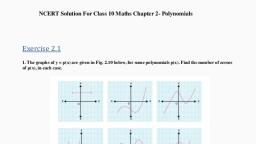
28, , MATHEMATICS, , (iv) The number of zeroes is 1. (Why?), (v) The number of zeroes is 1. (Why?), (vi) The number of zeroes is 4. (Why?), , EXERCISE 2.1, 1. The graphs of y = p(x) are given in Fig. 2.10 below, for some polynomials p(x). Find the, number of zeroes of p(x), in each case., , Fig. 2.10, , 2.3 Relationship between Zeroes and Coefficients of a Polynomial, You have already seen that zero of a linear polynomial ax + b is − b . We will now try, a, to answer the question raised in Section 2.1 regarding the relationship between zeroes, and coefficients of a quadratic polynomial. For this, let us take a quadratic polynomial,, say p(x) = 2x2 – 8x + 6. In Class IX, you have learnt how to factorise quadratic, polynomials by splitting the middle term. So, here we need to split the middle term, ‘– 8x’ as a sum of two terms, whose product is 6 × 2x2 = 12x2. So, we write, 2x2 – 8x + 6 = 2x2 – 6x – 2x + 6 = 2x(x – 3) – 2(x – 3), = (2x – 2)(x – 3) = 2(x – 1)(x – 3), , 2021–22
Page 10 :
POLYNOMIALS, , 29, , So, the value of p(x) = 2x2 – 8x + 6 is zero when x – 1 = 0 or x – 3 = 0, i.e., when, x = 1 or x = 3. So, the zeroes of 2x2 – 8x + 6 are 1 and 3. Observe that :, , −(−8) −(Coefficient of x), =, 2, Coefficient of x 2, 6, Constant term, Product of its zeroes = 1 × 3 = 3 = =, 2 Coefficient of x 2, Sum of its zeroes, , = 1+ 3 = 4 =, , Let us take one more quadratic polynomial, say, p(x) = 3x2 + 5x – 2. By the, method of splitting the middle term,, 3x2 + 5x – 2 = 3x2 + 6x – x – 2 = 3x(x + 2) –1(x + 2), = (3x – 1)(x + 2), Hence, the value of 3x2 + 5x – 2 is zero when either 3x – 1 = 0 or x + 2 = 0, i.e.,, when x =, , 1, 1, or x = –2. So, the zeroes of 3x2 + 5x – 2 are and – 2. Observe that :, 3, 3, Sum of its zeroes, , =, , Product of its zeroes =, , 1, − 5 − (Coefficient of x), + (− 2) =, =, 3, 3, Coefficient of x 2, 1, −2, Constant term, × ( − 2) =, =, 3, 3, Coefficient of x 2, , In general, if α* and β* are the zeroes of the quadratic polynomial p(x) = ax2 + bx + c,, a ≠ 0, then you know that x – α and x – β are the factors of p(x). Therefore,, ax2 + bx + c = k(x – α) (x – β), where k is a constant, = k[x2 – (α + β)x + α β], = kx2 – k(α + β)x + k α β, Comparing the coefficients of x2, x and constant terms on both the sides, we get, a = k, b = – k(α + β) and c = kαβ., This gives, , α+β=, αβ =, , –b, ,, a, , c, a, , * α,β are Greek letters pronounced as ‘alpha’ and ‘beta’ respectively. We will use later one, more letter ‘γ’ pronounced as ‘gamma’., , 2021–22
Page 11 :
30, , i.e.,, , MATHEMATICS, , sum of zeroes = α + β = −, , product of zeroes = αβ =, , b, − (Coefficient of x), =, ,, a, Coefficient of x2, , c, Constant term, ., =, a, Coefficient of x 2, , Let us consider some examples., Example 2 : Find the zeroes of the quadratic polynomial x2 + 7x + 10, and verify the, relationship between the zeroes and the coefficients., Solution : We have, x2 + 7x + 10 = (x + 2)(x + 5), So, the value of x2 + 7x + 10 is zero when x + 2 = 0 or x + 5 = 0, i.e., when x = – 2 or, x = –5. Therefore, the zeroes of x2 + 7x + 10 are – 2 and – 5. Now,, sum of zeroes = – 2 + (– 5) = – (7) =, , product of zeroes = (− 2) × (− 5) = 10 =, , −(7) – (Coefficient of x) ,, =, 1, Coefficient of x 2, , 10, Constant term, =, ⋅, 1 Coefficient of x 2, , Example 3 : Find the zeroes of the polynomial x2 – 3 and verify the relationship, between the zeroes and the coefficients., Solution : Recall the identity a2 – b2 = (a – b)(a + b). Using it, we can write:, , (, , )(, , x2 – 3 = x − 3 x + 3, So, the value of x2 – 3 is zero when x =, Therefore, the zeroes of x2 – 3 are, , ), , 3 or x = – 3⋅, , 3 and − 3 ⋅, , Now,, sum of zeroes =, , product of zeroes =, , 3− 3= 0 =, , − (Coefficient of x) ,, Coefficient of x2, , Constant term, ( 3 )( − 3 ) = – 3 = −13 = Coefficient, of x, , 2021–22, , 2, , ⋅
Page 12 :
POLYNOMIALS, , 31, , Example 4 : Find a quadratic polynomial, the sum and product of whose zeroes are, – 3 and 2, respectively., Solution : Let the quadratic polynomial be ax2 + bx + c, and its zeroes be α and β., We have, α+β= –3=, , αβ = 2 =, , and, , −b ,, a, , c., a, , If a = 1, then b = 3 and c = 2., So, one quadratic polynomial which fits the given conditions is x2 + 3x + 2., You can check that any other quadratic polynomial that fits these conditions will, be of the form k(x2 + 3x + 2), where k is real., Let us now look at cubic polynomials. Do you think a similar relation holds, between the zeroes of a cubic polynomial and its coefficients?, Let us consider p(x) = 2x3 – 5x2 – 14x + 8., , 1, ⋅ Since p(x) can have atmost three, 2, zeroes, these are the zeores of 2x3 – 5x2 – 14x + 8. Now,, You can check that p(x) = 0 for x = 4, – 2,, , sum of the zeroes = 4 + ( −2) +, , product of the zeroes = 4 × ( −2) ×, , 1 5 − (−5) − (Coefficient of x 2 ), = =, =, ,, 2 2, 2, Coefficient of x 3, , 1, −8, – Constant term, ., = −4 =, =, 2, 2, Coefficient of x 3, , However, there is one more relationship here. Consider the sum of the products, of the zeroes taken two at a time. We have, , {4 × (− 2)} + (− 2) ×, , , 1 1, , + × 4, 2 2, , , = – 8 −1+ 2 = −7 =, , −14, Coefficient of x, =, ., 2, Coefficient of x3, , In general, it can be proved that if α, β, γ are the zeroes of the cubic polynomial, ax3 + bx2 + cx + d, then, , 2021–22
Page 13 :
32, , MATHEMATICS, , –b, ,, a, c, αβ + βγ + γα = ,, a, –d, ., α β γ =, a, Let us consider an example., α+β+γ=, , 1, are the zeroes of the cubic polynomial, 3, p(x) = 3x3 – 5x2 – 11x – 3, and then verify the relationship between the zeroes and the, coefficients., , Example 5* : Verify that 3, –1, −, , Solution : Comparing the given polynomial with ax3 + bx2 + cx + d, we get, a = 3, b = – 5, c = –11, d = – 3. Further, p(3) = 3 × 33 – (5 × 32) – (11 × 3) – 3 = 81 – 45 – 33 – 3 = 0,, p(–1) = 3 × (–1)3 – 5 × (–1)2 – 11 × (–1) – 3 = –3 – 5 + 11 – 3 = 0,, 3, , 2, , 1, 1, 1, 1, p − = 3 × − − 5 × − − 11 × − − 3 ,, 3, 3, 3, 3, , = –, , 1 5 11, 2 2, − +, −3=– + =0, 9 9 3, 3 3, , 1, are the zeroes of 3x3 – 5x2 – 11x – 3., 3, 1, So, we take α = 3, β = –1 and γ = − ⋅, 3, Now,, 1 5 −(−5) −b ,, 1, α + β + γ = 3 + (−1) + − = 2 − = =, =, 3 3, 3, a, 3, Therefore, 3, –1 and −, , −11 c ,, 1, 1 1, αβ + β γ + γ α = 3 × (−1) + (−1) × − + − × 3 = − 3 + − 1 =, =, a, 3, 3, 3 3, , − ( −3) − d ., 1, αβγ = 3 × ( −1) × − = 1 =, =, 3, a, 3, * Not from the examination point of view., , 2021–22
Page 14 :
POLYNOMIALS, , 33, , EXERCISE 2.2, 1. Find the zeroes of the following quadratic polynomials and verify the relationship between, the zeroes and the coefficients., (i) x2 – 2x – 8, (iv) 4u2 + 8u, , (ii) 4s2 – 4s + 1, , (iii) 6x2 – 3 – 7x, , (v) t2 – 15, , (vi) 3x2 – x – 4, , 2. Find a quadratic polynomial each with the given numbers as the sum and product of its, zeroes respectively., 1,, 1, 2,, −1, (ii), (iii) 0, 5, (i), 4, 3, (iv) 1, 1, , (v) −, , 1, 1, 4 4, , (vi) 4, 1, , 2.4 Division Algorithm for Polynomials, You know that a cubic polynomial has at most three zeroes. However, if you are given, only one zero, can you find the other two? For this, let us consider the cubic polynomial, x3 – 3x2 – x + 3. If we tell you that one of its zeroes is 1, then you know that x – 1 is, a factor of x3 – 3x2 – x + 3. So, you can divide x3 – 3x2 – x + 3 by x – 1, as you have, learnt in Class IX, to get the quotient x2 – 2x – 3., Next, you could get the factors of x2 – 2x – 3, by splitting the middle term, as, (x + 1)(x – 3). This would give you, x3 – 3x2 – x + 3 = (x – 1)(x2 – 2x – 3), = (x – 1)(x + 1)(x – 3), So, all the three zeroes of the cubic polynomial are now known to you as, 1, – 1, 3., Let us discuss the method of dividing one polynomial by another in some detail., Before noting the steps formally, consider an example., Example 6 : Divide 2x2 + 3x + 1 by x + 2., Solution : Note that we stop the division process when, either the remainder is zero or its degree is less than the, degree of the divisor. So, here the quotient is 2x – 1 and, the remainder is 3. Also,, (2x – 1)(x + 2) + 3 = 2x2 + 3x – 2 + 3 = 2x2 + 3x + 1, i.e.,, 2x2 + 3x + 1 = (x + 2)(2x – 1) + 3, Therefore, Dividend = Divisor × Quotient + Remainder, , 2x – 1, x+2, , 2, , 2x + 3x + 1, 2x 2 + 4x, , Let us now extend this process to divide a polynomial by a quadratic polynomial., , 2021–22
Page 15 :
34, , MATHEMATICS, , Example 7 : Divide 3x3 + x2 + 2x + 5 by 1 + 2x + x2., , 3x – 5, , Solution : We first arrange the terms of the, dividend and the divisor in the decreasing order, of their degrees. Recall that arranging the terms, in this order is called writing the polynomials in, standard form. In this example, the dividend is, already in standard form, and the divisor, in, standard form, is x2 + 2x + 1., , x2 + 2 x + 1, –, , 3x3 + 6x2 +3 x, –, –, 2, –5x – x + 5, –5x2 – 10x – 5, +, + +, 9x + 10, , Step 1 : To obtain the first term of the quotient, divide the highest degree term of the, dividend (i.e., 3x3) by the highest degree term of the divisor (i.e., x2). This is 3x. Then, carry out the division process. What remains is – 5x2 – x + 5., Step 2 : Now, to obtain the second term of the quotient, divide the highest degree term, of the new dividend (i.e., –5x2) by the highest degree term of the divisor (i.e., x2). This, gives –5. Again carry out the division process with – 5x2 – x + 5., Step 3 : What remains is 9x + 10. Now, the degree of 9x + 10 is less than the degree, of the divisor x2 + 2x + 1. So, we cannot continue the division any further., So, the quotient is 3x – 5 and the remainder is 9x + 10. Also,, (x2 + 2x + 1) × (3x – 5) + (9x + 10) = 3x3 + 6x2 + 3x – 5x2 – 10x – 5 + 9x + 10, = 3x3 + x2 + 2x + 5, Here again, we see that, Dividend = Divisor × Quotient + Remainder, What we are applying here is an algorithm which is similar to Euclid’s division, algorithm that you studied in Chapter 1., This says that, If p(x) and g(x) are any two polynomials with g(x) ≠ 0, then we can find, polynomials q(x) and r(x) such that, p(x) = g(x) × q(x) + r(x),, where r(x) = 0 or degree of r(x) < degree of g(x)., This result is known as the Division Algorithm for polynomials., Let us now take some examples to illustrate its use., Example 8 : Divide 3x2 – x3 – 3x + 5 by x – 1 – x2, and verify the division algorithm., , 2021–22
Page 16 :
POLYNOMIALS, , 35, , Solution : Note that the given polynomials, are not in standard form. To carry out, division, we first write both the dividend and, divisor in decreasing orders of their degrees., So, dividend = –x 3 + 3x 2 – 3x + 5 and, divisor = –x2 + x – 1., Division process is shown on the right side., We stop here since degree (3) = 0 < 2 = degree (–x2 + x – 1)., So, quotient = x – 2, remainder = 3., Now,, Divisor × Quotient + Remainder, = (–x2 + x – 1) (x – 2) + 3, = –x3 + x2 – x + 2x2 – 2x + 2 + 3, = –x3 + 3x2 – 3x + 5, = Dividend, In this way, the division algorithm is verified., Example 9 : Find all the zeroes of 2x4 – 3x3 – 3x2 + 6x – 2, if you know that two of, its zeroes are, , 2 and − 2 ., , Solution : Since two zeroes are, , (, , 2 and − 2 , x − 2, , )( x + 2 ), , = x2 – 2 is a, , factor of the given polynomial. Now, we divide the given polynomial by x2 – 2., , First term of quotient is, , 2x4, = 2 x2, 2, x, , Second term of quotient is, , −3x3, = − 3x, x2, , x2, Third term of quotient is 2 = 1, x, , 2021–22
Page 17 :
36, , MATHEMATICS, , So, 2x4 – 3x3 – 3x2 + 6x – 2 = (x2 – 2)(2x2 – 3x + 1)., Now, by splitting –3x, we factorise 2x 2 – 3x + 1 as (2x – 1)(x – 1). So, its zeroes, 1, are given by x =, and x = 1. Therefore, the zeroes of the given polynomial are, 2, 1, 2, − 2, , and 1., 2, , EXERCISE 2.3, 1. Divide the polynomial p(x) by the polynomial g(x) and find the quotient and remainder, in each of the following :, (i) p(x) = x3 – 3x2 + 5x – 3,, , g(x) = x2 – 2, , (ii) p(x) = x4 – 3x2 + 4x + 5, g(x) = x2 + 1 – x, (iii) p(x) = x4 – 5x + 6,, , g(x) = 2 – x2, , 2. Check whether the first polynomial is a factor of the second polynomial by dividing the, second polynomial by the first polynomial:, (i) t2 – 3, 2t4 + 3t3 – 2t2 – 9t – 12, (ii) x2 + 3x + 1, 3x4 + 5x3 – 7x2 + 2x + 2, (iii) x3 – 3x + 1, x5 – 4x3 + x2 + 3x + 1, 5, 5, and – ⋅, 3, 3, 4. On dividing x3 – 3x2 + x + 2 by a polynomial g(x), the quotient and remainder were x – 2, and –2x + 4, respectively. Find g(x)., , 3. Obtain all other zeroes of 3x4 + 6x3 – 2x2 – 10x – 5, if two of its zeroes are, , 5. Give examples of polynomials p(x), g(x), q(x) and r(x), which satisfy the division algorithm, and, (i) deg p(x) = deg q(x), , (ii) deg q(x) = deg r(x), , (iii) deg r(x) = 0, , EXERCISE 2.4 (Optional)*, 1. Verify that the numbers given alongside of the cubic polynomials below are their zeroes., Also verify the relationship between the zeroes and the coefficients in each case:, 1,, 1, – 2, (ii) x3 – 4x2 + 5x – 2; 2, 1, 1, 2, 2. Find a cubic polynomial with the sum, sum of the product of its zeroes taken two at a, time, and the product of its zeroes as 2, –7, –14 respectively., , (i) 2x3 + x2 – 5x + 2;, , *These exercises are not from the examination point of view., , 2021–22
Page 18 :
POLYNOMIALS, , 37, , 3. If the zeroes of the polynomial x3 – 3x2 + x + 1 are a – b, a, a + b, find a and b., 4. If two zeroes of the polynomial x4 – 6x3 – 26x2 + 138x – 35 are 2 ± 3 , find other zeroes., 5. If the polynomial x4 – 6x3 + 16x2 – 25x + 10 is divided by another polynomial x2 – 2x + k,, the remainder comes out to be x + a, find k and a., , 2.5 Summary, In this chapter, you have studied the following points:, 1. Polynomials of degrees 1, 2 and 3 are called linear, quadratic and cubic polynomials, respectively., 2. A quadratic polynomial in x with real coefficients is of the form ax2 + bx + c, where a, b, c, are real numbers with a ≠ 0., 3. The zeroes of a polynomial p(x) are precisely the x-coordinates of the points, where the, graph of y = p(x) intersects the x -axis., 4. A quadratic polynomial can have at most 2 zeroes and a cubic polynomial can have, at most 3 zeroes., 5. If α and β are the zeroes of the quadratic polynomial ax2 + bx + c, then, α +β = −, , b, ,, a, , αβ =, , c, ., a, , 6. If α, β, γ are the zeroes of the cubic polynomial ax3 + bx2 + cx + d, then, α +β + γ =, , −b ,, a, , αβ+ β γ + γ α =, , and, , αβγ =, , c,, a, , −d ., a, , 7. The division algorithm states that given any polynomial p(x) and any non-zero, polynomial g(x), there are polynomials q(x) and r(x) such that, , p(x) = g(x) q(x) + r(x),, where, , r(x) = 0 or degree r(x) < degree g(x)., , 2021–22



 Learn better on this topic