Page 1 :
POWER SHARING
Page 3 :
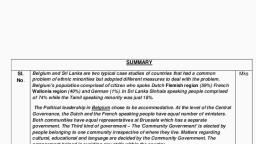
STORY OF BELGIUM, Belgium is a small country in Europe with a population of over 1 crore, about half the population of Haryana.
Page 4 :
STORY OF BELGIUM, Of the country’s total population, 59% speaks Dutch language, 40% of people speak French and the remaining 1% speak German. Look at the map below to know the language variation of Belgium. , The minority French-speaking community was rich and powerful, so they got the benefit of economic development and education. This created tensions between the Dutch-speaking and French-speaking communities during the 1950s and 1960s.
Page 6 :
Accommodation in Belgium, In Belgium, the government handled the community difference very well. Between 1970 and 1993, Belgian leaders amended their constitution four times and came up with a new model to run the government. , .
Page 8 :
Story of Sri Lanka, Sri Lanka, it is an island nation having a population of 2 crores, about the same as in Haryana. Sri Lanka has a diverse population.
Page 9 :
The major social groups are the Sinhala-speakers (74%) and the Tamil-speakers (18%). Among Tamils, there are two subgroups, “Sri Lankan Tamils” and “Indian Tamils”. You can see the map below to know the population distribution of different communities of Sri Lanka.
Page 18 :
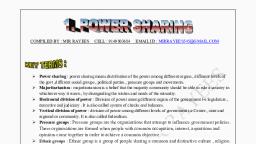
Form of Power Sharing, Most of you must think that Sharing power = dividing power = weakening the country. , A similar thing was believed in the past. It was assumed that all the power of a government must reside in one person or group of persons located at one place. Otherwise, it would be very difficult to make quick decisions and to enforce them. , But these notions have changed with the emergence of democracy. In a democracy, people rule themselves through institutions of self-government. Everyone has a voice in the shaping of public policies. Therefore, in a democratic country, political power should be distributed among citizens.
Page 19 :
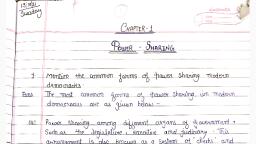
Form of Power Sharing, In modern democracies, power sharing can take many forms, as mentioned below:, Power is shared among different organs of government, such as the legislature, executive and judiciary. This is called horizontal distribution of power because it allows different organs of government placed at the same level to exercise different powers. Such separation ensures that none of the organs can exercise unlimited power. Each organ checks the others. This arrangement is called a system of checks and balances., Power can be shared among governments at different levels – a general government for the entire country and governments at the provincial or regional level which is called federal government., Power may also be shared among different social groups such as the religious and linguistic groups. ‘Community government’ in Belgium is a good example of this arrangement. This method is used to give minority communities a fair share in power., Power sharing arrangements can also be seen in the way political parties, pressure groups and movements control or influence those in power. When two or more parties form an alliance to contest elections and if they get elected, they form a coalition government and thus share power.
Page 20 :
I. Power is shared among different organs of government
Page 21 :
II. Power can be shared among governments at different levels
Page 22 :
III. Power may also be shared among different social groups
Page 23 :
IV. Coalition Government