Page 1 :
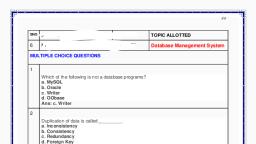
Assignment Questions, Chapter 3(Data Base management system), Fill in the Blanks, 1 A __________ is an organized collection of data., 2. A ________________ is a software package that can be used for creating and, managing databases., 3. A ____________ is a database management system that is based on the, relational model., 4.Three popular DBMS software are ________, ________, & _______., 5. A ____________ is a unique value that identifies a row in a table., 6. Composite Key is a combination of ________ columns., Short Answer Type Questions, 1 What does DBMS stands for?, 2. What does RDBMS stands for?, 3. How is data organized in a RDBMS?, 4.State the relationship and difference between a primary and foreign key?, II Fill in the blanks, 1. A table is a set of data elements that is organized using a model of vertical, ___________ and horizontal ____________., 2. A _________ is a set of data values of a particular type, one for each row of, the table., 3. A ___________ represents a single, data item in a table., 4. _____________ are used to identify which type of data we are going to store, in the database., Short Answer type question, 1. In how many ways tables can be created in Base?, 2. Why are data types used in DBMS /RDBMS?, 3. List datatypes available in Numeric Datatype?

Page 2 :
III Fill in the blanks, 1. The types of languages used for creating and manipulating the data in the, Database are ______________ & ______________., 2. A ____________________ is a standard for commands that define the, different structures in a database., 3. A ______________ is a language that enables users to access and manipulate, data in a database., 4. A _____________ is a part of DML involving information retrieval only., 5. A popular data manipulation language is _________________., Short type questions, 1. What is the file extension for databases created using OpenOffice.Org, Base?, 2. How many types of relationships can be created in Base? Explain each of, the them., 3. What do you mean by Sorting? In how many ways it can be done?, 4. Explain Referential Integrity with the help of an example.