Notes of Class 10 A, History nationalism in India.pdf - Study Material
Page 1 :
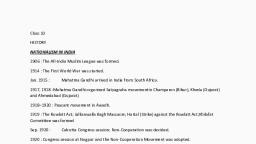
T I: India and the Contemporary World - Il, Section 1: Events and Processes, , NATIONALISM, SL LP, , , , , , Syllabus, , > The First World War, Khilafat and Non-Cooperation, > Differing Strands within the Movement, , * Towards Civil Disobedience, , ~ The Sense of Collective Belonging, , , , , , , , © Learning Outcomes, , » Recognize the characteristics of Indian nationalism through a case study of Non-Cooperation and Civil, Disobedience Movement., , + Analyze the nature of the diverse social movements of the time., > Familiarize with the writings and ideals of different political groups and individuals., > Appreciate the ideas promoting Pan Indian belongingness., , , , , , , , i=) Revision Notes, , The First World War, Khilafat and Non-Cooperation Moveme, , > Effects of First World War: The First World War led to a huge increase in defence expenditure., This was financed by war loans and by increasing taxes. Custom duties were raised and, income tax was introduced to raise extra revenue. Prices of items increased during the war, years. The prices doubled between 1913 and 1918. The common people were the worst, sufferers because of the price rise. Forced recruitment of rural people in the army was, another cause of widespread anger amongst people., > Crop failure in many parts of India resulted in an acute shortage of foods, Influenza epidemic, further aggravated the problem. According to the 1921 census, about 12 to 13 million people, died because of famines and epidemic., + The Idea of Satyagraha ~, @ = Mahatma Gandhi returned to India in January 1915. His heroic fight for the Indians in South, Africa was well-known. His noble method of mass agitation known as Satyagraha has yielded good results., @ The idea of satyagraha emphasised the power of truth and the need to search for truth. In 1917, Gandhi, travelled to Champaran in Bihar to inspire the peasants to struggle against the oppressive plantation system., @ The method of Satyagraha was based on the idea that if someone is fighting for a true cause, there is no, need to use any physical force to fight the oppressor. Gandhiji believed that a Satyagrahi could win a battle, through non-violence, i.c., without being aggressive or revengeful.
Page 3 :
» Some early Satyagraha movements organised by Gandhiji:, @ Peasants’ Movement in Champaran (Bihar) in 1917., , @ Peasants’ Movement in Kheda district (Gujarat) in 1917., , @ = Mill workers’ Movement in Ahmedabad in 1918., , >» The Rowlatt Act (1919):, © The Rowlatt Act was passed by the Imperial Legislative Council in 1919. The Indian members did not support, , the Act, but it was passed nevertheless. The Act gave enormous powers to the British Government to repress, political activities. It allowed detention of political prisoners without trial for two years., , © On6t April, 1919, Gandhiji launched a nationwide Satyagraha against the proposed Rowlatt Act. The call of, a strike on 6!" April got a huge response. People came out in support in various cities, shops were shut down, and workers in railway workshops went on strike. The British administration decided to clamp down on the, nationalists. Several local leaders were arrested. Mahatma Gandhi was barred from entering Delhi., , ~ Jallianwala Bagh Incident:, © On 10" April 1919, in Amritsar, the Police fired upon a peaceful procession. This provoked widespread attacks, , on government establishments. Martial Law was imposed in Amritsar and the command of the area was, given to General Dyer., , @ = The infamous (shocking) Jallianwala Bagh Massacre took place on 13" April; the day on which Baisakhi is, celebrated in Punjab. A crowd of villagers came to participate in a fair in Jallianwala Bagh. It was enclosed, from all sides with narrow entry points., , © General Dyer blocked the exit points and opened fire on the crowd. Hundreds of people were killed in that, incident. Public reaction to the incident took a violent turn in many north Indian towns. The government was, quite brutal in its response. Things turned highly violent. Mahatma Gandhi called off the movement as he did, not want to continue the violence., , > Khilafat Movement: The Khilafat issue gave Mahatma Gandhi an opportunity to bring the Hindus and Muslims, on a common platform. The Ottoman Turkey was badly defeated in the First World War. There were rumours, about a harsh peace treaty likely to be imposed on the Ottoman Emperor, who was the spiritual head of the, Islamic world (the Khalifa). A Khilafat committee was formed in Bombay in March 1919 to defend the Khalifa., This committee had leaders like the brothers Muhammad Ali and Shaukat Ali. They also wanted Mahatma, Gandhi to take up the cause to build a united mass action. At the Calcutta session of the Congress in September, 1920, the resolution was passed to launch a Non-Cooperation Movement in support of Khilafat and also for, Swaraj., , » Non-Cooperation Movement: In his famous book Hind Swaraj (1909), Mahatma Gandhi declared that British, rule was established in India with the cooperation of Indians and had survived only because of this cooperation. If, Indians refused to cooperate, British rule in India would collapse within a year, and Swaraj would be established., Gandhiji believed that if Indians begin to refuse to cooperate, the British rulers will have no other way than to, leave India, , » Some of the proposals of Non-Cooperation Movement:, , @ Surrender the titles which were awarded by the British Government., , © Boycott of Civil Services, Army, Police, Courts, Legislative Councils and Schools., , © Boycott of foreign goods., , © Launch full Civil Disobedience campaign, if the government persisted with repressive measures., , Differing Strands within the Movemen, , Differing Strands within the Movement: The Non-Cooperation-Khilafat Movement began in January 1921., Various social groups participated in this movement, each with its own specific aspiration. All of them responded, to the call of swaraj, but the term meant different things to different people., , » Awadh: The Peasants’ Movement in Awadh was led by Baba Ramchandra. He was a Sanyasi who had earlier, worked in Fiji as an indentured labourer. The peasants were against the high rents and many other cesses, which, were demanded by talukdars and landlords. The peasants demanded reduction of revenue, abolition of the, begar and social boycott of oppressive landlords, , y Tribal Peasants: Tribal peasants gave their own interpretation of Mahatma Gandhi and the idea of Swaraj. The, tribals were prevented from entering, the forests to graze cattle or to collect fruits and firewood. The new forest, laws were posing threats to their livelihoods. The government forced them to do the begar on road construction., Many rebels from the tribal areas became violent and often carried guerrilla warfare against the British Officials., , + Swaraj in the Plantations: The plantation workers were prevented from leaving the tea gardens without, permission, as per the Inland Emigration Act of 1859. When the news of Non-Cooperation Movement spread, to the plantations, many workers began to defy the authorities. They left plantations and headed towards their, homes. But they got stranded on the way because of a railway and steamer strike. They were caught by the police, and brutally beaten up.
Page 4 :
Civil Disobedience Movement and People’s Participation, , ., , Simon Commission, , @ The British Government constituted a Statutory Commission under Sir John Simon. The, Commission was made to look into the functioning of the constitutional system in India, and suggest changes. But since all the members in the Commission were British, the, Indian leaders opposed the Commission., , e The Simon Commission arrived in India in 1928. It was greeted with the slogan ‘Go back,, , Simon’. All parties joined the protest. In October 1929, Lord Irwin announced a vague, offer of ‘Dominion Status’ for India but its timing was not specified. He also offered to, hold a Round Table Conference to discuss the future Constitution., , Salt March (Beginning of Civil Disobedience Movement), , @ Mahatma Gandhi believed that salt could be a powerful symbol to unite the whole nation. Most of the people,, including the British scoffed at the idea. Abolition of the salt tax was among many demands which were, raised by Gandhiji through a letter to Viceroy Irwin., , e The Salt March or Dandi March was started by Gandhiji on 12 March, 1930. He was accompanied by 78, volunteers. They walked for 24 days to cover a distance of 240 miles from Sabarmati to Dandi. Many more, joined them on the way. On 6" April, 1930, Gandhiji ceremonially violated the law by manufacturing a fistful, of salt., , e The Salt March marked the beginning of the Civil Disobedience Movement. Thousands of people broke the, salt law in different parts of the country. People demonstrated in front of government salt factories. Foreign cloths, were boycotted. Peasants refused to pay revenue. Village officials resigned. Tribal people violated forest laws., , Response of British Rulers: The Colonial Government began to arrest the Congress leaders. This led to violent, clashes in many places. Mahatma Gandhi was arrested about a month later. People began to attack the symbols, of British rule; such as Police posts, Municipal buildings, Law courts and Railway stations. The Government's, repression was quite brutal. Even women and children were beaten up. About 100,000 people were arrested., Round Table Conference: When things began to take a violent turn, Mahatma Gandhi called-off the movement., He signed a pact with Irwin on 5'* March, 1931. This was called the Gandhi-Irwin Pact. As per the Pact, Gandhiji, agreed to participate in the Round Table Conference in London. In lieu of that, the government agreed to release, the political prisoners. Gandhiji went to London in December 1931. The negotiations broke down and Gandhiji, had to return with disappointment. When Gandhiji came back to India, he found that most of the leaders were, put in jail. Congress had been declared illegal. Many measures were taken to prevent meetings, demonstrations, and boycotts. Mahatma Gandhi relaunched the Civil Disobedience Movement. By 1934, the movement had lost, its momentum,, , Farmers: For the farmers, the fight for Swaraj was a struggle against high revenues. When the Movement was., , called off in 1931, without the revenue rates being revised, the farmers were highly disappointed. Many of them, , refused to participate when the Movement was relaunched in 1932. The small tenants just wanted the unpaid, rent to the landlord to be remitted. They often joined the radical movements which were led by Socialists and, , Communists. Congress did not want to alienate the rich landlords and hence, the relationship between the poor, , peasants and Congress was uncertain., , Businessmen: The Indian Merchants and Industrial ‘ould grow their Business during the First World War., , They were against those colonial policies which restricted their business activities. They wanted protection against, , imports and a Rupee-Sterling Foreign Exchange ratio which would discourage imports. The Indian Industrial, , and Commercial Congress was formed in 1920 and the Federation of the Indian Chamber of Commerce and, , Industries (FICCI) was formed in 1927. These were the results of attempts to bring the common business interests, , ona common platform. For the Businessmen, Swaraj meant an end to oppressive Colonial policies. They wanted, , an environment which could allow the business to flourish. They were apprehensive of militant activities and of, growing influence of Socialism among the younger members of the Congress., , Industrial Workers: The Industrial workers showed a lukewarm response to the Civil Disobedience Movement., , Since, industrialists were closer to the Congress, workers kept a distance from the Movement. But some worke!, , selectively participated in the Movement. Congress did not want to alienate the Industrialists and hence,, , preferred to keep the workers’ demands at bay., , Depressed Classes: Dr. B. R. Ambedkar demanded for separate electorates for dalits. This made a clash between, , Gandhiji and Ambedkar. When British accepted their demand, Gandhiji began a fast unto death as he believed, , that it would slow down the process of their integration into society. As a result Ambedkar and Gandhiji signed, , an agreement known as Poona Pact of September 1932 in which dalits got reservation in Provincial and Central, , Legislative councils, , Women's Participation: Women also participated in the Civil Disobedience Movement in large numbers., , However, most of the women were from High-Caste families in the urban areas and from rich peasant households, , in rural areas. But for a long time, the Congress was reluctant to give any position of authority to women within, , the organisation. The Congress was just keen on the symbolic presence of women.
Page 5 :
The Sense of Collective Belong, , > The Sense of Collective Belonging, , e Nationalist Movement spreads when people belonging to different regions and, communities begin to develop a sense of collective belongingness. The identity of a, nation is most often symbolized in a figure or an image., , e The image of Bharat Mata was first created by Bankim Chandra Chattopadhyay in, 1870 when he wrote ‘Vande Mataram’ for our motherland. Indian folk songs and folk, tales sung by people played an important role in promoting the idea of nationalism. In, Bengal, Rabindranath Tagore and in Madras, Natesa Sastri made collection of folk tales, and songs which led the Movement for folk revival., , © During the Swadeshi Movement, a tri-color (red, green and yellow) flag was designed in, Bengal. It had eight lotuses representing eight provinces and a crescent moon representing, Hindus and Muslims, , © Means of creating a feeling of nationalism was through reinterpretation of history. The nationalist writers, urged the readers to take pride in India’s great achievements in the past and struggle to change the miserable, conditions of life under British rule., , , , i=) Know the Terms, , > Nationalism: It is a political, social and economic ideology or a movement characterised by the promotion of the, interests of a nation, as a whole., , > Satyagraha: The policy of passive political resistance inaugurated by Mohandas Karamchand Gandhi during his, stay in South Africa. It is based on the ideals of truth and non-violence., , >» Khalifa: The spiritual head of the Islamic World., , > Conscription/Forced Recruitment: A process by which the colonial state forced people to join the army., , > Rowlatt Act: It was an Act which gave the British government enormous power to repress political activities. It, allowed that government could arrest anybody without a trial for two years., , > Jallianwala Bagh Massacre: The Jallianwala Bagh Massacre, also known as the Amritsar Massacre, took place on, 13" April, 1919 when troops of the British Indian Army under the command of General Dyer opened fire on the, crowd of Baisakhi pilgrims, who had gathered in Jallianwala Bagh, Amritsar, Punjab., , » Non-Cooperation Movement: Began in January 1921, the main aim of this movement was not to cooperate with, the British. It included surrendering of government titles, boycott of Civil Services, Army, Police, Courts and, Legislative Councils, School and Foreign Goods; and a full Civil Disobedience campaign would be launched., , » Swadeshi: The Swadeshi Movement involved boycotting British products and the revival of domestic made, products and production technique., , > Boycott: A boycott is a form of consumer activism involving the act of voluntarily abstaining from using, buying, or dealing with a person, organisation or country as an expression of protest usually for political reason., , > Begar: Labour that villagers were forced to contribute without any payment., , > Picket: A form of demonstration or protest by which people block the entrance to a shop, factory or office., , > Civil Disobedience: During Civil Disobedience Movement people were asked not only to refuse cooperation, with the British but also to break the Colonial Laws., , >» Swaraj: “Swaraj” means Freedom or Self-rule. In 1920, “Swaraj” meant “Self-Government” within the empire if, possible and outside if necessary., , > Simon Commission: The new Tory government in Britain constituted a Statutory Commission under Sir John, Simon. The Commission was sent to India to look into the functioning of the Constitutional system in India and, suggest changes. It arrived in India in 1928., , » Galt Law: Saltis consumed by both the poor and the rich, and is one of the most essential items of foods everywhere, in the world. The British Government had a monopoly on the production of salt in India. By imposing a ‘salt tax’, the Government hit both the rich and the poor, especially the poor. Gandhiji thought it was the most repressive, Act of the British Government and chose to defy it by breaking the “Salt Law”., , > Gandhi-Irwin Pact: When the British Government responded with a policy of brutal repression against the Civil, Disobedience Movement, Mahatma Gandhi decided to call off the movement. He entered into a pact with Lord Irwin, on 5 March, 1931. Under this pact, Gandhiji consented to participate in a Round Table Conference in London., , » Folkdores: The traditional beliefs, customs and stories of a community that are passed through the generations by, word of mouth. Many nationalist leaders took help of folk tales to spread the idea of nationalism. It was believed, that the folk tales revealed the true picture of traditional culture.



 Learn better on this topic