Page 1 :
CHAPTER O1, , Carbon and It's, Compounds, , In this Chapter..., , Covalent Bonding in Carbon, , Compounds, e Allotropes of Carbon, , e Hydrocarbons, @ Isomerism, e Functional Groups., , , , Organic Compounds, , Carbon is the third most important element after oxygen and, hydrogen, for the existence of life on the Earth. The Earth, crust has only 0.02% carbon which is present in the form of, minerals (like carbonates, hydrogen-carbonates, coal,, petroleum, etc.) and the atmosphere has 0.03% of carbon, dioxide., , Fuels (like wood, kerosene, coal, LPG, CNG, petrol, etc.), clothing material (like cotton, nylon, polyester, etc.), paper,, rubber, plastics, leather, drugs and dyes are all made up of, carbon., , Covalent Bonding in Carbon Compounds, , The bonds which are formed by the sharing of an electron pair, between the atoms (either same or different atoms) are known, as covalent bonds., , Atomic number of carbon (C) is 6., So, its electronic configuration = x i, , Thus, there are 4 electrons in its outermost shell and its octet, , can be completed by the following two ways, , + It could gain 4 electrons and form C* anion. But for a, nucleus having 6 protons, it would be difficult to hold on 10, electrons, i.e. 4 extra electrons., , , , e Homologous Series, , + It could lose 4 electrons and form C** cation. But a large, amount of energy is required to remove 4 electrons, leaving behind a carbon cation with 6 protons in its, nucleus holding on just two electrons together, which is, not possible., , , , In order to overcome this problem, carbon shares its, valence electrons with other atoms of carbon or with atoms of, other elements., , These shared electrons belong to the outermost shells of, both atoms and in this way, both atoms attain the nearest, noble gas configuration. This type of bonding is called, covalent bonding., , Compounds having covalent bonds are called covalent, compounds, these are generally poor conductor of, electricity., , Examples of Covalent Bonding, , Some example depicting of covalent bonding are as follows, , 1. Formation of Methane (CH,), , In the formation of a methane molecule, one carbon atom, shares its 4 electrons with four hydrogen atoms (one electron, of each hydrogen atom). It shows carbon is tetravalent
Page 2 :
because it possesses 4 valence electrons and hydrogen is, monovalent because it has only 1 valence electron., , Before Shared After, combination Electrons combination, , , , @) 7, — or ts, , Methane (CH,) molecule, , 2. Formation of Water Molecule (H,0), , Atomic number of O = 8 ., Electronic configuration = 26, , , , Atomic number of H =1, Electronic configuration = ., , To attain the stable electronic configuration of the nearest, noble gas, hydrogen needs 1 electron and oxygen needs, 2 electrons. So, two hydrogen atoms share an electron pair, with the oxygen atom such that hydrogen acquires a duplet, configuration and oxygen an octet, resulting in the, formation of two single covalent bonds., Before After, combination combination Shared electrons, , @0c@ — ORG oe o—n, , Water (H,0) molecule, , Properties of Covalent Compounds, , The compounds containing covalent bonds are called, covalent compounds. They have following properties i.e., Covalent compounds have low melting and boiling points, due to small intermolecular forces of attraction between the, atoms., , Covalent compounds are generally poor conductors of, electricity. This is because the electrons are shared, between atoms and no charged particles are formed in these, compounds., , Covalent compounds are generally volatile in nature., , Allotropes of Carbon, , Allotropy is the property by virtue of which an element exists, in more than one form and each form has different physical, properties but identical chemical properties. These different, forms are called allotropes. Carbon exists in different, allotropic forms; some of them are diamond, graphite and, fullerene., * Diamond is a colourless transparent substance and very, hard whereas graphite is an opaque substance which have, smooth surface and slippery to touch., , , , , + Fullerenes are recently discovered allotropic forms of, carbon which were prepared for the first time by HW, Kroto, Smalley and Robert Curt by the action of laser beam, on the vapours of graphite., , Versatile Nature of Carbon, , Main factors that are responsible for the formation of large, number of carbon compounds are, (i) Catenation The property of self linking of elements mainly, C-atoms through covalent bonds to form long, straight or, branched chains and rings of different sizes is called, catenation. Carbon shows maximum catenation in the, periodic table due to its small size and strong C —C bond., (ii) Tetravalency of carbon The valency of carbon is four, i.e., it is capable of bonding or pairing with four other carbon, atoms or with the atoms of some other monovalent, elements like hydrogen, halogen (chlorine, bromine), etc., (iii) Tendency to form multiple bonds Carbon has a strong, tendency to form multiple bonds due to it’s small size. It, shares more than one electron pair with its own atoms or, with the atoms of elements like oxygen, nitrogen,, sulphur, ete., , Organic Compounds, , The compounds of carbon except its oxides, carbonates and, hydrogen carbonate salts, are known as organic compounds., In 1828, German chemist Friedrich Wohler accidently, prepared urea from ammonium cyanate when he was trying to, prepare ammonium cyanate by heating ammonium sulphate, and potassium cyanate. Thus, synthesis of urea discarded the, vital force theory., , Hydrocarbons, , Organic compounds made up of carbon and hydrogen are, called hydrocarbons. These are of two types, i.e., , 1. Aliphatic Saturated Hydrocarbons, , Saturated aliphatic hydrocarbons are called alkane or paraffin., All the carbon atoms in these are bonded through single bonds., The general formula of these compounds is C,Hg,, 2 and suffix, “sane” is used in their nomenclature., , e.g. CH, (methane), C,H, (ethane), etc., , , , , , , , , , , , 2. Aliphatic Unsaturated Hydrocarbons, , Those compounds in which at least one double or triple bond, , is present between two carbon atoms are called unsaturated, , hdyrocarbons., , Aliphatic unsaturated hydrocarbons are of two types, , (i) Alkene Those hydrocarbons which have at least one, , carbon-carbon double bond are called alkenes or olefins., The general formula of these compounds is C,H,,,,, e.g. CyH, (ethene).
Page 3 :
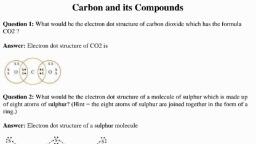
(ii) Alkyne Those hydrocarbons which must have at least, one carbon-carbon triple bond are called alkynes. The, general common formula of these compounds is, C,Hg,.2, €.8 CgH, (ethyne)., , Structure of Saturated and Unsaturated, Compounds, , Steps to draw the structure of carbon compound are, , Step L. First connect all the carbon atoms together with a, single bond., , Step I. After that use the hydrogen atoms to satisfy the, remaining valencies of carbon (as carbon forms 4, bonds due to its 4 valency),, , Step U1. If number of available H-atoms are less than what is, required, satisfy the remaining valency by using, double or triple bond., , 1. Structure of Propane (C;H,), , Same rules are followed here as in case of ethane. Here, the, , three carbon atoms are linked together with a single bond., , c—c—c {Step I], , To satisfy the remaining valencies of carbon atoms, hydrogen, , atoms are linked with them., , H H H, , n—6—6 Con, , hhh, , 2 carbon atoms are bonded to 3 hydrogen atoms and 1 carbon, atom is bonded to 2 hydrogen atoms., , Electron dot structure of propane, , [Step 11), , , , 2. Structure of Ethene (C,H,), Link the two carbon atoms by single bond., c—c [Step 1], , Link the four hydrogen atoms with carbon atom to satisfy the, unsatisfied valencies of carbon., , H \ H, , De-eK, H H, , But in this case, even after linking the available hydrogen, atoms with carbon atoms, still one valency of each carbon, , [Step 11], , , , , , To satisfy it, a double bond is used between the two carbon, atoms. H x J, =C Step HI, BOK [Step 111], , H H, Now, all the four valencies of carbon are satisfied., Electron dot structure of ethene, 3. Structure of Ethyne (C,H,), Link the two carbon atoms by single bond., , c—C [Step 1], , Link the two hydrogen atoms with unsatisfied valencies of, n., , H—C—C—H [Step 11], But in this case even after linking the available hydrogen, atoms with carbon atoms, still two valencies of each carbon is, , unsatisfy. To satisfy it, a triple bond is used between the two, , carbon atoms., H—C=C—H [Step 111], , In ethyne, the two carbon atoms share three pairs of, electrons among themselves to form a carbon-carbon triple, bond., , Each carbon atom shares one electron with each hydrogen, atom to form two carbon-hydrogen single bonds., Electron dot structure of ethyne, , CH Be O, , Structure of Cyclic Compounds, In some compounds, carbon atoms are arranged in the form, of ring. e.g. cyclohexane (CH, ) and benzene (CgH,), , , H M i, \, vN, ae, HY AH HC C-H, He®, SH \4, f |, HH H, Ai Cote, Gbied (Benzene)
Page 4 :
Isomerism, , Organic compounds with same molecular formula but, different chemical and physical properties are called, isomers. This phenomenon is called isomerism., , The difference in properties of these compounds is due to, the difference in their structures. These compounds have, identical molecular formula but different structures. Hence,, they are called structural isomers and phenomenon is, called structural isomerism., , e.g. Two structural isomers are possible for butane (C,H) 9)., , H, H H H H H | 4a, rot ot | <<, H—C—C—C—C—H H—-C—CQ, I ot tod | Io Se-H, H H HH HoH IX, H H, Straight chain structure Branched chain structure, , Functional Groups, , Groups which combine with a carbon chain and decide its, chemical properties are called functional groups., , e.g. — OH in R—OH will decide the chemical properties, of this compound, thus it is a functional group., , Names and Formulae of Functional Group, , , , , , , , , , Name of functional group —- Formula of functional group, Alcohol —OH, Aldehyde oO, — CHO or ll —H, Ketone I, , , , Carboxylic acid 1, —C—O—H, , , , Thus, — OH in methyl alcohol (CH. 0H) and —COOH, (carboxylic acid) in formic acid (H-COOH) are present as, functional groups., , Homologous Series, , A series of similarly constituted compounds in which the, members present have the same functional group and similar, chemical properties and any two successive members in a, particular series differ in their molecular formula by a, —CH,— unit, is called a homologous series., , e.g. CH, C,H, C,H, C,Hjo are the members of alkane, family.
Page 5 :
Chapter, Practice, , Objective Questions, , ® Multiple Choice Questions, , 1., , », , °, , =, , Carbon exists in the atmosphere in the form of, @ enlyeahon momnide, (b) carbon monoxide in traces and carbon dioxide, (c) only carbon dioxide, , (d) coal, , Which of the following will contain covalent double, bond between its atoms?, (a) Hy, , (c) Nacl, , (b) Og, , (Cl,, , Which of the following is the correct representation, of electron dot structure of nitrogen? (NCERT Exemplar), , (a) NINE, , , , iN, , , , , , (NEN (@) INE, , . Carbon can use four hydrogen atoms to form, , methane (CH, ), because, , (a) valency of carbon is four, , (b) valency of hydrogen is one, , (c) Both (a) and (b), , (d) carbon gets noble gas configuration by making four, covalent bonds with hydrogen, , A molecule of ammonia (NH3)has (CERT Exemplar), , (a) only single bonds, (b) only double bonds, , (0) only triple bonds, , (d) two double bonds and one single bond, , , , The structure of Ss, molecule is ........ shaped., (b) crown, , (d) rectangle, , (a) ring, (c) circle, Which of the following is not the use of graphite?, nt, , manufacturing of lead-pencils, , , , , , icturing of artifi, (d) It is used for making insulated plates, , 12. Structural formula of ethyne is, , Which of the following elements does not show, tetravalency?, (a) Ge (b) Si, , (Cc (d)O, , , , ..is the first synthesised organic compound., (a) Alcohol (b) Urea, (c) Vinegar (d) Benzene, , (NCERT Exemplar) 10. Pentane has the molecular formula CH). It has, , (NCERT Exemplar), (b) 12 covalent bonds, (d) 17 covalent bonds, , (a) 5 covalent bonds, (c) 16 covalent bonds, , 11. Match the following :, , , , , Column I Column IL, A. CH, (i) Cyclic compound, B. CH, Alkyne, CH,, D. C\Hy, Codes, , x BC, (a) (iv) (i) (ii), (b) (iii) (iv), () i) (iv) (iii), (d) (ii) (iii) (i) (iv), (NCERT Exemplar), , (a) H—C = C—H (b) HJC—C = C—H, , H H H H, , 7 4, (c) Nene (d) nc —C—H, nH” \ H H H, , 13. Which among the following are unsaturated, , hydrocarbons?, () CH, —CH, —CH,, CH,, , (ii) CH, —CH = CH—CH,, , |, (iii) CH, —C—CH, (iv) CH, —C= CH,, |, , , , CH; CH,, (a) (i) and (iii) (b) (ii) and (iii) (NCERT Exemplar), (6) (ii) and (iv) (d) (ii), (iii) and (iv)