Page 1 :
REPORTED SPEECH, DIRECT Vs INDIRECT
Page 2 :
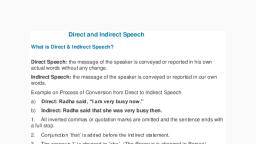
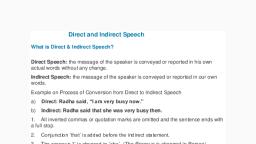
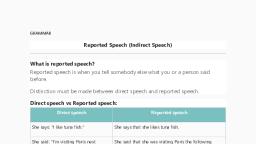
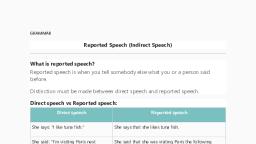
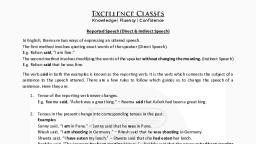
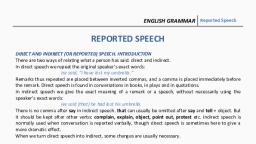
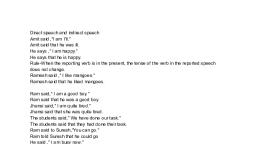
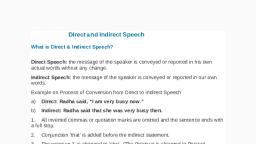
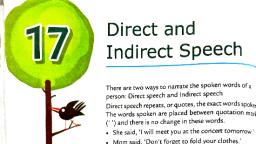
Two ways of saying what someone, else said earlier, DIRECT, - Kyra said, “I can speak perfect English.”, INDIRECT, - Kyra said that she could speak perfect English.
Page 3 :
Three main types of sentences are converted from, Direct into Indirect, 1. Statements (Assertive sentences), 2. Questions (Interrogative sentences), 3. Imperative Sentences (requests, command, advice, instructions), 4. Exclamatory Sentences
Page 4 :
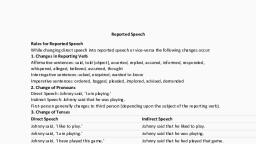
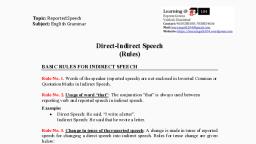
RULES FOR CHANGING DIRECT TO INDIRECT, 1. Remove the quotation marks ( , “ ‘’ )., 2. use of the word ‘that’, ‘if’ or ‘whether’., 3. Change the Pronouns., , 4. Backshift the Tense ( if reporting verb is in Past Tense – ‘said’,, ‘told’, ‘asked’ etc.), 5. Change the Time and Place expressions.
Page 5 :
An example, Direct speech, - Kyra said, “I have an important meeting this evening.”, , Indirect speech, - Kyra said that she had an important meeting that evening.
Page 6 :
CHANGING PRONOUNS
Page 7 :
CHANGE IN TIME and PLACE EXPRESSIONS, -, , Now ---> Then, This ---> That, Today ---> That day, Here ---> there, Tomorrow ---> the next day/ the day after, Yesterday ---> the previous day/ the day before, ago ---> before/ previously, next week ---> the following week, last week ---> the previous week
Page 8 :
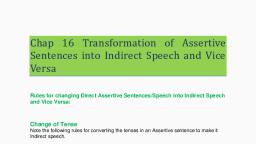
CHANGE IN TENSE, 1., 2., 3., 4., 5., 6., 7., , Present Simple ---> Past Simple, Present Continuous ---> Past Continuous, Present perfect ---> Past Perfect, Present Perfect Continuous ---> Past Perfect Continuous, Past Simple ---> Past Perfect, Past Continuous ----> Past Perfect Continuous, Past Perfect ----> Past Perfect ( No change )
Page 9 :
Simple way to remember, DIRECT SPEECH, -, , do/ does, is/ am/ are, has/ have, will, shall, can, may, would, should, could,, might, , INDIRECT SPEECH, did, was/ were, had, would, should, could, might, -----> no change
Page 10 :
STATEMENTS / ASSERTIVE, SENTENCES
Page 11 :
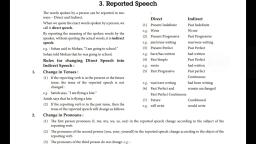
STATEMENTS / ASSERTIVE SENTENCES, If the reporting verb is in past tense, then reported verb, will be changed as per the following criterion:, 1. Present indefinite tense is changed into past indefinite, tense. For example:, • Direct Speech: They said, “They take exercise every day.”, • Indirect Speech: They said that they took exercise every, day., 2. Present continuous is changed into past continuous, tense., • Direct Speech: They said, “They are taking exercise every, day.”, • Indirect Speech: They said that they were taking exercise, every day.
Page 12 :
3. Present perfect is changed into the past perfect tense., • Direct Speech: They said, “They have taken exercise.”, • Indirect Speech: They said that they had taken exercise., 4. Present perfect continuous tense is changed into past, perfect continuous tense., • Direct Speech: They said, “They have been taking exercise, since morning.”, • Indirect Speech: They said that they had been taking exercise, since morning.
Page 13 :
5. Past indefinite is changed into past perfect tense., • Direct Speech: They said, “They took exercise.”, • Indirect Speech: They said that they had taken exercise., , 6. Past continuous tense is changed into past perfect continuous tense., • Direct Speech: They said, “They were taking exercise.”, • Indirect Speech: They said that they had been taking exercise., 7. No changes are required to be made into past perfect and past perfect, continuous tenses., • Direct Speech: They said, “They had taken exercise.”, • Indirect Speech: They said that they had taken exercise., 8. In Future Tense, while no changes are made except shall and will are changed, into would., • Direct Speech: They said, “They will take exercise.”, • Indirect Speech: They said that they would take exercise.
Page 14 :
INTERROGATIVE, SENTENCES, , (Questions)
Page 15 :
RULES, • There are two main kinds of interrogative sentences., , 1. Those which start with an auxiliary verb like can, has, have, will, do etc., Like : Can you help me in my project work ?, Have you started your project work ?, 2. Those which start with a question word such as what, why, when, where,, how etc., Like : Where are you going ?, What have you prepared for dinner tonight ?
Page 16 :
* Interrogative sentences beginning with an auxiliary verb, (can, are, has, have, do etc.) are changed into the indirect speech, by using the connective if or whether., , * The reporting verb said (or any other word used as the, reporting verb) changes to asked, questioned, or enquired of in, the indirect speech.
Page 17 :
Study the following examples carefully to, understand the rules mentioned above., 1. Direct: She said to me, ‘Are you coming with us?’, Indirect: She asked me if I was going with them. OR She asked me if I, was coming with them., , 2. Direct: She said to me, ‘Are you unwell?’, Indirect: She asked me if I was unwell.
Page 18 :
3. Direct: I said to him, ‘Were you present at the meeting yesterday?’, Indirect: I asked him whether he had been present at the meeting the, day before (or the previous day)., , 4. Direct: The woman asked the stranger, ‘Should I help you?’, Indirect: The woman asked the stranger whether she should help him., , • Note that the auxiliary verbs should, could, would, ought to and, , might do not change in the indirect speech.
Page 19 :
If question starts with 'question word' (what,, where, when, how etc) then we will use the same, question word in our Indirect speech., Example - Tom said to me, 'How are you?’, , Tom asked me how I was.
Page 20 :
SOME MORE EXAMPLES, Direct speech, , Indirect speech, , “What is your name?" he asked me., , He asked me what my name was., , "How old is your mother?", he asked., , He asked how old my mother was., , The policeman said to the boy, "Where do you, live?", , The policeman asked the boy where he lived., , "What time does the train arrive?" she asked., , She asked what time the train arrived., , “When can we have dinner?" she asked., Peter said to John, "Why are you so late?", , She asked when they could have dinner., Peter asked John why he was so late.
Page 21 :
•IMPERATIVE SENTENCES, Requests, Commands, Advice,, Suggestions
Page 22 :
Some Examples, • Open the door., , ( Command ), , • Please help me. ( Request ), , • Quit smoking., •, , ( Advice ), , Practice yoga daily. ( Advice/ suggestion )
Page 23 :
RULES, • Reporting verb in Direct Speech like ‘said’, ‘told’ etc. changes, into ‘requested’, ‘advised’, suggested’, etc., EXAMPLES, , Direct : She said to me, “Please help me.”, Indirect : She requested me to help her., Direct : Teacher said to, “Do not waste your time.”, Indirect : Teacher advised him not to waste his time.
Page 24 :
EXCLAMATORY SENTENCES, •, , Exclamatory sentences express the state of joy, sorrow, wonder, or regret., Examples, - Hurrah!, , I won the competition., , (state of joy), , - Alas! I could not qualify the exam. (state of sorrow), - Wow! What a beautiful car. ( state of wonder )
Page 25 :
RULES, • To change Exclamatory sentences into Indirect speech, we use, specific words like ‘exclaimed with joy’, ‘exclaimed with sorrow’,, exclaimed with wonder’ etc., Direct : They said, “Hurrah! We won the game.”, Indirect : They exclaimed with joy that they had won the game., Direct : she said, “Alas! I lost my expensive watch.”, Indirect : She exclaimed with sorrow that she had lost her expensive, watch.
Page 26 :
• Complete the sentences in reported speech. Note whether the sentence, is a request, a statement or a question., 1. He said, "I like this song.“, → He said______________, , 2. "Where is your sister?" she asked me., → She asked me_____________________, , 3. "I don't speak Italian," she said., → She said _________________________, 4. "Say hello to Jim," they said., → They asked me_________________________, , 5."The film began at seven o'clock," he said., → He said_________________________________
Page 27 :
6. "Don't play on the grass, boys," she said., → She told the boys______________________, 7. "Where have you spent your money?" she asked him., → She asked him_________________________________, , 8. "I never make mistakes," he said., → He said__________________________________, 9. "Does she know Robert?" he wanted to know., → He wanted to know________________________, 10. "Don't try this at home," the stuntman told the audience., → The stuntman advised the audience ________________
Page 28 :
11. "Don't waste your money" she said., She told the boys___________________, 12. "What have you decided to do?" she asked him., She asked him__________________________, 13. "I always wake up early," he said., He said_______________________________, 14. "You should revise your lessons," he said., He advised the students ___________________________, 15. "Where have you been?" he asked me., He wanted to know______________________________