Notes of Class 10th, English tiger in the zoo.pdf - Study Material
Page 3 :
POEM, , HE STALKS IN HIS VIVID STRIPES, THE FEW STEPS OF HIS CAGE,, ON PADS OF VELVET QUIET,, IN HIS QUIET RAGE., , EXPLANATION – THE POET COMPARES THE BEHAVIOUR OF A TIGER WHEN HE IS IN A ZOO AND, WHEN HE IS IN HIS NATURAL HABITAT- THE JUNGLE. IN THE FIRST PARAGRAPH THE POET TELLS US THAT, WHEN THE TIGER IS IN THE ZOO, WE CAN SEE HIM WALKING IN HIS CAGE. A TIGER CAN BE IDENTIFIED, BY THE STRIPES ON HIS BODY. HIS FEET ARE AS SOFT AS VELVET, SO WHEN HE MOVES, NO NOISE IS, MADE.WHEN HE IS IN THE CAGE HE IS ANGRY BECAUSE HE FEELS TRAPPED AND LONGS TO GO OUT., , HE SHOULD BE LURKING IN SHADOW,, SLIDING THROUGH LONG GRASS, NEAR THE WATER HOLE, WHERE PLUM DEER PASS., EXAPLANATION – ‘HE’ IN THE ABOVE LINES REFERS TO THE TIGER. A TIGER WHEN HE IS, IN THE JUNGLE, HE CONCELS HIMSELF IN SHADOWS. HE HIDES HIMSELF IN THE LONG, GRASS AND WAITS FOR HIS PREY, NEAR THE SOURCE OF WATER.ANIMALS COME TO, THE SOURCE OF WATER TO HAVE WATER AND THAT’S THE TIME THE TIGER ATTACKS, AND HUNTS. IT IS A PLACE WHERE HE CAN FIND FAT DEER.
Page 4 :
HE SHOULD BE SNARLING AROUND HOUSES, AT THE JUNGLE’S EDGE,, BARING HIS WHITE FANGS, HIS CLAWS,, TERRORISING THE VILLAGE!, , EXPLANATION – THE TIGER’ S NATURAL BEHAVIOUR IS TO ROAR. SO IT ROARS, NEAR, THE HOUSES, SITUATED AT THE EDGE OF THE JUNGLE. THE TIGER SHOWS HIS WHITE, TEETH AND CLAWS TO SCARE THE VILLAGERS. IT IS NOT THAT THE TIGER ENJOYS, SCARING THE VILLAGERS, IT’S JUST THE TIGER’S NATURE TO DO SO., , BUT HE’S LOCKED IN A CONCRETE CELL,, HIS STRENGTH BEHING BARS,, STALKING THE LENGTH OF HIS CAGE,, IGNORING VISITORS., , EXPLANATION- THE POET SAYS; THAT INSTEAD OF DOING WHAT IS IN HIS NATURE, IT’S, LOCKED IN A CAGE, IN THE ZOO. HIS STRENGHT CANNOT BERAK THE IRON BARS OF THE, CAGE. HE WALKS IN HIS CAGE, BUT HE PAYS NO HEED TO THE PEOPLE WHO COME TO, THE ZOO., , HE HEARS THE LAST VOICE AT NIGHT,, THE PATROLLING CARS,, AND STARES WITH HIS BRILLIANT EYES, AT THE BRILLIANT STARS., EXPLANATION – THE LAST VOICE THAT HE HEARS IS THE VOICE OF THE PATROLLING, CARS. THE PATROLLING CARS COME TO CHECK IF ALL THE ANIMALS ARE SAFE IN THE, CAGE.HE LOOKS AT THE STARS WITH LONGING IN HIS EYES. PERHAPS, LIKE THE STARS, SHINE IN THE DARKNESS AND GIVE US LIGHT, HE TOO HOPES TO BE BACK IN THE, JUNGLE.
Page 5 :
POETIC DEVICE, 1) PERSONIFICATION – INANIMATED OBJECT OR AN ABSTRACT IDEA AS A, PERSON HAVING HUMAN TRAITS., IN THIS POEM, THE TIGER IS ADDRESS AS “HE” MEANING, IT IS TREATED, AS A HUMAN., 2) OXYMORON – A FIGURE OF SPEECH IN WHICH APPARENTLY, CONTRADICTORY TERMS APPEAR IN CONJUNCTION., IN THIS POEM, “QUIET” AND “RAGE” ARE USED TOGETHER, THOUGH HEIR, MEANING IS ENTIRELY DIFFERENT., 3) METAPHOR – COMPARES TWO OBJECTS, WITHOUT USING “LIKE” OR “AS”., IN THIS POEM, THE PADS OF THE TIGR IS COMPARED TO VEVET., , CENTRAL IDEA OF THE POEM, THE POET, THROUGH THIS POEM, WANTS TO CONVEY THAT ANIMALS, SHOULD BE IN THEIR NATURAL HABITAT. NO ONE LIKES TO BE TRAPPED, AND CAGED. WE ALL WANT TO BE FREE, SO WHY THE ANIMALS SHOULD, BE TREATED DIFFERENTLY. AFTER ALL, THEY ARE ALSO LIVING BEINGS., , QUESTIONS AND ANSWERS, Q1) NAME THE POET?, ANS) THE POET IS LESLIE NORRIS., Q2) WHERE IS THE TIGER?, ANS) THE TIGER IS IN A ZOO., Q3) WHAT DOES A TIGER DO IN THE ZOO?, ANS) A ZOO IS NOT THE NATURAL HABITAT OF THE TIGER. THE TIGER, FEELS TRAPPED. HE WALKS THE LENGH OF HIS CAGE, IGNORING, VISITORS. HE FEELS HELPLESS AND HOPES TO BE FREE, SOMEDAY., Q4) WHAT DOES A TIGER DO IN THE JUNGLE?, ANS) WHEN A TIGER IS IN THE JUNGLE, HE HIDES IN SHADOWS AND, HUNTS., HE SNARLS AND SCARES THE VILLAGERS. HE ENJOYS THE FREEDOM.
Page 6 :
Q5) WHY ARE ZOOS NECESSARY?, ANS) ZOOS ARE NECESSARY BECAUSE WE LEARN A LOT ABOUT ANIMALS,, WHEN WE VISIT A ZOO. ZOOS’ HELP IN PRESEVING ANIMALS. ZOOS’, ALSO ENGAGE IN BREEDING PROGRAMMES, SO THAT NEARLY, EXTINCT ANIMALS CAN BE SAVED., , PRESENTED BY –, MANVI MANISHA TIGGA., UPGRADED +2 HIGH SCHOOL,, SIMULDANGA., JAMSHEDPUR -01, EAST SINGHBHUM.
Page 7 :
10th, , 10th, , Free, , Important Questions, , Science, , Science, , MCQ, , and Answer, , Lessons, , Mcq, , Test, Science, , Class, , Class, , 10th, , 10th, , Hindi, , Hindi, , Lessons, , Mcq, , Take, Free, MCQ, Test, Hindi, , Class, , Take, , Class 10 Social, , 10th, , Free, , Science Important, , SST, , MCQ, , Questions and, , Lessons, , Test SST, , Answers, , Class, 10th, Sanskrit, Lessons, , Q1- The poem draws a contrast between _____ and _____ ., A) animals, human beings, B) tiger in a zoo, tiger in a forest, C) tiger in a zoo, humans, D) humans, tiger in forest, , Q2- What has been personified in the poem?
Page 8 :
A) tiger, B) forest, C) zoo, D) all of the above, , Q3- Name the poetic device used in the line “In his quiet rage”., A) metaphor, B) assonance, C) Oxymoron, D) Consonance, , Q4- Name the poetic device used in the line “He stalks in his vivid, stripes”., A) metaphor, B) assonance, C) Oxymoron, D) Consonance, , Q5- Name the poetic device used in the line “On pads of velvet, quiet”., A) metaphor, B) assonance, C) Oxymoron, D) Consonance, , Q6- Name the poetic device used in the line “Baring his white, fangs,his claws”.
Page 9 :
A) metaphor, B) assonance, C) Oxymoron, D) Consonance, Correct Answer:D, , Q7- Why should he be lurking in shadow?, A) out of fear, B) out of anger, C) to catch the deer, D) both 1 and 2, , Q8- By “ignoring visitors”, what is the poet trying to say?, A) tiger knows his power is restricted, B) there is no use of showing rage, C) he is less terrorising because of the cage, D) all of the above, , Q9- What describes “tiger in a cell”?, A) Locked in concrete cell, B) snarling around houses, C) shadow, long grass, D) baring his white fangs, , Q10- What described “tiger in a jungle”?
Page 10 :
A) Locked in concrete cell, B) his strength behind bars, C) ignoring visitors, D) baring his white fangs, , Important Videos Links, Class 10 History Lesson Video Explanation, Class 10 Civics Lesson Video Explanation, Class 10 Economics Lesson Video Explanation, Class 10 Geography Lesson Video Explanation, Class 10 SST Sample Question Papers, , ANSWER KEY, 1, , B, , 2, , A, , 3, , C, , 4, , D, , 5, , A, , 6, , D, , 7, , C, , 8, , D, , 9, , A
Page 11 :
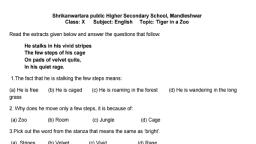
A Tiger in the Zoo, STANZA 1, He stalks in his vivid stripes, The few steps of his cage,, On pads of velvet quiet,, In his quiet rage., Questions :, (a) Who is ‘he’ here? How does ‘he’ walk?, (b) What emotion does ‘he’ show?, (c) What does ‘pads of velvet’ mean?, (d) Name the poem and the poet., (e) Which words rhyme in this stanza?, Answers :, (a) Here ‘he’ is the tiger. ‘He’ walks with pride., (b) ‘He’ shows anger coupled., (c) ‘Pads of velvet’ means this animal’s soft soles., (d) Poem: A Tiger in the Zoo., Poet: Leslie Norris., (e) The rhyming words are cage – rage, STANZA 2, He should be lurking in shadow,, Sliding through long grass, Near the water hole, Where plump deer pass., Questions :, (a) How should the tiger walk through the grass?, (b) Why should the tiger lurk in the shadow?, (c) Who passes near the water hole?, (d) Where should the tiger hide to himself?, (e) Which are the rhyming words in this stanza?, Answers :, (a) The tiger should slide through the grass., (b) The tiger should lurk in the shadow to hunt for food., (c) The fat deer pass near the water hole., (d) The tiger should hide to himself near the water hole., (e) The rhyming words are grass-pass., STANZA 3, He should be snarling around houses, At the jungle’s edge., Baring his white fangs, his claws,, Terrorising the village!, Questions :, (a) What should he be doing near the houses?, (b) Where are these houses situated?, (c) How would he terrorise the villagers?, (d) Who does ‘he’ refer to in this stanza?, (e) Which are the rhyming words in this stanza?, Answers :, (a) He should be snarling near the houses.
Page 12 :
(b) These houses are at the edge of the jungle., (c) He would terrorise the villagers by showing his fangs and claws., (d) ‘He’ refers to the tiger., (e) The rhyming words are edge-village., STANZA 4, But he locked in a concrete cell,, His strength behind bars,, Stalking the length of his cage,, Ignoring visitors., Questions :, (a) in what kind of a cell is he locked?, (b) Whose strength is behind bars?, (c) How does he react to the visitors?, (d) Who is being ignored?, (e) Name the poem and the poet., Answers :, (a) He is locked in a concrete cell., (b) The strength of the locked animal is behind bars., (c) He ignores the visitors., (d) The visitors are being ignored., (e) Poem: A Tiger in the Zoo., Poet: Leslie Norris., STANZA 5, He hears the last voice at night,, [H.B.S.E. March. 2017 (Set-B)], The patrolling cars,, And stares with his brilliant eyes, At the brilliant stars., Questions :, (a) What sound does the tiger hear at night?, (b) How do his eyes look?, (c) At what does he look at night?, (d) Which word in the stanza means ‘looks intently’?, (e) Which are the rhyming words in this stanza?, Ans., (a) The tiger hears the sound of the patrolling cars at night., (b) His eyes look brilliant., (c) He looks at the shining stars at night., (d) The word is ‘stares’., (e) The rhyming words are cars-stars., , MULTIPLE CHOICE QUESTIONS, 1. What does a tiger have on his body?, (A) spots, (C) stars, Ans. (B) stripes, 2. How does a tiger feel in a cage?, (A) happy, (C) free, Ans. (D) angry, , (B) stripes, (D) all of the above, , (B) contented, (D) angry
Page 13 :
3. How are the pads of a tiger?, (A) velvet, (B) rough, (C) hard, (D) all of the above, Ans. (A) velvet, 4. What does the tiger hunt near the water hole?, (A) lions, (B) elephants, (C) deer, (D) all of the above, Ans. (C) deer, 5. Where do the tigers hunt the deer?, (A) in the cage, (B) near the water hole, (C) near the cage, (D) all of the above., Ans. (B) near the water hole, 6. Where should the tiger be snarling?, (A) at the jungle’s edge, (B) at the cage’s edge, (C) in the cage, (D) all of the above, Ans. (A) at the jungle’s edge, 7. A tiger Is happy when…………….., (A) he is in the cage, (B) he is near the cage, (C) he frightens the visitors, (D) he is free in the forest, Ans. (I)) he is a tree in the forest, 8. What is the tiger’s attitude towards visitors?, (A) loving, (B) hating, (C) ignoring, (D) threatening, Ans. (C) ignoring, 9. What is patrolling at night?, (A) can, (B) tigers, (C) deer, (D) all of the above, Ans. (A) cars, 10. How are the eves of the tiger?, (A) dull, (B) brilliant, (C) sleepy, (D) sad, Ans. (B) brilliant, 11. What is ‘brilliant’ in the poem ‘Tiger in the Zoo’?, (A) the tiger’s eyes, (B) the stars, (C) both (A) and (B), (D) none of the above, Ans. (C) both (A) and (B), Extract Based / comprehension test Questions and Answers, , Read the extracts and answer the questions that follow., He stalks in his vivid stripes, The few steps of his cage,, On pads of velvet quiet,, In his quiet rage., (a) Who is ‘He’ in the above lines?, (b) Where is he?, (c) Where and how is he walking?, (d) In which mood is he? Why?, Ans. (a) Tiger., (b) In a small cage., (c) He walks in his cage slowly and quietly with firm strides in a proud manner., (d) He is angry because instead of moving freely in the forest, he is confined to a small cage., 2. He should be lurking in shadow,
Page 14 :
Sliding through long grass, Near the waterhole, Where plump deer pass., (a) Where is the tiger hiding?, (b) Who is going to be his prey?, (c) Why should he be lurking in shadow?, (d) What is the rhyme scheme of these lines?, Ans. (a) He is hiding in a shadowy dark place in the long grass., (b) A fat deer who will come that way to drink water is going to be his prey., (c) He should be lurking in shadow to attack the deer who comes to drink water at the waterhole., (d) a b c b., 3. He should be snarling around houses, At the jungle’s edge,, Baring his white fangs, his claws,, Terrorising the village!, (a) The poet says ‘He should be ….’, which means that he is not doing it at present so where is he, and what is he doing?, (b) Where should ‘he’ be?, (c) What is ‘his’ attitude towards visitors?, (d) How does he terrorise the villagers?, Ans. (a) He is in a village showing his white teeth and claws. He is terrorising villagers., (b) In the forest., (c) He is terrorising the villagers., (d) He terrorises the villagers by showing his sharp teeth and claws and growling., 4. But he’s locked in a concrete cell,, His strength behind bars,, Stalking the length of his cage,, Ignoring visitors,, (a) What does the expression —stalking the length of his cage’ imply?, (b) Was he interested in the visitors, (c) Which expression tells you this?, (d) What kind of enclosure the tiger was kept in?, Ans. (a) It means the tiger was walking from one end of the cage to another as if trying to measure, the length of the cage., (b) No, he was not., (c) The expression—’ignoring visitors’ tells us this., (d) He was kept in a cell made of concrete walls and long, strong bars so that the tiger could not, escape., 5. He hears the last voice at night,, The patrolling cars,, And stares with his brilliant eyes, At the brilliant stars., (a) What does he hear at night in the zoo?, (b) What do you think he might be hearing when he was in the forest?, (c) How do the eyes of a tiger look at night?, (d) Why do they look so?
Page 15 :
Ans. (a) He hears the sounds of cars of guard making rounds to check if everything was right., (b) He must be hearing the sound of other wild animals., (c) They look bright and shining., (d) This is because of a characteristic of the cat family to which they belong., Extra Very Short Answer Type Important Questions, , 1.Read the poem again, and work in pairs or groups to do the following tasks., (i) Find the words that describe the movements and actions of the tiger in the case and in, the wild. Arrange them in two columns., (ii) Find the words that describe the two places, and arrange them in two columns., Now try to share ideas about how the poet uses words and images to contrast the two, situations., Ans: (i), In the cage, , In the wild, , Stalks, , Lurking in shadow, , Few steps of his cage, , Sliding through long grass, , Quiet rage, , Snarling around houses, , Locked in a concrete cell, , Baring his white fangs, his claws, , Stalking the length of his cage, , Terrorising the village, , Ignoring visitors, Stares at the brilliant stars, (ii), Cage, , Wild, , Few steps of his cage, , Shadow, , Concrete cell, , Long grass, , Locked, , Water hole, , Behind bars, , Plump deer, , Visitors, , Houses at the jungle’s edge, , Patrolling cars, , Village
Page 16 :
2.Notice the use of a word repeated in lines such as these:, (i) On pads of velvet quiet,, In his quiet rage., (ii) And stares with his brilliant eyes, At the brilliant stars., What do you think is the effect of this repetition?, Ans: This repetition is a poetic device used by the poet in order to increases the intensity of the, tiger’s rage and his helpless silence. ‘Velvet quiet’ refers to the quiet velvetpads of the tiger,, which cannot run or leap. They can only walk around the limited space in the cage. The use of, ‘quiet rage’ symbolises the anger and ferocity that is building up inside the tiger as it wants to, run out into the forest and attack a deer, but the rage is quiet because it cannot come out in the, open as it is in the cage., This double use of ‘quiet’ has brought immense beauty to the poem. Similarly, the use of, ‘brilliant’ for the tiger’s eyes as well as the stars also brings out the magnificence of these lines., The tiger has dreams of being free in its ‘brilliant’ eyes. It sees the stars (that have also been, described as brilliant) with the same eyes. It stares at the brilliant stars with its brilliant eyes, thinking about how beautiful its life could be in the forest. The repetitiveness of these words, gives a wonderful effect to the poem., 3.Read the following two poems − one about a tiger and the other about a panther. Then, discuss:, Are zoos necessary for the protection or conservation of some species of animals? Are they, useful for educating the public? Are there alternatives to zoos?, The Tiger, The tiger behind the bars of his cage growls,, The tiger behind the bars of his cage snarls,, The tiger behind the bars of his cage roars., Then he thinks., It would be nice not to be behind bars all, The time, Because they spoil my view, I wish I were wild, not on show., But if I were wild, hunters might shoot me,, But if I were wild, food might poison me,, But if I were wild, water might drown me., Then he stops thinking, And…, The tiger behind the bars of his cage growls,, The tiger behind the bars of his cage snarls,, The tiger behind the bars of his cage roars., PETER NIBLETT, The Panther, His vision, from the constantly passing bars,, has grown so weary that it cannot hold, anything else. It seems to him there are
Page 17 :
a thousand bars; and behind the bars, no world., As he paces in cramped circles, over and over,, the movement of his powerful soft strides, is like a ritual dance around a centre, in which a mighty will stands paralysed., Only at times, the curtain of the pupils, lifts, quietly. An image enters in,, rushes down through the tensed, arrested muscles,, plunges into the heart and is gone., RAINER MARIA RILKE, Ans: The Zoo is very necessary place for some animals asthey could be hunted down, poisoned, by some wild food, or could drown in water in the forest. They also aware public about the, nature of animals and make human friendly with animals. However, a zoo is not the correct, substitute for a forest. In a zoo, an animal would feel caged, bound, and not free to roam about in, the wild. It is for this reason that wildlife sanctuaries and national parks have been instituted in, order to conserve several endangered species. These places provide protection as well as natural, surroundings to these species., They can roam about freely in their habitats and are safe too. The public can visit these parks and, get educated about the animals and their lifestyles. The parks and sanctuaries are run using a, strict set of rules, the most prominent being the ban on hunting. Since the animals are in the, open, visitors would not be able feed them and would not misbehave or try to play with them as, they are under strict guidance. Such incidents have been recorded in zoos where people irritate, and tease the animals. Hence, a wild life sanctuary is a good alternative for animals to be safe as, well as in their natural surroundings.



 Learn better on this topic