Page 1 :
BEFORE YOU READ, Anneliese Marie ‘Anne’ Frank (12, June 1929 – February/March, 1945) was a German – born, Jewish girl who wrote while in, hiding with her family and four, friends in Amsterdam during the, German occupation of the, Netherlands in World War II. Her, family had moved to Amsterdam, after the Nazis gained power in, “This is a photo as I would wish Germany but were trapped when, myself to look all the time. Then, the Nazi occupation extended into, I would, maybe, have a chance, the Netherlands. As persecutions, to come to Hollywood.”, – Anne Frank, 10 October 1942 against the Jewish population, increased, the family went into, hiding in July 1942 in hidden rooms in her father Otto Frank’s, office building. After two years in hiding, the group was betrayed, and transported to the concentration camp system where Anne died, of typhus in Bergen-Belsen within days of her sister, Margot Frank., Her father, Otto, the only survivor of the group, returned to Amsterdam, after the war ended, to find that her diary had been saved. Convinced, that it was a unique record, he took action to have it published in, English under the name The Diary of a Young Girl., The diary was given to Anne Frank for her thirteenth birthday, and chronicles the events of her life from 12 June 1942 until its, final entry of 1 August 1944. It was eventually translated from its, original Dutch into many languages and became one of the world’s, most widely read books. There have also been several films,, television and theatrical productions, and even an opera, based on, the diary. Described as the work of a mature and insightful mind,, the diary provides an intimate examination of daily life under Nazi, occupation. Anne Frank has become one of the most renowned and, discussed of the Holocaust victims.
Page 2 :
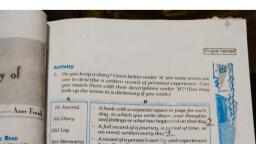
Activity, 1. Do you keep a diary? Given below under ‘A’ are some terms we, use to describe a written record of personal experience. Can, you match them with their descriptions under ‘B’? (You may, look up the terms in a dictionary if you wish.), A, , (i) Journal, (ii) Diary, (iii) Log, (iv) Memoir(s), , B, , – A book with a separate space or page for each, day, in which you write down your thoughts, and feelings or what has happened on that day, – A full record of a journey, a period of time, or, an event, written every day, – A record of a person’s own life and experiences, (usually, a famous person), – A written record of events with times and, dates, usually official, , 2. Here are some entries from personal records. Use the definitions, above to decide which of the entries might be from a diary, a, journal, a log or a memoir., (i) I woke up very late today and promptly got a scolding from, Mum! I can’t help it — how can I miss the FIFA World Cup, matches?, Ans:, Went to the office of the Director, Had lunch with Chairman, Received Rahul at the airport, Dinner at home, , (iii) The ride to Ooty was uneventful. We rested for a while every, 50 km or so, and used the time to capture the magnificent, landscape with my HandyCam. From Ooty we went on to, Bangalore., What a contrast! The noise and pollution of this once-beautiful, city really broke my heart., Ans:, (iv) This is how Raj Kapoor found me — all wet and ragged, outside R.K.Studios. He was then looking for just someone, like this for a small role in Mera Naam Joker, and he cast, me on the spot. The rest, as they say, is history!, Ans:, , From the Diary of Anne Frank, , (ii) 10:30 a.m., 01:00 p.m., 05:45 p.m., 09:30 p.m., Ans:, , 49
Page 3 :
First Flight, 50, , WRITING in a diary is a really strange experience for, someone like me. Not only because I’ve never written, anything before, but also because it seems to me, that later on neither I nor anyone else will be, interested in the musings of a thirteen-year-old, schoolgirl. Oh well, it doesn’t matter. I feel like, writing, and I have an even greater need to get all, kinds of things off my chest., ‘Paper has more patience than people.’ I thought, of this saying on one of those days when I was feeling, a little depressed and was sitting at home with my, chin in my hands, bored and listless, wondering, whether to stay in or go out. I finally stayed where I, was, brooding: Yes, paper does have more patience,, and since I’m not planning to let anyone else read, this stiff-backed notebook grandly referred to as a, ‘diary’, unless I should ever find a real friend, it, probably won’t make a bit of difference., Now I’m back to the point that prompted me, to keep a diary in the first place: I don’t have a, friend., Let me put it more clearly, since no one will, believe that a thirteen-year-old girl is completely, alone in the world. And I’m not. I have loving parents, and a sixteen-year-old sister, and there are about, thirty people I can call friends. I have a family,, loving aunts and a good home. No, on the surface I, seem to have everything, except my one true friend., All I think about when I’m with friends is having a, good time. I can’t bring myself to talk about anything, but ordinary everyday things. We don’t seem to be, able to get any closer, and that’s the problem. Maybe, it’s my fault that we don’t confide in each other. In, any case, that’s just how things are, and, unfortunately they’re not liable to change. This is, why I’ve started the diary., To enhance the image of this long-awaited friend, in my imagination, I don’t want to jot down the, facts in this diary the way most people would do,, but I want the diary to be my friend, and I’m going, to call this friend ‘Kitty’., , listless, with no energy or, interest, , confide, to tell personal, things privately to a, person that one, trusts
Page 4 :
Oral Comprehension Check, 1. What makes writing in a diary a strange experience for Anne Frank?, 2. Why does Anne want to keep a diary?, 3. Why did Anne think she could confide more in her diary than in people?, , Oral Comprehension Check, 1. Why does Anne provide a brief sketch of her life?, 2. What tells you that Anne loved her grandmother?, , plunked down (an, informal word), put down in a casual, way, , 51, , From the Diary of Anne Frank, , Since no one would understand a word of my, stories to Kitty if I were to plunge right in, I’d better, provide a brief sketch of my life, much as I dislike, doing so., My father, the most adorable father I’ve ever seen,, didn’t marry my mother until he was thirty-six and, she was twenty-five. My sister, Margot, was born, in Frankfurt in Germany in 1926. I was born on 12, June 1929. I lived in Frankfurt until I was four. My, father emigrated to Holland in 1933. My mother,, Edith Hollander Frank, went with him to Holland, in September, while Margot and I were sent to, Aachen to stay with our grandmother. Margot went, to Holland in December, and I followed in February,, when I was plunked down on the table as a birthday, present for Margot., I started right away at the Montessori nursery, school. I stayed there until I was six, at which time, I started in the first form. In the sixth form my, teacher was Mrs Kuperus, the headmistress. At the, end of the year we were both in tears as we said a, heartbreaking farewell., In the summer of 1941 Grandma fell ill and had, to have an operation, so my birthday passed with, little celebration., Grandma died in January 1942. No one knows, how often I think of her and still love her. This, birthday celebration in 1942 was intended to make, up for the other, and Grandma’s candle was lit along, with the rest., The four of us are still doing well, and that brings, me to the present date of 20 June 1942, and the, solemn dedication of my diary.
Page 5 :
First Flight, , Saturday, 20 June 1942, , 52, , Dearest Kitty,, Our entire class is quaking in its boots. The, reason, of course, is the forthcoming meeting in, which the teachers decide who’ll move up to the, next form and who’ll be kept back. Half the class is, making bets. G.N. and I laugh ourselves silly at the, two boys behind us, C.N. and Jacques, who have, staked their entire holiday savings on their bet., From morning to night, it’s “You’re going to pass”,, “No, I’m not”, “Yes, you are”, “No, I’m not”. Even G.’s, pleading glances and my angry outbursts can’t calm, them down. If you ask me, there are so many, dummies that about a quarter of the class should, be kept back, but teachers are the most, unpredictable creatures on earth., I’m not so worried about my girlfriends and, myself. We’ll make it. The only subject I’m not sure, about is maths. Anyway, all we can do is wait. Until, then, we keep telling each other not to lose heart., I get along pretty well with all my teachers. There, are nine of them, seven men and two women. Mr, Keesing, the old fogey who teaches maths, was, annoyed with me for ages because I talked so much., After several warnings, he assigned me extra, homework. An essay on the subject, ‘A Chatterbox’., A chatterbox — what can you write about that? I’d, worry about that later, I decided. I jotted down the, title in my notebook, tucked it in my bag and tried, to keep quiet., That evening, after I’d finished the rest of my, homework, the note about the essay caught my eye., I began thinking about the subject while chewing, the tip of my fountain pen. Anyone could ramble on, and leave big spaces between the words, but the, trick was to come up with convincing arguments to, prove the necessity of talking. I thought and, thought, and suddenly I had an idea. I wrote the, three pages Mr Keesing had assigned me and was, satisfied. I argued that talking is a student’s trait, and that I would do my best to keep it under control,, , quaking in its boots, shaking with fear, and nervousness, , old fogey, an old-fashioned, person, , ramble on, talk or write, aimlessly for long, convincing, argument, a statement made in, such a manner that, people believe it
Page 6 :
but that I would never be able to cure myself of the, habit since my mother talked as much as I did if, not more, and that there’s not much you can do, about inherited traits., Mr Keesing had a good laugh at my arguments,, but when I proceeded to talk my way through the, next lesson, he assigned me a second essay. This, time it was supposed to be on ‘An Incorrigible, Chatterbox’. I handed it in, and Mr Keesing had, nothing to complain about for two whole lessons., However, during the third lesson he’d finally had, enough. “Anne Frank, as punishment for talking in, class, write an essay entitled — ‘Quack, Quack,, Quack, Said Mistress Chatterbox’.”, , inherited traits, qualities (physical or, mental) that one gets, from one’s parents, incorrigible, something that, cannot be corrected, (usually a bad, quality), , 53, , From the Diary of Anne Frank, , The class roared. I had to laugh too, though I’d, nearly exhausted my ingenuity on the topic of ingenuity, chatterboxes. It was time to come up with originality and, something else, something original. My friend, inventiveness, Sanne, who’s good at poetry, offered to help me write, the essay from beginning to end in verse and I, jumped for joy. Mr Keesing was trying to play a, joke on me with this ridiculous subject, but I’d make, sure the joke was on him., I finished my poem, and it was beautiful! It was, about a mother duck and a father swan with three, baby ducklings who were bitten to death by the, father because they quacked too much. Luckily, Mr, Keesing took the joke the right way. He read the
Page 7 :
poem to the class, adding his own comments, and, to several other classes as well. Since then I’ve been, allowed to talk and haven’t been assigned any extra, homework. On the contrary, Mr Keesing’s always, making jokes these days., Yours,, Anne, [Extracted from The Diary of a Young Girl,, with slight adaptation], , First Flight, , Oral Comprehension Check, 1. Why was Mr Keesing annoyed with Anne? What did he ask her to do?, 2. How did Anne justify her being a chatterbox in her essay?, 3. Do you think Mr Keesing was a strict teacher?, 4. What made Mr Keesing allow Anne to talk in class?, , 54, , 1. Was Anne right when she said that the world would not be interested in the, musings of a thirteen-year-old girl?, 2. There are some examples of diary or journal entries in the ‘Before You Read’, section. Compare these with what Anne writes in her diary. What language, was the diary originally written in? In what way is Anne’s diary different?, 3. Why does Anne need to give a brief sketch about her family? Does she treat, ‘Kitty’ as an insider or an outsider?, 4. How does Anne feel about her father, her grandmother, Mrs Kuperus and, Mr Keesing? What do these tell you about her?, 5. What does Anne write in her first essay?, 6. Anne says teachers are most unpredictable. Is Mr Keesing unpredictable?, How?, 7. What do these statements tell you about Anne Frank as a person?, (i) We don’t seem to be able to get any closer, and that’s the problem. Maybe, it’s my fault that we don’t confide in each other., (ii) I don’t want to jot down the facts in this diary the way most people, would, but I want the diary to be my friend., (iii) Margot went to Holland in December, and I followed in February, when, I was plunked down on the table as a birthday present for Margot., (iv) If you ask me, there are so many dummies that about a quarter of the, class should be kept back, but teachers are the most unpredictable, creatures on earth.
Page 8 :
(v) Anyone could ramble on and leave big spaces between the words, but, the trick was to come up with convincing arguments to prove the necessity, of talking., , I. Look at the following words., headmistress, , long-awaited, , homework, , notebook, , stiff-backed, , outbursts, , These words are compound words. They are made up of two or more words., Compound words can be:, • nouns: headmistress, homework, notebook, outbursts, • adjectives: long-awaited, stiff-backed, • verbs: sleep-walk, baby-sit, Match the compound words under ‘A’ with their meanings under ‘B’., Use each in a sentence., A, B, 1. Heartbreaking – obeying and respecting the law, 2. Homesick, , – think about pleasant things, forgetting about the, present, – something produced by a person, machine or, organisation, , 4. Law-abiding, , – producing great sadness, , 5. Overdo, , – an occasion when vehicles/machines stop working, , 6. Daydream, , – an informal word which means a very stupid person, , 7. Breakdown, , – missing home and family very much, , 8. Output, , – do something to an excessive degree, , II. Phrasal Verbs, A phrasal verb is a verb followed by a preposition or an adverb. Its meaning, is often different from the meanings of its parts. Compare the meanings of, the verbs get on and run away in (a) and (b) below. You can easily guess their, meanings in (a) but in (b) they have special meanings., (a) • She got on at Agra when the bus stopped for breakfast., • Dev Anand ran away from home when he was a teenager., (b) • She’s eager to get on in life. (succeed), • The visitors ran away with the match. (won easily), , From the Diary of Anne Frank, , 3. Blockhead, , 55
Page 9 :
Some phrasal verbs have three parts: a verb followed by an adverb and a, preposition., (c) Our car ran out of petrol just outside the city limits., (d) The government wants to reach out to the people with this new, campaign., 1. The text you’ve just read has a number of phrasal verbs commonly, used in English. Look up the following in a dictionary for their, meanings (under the entry for the italicised word)., (i) plunge (right) in, , (iii) ramble on, , (ii) kept back, , (iv) get along with, , First Flight, , 2. Now find the sentences in the lesson that have the phrasal verbs, given below. Match them with their meanings. (You have already, found out the meanings of some of them.) Are their meanings the, same as that of their parts? (Note that two parts of a phrasal verb, may occur separated in the text.), , 56, , (i), (ii), (iii), (iv), (v), (vi), (vii), (viii), (ix), , plunge in, kept back, move up, ramble on, get along with, , –, –, –, –, –, , calm down, stay in, make up for, hand in, , –, –, –, –, , speak or write without focus, stay indoors, make (them) remain quiet, have a good relationship with, give an assignment (homework) to a person in, authority (the teacher), compensate, go straight to the topic, go to the next grade, not promoted, , III. Idioms, Idioms are groups of words with a fixed order, and a particular meaning,, different from the meanings of each of their words put together. (Phrasal, verbs can also be idioms; they are said to be ‘idiomatic’ when their meaning, is unpredictable.) For example, do you know what it means to ‘meet one’s, match’ in English? It means to meet someone who is as good as oneself, or, even better, in some skill or quality. Do you know what it means to ‘let the, cat out of the bag’? Can you guess?, 1. Here are a few sentences from the text which have idiomatic, expressions. Can you say what each means? (You might want to, consult a dictionary first.), (i) Our entire class is quaking in its boots., , (ii) Until then, we keep telling each other not to lose heart.
Page 10 :
(iii) Mr Keesing was annoyed with me for ages because I talked so much., , (iv) Mr Keesing was trying to play a joke on me with this ridiculous, subject, but I’d make sure the joke was on him., , 2. Here are a few more idiomatic expressions that occur in the text., Try to use them in sentences of your own., (i) caught my eye, (ii) he’d had enough, , (iii) laugh ourselves silly, (iv) can’t bring myself to, , IV. Do you know how to use a dictionary to find out the meanings of idiomatic, expressions? Take, for example, the expression caught my eye in the story., Where — under which word — would you look for it in the dictionary?, Look for it under the first word. But if the first word is a ‘grammatical’ word, like a, the, for, etc., then take the next word. That is, look for the first, ‘meaningful’ word in the expression. In our example, it is the word caught., But you won’t find caught in the dictionary, because it is the past tense of, catch. You’ll find caught listed under catch. So you must look under catch for, the expression caught my eye. Which other expressions with catch are listed, in your dictionary?, Note that a dictionary entry usually first gives the meanings of the word, itself, and then gives a list of idiomatic expressions using that word. For, example, study this partial entry for the noun ‘eye’ from the Oxford Advanced, Learner’s Dictionary, 2005., , 57, , Eye, • Part of Body 1 [C] either of the two organs on the face that you see, with: The suspect has dark hair and green eyes., • Ability to See 3 [sing.] the ability to see: A surgeon needs a good eye, and a steady hand., • Way of Seeing 4 [C, usually sing.] a particular way of seeing sth: He, looked at the design with the eye of an engineer., • Of Needle 5 [C] the hole in the end of a needle that you put the thread, through., IDM be all eyes to be watching sb/sth carefully and with a lot of interest, before/in front of sb’s (very) eyes in sb’s presence; in front of sb: He had, seen his life’s work destroyed before his very eyes. Be up to your eyes in, sth to have a lot of sth to deal with: We’re up to our eyes in work., , From the Diary of Anne Frank, , • Noun
Page 11 :
You have read the expression ‘not to lose heart’ in this text. Now find, out the meanings of the following expressions using the word ‘heart’.Use, each of them in a sentence of your own., 1. break somebody’s heart, 2. close/dear to heart, 3. from the (bottom of your) heart, 4. have a heart, 5. have a heart of stone, 6. your heart goes out to somebody, V. Contracted Forms, When we speak, we use ‘contracted forms’ or short forms such as these:, can’t (for can not or cannot), , I’d (for I would or I had), , she’s (for she is), , First Flight, , Notice that contracted forms are also written with an apostrophe to show a, shortening of the spelling of not, would, or is as in the above example., Writing a diary is like speaking to oneself. Plays (and often, novels) also have, speech in written form. So we usually come across contracted forms in, diaries, plays and novels., 1. Make a list of the contracted forms in the text. Rewrite them as full, forms of two words., For example:, I’ve = I have, , 58, , 2. We have seen that some contracted forms can stand for two different, full forms:, I’d = I had or I would, Find in the text the contracted forms that stand for two different, full forms, and say what these are., , Here is an extract adapted from a one-act play. In this extract, angry neighbours, who think Joe the Inventor’s new spinning machine will make them lose their, jobs come to destroy Joe’s model of the machine., You’ve just seen how contracted forms can make a written text sound like actual, speech. Try to make this extract sound more like a real conversation by changing, some of the verbs back into contracted forms. Then speak out the lines., [The door is flung open, and several men tramp in. They carry sticks, and one, of them, HOB, has a hammer.], MOB, , : Now where is your husband, mistress?, , MARY, , : In his bed. He is sick, and weary. You would not harm him!
Page 12 :
HOB, , : We are going to smash his evil work to pieces. Where is the, machine?, , SECOND : On the table yonder., MAN, HOB, , : Then here is the end of it!, [HOB smashes the model. MARY screams.], , HOB, , : And now for your husband!, , MARY, , : Neighbours, he is a sick man and almost a cripple. You would not, hurt him!, , HOB, , : He is planning to take away our daily bread… We will show him, what we think of him and his ways!, , MARY, , : You have broken his machine… You have done enough…, , Now you know what a diary is and how to keep one. Can you keep a diary for a, week recording the events that occur? You may share your diary with your, class, if you wish to. Use the following hints to write your diary., • Though your diary is very private, write as if you are writing for someone else., • Present your thoughts in a convincing manner., • Use words that convey your feelings, and words that ‘paint pictures’ for the, reader. Be brief., , 59, , ‘Diary language’ has some typical features such as subjectless sentences (Got, up late in the morning), sentence fragments without subjects or verbs (…too, bad, boring, not good), contracted forms (they’re, I’ve, can’t, didn’t, etc.), and, everyday expressions which people use in speech. Remember not to use such, language in more formal kinds of writing., , Summary, This entry in the diary has been made on, , by, , who told Pepys about the fire was called, , . The person, , . She called at, , the morning. Pepys went back to sleep because, in the morning. By then about, down. The fire had spread to, to the, , in, , . Pepys rose again at, houses had been burned, , by London Bridge. Pepys then walked, , along with Sir J. Robinson’s, , ., , From the Diary of Anne Frank, , Your teacher will read out an extract from The Diary of Samuel Pepys (given on, the next page) about the great fire of London. As you listen complete this summary, of the happenings.
Page 13 :
WHAT WE HAVE DONE, 1., , Diary writing is one of the best ways to practise writing. Students do not have to, think up or imagine what to write about; they only have to find words to write, about what has happened. Initiate your students into the habit of keeping a diary., , 2., , Anne Frank’s diary became a public document after World War II. Discuss with your, students diaries which became historical documents, such as Samuel Pepys’s diary., You may draw students’ attention to different types of diaries, e.g. private diary,, general diary. Army officers, businessmen, doctors, executives, lawyers, motorists,, police officers keep a general diary to record events that happen during the day, and events that are scheduled for the day, such as appointments, meetings, things, to be done, etc., , 3., , Passage for listening exercise:, , First Flight, , The Great Fire of London [1666], , 60, , September 2nd (Lord’s Day). Jane called us up about three in the morning,, to tell us of a great fire they saw in the city. So I rose and slipped on my, nightgown, and went to her window, and thought it to be on the backside, of Marke-Lane at the farthest; but being unused to such fire as followed,, I thought it far enough off, and so went to bed again and to sleep., About seven rose again to dress myself, and then looked out of the, window, and saw the fire not so much as it was and further off. By and by, Jane comes and tells me that she hears that above 300 houses have, been burned down tonight by the fire we saw, and that it is now burning, down all Fish Street, by London Bridge., So I made myself ready presently, and walked to the Tower, and there got, up upon one of the high places, Sir J. Robinson’s little son going up with, me; and there I did see the houses at that end of the bridge all on fire,, and an infinite great fire on this and the other side of the bridge., [From The Diary of Samuel Pepys ], , WHAT YOU CAN DO, After they have completed the lesson, including the writing exercise, students can be, asked to make a diary jotting for the previous day. Perhaps you could also write a diary, entry describing what happened in school/class on the previous day, to share with the, class — try and make it amusing and interesting! Collect students’ pages (they may be, allowed to sign their names or make it anonymous, as they wish) and put them up on, the class notice board, together with your page, for everyone to read.
Page 14 :
Amanda!, Every child feels that she/he is controlled and instructed not to do, one thing or another. You too may feel that your freedom is curtailed., Write down some of the things you want to do, but your parents/, elders do not allow you to. To read the poem aloud, form pairs,, each reading alternate stanzas. You are in for a surprise!, , Don’t bite your nails, Amanda!, Don’t hunch your shoulders, Amanda!, Stop that slouching and sit up straight,, Amanda!, (There is a languid, emerald sea,, where the sole inhabitant is me—, a mermaid, drifting blissfully.), Did you finish your homework, Amanda?, Did you tidy your room, Amanda?, I thought I told you to clean your shoes,, Amanda!, (I am an orphan, roaming the street., I pattern soft dust with my hushed, bare feet., The silence is golden, the freedom is sweet.), Don’t eat that chocolate, Amanda!, Remember your acne, Amanda!, Will you please look at me when I’m speaking to you,, Amanda!
Page 15 :
(I am Rapunzel, I have not a care;, life in a tower is tranquil and rare;, I’ll certainly never let down my bright hair!), Stop that sulking at once, Amanda!, You’re always so moody, Amanda!, Anyone would think that I nagged at you,, Amanda!, , ROBIN KLEIN, , First Flight, , languid: relaxed, , 62, , drifting: moving slowly, pattern: make patterns, tranquil: calm, , 1. How old do you think Amanda is? How do you know this?, 2. Who do you think is speaking to her?, 3. Why are Stanzas 2, 4 and 6 given in parenthesis?, 4. Who is the speaker in Stanzas 2, 4 and 6? Do you think this speaker is, listening to the speaker in Stanzas 1, 3, 5, and 7?, 5. What could Amanda do if she were a mermaid?, 6. Is Amanda an orphan? Why does she say so?, 7. Do you know the story of Rapunzel? Why does she want to be Rapunzel?, 8. What does the girl yearn for? What does this poem tell you about Amanda?, 9. Read the last stanza. Do you think Amanda is sulking and is moody?