Notes of Nosgay 9th And 10th, English NELSON MANDELA.pdf - Study Material
Page 1 :
CHAPTER :2 NELSON MANDELA, DETAILED SUMMARY- Nelson Mandela, 1. First Non-Racial Government: It was the 10th of May, 1994. The day, was bright and clear. The inauguration ceremony of the first non-, racial government was held at the lovely amphitheatre in the Union, Buildings in Pretoria. It was the largest gathering of international, leaders on South African soil. Politicians and dignitaries from more, than 140 countries attended the ceremony. First of all Mr. de Klerk, was sworn-in as second Deputy President. Then Thabo Mbeki was, sworn-in as the first Deputy President. Then came Mandela's turn., He was sworn-in as the first black President of South Africa., 2. Mandela's speech: Mandela spoke how for decades South Africa, was the seat of white supremacy. Now the presence of all people, confer glory and hope to newborn liberty. The blacks who were, considered as outlaws not so long ago were hosting the nations of, the world on their soil. Their victory over 'apartheid' was a common, victory for justice, peace and human dignity. Political freedom had, been won. Now they would work hard to liberate all their people from, the bondage of poverty, deprivation and diseases. Never would, South Africa again face the oppression of one by another., 3. impressive Display of jets: Then there was a spectacular display of, jets. South African jets and helicopters roared in perfect formation, over them in the sky. It was also a demonstration of the military's, loyalty to democracy and to the new government. Then two national, anthems were played., 4. The sense of History: Nelson Mandela was overwhelmed with a, sense of history. A few years after the Anglo-Boer war, apartheid, was introduced in South Africa. The society based on racial-, discrimination was the harshest and most inhuman society in the, world. Now a new system based on the equality of all men, regardless of their colour and race has replaced the old and cruel, system., 5. The policy of Apartheid: Apartheid created a deep and lasting, wound in the people. The decades of exploitation and oppression of, the black produced heroes like Tambo's, Sislus and others. These, P.
Page 2 :
black heroes were men of extraordinary courage, wisdom and, generosity. The greatest wealth of South Africa was not in its, minerals and diamonds but in men of such great character., 6. The struggle of Comrades: Nelson Mandela learnt the meaning of, courage from such brave comrades. Courage is the victory over fear., These comrades were ready to risk and sacrifice their lives for an, idea-the idea of freedom and equality. Even in the darkest prisons, their hopes and faith were not broken. They never allowed the flame, of struggle to be extinguished., 7. Twin Responsibilities: Nelson Mandela thought that every man has, twin obligations. He has a duty towards his wife and children and an, obligation to his people and country. In South Africa, it was, impossible for blacks like him to fulfil both those obligations. If any, black tried to live like a free human being, he was punished and, isolated. He was forced to live an isolated life, away from his, |, family. He was forced to live a life of rebellion and secrecy., 8. Joining the African National Congress: Mandela realised that not, only was he deprived of freedom but his brothers and sisters were, also deprived of freedom. That was why he joined the African, National Congress. It was his desire for the freedom of his people, and their self-respect that totally transformed him from a weak, young man to a bold one. A law-abiding lawyer was forced to, become an outlaw. He realised that freedom is indivisible. He knew, the oppressed must be liberated. The oppressed and the oppressor, alike are robbed of their humanity. Both of them must be liberated, PRE, Main Points of the Story, 1. The inauguration ceremony of the first non-racial government was, held in the Union Buildings in Pretoria., 2. Politicians and dignitaries from more than 140 countries attended, the ceremony., 3. Nelson Mandela was then sworn-in as the President of the Republic, of South Africa.
Page 3 :
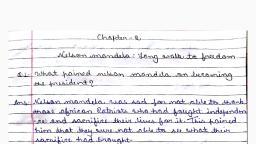
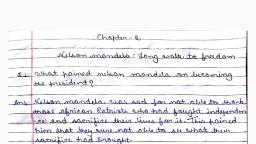
4. For decades South Africa had been the seat for white supremacy., 5. The blacks were considered as outlaws., 6. Their victory over 'apartheid' was a common victory for justice,, peace and freedom., 7. Nelson Mandela was overwhelmed with a sense of history., 8. The society based on racial discrimination was the harshest and, most inhuman society in the world., 9. The decades of oppression and exploitation of the blacks produced, heroes like Tambo's, Sisulu and others in South Africa., 10. Mandela learned the meaning of courage from such brave, comrades who were ready to sacrifice their lives for the freedom of, their people., 11. Every man has twin responsibilities -responsibilities towards his, family and for his people and country., 12. If any black tried to live like a free human being, he was punished, and isolated from his family and community., 13. Mandela realised that not only he but his brothers and sisters were, deprived of freedom., 14. His desire for the freedom and dignity of his people made him a, rebel., 15. He realised that freedom is indivisible., Q.1 What pained Nelson Mandela on becoming the President of South, Africa?, Ans. Nelson Mandela was sad for not able to thank those African patriots, who had fought for independence and sacrificed their lives for it. This, pained him that they were not able to see what their sacrifices had brought., Q.2 When did Mandela's hunger for self-turn into a hunger for freedom for, all his people?, Ans. Mandela gradually realized that freedom was curtailed for those, people who looked like he did, but not for the whites. Consequently, he, joined the African National Congress, and that was when his “hunger for, freedom" became a "greater hunger."
Page 4 :
Q.3. Why is 10th May 1994 important for South Africa?, Ans. 10th May 1994 is important for South Africa because first democratic, non-racial government elections were held on this day in the country., Nelson Mandela became the first black president of the country., Q.4. What ideals does Mandela set out for the future of South Afric, speech?, Ans. The ideal Mandela set out for the future of South Africa in his speech, was to liberate the people of South Africa from continuing bondage of, poverty, deprivation, suffering, gender and other discriminations., in his, Q.5 What did Nelson Mandela pledge when he was sworn in as President?, Ans. Nelson Mandela pledged to uphold the Constitution of his country and, devote him to liberate his people from the bondage of poverty, deprivation,, suffering, gender and other discriminations. There would be freedom and, justice for all., Q.6 Why was the 10th of May, 1994 a red letter day in the history of South, Africa?, Ans. 10th of May, 1994 was a red-letter day in the history of South Africa. It, was the day when the hated regime of apartheid came to an end. A new, democratically elected non-racial government under Nelson Mandela was to, be sworn in. Many international leaders and dignities came to pay their, respect to the new government., RRE, Q.7 Where did the ceremonies take place? What had it been for decades?, Ans. The ceremonies of the inauguration of the new government took place, at the lovely sandstone amphitheatre in the Union Buildings in Pretoria. The, same place had remained the seat of white supremacy for decades., Q.8 Who were the persons sworn in on the 10th of May? What did Mandela, pledge to obey?
Page 5 :
Ans. Mr. de Klerk was first sworn in as second Deputy President. Then, Thabo Mbeki was sworn in as first Deputy President. Then, in the end, Mr, Nelson Mandela was sworn in as the President of the Republic of South, Africa. He pledged to obey and uphold the constitution and devote himself, to the well being of the Republic and its people., Q.9 What did the display of jets and military salute symbolise?, Ans. There was a spectacular show of South African jets and troop carriers, over the Union Buildings. The highest generals of the military and police, saluted President Mandela. It was a clear demonstration of the military's, loyalty to democracy, to a free and fairly elected government., Q.10 What did the playing of two national anthems symbolise?, Ans. On the historic day of the inauguration ceremony of the Republic of, South Africa, two national anthems were played. The whites song `Nkosi, Sikelel-i-Africa' and the black sang 'Die Stem', Neither group knew the lyrics, of the anthem they once despised. They would soon know the words by, heart., Q.11 How did the policy of apartheid create a deep and lasting wound in, South African blacks?, Ans. No doubt, the policy of apartheid created a deep and lasting wound in, South Africa and the blacks. It would take many years to recover from that, profound hurt. The racial discrimination unleashed a reign of terror,, oppression and brutality on the blacks of South Africa., Q.12 What are the twin obligations every man has in life?, Ans. Mandela thinks that every man has twin obligations in life. The first is, his obligation to his family, to his parents, to his wife and children. The, second duty is his duty to his people, his community and his country. Each, man has to fulfil these two obligations according to his position and, abilities., Q.13 What, according to Mandela, is 'true freedom'?, Ans. When Mandela was a boy, freedom for him meant to run freely in the, fields and to swim in the streams. As a young man, he wanted basic and



 Learn better on this topic