Page 1 :
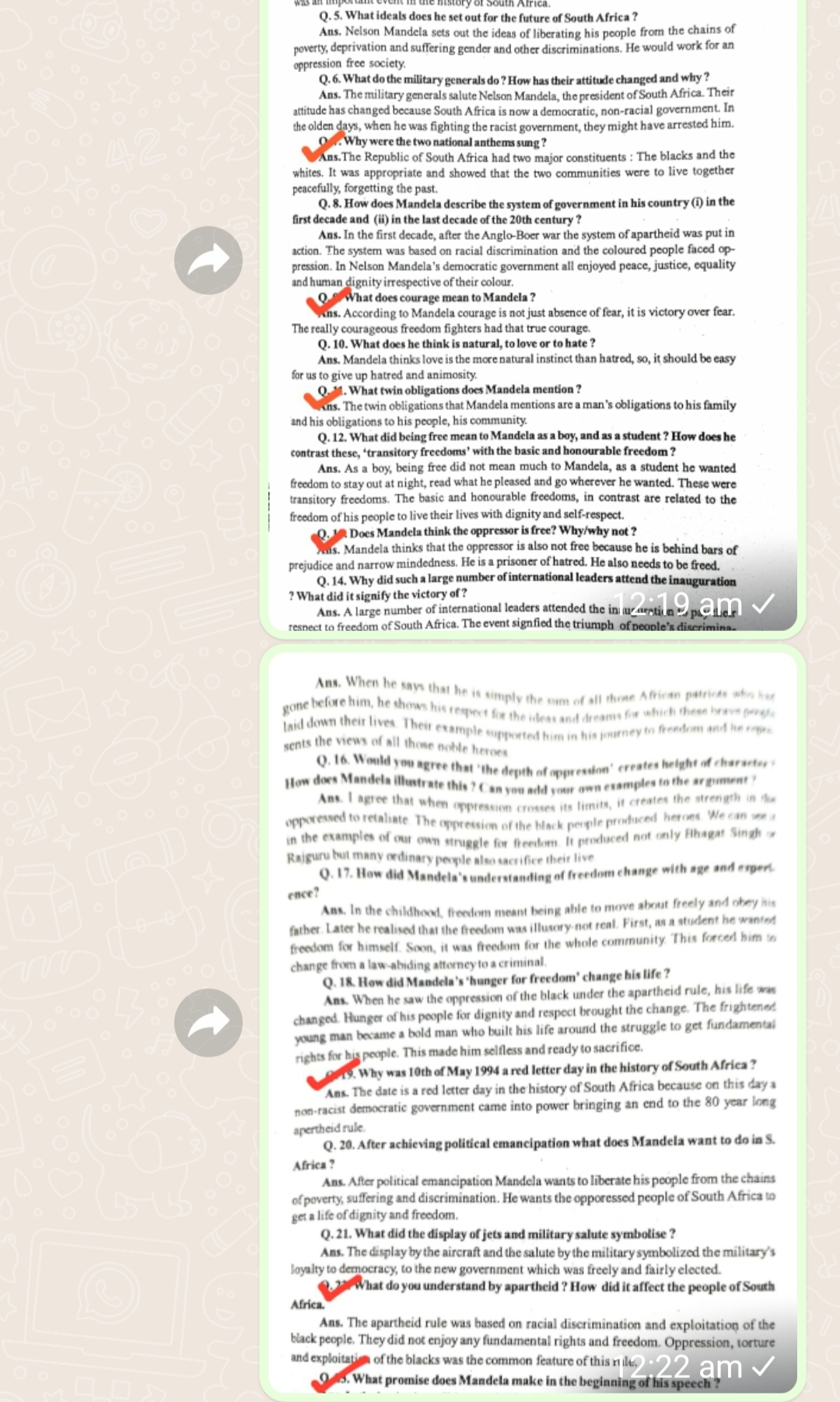
ee en SS SOs Cus boa, , Q.5, What ideals does he set out for the future of South Africa ?, , Ans. Nelson Mandela sets out the ideas of liberating his people from the chains of, poverty, deprivation and suffering gender and other discriminations. He would work for an, oppression free society,, , Q.6. What do the military generals do? How has their attitude changed and why ?, , Ans. The military generals salute Nelson Mandela, the president of South Africa. Their, attitude has changed because South Africa is now a democratic, non-racial government. In, the olden days, when he was fighting the racist government, they might have arrested him., , ‘were the two national anthems sung ?, , The Republic of South Africa had two major constituents : The blacks and the, whites. It was appropriate and showed that the two communities were to live together, peacefully, forgetting the past., , Q.8. How does Mandela describe the system of government in his country (i) in the, first decade and (ji) in the last decade of the 20th century ?, , ‘Ans. In the first decade, after the Anglo-Boer war the system of apartheid was put in, action. The system was based on racial discrimination and the coloured people faced oppression. In Nelson Mandela's democratic government all enjoyed peace, justice, equality, and human dignity irrespective of their colour,, , Zeer an, . According to Mandela courage is not just absence of fear, it is victory over fear., The really courageous freedom fighters had that true courage., , Q. 10. What does he think is natural, tolove or to hate ?, , ‘Ans, Mandela thinks love is the more natural instinct than hatred, $0, it should be easy, for us to give up hatred and animosity., , |. What twin obligations docs Mandela mention ?, ‘The twin obligations that Mandela mentions are a man’s obligations to his family, and his obligations to his people, his community., , Q. 12. What did being free mean to Mandela as a boy, and as a student ? How does he, contrast these, ‘transitory freedoms’ with the basic and honourable freedom ?, , ‘Ans. As a boy, being free did not mean much to Mandela, as a student he wanted, freedom to stay out at night, read what he pleased and go wherever he wanted. These were, transitory freedoms. The basic and honourable freedoms, in contrast are related to the, freedom of his people to live their lives with dignity and self-respect., , Does Mandela think the oppressor is free? Why/why not ?, Mandela thinks that the oppressor is also not free because he is behind bars of, prejudice and narrow mindedness, He is a prisoner of hatred. He also needs to be freed., , Q. 14, Why did such a large number of international leaders attend the, 7 What did it signify the victory of ? 'e, , ‘Ans. A large number of international leaders attended the in,, resneet to freedom of South Africa. The event signfied the, , , , , , Ans. When We save ther he, , simpy ¢ shone Afrione poatricns wt, ve Heine Hit, We shor his ap IY the wen of all theme AMbOan, Indl down theit lives. Their examnts ten nd Arve yen ronda ood he cage, sents the VIEWS Of All theme notte 4 Are tecd toiene ven hie fen, , heroes, , Q. 16. Would you weree th, How does Mandela ithestrate hi, Ams. | agree that wher, , height of character, tothe ment, , creates the strength in the, , at "the deg af appwenshon’ ©, 16 7 Cm yoo ached yor crm, OPP resem cremses ite Henete,, appecested to retaliate The anpression af the Mack people preniuced heros, in the examples of our own etry ale for freedom. It produced net caly Ahagat Singh », Rajgurv bul MANY cedinary people alan anceifice their live, , Q. 17. How did Mandeta's understanding of freedom «, , , , , , , , We cone sam, , ange with age and expert, , ence?, Ams. In the childhowst, freeviom meant being able to mave abaut freely and obey his, father Later he realised that the freedom was illusary:not real. First, a8 atudent he wanted, freedom for himself. Soon, it was fteedwn for the whole community, This forced bem to, from a law-abiding attorney to a criminal,, ~r 18 How did Mondale hunger for freedom’ change his life?, ‘Ans. When he saw the oppression of the black under the apartheid rule, n life wae, changed. Hunger of his people for dignity and respect brought the change The frightened, young man became a bold man who built his life arousrd the struggle to get fundamental, , fless and ready to sacrifice,, rights for hig people. This made him sel, att in wa hy 194 are eter ayn the ior of South Arie, , fans. The date is a red letter day in the history of South Africa because on this day, non-racist democratic government came into power bringing an end to the 80 year long, aperthe:d rule, , Q. 20, After achieving political emancipation what does Mandela want to do ia S., Africa?, , Ans. After political emancipation Mandela wants to liberate his people from the chains, of poverty, suffering and discrimination. He wants the opporessed people of South Africa to, get life of dignity and freedom., , Q.21. What did the display of jets and military salute symbolise ?, , Ans. The display by the aircraft and the salute by the military symbolized the military's, loyalty to democracy, (o the new government which was freely and fairly elected., , do you understand by apartheid ? Haw did it affect the people of South, , , , , , Africa,, , ‘Ans. The apartheid rule was based on racial discrimination and exploitation of the, black people, They did not enjoy any fundamental rights and freedom., and exploit of the blacks was the common feature of this in ily, , GA et prone ns Monta aa ate