Notes of 10, English & English Making Of A Scientist.pdf - Study Material
Page 1 :
The Making of a Scientist Extra Questions and Answers Short Answer Type, Question 1., Why did viceroy butterflies copy monarchs?, Answer:, Viceroy butterflies copied monarchs because monarchs do not taste good to birds., Viceroy butterflies on the other hand taste good to birds. So, the more they look similar, to monarchs, the less likely they are to become a bird’s prey. Thus they protect, themselves., Question 2., Why did Richard Ebright give up tagging butterflies?, Answer:, Richard Ebright lost interest in tagging butterflies as it was tedious and there was not, much feedback. He could recapture only two butterflies in all the time he did it and they, were not more than seventy five miles away from where he lived., Question 3., What are the ingredients in the making of a scientist?, Answer:, The author gave examples from Richard Ebright’s life to show the ingredients to make a, scientist. Start with a first rate mind, add curiosity, and mix in the will to win for the right, reasons., Question 4., What was the common belief about the twelve tiny gold spots on a monarch pupa?, What is the actual purpose of these tiny gold spots?, Answer:, These twelve tiny gold spots were believed to be ornamental only. The actual purpose, of these tiny gold spots is to produce a hormone necessary for the butterfly’s full, development., Question 5., “But there was one thing I could do-collect things”. What collection did Ebright make?, When did he start making collection?, Answer:, Ebright began collecting butterflies, rocks, fossils and coins. He began as early as when, he was in kindergarten. He collected with same determination that had marked all his, activities., Question 6., What other interests besides science did Richard Ebright pursue?, Answer:
Page 2 :
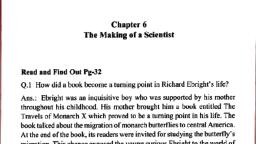
Richard Ebright was a champion debater and public speaker. He was a good canoeist, and all-around outdoor person. He was also an expert photographer, particularly of, natural and scientific exhibits., Question 7., How did Richard Ebright’s mother help him to become a scientist?, Answer:, Ebright’s mother was his only companion. She used to encourage the child to learn, whatever he wanted to learn. She took him on trips, brought him telescopes,, microscopes, cameras, mounting materials and other such equipments., Question 8., Which book did Ebright mother get for him? How did it change his life?, Answer:, Ebright’s mother got a children’s book called The Travel of Monarch X’ for him. The, book invited readers to help study butterfly migrations and actively participate in, tagging butterflies to help in the research being conducted by Dr Frederick A. Urquhart., Ebright then went on to raise an entire flock of butterflies in the basement of his home., In this way the book managed to keep his enthusiasm in the study of butterflies alive for, several years and opened the world of science to the young collector who never lost his, scientific curiosity. ,, Question 9., Why did Richard Ebright raise a flock of butterflies?, Answer:, At the end of the book, “The travels of Monarch X’, readers were invited to help study, butterfly migrations. They were asked to tag butterflies for research by Dr Frederick A., Urquhart. The butterfly collecting season around reading lasts six weeks in late, summery. If Ebright went to chase them one by one, he could not catch very many. So, he decided to raise a flock of butterflies., Question 10., Mention any two Ebright contributions to the world of science., Answer:, Ebright made valuable contributions to the world of science. He discovered an unknown, insect hormone and also determined how the cell could read the blueprint of its DNA., Question 11., What lesson did Ebright learn when he did not win anything at the science fair?, Answer:, When Ebright did not win anything at the science fair, he learnt a lesson that he needed, to do real experiments, not simply make a neat display. His entry was slides of frog, tissues which he showed under a microscope.
Page 3 :
Question 12., What lesson does Ebright learn when he does not win anything at a science fair?, Answer:, Ebright realizes that were display of his collection does not mean science. To win at a, science fair he will have to do real experiments and prove his worth., Question 13., What experiments and projects does he then undertake?, Answer:, He then undertakes the projects and experiments to find out what actually causes the, viral disease that kills nearly all Monarch caterpillars. He then works on a project to test, the theory that viceroy butterflies copy monarchs to survive., Question 14., What are the qualities that go into the making of a scientist?, Answer:, The author mentions three qualities that go into the making of a scientist—a first-rate, mind, curiosity, and the will to win for the right reasons. Richard Ebright was a very, intelligent student. He was also a champion debater, a public speaker, a good canoeist, and an expert photographer. He always tried to put that extra effort in his work. He was, competitive, but for the right reasons. From the very beginning, he had a driving, curiosity along with a bright mind; and it was this curiosity that ultimately led him to his, theory about cell life., The Making of a Scientist Extra Questions and Answers Long Answer Type, Question 1., Although Richard does not win anything at the science fair but it was a stepping stone, for his success. With reference to the story ‘The Making of a Scientist’ of the above, statement, give your comments whether competitions are for winning sake or to give, your best at work., Answer:, It is true, no one can deny the fact that every person wants to be a winner. Each has, basic wish to reach ‘ at the top. For that many competitions are organised at various, levels. But still we must accept that all cannot be winners. Participation is more, important than winning. The participant should work hard to reach their level best., Failures should not make us disheartened and best way to overcome failure is to learn, through our mistakes. We cannot deny that experimentation and learning are stepping, stones to our success. So we should try to give our best., Question 2., Besides curiosity a number of other values are required to become a successful, scientist. Explain with reference to the chapter, ‘The Making of a Scientist’.
Page 4 :
Answer:, From very young age Richard Ebright was competitive and put in extra effort with, curiosity for the right reason to win. But his mother was always very dedicated and, made his spirits rise high. He did not lose heart even after losing when he was in, seventh grade. To him people around were very encouraging., His mother’s encouragement was really an eye-opener. She took him on trips, bought, him telescopes, microscopes, cameras, mounting materials and other equipment. Thus, constant support of each other opened a new world. This helps us to conclude that hard, work, parental guidance and keen observation are the qualities which help one to excel., Question 3., Ebright’s mother played a pivotal role in enabling him to become a successful scientist., This is true for most of our lives. Our parents help us a lot in our education. Their, guidance is very important in what we become in later life. Based on your reading of the, story how did Ebright’s mother help him in becoming a scientist?, Answer:, Parents play a pivotal role in determining not just our behaviour but also our future in, most cases. They are the ones who teach us wrong from right. For most of us, parents, are our role models. Ebright’s mother supported her son in becoming a scientist. She, gave him an intensive training. She took him on trips, bought him telescopes,, microscopes, cameras, mounting materials and other equipments., She used to keep her son busy. If she found him sitting idle, she would find work for, him-not physical work, but learning things. His mother was very supportive. She wrote, to Dr Urquhart also so that her son could be busy in research activity. She helped her, son a lot. She inspired him to explore new things and instilled a sense of discovery into, her child., SHINING STAR CLASSES BY KAMLESH SIR



 Learn better on this topic