Notes of Class 10 Matric, English & English Life Henry Van Dyke.pdf - Study Material
Page 1 :
LIFE, By Henry Van Dyke
Page 2 :
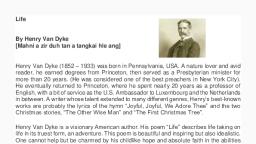
Meet the poet, , • Henry van Dyke (1852 - 1933) was born in, Pennsylvania., • A nature lover and avid reader, he earned, degrees from Princeton then served as a, Presbyterian minister for more than 20, years., • He eventually returned to Princeton,, where he spent nearly 20 years as a, professor of English., • He had also served as U.S. ambassador, to Luxembourg and the Netherlands in, between.
Page 3 :
MEET THE POET, , • He was a writer whose, talent extended to many, different genres., • Henry's best known works, are probably the lyrics of, the hymn "Joyful, Joyful,, We Adore Thee" and the, Christmas stories, "The, Story of the Other Wise, Man" and "The First, Christmas Tree."
Page 4 :
POETIC STYLE, , • Henry van Dyke’s poetic style is based on, intellectual brevity, strong atmosphere, and, symbolic and figurative language., • Most of his themes are related to nature, love of, the outdoors, Christianity, and God., • He was a great conversationalist, but mostly he, is remembered for his erudite writing.
Page 5 :
LIFE - A SONNET, •, •, •, •, , A sonnet is a poem with 14 lines., The poem ‘Life’ is written in the form of Italian sonnet., It is separated into an eight line stanza and a six line stanza., The first stanza (with eight lines) is called an octave and follows, rhyme pattern- abbaabba., • The second stanza (with six lines) is called a sestet and follows, one of the given rhyme patterns- cdcdcd, cdecde, cdeced, cdcedc,, cddcdc.
Page 6 :
Let me but live my life from year to year,, With forward face and unreluctant soul;, Not hurrying to, nor turning from the goal;, Not mourning for the things that disappear, In the dim past, nor holding back in fear, From what the future veils; but with a whole, And happy heart, that pays its toll, To Youth and Age, and travels on with cheer.
Page 7 :
So let the way wind up the hill or down,, O'er rough or smooth, the journey will be joy:, Still seeking what I sought when but a boy,, New friendship, high adventure, and a crown,, My heart will keep the courage of the quest,, And hope the road's last turn will be the best.
Page 8 :
Poetic Devices, Let me but live my life from year to year,, With forward face and unreluctant soul;, Not hurrying to, nor turning from the goal;, Not mourning for the things that disappear, Alliteration, It is a figure of speech in which words that start with the same, sound is repeated in the same line., Line 1: let, live, life, Line 2: forward face, Line 4: things that
Page 9 :
Couplet, A pair of successive lines of verse, typically rhyming and of the, same length. Lines 2 & 3 serve as a couplet., Consonance, Consonant sounds being repeated in closely connected words in, the same line. In line 3, /t/ sound is repeated in the words not, to,, turning, , Anaphora, Two or more consecutive lines starting with the same word or, phrase. Here lines 3 & 4 start with the word ‘Not’.
Page 10 :
Epithet, an adjective or phrase expressing a quality or attribute regarded as, characteristic of the person or thing mentioned., In the given lines “forward face” and “unreluctant soul” acts as, epithets., , Metaphor, A metaphor is a figure of speech that, for rhetorical effect, directly, refers to one thing by mentioning another. It may provide clarity, or identify hidden similarities between two different ideas., Here the phrase “forward face” relates to having an open and, transparent outlook.
Page 11 :
Not mourning for the things that disappear, In the dim past, nor holding back in fear, From what the future veils; but with a whole, And happy heart, that pays its toll, To Youth and Age, and travels on with cheer., Enjambment, In verse, the continuation of a sentence without a pause beyond the, end of a line, couplet or stanza., , Epithet, Line 5: Dim past, Line 7: Happy heart
Page 12 :
Metaphor, A figure of speech in which a word or phrase is applied to an object, or action to which it is not literally applicable., Here, toll serves as a metaphor for the responsibilities or the, challenges that is to be faced at each stage of life., Alliteration, Line 6: from, future, Line 7: happy heart, Couplet, Lines 4 & 5
Page 13 :
Personification, The attribution of a personal nature or human characteristics to, something non-human, or the representation of an abstract quality, in human form., The term “future veils” indicates that something is kept hidden by, the future., Antithesis, Antithesis is used in writing or speech either as a proposition that, contrasts with or reverses some previously mentioned proposition,, or when two opposites are introduced together for contrasting, effect., The terms “Youth and Age” gives a contrasting effect to the stages, of life.
Page 14 :
Antithesis, , Oxymoron is a figure of speech, pairing two words together that, are opposing and/or, contradictory. As a literary, device, oxymoron has the effect, of creating an impression,, enhancing a concept, and even, entertaining the reader., Examples: only choice, same, difference etc., , Oxymoron, , Antithesis, which literally, means “opposite,” is a, rhetorical device in which two, opposite ideas are put, together in a sentence to, achieve a contrasting effect., Example: “It was the best of, times, it was the worst of, times, it was the age, of wisdom, it was the age, of foolishness, …”
Page 15 :
Stanza 1, OCTAVE:, stanza with 8 lines, RHYME SCHEME:, abba abba, RHYMING WORDS:, Year, disappear, fear, cheer, Soul, goal, whole, toll
Page 16 :
So let the way wind up the hill or down,, O'er rough or smooth, the journey will be joy:, Still seeking what I sought when but a boy,, Personification, Line 1: Way is personified by giving it the quality of decision, making., , Antithesis, Line 2: rough or smooth
Page 17 :
Metaphor, Line 1: The word way here represents life and the line itself talks, about ups and downs in the life., , Alliteration, , Line 1: way wind, Line 2: journey, joy, Line 3: still, seeking, sought;, what, when, but, boy
Page 18 :
New friendship, high adventure, and a crown,, My heart will keep the courage of the quest,, And hope the road's last turn will be the best., Epithet, Epithet is a descriptive literary device that describes a place, a, thing, or a person in such a way that it helps in making its, characteristics more prominent than they actually are. Also, it is, known as a “by-name,” or “descriptive title.”, Line 4: new friendship & high adventure, Metaphor, Line 3: “road’s last turn” refers to the last stage of life.
Page 19 :
Symbolism, Symbolism is the use of symbols to signify ideas and qualities, by, giving them symbolic meanings that are different from their literal, sense., Line 4: Here, crown is used as a symbol for success or achievement., The crown traditionally represents power, legitimacy, victory,, triumph, honour, and glory, as well as immortality, righteousness,, and resurrection, , Consonance, Line 6: last, turn, best, /t/ sound is repeated.
Page 20 :
Stanza 2, SESTET:, Stanza with 6 lines, , RHYME SCHEME:, cdd cee, RHYMING WORDS:, Down, crown, Joy, boy, Quest, best



 Learn better on this topic