Page 1 :
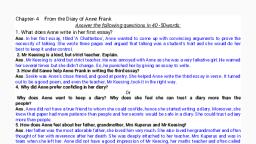
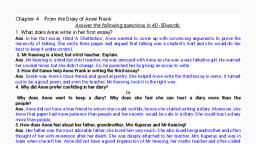
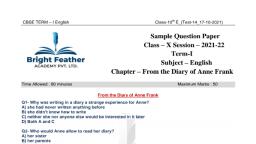
(First Flight)(Chapter- 4) (From the Diary of Anne Frank), (Class - 10), Oral Comprehension Check - I, Question:, 1. What makes writing in a diary a strange experience for Anne Frank?, 2. Why does Anne want to keep a diary?, 3. Why did Anne think she could confide more in her diary than in people?, . Answer:, 1. She mentioned that writing a diary is a strange experience for her because firstly she had never, written anything like this before and secondly she thought that nobody is going to read or would be, interested in her diary., 2. The 13-year-old girl was all alone in this world. She didn't have friend. Therefore she wanted to, keep a diary unless she would have founda real friend., 3. Anne did not have any friends. She could confide in her close friend but she didn't have one, the, friends she had there were to have more fun and good times rather than the ones on whom she, could confide. She believed that a paper has more patience than people, so she decided to write and, confide in a diary., Oral Comprehension Check – II, Question:, 1. Why does Anne provide a brief sketch of her life?, 2. What, lls you that Anne loved her grandmother?, Eu Answer:, 1. Anne thought that no one would understand a word of her stories if she was to plunge right in,, therefore she provides a brief sketch of her own life., 2. While giving brief sketch of her life she made a statement that no one knows how often she still, misses her grandmother and still loves her grandma. One more touching gesture where they light, up one candle for grandmother during Anne's birthday is also a poignant reminder of her love for, grandma., Oral Comprehension Check - III, Question:, 1. Why was Mr Keesing annoyed with Anne? What did he ask her to do?, 2. How did Anne justify her being a chatterbox in her essay?, 3. Do you think Mr Keesing was a strict teacher?, 4. What made Mr Keesing allow Anne to talk in class?, Answer:, 1. Mr. Keesing was an old fogey who taught Anne at school. He was annoyed with Anne because she, talked so much in the class. After several warnings he assigned her extra homework, asking her to, write an essay on the subject, 'A Chatterbox'., 2. At first she was confused from where to start. She began thinking and wrote. Anne though that, she would come up with convincing arguments prove that talking is a necessity. She justified her, argument by writing two things, one that chatting in student's traits and other reason that nothing, can be done about someone's inherited traits., 1
Page 2 :
(First Flight)(Chapter- 4) (From the Diary of Anne Frank), (Class - 10), 3. Mr. Keesing was a strict teacher. He was a disciplined man and liked the same in his class while, he was teaching. Anne was a talkative child. He punished Anne and asked her to write an essay on, the topic 'A Chatterbox'. Anne wrote convincing arguments in her essay. He had a good laugh at her, arguments. However, Anne continued with her talking. Mr. Keesing punished her again by asking, her to write another essay. This time the topic was 'An Incorrigible Chatterbox'. Anne kept talking, even after all of this. Mr. Keesing had enough and asked her to write on the topic 'Quack Quack, Quack, said Mistress Chatterbox". He was trying to play a joke on her. She came up with a brilliant, poem with help of her friend Sanne. He read this poem in the class, acknowledging its content., Therefore, after taking all these events into considerations we can say that Mr. Keesing was not, entirely a strict teacher. He was fun-loving too., 4. Anne was smart kid. She was able to give convincing arguments for her talkative nature every, time she was punished. On all the three occasions he gave her topics to write essays on. In return, Anne came up with something impressive. Eventually, Mr. Keesing accepted the fact that Anne, would always be the way she is. Hence, he allowed her to talk in class., Thinking about the Text, Question:, 1. Was Anne right when she said that the world would not be interested in the musings of a thirteen-, year-old girl?, 2. There are some examples of diary or journal entries in the 'Before You Read' section. Compare, these with what Anne writes in her diary. What language was the diary originally written in? In, what way is Anne's diary different?, 3. Why does Anne need to give a brief sketch about her family? Does she treat 'Kitty' as an insider, or an outsider?, 4. How does Anne feel about her father, her grandmother, Mrs Kuperus and Mr Keesing? What do, these tell you about her?, 5. What does Anne write in her first essay?, 6. Anne says teachers are most unpredictable. Is Mr Keesing unpredictable? How?, 7. What do these statements tell you about Anne Frank as a person?, (i) We don't seem to be able to get any closer, and that's the problem. Maybe it's, my, fault that, we don't confide in each other., (ii) I don't want to jot down the facts in this diary the way most people would, but I want the, diary to be my friend., (iii) Margot went to Holland in December, and I followed in February, when I was plunked, down on the table as a birthday present for Margot., (iv) If you ask me, there are so many dummies that about a quarter of the class should be, kept back, but teachers are the most unpredictable creatures on earth., (v) Anyone could ramble on and leave big spaces between the words, but the trick was to, come up with convincing arguments to prove the necessity of talking., - Answer:, 1. No, Anne was not right when she said that the world would not be interested in the musings of a, thirteen-year-old girl., 2
Page 3 :
(First Flight)(Chapter- 4) (From the Diary of Anne Frank), (Class - 10), 2. Originally Anne's diary was written in Dutch. Her diary was different from the others in many, aspects. She had named her diary 'Kitty'. She took it as her only true friend whom she could confide, in. Anne treated it as another person who listened to her daily accounts. She wrote all her thoughts, in it. She started by writing 'Dearest kitty' and ended the account by writing, Yours, Anne'. Her diary, was a lot more personal than other diaries., 3. Anne Frank was 13 years old. She had no friends. Anne said that paper is more patient than, people. She was all alone as she had no real friend. Anne Frank gives the sketch of her adorable, father, compassionate mother, kind grandmother, and loving sister no clears the reader's, perception that there is nobody to take care of Anne Frank. She had named her diary Kitty. She, treated it as an insider because she called it her best friend and was ready to confide in it., 4. Anne said that she had the most adorable father ever seen. She loved her grandmother so much, that she remembered her even after her death. She wrote in her diary that no one knew how often, she thought of her grandmother and still loved her. Mrs Kuperus was her teacher in the sixth form, at the Montessori nursery school. She was also the headmistress. At the end of the year, they were, both in tears as they had a heart-breaking farewell., Mr Keesing was her Maths teacher. Anne used to talk too much which annoyed Mr. Keesing. Every, time she was punished by Mr. Keesing Anne was able to justify her talkative nature by giving, convincing arguments. He was impressed by the manner in which she presented her arguments., All these events indicate how lovable and smart Anne was. Everybody was attached to her, and even, Mr Keesing could not help but laugh at her essays and acknowledge her sharp mind., 5. Anne was given to write essay as her a part of her punishment not once, not twice but three times, by her maths teacher Mr. Keesing. The topic for first essay was 'A Chatterbox'. Anne wanted came, up with convincing arguments to prove the necessity of talking. She gave arguments that talking, was a student's trait and that she would do her best to keep it under control. She further wrote that, she would never be able to cure herself of the habit since her mother talked as much as she did and, it was an inherent trait. There was not much that one could do about inherited traits. Mr Keesing, too had a good laugh reading her arguments., 6. When it was time for the results all the students were making assumptions that who would, and who out be asked to stay back. Anne felt that a quarter of her class was dumb, and should be, kept back and not promoted to the next class. However, she also felt that the teachers were the most, pass, unpredictable creatures on earth. Same can be said for Mr. Keesing. Any teacher would lose temper, the way Anne always talked while the class was going on. After several warnings, Mr. Keesing did, gave Anne extra homework. She had to write an essay on 'A Chatterbox'. In this way, he tried to play, a joke on her. He had a good laugh when she gave her arguments in the essay., Each and every time that she was asked to write such essays, she wrote very well. She kept, countering his jokes. He took all the jokes in the right spirit. Eventually he accepted her talkative, nature and actually allowed her to talk in class. He did not even assign her any more extra, homework. That is why it can be said that Mr Keesing was unpredictable., 7. (i) These lines show that Anne had no real friend whom she could confide in. She even put the, blame on herself that the fault might be hers because she does not let others come close to her., 3
Page 4 :
(First Flight)(Chapter- 4) (From the Diary of Anne Frank), (Class - 10), (ii) This line shows that Anne really considered her diary 'Kitty' as a real friend whom she could, confide in and narrate all her stories to., (iii) Anne uses the phrase 'plunked down' shows her sense of humour. She was a fun-loving person,, witty and knew how to present things in a funny way. She narrated this incident with a lot of fun., (iv) When it was time for results she had an opinion on everyone. She thought that a quarter of her, class was full of dumb students, which tells that she herself was intelligent enough to make it to the, next class. She thought that teachers were the most unpredictable creatures on earth because, nobody could say which students they would fail and which students would be passed on to the, next class., (v) This statement shows that Anne knew a lot about writing. She took the task of writing an essay, as a punishment. She did not want to write it like others who merely left big spaces between the, words to make the essay look voluminous. She knew that the trick was to come up with a convincing, argument to prove the necessity of talking. She was different in her approach from everybody else., Thinking about Language, Question I:, Look at the following words., long-awaited, stiff-backed, headmistress, homework, notebook, outbursts, These words are compound words. They are made up of two or more words., Compound words can be:, • nouns: headmistress,, adjectives: long-awaited, stiff-backed, • verbs: sleep-walk, baby-sit, Match the compound words under 'A' with their meanings under 'B'. Use each in a sentence., rk, notebook,, bursts, А, B, - obeying and respecting the law, - think about pleasant things, forgetting about the present, - something produced by a person, machine or organisation, - producing great sadness, - an occasion when vehicles/machines stop working, - an informal word which means a very stupid person, - missing home and family very much, - do something to an excessive degree, 1. Heartbreaking, 2. Homesick, 3. Blockhead, 4. Law-abiding, 5. Overdo, 6. Daydream, 7. Breakdown, 8. Output, Answer I:, A, B, - producing great sadness, - missing home and family very much, - an informal word which means a very stupid person, - obeying and respecting the law, - do something to an excessive degree, - think about pleasant things, forgetting about the present, - an occasion when vehicles/machines stop working, - something produced by a person, machine or organisation, 1. Heartbreaking, 2. Homesick, 3. Blockhead, 4. Law-abiding, 5. Overdo, 6. Daydream, 7. Breakdown, 8. Output, 4
Page 5 :
(First Flight)(Chapter 4) (From the Diary of Anne Frank), (Class - 10), Question II:, Phrasal Verbs, A phrasal verb is a verb followed by a preposition or an adverb. Its meaning is often different from, the meanings of its parts. Compare the meanings of the verbs get on and run away in (a) and (b), below. You can easily guess their meanings in (a) but in (b) they have special meanings., (a), • She got on at Agra when the bus stopped for breakfast., • Dev Anand ran away from home when he was a teenager., (b), • She's eager to get on in life. (succeed), • The visitors ran away with the match. (won easily), Some phrasal verbs have three parts: a verb followed by an adverb and a preposition., (c) Our car ran out of petrol just outside the city limits., (d) The government wants to reach out to the people with this new campaign., 1. The text you've just read has a number of phrasal verbs commonly used in English. Look up the, following in a dictionary for their meanings (under the entry for the italicised word)., (iii) ramble on, (i) plunge (right) in, (ii) kept back, (iv) get along with, 2. Now find the sentences in the lesson that have the phrasal verbs given below. Match them with, their meanings. (You have already found out the meanings of some of them.) Are their meanings, the same as that of their parts? (Note that two parts of a phrasal verb may occur separated in the, text.), (i) plunge in, (ii) kept back, (iii) move up, - speak or write without focus, stay indoors, - make (them) remain quiet, - have a good relationship with, - give an assignment (homework) to a person in, authority (the teacher), (iv) ramble on, (v) get along with, (vi) calm down, - compensate, - go straight to the topic, - go to the next grade, not promoted, (vii) stay in, (viii) make up for, (ix) hand in, Answer II:, (i) plunge in, (ii) kept back, (iii) move up, - go straight to the topic, - not promoted, - go to the next grade, - speak or write without focus, (iv) ramble on, (v) get along with, (vi) calm down, (vii) stay in, (viii) make up for, compensate, make (them) remain quiet, - stay indoors, - have a good relationship with, - give an assignment (homework) to a person in, authority (the teacher), (ix) hand in