Notes of Class 10th, English fire and ice.pdf - Study Material
Page 1 :
Dust of Snow, , BY ROBERT FROST, , The way a crow, Shook down on me, , The dust of snow, From a hemlock tree, Has given my heart, , Dust of snow: fine particles of snow., Watching the fall of dust of snow is very, enjoying in the high altitudes., Hemlock Tree: a poisonous tree with small, white flowers., Hemlock is a poisonous tree found in mountain, areas, , A change of mood, And saved some part, Of a day I had rued., , About the Poet, Robert Frost was a famous American poet. He was born in San, Francisco on March 26, 1874. His father belonged to New England, and his, mother was a Scottish emigrant from Edinburgh. By 1920s, Frost was the, most celebrated poet in America. His poetical works’ A Boy’s Will’ (1913),, ‘North of Boston’ (1914), New Hampshire’ (1923), ‘A Further Range’, (1936) ‘Steeple Bush’ (1947) and ‘In the Clearing’ (1962) increased his, fame and honour. The poem ‘Dust of Snow’ was published in ‘New, Hampshire’ in 1923. This collection gave him the Pulitzer Prize.
Page 2 :
Introduction of the lesson- Dust of Snow, INTRODUCTION, Robert Frost, a well known American poet of nature, in this poem, he, presents a moment that seems simple but has a larger significance. It is a, highly symbolic poem. One day the poet was in a depressed mood. A, pleasant thing happened under a tree. It changed the poet’s mood. It saved, the rest of the day for the poet., key points, , , , , , The poem describes a very simple happening in very simple words., It tells us that sometimes even a small incident may prove to be of a, larger significance., The poet is upset in the beginning of the poem but a small incident of, falling of snow changes his mood totally., In the end of the poem the poet feels relaxed and thankful to the, nature for saving his day from being wasted., , EXPLANATION OF THE POEM, Stanza 1, The way a crow, Shook down on me, The dust of snow, From a hemlock tree, WORD MEANINGS, dust of snow – particles of snow, hemlock tree – a poisonous plant (tree) with small white flowers, Exp – The poet, Robert Frost, recounts a small incident that changes his, mood. It seems very ‘ simple but it has great significance. The poet was, once very depressed and hopeless. He was in a state of sorrow and was, lost in his thoughts. He was standing under the hemlock tree. Suddenly a, crow, that was sitting on the tree, shook the tree and the fine particles of, snow from the tree fell on the poet.
Page 3 :
Stanza 2, Has given my heart, A change of mood, And saved some part, Of a day I had rued., WORD MEANINGS, mood – a state of mind, rued – held in regret, Exp – When the soft and cold snow fell on the poet it changed his mood, from sad to happy. He started feeling soothed and refreshed. This simple, incident helped him enjoy the remaining part of the day. He, thus, became, happy as it saved his rest of the day from being wasted and held in regret., Poetic Devices Used in the Poem, , , , Rhyme scheme – abab, Symbolism – Hemlock tree, Crow, , Poetic Devices, 1. Literary devices used in Dust of Snow by Robert Frost, Alliteration:, Alliteration is the repetition of same consonant sound in the nearby words, Alliteration spoted in the "Dust of Snow", Has given my heart, And saved some part, Alliterative words: Has, Heart; Saved Some
Page 4 :
Central Idea of the Poem, ‘Dust of Snow’ is a small poem written by the famous American poet,, Robert Frost. The poem is set on a wintry day. In the first stanza, the poet, describes a simple natural happening. The snow is falling heavily. The, snowy flakes have covered the top of the trees. The poet is standing under, a hemlock tree. The movement and alighting of a crow on that tree, make, the dust of snowfall on the poet., The crow, a symbol of ill omen and the hemlock tree, associated with a, person, is not auspicious things. However, in the second stanza, the falling, of snowflakes and the scene leave a tremendous effect on the mental state, and mood of the poet. So far, the day has been quite gloomy and wastage, for him. But this ordinary natural happening suddenly brings the desired, change in his mood. It gladdens his heart. He realises that the falling of, snowflakes on him has saved the day. Now he has no regret as the whole, of the day has not gone waste. The moments of the snowfall and their, effect have saved the day. They have brought a change in his mood and, delighted and uplifted his spirits., , DETAILED SUMMARY, Dust of Snow’ is an awful poem of nature by Robert Frosty In this poem a, symbolic incident is present The poet is standing under a hemlock tree. He, is in a sad mood. He thinks that his day has been lost then a crow shakes, the hemlock tree-and the dust of snow falls on him. This little incident, brings about a sudden change in the state of the poet’s mind. His mood, has ‘changed. He thinks that it has saved the rest of his day and gets busy, with his work like the crow., 1.Flakes of Snow:, It was a day of winter. It was snowing all around. A fine dust of snow had, covered the tops of the trees. A hemlock tree was standing there. The top, of the hemlock tree was all covered with the fine dust of snow. The poet, was standing under that hemlock tree.
Page 5 :
2. Sudden Arrival of a Crow, Falling of Snow Dust on Poet:, A crow from nowhere came and perched on the top of the tree. The, sudden movement of the crow made the dust of snow fall down. The flakes, of snow fell on the poet who was standing under that tree., 3. Simple Natural Happening:, The arrival of a crow and its sitting on the hemlock tree is just an ordinary, happening. There is nothing great about the incident. On the other hand,, the crow stands for an ill omen and the hemlock the tree is associated with, poison. But these seemingly simple things of nature leave a deep impact, on the mind and mood of the poet., 4. Change in the Mood:, This ordinary incident leaves a deep impact on the poet. So far it has been, a very dull and disappointing day for the poet. The day has not gone well, for him. But the falling of the flakes and dust of snow on him are welcome, signs for the poet. His mood changes for the better and his spirits are, uplifted. Now he realises that the whole day has not gone waste. Those, moments while he is enjoying the fall of snow dust on him are his happy, moments. They lift up his mood and gladden his heart. Now he realises that, at least some part of the day has been spent happily. In the end,, satisfaction replaces regret., Value Points of the Poem, , , , , , , , , , It is a winter’s day., The treetops were covered with masses of snowflakes., The poet was walking under one such snow covered tree., This tree was a hemlock tree, a conifer associated with poisonous, qualities., A crow alighted on the hemlock tree suddenly., The sudden movement of the crow, the mass of snowflakes started, falling down the tree., The snowflakes fell down upon the poet who was standing under the, tree., The mass of snowflakes was so light and find that it looked like the, dust of white snow.
Page 6 :
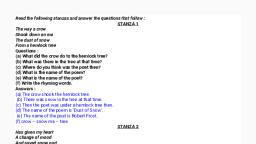
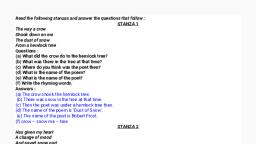
The sudden movement and arrival of the crow and the falling of the, flakes of snow look like just ordinary happenings., But the falling of fine snowflakes on the poet leaves a tremendous, effect on him., Before this, the poet was in a gloomy or despairing mood., However, this simple beautiful act of nature has a very comforting, effect on him., The fall of snow over him changes his mood and mental state.It, gladdens his heart., Before this incident, that particular day was not going too well for him., He had decided in his mind that day would go waste., However, the fall of snowflakes on him makes him realise that the, whole day has not been wasted., At least, this part of the day when he is enjoying the snowflakes has, been saved., At least, some part of the day has been pleasant., If he had not experienced such a pleasant experience, he would have, regretted at the wastage of the whole day., Following is the complete question bank for Dust of Snow1. COMPREHENSION OF STANZAS, Read the following stanzas and answer the questions that follow :, STANZA 1, The way a crow, Shook down on me, The dust of snow, From a hemlock tree, Questions :, (a) What did the crow do to the hemlock tree?, (b) What was there in the tree at that time?, (c) Where do you think was the poet then?, (d) What is the name of the poem?, (e) What is the name of the poet?, (f) Write the rhyming words., Answers :, (a) The crow shook the hemlock tree., (b) There was snow in the tree at that time., (c) Then the poet was under a hemlock tree then., (d) The name of the poem is ‘Dust of Snow’.
Page 7 :
(e) The name of the poet is Robert Frost., (f) crow – snow me – tree, STANZA 2, Has given my heart, A change of mood, And saved some part, Of a day I had rued., Questions :, (a) What had given the poet ‘a change of mood’?, (b) What had the poet thought of that day?, (c) How was some part of the day saved for the poet?, (d) Name the poem., (e) Name the poet., (f) What is the rhyme scheme of this stanza?, Answers:, (a) The falling of dust of snow on the poet had changed his mood, (b)He had felt sad about that day. But the fall of snow dust changed, his mood., (c) He stopped ruing the day and his mood changed., (d)Dust of Snow., (e) Robert Frost., (f) The rhyme scheme of this stanza is ‘abab’., , Thinking about the Poem, Question 1., What is a “dust of snow”? What does the poet say has changed his mood?, How has the poet’s mood changed?, Answer:, The ‘dust of snow’ means the fine particles or flakes of snow. The sudden, shower in the form of the dust of snow changed the poet’s mood. The, poet’s mood changed from sad to happy. He felt refreshed and wanted to, enjoy the rest of the day.
Page 8 :
Question 2., How does Frost present nature in this poem? The following questions may, help you to think of an answer., 1. What are the birds that are usually named in poems? Do you think, crow is often mentioned in poems? What images come to your mind, when you think of a crow?, 2. Again, what is ‘a hemlock tree’? Why doesn’t the poet write about, more ‘beautiful’ tree such as a maple, or an oak, or a pine?, 3. What do the ‘crow’ and ‘hemlock’ represent-joy or sorrow? What does, the dust of snow that the crow shakes off a hemlock tree stand for?, Answer:, Frost presents nature in a very different manner in the poem,, 1. Generally, poets take the birds and trees which are known for their, beauty and good qualities like peacock, parrot, cuckoo, mynah and, trees full of beautiful flowers and fruits, etc. But here Frost has taken a, totally different approach. He chose a crow, which is not often used in, poems. Crow is black in colour with very harsh voice and is believed to, be a symbol of bad omen. Thinking of a crow brings very depressing, and sorrowful pictures to our mind., 2. A hemlock tree is poisonous plant with small white flowers. The poet,, Robert Frost, didn’t choose to use an oak, maple or pine tree. Instead,, he chose the hemlock tree and left all the beautiful trees present in the, world. Actually he did so to present his mood and feelings., 3. The crow and hemlock tree represent sorrow and depression felt by, the poet in this materialistic world. The dust of snow is the symbol of, natural joy and energy. The dust of snow that the crow shakes off a, hemlock tree means passing through the sad and depressing, moments the pdet is entering into the time full of joy and optimism., , ***************************
Page 9 :
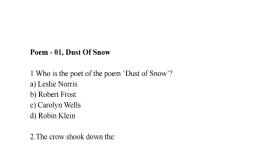
10th, , 10th, , Free, , Important Questions, , Science, , Science, , MCQ, , and Answer, , Lessons, , Mcq, , Test, Science, , Class, , Class, , 10th, , 10th, , Hindi, , Hindi, , Lessons, , Mcq, , Take, Free, MCQ, Test, Hindi, , Class, , Take, , Class 10 Social, , 10th, , Free, , Science Important, , SST, , MCQ, , Questions and, , Lessons, , Test SST, , Answers, , Class, 10th, Sanskrit, Lessons, , Q1- Who is the poet of the poem “Dust of Snow”?, A) Leslie Norris, B) Robert Frost, C) Carolyn Wells, D) Robin Klein, , Q2- Why does the poet call it “dust of snow”?
Page 10 :
A) snow particles were too tiny, B) they came over him like dust, C) they felt like dust, D) they looked like dust, , Q3- The poet says, “Of a day I had rued”. What is the meaning of, “rued”?, A) ruined, B) held in regret, C) ruled, D) conquered, , Q4- What uplifted his mood?, A) falling of snow on his shoulder, B) the crow, C) hemlock tree, D) all of the above, , Q5- What is the rhyme scheme of the poem?, A) baba cdcd, B) abab cdcd, C) abab cddc, D) abba cdcd, , Q6- Name the poetic device used in the line “Has given my heart”, A) alliteration, B) metaphor
Page 11 :
C) oxymoron, D) similie, , Q7- Name the poetic device used in the line “And saved some, part”, A) alliteration, B) metaphor, C) oxymoron, D) similie, , Q8- What does “Dust of Snow” represent?, A) healing power of nature, B) particles of snow, C) cool weather, D) none of the above, , Q9- What are the two negative creatures that Frost used as, carriers of positivity?, A) snow, dust, B) hemlock tree, snow, C) snow, crow, D) hemlock tree, crow, , Q10- The crow and Hemlock tree symbolize ____, A) sorrow, B) happiness
Page 12 :
C) celebration, D) death, , Important Videos Links, Class 10 History Lesson Video Explanation, Class 10 Civics Lesson Video Explanation, Class 10 Economics Lesson Video Explanation, Class 10 Geography Lesson Video Explanation, Class 10 SST Sample Question Papers, , ANSWER KEY, 1, , B, , 2, , A, , 3, , B, , 4, , A, , 5, , B, , 6, , A, , 7, , A, , 8, , A, , 9, , D, , 10, , A
Page 13 :
CLASS X, FIRE AND ICE, ABOUT THE POET, , WRITTEN BY :, ROBERT FROST, , Robert Frost was an American poet. He was the author of numerous poetry collections. He is known for, his realistic depictions of life., , INTRODUCTION, ‘Fire and Ice’ is a poem that tells about the end of world. The poem is revolving around the theme that, human emotions are destructive. Fire stands for passion and desire and ice stands for hatred. Both the, emotions are dangerous and may bring the world to an end., EXPLANATION, “Some say the world will end in fire, Some say in ice., From what I tasted of desire, I hold with those who favour fire”, DIFFICULT WORDS:, Desire – A strong feeling to have something., Favour – Approval, support, In these lines the poet discusses about the possibilities by which the world will come to an end. One, such possibility is the world ending in flames of fire. The poet compares the fire with human passion and, desire. He also says that he is quite familiar with this concept of desire., He also knows about the capability of desire which can be produced in human being. The poet frankly, confesses that he agrees with those who believe that the world will be burnt to ash. He brings about the, idea that human being let their emotions rule them and the consequence of unmonitored longing is, chaos., “But if it had to perish twice,, I think I know enough of hate
Page 14 :
To say that for destruction ice, Is also great, And would suffice, , DIFFICULT WORDS:, Perish – die, Suffice – be sufficient, In these lines the poet waves off the first option of fire and says that if the world has to expire twice, ice, would be equally competent in ending it. He brings about a contrast between ‘ice’ and ‘hatred’. He says, that hatred is also an emotion he is familiar with and that he knows what kind of danger can arise from, hatred. Though slow and steady , it has the same effect that desire has on us., So if given an option between fire and ice, ice would be just as destructive as fire to destroy the world., LITERARY DEVICE, 1. Alliteration – Repetition of a consonant sound at the start of two or more closely placed words., The Sound of ‘f’ in favour fire’,’w’ in world will, 2. Personification – Personification is to give human qualities to inanimate objects. In this poem,, ‘fire’ and ‘ice’ are capable of destructions. Thus the poet personifies fire and ice by giving them, mind and Power to destroy anything., 3. Enjambment – It is defined as the thought or clause that does not come to an end at a line, break, rather it moves over to the next line., Example – ‘From what I’ve tasted of desire, I hold with those who favour fire’, , SUMMARY, In this poem the poet tells us about the two possibilities by which the world will come to an end. Some, says that the world will end in fire. The poet says that he is in favour of those people who say that the, world will end in fire. This is because he has seen the effect and result of uncontrolled and unending, desires over the life of human beings. He finds that human evil desires are similar to the fire in its, nature. So this fire of desire may become someday a big reason for the destruction of the world. On the, other hand, the second belief in this regard says that ice is also equally efficient in the destruction of the, world. Here the poet compares the nature of ice with hatred and ignorance. As ice can make the body, numb with its prolonged contact, similarly the hatred can also give the numbness to our mind and, thoughts. Therefore it can make us insensitive and cruel. Such cruelty towards humanity can also bring
Page 15 :
the world to its end. The poet says that if the world will be given another chance for destruction than it, will surely due to ice like hatred. The poem is revolving around the theme that human emotions has the, power of destruction and it has two forms; fire of desire and ice of hatred., PREPARED BY:, SUMEETA SRIVASTVA, EAST SINGBHUM
Page 16 :
Science, , Science, , MCQ, , Lessons, , Mcq, , Test, , and Answer, , Science, Class, , Class, , 10th, , 10th, , Hindi, , Hindi, , Lessons, , Mcq, , Take, Free, MCQ, Test, Hindi, , Class, , Take, , Class 10 Social, , 10th, , Free, , Science Important, , SST, , MCQ, , Questions and, , Lessons, , Test SST, , Answers, , Class, 10th, Sanskrit, Lessons, , Q1- Who is the poet of the poem “Fire and Ice”?, A) Leslie Norris, B) Robert Frost, C) Carolyn Wells, D) Robin Klein, , Q2- What does the poet compare fire with?, A) hatred, B) desire
Page 17 :
C) hot, D) both 1 and 3, , Q3- What is the meaning of “perish”?, A) bloom, B) rise, C) die, D) glow, , Q4- What would suffice if the world were to perish twice?, A) ice, B) fire, C) hatred, D) both 1 and 2, , Q5- What would be a better option to end the earth?, A) fire, B) ice, C) both are equally competent, D) none, , Q6- What is the rhyming scheme of the poem?, A) abaa bcbcb, B) aaba bcbcb, C) aaab bcbcb, D) abab bcbcb
Page 18 :
Q7- Name the poetic device used in the line “I hold with those who, favour fire”., A) Assonance, B) Alliteration, C) None, D) Both, , Q8- Name the poetic device used in the line “Some say the world, will end in fire”., A) Metaphor, B) Imagery, C) Alliteration, D) Oxymoron, , Q9- Name the poetic device used in the line “To say that for, destruction ice is also great”., A) Metaphor, B) Imagery, C) Alliteration, D) Oxymoron, , Q10- Where has he used personification?, A) fire, B) ice, C) earth, D) both 1 and 2
Page 19 :
Important Videos Links, Class 10 History Lesson Video Explanation, Class 10 Civics Lesson Video Explanation, Class 10 Economics Lesson Video Explanation, Class 10 Geography Lesson Video Explanation, Class 10 SST Sample Question Papers, , ANSWER KEY, 1, , B, , 2, , B, , 3, , C, , 4, , D, , 5, , C, , 6, , A, , 7, , D, , 8, , B, , 9, , B, , 10, , D



 Learn better on this topic