Page 1 :
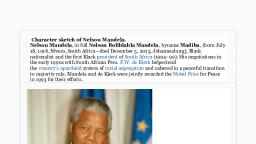
Invictus, A. 1. a) Ans: iii, b. When Mandela became the President, he had to walk a tightrope. He could see that the, majority black population who suffered injustice and persecution under the white minority rule, wanted to have better education, employment opportunities and economic prosperity. The, whites, on the other hand, were terrified that they would be singled out for punishment and, revenge. As the President of South Africa, Nelson Mandela had to ensure that every citizen of, the country received justice and equal opportunities and that they were not unfairly targeted., This is what is meant by ' balancing black aspirations with white fears'., c. Two of the most crucial problems of the country were crime and unemployment., 2. a. Here, 'that' refers to coming together of whites and blacks of South Africa for the purpose, of supporting the home team during the rugby World Cup in 1995., b. When the Springboks were playing a match in the World Cup rugby championship in 1995,, the white police officers were delighted to see their home team winning. They expressed their, joy by hoisting a young black boy on their shoulders., c. The word 'testimony' means the same as 'proof'., 3. a. The occasion being celebrated was South Africa's victory over New Zealand in the final of, the rugby World Cup championship in 1995., b. In the final, South Africa clashed with New Zealand which was a formidable team. The, Springboks were the underdogs while the Kiwis were the clear favourites. Since the home team, managed to beat the much-fancied New Zealanders, it was considered an impossible feat., c. The description 'myriad races' suggests the racial diversity of South Africa which is called a, rainbow nation., 4. a. The many faces of pride are a noble one, an obscene one, or a cruel one., b. As a leader of the freedom struggle, Nelson Mandela suffered terribly at the hands of the, white rulers. When he became the president of South Africa, he could have used his power to, punish his oppressors. But, he chose to forgive them and used the power of sports to unite the, country. This is an example that shows Mandela chose the noble face., c. Though Mandela underwent long spells of imprisonment and suffered oppression, he did not, give up hope or turn bitter and vindictive. This speaks volumes about his indomitable spirit,, courage, optimism and nobility of character., B. 1. After his release from prison, Mandela began working to bring about an end to apartheid., In this regard, he made sure that full democratic elections were held where the black majority, population could vote.
Page 2 :
2. Mandela was in the forefront of the struggle to end apartheid in South Africa. He mobilised, his countrymen and inspired them to fight against the ruling whites. He was imprisoned due to, his active involvement in the movement to end apartheid., 3. Mandela's security team consisted of both black and white officials who were hostile towards, each other. He noticed that though they were supposed to take care of his safety and security,, they were sharply divided along racial lines. The president was disturbed by this lack of, harmony in his security team., 4. The New Zealand rugby team had a formidable reputation. It was the most triumphant rugby, team in the world and the favourites. Their star player, Jonah Lomu, was in great form and New, Zealand's victory in the final was almost a forgone conclusion. On the other hand, the, Springboks were a mediocre team and were considered no match for the Kiwis. Hence, it was, almost impossible to defeat the New Zealand team., 5. In one of the rugby matches attended by Mandela, he was distressed to see the non-white, spectators in the stadium jeering at their home team as it was an all-white team that, symbolised the prejudice associated with apartheid. He was also ridiculed by some of the white, people in the crowd. But, during the rugby World Cup in 1995, Mandela showed up at the, stadium wearing a Springbok jersey with Pienaar's number six on it. The crowd loved this, gesture from their President and began to chant his name. They rose above their differences, and supported their home team unitedly., C. 1. When the people of South Africa were reeling from the evil system of apartheid, they, needed a leader who could mobilise the people to fight against the unjust and oppressive, regime. When apartheid was abolished and democratic elections were held in 1994, Nelson, Mandela became the president of the country. The need of the hour was a strong and decisive, leadership that could defuse the simmering tensions between the whites and non-whites of, South Africa and unite the country. Mandela fitted the bill perfectly and set about bridging the, racial divide that threatened to tear the country apart. He realised that he would be able to, bring the country together through sports. He asked Pienaar, captain of the Springboks, to, interact with the local people and win their hearts and support. This piece of advice bore fruit, when South Africa beat New Zealand in the Rugby World Cup final in 1995. This was largely due, to the support of the home crowd who forgot their differences and cheered their national team, unitedly. Thus, owing to Mandela's visionary leadership the country became united as well as, emerged as world champions in Rugby World Cup., 2. The poem 'Invictus' written by William Ernest Henley was a source of inspiration for, Mandela. When he was in prison, he would often recall the poem and it would lift his sagging, spirit. The poem has an inspiring message that says one should never give up no matter how, tough the challenges or circumstances are in one's life.
Page 3 :
Mandela told Pienaar about the poem in order to motivate him. The message that he gave, Pienaar was winning the hearts and minds of black South Africans would not be easy. It would, be a great challenge. However, if he persisted in his attempt, he would succeed in the long run., It clearly shows that Mandela was a leader with great insight into human psychology. He knew, how to inspire others with his vision., 3. When Mandela conveyed to Pienaar that he should try to win the hearts and minds of the, local people, the latter swung into action immediately. He along with his teammates started, interacting with his non-white countrymen and managed to get their support. As a result, the, Sringboks started winning matches in the Rugby World Cup and contrary to all expectations,, they defeated the formidable New Zealand team in the final. This was a remarkable, achievement and it became possible because Pienaar followed the advice of his president. After, the final match, when the captain and the president met on the field to celebrate the victory,, Pienaar graciously gave the credit for victory to Mandela. It shows the humility of the captain, who realised that without Mandela's inspiring and visionary leadership the Springboks would, not have won the Rugby World Cup trophy.