Notes of Class 10, English 10.59_compressed.pdf - Study Material
Page 1 :
</ NtseBookCormer, , , , , , , Chapter, , 11, , The Proposal (Play), , —By Anton Chekov, , Summary :, , ‘The Proposal’ is a one-act play, a farce, by the Russian short, story writer and dramatist Anton Chekhov. It was written in, 1888-89. The play is about the tendency of wealthy families to, seek ties with other wealthy families, to increase their estates by, encouraging marriages that make good economic sense. Ivan, Lomov, a long time wealthy neighbour of Stepan Chubukov, also, wealthy, comes to seek the hand of Chubukov's twenty-fiveyear-old daughter, Natalya. All three are quarrelsome people, and they quarrel over petty issues. To begin with, Lomov starts, to quarrel with Natalya about a piece of land called Oxen, , meadows which both claim is theirs. When Lomov has left, harajiica af ill haalth Chithhikav mantinne that | amny had rama
Page 2 :
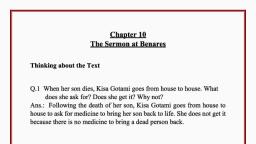
(b) What did the Buddha want Kisa Gotami to understand ?, , Ans. (a) Kisa Gotami was sad because her only son had died., In her hour of grief, she went from house to house in search of a, medicine to cure him. She had become selfish in wanting her, son back., , (b)Buddha wanted Kisa Gotami to understand that death is, common to all and no one could avoid dying. No one can save, their relatives. So wise do not grieve after accepting this truth of, dead., , 82.Mark! While relatives are looking on and lamenting deeply,, one by one mortals are carried off, like an ox that is led to the, , ~~) NtseBookCormer, , slaughter. So the world is afflicted with death and decay,, therefore the wise do not grieve, knowing the terms of the world., , (a) What is the fate of mortals?, (i) They will die., , (ii) They will come back to life., (iii) They will kill others., , (iv) They will get killed., , (b) Choose the answer that lists the correct option about the, meaning of the Buddha's message., , , , , , , , , , , , , , , , , , , , , , , , (i) Option 1, , (il) Option 2, , (iii) Option 3, , (Iv) Option 4, , (c)What do the relatives do when one dies?, (i) They participate in rituals., , (ii) They do the rituals., , (iii) They lament deeply., , (iv) They make merry., , (d) What do the wise men know?, (i) Their friends, , , , <~) NtseBookComer, , (ii) Their relatives, (iii) Their parents, (iv) The facts of life, , (e) The extract uses the phrase, ‘... Knowing the terms of the, world.’ Which of the following expressions is incorrect with, respect to the word ‘terms’?
Page 3 :
<j NtseBookComer, , (b) Mention the incident which prompted ‘him’ to become a, beggar ?, , Ans. (a) ‘He’ was Gautam Buddha, a Prince who was named, Siddhartha Gautam by his parents. He was born in 563 B.C. in, North India., , (b)Once Prince Siddhartha had gone for hunting where he came, across a sick man, an aged man, a monk asking for alms and, also witnessed a funeral procession. Unable to understand, those sufferings, he became an ascetic and went in search of, spiritual knowledge., , 81.And she thought to herself, “How selfish am | in my grief!, Death is common to all; yet in this valley of desolation there is a, path that leads him to immortality who has surrendered all, selfishness.” The Buddha said, “The life of mortals in this world, is troubled and brief and combined with pain. For there is not, any means by which those that have been born can avoid dying;, after reaching old age there is death; of such a nature are living, beings., , (a) Why was Kisa Gotami sad ? What did she do in her hour of, grief ?, , (b) What did the Buddha want Kisa Gotami to understand ?, , Ans. (a) Kisa Gotami was sad because her only son had died., In her hour of grief, she went from house to house in search of a, medicine to cure him. She had become selfish in wanting her, son back., , (b)Buddha wanted Kisa Gotami to understand that death is, common to all and no one could avoid dying. No one can save, their relatives. So wise do not grieve after accepting this truth of, dead., , 82.Mark! While relatives are looking on and lamenting deeply,, one by one mortals are carried off, like an ox th, 447/711, , , , </ NtseBookComer, , slaughter. So the world is afflicted with death and decay,, therefore the wise do not grieve, knowing the terms of the world., , (a) What is the fate of mortals?, (i) They will die., , (ii) They will come back to life., (iii) They will kill others., , (iv) They will get killed., , (b) Choose the answer that lists the correct option about the, meaning of the Buddha's message., , , , , , , , , , , , , , , , , , , , , , , , L a a, ‘ei, 5 es &, i &, {i) Option 1, , (ii) Ontion 2
Page 4 :
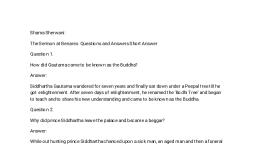
<<] NtseBookCorner, , 79.Life is full of trials and tribulations. Kisa Gotami also passes, through a period of grief in her life. How does she behave in, those circumstances ? What lesson does a reader learn from, the story of her life ? Give any two points how you would like to, act in the midst of adverse circumstances., , Ans. Kisa Gotami’s only son had died. Grief-stricken, she went, about asking people for medicine to revive her dead son. At the, behest of a man, she went to the Buddha who said he would, cure her son only if she could gather some mustard seeds from, a house where no death had ever occurred. After knocking, several doors and being unsuccessful, she realised that death, was common to all and it could not be avoided. No one can, save anyone, so, weeping over a dead soul was fruitless. It was, wise to stop grieving and accept the truth. Grieving over what is, lost would only cause pain and suffering and doing that too,, cannot bring one back to life. Accept life as it comes, be grateful, and live it to the fullest with peace of mind and good health., , . Reference to Context Questions ., , Read the extract given below and answer the questions that, follow :, , , , 80.At twelve, he was sent away for schooling in the Hindu, sacred scriptures and years later he retumed home to marry a, princess. They had a son and lived for ten years as befitted, royalty. At about the age of twenty-five, the prince heretofore, shielded from the sufferings of the world, while going out on, hunting, chanced upon a sick man, then an aged man, then a, funeral procession, and finally a monk begging for alms. These, sights so moved him that he at once became a beggar and went, out into the world to seek enlightenment concerning the sorrows, he had witnessed., , (a) Who was ‘he’ in the passage ? When and where was ‘he’, bom ?, , <~) NtseBookCormer, , (b) Mention the incident which prompted ‘him’ to become a, beggar ?, , Ans. (a) ‘He’ was Gautam Buddha, a Prince who was named, Siddhartha Gautam by his parents. He was born in 563 B.C. in, North India, , (b)Once Prince Siddhartha had gone for hunting where he came, across a sick man, an aged man, a monk asking for alms and, also witnessed a funeral procession. Unable to understand, those sufferings, he became an ascetic and went in search of, spiritual knowledge., , 81.And she thought to herself, “How selfish am | in my grief!, Death is common to all; yet in this valley of desolation there is a, path that leads him to immortality who has surrendered ail, Selfishness.” The Buddha said, “The life of mortals in this world, is troubled and brief and combined with pain. For there is not, any means by which those that have been born can avoid dying;, baled reaching old age there is death; of such a nature are living, eings., , (a) Why was Kisa Gotami sad ? What did she do in her hour of, grief ?, (b) What did the Buddha want Kisa Gotami to understand ?, , Ans. (a) Kisa Gotami was sad because her only son had died., In her hour of grief, she went from house to house in search of a, , a" oe aeaaen ae ae, , , , Pear Sse
Page 5 :
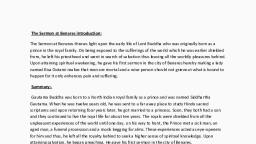
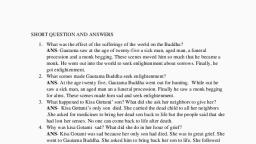
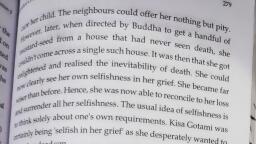
Ans. In his sermon at Benares, Buddha taught Gotami that the, life of mortals is brief, troubled and combined with pain. Death is, common for all, it cannot be avoided. He compares human life, to ripe fruits that eventually decay or as earthen vessels that will, break someday. Neither a father nor his kinsmen can save, , <<) NtseBookCorner, , anyone. Weeping or grieving cannot bring back the dead to life, nor bring peace of mind but can only cause pain and suffering to, the grieving body. One should accept death without lamentation,, complaint and overcome sorrow and grief thus bringing peace of, mind, which is a blessing., , 77. Through ‘The Sermon at Benares’, the Buddha preached, that death Is inevitable and we need to overcome the, suffering and pain that follows. Based on your reading of, the lesson, write how one should cope with the death of a, loved one.o, , Ans. Everything we need to achieve has to undergo pain and, suffering. We must let go of grief, sorrow and even the fear of, death to step out into the world to achieve something. World is, afflicted with death and decay, nothing is spared and no one can, avoid it. If we fear or grieve over the death of our loved one, it, will not lessen our sorrow nor will the person come back to life,, in fact, we will end up spoiling our own health and losing our, peace of mind. Surrendering selfishness and leading a virtuous, life is the safest option., , 78. “The life of mortals in this world is troubled and brief, and combined with pain......” With this statement of the, Buddha, find out the moral value that Kisa Gotami learnt, after the death of her child.>, , Ans. Kisa Gotami learnt that death and suffering are the part, and parcel of life. Nothing is everlasting and one has to accept, this truth in the hour of grief. In order to detach themselves from, the worldly life and the farsightedness to gain peace of mind one, must remain calm and composed. Weeping and grieving does, not bring peace of mind but only pain, which affects the body., People who are wise, never complain or lament over their loss., They accept the truth and are blessed with It. So, the wisdom, lies in the fact that people should not get distressed with pain,, suffering or death., , 445/711, , ~/ NtseBookCorner, , 79.Life is full of trials and tribulations. Kisa Gotami also passes, through a period of grief in her life. How does she behave in, those circumstances ? What lesson does a reader learn from, the story of her life ? Give any two points how you would like to, act in the midst of adverse circumstances..., , Ans. Kisa Gotami’s only son had died. Grief-stricken, she went, about asking people for medicine to revive her dead son. At the, behest of a man, she went to the Buddha who said he would, cure her son only if she could gather some mustard seeds from, a house where no death had ever occurred. After knocking, several doors and being unsuccessful, she realised that death, was common to all and it could not be avoided. No one can, save anyone, so, weeping over a dead soul was fruitless. It was, wise to stop grieving and accept the truth. Grieving over what is, lost would only cause pain and suffering and doing that too,, cannot bring one back to life. Accept life as it comes, be grateful, and live it to the fullest with peace of mind and good health., , Reference to Context Questions



 Learn better on this topic