Notes of Class 10, Chemistry Science Term 1 X.pdf - Study Material
Page 2 :
CBSE 2022, , SCIENCE, , Including Competency Based Questions, , CLASS 10, Term 1, Chapter-wise MCQ Bank, Purchase Hard book From Amazon, , www.cbse.online
Page 3 :
MCQ Bank Science Class 10 Term 1, Edition 2021, Copyright © By Nodia and Company, , Information contained in this book has been obtained by author, from sources believes to be reliable. However,, neither www.cbse.online nor its author guarantee the accuracy or completeness of any information herein,, and www.cbse.online nor its author shall be responsible for any error, omissions, or damages arising out of, use of this information. This book is published with the understanding that www.cbse.online and its author, are supplying information but are not attempting to render engineering or other professional services., , ISBN : 978-9384843618, , Published by Nodia and Company, , MRP Rs 460.00, , This book is available on amazon only and not available in market., , www.cbse.online, , Published by Nodia and Company, 126, Sector 6, Vidyadhar Nagar, Jaipur 302039, , Phone :+91 9001005245
Page 4 :
Contents, CHAP 1., , Chemical Reaction and Equations, , CHAP 2., , Acids, Bases and Salts, , 60-118, , CHAP 3., , Metal and Non Metals, , 119-169, , CHAP 4., , Life Processes, , 170-239, , CHAP 5., , Light- Reflection and Refraction, , 240-316, , CHAP 6., , Human Eye and Colorful World, , 317-350, , Don’t Take Printout of This File because, this is not useful. You can purchase hard, book from Amazon. Hard book includes, explanation of all MCQs in print form., , 5-59
Page 5 :
Available Also :, , MCQ Bank for CBSE 2022 Term 1, , Class 10th, Science, Social Science, English, HINDI, SANSKRIT, These question bank are available on Amazon., , Scan QR Code to Purchase MCQ Bank
Page 6 :
This PDF is review version of hard book available on Amazon. In hard book full explanation are given with question., Chap 2, , Chemical Reactions amd Equations Page 5, , �ChAptER 1, �Chemical Reaction and Equation, 2.1 introduction, , 2.2 Chemical Equation, , Chemistry is the branch of science in which, we study the composition, properties and, transformation of matter. We observe changes, in matter all around us. These changes are of, two types:, 2.1.1 Physical Change, A change in which there is a change in physical, appearance of a substance but no change in its, basic composition, is known as a physical change., For example, melting of butter and wax, boiling, of water, dissolving of salt in water, breaking of, glass, sublimation of a solid on heating, etc. No, new chemical substance is formed in a physical, change., 2.1.2 Chemical Change, A change in which one or more new substances, having properties and compositions different, from the original substance are formed, is known, as a chemical change. For example, burning, of paper, wood, coal and magnesium ribbon,, making of curd from milk, digestion of food,, ripening of fruits, bursting of a cracker, boiling, of egg, etc. Chemical changes are also called, chemical reactions., A chemical reaction is accompanied, by changes in physical state, formation of, a precipitate, change of colour, change in, temperature or evolution of a gas., Normally, a chemical change is permanent, and cannot be reversed easily., , 2.2.1 Word Equation, A word equation simply shows the change of, reactants to products through an arrow placed, between them. The reactants are written on the, left-hand side (LHS) with a plus sign in case, of two or more reactants and the products are, written on the right-hand side (RHS) with a, plus sign in case of two or more products. The, arrowhead shows the direction of the reaction, pointing towards the products., 2.2.2 Skeletal Chemical Equation, A chemical equation in which symbols and, formulae are used instead of words to show a, chemical reaction is called a skeletal chemical, equation., 2.2.3 Balanced Chemical Equation, A chemical equation in which the number of, atoms of each element of reactants is equal to, that of products, is called a balanced chemical, equation., 2.2.4 Balancing a Chemical Equation, Equalising the number of atoms of each element, on reactants and products sides of a chemical, equation is called balancing a chemical equation., 1. A chemical equation can be made more, informative by adding physical states of, reactants and products, reaction conditions,, heat change during the reaction, i.e., heat, released or absorbed, concentration of, reactants and products, speed or rate of the, reaction, i.e., slow or fast, and nature of the, reaction, i.e., forward or backward to the, , To Purchase Hard Book of From Amazon Click Here., For More Details Whatsapp at 8905629969
Page 7 :
For Answer and Explanation Question Click the Link in Pink Color., Page 6, , Chemical Reactions amd Equations, , equation., , Potassium (K), , 2.2.5 Characteristics of Chemical Equations, , Sodium (Na), , 1. Chemical equation gives the names of, different reactants and products of a chemical, reaction., 2. It gives the number of atoms or molecules, of reactants and products of a chemical, reaction., 3. Chemical equation gives relative number of, moles of reactants and products., 4. It gives the relative amount by mass or, weight of reactants and products., 5. Chemical equation also gives relative volume, of gaseous reactants and products., , Calcium (Ca), , 2.3.1 Combination Reaction, A reaction in which two or more substances, combine together to form a single product is, known as a combination reaction., The combination reaction is often called, synthesis., Heat, MgO (s) + H 2 O (l), Mg (OH) 2 (aq), Water, , Most reactive, , Magnesium (Mg), Aluminium (Al), Zinc (Zn), Iron (Fe), Lead (Pb), Copper (Cu), Silver (Ag), Gold (Au), Platinum (Pt), , Least reactive, , Activity series of some common metals, , 2.3 Types of Chemical Reactions, , Magnesium oxide, , Chap 2, , Magnesium hydroxide, , + Heat, 2.3.2 Decomposition Reaction, The reaction in which a single substance, breaks down to form two or more substances,, is called a decomposition reaction. For example,, decomposition of FeSO 4 on heating., Heat, 2FeSO 4 (s), Fe 2 O 3 (s) + SO 2 (g) + SO 3 (g), , Few examples of displacement reactions are as, follows:, 1. Displacement of copper from a solution of, copper sulphate by iron, Fe (s) + CuSO 4 (aq) " Cu (s) + FeSO 4 (aq), 2. Displacement of silver from silver nitrate, solution by copper, Cu (s) + 2AgNO 3 (aq) " 2Ag (s), + Cu (NO 3) 2 (aq), 3. Displacement of iron from iron sulphate, solution by magnesium, Mg (s) + FeSO 4 (aq) " MgSO 4 (aq) + Fe (s), 4. Zinc displaces hydrogen from dilute sulphuric, acid., Zn (s) + dil.H 2 SO 4 (aq) " ZnSO 4 (aq), + H 2 (g) -, , Ferric oxide, , 2.3.3 Displacement Reaction, The reaction in which one atom or a group of, atoms of a compound is replaced by another, atom, is called a displacement reaction. Generally,, a more reactive metal displaces a less reactive, metal from its salt solution in displacement, reaction., The series in which metals are arranged in, the decreasing order of their reactivity is called, activity series of metals., , 2.3.4 Double Displacement Reaction, The reaction in which anions and cations of two, different molecules exchange places, forming two, completely different compounds, is called double, displacement reaction. For example,, Na 2 SO 4 (aq) + BaCl 2 (aq) " BaSO 4 (s) ., Sodium, sulphate, , Barium, chloride, , To Purchase Hard Book of From Amazon Click Here., For More Details Whatsapp at 8905629969, , Barium, sulphate, , + 2NaCl (aq), Sodium, chloride
Page 8 :
This PDF is review version of hard book available on Amazon. In hard book full explanation are given with question., Chap 2, , Chemical Reactions amd Equations Page 7, , The common types of double displacement, reactions are as follows:, 1. Precipitation Reaction : It is a chemical, reaction in which one of the products is, precipitated as an insoluble solid. For, example,, AgNO 3 (aq) + NaCl (aq) " AgCl (s) ., (White ppt.), , + NaNO 3 (aq), 2. Neutralisation Reaction : It is chemical, reaction in which a strong acid and a strong, base react with each other to form water and, salt. For example,, NaOH (aq) + HCl (aq) " NaCl (aq) + H 2 O (l), , 2.3.6 Electronic Concept of Oxidation and, Reduction, Oxidation is the loss of electrons by a species, (an atom, a molecule or an ion)., K $ K+ + e−, Zn + Zn2+ $ 2e−, Reduction is the gain of electrons by a species, (an atom, a molecule or an ion)., , 2.3.5 Redox Reaction, , Ag+ + e− $ Ag, , 1. Oxidation : If a substance gains oxygen or, loses hydrogen in a reaction, the substance is, said to be oxidised and the process is known, as oxidation., 2. Reduction : If a substance loses oxygen and, gains hydrogen in a reaction, the substance is, said to be reduced and the process involved, is known as reduction., Reduction and oxidation take place, simultaneously in few reactions. Such, reactions are known as redox reactions., 3. Oxidising Agent : If a substance oxidises the, other substance but itself gets reduced, then, it is known as an oxidising agent., 4. Reducing Agent : If a substance reduces the, other substance but itself gets oxidised, then, it is known as a reducing agent., For example,, , S + 3e− $ S2−, , MgO + H 2 $ Mg + H 2 O, Here, H 2 is the reducing agent as it reduces, MgO to Mg and itself gets oxidised to H 2 O. On, the other hand, magnesium oxide is the oxidising, agent which oxidises H 2 to H 2 O and itself gets, reduced to Mg., Thus, an oxidising agent gets reduced and a, reducing agent gets oxidised in a redox reaction., , 1. Exothermic Reaction : A chemical reaction, in which heat is released along with the, formation of product, is called exothermic, reaction. For example,, C (s) + O 2 (g) $ CO 2 (g) + Heat, CaO (s) + H 2 O (l) $ Ca (OH) 2 (aq) + Heat, , Calcium oxide, (Lime), , Water, , Calcium hydroxide, (Slaked lime), , 2. Endothermic Reaction : A chemical reaction, in which heat is absorbed along with the, formation of product, is called endothermic, reaction. For example,, NH 4 Cl (s) + H 2 O (l) $ NH 4 Cl (aq) − Heat, N 2 (g) + O 2 (g) $ 2NO (g) − Heat, 2.3.7 Corrosion, It is the process of slow conversion of metals into, their undesirable compounds by the attack of air, (oxygen) and moisture., 1. Rusting : When iron and iron articles are, exposed to air and water, a reddish-brown, layer is formed on the surface. This layer, is called rust [hydrated iron(III) oxide,, Fe 2 O 3 $ x H 2 O ]. Hence, corrosion of iron is, , To Purchase Hard Book of From Amazon Click Here., For More Details Whatsapp at 8905629969
Page 9 :
For Answer and Explanation Question Click the Link in Pink Color., Page 8, , Chemical Reactions amd Equations, , known as rusting., 2. Rancidity : When cooked food items, containing oil and fat are kept exposed, and unprotected, they become rancid and, produce an unpleasant smell and taste., The phenomenon involved here is known as, rancidity., 3. Prevention of Rancidity : Rancidity can be, prevented by adding antioxidants, keeping, food items at low temperature, keeping food, items in vacuum packing or airtight container, and replacing air by nitrogen gas., �, �******, , Chap 2, , ��mulitiple choice QUESTION, , 1., , A solution of substance X is used for white, washing. Here X is:, (a) CaO, (b) CaO 2, (c) NaCl, (d) KCl, Sol : www.cbse.site/sc/am101, , 2., , Don’t Take Printout of This File because, this is not useful. You can purchase hard, book from Amazon. Hard book includes, explanation of all MCQs in print form., , Which of the following statements about, the reaction below are incorrect?, 2PbO (s) + C (s) $ 2Pb (s) + CO 2 (g), 1. Lead is getting reduced., 2. Carbon dioxide is getting oxidised., 3. Carbon is getting oxidised., 4. Lead oxide is getting reduced., (a) 1 and 2, (b) 1 and 3, (c) 1, 2 and 3, (d) all of the above, Sol : www.cbse.site/sc/am102, , 3., , Fe 2 O 3 + 2Al $ Al 2 O 3 + 2Fe, The above reaction is an example of a, (a) combination reaction., (b) double displacement reaction., (c) decomposition reaction., (d) displacement reaction., Sol : www.cbse.site/sc/am103, , 4., , What happens when dilute hydrochloric, acid is added to iron fillings?, (a) Hydrogen gas and iron chloride are, produced., (b) Chlorine gas and iron hydroxide are, produced., , To Purchase Hard Book of From Amazon Click Here., For More Details Whatsapp at 8905629969
Page 10 :
This PDF is review version of hard book available on Amazon. In hard book full explanation are given with question., Chap 2, , Chemical Reactions amd Equations Page 9, , $ Cu (NO 3) 2 (aq) + 2Ag (s), , (c) No reaction takes place., (d) Iron salt and water are produced., , Heat, , (b) CuCO 3 (s), CuO (s) + CO 2 (g), (c) N 2 (g) + 3H 2 (g) $ 2H 3 (g), (d) AgNO 3 (aq) + NaCl (aq), $ AgCl (s) + NaNO 3 (aq), , Sol : www.cbse.site/sc/am104, , 5., , Identify the substances that is oxidized, and the substances that is reduced in the, following reactions:, 4Na (s) + O 2 (g) $ 2Na 2 O (s), (a), (b), (c), (d), , Na,, Na,, O2,, O2,, , O2, Na, Na, O2, , Identify the substances that is oxidized, and the substances that is reduced in the, following reactions:, CuO (s) + H 2 (g) $ Cu (s) + H 2 O (l), (a), (b), (c), (d), , 9., , Which one of the following is the example, of oxidation?, Burning, (a) 2Mg (s) + O 2 (g), 2MgO (s), Heat, , Sol : www.cbse.site/sc/am105, , 6., , Sol : www.cbse.site/sc/am108, , H 2 , CuO, H2, H2O, H 2 , Cu, Cu, H 2, , Sol : www.cbse.site/sc/am106, , (b) CuO (s) + H 2 (g), Cu (s) + H 2 O (g), (c) Fe 2 O 3 (s) + 2Al (s) $ Al 2 O 3 (s), , + 2Fe (s), (d) None of these, Sol : www.cbse.site/sc/am109, , 10. A shiny brown coloured element X on, heating in air becomes black in colour., HereX is:, (a) Copper, (b) Silver, (c) Aluminium, (d) Mercury, Sol : www.cbse.site/sc/am110, , 7., , Translate the following statement into the, chemical equation and choose the correct, option “Hydrogen gas combines with, nitrogen to form ammonia.”, (a) 3H 2 (g) + N 2 (g) $ 2NH 3 (g), (b) H 2 (g) + N 2 (g) $ NH 2 (g), (c) 2H (g) + N 2 (g) $ 2NH 3, (d) None of these, Sol : www.cbse.site/sc/am107, , 11. Which of the following statement is correct, regarding to physical changes?, (a) In physical change, new substance is, formed., (b) In physical change, no new substance, is formed., (c) In physical change, chemical composition of substance is changed., (d) None of these, Sol : www.cbse.site/sc/am111, , 8., , Which one of the following is the example, of precipitation reaction?, (a) Cu (s) + 2AgNO 3 (aq), , To Purchase Hard Book of From Amazon Click Here., For More Details Whatsapp at 8905629969
Page 11 :
For Answer and Explanation Question Click the Link in Pink Color., Page 10, , 12., , Chemical Reactions amd Equations, , FeS + H 2 SO 4 $ FeSO 4 + H 2 S -., In the above equation - indicates:, (a) gas evolved, (b) insoluble substance formed, (c) reactive element, (d) element is not useful in chemical, equation, Sol : www.cbse.site/sc/am112, , 13., , CaO (s) + H 2 O (l) $ X (s) + Heat, + Hissing sound., Here X is:, (a) Cu(OH), (b) Cu (OH) 2, (c) 2CaOH, (d) Ca 2 OH, Sol : www.cbse.site/sc/am113, , 14. The balancing of chemical equation is, based on:, (a) Law of conservation of energy, (b) Law of conservation of mass, (c) Law of conservation of heat, (d) None of these, Sol : www.cbse.site/sc/am114, , 15. When white silver chloride is left exposed, to sunlight, it colours becomes:, (a) Gray, (b) Yellow, (c) Green, (d) Red, Sol : www.cbse.site/sc/am115, , 16. Complete the following chemical reaction, with correct option:, Pb (NO 3) 2 + 2KI $ .......... + 2KNO 3, , (a), (b), (c), (d), , Chap 2, , PbI 2, PbNO 3, Pb (NO 3) 2, PbIO 3, , Sol : www.cbse.site/sc/am116, , 17. Which of the following is not a chemical, reaction?, (a) Souring of milk, (b) Dissolution of sugar in water, (c) Rusting of iron, (d) Digestion of food in the body, Sol : www.cbse.site/sc/am117, , 18., , Na 2 CO 3 + XHCl $ 2NaCl + CO 2 + H 2 O, In above reaction, the value of X is:, (a) 1, (b) 2, (c) 3, (d) 4, Sol : www.cbse.site/sc/am118, , 19., , PCl 5 (s) + XH 2 O (l) $ YH 3 PO 4 (aq), + ZHCl (aq)., The value of X,Y and Z are:, (a) X -4, Y -3, Z -3, (b) X -4, Y -1, Z -5, (c) X -1, Y -2, Z -3, (d) X -5, Y -1, Z -2, Sol : www.cbse.site/sc/am119, , 20. What happens when ferrous sulphate, crystals are heated?, (a) A gas having the smell of burning, sulphur is evolved., (b) No gas is evolved., (c) Brown coloured gas is evolved., , To Purchase Hard Book of From Amazon Click Here., For More Details Whatsapp at 8905629969
Page 12 :
This PDF is review version of hard book available on Amazon. In hard book full explanation are given with question., Chap 2, , Chemical Reactions amd Equations Page 11, , (d) Colourless, evolved., , and, , odourless, , gas, , is, , Sol : www.cbse.site/sc/am120, , 21. In the reaction Br 2 + 2I $ 2Br− + I 2 , the, oxidising agent is:, (a) Br 2, (b) I(c) Br(d) I 2, Sol : www.cbse.site/sc/am121, , Don’t Take Printout of This File because, this is not useful. You can purchase hard, book from Amazon. Hard book includes, explanation of all MCQs in print form., 22. Which of the following is not a thermal, decomposition reaction?, (a) 2KClO 3 $ 2KCl + 3O 2, (b) ZnCO 3 $ ZnO + CO 2, (c) 2FeSO 4 $ Fe 2 O 3 + SO 2 + SO 3, (d) 2H 2 O $ 2H 2 + O 2, Sol : www.cbse.site/sc/am122, , 23. Y + 2HCl $ ZnCl 2 + H 2 . In the above, reaction, Y is:, (a) Aluminium, (b) Copper, (c) Sodium, (d) Zinc, , called .......... reaction., (a) Decomposition, (b) Combination, (c) Precipitation, (d) Displacement, Sol : www.cbse.site/sc/am124, , 25. Which of the following example is a, decomposition reaction?, (a) Evaporation of water, (b) Exposure of photographic film in the, presence of light, (c) Heating sulphur in the presence of, oxygen, (d) Dissolving salt in water, Sol : www.cbse.site/sc/am125, , 26. When petrol, in the presence of oxygen gas,, burns inside the engine of a car, carbon, dioxide and water are produced. The, temperature inside the engine becomes very, high. Which of the following statements is, correct?, (a) The burning of petrol is an example of, a physical change., (b) Heat energy is taken out from the, surroundings., (c) Oxygen and petrol are the reactants, in this process., (d) This process is triggered by light, energy., Sol : www.cbse.site/sc/am126, , Sol : www.cbse.site/sc/am123, , 24. The chemical reactions in which one, element takes the position or place of, another element present in a compound are, , To Purchase Hard Book of From Amazon Click Here., For More Details Whatsapp at 8905629969
Page 13 :
For Answer and Explanation Question Click the Link in Pink Color., Page 12, , Chemical Reactions amd Equations, , 27. Calcium oxide reacts vigorously with water., , Chap 2, , (b) a displacement reaction, (c) a decomposition reaction, (d) a double displacement reaction, Sol : www.cbse.site/sc/am129, , 30., Identify the incorrect statements., 1. It is an endothermic reaction., 2. Slaked lime is produced., 3. Quick lime is produced., 4. It is an exothermic reaction., 5. It is a combination reaction., (a) 1 and 2, (b) 3 and 4, (c) 1 and 3, (d) 2, 4 and 5, Sol : www.cbse.site/sc/am127, , 28. Which of the following statements about, the reaction given below are incorrect?, 2PbO (s) + C (s) $ 2Pb (s) + CO 2 (g), 1. Lead is getting reduced., 2. Carbon dioxide is getting oxidised., 3. Carbon is getting oxidised., 4. Lead oxide is getting reduced., (a) 1 and 2, (b) 3 and 4, (c) 1 and 3, (d) 2 and 4, , 3MnO 2 + 4Al $ 3Mn + 2Al 2 O 3, The oxidising agent in the above reaction, is:, (a) MnO 2, (b) Al, (c) Mn, (d) Al 2 O 3, Sol : www.cbse.site/sc/am130, , 31. Which of the following processes does not, involve either oxidation or reduction?, (a) Formation of slaked lime from quick, lime, (b) Heating mercuric oxide, (c) Formation of manganese chloride from, manganese oxide, (d) Formation of zinc from zinc blend, Sol : www.cbse.site/sc/am131, , 32. The given diagram represents a .........., reaction., , Sol : www.cbse.site/sc/am128, , 29. When hydrogen sulphide gas is passed, through a blue solution of copper sulphate,, a black precipitate of copper sulphide is, obtained and the sulphuric acid so formed, remains in the solution. The reaction is an, example of, (a) a combination reaction, , (a) Thermal decomposition, (b) Displacement, (c) Double displacement, , To Purchase Hard Book of From Amazon Click Here., For More Details Whatsapp at 8905629969
Page 14 :
This PDF is review version of hard book available on Amazon. In hard book full explanation are given with question., Chap 2, , Chemical Reactions amd Equations Page 13, , (d) Combination, Sol : www.cbse.site/sc/am132, , 33. On burning magnesium ribbon in air, it, is observed that it burns brightly leaving, behind a .......... powder., (a) White, (b) Green, (c) Yellow, (d) Black, Sol : www.cbse.site/sc/am133, , 34. Which of the following is not a physical, change?, (a) Boiling of water to give water vapour, (b) Melting or ice to give water, (c) Dissolution of salt in water, (d) Combustion of Liquefied Petroleum, Gas (LPG), Sol : www.cbse.site/sc/am134, , 35. The following reaction is an example of a, 4NH 3 (g) + 5O 2 (g) $ 4NO (g) + 4H 2 O (g), 1. displacement reaction, 2. combination reaction, 3. redox reaction, 4. neutralisation reaction, (a) 1 and 4, (b) 2 and 3, (c) 1 and 3, (d) 3 and 4, Sol : www.cbse.site/sc/am135, , 36. Which of the following statements about, the given reaction are correct?, 3Fe (s) + 4H 2 O (g) $ Fe 3 O 4 (s) + 4H 2 (g), 1. Iron metal is getting oxidised., 2. Water is getting reduced., , 3. Water is acting as reducing agent., 4. Water is acting as oxidising agent., (a) 1, 2 and 3, (b) 3 and 4, (c) 1, 2 and 4, (d) 2 and 4, Sol : www.cbse.site/sc/am136, , 37. Which of the following are exothermic, processes?, 1. Reaction of water with quick lime., 2. Dilution of an acid., 3. Evaporation of water., 4. Sublimation of camphor (crystals)., (a) 1 and 2, (b) 2 and 3, (c) 1 and 4, (d) 3 and 4, Sol : www.cbse.site/sc/am137, , 38. A dilute ferrous sulphate solution was, gradually added to the beaker containing, acidified permanganate solution. The light, purple colour of the solution fades and, finally disappears., Which of the following is the correct, explanation for the observation?, (a) KMnO 4 is an oxidising agent, it, oxidises FeSO 4 ., (b) FeSO 4 acts as an oxidising agent and, oxidises KMnO 4 ., (c) The colour disappears due to dilution;, no reaction is involved., (d) KMnO 4 is an unstable compound and, decomposes in presence of FeSO 4 to a, colourless compound., Sol : www.cbse.site/sc/am138, , 39. Which among the following is (are) double, , To Purchase Hard Book of From Amazon Click Here., For More Details Whatsapp at 8905629969
Page 15 :
For Answer and Explanation Question Click the Link in Pink Color., Page 14, , Chemical Reactions amd Equations, , displacement reaction(s)?, 1. Pb + CuCl 2 $ PbCl 2 + Cu, 2. Na 2 SO 4 + BaCl 2 $ BaSO 4 + 2NaCl, 3. C + O 2 $ CO 2, 4. CH 4 + 2O 2 $ CO 2 + 2H 2 O, (a) 1 and 4, (b) Only 2, (c) 1 and 2, (d) 3 and 4, Sol : www.cbse.site/sc/am139, , 40. Which among the following statement(s), is(are) true?, Exposure of silver chloride to sunlight for a, long duration turns grey due to, 1. the formation of silver by decomposition, of silver chloride., 2. sublimation of silver chloride., 3. decomposition of chlorine gas from silver, chloride., 4. oxidation of silver chloride., (a) Only 1, (b) 1 and 3, (c) 2 and 3, (d) Only 4, Sol : www.cbse.site/sc/am140, , 41. Solid calcium oxide reacts vigorously, with water to form calcium hydroxide, accompanied by liberation of heat. This, process is called slaking of lime. Calcium, hydroxide dissolves in water to form its, solution called lime water. Which among, the following is (are) true about slaking of, lime and the solution formed?, 1. It is an endothermic reaction., 2. It is an exothermic reaction., 3. The pH of the resulting solution will be, more than seven., 4. The pH of the resulting solution will be, less than seven., (a) 1 and 2, , Chap 2, , (b) 2 and 3, (c) 1 and 4, (d) 3 and 4, Sol : www.cbse.site/sc/am141, , 42. Barium chloride on reacting with, ammonium sulphate forms barium sulphate, and ammonium chloride. Which of the, following correctly represents the type of, the reaction involved?, 1. Displacement reaction, 2. Precipitation reaction, 3. Combination reaction, 4. Double displacement reaction, (a) Only 1, (b) Only 2, (c) Only 4, (d) 2 and 4, Sol : www.cbse.site/sc/am142, , 43. Electrolysis of water is a decomposition, reaction. The mole ratio of hydrogen and, oxygen gases liberated during electrolysis, of water is, (a) 1 : 1, (b) 2 : 1, (c) 4 : 1, (d) 1 : 2, Sol : www.cbse.site/sc/am143, , 44. Which of the following is(are), endothermic process(es)?, 1. Dilution of sulphuric acid, 2. Sublimation of dry ice, 3. Condensation of water vapours, 4. Evaporation of water, (a) 1 and 3, (b) Only 2, (c) Only 3, , To Purchase Hard Book of From Amazon Click Here., For More Details Whatsapp at 8905629969, , an
Page 16 :
This PDF is review version of hard book available on Amazon. In hard book full explanation are given with question., Chap 2, , Chemical Reactions amd Equations Page 15, , (d) 2 and 4, Sol : www.cbse.site/sc/am144, , 45. In the double displacement reaction, between aqueous potassium iodide and, aqueous lead nitrate, a yellow precipitate, of lead iodide is formed. While performing, the activity if lead nitrate is not available,, which of the following can be used in place, of lead nitrate?, (a) Lead sulphate (insoluble), (b) Lead acetate, (c) Ammonium nitrate, (d) Potassium sulphate, Sol : www.cbse.site/sc/am145, , 46. Which of the following gases can be used, for storage of fresh sample of an oil for a, long time?, (a) Carbon dioxide or oxygen, (b) Nitrogen or oxygen, (c) Carbon dioxide or helium, (d) Helium or nitrogen, Sol : www.cbse.site/sc/am146, , 47. The following reaction is used for the, preparation of oxygen gas in the laboratory, Heat, 2KClO 3 (s) Catalyst 2KCl (s) + 3O 2 (g), Which of the following statement(s) is(are), correct about the reaction?, (a) It is a decomposition reaction and, endothermic in nature., (b) It is a combination reaction., (c) It is a decomposition reaction and, accompanied by release of heat., (d) It is a photochemical decomposition, reaction and exothermic in nature., Sol : www.cbse.site/sc/am147, , 48. Which one of the following processes involve, chemical reactions?, (a) Storing of oxygen gas under pressure, in a gas cylinder, (b) Liquefaction of air, (c) Keeping petrol in a china dish in the, open, (d) Heating copper wire in presence of air, at high temperature, Sol : www.cbse.site/sc/am148, , 49. In which of the following chemical, equations, the abbreviations represent the, correct states of the reactants and products, involved at reaction temperature?, (a) 2H 2 (I) + O 2 (I) $ 2H 2 O (g), (b) 2H 2 (g) + O 2 (I) $ 2H 2 O (I), (c) 2H 2 (g) + O 2 (g) $ 2H 2 O (I), (d) 2H 2 (g) + O 2 (g) $ 2H 2 O (g), Sol : www.cbse.site/sc/am149, , 50. Which of the following are combination, reaction?, Heat, 1. 2KClO 3, 2KCl + 3O 2, 2. MgO + H 2 O $ Mg (OH) 2, 3. 4Al + 3O 2 $ 2Al 2 O 3, 4. Zn + FeSO 4 $ ZnSO 4 + Fe, (a), (b), (c), (d), , 1, 3, 2, 2, , and, and, and, and, , 3, 4, 4, 3, , Sol : www.cbse.site/sc/am150, , 51. The addition of hydrogen to a substance is, known as:, (a) Oxidation, (b) Reduction, (c) Redox reaction, (d) Precipitation, , To Purchase Hard Book of From Amazon Click Here., For More Details Whatsapp at 8905629969
Page 17 :
For Answer and Explanation Question Click the Link in Pink Color., Page 16, , Chemical Reactions amd Equations, , Sol : www.cbse.site/sc/am151, , 52. The oxidation of oils or fats in a food is, known as:, (a) Corrosion, (b) Rust, (c) Rancidity, (d) Oxidisation, Sol : www.cbse.site/sc/am152, , 53. The necessary conditions for combustion, precess to occur are, 1. availability of air/oxygen., 2. availability or air/oxygen and fuel., 3. temperature of fuel below ignition temperature., 4. temperature of fuel above ignition temperature., Select the correct alternative., (a) 1 and 2, (b) 2 and 4, (c) 3 and 1, (d) 4 and 1, Sol : www.cbse.site/sc/am153, , Chap 2, , 55. Oxygen gas reacts with hydrogen to, produce water. The reaction is represented, by the equation:, O 2 (g) + H 2 (g) $ H 2 O (I), The above reaction is an example of, 1. Oxidation of hydrogen, 2. Reduction of oxygen, 3. Reduction of hydrogen, 4. Redox reaction, (a) 1, 2 and 3, (b) 2, 3 and 4, (c) 1, 3 and 4, (d) 1, 2 and 4, Sol : www.cbse.site/sc/am155, , 56. Compound A on strong heating in a boiling, tube gives off reddish brown fumes and a, yellow residue. When the aqueous solution, of A is treated with few drops of sodium, hydroxide solution, a white precipitate, appeared. Identify the cation and anion, present in the compound A., (a) Copper(II) and nitrate, (b) Lead(II) and chloride, (c) Zinc and sulphate, (d) Lead(II) and nitrate, Sol : www.cbse.site/sc/am156, , 54. The reaction between carbon and oxygen, can be represented as, T, C (s) + O 2 (g), CO 2 (g) + Heat, In which of the following type(s), the above, reaction can be classified?, 1. Combustion reaction, 2. Displacement reaction, 3. Endothermic reaction, 4. Combination reaction, (a) 1 and 3, (b) 1, 3 and 4, (c) 1 and 4, (d) 1 Only, Sol : www.cbse.site/sc/am154, , 57. Magnesium ribbon is rubbed with sand, paper before making it to burn. The reason, of rubbing the ribbon is to:, (a) remove moisture condensed over the, surface of ribbon., (b) generate heat due to exothermic, reaction., (c) remove magnesium oxide formed over, the surface of magnesium., (d) mix silicon from sand paper (silicon, dioxide) with magnesium for lowering, ignition temperature of the ribbon., Sol : www.cbse.site/sc/am157, , To Purchase Hard Book of From Amazon Click Here., For More Details Whatsapp at 8905629969
Page 18 :
This PDF is review version of hard book available on Amazon. In hard book full explanation are given with question., Chap 2, , Chemical Reactions amd Equations Page 17, , 58. Which of the following is a feasible reaction? 62. An integer precedes the formula of each, substance; is known as .......... coefficients., (a) Ba (s) + K 2 SO 4 (aq) $ BaSO 4 (aq), (a) chemical, , + 2K (s), (b) physical, (b), (c) stoichiometric, Zn (s) + 2AgNO 3 (aq) $ Zn (NO 3) 2 (aq), (d) thermal, , + 2Ag (s), (c), Sol : www.cbse.site/sc/am162, Mg (s) + Na 2 SO 4 (aq) $ MgSO 4 (aq), , + 2Na (s), (d) Cu (s) + MgSO 4 (aq) $ CuSO 4 (aq), 63. 2Mg (s) + O 2 (g) $ 2MgO (s), , + Mg (s), The stoichiometric coefficient of O 2 is:, (a) 1, Sol : www.cbse.site/sc/am158, (b) 2, (c) 3, 59. The symbolic representation of an actual, (d) 4, chemical change is known as, Sol : www.cbse.site/sc/am163, (a) Chemical equation, (b) Chemical formula, (c) Chemical symbol, 64. The statement of law of conservation of, (d) Physical formula, mass is:, Sol : www.cbse.site/sc/am159, , 60. Which of the following chemical reaction is, correct?, (a) 2Mg (s) + O 2 (g) $ 2MgO (s), (b) 2Mg (s) + O 2 (g) $ MgO + O 2, (c) Mg (s) + O 2 $ 2MgO (s), (d) 2Mg (s) + 2O 2 $ 2MgO + O 2, Sol : www.cbse.site/sc/am160, , 61., , N 2 + 3H 2 $ 2NH 3, In the above reaction and products are:, Reactants, , Products, , (a) N 2 , H 2, , NH 3, , (b) NH 3, , N2, H2, , (c) N 2, , H 2 , NH 3, , (d) N 2 NH 3, , H2, , (a) mass can neither be created nor, destroy., (b) mass can be created nor destroy., (c) mass of the body cannot be remain, same., (d) none of these., Sol : www.cbse.site/sc/am164, , 65. Which of the following statement is correct, regarding to chemical equation?, (a) A chemical equation does not indicate, about the condition for the reaction., (b) It gives the idea about the rate of, reaction., (c) It gives the information about the, heat., (d) It gives idea about the mechanism of, the reaction., Sol : www.cbse.site/sc/am165, , Sol : www.cbse.site/sc/am161, , To Purchase Hard Book of From Amazon Click Here., For More Details Whatsapp at 8905629969
Page 19 :
For Answer and Explanation Question Click the Link in Pink Color., Page 18, , Chemical Reactions amd Equations, , 66. Which one of the following, decomposition reaction?, Sunlight, (a) H 2 + Cl 2, 2HCl, Heat, (b) 2Mg + O 2, 2MgO, (c) CaO + H 2 O $ Ca (OH) 2, (d) 2KClO 3 $ 2KCl + 3O 2, , is, , Chap 2, , exothermic reaction?, (a) N 2 + 3H 2 $ 2NH 3 + Heat, (b) N 2 + O 2 $ 2NO − Heat, (c) CuO + H 2 $ Cu + H 2 O, (d) Mg + Cl 2 $ MgCl 2, , the, , Sol : www.cbse.site/sc/am170, , Sol : www.cbse.site/sc/am166, , 67. The oxidation and reduction takes place, simultaneously in .......... reaction., (a) displacement, (b) redox, (c) combination, (d) decomposition, , 71. Which of the following is the factor of, influence the corrosion?, (a) Reactivity of metals, (b) Presence of impunities, (c) Strain in the metal, (d) All of the above, Sol : www.cbse.site/sc/am171, , Sol : www.cbse.site/sc/am167, , 68. Which of the following is correct regarding, the oxidizing agent?, (a) It gives oxygen for oxidation., (b) It does not gives oxygen for oxidation., (c) It does not remove hydrogen., (d) It gives oxygen and does not remove, hydrogen., , 72. Which method is used for preventing, corrosions?, (a) Galvanization, (b) Electroplating, (c) Both (a) and (b), (d) Thermosetting, Sol : www.cbse.site/sc/am172, , Sol : www.cbse.site/sc/am168, 73., 69., , CuO + H 2 $ Cu + H 2 O, Which of the following pair is correct, regarding to oxidation and reduction?, Oxidation, , Reduction, , (a) CuO, , H2, , (b) H 2, , CuO, , (c) H 2 O, , H2, , (d) H 2, , H2O, , Sol : www.cbse.site/sc/am173, , Sol : www.cbse.site/sc/am169, , 70. Which, , of, , the, , following, , BaCl 2 + H 2 SO 4 $ X BaSO 4 + Y HCl, The value of X and Y in the above chemical, equation are:, (a) 1, 2, (b) 2, 1, (c) 1, 1, (d) 1, 3, , equation, , is, , 74. The balancing chemical equation of, following statement is:, “Silver bromide on exposure to sunlight, decomposes into silver and bromine”., (a) 2AgBr $ 2Ag + Br, , To Purchase Hard Book of From Amazon Click Here., For More Details Whatsapp at 8905629969
Page 20 :
This PDF is review version of hard book available on Amazon. In hard book full explanation are given with question., Chap 2, , Chemical Reactions amd Equations Page 19, , (b) 2AgBr, , Sunlight, , 2Ag + Br2, , (c), , Sunlight, , Ag + Br2, , 2AgBr, , (d) AgBr, , Sunlight, , Ag + 2Br, , Sol : www.cbse.site/sc/am174, , 78. Which of the following pair is incorrect?, Reaction, , 75. The indication of chemical reaction in an, activity is/are:, (a) change in state, (b) change in colour, (c) change in temperature, (d) all of the above, Sol : www.cbse.site/sc/am175, , 76. When potassium iodine solution is added, to a solution of lead nitrate .......... reaction, occurs., (a) combination, (b) decomposition, (c) displacement, (d) redox, Sol : www.cbse.site/sc/am176, , 77., , X + Barium chloride $, um chloride, Here X and Y are:, (a) NaSO 4 , BaSO 4, (b) BaSO 4 , Na 2 SO 4, (c) BaSO 2 , NaSO 4, (d) Na 2 SO 4 , BaSO 4, , Y, , + Sodi-, , (White ppt), , Sol : www.cbse.site/sc/am177, , Don’t Take Printout of This File because, this is not useful. You can purchase hard, book from Amazon. Hard book includes, explanation of all MCQs in print form., , Reaction Name, , (a) CH 4 + 2O 2 " CO 2 Combustion, + 2H 2 O reaction and, oxidation, reaction, (b) Pb (NO 3) 2 + 2KI Double, " PbI 2 + 2KNO 3 displacement, and, precipitation, reaction, Combination, (c) CaO + H 2 O, " Ca (OH) 2 reaction, Combination, (d) CuSO 4 + Zn, " ZnSO 4 + Cu reaction, Sol : www.cbse.site/sc/am178, , 79. Which one reaction shows the property of, double displacement reaction?, (a) CuSO 4 + Zn $ ZnSO 4 + Cu, (b) Cu + 2AgNO 3 $ Cu (NO 3) 2 + 2Ag, (c) NaOH + HCl $ NaCl + H 2 O, (d) None of these, Sol : www.cbse.site/sc/am179, , 80. When the powder of a common metal is, heated in an open china dish, its colour, turns black. However, when hydrogen is, passed over the hot black substance so, formed, it regains its original colour., Which type of chemical reaction take place, in each step?, (a) oxidation, redox, (b) redox, oxidation, (c) oxidation, oxidation, , To Purchase Hard Book of From Amazon Click Here., For More Details Whatsapp at 8905629969
Page 22 :
This PDF is review version of hard book available on Amazon. In hard book full explanation are given with question., Chap 2, , Chemical Reactions amd Equations Page 21, , 89. What happens when dilute hydrochloric, acid is added to iron fillings?, (a) Hydrogen gas and iron chloride are, produced., (b) Chlorine gas and iron hydroxide are, produced., (c) No reaction takes place., (d) Iron salt and water are produced., Sol : www.cbse.site/sc/am189, , 90. The reaction 2Na + Cl 2 $ 2NaCl is an, example of, (a) combination reaction, (b) decomposition reaction, (c) displacement reaction, (d) double displacement reaction, , displacement reaction?, (a) NaOH + HNO 3 " NaNO 3 + H 2 O, (b) Cu + 2AgNO 3 " Cu (NO 3) 2 + 2Ag, (c) 2Hg + O 2 " 2HgO, (d) FeCl 3 + 2NaOH " 3NaCl + Fe (OH) 3, Sol : www.cbse.site/sc/am193, , 94. The reaction in which two compounds, exchange their ions to form two new, compounds is called:, (a) displacement reaction, (b) decomposition reaction, (c) isomerization reaction, (d) metathesis, reaction, or, double, decomposition reaction, Sol : www.cbse.site/sc/am194, , Sol : www.cbse.site/sc/am190, , 91. Which of the following reactions involves, the combination of two element?, (a) CaO + CO 2 $ CaCO 3, (b) 4Na + O 2 $ 2N 2 O, (c) SO 2 + 12 O 2 $ SO 3, (d) NH 3 + HCl $ NH 4 Cl, Sol : www.cbse.site/sc/am191, , 92. When lead nitrate is heated, it breaks down, into lead monoxide, nitrogen dioxide and, oxygen., 2Pb (NO 3) 2 $ 2PbO + 4NO 2 + O 2, The reaction is an example of:, (a) Combination reaction, (b) Decomposition reaction, (c) Double displacement reaction, (d) Displacement reaction, Sol : www.cbse.site/sc/am192, , 93. Which of the following is an example of, , 95. When hydrogen sulphide gas is passed, through a blue solution of copper sulphate,, a black precipitate of copper sulphide is, obtained and the sulphuric acid so formed, remains in the solution. The reaction is an, example of:, (a) combination reaction, (b) displacement reaction, (c) decomposition reaction, (d) double displacement reaction, Sol : www.cbse.site/sc/am195, , 96. When the gases sulphur dioxide and, hydrogen sulphide mix in the presence of, water, the following reaction takes places:, SO 2 + 2H 2 S $ 2H 2 O + 3S, Here, hydrogen sulphide is acting as:, (a) an oxidizing agent, (b) a reducing agent, (c) a dehydrating agent, (d) a catalyst, Sol : www.cbse.site/sc/am196, , To Purchase Hard Book of From Amazon Click Here., For More Details Whatsapp at 8905629969
Page 23 :
For Answer and Explanation Question Click the Link in Pink Color., Page 22, , Chemical Reactions amd Equations, , 97. In the reaction:, 2FeCl 2 + Cl 2 $ 2FeCl 3, Chlorine may be regarded as:, (a) an oxidizing agent, (b) a reducing agent, (c) a catalyst, (d) providing an inert medium, Sol : www.cbse.site/sc/am197, , 98. Which of the following is not a balanced, equation?, (a) Ca (HO) 2 + CO 2 $ CaCO 3 + H 2 O, (b) Fe + CuSO 4 $ FeSO 4 + Cu, T, (c) KClO 4, KCl + 2O 2, (d) Cu + 2HNO 3 $ Cu (NO 3) 2 + 2NO 2, +H2O, Sol : www.cbse.site/sc/am198, , 99., , Fe 2 O 3 + 2Al $ Al 2 O 3 + 2Fe, (a) Combination reaction, (b) Double displacement reaction, (c) Decomposition reaction, (d) Displacement reaction, Sol : www.cbse.site/sc/am199, , 100. Which of the following are correctly, matched?, 1. Dissolution, , Solute gets dissolved, in a solvent., , 2. Exothermic, , Heat in absorbed., , 3. Reversible, change, , Reactants can be, obtained., , Which of the above are correct?, (a) 1 and 2, (b) 2 and 3, (c) 1 and 3, (d) 1, 2 and 3, , Chap 2, , Sol : www.cbse.site/sc/am200, , 101. Which of the following is correct for a, physical change?, 1. Only physical properties change., 2. Large amount of heat is absorbed or, evolved., Which of the above statements is/are, correct?, (a) Only 1, (b) Only 2, (c) Both 1 and 2, (d) Neither 1 and 2, Sol : www.cbse.site/sc/am201, , 102. Which of the following is not a chemical, change?, (a) Burning of a candle., (b) Cooking a food, (c) Sublimation, (d) Germination of seeds, Sol : www.cbse.site/sc/am202, , 103. Rusting of iron can be prevented by:, 1. Painting, 2. Galvanisation, 3. Electrolytic refining, 4. Alloying, Which of the above are correct?, (a) 1, 2 and 3, (b) 1, 2 and 4, (c) 2, 3 and 4, (d) 1, 2, 3 and 4, Sol : www.cbse.site/sc/am203, , 104. Which of the following is the observations, of the chemical reaction?, 1. Change in state, 2. Evolution of a gas, , To Purchase Hard Book of From Amazon Click Here., For More Details Whatsapp at 8905629969
Page 24 :
This PDF is review version of hard book available on Amazon. In hard book full explanation are given with question., Chap 2, , Chemical Reactions amd Equations Page 23, , 3. Change in colour, 4. Change in temperature, (a) 1, 2 and 3, (b) 1, 2 and 4, (c) 1, 3 and 4, (d) 1, 2, 3 and 4, , (a), (b), (c), (d), , 1 and 2, 2 and 3, 1 and 3, 1, 2 and 3, , Sol : www.cbse.site/sc/am207, , Sol : www.cbse.site/sc/am204, 108. Which of the following are correctly, matched?, 105. Which of the following are correctly, matched?, 1. Reactant .......... substance which, undergoes change., 2. Product .......... new substance., 3. Chemical reaction .......... simplest form., (a) 1 and 2, (b) 2 and 3, (c) 1 and 3, (d) 1, 2 and 3, Sol : www.cbse.site/sc/am205, , 106. Which of the following is/are correct for a, balanced chemical equation?, 1. It is based on law of conservation of, mass., 2. The physical states makes the chemical, reaction less informative., (a) Only 1, (b) Only 2, (c) Both 1 and 2, (d) Neither 1 nor 2, Sol : www.cbse.site/sc/am206, , 107. Which of the following are correctly, matched?, Symbol, , 1. Combination, reaction, , Formation of single, product., , 2. Decomposition Break down of, reaction, single, entity., 3. Thermal, decomposition, , Heat is used., , 4. Displacement, reaction, , Based on reactivity, series., , (a), (b), (c), (d), , 1,, 1,, 1,, 1,, , 2 and 3, 2 and 4, 3 and 4, 2, 3 and 4, , Sol : www.cbse.site/sc/am208, , 109. Which of the statements about the reaction, below are correct?, 2PbO (s) + C (s) $ 2Pb (s) + CO 2 (g), 1. Lead is getting reduced., 2. Carbon dioxide is getting oxidised., 3. Carbon is getting oxidised., 4. Lead oxide is getting reduced., (a) 1 and 2, (b) 1 and 3, (c) 1, 2 and 3, (d) All the above, Sol : www.cbse.site/sc/am209, , State, , 1. Aq, , soluble in alcohol, , 2. l, , liquid, , 3. s, , solid, , 110. When hydrogen sulphide gas is passed, through a blue solution of copper sulphate,, , To Purchase Hard Book of From Amazon Click Here., For More Details Whatsapp at 8905629969
Page 25 :
For Answer and Explanation Question Click the Link in Pink Color., Page 24, , Chemical Reactions amd Equations, , a black precipitate of copper sulphide is, obtained and the sulphuric acid so formed, remains in the solution. The reaction is an, example of(a) a combination reaction, (b) a displacement reaction, (c) a decomposition reaction, (d) a double decomposition reaction, Sol : www.cbse.site/sc/am210, , 111. What happens when copper rod is dipped, in iron sulphate solution?, (a) Copper displaces iron, (b) Blue colour of copper sulphate solution, is obtained, (c) No reaction takes place, (d) Reaction is exothermic, Sol : www.cbse.site/sc/am211, , 112. A student added dilute HCl to a test tube, containing zinc granules and made following, observations :, (a) the zinc surface became dull and black, (b) a gas evolved which burnt with a pop, sound, (c) the solution remained colourless, (d) the solution becomes green in colour, Sol : www.cbse.site/sc/am212, , 113. A dilute solution of sodium carbonate was, added to two test tubes - one containing, dil HCl (A) and the other containing dilute, NaOH(B). Which of the following was the, correct observation?, (a) A brown coloured gas liberated in test, tube A., (b) A brown coloured gas liberated in test, tube B., (c) A colourless gas liberated in test tube, , Chap 2, , A., (d) A colourless gas liberated in test tube, B., Sol : www.cbse.site/sc/am213, , 114. When the gases sulphur dioxide and hydrogen, sulphide mix in the presence of water, the, reaction is SO 2 + 2H 2 S " 2H 2 O + 3S ., Here hydrogen sulphide is acting as:, (a) an oxidising agent, (b) a reducing agent, (c) a dehydrating agent, (d) a catalyst, Sol : www.cbse.site/sc/am214, , 115. CuO + H 2 " H 2 O + Cu , reaction is an, example of:, (a) redox reaction, (b) synthesis reaction, (c) neutralisation, (d) analysis reaction, Sol : www.cbse.site/sc/am215, , 116. Fe 2 O 3 + 2Al " Al 2 O 3 + 2Fe, The above reaction is an example of a(a) combination reaction, (b) double displacement reaction, (c) decomposition reaction, (d) displacement reaction, Sol : www.cbse.site/sc/am216, , 117. When Ca (NO 3) 2 is heated, it gives CaO,, NO 2 (g) and O 2 (g). The correct number, of moles of Ca (NO 3) 2 , CaO, NO 2 (g) and, O 2 (g) are present in the reaction are, respectively, (a) 1, 2, 4, 1, (b) 2, 2, 4, 1, , To Purchase Hard Book of From Amazon Click Here., For More Details Whatsapp at 8905629969
Page 26 :
This PDF is review version of hard book available on Amazon. In hard book full explanation are given with question., Chap 2, , Chemical Reactions amd Equations Page 25, , (c) 2, 1, 3, 2, (d) 2, 2, 2, 1, Sol : www.cbse.site/sc/am217, , 118. Which of the following reaction is, characterised by the yellow colour of, product?, T, (a) 2Pb 3 O 4, 6PbO (s) + O 2 (g), (b) Zn (s) + H 2 SO 4 $ ZnSO 4 + H 2, (c) Na 2 CO 3 + H 2 SO 4 $ Na 2 SO 4 + H 2 O, + CO 2, T, (d) 2KClO 3, 2KCl + 3O 2 (g), Sol : www.cbse.site/sc/am218, , 119. Which one of the following involve a, chemical reaction?, (a) Heating magnesium wire in the, presence of air at high temperature, (b) Evaporation of water, (c) Storing on nitrogen gas under pressure, (d) Keeping petrol in a China dish in, open, Sol : www.cbse.site/sc/am219, , 120. Ethane (C 2 H 6) on complete combustion, gave CO 2 and water. It shows that the, results are in accordance with the law of, conservation of mass. Then, the coefficient, of oxygen is equal to, (a) 7/2, (b) 3/2, (c) 5/2, (d) 9/2, Sol : www.cbse.site/sc/am220, , 121. Assertion : Corrosion of iron is a serious, problem., Reason : Every year an enormous amount, , of money is spent to replace damaged iron., (a) Both Assertion and Reason are True, and Reason is the correct explanation, of the Assertion., (b) Both Assertion and Reason are, True but Reason is not the Correct, explanation of the Assertion., (c) Assertion is True but the Reason is, False., (d) Both Assertion and Reason are False., Sol : www.cbse.site/sc/am221, , 122. Assertion : Changing of colour of copper, from reddish brown to black is an example, of reduction., Reason : Hydrogen is removed., (a) Both Assertion and Reason are True, and Reason is the correct explanation, of the Assertion., (b) Both Assertion and Reason are, True but Reason is not the Correct, explanation of the Assertion., (c) Assertion is True but the Reason is, False., (d) Both Assertion and Reason are False., Sol : www.cbse.site/sc/am222, , 123. Assertion : When iron nail is dipped in, copper sulphate solution, the iron nail, becomes brownish in colour and the blue, colour of copper solution fade., Reason : Equation representing this change, is, Cu + FeSO 4 $ CuSO 4 + Fe, (a) Both Assertion and Reason are True, and Reason is the correct explanation, of the Assertion., (b) Both Assertion and Reason are, True but Reason is not the Correct, explanation of the Assertion., (c) Assertion is True but the Reason is, , To Purchase Hard Book of From Amazon Click Here., For More Details Whatsapp at 8905629969
Page 27 :
For Answer and Explanation Question Click the Link in Pink Color., Page 26, , Chemical Reactions amd Equations, , False., (d) Both Assertion and Reason are False., Sol : www.cbse.site/sc/am223, , 124. Assertion : Silver chloride turns grey is, sunlight., Reason : Silver is one of the least reactive, metals., (a) Both Assertion and Reason are True, and Reason is the correct explanation, of the Assertion., (b) Both Assertion and Reason are, True but Reason is not the Correct, explanation of the Assertion., (c) Assertion is True but the Reason is, False., (d) Both Assertion and Reason are False., Sol : www.cbse.site/sc/am224, , 125. Assertion : When water is added to calcium, oxide, a large amount of heat is produced., Reason : It is an endothermic reaction., (a) Both Assertion and Reason are True, and Reason is the correct explanation, of the Assertion., (b) Both Assertion and Reason are, True but Reason is not the Correct, explanation of the Assertion., (c) Assertion is True but the Reason is, False., (d) Both Assertion and Reason are False., Sol : www.cbse.site/sc/am225, , 126. Assertion : A chemical equation should be, balanced., Reason : Number of atoms of each element, should be same on reactants as well as, products side., (a) Both Assertion and Reason are True, and Reason is the correct explanation, , Chap 2, , of the Assertion., (b) Both Assertion and Reason are, True but Reason is not the Correct, explanation of the Assertion., (c) Assertion is True but the Reason is, False., (d) Both Assertion and Reason are False., Sol : www.cbse.site/sc/am226, , 127. Assertion : Chemical equations can be, made more informative., Reason : We can write physical state of, reactants and products, temperature and, pressure, name of catalyst used etc., (a) Both Assertion and Reason are True, and Reason is the correct explanation, of the Assertion., (b) Both Assertion and Reason are, True but Reason is not the Correct, explanation of the Assertion., (c) Assertion is True but the Reason is, False., (d) Both Assertion and Reason are False., Sol : www.cbse.site/sc/am227, , 128. Assertion : Equation, C (s) + O 2 (g) $ CO 2 (g) is an example of, combination reaction., Reason : In the given above equation,, carbon and oxygen react to give carbon, dioxide., (a) Both Assertion and Reason are True, and Reason is the correct explanation, of the Assertion., (b) Both Assertion and Reason are, True but Reason is not the Correct, explanation of the Assertion., (c) Assertion is True but the Reason is, False., (d) Both Assertion and Reason are False., Sol : www.cbse.site/sc/am228, , To Purchase Hard Book of From Amazon Click Here., For More Details Whatsapp at 8905629969
Page 28 :
This PDF is review version of hard book available on Amazon. In hard book full explanation are given with question., Chap 2, , Chemical Reactions amd Equations Page 27, , 129. Assertion : Chips manufacturers usually, flush bags of chips with oxygen gas., Reason : It adds taste to chips., (a) Both Assertion and Reason are True, and Reason is the correct explanation, of the Assertion., (b) Both Assertion and Reason are, True but Reason is not the Correct, explanation of the Assertion., (c) Assertion is True but the Reason is, False., (d) Both Assertion and Reason are False., Sol : www.cbse.site/sc/am229, , 130. Assertion : Precipitation reactions produce, insoluble salts., Reason : Precipitation reaction is a double, decomposition reaction., (a) Both Assertion and Reason are True, and Reason is the correct explanation, of the Assertion., (b) Both Assertion and Reason are, True but Reason is not the Correct, explanation of the Assertion., (c) Assertion is True but the Reason is, False., (d) Both Assertion and Reason are False., Sol : www.cbse.site/sc/am230, , 131. Assertion : During digestion, carbohydrates, are broken down to form glucose., Reason : Glucose is necessary for breathing., (a) Both Assertion and Reason are True, and Reason is the correct explanation, of the Assertion., (b) Both Assertion and Reason are, True but Reason is not the Correct, explanation of the Assertion., (c) Assertion is True but the Reason is, False., (d) Both Assertion and Reason are False., , Sol : www.cbse.site/sc/am231, , 132. Assertion : Decomposition reactions are, similar to combination reactions., Reason : Both reactions need a catalyst, to occur., (a) Both Assertion and Reason are True, and Reason is the correct explanation, of the Assertion., (b) Both Assertion and Reason are, True but Reason is not the Correct, explanation of the Assertion., (c) Assertion is True but the Reason is, False., (d) Both Assertion and Reason are False., Sol : www.cbse.site/sc/am232, , 133. Assertion : Corrosion of iron is commonly, known as rusting., Reason : Corrosion of iron occurs in, presence of water and air., (a) Both Assertion and Reason are True, and Reason is the correct explanation, of the Assertion., (b) Both Assertion and Reason are, True but Reason is not the Correct, explanation of the Assertion., (c) Assertion is True but the Reason is, False., (d) Both Assertion and Reason are False., Sol : www.cbse.site/sc/am233, , 134. Assertion : A reducing agent is a substance, which can either accept electron., Reason : A substance which helps in, oxidation is known as reducing agent., (a) Both Assertion and Reason are True, and Reason is the correct explanation, of the Assertion., (b) Both Assertion and Reason are, , To Purchase Hard Book of From Amazon Click Here., For More Details Whatsapp at 8905629969
Page 29 :
For Answer and Explanation Question Click the Link in Pink Color., Page 28, , Chemical Reactions amd Equations, , True but Reason is not the Correct, explanation of the Assertion., (c) Assertion is True but the Reason is, False., (d) Assertion (A) is false but reason (R), is true., Sol : www.cbse.site/sc/am234, , 135. Assertion : The balancing of chemical, equations is based on law of conservation, of mass., Reason : Total mass of reactants is equal to, total mass of products., (a) Both Assertion and Reason are True, and Reason is the correct explanation, of the Assertion., (b) Both Assertion and Reason are, True but Reason is not the Correct, explanation of the Assertion., (c) Assertion is True but the Reason is, False., (d) Both Assertion and Reason are False., Sol : www.cbse.site/sc/am235, , 136. Assertion : Carbon dioxide turns lime, water milky., Reason : Carbon dioxide sullies the water., (a) Both Assertion and Reason are True, and Reason is the correct explanation, of the Assertion., (b) Both Assertion and Reason are, True but Reason is not the Correct, explanation of the Assertion., (c) Assertion is True but the Reason is, False., (d) Both Assertion and Reason are False., Sol : www.cbse.site/sc/am236, , 137. Assertion : A chemical reaction becomes, , Chap 2, , faster at higher temperatures., Reason : At higher temperatures, molecular, motion becomes more rapid., (a) Both Assertion and Reason are True, and Reason is the correct explanation, of the Assertion., (b) Both Assertion and Reason are, True but Reason is not the Correct, explanation of the Assertion., (c) Assertion is True but the Reason is, False., (d) Both Assertion and Reason are False., Sol : www.cbse.site/sc/am237, , 138. Assertion : The following chemical equation,, 2C 6 H 6 + 7O 2 $ 4CO 2 + 6H 2 O, is a balanced chemical equation., Reason : In a balanced chemical equation,, the total number of atoms of each element, may or may not equal on both side of the, equation., (a) Both Assertion and Reason are True, and Reason is the correct explanation, of the Assertion., (b) Both Assertion and Reason are, True but Reason is not the Correct, explanation of the Assertion., (c) Assertion is True but the Reason is, False., (d) Both Assertion and Reason are False., Sol : www.cbse.site/sc/am238, , 139. Assertion : Fe 2 O 3 + 2Al $ Al 2 O 3 + 2Fe, The above chemical equation is an example, of displacement reaction., Reason : Aluminium being more reactive, than iron, displaces Fe from its oxide., (a) Both Assertion and Reason are True, and Reason is the correct explanation, of the Assertion., (b) Both Assertion and Reason are, , To Purchase Hard Book of From Amazon Click Here., For More Details Whatsapp at 8905629969
Page 30 :
This PDF is review version of hard book available on Amazon. In hard book full explanation are given with question., Chap 2, , Chemical Reactions amd Equations Page 29, , True but Reason is not the Correct, explanation of the Assertion., (c) Assertion is True but the Reason is, False., (d) Both Assertion and Reason are False., Sol : www.cbse.site/sc/am239, , 140. Assertion : Photosynthesis is considered as, an endothermic reaction., Reason : Energy gets released in the process, of photosynthesis., (a) Both Assertion and Reason are True, and Reason is the correct explanation, of the Assertion., (b) Both Assertion and Reason are, True but Reason is not the Correct, explanation of the Assertion., (c) Assertion is True but the Reason is, False., (d) Both Assertion and Reason are False., , Sol : www.cbse.site/sc/am241, , ��competency, , BASED QUESTION, , 142. Sunita takes about 2 g ferrous sulphate, crystals in dry boiling tube and heat the, boiling tube over the flame of a burner or, spirit lamp as shown in the figure., , Sol : www.cbse.site/sc/am240, , 141. Assertion : In the following chemical, equation,, CuO (s) + Zn (s) $ ZnO (s) + Cu (s), Zinc is getting oxidised and copper oxide is, getting reduced., Reason : The process in which oxygen is, added to a substance is called oxidation, whereas the process in which oxygen, is removed from a substance is called, reduction., (a) Both Assertion and Reason are True, and Reason is the correct explanation, of the Assertion., (b) Both Assertion and Reason are, True but Reason is not the Correct, explanation of the Assertion., (c) Assertion is True but the Reason is, False., (d) Both Assertion and Reason are False., , The, (a), (b), (c), (d), , colour of crystals after heating is:, Black, Brown, Green, Orange, , Sol : www.cbse.site/sc/am242, , 143. Three beakers labelled as P, Q and R each, containing 25 ml of water were taken. A, small amount of NaOH, anhydrous CuSO 4, and NaCl were added to the beakers P, Q, and R respectively. It was observed that, there was an increase in the temperature, of the solutions contained in beakers P, and Q , whereas in case of breaker R, the, temperature of the solution falls. Which, one of the following statements(s) is (are), , To Purchase Hard Book of From Amazon Click Here., For More Details Whatsapp at 8905629969
Page 31 :
For Answer and Explanation Question Click the Link in Pink Color., Page 30, , Chemical Reactions amd Equations, , Chap 2, , correct?, , 1. In beakers P and Q , exothermic process, has occurred., 2. In beakers P and Q , endothermic process, has occurred., 3. In beaker R, exothermic process has, occurred., 4. In beaker R, endothermic process has, occurred., (a) Only 1, (b) Only 2, (c) 1 and 4, (d) 2 and 3, , Which of the following product is formed in, the above process?, (a) Lead oxide, (b) Lead carbonate, (c) Lead sulphide, (d) Lead sulphide, Sol : www.cbse.site/sc/am244, , 145. A experimental arrangement of formation, of gas is shown in the figure:, , Sol : www.cbse.site/sc/am243, , 144. Ramesh is science teacher in Kendriya, Vidyalya. He asked Sunita to perform, following activity steps with lead nitrate, powder., • Take about 2 g lead nitrate powder in a, boiling tube., • Hold the boiling tube with a pair of, tongs and heat it over a flame as shown, in figure., Which gas is present in tube A?, (a) Oxygen, , To Purchase Hard Book of From Amazon Click Here., For More Details Whatsapp at 8905629969
Page 32 :
This PDF is review version of hard book available on Amazon. In hard book full explanation are given with question., Chap 2, , Chemical Reactions amd Equations Page 31, , (b) Hydrogen, (c) Helium, (d) Nitrogen, , solution for one week., , Sol : www.cbse.site/sc/am245, , 146. The silver chloride placed under the, sunlight as shown in the figure:, , The, time, (a), (b), (c), (d), , colour of silver chloride after some, is:, Black, Green, Gray, Yellow, , After one week, the colour of sulphate, solution is:, (a) Green, (b) Yellow, (c) Red, (d) Colourless, Sol : www.cbse.site/sc/am247, , 148. Sodium sulphate and barium chloride, mixed together as shown in the figure., , Sol : www.cbse.site/sc/am246, , 147. One day Mohan was performing an, experiment in the laboratory. By mistake he, leaves the iron mail in the copper sulphate, , Which colour substance is formed in the, test tube?, (a) White, (b) Black, (c) Green, (d) Yellow, , To Purchase Hard Book of From Amazon Click Here., For More Details Whatsapp at 8905629969
Page 33 :
For Answer and Explanation Question Click the Link in Pink Color., Page 32, , Chemical Reactions amd Equations, , Chap 2, , Sol : www.cbse.site/sc/am248, , 149. A small amount of copper power is heated, as shown in the figure., , Which reaction shows the above process?, (a) 2Cu + O 2 $ 2CuO, (b) CuO + H 2 $ Cu + H 2 O, (c) Cu + O 2 $ 2CuO, (d) CuO + N 2 $ Cu + N 2 O, Sol : www.cbse.site/sc/am249, , 150. The reason of colour changing of silver, anklet after few day is:, (a) formation of silver sulphide., (b) formation of silver nitrate., (c) formation of silver chloride., (d) formation of silver bromide., Sol : www.cbse.site/sc/am250, , 151. The science teacher ordered to Mohit done, the following practical step with magnesium, ribbon:, 1. Clean a magnesium ribbon about 3-4 cm, long by rubbing it with sandpaper., 2. Hold it with a pair of tongs. Burn it, using a spirit lamp or burner and collect, the ash so formed in a watch-glass as, shown in Figure. Burn the magnesium, ribbon keeping it away as far as possible, from your eyes., , Which of the following reaction is take, place here?, (a) 2Mg + O 2 $ 2MgO, (b) 2Mg + H 2 $ 2MgH, (c) 2Mg + N 2 $ 2MgN, (d) 2Mg + He 2 $ 2MgHe, Sol : www.cbse.site/sc/am251, , 152. The science teacher said to Ram to, perform a experiment with lead nitrate and, potassium iodide. He done the following, steps under the observation of our teacher., 1. Take lead nitrate solution in a beaker., 2. Take potassium iodide solution in a test, tube. (Both solutions are colourless)., 3. Add potassium iodide solution slowly to, the lead nitrate solution., Which chemical reaction take place here?, (a) Pb (NO 3) 2 + 2KI $ PbI 2 + 2KNO 3, (b) Pb (NO 3) 2 + KI $ PbI 2 + 2NO 3, (c) Pb (NO 3) 2 + I $ PbI + 2K, (d) Pb (NO 3) + 2KI $ 2PbI 2 + 2KNO 3, Sol : www.cbse.site/sc/am252, , 153. One day Sunita went in the science lab and, the take a few zinc granules in a conical flask, or a test tube and add dilute hydrochloric, , To Purchase Hard Book of From Amazon Click Here., For More Details Whatsapp at 8905629969
Page 34 :
This PDF is review version of hard book available on Amazon. In hard book full explanation are given with question., Chap 2, , Chemical Reactions amd Equations Page 33, , acid or sulphuric acid in it., , 155. Which change is observed by Ganesh after, touching the beaker?, (a) Change in temperature, (b) Change in the shape of beaker, (c) Change in the colour of water, (d) None of these, Sol : www.cbse.site/sc/am254, �, �Direction For Questions, (156-160), , Which change is seen by Sunita in the, above experimental process?, (a) Change in temperature, (b) Change in colour, (c) Evolution of gas, (d) Change in state, Sol : www.cbse.site/sc/am253, , In chemistry lab, a student took HCl in a, beaker and was placed on a white paper with, cross mark. When seen through the beaker, the mark as shown in the figure was visible., On adding some sodium thiosulphate in, the beaker the cross marked disappeared., When seen through the beaker. The student, observed some reaction as the products, formed were different than the reactants., Both the reactants were transparent., , �, �Direction For Questions, (154-155), Teacher asked Ganesh to do following, experiment., • Take a small amount of calcium oxide or, quick lime in a beaker., • Slowly add water to this., • Touch the beaker as shown in Figure., , 154. Which of the following reaction take place, here?, (a) CaO + H 2 O $ Ca (OH) 2 + Heat, (b) CaO + H 2 O $ Ca (OH) 2 − Heat, (c) CaO + H 2 O $ CaH 2 + Heat, (d) CaO + H 2 O $ Ca (OH) 2, Sol : www.cbse.site/sc/am254, , 156. Which of the following reaction is of similar, type as observed in the given set up., (a) CaO (s) + H 2 O (l) " Ca (OH) 2 (aq), O, (b) 2FeSO 4 (s), Fe 2 O 3 (s) + SO 2 (g), , + SO 3 (g), (c) Fe (s) + CuSO 4 (aq) " FeSO 4 (aq), , + Cu (s), (d) Na 2 SO 4 (aq) + BaCl 2 (aq) " BaSO 4 (s), , + 2NaCl (aq), , To Purchase Hard Book of From Amazon Click Here., For More Details Whatsapp at 8905629969
Page 35 :
For Answer and Explanation Question Click the Link in Pink Color., Page 34, , Chemical Reactions amd Equations, , Sol : www.cbse.site/sc/am255, , 157. Name the resultant insoluble substance, formed in the flask., (a) Sulphur, (b) Sodium sulphide, (c) Sodium sulphate, (d) Sodium carbonate, Sol : www.cbse.site/sc/am255, , 158. Which of the following reaction is done in, the above arrangement?, (a) Double displacement reaction, (b) Displacement reaction, (c) Precipitation reaction, (d) Redox reaction, Sol : www.cbse.site/sc/am255, , 159. Why did the cross mark disappear?, (a) The solution so formed has ability, to absorb black colour hence black, coloured cross is not seen., (b) The resultant solution has high, viscosity due to which it refracts the, light to other angle., (c) The resultant solution is dark coloured, which does not allow the light to pass, through it., (d) The insoluble precipitate that is, formed in the flask does not allow, the light to pass through it to see the, cross mark., Sol : www.cbse.site/sc/am255, , Chap 2, , (c) SO 3, (d) O 2, Sol : www.cbse.site/sc/am255, �, �Direction For Questions, (161-162), A reaction in which a single reactant breaks, down to form two or more products is known, as decomposition reaction. Decomposition, reaction is just the opposite of combination, reaction., The decomposition reaction takes place, only when the energy in the form of heat,, electricity or light is supplied., Oxygen, is, prepared, by, catalytic, decomposition of potassium chlorate, ^KClO 3h. Decomposition of potassium, chlorate gives potassium chloride (KCl), and oxygen ^O 2h. The following reaction, takes place :, KClO 3 (s) $ KCl (s) + O 2 (g), 161. How many moles of KClO 3 are required to, produce 2.4 moles of O 2 ?, (a) 1.6, (b) 2.9, (c) 1.9, (d) 2.4, Sol : www.cbse.site/sc/am256, , 162. Which of following element is reduced in, the given reaction?, (a) Oxygen, (b) Potassium, (c) Chlorine, (d) None of these, Sol : www.cbse.site/sc/am256, , 160. Which of the following gas is formed in, above reaction?, (a) Cl 2, (b) SO 2, , �, �Direction For Questions, (163-164), Corrosion, , is, , the, , To Purchase Hard Book of From Amazon Click Here., For More Details Whatsapp at 8905629969, , phenomenon, , of
Page 36 :
This PDF is review version of hard book available on Amazon. In hard book full explanation are given with question., Chap 2, , Chemical Reactions amd Equations Page 35, , deterioration of surface of metal in presence, of air and moisture. It is a natural process, and in the presence of a moist atmosphere,, chemically active metals get corroded. This, is oxidation reaction. Rusting is the process, where iron corrodes due to exposure to, the atmosphere. The main circumstance, of corrosion occurs with iron because it, is a structural material in construction,, bridges, buildings, rail transport, ships, etc., Aluminium is also an important structural, metal, but even aluminium undergoes, oxidation reactions. However, aluminium, doesn’t corrode or oxidise as rapidly as its, reactivity suggests. An alloy of aluminium, or any other metal like magnesium can, make aluminium stronger and harder., Copper (Cu) corrodes and forms a basic, green carbonate and lead corrodes to form, a white lead oxide or carbonate., 163. Which two metals do not corrode easily?, (a) Gold, (b) Copper, (c) Platinum, (d) Both (a) and (b), Sol : www.cbse.site/sc/am257, , 164. Select the incorrect statement from the, following options :, (a) Replace of corroded equipment is time, consuming., (b) Corrosion is a type of oxidation, reaction., (c) Corrosion increases the electrical, conductivity of metals., (d) Corrosion causes leakage of toxic, liquid or gases., Sol : www.cbse.site/sc/am257, �, �Direction For Questions, (165-168), , Any process which involves addition, of oxygen (or non-metallic element) or, removal of hydrogen (or metallic element), or loss of electron(s) from an atom or an ion, is called oxidation reaction. The substance, which can bring about oxidation of other, substances is called oxidising agent., Any process which involves addition of, hydrogen (or metallic element) or removal, of oxygen (or non-metallic element) or gain, of electrons(s) by atom an or ion is called, reduction reaction., The substance which can bring about, reduction of other substances is called a, reducing agent., Oxidation and reduction always take place, together and these type of reactions are, known as redox reactions. Some of the, examples of redox reactions are given, below:, a. Pb 3 O 4 + 8HCl " 3PbCl 2 + Cl 2 + 4H 2 O, b. 2Mg + O 2 $ 2MgO, c. CuSO 4 + Zn $ Cu + ZnSO 4, d. V2 O 5 + 5Ca $ 2V + 5CaO, e. 3Fe + 4H 2 O $ Fe 3 O 4 + 4H 2, f. CuO + H 2 $ Cu + H 2 O, 165. Which of the following is the example of, oxidation reaction from your everyday life?, (a) Corrosion, (b) Rancidity, (c) Electricity in batteries, (d) Both (a) and (b), Sol : www.cbse.site/sc/am258, , 166. The oxidising agent in the reaction c and, f are:, (a) CuSO 4 and CuO, (b) CuO and CuSO 4, (c) Zn and CuO, (d) CuO and Zn, , To Purchase Hard Book of From Amazon Click Here., For More Details Whatsapp at 8905629969
Page 37 :
For Answer and Explanation Question Click the Link in Pink Color., Page 36, , Chemical Reactions amd Equations, , Chap 2, , Sol : www.cbse.site/sc/am258, , 167. Which of the following is an oxidising, agent?, (a) LiAlH 4, (b) Alkaline KMnO 4, (c) Acidified K 2 Cr 2 O 7, (d) Both (b) and (c), Sol : www.cbse.site/sc/am258, , 168. A reaction in which a single reactant breaks, down to form two or more products is known, as decomposition reaction. Decomposition, reaction is just the opposite of combination, reaction. The decomposition reaction takes, place only when the energy in the form of, heat, electricity or light is supplied., Example: Ferrous sulphate crystals on, heating in a dry boiling tube gives the, following reaction:, 2FeSO 4 (s), , Heat, , Fe 2 O 3 (s) + SO 2 (g) + SO 3 (g), , Which of the following gas has a smell of, burning sulphur?, (a) Sulphur oxide, (b) Sulphur dioxide, (c) Sulphur chloride, (d) None of these, Sol : www.cbse.site/sc/am259, , Redox reactions play a vital role in our, daily life. Generation of electricity in, batteries, production of heat energy by, burning chemical substances, extraction of, metals, manufacture of a number of useful, products are common examples of redox, reactions., 169. Which of the following are the reducing, agent in (a) and (c)?, (a) H 2 , Zn, (b) Zn, H 2, (c) Cu, H 2, (d) H 2 , Cu, Sol : www.cbse.site/sc/am260, , �, �Direction For Questions, (169-171), Chemical reactions where oxidation and, reduction both take place simultaneously, are called redox reactions. In the word,, ‘REDOX’ ‘RED’ stands for reduction and, ‘OX’ stands for oxidation., Examples:, , 170. Which of the following is not a example of, redox reaction?, (a) CO 2 + H 2 " CO + H 2 O, (b) Zn + CuSO 4 " Cu + ZnSO 4, (c) MnO 2 + 4HCl " MnCl 2 + Cl 2 + 2H 2 O, (d) HCl + NaOH " NaCl + H 2 O, Sol : www.cbse.site/sc/am260, , To Purchase Hard Book of From Amazon Click Here., For More Details Whatsapp at 8905629969
Page 38 :
This PDF is review version of hard book available on Amazon. In hard book full explanation are given with question., Chap 2, , 171. The, is:, (a), (b), (c), (d), , Chemical Reactions amd Equations Page 37, , other name of displacement reaction, Decomposition reaction, Combination reaction, Displacement reaction, None of these, , Sol : www.cbse.site/sc/am260, , 172. Magnesium ribbon burns in air with a, dazzling white flame. This is due to the, formation of a white solid. This white solid, dissolves in water and gives a solution, which turns red litmus blue., Which type of reaction is performed in, above process?, (a) Combination reaction, (b) Decomposition reaction, (c) Redox reaction, (d) Oxidation reaction, Sol : www.cbse.site/sc/am261, , 173. A reaction in which two or more reactants, combine to form a single product is called, combination reaction. In combination, reactions following three cases are observed:, Combination of two elements: Two elements, combine to form a new compound. Some, examples are:, Combination of hydrogen and chlorine:, Sunlight, , H 2 (g) + Cl 2 (g), 2HCl (g), Formation of iron sulphide:, Heat, Fe (s) + S (s), FeS (s), Burning of coal:, C (s) + O 2 (g) $ CO 2 (g), Combustion of hydrogen:, 2H 2 (g) + O 2 (g) $ 2H 2 O (I), , 2Mg (s) + O 2 (g) $ 2MgO (s), Which of the following is not a combination, reaction?, (a) NH 3 + HCl $ NH 4 Cl, (b) 2NO + O 2 $ 2NO 2, (c) 2SO 2 + O 2 $ 2SO 3, (d) Cu 2 O + H 2 $ Cu + H 2 O, Sol : www.cbse.site/sc/am262, , 174. A balanced chemical equation is one which, contains an equal number of atoms of each, element on both the sides of the equation., An unbalanced chemical equation is one in, which the number of atoms of the elements, on the two sides of the equation is not the, same. An unbalanced chemical equation is, also called skeletal chemical equation., Kl + Cl 2 " KCl + l 2 (Unbalanced chemical, equation)., 2Kl + Cl 2 " 2KCl + l 2 (Balanced chemical, equation)., , To Purchase Hard Book of From Amazon Click Here., For More Details Whatsapp at 8905629969
Page 39 :
For Answer and Explanation Question Click the Link in Pink Color., Page 38, , Chemical Reactions amd Equations, , C 3 H 8 + 5O 2 $ 3CO 2 + 4H 2 O, Fe (s) + H 2 O (g) $ Fe 3 O 4 (s) + H 2 (g), The balance chemical equation of above, skeletal chemical equation is:, (a) 2Fe (s) + 4H 2 O (g) " Fe 3 O 4 (s) + 4H 2 (g), (b) 3Fe (s) + 4H 2 O (g) " Fe 3 O 4 (s) + 4H 2 (g), (c) 5Fe (s) + 4H 2 O (g) " Fe 3 O 4 (s) + H 2 (g), (d) 3Fe (s) + 4H 2 O (g) " Fe 2 O 4 (s) + H 2 (g), Sol : www.cbse.site/sc/am263, �, �******, , Don’t Take Printout of This File because, this is not useful. You can purchase hard, book from Amazon. Hard book includes, explanation of all MCQs in print form., �, �******, , To Purchase Hard Book of From Amazon Click Here., For More Details Whatsapp at 8905629969, , Chap 2
Page 40 :
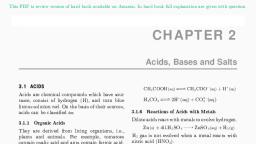
This PDF is review version of hard book available on Amazon. In hard book full explanation are given with question., Chap 3 Acids, Bases and Salts Page 39, , �, �CHAPTER, 2, �Acids, Bases and Salts, 3.1 Acids, Acids are chemical compounds which have sour, taste, consist of hydrogen (H), and turn blue, litmus solution red. On the basis of their sources,, acids can be classified as:, , CH 2 COOH (aq), , H 2 CO 3, , CH 3 COO− (aq) + H+ (aq), , 2H+ (aq) + CO 23− (aq), , 3.1.6 Reactions of Acids with Metals, Dilute acids react with metals to evolve hydrogen., , 3.1.1 Organic Acids, , Zn (s) + dil.H 2 SO 4 $ ZnSO 4 (aq) + H 2 (g), , They are derived from living organisms, i.e.,, plants and animals. For example, tomatoes, contain oxalic acid and ants contain formic acid., , H 2 gas is not evolved when a metal reacts with, nitric acid (HNO 3)., , 3.1.2 Mineral Acids, , 3.1.7 Reactions of Acids with Metal Oxides, , They are obtained from mineral sources, e.g.,, sulphuric acid, nitric acid and hydrochloric acid., They are inorganic acids. Many mineral acids, find extensive use and application., , Metal oxides, being basic in nature, react with, acids to form salt and water., , 3.1.3 Arrhenius Theory of Acids, According to this theory, acids are substances, that ionise to give H+ ions when dissolved in, water, e.g.,, H+ (aq) + Cl− (aq), , HCl (aq), , CaO (s) + 2HCl (aq) $ CaCl 2 (aq) + H 2 O (l), 3.1.8 Reactions of Acids with Metal Carbonates, and Metal Hydrogen carbonates, Acids break up metal carbonates and metal, hydrogen carbonates to evolve carbon dioxide, gas with brisk effervescence., NaCO 3 (s) + 2HCl (aq) $ 2NaCl (aq), + H 2 O (l) + CO 2 (g), , 3.1.4 Strong Acids, These acids ionise more or less completely when, dissolved in water, e.g., sulphuric acid (H 2 SO 4), nitric acid (HNO 3) and hydrochloric acid (HCl)., , NaHCO 3 (s) + HCl (aq) $ NaCl (aq), + H 2 O (l) + CO 2 (g), , HCl (aq) $ H+ (aq) + Cl− (aq), H 2 SO 4 (aq) $ 2H+ (aq) + SO 24− (aq), 3.1.5 Weak Acids, These acids ionise to a small extent when dissolved, in water, e.g., acetic acid (CH 3 COOH), formic, acid (HCOOH) and carbonic acid (H 2 CO 3)., , 3.2 Bases, Bases are chemical compounds which have bitter, taste, are soapy and slippery to touch, and turn, red litmus solution blue, e.g., sodium hydroxide,, potassium hydroxide, aluminium hydroxide, etc., Those bases which are soluble in water are called, alkalis., , To Purchase Hard Book of From Amazon Click Here., For More Details Whatsapp at 8905629969
Page 41 :
For Answer and Explanation Question Click the Link in Pink Color., Page 40 Acids, Bases and Salts, , 2NaOH (aq) + CO 2 (g) $ Na 2 CO 3 (aq), , 3.2.1 Arrhenius Theory of Bases, According to this theory, bases are substances, that ionise to give hydroxyl ion (OH-) when, dissolved in water, e.g.,, +, , −, , NaOH (aq) $ Na (aq) + OH (aq), 3.2.2 Strong Bases, They ionise more or less completely on dissolving, in water, e.g., NaOH, KOH, Ca (OH) 2 etc., NaOH (aq) $ Na+ (aq) + OH− (aq), 3.2.3 Weak Bases, They ionise to a small extent on dissolving in, water, e.g., ammonium hydroxide (NH 4 OH),, copper hydroxide [Cu (OH) 2], etc., NH 4 OH (aq), , Chap 3, , NH +4 (aq) + OH− (aq), , + H 2 O (l), 3.2.7 Neutralisation, When an acid reacts with a base, it gives salt, and water, it is called neutralisation reaction,, and also it is an exothermic process., HCl (aq) + NaOH (aq) " NaCl (aq) + H 2 O (l), 3.2.8 pH, The negative exponent of 10 to which it must, be raised in order to express the hydrogen ion, concentration of the solution in mole per litre., Mathematically, [H+ (aq)] = 10−pH, Higher the H+ (aq) concentration, lower is, the pH value., 3.2.9 pH Scale, , 3.2.4 Indicators, Acid-base indicators (indicators) are natural or, synthetic dyes which show a change of colour, depending upon the acidity or alkalinity of a, solution., The indicator like litmus is red in acidic, and blue in basic medium. Methyl orange, is red in acidic and yellow in basic medium., Phenolphthalein is colourless in acidic and, pinkish-red in basic medium., 1. Olfactory Indicators : Those substances, whose odour changes in acidic or basic, medium are called olfactory indicators, e.g.,, the smell of onion diminishes in a base but, remains as such in an acid., 3.2.5 Reactions of Bases with Metals, Metals like Zn and Al react with strong alkalis, to evolve H 2 gas., , In neutral solution and pure water, pH = 7,, acidic solutions, pH < 7 and alkaline solutions,, pH > 7 ., 3.2.10 Universal Indicator, It is a pH indicator composed of several, compounds that exhibit colour changes over a, pH value range from 0 to 14. It not only shows, acidic or basic nature of solution but also shows, approximate pH by giving a particular colour for, a specific value of pH., , 3.3 Salts, They are ionic compounds formed by the, combination of cation from base and anion from, acid., NaOH (aq) + HCl (aq) $ NaCl (aq), (Base), , (Acid), , + H 2 O (l), , Zn (s) + 2NaOH (aq) " Na 2 ZnO 2 (aq) + H 2 (g), Sodium zincate, , 3.2.6 Reactions of Bases with Non-metallic, Oxides, Bases react with acidic oxides to form salt and, water., , (Salt), , (Water), , 3.3.1 pH of Salt Solutions, 1. The salt of a strong acid and a weak base, gives acidic solution (pH less than 7)., NH 4 Cl (s) + H 2 O (l), , To Purchase Hard Book of From Amazon Click Here., For More Details Whatsapp at 8905629969, , NH 4 OH (aq)
Page 42 :
This PDF is review version of hard book available on Amazon. In hard book full explanation are given with question., Chap 3 Acids, Bases and Salts Page 41, , + HCl (aq), Here, hydrochloric acid (strong acid) ionises, to give H+ (aq) ions which is greater than, ammonium hydroxide (weak base) ionises to, give OH- (aq) ions, so, the solution is acidic., 2. The salt of a strong base (NaOH) and a weak, acid H 2 CO 3 gives basic solution (pH more, than 7)., NH 2 CO 3 (s) + H 2 O (l), , 2NaOH (aq), + H 2 CO 3 (aq), -, , Here, NaOH releases OH (aq) ion more, and H 2 CO 3 releases H+ (aq) ion less, so, the, solution is basic., 3. The salt of a weak acid (HA) and a weak, base (BOH) gives slightly acidic or slightly, basic or neutral solution (BA)., BA + H 2 O, , HA + BOH, , If acid is stronger than base, the solution is, acidic (pH < 7). If acid is weaker than the, base, the solution is basic (pH > 7) . If acid, and base formed are of equal strength, the, solution is neutral (pH = 7) ., 4. The salt of a strong acid and a strong base, gives neutral solution(pH = 7) . Salts of, strong acids and bases, e.g., NaCl, Na 2 SO 4 ,, etc., on dissolving in water do not hydrolyse,, so, not disturb the pH = 7., 3.3.2 Sodium Chloride (NaCI), It is common salt. It is obtained from sea water, by the process of evaporation., Uses of Sodium Chloride, 1. Sodium chloride (NaCI) helps in proper, functioning of the human body, i.e., in muscle, contraction, etc. It helps the body to prepare, hydrochloric acid in gastric juice., 2. It is used in cooking food and it improves the, flavour of food., 3. It is used to prepare NaOH, Na 2 CO 3 , etc., 3.3.3 Sodium Hydroxide (NaOH), It is prepared on a large scale by electrolysis of a, conc. solution of sodium chloride. This solution, , is called brine., 2NaCl (aq) + 2H 2 O (l), , Electric, Current, , 2NaOH (aq), , + H 2 (g) + Cl 2 (g), Hydrogen gas is obtained at cathode and, chlorine gas at anode. NaOH remains in solution., The solution on evaporation gives solid NaOH., This process is called chlor-alkali process., 1. Sodium Hydroxide is used in manufacturing, soaps, detergents, paper, artificial silk, (rayon) and dyes. It is used in manufacturing, chemicals, i.e., sodium hypochlorite, sodium, chlorate, etc., 3.3.4 Uses of Hydrogen Gas, It is used In manufacturing of ammonia and, methyl alcohol and to prepare hydrochloric acid., It is used fur hydrogenating oils to give fats., Vegetable oils on hydrogenation give margarine., Vegetable oil + H 2 " Margarine (vegetable ghee), 3.3.5 Uses of Chlorine Gas, It is used as a bleaching agent in textile industry, and used for sterilising water., 3.3.6 Washing Soda (Na 2 CO 3 $ 10H 2 O), It is obtained from sodium carbonate (Na 2 CO 3), through ammonia-soda or Solvay process. Its, chemical name is sodium carbonate decahydrate., Uses of Washing Soda : It is used for washing, clothes and in manufacturing glass, caustic soda,, borax, etc., 3.3.7 Baking Soda (NaHCO 3), It is prepared by passing carbon dioxide through, an aqueous solution of sodium carbonate. Its, chemical name is sodium hydrogen carbonate or, sodium bicarbonate., Na 2 CO 3 + CO 2 + H 2 O $ 2NaHCO 3, It Is a white crystalline solid, sparingly, soluble in water and its aqueous solution is, mildly alkaline. It decomposes on heating to give, Na 2 CO 3 and release CO 2 . It reacts with acids, (H+) to evolve CO 2 ., , To Purchase Hard Book of From Amazon Click Here., For More Details Whatsapp at 8905629969
Page 43 :
For Answer and Explanation Question Click the Link in Pink Color., Page 42 Acids, Bases and Salts, , 2NaHCO 3, , Heat, , Na 2 CO 3 + H 2 O + CO 2, , NaHCO 3 + H+ $ Na+ + H 2 O + CO 2, 3.3.8 Uses of Baking Soda, It is used in cooking and as an antacid to correct, the acidity of stomach. It is used in making, effervescent drinks and in fire extinguishers, and, also in preparing baking powder., 3.3.9 Bleaching Powder, The chemical name of bleaching powder is, calcium oxychloride (CaOCl 2). It is obtained by, passing Cl 2 gas over dry slaked lime., Ca (OH) 2 (s) + Cl 2 (g), , 30cC − 35cC, , CaOCl 2 (s), + H 2 O (l), , 3.3.10 Uses of Bleaching Powder, It is used for bleaching of wood pulp, cotton,, and as a disinfectant., , that is loosely attached to a certain number of, water molecules is called hydrated salt. These, water molecules are water of crystallisation., 2. Hygroscopy : Those substances which, absorb moisture from atmosphere at, ordinary temperature, are called hygroscopic, substances, and the property is known as, hygroscopy, e.g., conc. H 2 SO 4, etc., 3. Deliquescence : Those substances which, absorb moisture from atmosphere at ordinary, temperature and ultimately dissolve in the, absorbed water to form a solution are called, deliquescent substances and the phenomenon, is called deliquescence, e.g., NaOH, KOH,, etc., 4. Efflorescence : Certain hydrated salts when, exposed to air at ordinary temperature lose, their water of crystallisation either partially, or completely, are called efflorescent salts, and the phenomenon is called efflorescence,, e.g., washing soda, epsom salt, etc., �******, �, , 3.3.11 Plaster of Paris, Its chemical name is calcium sulphate, hemihydrate [CaSO 4 $ (1/2) H 2 O]. It is obtained, by heating gypsum (CaSO 4 $ 2H 2 O)., CaSO 4 $ 2H 2 O, , Chap 3, , 373 K - 398 K, In a ki ln, , CaSO 4, , $ (1/2) H 2 O + (3/2) H 2 O, Plaster of Paris on mixing with an adequate, quantity of water, it forms a gypsum again., , Don’t Take Printout of This File because, this is not useful. You can purchase hard, book from Amazon. Hard book includes, explanation of all MCQs in print form., , CaSO 4 $ (1/2) H 2 O + (3/2) H 2 O, $ CaSO 4 $ 2H 2 O, 3.3.12 Uses of Plaster of Paris, It is used for immobilising the affected fractured, part of bone leading to quick recovery. It is also, used for making decorative pieces such as toys,, statues, etc., Plaster of Paris should be stored in moistureproof container., 3.3.13 Water of Crystallisation, 1. Hydrated Salts : A crystalline salt molecule, , To Purchase Hard Book of From Amazon Click Here., For More Details Whatsapp at 8905629969
Page 44 :
This PDF is review version of hard book available on Amazon. In hard book full explanation are given with question., Chap 3 Acids, Bases and Salts Page 43, , ��mulitiple choice QUESTION, , 1., , A solution turns red litmus blue, its pH is, likely to be, (a) 1, (b) 4, (c) 5, (d) 10, , Sol : www.cbse.site/sc/bm104, , 5., , Sol : www.cbse.site/sc/bm101, , 2., , A solution reacts with crushed egg-shells to, give a gas that turns lime-water milky. The, solution contains, (a) NaCl, (b) HCl, (c) LiCl, (d) KCl, Sol : www.cbse.site/sc/bm102, , 3., , 10 mL of a solution of NaOH is found to, be completely neutralised by 8 mL of a, given solution of HCl. If we take 20 mL of, the same solution of NaOH, the amount of, HCl solution (the same solution as before), required to neutralise it will be(a) 4 mL, (b) 8 mL, (c) 12 mL, (d) 16 mL, Sol : www.cbse.site/sc/bm103, , 4., , Which one of the following types of, medicines is used for treating indigestion?, (a) Antibiotic, (b) Analgesic, (c) Antacid, (d) Antiseptic, , What happens when a solution of an acid, is mixed with a solution of a base in a test, tube?, 1. Salt formation takes place., 2. The temperature of the solution remains, the same., 3. The temperature of the solution, decreases., 4. The temperature of the solution, increases., (a) Only 1, (b) 1 and 2, (c) 2 and 4, (d) 1 and 4, Sol : www.cbse.site/sc/bm105, , 6., , An aqueous solution turns red litmus, solution blue. Excess addition of which of, the following solution would reverse the, change?, (a) Baking powder, (b) Lime, (c) Ammonium hydroxide solution, (d) Hydrochloric acid, Sol : www.cbse.site/sc/bm106, , 7., , During the preparation of hydrogen chloride, gas on a humid day, the gas is usually passed, through the guard tube containing calcium, chloride. The role of calcium chloride taken, in the guard tube is to, (a) absorb the evolved gas, (b) moisten the gas, (c) absorb moisture from the gas, (d) absorb Cl- ions from the evolved gas., Sol : www.cbse.site/sc/bm107, , To Purchase Hard Book of From Amazon Click Here., For More Details Whatsapp at 8905629969
Page 45 :
For Answer and Explanation Question Click the Link in Pink Color., Page 44 Acids, Bases and Salts, , 8., , Which of the following salts does not, contain water of crystallization?, (a) Blue vitriol, (b) Baking soda, (c) Washing soda, (d) Gypsum, , Chap 3, , increasing order of acidic strength?, (a) Water 1 Acetic 1 Hydrochloric, (b) Water 1 Hydrochloric 1 Acetic, (c) Acetic 1 Water 1 Hydrochloric, (d) Hydrochloric 1 Water 1 Acetic, Sol : www.cbse.site/sc/bm112, , Sol : www.cbse.site/sc/bm108, , 9., , Sodium carbonate is a basic salt because it, is a salt of, (a) strong acid and strong base, (b) weak acid and weak base, (c) strong acid and weak base, (d) weak acid and strong base, Sol : www.cbse.site/sc/bm109, , 10. Calcium phosphate is present in tooth, enamel. Its nature is, (a) basic, (b) acidic, (c) neutral, (d) amphoteric, Sol : www.cbse.site/sc/bm110, , 11. A sample of soil is mixed with water and, allowed to settle. The clear supernatant, solution turns the pH paper yellowishorange. Which of the following would, change the colour of this pH paper to, greenish-blue?, (a) Lemon Juice, (b) Vinegar, (c) Common salt, (d) An antacid, , 13. If a few drops of a concentrated acid, accidentally spills over the hand of a, student, what should be done?, (a) Wash the hand with saline solution., (b) Wash the hand immediately with, plenty of water and apply a paste of, sodium hydrogen carbonate., (c) After washing with plenty of water, apply solution of sodium hydroxide on, the hand., (d) Neutralize the acid with a strong, alkali., Sol : www.cbse.site/sc/bm113, , 14. Sodium hydrogen carbonate when added, to acetic acid evolves a gas. Which of the, following statements are true about the gas, evolved?, 1. It turns lime water milky., 2. It extinguishes a burnings splinter., 3. it dissolves in a solution of sodium, hydroxide., 4. It has a pungent odour., (a) 1 and 2, (b) 1, 2 and 3, (c) 2, 3 and 4, (d) 1 and 4, Sol : www.cbse.site/sc/bm114, , Sol : www.cbse.site/sc/bm111, , 12. Which of the following gives the correct, , 15. Common salt besides being used in kitchen, can also be used as the raw material for, making, 1. washing soda, , To Purchase Hard Book of From Amazon Click Here., For More Details Whatsapp at 8905629969
Page 46 :
This PDF is review version of hard book available on Amazon. In hard book full explanation are given with question., Chap 3 Acids, Bases and Salts Page 45, , Sol : www.cbse.site/sc/bm118, , 2. bleaching powder, 3. baking soda, 4. slaked lime, (a), (b), (c), (d), , 1 and 2, 1, 2 and 4, 1 and 3, 1, 3 and 4, , Sol : www.cbse.site/sc/bm115, , 19. The pH of the gastric juices released during, digestion is, (a) less than 7, (b) more than 7, (c) equal to 7, (d) equal to 0, Sol : www.cbse.site/sc/bm119, , 16. One of the constituents of baking powder, is sodium hydrogen carbonate, the other, constituent is, (a) hydrochloric acid, (b) tartaric acid, (c) acetic acid, (d) sulphuric acid, Sol : www.cbse.site/sc/bm116, , 17. To protect tooth decay we are advised to, brush our teeth regularly. The nature of, the toothpaste commonly used is, (a) acidic, (b) neutral, (c) basic, (d) corrosive, Sol : www.cbse.site/sc/bm117, , 18. Which of the following statements is correct, about an aqueous solution of an acid and, of base?, 1. Higher the pH, stronger the acid, 2. Higher the pH, weaker the acid, 3. Lower the pH, stronger the base, 4. Lower the pH, weaker the base, (a), (b), (c), (d), , 1, 2, 1, 2, , and, and, and, and, , 3, 3, 4, 4, , 20. Which of the following phenomena occur,, when a small amount of acid is added to, water?, 1. Ionization, 2. Neutralization, 3. Dilution, 4. Salt formation, (a) 1 and 2, (b) 1 and 3, (c) 2 and 3, (d) 2 and 4, Sol : www.cbse.site/sc/bm120, , 21. Which one of the following can be used, as an acid-base indicator by a visually, impaired student?, (a) Litmus, (b) Turmeric, (c) Vanilla essence, (d) Petunia leaves, Sol : www.cbse.site/sc/bm121, , 22. Which of the following substances will not, give carbon dioxide on treatment with, dilute acid?, (a) Marble, (b) Limestone, (c) Baking soda, , To Purchase Hard Book of From Amazon Click Here., For More Details Whatsapp at 8905629969
Page 47 :
For Answer and Explanation Question Click the Link in Pink Color., Page 46 Acids, Bases and Salts, , (d) Lime, , (d) Only 4, , Sol : www.cbse.site/sc/bm122, , Sol : www.cbse.site/sc/bm124, , 23. Which of the following is acidic in nature?, (a) Lime juice, (b) Human blood, (c) Lime water, (d) Antacid, Sol : www.cbse.site/sc/bm123, , Chap 3, , 25. Which of the following is used for dissolution, of gold?, (a) Hydrochloric acid, (b) Sulphuric acid, (c) Nitric acid, (d) Aqua regia, Sol : www.cbse.site/sc/bm125, , 24. In an attempt to demonstrate electrical, conductivity through an electrolyte, the, following apparatus (figure) was set up., , 26. Which of the following is not a mineral, acid?, (a) Hydrochloric acid, (b) Citric acid, (c) Sulphuric acid, (d) Nitric acid, Sol : www.cbse.site/sc/bm126, , 27. Which among the following is not a base?, (a) NaOH, (b) KOH, (c) NH 4 OH, (d) C 2 H 5 OH, Sol : www.cbse.site/sc/bm127, Which among the following statement (s), is (are) correct?, 1. Bulb will not glow because electrolyte is, not acidic., 2. Bulb will glow because NaOH is a strong, base and furnishes ions for conduction., 3. Bulb will not glow because circuit is, incomplete., 4. Bulb will not glow because it depends, upon the type of electrolytic solution., (a) 1 and 3, (b) 2 and 4, (c) Only 2, , 28. Which of the following statements is not, correct?, (a) All metal carbonates react with acid, to give a salt, water and carbon, dioxide., (b) All metal oxides react with water to, give salt and acid., (c) Some metals react with acids to give, salt and hydrogen., (d) Some non-metal oxides react with, water to form acid., , To Purchase Hard Book of From Amazon Click Here., For More Details Whatsapp at 8905629969
Page 48 :
This PDF is review version of hard book available on Amazon. In hard book full explanation are given with question., Chap 3 Acids, Bases and Salts Page 47, , Sol : www.cbse.site/sc/bm128, , 29. Match the chemical substances given, in column (A) with their appropriate, application given in column (B), Column (A), , Column (B), , A. Bleaching, powder, , (i), , Preparation of, glass, , B. Baking soda, , (ii), , Production of, H 2 and Cl 2, , C. Washing soda, , (iii) Decolorization, , D. Sodium chloride (iv) Antacid, , (a), (b), (c), (d), , AAAA-, , (ii), B- (i), C- (iv), D- (iii), (iii), B- (ii), C- (iv), D- (i), (iii), B- (iv), C- (i), D- (ii), (ii), B- (iv), C- (i), D- (iii), , Sol : www.cbse.site/sc/bm129, , 30. Equal volumes of hydrochloric acid and, sodium hydroxide solutions of same, concentration are mixed and the pH of, the resulting solution is checked with a pH, paper. What would be the colour obtained?, , 3. It gives both hydrogen and hydroxyl ion, in the solution., 4. It forms hydronium ion in the solution, due to the combination of hydrogen ion, with water molecule., (a) Only 1, (b) Only 3, (c) 2 and 4, (d) 3 and 4, Sol : www.cbse.site/sc/bm131, , 32. Which of the following statements is true, for acids?, (a) Bitter and change red litmus to blue, (b) Sour and change red litmus to blue, (c) Sour and change blue litmus to red, (d) Bitter and change blue litmus to red, Sol : www.cbse.site/sc/bm132, , 33. Which of the following are present in a, dilute aqueous solution of hydrochloric, acid?, (a) H 3 O+ + Cl−, (b) H 3 O+ + OH−, (c) Cl− + OH−, (d) Unionized HCl, Sol : www.cbse.site/sc/bm133, , (a), (b), (c), (d), , Red, Yellow, Yellowish green, Blue, , Sol : www.cbse.site/sc/bm130, , 31. Which of the following is (are) true when, HCl (g) is passed through water?, 1. It does not ionise in the solution as it is, a covalent compound., 2. It ionizes in the solution., , 34. Identify the correct representation of, reaction occurring during chlor-alkali, process., (a) 2NaCl (l ) + 2H 2 O (l ) " 2NaOH (l ), + Cl 2(g) + H 2(g), (b) 2NaCl (aq) + 2H 2 O (aq) " 2NaOH (aq), + Cl 2(g) + H 2(g), (c) 2NaCl (aq) + 2H 2 O (l ) " 2NaOH (aq), + Cl 2(aq) + H 2(aq), (d) 2NaCl (aq) + 2H 2 O (l ) " 2NaOH (aq), + Cl 2(g) + H 2(g), , To Purchase Hard Book of From Amazon Click Here., For More Details Whatsapp at 8905629969
Page 49 :
For Answer and Explanation Question Click the Link in Pink Color., Page 48 Acids, Bases and Salts, , Sol : www.cbse.site/sc/bm134, , 35. Which of the following statements is/are, correct for litmus?, 1. Litmus solution is a purple dye., 2. It is extracted from lichen., 3. In neutral solution. it remains colourless., (a) 1 and 2, (b) 2 and 3, (c) 1 and 3, (d) 1, 2 and 3, Sol : www.cbse.site/sc/bm135, , 36. Which of the following is/are correct for, olfactory indicators?, 1. Their colour changes with acid or base., 2. Onion, vanilla or clove are examples., (a) Only 1, (b) Only 2, (c) Both 1 and 2, (d) Neither 1 nor 2, Sol : www.cbse.site/sc/bm136, , 37. Which of the following are correctly, matched?, 1. Acid + salt, , metal + hydrogen, , 2. Acid + metal, carbonate, , salt + carbon, dioxide + water, , 3. Metal oxide +, acid, , salt + water, , (a), (b), (c), (d), , diluting acid?, 1. Adding acid to water by stirring., 2. Adding water to acid by stirring., (a) Only 1, (b) Only 2, (c) Both 1 and 2, (d) Neither 1 nor 2, Sol : www.cbse.site/sc/bm138, , 39. Which of the following is/are correct for, pH?, 1. A scale for measuring hydronium ion, concentration., 2. Values less than 7 on the pH scale, represent an acidic solution., 3. As the pH value increases from 7 to 14,, it represents an increase in hydrogen, ion concentration in the solution., (a) Only 1, (b) Only 2, (c) Only 3, (d) 1, 2 and 3, Sol : www.cbse.site/sc/bm139, , 40. Which of the following are correctly, matched?, 1. Plants and, animals, , pH range is 7.0 to 7.8, , 2. Rain water, , pH is 7.6, , 3. Tooth decay, , pH less than 5.5, , (a), (b), (c), (d), , 1 and 2, 2 and 3, 1 and 3, 1, 2 and 3, , Chap 3, , 1 and 2, 2 and 3, 1 and 3, 1, 2 and 3, , Sol : www.cbse.site/sc/bm140, , Sol : www.cbse.site/sc/bm137, 41. Which of the following are correctly, 38. Which of the following is/are correct for, , To Purchase Hard Book of From Amazon Click Here., For More Details Whatsapp at 8905629969
Page 50 :
This PDF is review version of hard book available on Amazon. In hard book full explanation are given with question., Chap 3 Acids, Bases and Salts Page 49, , matched?, 1. Common salt formed by sodium, hydroxide and, hydrochloric acid., 2. Brine, , aqueous solution of, sodium chloride., , 3. Chlor-alkali, process, , formation of sodium, chloride, , (a), (b), (c), (d), , 1 and 2, 2 and 3, 1 and 3, 1, 2 and 3, , Sol : www.cbse.site/sc/bm141, , 42. Which of the following are correctly, matched?, 1. Bleaching, powder, , oxidising agent in, chemical industries., , 2. Baking powder a mixture of sodium, hydrogen carbonate, and a mild edible, acid., 3. Washing soda, (a), (b), (c), (d), , remove permanent, hardness of water., , 1 and 2, 2 and 3, 1 and 3, 1, 2 and 3, , Sol : www.cbse.site/sc/bm142, , 43. The chemical formula of plaster of paris is, (a) CaSO 4 $ 1 H 2 O, 2, 1, (b) CaSO 3 $ H 2 O, 2, (c) Ca $ SO 4 1 O 2, 2, (d) SO 4 $ 1 H 2 O, 2, Sol : www.cbse.site/sc/bm143, , 44. Which of the following are responsible for, causing acid-rain?, (a) Oxides of sulphur and carbon dioxide, (b) Oxides of nitrogen and carbon, monoxide, (c) Hydrogen sulphide and carbon dioxide, (d) Oxides of sulphur and nitrogen, Sol : www.cbse.site/sc/bm144, , 45. On washing with soap, a turmeric stain on, the cloth turns to red because, 1. Soap solution is alkaline., 2. Soap solution is acidic., 3. Turmeric contains a natural indicator., 4. Turmeric contains litmus., Select the correct alternative., (a) 1 and 3, (b) 2 and 4, (c) 3 and 2, (d) 1 and 4, Sol : www.cbse.site/sc/bm145, , 46. Which of the following are used as an, antacid to reduce acidity in stomach?, (a) Sodium carbonate and magnesium, hydroxide, (b) Magnesium hydroxide and sodium, hydroxide, (c) Sodium bicarbonate and calcium, hydroxide, (d) Sodium bicarbonate and magnesium, hydroxide, Sol : www.cbse.site/sc/bm146, , 47. A highly reactive element (X ) reacts with, oxygen of air even at room temperature to, give an oxide (Y ). The oxide (Y ) is soluble, in water. The aqueous solution of (Y ) does, not change the colour of red litmus solution, but reacts with an aqueous solution of, , To Purchase Hard Book of From Amazon Click Here., For More Details Whatsapp at 8905629969
Page 51 :
For Answer and Explanation Question Click the Link in Pink Color., Page 50 Acids, Bases and Salts, , sodium hydroxide. Here X is(a) sodium, (b) phosphorus, (c) carbon, (d) sulphur, , X , Y and Z respectively are, (a) CaCO 3 , Ca (OH) 2 , CaOCl 2, (b) Ca (OH) 2 , CaO, CaOCl 2, (c) CaCO 3 , CaOCl 2 , Ca (OH) 2, (d) Ca (OH) 2 , CaCO 3 , CaOCl 2, , Sol : www.cbse.site/sc/bm147, , Sol : www.cbse.site/sc/bm150, , 48. Some of the substances used in making of a, modern safety match box are listed below :, 1. Antimony trisulfide, 2. Glass powder, 3. Potassium chlorate, 4. Red phosphorus, The head of modern safety match stick, contains :, (a) 1 and 4, (b) 2 and 3, (c) 3 and 4, (d) 3 and 1, Sol : www.cbse.site/sc/bm148, , 49. Calamine is used to reduce the irritating, effect of ant bite/sting because it reacts, with (X ) released due to the bite/sting of, ants with (Y ) present in calamine. Then, (X ) and (Y ) respectively are :, (a) Sodium hydrogen carbonate and, formic acid, (b) Formic acid and zinc carbonate, (c) Acetic acid and common salt, (d) Hydrochloric acid and zinc oxide, Sol : www.cbse.site/sc/bm149, , 50. A metal carbonate X on treatment with, a mineral acid liberates a gas which when, passed through an aqueous solution of a, substance Y on reaction with the gas, obtained at anode during electrolysis of, brine gives a compound Z which can decolourise coloured fabrics. The compounds, , Chap 3, , 51. A salt can be produced by reaction between, 1. a weak acid and weak base., 2. metal oxide and water., 3. metal and a mineral acid., 4. metal oxide and a mineral acid., (a) 1, 2 and 3, (b) 2, 3 and 4, (c) 3, 4 and 1, (d) 4, 1 and 2, Sol : www.cbse.site/sc/bm151, , 52. Which of the following is true about the, two statements?, Statement I : Reactivity of aluminium, decreases when it is dipped in nitric acid, Statement II : A protective layer of, aluminium nitrate is formed when, aluminium is dipped in nitric acid., (a) I is correct but II is incorrect, (b) I is incorrect but II is correct, (c) Both the statements are correct and, II is also the correct explanation of I, (d) Both the statements are correct but II, is not correct explanation of I, Sol : www.cbse.site/sc/bm152, , 53. A silvery white metal X reacts with water, at room temperature to produce a water, soluble compound Y and a colourless gas, Z . The reaction is highly exothermic and, the Z catches fire immediately during, the reaction. The solution of Y in water, on reacting with stoichiometric amount of, , To Purchase Hard Book of From Amazon Click Here., For More Details Whatsapp at 8905629969
Page 52 :
This PDF is review version of hard book available on Amazon. In hard book full explanation are given with question., Chap 3 Acids, Bases and Salts Page 51, , dilute solution of hydrochloric acid gives a, solution of pH = 7.0 . The compounds X ,, Y and Z respectively are(a) Al, Al (OH) 3 and H 2, (b) Ag, AgOH and H 2, (c) K, KCl and H 2, (d) Na, NaOH and H 2, , passed through an aqueous solution of R,, baking soda is formed. The substances P, and Q are, (a) HCl and NaOH, (b) HCl and Na 2 CO 3, (c) Na and HCl, (d) Na 2 CO 3 and H 2 O, , Sol : www.cbse.site/sc/bm153, , Sol : www.cbse.site/sc/bm156, , 54. Match the items of Column I with the items, of the Column II, Column I, , Column II, , (i), , NH 4 OH + CH3 COOH, " CH3 COONH 4 + H2 O, , (A) Thermal, decomposition, , (ii), , 2AgBr " 2Ag + Br2, , (B) Thermite, reaction, , (iii) ZnCO3 " ZnO + CO2, (iv), , (a), (b), (c), (d), , (C) Photochemical, reaction, , 2Al + Fe2 O3 " 2Fe + Al2 O3 (D) Neutralization, reaction, , (iv)-(B), (iii)-(D), (ii)-(A), (i)-(C), (iii)-(A), (i)-(B), (iii)-(C), (iv)-(D), (ii)-(B), (iv)-(A), (i)-(C), (iii)-(D), (i)-(D), (ii)-(C), (iii)-(A), (iv)-(B), , Sol : www.cbse.site/sc/bm154, , 55. Which of the following represents the correct, order of the acidic strength for equimolar, aqueous solutions of HCl, H 2 SO 4 , NH 4 OH, and NaOH, (a) HCl 1 NH 4 OH 1 NaOH 1 H 2 SO 4, (b) NH 4 OH 1 NaOH 1 H 2 SO 4 1 HCl, (c) HCl 1 H 2 SO 4 1 NH 4 OH 1 NaOH, (d) NaOH 1 NH 4 OH 1 HCl 1 H 2 SO 4, Sol : www.cbse.site/sc/bm155, , 56., , P substance a react with another substance, Q to produce the product R and a gas S., If a mixture of the gas S. and ammonia is, , 57. The reaction that differs from the rest of, the reaction given is(a) formation of calcium oxide from, limestone, (b) formation, of, aluminium, from, aluminium oxide, (c) formation of sodium carbonate from, sodium hydrogen carbonate, (d) formation of mercury from mercuric, oxide, Sol : www.cbse.site/sc/bm157, , 58. An element X reacts with dilute H 2 SO 4, as well as with NaOH to produce salt and, H 2 (g). Hence, it may be concluded that :, 1. X is an electro-positive element., 2. oxide of X is basic in nature., 3. oxide of X is acidic in nature., 4. X is an electronegative element., (a) 1, 2, 3, (b) 4, 1, 2, (c) 3, 4, 1, (d) 2, 3, 4, Sol : www.cbse.site/sc/bm158, , 59. The turmeric solution will turn red by an, aqueous solution of(a) potassium acetate, (b) copper sulphate, (c) sodium sulphate, , To Purchase Hard Book of From Amazon Click Here., For More Details Whatsapp at 8905629969
Page 53 :
For Answer and Explanation Question Click the Link in Pink Color., Page 52 Acids, Bases and Salts, , (d) ferric chloride, , Chap 3, , Sol : www.cbse.site/sc/bm162, , Sol : www.cbse.site/sc/bm159, , 60. The schematic diagram is given below :, , 63. Which of the following statement is, incorrect for acids?, (a) They, pink, colour, with, give, phenolphthalein., (b) They give H+ ions in water., (c) They are sow in taste., (d) They turn blue litmus red., Sol : www.cbse.site/sc/bm163, , Which of the following is an incorrect, statement?, (a) A and E are chemically same., (b) A and D are chemically same., (c) D and E are chemically same., (d) C and E are chemically same., , 64. Which two substances react to give salt, and water only?, (a) Copper (II) oxide and ethanoic acid, (b) Magnesium and sulphuric acid, (c) Sodium oxide and water, (d) Zinc carbonate and hydrochloric acid, Sol : www.cbse.site/sc/bm164, , Sol : www.cbse.site/sc/bm160, , 61. When an acid reacts with a metal than X, gas is liberated. Here X is(a) Ammonia gas, (b) Hydrogen gas, (c) Carbon dioxide gas, (d) Methane gas, Sol : www.cbse.site/sc/bm161, , 62. Which of the following is not true for acids?, (a) Acid react with copper (II) oxide to, produce a blue solution., (b) Acid liberate carbon dioxide gas when, reacted with sodium carbon-ale, (c) Acid liberate hydrogen gas when, reacted with magnesium ribbon., (d) Acid produces hydrogen molecules, when dissolved in water., , 65. A solution in test tube ‘A’ turns red litmus, blue, evolves hydrogen gas on reaction, with zinc and does not react with sodium, carbonate. Whereas, solution in test, tube ‘B’ turns blue litmus red, liberates, hydrogen gas on reaction with zinc and, evolves carbon dioxide gas with sodium, carbonate. Identify ‘A’ and ‘B’ ., (a) ‘A’ is an acid, ‘B’ is a base., (b) ‘A’ is a base, ‘B’ is an acid., (c) Both ‘A’ and ‘B’ are bases., (d) Both ‘A’ and ‘B’ are acids., Sol : www.cbse.site/sc/bm165, , 66. Which of the following will turn red litmus, to blue?, (a) Vinegar, (b) Banking soda solution, (c) Soft drink, , To Purchase Hard Book of From Amazon Click Here., For More Details Whatsapp at 8905629969
Page 54 :
This PDF is review version of hard book available on Amazon. In hard book full explanation are given with question., Chap 3 Acids, Bases and Salts Page 53, , (d) Lemon juice, Sol : www.cbse.site/sc/bm166, , 70. When pH strip is dipped in each bottle,, the colour shown by bottle A and B will, be respectively:, , 67. Which gas is evolved when acids react with, metal carbonates?, (a) H 2, (b) CO 2, (c) O 2, (d) NH 3, Sol : www.cbse.site/sc/bm167, , 68. The colour of the pH paper turned red, when it was dipped in X solution. The X, is(a) Dilute Hydrochloric acid., (b) Dilute sodium hydroxide solution., (c) Tap water, (d) Dilute sodium bicarbonate solution., Sol : www.cbse.site/sc/bm168, , 69. Which of the following is not a base?, (a) NaCl, (b) KOH, (c) ZnO, (d) Al (OH) 3, Sol : www.cbse.site/sc/bm169, , Don’t Take Printout of This File because, this is not useful. You can purchase hard, book from Amazon. Hard book includes, explanation of all MCQs in print form., , (a), (b), (c), (d), , orange, blue, blue, orange, green, blue, blue, green, , Sol : www.cbse.site/sc/bm170, , 71., , 2NaOH + Zn $ X + H 2, Here X is, (a) Na 2 ZnO 2, (b) NaZnO 2, (c) Na 2 ZnO, (d) Na 3 ZnO 2, Sol : www.cbse.site/sc/bm171, , 72. Which of the following solutions has the, lowers pH value?, (a) 0.1 molar NaCl solution, (b) 0.01 molar NaHCO 3 solution, (c) 0.001 molar Na2CO 3 solution, (d) 0.01 molar NaOH solution, Sol : www.cbse.site/sc/bm172, , 73. On putting a few drops of X liquid on the, pH paper the colour of pH paper changes, to violet. The liquid X is, (a) Dilute sodium hydroxide, , To Purchase Hard Book of From Amazon Click Here., For More Details Whatsapp at 8905629969
Page 55 :
For Answer and Explanation Question Click the Link in Pink Color., Page 54 Acids, Bases and Salts, , (b) Dilute hydrochloric acid, (c) Dilute acetic acid, (d) Water, Sol : www.cbse.site/sc/bm173, , 74. The, (a), (b), (c), (d), , term pH stands for:, potential of hydrogen, peak of hydrogen, push of hydrogen, pointed to hydrogen, , Sol : www.cbse.site/sc/bm174, , 75. pH of different solution are given in the, table below., , Chap 3, , incorrect?, (a) Bases are bitter to taste., (b) Bases are soapy and slippery to touch., (c) Bases are not a good conductor of, electricity., (d) None of these., Sol : www.cbse.site/sc/bm177, , 78. On diluting a solution of pH = 4.5 it pH, will, (a) increases, (b) decreases, (c) remain same, (d) firstly increases than decreases, Sol : www.cbse.site/sc/bm178, , Solution, , pH, , A, , 2.4, , B, , 14.0, , C, , 7.5, , Student Sample, , pH paper colour, , D, , 9.0, , A, , Water, , Blue, , B, , Dilute HCl, , Red, , C, , Dilute NaOH Blue, , D, , Dilute, Ethanoic, acid, , 79. In an experiment of pH paper four students, takes the following observation?, , Arrange the above solution in the increasing, order of OH- ion concentration., (a) D 1 C 1 B 1 A, (b) A 1 C 1 D 1 B, (c) C 1 D 1 B 1 A, (d) B 1 D 1 C 1 A, Sol : www.cbse.site/sc/bm175, , 76. Which of the following is more acidic in, nature?, (a) Baking soda, (b) Lime water, (c) Lemon, (d) Apple, Sol : www.cbse.site/sc/bm176, , 77. Which one of following property of base is, , Which student, observation?, (a) B, (b) C, (c) D, (d) A, , Orange, , takes, , the, , incorrect, , Sol : www.cbse.site/sc/bm179, , 80. Which of the following acid is present in, the vinegar?, (a) Acetic acid, (b) Tartaric acid, , To Purchase Hard Book of From Amazon Click Here., For More Details Whatsapp at 8905629969
Page 56 :
This PDF is review version of hard book available on Amazon. In hard book full explanation are given with question., Chap 3 Acids, Bases and Salts Page 55, , 85. Consider the following table :, , (c) Lactic acid, (d) Citric acid, Sol : www.cbse.site/sc/bm180, , 81. Which of the following is not a acid?, (a) KOH, (b) HNO 3, (c) HCl, (d) H 2 SO 4, , Sol : www.cbse.site/sc/bm183, , 84. Which of the following substance have, maximum value of pH?, (a) Lemon, (b) Rain water, (c) Sea water, (d) Apple, Sol : www.cbse.site/sc/bm184, , Lemon, , 2.3, , Battery acid, , x, , Sea water, , 8.5, , Apple, , 3.1, , value of x in above table is:, 0, 1.3, 2.5, 1.9, , Sol : www.cbse.site/sc/bm185, , 86. Which of the following pair is incorrect?, Substance, , Sol : www.cbse.site/sc/bm182, , 83. .......... indicator odour changes in acidic or, basic media., (a) Methyl orange, (b) Phenolphthalein, (c) Olfactory, (d) Ozonal, , pH, , The, (a), (b), (c), (d), , Sol : www.cbse.site/sc/bm181, , 82. Which of the following is the synthetic, indicator?, (a) Methyl orange, (b) Phenolphthalein, (c) China rose, (d) Both (a) and (b), , Substance, , pH, , (a) Hydrochloric acid, , 1.0, , (b) Vinegar, , 2.8, , (c) Lime water, , 11, , (d) Stomach acid, , 1, , Sol : www.cbse.site/sc/bm186, , 87. Which compound is formed due to the, reaction of acid on metal oxides?, (a) Oxygen, (b) Nitrogen, (c) Salt, (d) Ammonia, Sol : www.cbse.site/sc/bm187, , 88., , 2NaCl + (dil) H 2 SO 4 $ Na 2 SO 4 + Y, Here Y is., (a) Cl 2, (b) H 2, (c) 2HCl, (d) SO 2, , To Purchase Hard Book of From Amazon Click Here., For More Details Whatsapp at 8905629969
Page 57 :
For Answer and Explanation Question Click the Link in Pink Color., Page 56 Acids, Bases and Salts, , Sol : www.cbse.site/sc/bm188, , 89. The, (a), (b), (c), (d), , chemical name of bleaching powder is:, Calcium oxychloride, Calcium chloride, Calcium carbonate, Calcium sulfate, , Sol : www.cbse.site/sc/bm189, , 90. .......... is obtained by heating of gypsum., (a) Bleaching powder, (b) Plaster of paris, (c) Banking soda, (d) Sodium hydroxide, Sol : www.cbse.site/sc/bm190, , 91. .......... is obtained by passing Cl 2 over dry, slaked lime., (a) Plaster of paris, (b) Bleaching powder, (c) Banking soda, (d) Washing soda, Sol : www.cbse.site/sc/bm191, , 92. Washing soda is obtained from .........., carbonate., (a) Calcium, (b) Sodium, (c) Magnesium, (d) Zinc, Sol : www.cbse.site/sc/bm192, , 93. Read the following statements:, I. When a red litmus paper is dipped into, the reaction mixture of a saponification, reaction, it turns blue and the reaction, , Chap 3, , is exothermic., II. When a blue litmus paper is dipped into, the reaction mixture of a saponification, reaction, its colour does not change and, the reaction is exothermic., III. When a red litmus paper is dipped into, the reaction mixture of a saponification, reaction, its colour does not change and, the reaction is endothermic., IV. When a blue litmus paper is dipped into, the reaction mixture of a saponification, reaction, its colour does not change and, the reaction is endothermic., Which of the above statements are correct?, (a) I and II, (b) II and III, (c) III and IV, (d) I and IV, Sol : www.cbse.site/sc/bm193, , 94. A student prepared 20% sodium hydroxide, solution in a beaker containing water. The, observations noted by him are given below., I. Sodium hydroxide is in the form of, pellets., II. It dissolves in water readily., III. The beaker appears cold when touched, from outside., IV. Red litmus paper turns blue when, dipped into the solution., The correct observations are:, (a) I, II and III, (b) II, III and IV, (c) III, IV and I, (d) I, II and IV, Sol : www.cbse.site/sc/bm194, , 95. Hard water required for an experiment, is not available in a school laboratory., However, following salts are available in, the laboratory. Select the salts which may, be dissolved in water to make it hard for, , To Purchase Hard Book of From Amazon Click Here., For More Details Whatsapp at 8905629969
Page 58 :
This PDF is review version of hard book available on Amazon. In hard book full explanation are given with question., Chap 3 Acids, Bases and Salts Page 57, , the experiment., 1. Calcium Sulphate, 2. Sodium Sulphate, 3. Calcium Chloride, 4. Potassium Sulphate, 5. Sodium Hydrogen Carbonate, 6. Magnesium Chloride, (a) 1, 2 and 4, (b) 1, 3 and 6, (c) 3, 5 and 6, (d) 2, 4 and 5, Sol : www.cbse.site/sc/bm195, , 96. In an experiment to study the properties, of acetic acid, a student takes about 2 ml, of acetic acid in a dry test tube. He adds, about 2 ml of water to it and shakes the, test tube well. What will he observe ?, (a) The acetic acid dissolves readily in, water., (b) The solution becomes light orange., (c) Water floats over the surface of acetic, acid., (d) Acetic acid floats over the surface of, water., Sol : www.cbse.site/sc/bm196, , 97. A student takes 2 ml acetic acid in a dry, test tube and adds a pinch of sodium, hydrogen carbonate to it. He makes the, following observations:, I. A colourless and odourless gas evolves, with a brisk effervescence., II. The gas turns lime water milky when, passed through it., III. The gas burns with an explosion when, a burning splinter is brought near it., IV. The gas extinguishes the burning, splinter which is brough near it., The correct observations are:, (a) I, II and III, (b) II, III and IV, , (c) III, IV and I, (d) IV, I and II, Sol : www.cbse.site/sc/bm197, , 98. We need 20% aqueous solution of sodium, hydroxide for the study of saponification, reaction. When we open the lid of the, bottle containing solid sodium hydroxide, we observe it in which form?, (a) Colourless transparent beads, (b) Small white beads, (c) White pellets/flakes, (d) Fine white powder, Sol : www.cbse.site/sc/bm198, , 99. In a locality, hard water, required for an, experiment, is not available. However, the, following salts are available in the school, laboratory:, 1. Sodium sulphate, 2. Calcium sulphate, 3. Magnesium chloride, 4. Sodium chloride, 5. Calcium chloride, 6. Potassium sulphate, Which of the above may be dissolved, in water to obtain hard water for the, experiment?, (a) 2, 3 and 5, (b) 1, 2 and 5, (c) 1, 2, 4 and 6, (d) 3 and 5 only, Sol : www.cbse.site/sc/bm199, , 100. What do we observe on pouring acetic acid, on red and blue litmuts papers?, (a) Red litmus remains red and blue, litmus turns red., (b) Red litmus turns blue and blue litmus, remains blue., , To Purchase Hard Book of From Amazon Click Here., For More Details Whatsapp at 8905629969
Page 59 :
For Answer and Explanation Question Click the Link in Pink Color., Page 58 Acids, Bases and Salts, , (c), , Red litmus turns blue and blue litmus, turns red., (d) Red litmus becomes colourless and, blue litmus remains blue., Sol : www.cbse.site/sc/bm200, , 101. A student takes about 6 ml of distilled, water in each of the four test tubes A, B,, C and D , then dissolves in equal amount, four different salts name sodium chloride, in A Potassium Chloride in B , Calcium, Chloride in C and magnesium chloride in, D . He then adds 10 drop of soap solution, to each test tube and shakes its contents., The test tube(s) in which he would observe, a good amount of lather is:, (a) A and B, (b) Only A, (c) C and D, (d) Only B, Sol : www.cbse.site/sc/bm201, , 102. Hard water is not available for an, experiment in the school and its vicinity., However, some salts as given below are, available in the school laboratory., 1. Sodium Chloride, 2. Sodium Sulphate, 3. Calcium Chloride, 4. Calcium Sulphate, 5. Potassium Chloride, 6. Magnesium Sulphate, Select form the following a group of these, salts, each member of which may be, dissolved in water to make it hard., (a) 1, 2, 5, (b) 1, 3, 5, (c) 3, 4, 6, (d) 2, 4, 6, Sol : www.cbse.site/sc/bm202, , Chap 3, , 103. The pH of soft drink is .......... and they are, .......... ., (a) less than 7, acidic, (b) more than 7, basic, (c) equal to 7, neutral, (d) less than 7, basic, Sol : www.cbse.site/sc/bm203, , 104. When acidified potassium dichromate, solution is added to a jar containing sulphur, dioxide gas, the solution becomes:, (a) colourless, (b) brown, (c) dark orange, (d) green, Sol : www.cbse.site/sc/bm204, , 105. When you add a few drops of acetic acid to, a test-tube containing sodium bicarbonate, powder, which one of the following is your, observation?, (a) No reaction takes place., (b) A colourless gas with pungent smell is, released with brisk effervescence., (c) A brown coloured gas is released with, brisk effervescence., (d) Formation of bubbles of a colourless, and odourless gas., Sol : www.cbse.site/sc/bm205, , 106. A student require hard water for an, experiment in his laboratory which is not, available in the neighbouring area. In the, laboratory there are some salts, which when, dissolved in distilled water can convert it, into hard water. Select from the following, groups of salts, a group, each salt of which, when dissolved in distilled water will make, it hard., (a) Sodium chloride, Potassium chloride, , To Purchase Hard Book of From Amazon Click Here., For More Details Whatsapp at 8905629969
Page 60 :
This PDF is review version of hard book available on Amazon. In hard book full explanation are given with question., Chap 3 Acids, Bases and Salts Page 59, , (b) Sodium sulphate, Potassium sulphate, (c) Sodium sulphate, Calcium sulphate, (d) Calcium sulphate, Calcium chloride, Sol : www.cbse.site/sc/bm206, , 107. To a sample of turmeric adulterated with, metanil yellow, concentrated hydrochloric, acid was added. The colour of the reaction, mixture, (a) became green, (b) became blue, (c) remained the same, (d) disappeared, Sol : www.cbse.site/sc/bm207, , 111. When acid and base is mixed together than, which of the following is formed?, (a) Salt, (b) Base, (c) Acid, (d) Hydrogen, Sol : www.cbse.site/sc/bm211, , 112. Mixing of an acid or base with water is, known as .......... ., (a) dilution, (b) neutralisation, (c) indicators, (d) offertory inductors, Sol : www.cbse.site/sc/bm212, , 108. Which one of the following is used in, manufacturing of ammonia?, (a) Washing soda, (b) Bleaching powder, (c) Plaster of paris, (d) Hydrogen gas, Sol : www.cbse.site/sc/bm208, , 113. Which one of the following is used for, bleaching cotton and linen in textile, industry?, (a) Caustic soda, (b) Bleaching powder, (c) Baking soda, (d) Washing soda, Sol : www.cbse.site/sc/bm213, , 109. Which of the following acid present in curd?, (a) Acetic acid, (b) Citric acid, (c) Oxalic acid, (d) Lactic acid, Sol : www.cbse.site/sc/bm209, , 110. Metal carbonate + acid " salt + Y + water, Here Y is:, (a) carbon dioxide, (b) carbon monoxide, (c) carbon chloride, (d) metal oxide, Sol : www.cbse.site/sc/bm210, , 114. When electricity is passed through an, aqueous solution of sodium chloride than, .......... is formed., (a) Sodium hydroxide, (b) Sodium sulphate, (c) Sodium chloride, (d) Sodium bicarbonate, Sol : www.cbse.site/sc/bm214, , 115. When a few drops of liquid X were added, to distilled water. It was observed that the, pH of water decreased. The liquid sample, , To Purchase Hard Book of From Amazon Click Here., For More Details Whatsapp at 8905629969
Page 61 :
For Answer and Explanation Question Click the Link in Pink Color., Page 60 Acids, Bases and Salts, , X is:, (a) acid, (b) base, (c) salt, (d) mixture of salt and acid, Sol : www.cbse.site/sc/bm215, , Chap 3, , are warmed, a gas evolves which is bubbled, through a soap solution before testing., The name of the gas is:, (a) Hydrogen, (b) Oxygen, (c) Nitrogen, (d) Helium, Sol : www.cbse.site/sc/bm219, , 116. Which of following solution have a higher, concentration of H+ ions?, (a) 1 M HCl solution, (b) 1 M CH 3 COOH solution, (c) 0.5 M CH 3 COOH solution, (d) None of these, Sol : www.cbse.site/sc/bm216, , 117. Arrange the following in the increasing, order of pH values., A. NaOH solution, B. Blood, C. Lemon juice, D. Milk of magnesia, (a) C < B < D < A, (b) A < B < C < D, (c) D < C < B < A, (d) A < B < D < C, Sol : www.cbse.site/sc/bm217, , 120. A student take a small amount of copper, oxide in a beaker and dilute hydrochloric, acid slowly while stirring., Which of the following product is formed in, above process?, (a) CuCl 2, (b) CuCa, (c) CuMg 2, (d) CuCOH, Sol : www.cbse.site/sc/bm220, , 121. Which of the following property is incorrect, for acid?, (a) Acid have sour taste., (b) Acid are corrosive to metals., (c) Acid change red litmus paper to blue., (d) Acid become less acidic on mixing, with bases., Sol : www.cbse.site/sc/bm221, , 118. Which of following tablets are used by a, person suffering from acidity?, (a) Antacid, (b) Antabuse, (c) Antasalt, (d) None of these, Sol : www.cbse.site/sc/bm218, , 119. When 2 mL of sodium hydioxide solution, is added to a few pieces of granulated zinc, metal taken in test tube. When the contents, , 122. Which of the following pair is incorrect?, Acid, , Source, , (a) Ascorbic acid, , All citrus fruits, , (b) Malic acid, , Pears, , (c) Formic acid, , Ant stings, , (d) Acetic acid, , Milk, , Sol : www.cbse.site/sc/bm222, , To Purchase Hard Book of From Amazon Click Here., For More Details Whatsapp at 8905629969
Page 62 :
This PDF is review version of hard book available on Amazon. In hard book full explanation are given with question., Chap 3 Acids, Bases and Salts Page 61, , 123. Which of the following is the organic acids?, (a) HCl, (b) HNO 3, (c) H 2 SO 4, (d) CH 3 COOH, Sol : www.cbse.site/sc/bm223, , 124. Arrange the following acids on their basicity, in the table:, A = HCl , B = HNO 3 , C = H 3 PO 4, Type of acid, 1., , Monobasic, , 2., , Dibasic, , 3., , Tribasic, , (a), (b), (c), (d), , Acid, , 127. An, (a), (b), (c), (d), , acid produces .......... ions in water., Hydrogen, Helium, OHNone of these, , Sol : www.cbse.site/sc/bm227, , 128. Which of the following is the strong acid?, (a) CH 3 COOH, (b) HCN, (c) HBr, (d) HF, Sol : www.cbse.site/sc/bm228, , 1-A, 2-B, 3-C, 1-C, 2-B, 3-A, 1-A, 2-C, 3-B, 1-B, 2-C, 3-A, , 129. Which of the following pair is not correct?, Acid, , Sol : www.cbse.site/sc/bm224, , 125. .......... is used in bathing soaps., (a) Sodium hydroxide, (b) Potassium hydroxide, (c) Magnesium hydroxide, (d) Ammonium hydroxide, Sol : www.cbse.site/sc/bm225, , 126. Which of following in not a natural, indicator?, (a) Red cabbage, (b) China rose, (c) Turmeric, (d) Onion, Sol : www.cbse.site/sc/bm226, , Example, , (a) Monobasic acid, , HNO 3, , (b) Dibasic acid, , H 3 PO 3, , (c) Tribasic acid, , H 3 PO 4, , (d) Monobasic acid, , H 2 SO 4, , Sol : www.cbse.site/sc/bm229, , 130. .......... acid is used in car battery., (a) Nitric, (b) Sulpharic, (c) Carbonic, (d) Tartaric, Sol : www.cbse.site/sc/bm230, , 131. A body wanted to remove the grease strain, from our shirt. So he used a X solution., Here X solution is:, (a) Ammonium hydroxide, (b) Magnesium hydroxide, (c) Calcium hydroxide, (d) Sodium hydroxide, , To Purchase Hard Book of From Amazon Click Here., For More Details Whatsapp at 8905629969
Page 63 :
For Answer and Explanation Question Click the Link in Pink Color., Page 62 Acids, Bases and Salts, , Sol : www.cbse.site/sc/bm231, , 132. Which of the following is the correct for, dilution of acid and base?, (a) Acid or base added to water., (b) Water is added to acid or base., (c) Water is added drop by drop to acid, or base., (d) Water cannot be added in acid or, base., Sol : www.cbse.site/sc/bm232, , 133. The acidic solution is the one in which the, concentration of .......... is grater than that, of .......... ions., (a) H+, OH−, (b) DH−, H+, (c) H 3 O+, H+, (d) H+, H 3 O+, Sol : www.cbse.site/sc/bm233, , 134. The hydrogen ion concentration of solution, is 0.001 M. The pH of solution is?, (a) 3, (b) 2, (c) 1, (d) 1.5, Sol : www.cbse.site/sc/bm234, , 135. The hydrogen ion concentration of a, solution is 1.0 # 10-9 M . The pH of the, solution is:, (a) 10, (b) 9, (c) 11, (d) 8, Sol : www.cbse.site/sc/bm235, , Chap 3, , 136. The hydroxyl ion concentration of a solution, is 0.001 M. The pH of the solution is:, (a) 11, (b) 12, (c) 13, (d) 14, Sol : www.cbse.site/sc/bm236, , 137. The hydroxyl ion concentration of a solution, is 1.0 # 10-9 M . The pH of the solution is:, (a) 4, (b) 5, (c) 6, (d) 7, Sol : www.cbse.site/sc/bm237, , 138. Which of the following statement is, incorrect about acids?, (a) they change the colour of red litmus, to blue, (b) they have sour taste, (c) they may change the colour of, indicator, (d) they changes the colour or blue litmus, to red, Sol : www.cbse.site/sc/bm238, , 139. When Ca (OH) 2 reacts with CO 2 (g), it will, give CaCO 3 (s) and H 2 O (l). The nature of, CaCO 3 is, (a) acidic, (b) basic, (c) neutral, (d) All are possible, Sol : www.cbse.site/sc/bm239, , 140. The correct statement regarding universal, , To Purchase Hard Book of From Amazon Click Here., For More Details Whatsapp at 8905629969
Page 64 :
This PDF is review version of hard book available on Amazon. In hard book full explanation are given with question., Chap 3 Acids, Bases and Salts Page 63, , indicator is, (a) it gives orange colour at pH = 3, (b) it becomes colourless at pH = 7, (c) it is an indicator having pH = 7, (d) it gives blue colour at pH = 3, , (b) Solution P, (c) Solution R, (d) All of the above, Sol : www.cbse.site/sc/bm244, , Sol : www.cbse.site/sc/bm240, , 141. When NaOH and HCl are mixed in equal, molar quantities, the result is, (a) the formation of salt + H 2 O, (b) the formation of salt + H 2 (g), (c) the formation of salt + O 2 (g), (d) All above are correct, , 145. The reagent used to distinguish iron (II), chloride and iron (III) chloride is, (a) Warm water, (b) distilled water, (c) NaOH, (d) dil. HCl, Sol : www.cbse.site/sc/bm245, , Sol : www.cbse.site/sc/bm241, , 142. Aqueous solution of copper sulphate, reacts with aqueous ammonium hydroxide, solution to give., (a) green precipitate, (b) brown precipitate, (c) pale blue precipitate, (d) white precipitate, , 146. An acid (P) with sodium hydrogen, carbonate is used in making the cakes fluffy, and spongy. It is due to the release of (Q), gas in the reaction. Here, P and Q are, (a) P : Tartaric acid : Q : CO 2, (b) P : Succinic acid : Q : H 2, (c) P : Tartaric acid : Q : O 2, (d) P : Oxalic acid : Q : CO 2, Sol : www.cbse.site/sc/bm246, , Sol : www.cbse.site/sc/bm242, , 143. The, (a), (b), (c), (d), , organic acid present in tomato is, oxalic acid, lactic acid, malic acid, tartaric acid, , Sol : www.cbse.site/sc/bm243, , 144. You are having five solutions P, Q, R, S and, T with pH values as follows:, P = 1.8 , Q = 7 , R = 8.5 , S = 8 and T = 5, Which solution would be most likely to, liberate hydrogen with magnesium powder?, (a) Solution P and Q, , 147. The pH of a solution is 4.5. What should, be the change in the hydrogen ion, concentration of the solution, if its pH is to, increased to 6., (a) increases by 10 times, (b) doubled, (c) halved, (d) decreases to 1/10 of its original, concentration, Sol : www.cbse.site/sc/bm247, , 148. The pH of a solution is 6. Its hydrogen ion, concentration is decreased by 100 times,, the solution will be :, (a) more acidic, , To Purchase Hard Book of From Amazon Click Here., For More Details Whatsapp at 8905629969
Page 65 :
For Answer and Explanation Question Click the Link in Pink Color., Page 64 Acids, Bases and Salts, , (b) basic, (c) neutral, (d) unaffected, , (b) NaCl, (c) HCl, (d) LiCl, , Sol : www.cbse.site/sc/bm248, , Sol : www.cbse.site/sc/bm252, , 149. Bleaching powder is soluble in cold water, giving a milky solution due to(a) The absorption of carbon dioxide from, atmosphere, (b) available chlorine, (c) lime present in it, (d) calcium carbonate formation, Sol : www.cbse.site/sc/bm249, , 150. A blue litmus paper was first dipped in, dil. HCl and then in dil. NaOH solution. It, was observed that the colour of the litmus, paper(a) remains blue in both the solutions, (b) changed to red, (c) changed first to red and then to blue, (d) changed blue to colourless, Sol : www.cbse.site/sc/bm250, , 151. Bleaching powder gives smell of chlorine, because it(a) contains excess of chlorine, (b) is a mixture of chlorine and slaked, lime, (c) is unstable, (d) gives chlorine on exposure to, atmosphere, Sol : www.cbse.site/sc/bm251, , 152. A solution reacts with crushed egg-shells to, give a gas that turns lime-water milky. The, solution contains, (a) KCl, , Chap 3, , 153. Assertion : Olfactory indicators are those, whose colour changes in acidic and basic, medium., Reason : They react with acidic and basic, solutions., (a) Both Assertion and Reason are true, and Reason is the correct explanation, of the Assertion., (b) Both Assertion and Reason are, true but Reason is not the correct, explanation of the Assertion., (c) Assertion is true but the Reason is, false., (d) Both Assertion and Reason are false., Sol : www.cbse.site/sc/bm253, , 154. Assertion : Active metals react with acids, to liberate Hydrogen gas., Reason : It is an example of displacement, reaction., (a) Both Assertion and Reason are true, and Reason is the correct explanation, of the Assertion., (b) Both Assertion and Reason are, true but Reason is not the correct, explanation of the Assertion., (c) Assertion is true but the Reason is, false., (d) Both Assertion and Reason are false., Sol : www.cbse.site/sc/bm254, , 155. Assertion : Acids contain H+ ions., Reason : H+ ions neutralise acids., (a) Both Assertion and Reason are true, and Reason is the correct explanation, , To Purchase Hard Book of From Amazon Click Here., For More Details Whatsapp at 8905629969
Page 66 :
This PDF is review version of hard book available on Amazon. In hard book full explanation are given with question., Chap 3 Acids, Bases and Salts Page 65, , of the Assertion., (b) Both Assertion and Reason are, true but Reason is not the correct, explanation of the Assertion., (c) Assertion is true but the Reason is, false., (d) Both Assertion and Reason are false., Sol : www.cbse.site/sc/bm255, , 156. Assertion : The process of dissolving an acid, or a base in water is a highly exothermic, one., Reason : A large amount of heat is produced., (a) Both Assertion and Reason are true, and Reason is the correct explanation, of the Assertion., (b) Both Assertion and Reason are, true but Reason is not the correct, explanation of the Assertion., (c) Assertion is true but the Reason is, false., (d) Both Assertion and Reason are false., Sol : www.cbse.site/sc/bm256, , 157. Assertion : On heating, colour of hydrated, copper sulphate changes from blue to white., Reason : Copper sulphate is a crystalline, salt., (a) Both Assertion and Reason are true, and Reason is the correct explanation, of the Assertion., (b) Both Assertion and Reason are, true but Reason is not the correct, explanation of the Assertion., (c) Assertion is true but the Reason is, false., (d) Both Assertion and Reason are false., Sol : www.cbse.site/sc/bm257, , 158. Assertion : Plaster of Paris is obtained on, , heating gypsum at 373K., Reason : On heating gypsum at 373K, it, loses water molecules., (a) Both Assertion and Reason are true, and Reason is the correct explanation, of the Assertion., (b) Both Assertion and Reason are, true but Reason is not the correct, explanation of the Assertion., (c) Assertion is true but the Reason is, false., (d) Both Assertion and Reason are false., Sol : www.cbse.site/sc/bm258, , 159. Assertion : Salts of strong acids and weak, bases are basic in nature., Reason : pH value of such salt are mare, than 7., (a) Both Assertion and Reason are true, and Reason is the correct explanation, of the Assertion., (b) Both Assertion and Reason are, true but Reason is not the correct, explanation of the Assertion., (c) Assertion is true but the Reason is, false., (d) Both Assertion and Reason are false., Sol : www.cbse.site/sc/bm259, , 160. Assertion : When acid rain flows into the, river, it lowers the pH of the river water., Reason : The survival of aquatic life in such, river becomes difficult., (a) Both Assertion and Reason are true, and Reason is the correct explanation, of the Assertion., (b) Both Assertion and Reason are, true but Reason is not the correct, explanation of the Assertion., (c) Assertion is true but the Reason is, false., , To Purchase Hard Book of From Amazon Click Here., For More Details Whatsapp at 8905629969
Page 67 :
For Answer and Explanation Question Click the Link in Pink Color., Page 66 Acids, Bases and Salts, , (d) Both Assertion and Reason are false., Sol : www.cbse.site/sc/bm260, , 161. Assertion : Limestone, chalk and marble, react with acids to form salt, carbon dioxide, and water., Reason : Limestone, chalk and marble are, different forms of calcium carbonate., (a) Both Assertion and Reason are true, and Reason is the correct explanation, of the Assertion., (b) Both Assertion and Reason are, true but Reason is not the correct, explanation of the Assertion., (c) Assertion is true but the Reason is, false., (d) Both Assertion and Reason are false., Sol : www.cbse.site/sc/bm261, , 162. Assertion : In a neutralisation reaction,, metal and non-metal react to form salt., Reason : Metal contains H+ ions and nonmetal OH- ions., (a) Both Assertion and Reason are true, and Reason is the correct explanation, of the Assertion., (b) Both Assertion and Reason are, true but Reason is not the correct, explanation of the Assertion., (c) Assertion is true but the Reason is, false., (d) Both Assertion and Reason are false., Sol : www.cbse.site/sc/bm262, , 163. Assertion : Non-metallic oxides are acidic, is nature., Reason : Non-metallic oxides react with, base to form salt and water just like an, acid reacts with a base., (a) Both Assertion and Reason are true, , Chap 3, , and Reason is the correct explanation, of the Assertion., (b) Both Assertion and Reason are, true but Reason is not the correct, explanation of the Assertion., (c) Assertion is true but the Reason is, false., (d) Both Assertion and Reason are false., Sol : www.cbse.site/sc/bm263, , 164. Assertion : HCl produces hydronium ions, (H 3 O+) and chloride ions (Cl-) in aqueous, solution., Reason : In presence of water, base give, H+ ions., (a) Both Assertion and Reason are true, and Reason is the correct explanation, of Assertion., (b) Both Assertion and Reason are, true but reason is not the correct, explanation of Assertion., (c) Assertion is true but Reason is false., (d) Assertion is false but Reason is true., Sol : www.cbse.site/sc/bm264, , 165. Assertion : If the pH inside the mouth, decreases below 5.5, the decay of tooth, enamel begins., Reason : The bacteria present in mouth, degrades the sugar and left over food, particles and produce acids that remains in, the mouth after eating., (a) Both Assertion and Reason are true, and Reason is the correct explanation, of Assertion., (b) Both Assertion and Reason are, true but Reason is not the correct, explanation of Assertion., (c) Assertion is true but Reason is false., (d) Assertion is false but Reason is true., Sol : www.cbse.site/sc/bm265, , To Purchase Hard Book of From Amazon Click Here., For More Details Whatsapp at 8905629969
Page 68 :
This PDF is review version of hard book available on Amazon. In hard book full explanation are given with question., Chap 3 Acids, Bases and Salts Page 67, , 166. Assertion : H 2 CO 3 is a strong acid., Reason : A strong acid dissociates, completely or almost completely in water., (a) Both Assertion and Reason are true, and Reason is the correct explanation, of Assertion., (b) Both Assertion and Reason are, true but Reason is not the correct, explanation of Assertion., (c) Assertion is true but Reason is false., (d) Assertion is false but Reason is true., Sol : www.cbse.site/sc/bm266, , 169. Assertion : pH of ammonium chloride, solution is in acidic range., Reason : Solution of a salt of weak base, and strong acid is acidic., (a) Both Assertion and Reason are true, and Reason is the correct explanation, of Assertion., (b) Both Assertion and Reason are, true but Reason is not the correct, explanation of Assertion., (c) Assertion is true but Reason is false., (d) Assertion is false but Reason is true., Sol : www.cbse.site/sc/bm269, , 167. Assertion : Salts are the products of an, acid-base reaction., Reason : Salt may be acidic or basic., (a) Both Assertion and Reason are true, and Reason is the correct explanation, of Assertion., (b) Both Assertion and Reason are, true but Reason is not the correct, explanation of Assertion., (c) Assertion is true but Reason is false., (d) Assertion is false but Reason is true., Sol : www.cbse.site/sc/bm267, , 170. Assertion : Baking soda does not creates, acidity in the stomach., Reason : Baking soda is not alkaline., (a) Both Assertion and Reason are true, and Reason is the correct explanation, of Assertion., (b) Both Assertion and Reason are, true but Reason is not the correct, explanation of Assertion., (c) Assertion is true but Reason is false., (d) Assertion is true but Reason is false, Sol : www.cbse.site/sc/bm270, , 168. Assertion : On adding H 2 SO 4 to water the, resulting aqueous solution get corrosive., Reason : Hydronium ions are responsible, for corrosive action., (a) Both Assertion and Reason are true, and Reason is the correct explanation, of Assertion., (b) Both Assertion and Reason are, true but Reason is not the correct, explanation of Assertion., (c) Assertion is true but Reason is false., (d) Assertion is false but Reason is true., Sol : www.cbse.site/sc/bm268, , 171. Assertion : Plaster of Paris is used by, doctors by setting fractured bones., Reason : When Plaster of Paris is mixed, with water and applied around the fractured, limbs, it sets into a hard mass., (a) Both Assertion and Reason are true, and Reason is the correct explanation, of Assertion., (b) Both Assertion and Reason are, true but Reason is not the correct, explanation of Assertion., (c) Assertion is true but Reason is false., (d) Assertion is false but Reason is true., Sol : www.cbse.site/sc/bm271, , To Purchase Hard Book of From Amazon Click Here., For More Details Whatsapp at 8905629969
Page 69 :
For Answer and Explanation Question Click the Link in Pink Color., Page 68 Acids, Bases and Salts, , 172. Assertion : Sodium hydroxide reacts with, zinc to produce hydrogen gas., Reason : Acids reacts with active metals to, produce hydrogen gas., (a) Both Assertion and Reason are true, and Reason is the correct explanation, of Assertion., (b) Both Assertion and Reason are, true but Reason is not the correct, explanation of Assertion., (c) Assertion is true but Reason is false., (d) Assertion is false but Reason is true., Sol : www.cbse.site/sc/bm272, , ��competency, , BASED QUESTION, , Chap 3, , about experiment?, (a) Carbon dioxide, (b) Carbon monoxide, (c) Oxygen, (d) Carbon chloride, Sol : www.cbse.site/sc/bm273, �, �Direction For Questions, (175-176), Take about 2 ml of dilute NaOH solution, in a test tube and add two drops of, phenolphthalein solution., 174. The, (a), (b), (c), (d), , colour of solution is:, Pink, Blue, Red, Green, , Sol : www.cbse.site/sc/bm274, 173. A student takes two test tube A and B, and arrange the test tubes according to the, figure:, , 175. In the previous question, hydrochloric acid, is mixed drop by drop. The colour of this, solution is:, (a) Pink, (b) Blue, (c) Red, (d) Green, Sol : www.cbse.site/sc/bm274, , 176. A student adds a few drops of the universal, indicator to a dilute solution of sodium, , Student takes about 0.5 g of sodium, carbonate (Na 2 CO 3) in test tube A and, about 0.5 g of sodium hydrogen carbonate, (NaHCO 3) in test tube B . After this, student add about 2 ml of dilute HCl to, both the test tubes., Which of following gas is evolved in the, , To Purchase Hard Book of From Amazon Click Here., For More Details Whatsapp at 8905629969
Page 70 :
This PDF is review version of hard book available on Amazon. In hard book full explanation are given with question., Chap 3 Acids, Bases and Salts Page 69, , bicarbonate taken in a test tube., , (d) blue, mustard, Sol : www.cbse.site/sc/bm277, , 179. A student added dilute HCl to Zn granules, taken in a test tube as shown in figure. The, correct observation would be:, , The colour of mixture of universal indicator, and dilute sodium bicarbonate is:, (a) Green, (b) Yellow, (c) Violet, (d) Blue, Sol : www.cbse.site/sc/bm275, , 177. A student placed a few drops of a liquid, over a portion of the blue litmus paper as, shown in figure. He observed that the blue, litmus paper turned red. The liquid could, be:, (a) water, (b) dilute sodium bicarbonate solution, (c) dilute hydrochloric acid, (d) dilute sodium hydroxide, Sol : www.cbse.site/sc/bm276, , 178. A student was provided with a pH chart by, the teacher and asked to observe the colours, corresponding to pH 1 and 14 respectively., The correct answer would be, (a) yellow, green, (b) violet, orange, (c) red, blue, , (a), (b), (c), (d), , no change, evolution of gas, Zn granules turned green, formation of a precipitate, , Sol : www.cbse.site/sc/bm278, , Don’t Take Printout of This File because, this is not useful. You can purchase hard, book from Amazon. Hard book includes, explanation of all MCQs in print form., , 180. A student adds a few drops of the universal, indicator to a solution of dilute hydrochloric, acid in the way shown in the figure., He would observe that the colour of the, solution changes from colourless to:, , To Purchase Hard Book of From Amazon Click Here., For More Details Whatsapp at 8905629969
Page 71 :
For Answer and Explanation Question Click the Link in Pink Color., Page 70 Acids, Bases and Salts, , Chap 3, , labelled I and II respectively. On adding, zinc granules to both as shown in figure, it, is observed that at room temperature., , (a), (b), (c), (d), , red, yellow, violet, green, , Sol : www.cbse.site/sc/bm279, , 181. A student takes some zinc granules in a, test tube and adds dilute hydrochloric acid, to it. He would observe that the colour of, the zinc granules changes to, (a) Red, (b) Black, (c) Green, (d) Yellow, Sol : www.cbse.site/sc/bm280, , 182. On putting few drops of an unknown liquid, on pH strip, the colour of pH strip changed, to green. The liquid taken is likely to be:, (a) dilute sodium hydroxide solution, (b) lemon juice, (c) dilute hydrochloric acid, (d) water, , (a) no gas is evolved in either of the two, beakers., (b) gas is evolved in beaker II but not in, beaker I., (c) gas is evolved vigorously in both., (d) gas is evolved vigorously in beaker I, but not in beaker II., Sol : www.cbse.site/sc/bm282, , 184. You have four test tubes, P, Q, R, and, S containing sodium carbonate, sodium, chloride, lime water and blue litmus, solutions respective. Out of these the, material of which test tube/test tubes, would be suitable for the correct test of, acetic/ethanoic acid., (a) Only P, (b) P and Q, (c) R and S, (d) P and S, Sol : www.cbse.site/sc/bm283, , Sol : www.cbse.site/sc/bm281, , 183. 10 mL of HCl and 10 mL of NaOH solutions, are contacted in two separate beakers,, , 185. A student took two test tubes containing, 2 mL of dilute hydrochloric acid and, added zinc granules to test tube (P) and, solid sodium carbonate to test tube (Q) as, , To Purchase Hard Book of From Amazon Click Here., For More Details Whatsapp at 8905629969
Page 72 :
This PDF is review version of hard book available on Amazon. In hard book full explanation are given with question., Chap 3 Acids, Bases and Salts Page 71, , shown below., , (a), (b), (c), (d), , A>B>C, C>A>B, B>A>C, C>B>A, , Sol : www.cbse.site/sc/bm285, �, �Direction For Questions, (188-192), , The, (a), (b), (c), , correct observation would be, no reaction in any of the test tube, rapid reaction in both the test tubes, slow reaction in (P) and rapid reaction, in (Q), (d) rapid reaction in (P) but a slow, reaction in (Q), , Mr. Ashok assumed that the time taken for, 10 cm3 of CO 2 to be formed from a reaction, between equal volume of acid solutions and, 1.0 g of calcium carbonate is affected by, the pH of acid solution. Mr. Rajesh tested, his hypothesis and represented his results, is shown in the graph., , Sol : www.cbse.site/sc/bm284, , 186. On adding a few drops of universal indicator, to three unknown colourless solutions (A),, (B) and (C), taken separately in three test, tubes shown in the following diagrams, a, student observed the changes in colour as, green in (A), red in (B) and violet in (C )., , 187. What will happen at pH 6.5?, (a) No reaction, (b) Reaction occur very fast, (c) Slow reaction, (d) CO 2 will evolve, Sol : www.cbse.site/sc/bm286, , The decreasing order of pH of the solutions, taken is, , 188. What is the nature of CaCO 3 ?, (a) Acidic salt, (b) Basic salt, , To Purchase Hard Book of From Amazon Click Here., For More Details Whatsapp at 8905629969
Page 73 :
For Answer and Explanation Question Click the Link in Pink Color., Page 72 Acids, Bases and Salts, , (c) Amphoteric, (d) Can’t predict, Sol : www.cbse.site/sc/bm286, , 189. According to graph, a more acidic solution, will produce the gas:, (a) can’t predict, (b) more quickly, (c) less quickly, (d) at the same rate, , Chap 3, , but is corroded when the pH in the mouth, is below 5.5. Bacteria present in the mouth, produce acids by degradation of sugar and, food particles remaining in the mouth after, eating. The best way to prevent this is to, clean the mouth after eating food. Using, toothpastes, which are generally basic, for, cleaning the teeth can neutralise the excess, acid and prevent tooth decay., , Sol : www.cbse.site/sc/bm286, , 190. What will be time taken to collect 10 cm3, of CO 2 at pH = 5.0 ?, (a) 20 seconds, (b) 40 seconds, (c) 50 seconds, (d) 50 seconds, Sol : www.cbse.site/sc/bm286, , 191. Which of the following statements is correct, about an aqueous solution of an acid and, of a base?, 1. Lower the pH, weaker the base, 2. Lower the pH, stronger the base, 3. Higher the pH, weaker the acid, 4. Higher the pH, stronger the acid, (a) 1 and 3, (b) 2 and 3, (c) 1 and 4, (d) 2 and 4, Sol : www.cbse.site/sc/bm286, �, �Direction For Questions, (193-197), Tooth decay starts when the pH of the mouth, is lower than 5.5. Tooth enamel, made up of, calcium phosphate is the hardest substance, in the body. It does not dissolve in water,, , 192. The tooth decay be prevented:, (a) By rinsing mouth with excess of water, after eating., (b) By using basic toothpaste., (c) Both (a) and (b), (d) Preventing use of acidic substances, like lemon etc., Sol : www.cbse.site/sc/bm287, , 193. Teeth enamel is made of a substance called:, (a) Aluminium, (b) Calcium phosphate, (c) Iron, (d) Diamond, Sol : www.cbse.site/sc/bm287, , 194. Tooth decay in the mouth starts when:, (a) pH of mouth is below 5.5, (b) pH of mouth is 7.6, , To Purchase Hard Book of From Amazon Click Here., For More Details Whatsapp at 8905629969
Page 74 :
This PDF is review version of hard book available on Amazon. In hard book full explanation are given with question., Chap 3 Acids, Bases and Salts Page 73, , (c) pH of mouth is 7.5, (d) pH of mouth is 7, Sol : www.cbse.site/sc/bm287, , 195. The acidity in the mouth is due to:, (a) Undigestion of food., (b) Degradation of sugar and food particles, remaining in mouth by bacteria., (c) Drinkin8g of Mosambi juice., (d) Eating of acidic substances like, tomatoes, orange etc., Sol : www.cbse.site/sc/bm287, , 196. The, (a), (b), (c), (d), , hardest substance in the body is:, Tooth enamel, Lungs, Mouth, Trachea, , Sol : www.cbse.site/sc/bm287, �, �Direction For Questions, (198-202), Acidic solutions have excess of hydrogen, ions. Even the acidic solutions contain, hydroxide ions which come form the, ionisation of water but the concentration of, hydroxide ions in acidic solutions is much, less than that of hydrogen ions., The basic solution have excess of hydroxide, ions. Even the basic solutions have hydrogen, ions in them which come form the ionisation, of water but the concentration of hydrogen, ions in basic solutions is much less than, that of hydroxide ions., In 1909 Sorenson devised a scale (known, as pH scale) on which the strength of acid, solutions as well as basic solutions could be, represented by making use of the hydrogen, ion concentrations in them. Sorensen linked, the hydrogen ion concentrations of acid and, base solutions to the simple numbers 0 to, , 14 on his pH scale. The pH of a solution is, inversely proportional to the concentration, of hydrogen ions in it., In everyday life, pH plays an important, role on daily basis like in gardening and, farming, the best crops are usually obtained, with neutral or slightly acidic soil (pH 6.5, to 7.0), tooth decay starts when the pH of, mouth is lower than 5.5. Bee-sting leaves, an acid which causes pain and irritation, etc., 197. Which of the following substance(s) is, added by farmers if the soil is acidic?, (a) Common salt, (b) Slaked lime, (c) Vinegar, (d) Limestone, Sol : www.cbse.site/sc/bm288, , 198. Rain is called an acid rain when the pH is, (a) above 8.5, (b) below 6.5, (c) below 5.6, (d) between 7-8, Sol : www.cbse.site/sc/bm288, , 199. During indigestion, which acid is produced, by the stomach that causes irritation and, pain?, (a) Hydrochloric acid, (b) Sulphuric acid, (c) Nitric acid, (d) Phosphoric acid, Sol : www.cbse.site/sc/bm288, , 200. The basic salt that gives relief on the stung, area is, (a) washing soda, , To Purchase Hard Book of From Amazon Click Here., For More Details Whatsapp at 8905629969
Page 75 :
For Answer and Explanation Question Click the Link in Pink Color., Page 74 Acids, Bases and Salts, , (b) caustic soda, (c) baking soda, (d) bleaching powder, Sol : www.cbse.site/sc/bm288, , Chap 3, , added to an acid is, (a) pinkish red, (b) blue, (c) orange, (d) yellow, Sol : www.cbse.site/sc/bm289, , 201. Which of the following type of medicines is, used for the treatment of hyperacidity in, the stomach?, (a) Antiseptic, (b) Antibiotic, (c) Analgesic, (d) Antacid, Sol : www.cbse.site/sc/bm288, �, �Direction For Questions, (203-207), The acids are sour in taste while bases, are bitter in taste. Tasting a substance, is not a good way of finding out if it is, an acid or a base. Acids and bases can, be better distinguished with the help of, indicators. Indicators are substances that, undergo a change of colour with a change, of acidic, neutral or basic medium. Many, of these indicators are derived from natural, substances such as extracts from flower, petals and barrier. Some indicators are, prepared artificially. For example, methyl, orange and phenolphthalein., 202. When a few drops of phenolphthalein is, added to a solution having pH 8.5, then, the colour, (a) changes to blue, (b) changes to red, (c) changes to pink, (d) does not change, Sol : www.cbse.site/sc/bm289, , 203. The colour observed when methyl orange is, , 204. Which of the following statement(s) is, incorrect about the litmus paper?, (a) It is a most commonly used indicator., (b) In acidic solution, blue litmus paper, turns red., (c) In neutral solution, no colour change, is observed., (d) Litmus solution is a yellow dye, which, is extracted from the lichen plant., Sol : www.cbse.site/sc/bm289, , 205. Which solution will change blue litmus to, red?, (a) NaOH(aq), (b) NH 4 OH (aq), (c) KCl(aq), (d) H 2 SO 4 (aq), Sol : www.cbse.site/sc/bm289, , 206. Which of the following solutions will turn, phenolphthalein pink?, (a) HCl(aq), (b) CO 2 (aq), (c) KOH(aq), (d) H 2 SO 4 (aq), Sol : www.cbse.site/sc/bm289, �, �Direction For Questions, (208-212), Baking soda is also called sodium, bicarbonate. This is the major constituent, , To Purchase Hard Book of From Amazon Click Here., For More Details Whatsapp at 8905629969
Page 76 :
This PDF is review version of hard book available on Amazon. In hard book full explanation are given with question., Chap 3 Acids, Bases and Salts Page 75, , of baking powder., Sodium chloride is used as one of the raw, materials in the production of baking soda., Baking soda is commonly used to make, crispy pakoras, etc., in the kitchen. It is, also added for faster cooking. It is also used, in the preparation of effervescent drinks, and fruit salts and it is used as an antacid,, it neutralises excess acid in the stomach., 207. The, (a), (b), (c), (d), , chemical name of baking soda is, sodium hydrogen carbonate, sodium hydroxide, sodium carbonate decahydrate, calcium oxychloride, , Sol : www.cbse.site/sc/bm290, , 208. Which of the following statements is correct, regarding properties of baking soda?, (a) It is a yellow crystalline substance., (b) It is non-corrosive in nature., (c) It reacts with acids evolving hydrogen, gas., (d) All are correct, Sol : www.cbse.site/sc/bm290, , 209. The temperature above which sodium, bicarbonate decomposes to give sodium, carbonate is, (a) 283 K, (b) 309 K, (c) 373 K, (d) 575 K, Sol : www.cbse.site/sc/bm290, , 210. Baking powder is a mixture of, (a) sodium carbonate and ethanoic acid, (b) sodium hydrogen carbonate and, ethanoic acid, , (c) sodium carbonate and tartaric acid, (d) sodium hydrogen carbonate and, tartaric acid, Sol : www.cbse.site/sc/bm290, , 211. The, (a), (b), (c), (d), , chemical formula of baking soda is, NaHCO 3, NaOH, Na 2 CO 3 $ 10H 2 O, CaOCl 2, , Sol : www.cbse.site/sc/bm290, �, �Direction For Questions, (213-217), The pH of a solution is a measure of its, hydrogen ion (H+) concentration. It is, measured generally using pH scale. The, values on pH scale ranges from 0 to 14., A pH of 1 is very acidic and corresponds, to a high concentration of H+ ions. A pH, of 14 is very basic and corresponds to a, low concentration of H+ ions. The pH of a, neutral solution is 7. The table given below, shows the pH and H+ ion concentration, of some common aqueous solutions. The, leftmost column shows the number of moles, of H+ ions in 1 mole of liquid., The pH and Hydrogen ion (H+), Concentration of Some Solutions, H+, Concentration, (Moles), , pH Solution, , 10-1, , 1, , 10-2, , 2, , Gastric (stomach), juice, cola, lemon, juice, , 10-3, , 3, , Vinegar, , -4, , 10, , 4, , Tomato juice, , 10-5, , 5, , Black coffee, rain, water, , To Purchase Hard Book of From Amazon Click Here., For More Details Whatsapp at 8905629969
Page 77 :
For Answer and Explanation Question Click the Link in Pink Color., Page 76 Acids, Bases and Salts, , The pH and Hydrogen ion (H+), Concentration of Some Solutions, H+, Concentration, (Moles), , pH Solution, , 10-6, , 6, , Urine, , 10-7, , 7, , Pure water, , 10-8, , 8, , Sea water, , -9, , 9, , Baking soda, , -10, , 10, , 10, , 10-11, , 11, , Milk of magnesia, , 10-12, , 12, , Household bleach, , 10-13, , 13, , Oven cleaner, , 10-14, , 14, , 10, , 212. How is the hydrogen ion concentration and, pH related to each other?, (a) They are inversely proportional, (b) They are directly proportional, (c) They are equal, (d) They have no relation, Sol : www.cbse.site/sc/bm291, , 213. Among the given solutions in the above, table, the most basic in nature is, (a) pure water, (b) oven cleaner, (c) household bleach, (d) gastric juice, Sol : www.cbse.site/sc/bm291, , 214. The acid having highest hydrogen ion, concentration is one with, (a) pH = 2.5, (b) pH = 1.8, (c) pH = 7, (d) pH = 10, , Chap 3, , Sol : www.cbse.site/sc/bm291, , 215. Which of the following acids is used in, making of vinegar?, (a) Nitric acid, (b) Sulphuric acid, (c) Formic acid, (d) Acetic acid, Sol : www.cbse.site/sc/bm291, , 216. A basic solution could have a pH of, (a) 11, (b) 7, (c) 1, (d) 2, Sol : www.cbse.site/sc/bm291, �, �Direction For Questions, (218-222), A student takes the there solutions P, Q, and R and make the reaction of all these, solution with phenolphthalein indicator, and methyl orange indicator. He get the, following result:, Solutions Colour, change with, phenolphthalein, indicator, , Colour, change with, methyl, orange, indicator, , P, , Pink, , Yellow, , Q, , Colourless, , Orange, , R, , Colourless, , Red, , 217. The, (a), (b), (c), (d), , acidic solution is, P, Q, R, None of these, , To Purchase Hard Book of From Amazon Click Here., For More Details Whatsapp at 8905629969
Page 78 :
This PDF is review version of hard book available on Amazon. In hard book full explanation are given with question., Chap 3 Acids, Bases and Salts Page 77, , Sol : www.cbse.site/sc/bm292, , 218. The increasing of pH of solution P , Q and, R is, (a) P 1 Q 1 R, (b) R 1 P 1 Q, (c) R 1 Q 1 P, (d) Q 1 R 1 P, Sol : www.cbse.site/sc/bm292, , 219. Solutions P and Q could be, (a) HCl and NaOH, (b) NaOH and NaCl, (c) CH 3 COOH and CH 3 COONa, (d) HCl and Na 2 CO 3, Sol : www.cbse.site/sc/bm292, , 220. When solution P added to the China rose, indicator, the colour of the solution P, changes to, (a) Green, (b) Dark red, (c) Pink, (d) Colourless, Sol : www.cbse.site/sc/bm292, , 221. The solution which give pink colour after, reaction with phenolphthalein indicator is, (a) P, (b) Q, (c) R, (d) None of these, Sol : www.cbse.site/sc/bm292, �, �Direction For Questions, (223-227), In pure water, the concentrations of, , hydrogen ions and hydroxide ions are equal., Due to this, pure water is neither acidic nor, basic, it is neutral., Acidic solutions have excess of hydrogen, ions. Even the acidic solutions contain, hydroxide ions which come form the, ionisation of water but the concentration of, hydroxide ions in acidic solutions is much, less than than that of hydrogen ions., The basic solution have excess of hydroxide, ions. Even the basic solutions have hydrogen, ions in them which come form the ionisation, of water but the concentration of hydrogen, ions in basic solutions is much less than, that of hydroxide ions., In 1909 Sorenson devised a scale (known, as pH scale) on which the strength of acid, solutions as well as basic solutions could be, represented by making use of the hydrogen, ion concentrations in them. Sorensen linked, the hydrogen ion concentrations of acid and, base solutions to the simple numbers 0 to, 14 on his pH scale. The pH of a solution is, inversely proportional to the concentration, of hydrogen ions in it., pH may be defined as a number by which, negative power of 10 has to be raised in order, to express the concentration of hydrogen, ion of the solution i.e., [H+] = 10−pH where, the concentration of H+ ions is expressed, as moles/litre and is written as [H+]., S. No. Solution, , pH limit, , 1., , Saliva, , 6.5-7.5, , 2., , Lemon juice, , 2.2-2.4, , 3., , Tomato juice, , 4.0-4.4, , 4., , Coffee, , 4.5-5.5, , 222. When drops of tomato juice are dropped, on litmus paper than litmus paper will turn, (a) red, (b) yellow, (c) green, (d) black, , To Purchase Hard Book of From Amazon Click Here., For More Details Whatsapp at 8905629969
Page 79 :
For Answer and Explanation Question Click the Link in Pink Color., Page 78 Acids, Bases and Salts, , Sol : www.cbse.site/sc/bm293, , Chap 3, , reaction takes place:, NaHCO 3 + H+ $ CO 2 + H 2 O +, (From any acid), , 223. The, (a), (b), (c), (d), , nature of saliva in given table is, acidic, basic, Neither acidic nor basic, cannot be define, , Sol : www.cbse.site/sc/bm293, , 224. The, (a), (b), (c), (d), , effect of acid on litmus paper is, blue to red in colour, red to blue in colour, red to green in colour, green to red on colour, , Sol : www.cbse.site/sc/bm293, , Sodium salt of acid, Carbon dioxide produced during the, reaction causes bread or cake to rise making, them soft and spongy., Sodium hydrogen carbonate is also an, ingredient in antacids. Being alkaline, it, neutralises excess acid in the stomach and, provides relief., It is also used in soda-acid fire extinguishers., 227. Which of the following compound is used, in soda-acid fire extinguishers?, (a) Plaster of Paris, (b) Baking soda, (c) Washing soda, (d) Bleaching powder, Sol : www.cbse.site/sc/bm294, , 225. The, (a), (b), (c), (d), , effect of base on litmus paper is, Turns red litmus to blue in colour, Turns blue litmus to blue in colour, Turns red litmus to orange, None of these, , Sol : www.cbse.site/sc/bm293, , 228. .......... is the chemical name of baking soda., (a) Calcium hydrogen carbonate, (b) Sodium hydrogen carbonate, (c) Calcium carbonate, (d) Sodium carbonate, Sol : www.cbse.site/sc/bm294, , 226. The, (a), (b), (c), (d), , pH limit of coffee is, 4.5-5.5, 6.5-7.5, 1.4-2.5, 2.9-3.9, , Sol : www.cbse.site/sc/bm293, �, �Direction For Questions, (228-232), For making baking powder, which is a, mixture of baking soda (sodium hydrogen, carbonate) and a mild edible acid such, as tartaric acid. When baking powder is, heated or mixed in water, the following, , 229. Baking powder is a mixture of the following, compounds:, (a) Bleaching powder and citric acid, (b) Baking soda and oxalic acid, (c) Washing soda and citric acid, (d) Baking soda and tartaric acid, Sol : www.cbse.site/sc/bm294, , 230. Which ingredient is used in anti-acids which, gives relief in stomach by neutralising, excess acid?, (a) Magnesium hydroxide, , To Purchase Hard Book of From Amazon Click Here., For More Details Whatsapp at 8905629969
Page 80 :
This PDF is review version of hard book available on Amazon. In hard book full explanation are given with question., Chap 3 Acids, Bases and Salts Page 79, , (b) Sodium carbonate, (c) Aluminium hydroxide, (d) Sodium hydrogen carbonate, Sol : www.cbse.site/sc/bm294, , 231. What is the nature of baking soda?, (a) It is amphoteric, (b) It is acidic, (c) It is alkaline, (d) It is neutral, Sol : www.cbse.site/sc/bm294, �******, �, , Don’t Take Printout of This File because, this is not useful. You can purchase hard, book from Amazon. Hard book includes, explanation of all MCQs in print form., , To Purchase Hard Book of From Amazon Click Here., For More Details Whatsapp at 8905629969
Page 81 :
For Answer and Explanation Question Click the Link in Pink Color., Page 80 Metal and Non metals, , Chap 4, , �, �CHAPTER, �Metal and Non - Metals, 4.1 Elements, Till now, out of 118 elements known, only the, first 98 elements occur naturally on the earth., Elements are divided into metals, i.e., Fe, Cu,, Hg, Pb, etc., and nonmetals, i.e., C, O, H, N,, etc., Elements showing properties of both metals, and nonmetals like boron, silicon, germanium,, arsenic, antimony and tellurium are called, metalloids., , packed, i.e., have high density. However,, lithium (Li), sodium (Na) and potassium (K), have densities lesser than water., 6. Metals have high MP and BP because their, constituent atoms are closely packed and, strong forces of attraction exist between, them. Gallium and caesium will melt if kept, on the palm of our hand due to having low, MP. Metals are sonorous, i.e., give a ringing, sound when struck., , 4.1.1 Metals, , 4.1.2 Nonmetals, , Three-quarters of elements are metals. Coinage, metals Au, Ag and Pt are used to make coins,, etc., 1. Strategic metals titanium, chromium,, manganese, zirconium, etc., are used for, country’s economy and defence. Co, Cu, Fe,, Mg, K, Na and Zn are essential to human,, plant and animal health., 2. Metals are solid at room temp. except, mercury, i.e., liquid at room temp. They have, metallic lustre. They are hard and cannot be, easily cut with a sharp knife but metals Na, and K are so soft that they can be easily cut, with a knife. Chromium is the hardest and, caesium the softest metal., 3. Metals like Au, Ag, Cu, Sn, Al, etc., are, malleable, i.e., can be beaten with a hammer, into thin sheets. They are ductile, i.e., drawn, into fine wires. Gold is the most ductile and, malleable metal., 4. Metals are good conductors of heat and, electricity. Silver is the best conductor of, heat and electricity. Lead is a poor conductor, of heat and electricity., 5. Metals are crystalline in nature and densely, , All living organisms are composed of nonmetals,, i.e., carbon, hydrogen, oxygen and nitrogen., Oxygen, the survival of living organisms, is the, most abundant non-metal in the earth’s crust., 1. Out of 22 nonmetals, 10 are solids, 11 are, gases and 1 (Br) is a liquid. Solid nonmetals, are brittle, i.e., when hammered, e.g., S and, P. Nonmetals are non-malleable and nonductile., 2. Nonmetals are bad conductors of heat and, electricity except graphite. They have low, density, and low MP and BP except diamond, (3873 K) and graphite (3773 K) which have, high MP., 4.1.3 Chemical Properties of Metals, The metals when listed according to their, electron-releasing tendency, the list is called, activity series or reactivity series. It is shown in, decreasing order as follows:, K > Na > Ca > Mg > Al > Zn > Fe > CO >, Ni > Su > Pb > [H]* > Cu > Hg > Ag > Au, 1. Metals combine with O 2 to give their oxides,, e.g., metals like Na quickly burns with bright, golden yellow flame, Mg burns with dazzling, , To Purchase Hard Book of From Amazon Click Here., For More Details Whatsapp at 8905629969
Page 82 :
This PDF is review version of hard book available on Amazon. In hard book full explanation are given with question., Chap 4 Metal and Non metals Page 81, , white light to give magnesium oxide (MgO), and Al burns in O 2 to form aluminium oxide, (Al 2 O 3)., 2Mg + O 2 $ 2MgO, 4Al + 3O 2 $ 2Al 2 O 3, , Mg (s) + H 2 O (l) $ MgO (s) + H 2 (g), Fe, Al and Zn react on passing steam over, hot metal. Pb, Cu, Ag and Au do not react, with H 2 O ., 4.1.4 Reaction of Metals with Acids, , 2. Iron slowly rusts in moist air to form a reddishbrown powder called rust[Fe 2 O 3 $ xH 2 O]., 4Fe + 3O 2 $ 2Fe 2 O 3, Fe 2 O 3 + xH 2 O $ Fe 2 O 3 $ xH 2 O, 3. Silver and gold do not react with oxygen, even at high temperature., 4. Metals form basic oxides which react with, H 2 O to form basic solution, e.g.,, Na 2 O (s) + H 2 O (l) $ 2NaOH (aq), 5. Oxides of metals, insoluble in water, react, with acids to form salt and water., CaO (s) + 2HCl (aq) $ CaCl 2 (aq) + H 2 O (l), , 6. Amphoteric oxides ZnO, Al 2 O 3 and PbO 2, react with acid and base to form salt and, water, e.g.,, ZnO (s) + 2HCl (aq) " ZnCl 2 (aq) + H 2 O (l), or, ZnO (s) + 2NaOH (aq) " Na 2 ZnO 2 (aq), , + H 2 O (l), A metal placed above hydrogen is more, reactive than a metal placed below hydrogen., Sodium violently reacts with water, i.e.,, 2Na (s) + 2H 2 O (l) $ 2NaOH (aq) + H 2 (g), Lithium, potassium and calcium react with, cold water., 1. Ca reacts with H 2 O violently. The heat, evolved is insufficient for hydrogen to catch, fire., Ca, heavier than H 2 O , however, floats on, water because bobbles of H 2 gas evolved, during the reaction stick to the surface of Ca, and make it float. Less reactive metals like, Mg displace H 2 from boiling water., Ca (s) + 2H 2 O (l) $ Ca (OH) 2 (aq) + H 2 (g), , Active metals react with dil. acids to evolve H 2, and form salt., 1. Metals placed above hydrogen in the activity, series displace hydrogen from dil. hydrochloric, acid or dil. sulphuric acid to evolve hydrogen, gas and form the corresponding salt. Metals, like Cu, Ag, Au placed below hydrogen in, activity series do not evolve H 2 from dil., acids., 2. H 2 gas is not evolved when a metal reacts, with HNO 3 . Mg and Mn react with dil., HNO 3 to evolve H 2 gas, e.g.,, Mn + 2HNO 3 $ Mn (NO 3) 2 + H 2 Mg + 2HNO 3 $ Mg (NO 3) 2 + H 2, 3. The combining atom of metal loses one, or more of its valence electrons to change, into positive ion (cation) and atom of the, nonmetal gains these electrons to convert, into negative ion (anion). Due to transfer of, electrons between atoms of compounds, they, are ionic compounds., 4.1.5 Physical Properties of Ionic Compounds, Ionic compounds (solids) have high MP and BP., They are soluble in the water but are insoluble, in solvents kerosene, benzene, etc. They do not, conduct electricity in solid state due to the, presence of ions., 4.1.6 Chemical Properties of Nonmetals, Nonmetals containing 4 or more than 4 electrons, in their valence shell gain electrons to acquire, its octet to form negative ions, thus, called, electronegative elements., 1. Nonmetals, on heating in air, form their, respective oxides, e.g.,, C (s) + O 2 (g), , Heat, , CO 2 (g), , 2. Oxides of nonmetals, being acidic in character,, , To Purchase Hard Book of From Amazon Click Here., For More Details Whatsapp at 8905629969
Page 83 :
For Answer and Explanation Question Click the Link in Pink Color., Page 82 Metal and Non metals, , Chap 4, , ��mulitiple choice QUESTION, , dissolve in water to form acids, i.e.,, CO 2 (g) + H 2 O (l) $ H 2 CO 3 (aq), 3. Nonmetals act as oxidising agents because, they gain electrons and get reduced, e.g.,, fluorine (strongest oxidising agent). They, also form covalent compounds., , 1., , �, �******, , Don’t Take Printout of This File because, this is not useful. You can purchase hard, book from Amazon. Hard book includes, explanation of all MCQs in print form., , Which of the following property is generally, not shown by metals?, (a) Electrical conduction, (b) Sonorous in nature, (c) Dullness, (d) Ductility, Sol : www.cbse.site/sc/cm101, , 2., , The ability of metals to be drawn into thin, wire is known as, (a) Ductility, (b) Malleability, (c) Sonority, (d) Conductivity, Sol : www.cbse.site/sc/cm102, , Don’t Take Printout of This File because, this is not useful. You can purchase hard, book from Amazon. Hard book includes, explanation of all MCQs in print form., , 3., , Aluminium is used for making cooking, utensils. Which of the following properties, of aluminium are responsible for the same?, 1. Good thermal conductivity, 2. Good electrical conductivity, 3. Ductility, 4. High melting point, (a) 1 and 2, (b) 1 and 3, (c) 2 and 3, (d) 1 and 4, Sol : www.cbse.site/sc/cm103, , To Purchase Hard Book of From Amazon Click Here., For More Details Whatsapp at 8905629969
Page 84 :
This PDF is review version of hard book available on Amazon. In hard book full explanation are given with question., Chap 4 Metal and Non metals Page 83, , 4., , Which one of the following metals do not, react with cold as well as hot water?, (a) Na, (b) Ca, (c) Mg, (d) Fe, , Sol : www.cbse.site/sc/cm107, , 8., , The composition of aqua regia is, (a) Dil.HCl, 3, , Sol : www.cbse.site/sc/cm104, , (b) Conc.HCl, 3, , 5., , Sol : www.cbse.site/sc/cm105, , 6., , What happens when calcium is treated, with water?, 1. It does not react with water., 2. It reach violently with water., 3. It reacts less violently with water., 4. Bubbles of hydrogen gas formed stick to, the surface of calcium., (a) 1 and 4, (b) 2 and 3, (c) 1 and 2, (d) 3 and 4, Sol : www.cbse.site/sc/cm106, , 7., , (c) Conc.HCl, , Which of the following oxide(s) of iron, would be obtained on prolonged reaction of, iron with steam?, (a) FeO, (b) Fe 2 O 3, (c) Fe 3 O 4, (d) Fe 2 O 3 and Fe 3 O 4, , Generally metals react with acids to give, salt and hydrogen gas., Which of the following acids does not, give hydrogen gas on reacting with metals, (except Mn and Mg)?, (a) H 2 SO 4, (b) HCl, (c) HNO 3, (d) All of these, , 3, (d) Dil.HCl, 3, , :, , Conc.HNO 3, , :, , 1, , :, , Dil.HNO 3, , :, , 1, , :, , Conc.HNO 3, , :, , 1, , :, , Dil.HNO 3, , :, , 1, , Sol : www.cbse.site/sc/cm108, , 9., , Which of the following are not ionic, compounds?, 1. KCl, 2. HCl, 3. CCl 4, 4. NaCl, (a) 1 and 2, (b) 2 and 3, (c) 3 and 4, (d) 1 and 3, Sol : www.cbse.site/sc/cm109, , 10. Which one of the following properties is, not general exhibited by ionic compounds?, (a) Solubility in water, (b) Electrical conductivity in solid state, (c) High melting and boiling points, (d) Electrical conductivity in molten state, Sol : www.cbse.site/sc/cm110, , 11. Which of the following metals exist in their, native state in nature?, 1. Cu, , To Purchase Hard Book of From Amazon Click Here., For More Details Whatsapp at 8905629969
Page 85 :
For Answer and Explanation Question Click the Link in Pink Color., Page 84 Metal and Non metals, , 2. Au, 3. Zn, 4. Ag, (a) 1 and, (b) 2 and, (c) 2 and, (d) 3 and, , Chap 4, , in liquid state at room temperature?, (a) Na, (b) Fe, (c) Cr, (d) Hg, , 2, 3, 4, 4, , Sol : www.cbse.site/sc/cm115, , Sol : www.cbse.site/sc/cm111, , 12. Silver articles become black on prolonged, exposure to air. This is due to the formation, of, (a) Ag 3 N, (b) Ag 2 O, (c) Ag 2 S, (d) Ag 2 S and Ag 3 N, Sol : www.cbse.site/sc/cm112, , 16. Which of the following metals are obtained, by electrolysis of their chlorides in molten, state?, 1. Na, 2. Ca, 3. Fe, 4. Cu, (a) 1 and 4, (b) 3 and 4, (c) 1 and 3, (d) 1 and 2, Sol : www.cbse.site/sc/cm116, , 13. Stainless steel is very useful material for, out life. In stainless steel, iron is mixed with, (a) Ni and Cr, (b) Cu and Cr, (c) Ni and Cu, (d) Cu and Au, Sol : www.cbse.site/sc/cm113, , 14. If copper is kept open in air, it slowly loses, its shining brown surface and gains a green, coating. It is due to the formation of, (a) CuSO 4, (b) CuCO 3, (c) Cu (NO 3)2, (d) CuO, Sol : www.cbse.site/sc/cm114, , 17. Generally, non-metals are not lustrous., Which of the following non-metals is, lustrous?, (a) Sulphur, (b) Oxygen, (c) Nitrogen, (d) Iodine, Sol : www.cbse.site/sc/cm117, , Don’t Take Printout of This File because, this is not useful. You can purchase hard, book from Amazon. Hard book includes, explanation of all MCQs in print form., , 15. Generally, metals are solid in nature., Which one of the following metals is found, , To Purchase Hard Book of From Amazon Click Here., For More Details Whatsapp at 8905629969
Page 86 :
This PDF is review version of hard book available on Amazon. In hard book full explanation are given with question., Chap 4 Metal and Non metals Page 85, , 18. Which one of the following four metals, would be displaced from the solution of its, salts by other three metals?, (a) Mg, (b) Ag, (c) Zn, (d) Cu, Sol : www.cbse.site/sc/cm118, , 19. 2 mL each of concentrated HCl, HNO 3, and a mixture of concentrated HCl and, concentrated HNO 3 in the ratio of 3 : 1, were taken in test tubes labelled as A, B, and C . A small piece of metal was put in, each test tube. No change occurred in test, tubes A and B but the metal got dissolved, in test tube C respectively. The metal, could be, (a) Al, (b) Au, (c) Cu, (d) Pt, Sol : www.cbse.site/sc/cm119, , 20. An, (a), (b), (c), (d), , alloy is, an element, a compound, a homogeneous mixture, a heterogeneous mixture., , Sol : www.cbse.site/sc/cm120, , 21. An element A is soft and can be cut with a, knife. This is very reactive to air and cannot, be kept open in air. It reacts vigorously, with water. Identify the element from the, following :, (a) Mg, (b) Na, (c) P, , (d) Ca, Sol : www.cbse.site/sc/cm121, , 22. Alloys are homogeneous mixtures of a, metal with a metal or non-metal., Which among the following alloys contain, non-metal as one of its constituents?, (a) Brass, (b) Bronze, (c) Amalgam, (d) Steel, Sol : www.cbse.site/sc/cm122, , 23. Which among the following statements is, incorrect for magnesium metal?, (a) It burns in oxygen with a dazzling, white flame., (b) It reacts with cold water to form, magnesium, oxide, and, evolves, hydrogen gas., (c) It reacts with hot water to form, magnesium hydroxide and evolves, hydrogen gas., (d) It reacts with steam to form magnesium, hydroxide and evolves hydrogen gas., Sol : www.cbse.site/sc/cm123, , 24. Which among the following alloys contain, mercury as one of its constituents?, (a) Stainless steel, (b) Alnico, (c) Solder, (d) Zinc amalgam, Sol : www.cbse.site/sc/cm124, , 25. Reaction between X and Y , forms, compound Z . X loses electron and Y gains, electron. Which of the following properties, , To Purchase Hard Book of From Amazon Click Here., For More Details Whatsapp at 8905629969
Page 87 :
For Answer and Explanation Question Click the Link in Pink Color., Page 86 Metal and Non metals, , Chap 4, , is not shown by Z ?, (a) Has high melting point, (b) Has low melting point, (c) Conducts electricity in molten state, (d) Occurs as solid, , used, (a), (b), (c), (d), , Sol : www.cbse.site/sc/cm125, , Sol : www.cbse.site/sc/cm129, , 26. The electronic configurations of three, elements X , Y and Z are X - 2, 8; Y - 2, 8,, 7 and Z - 2, 8, 2. which of the following is, correct?, (a) X is a metal., (b) Y is a metal., (c) Z is a non-metal., (d) Y is a non-metal and Z is a metal., , is, Sulphur, Graphite, PVC, all can be used., , 30. Which of the following non-metals is a, liquid?, (a) Carbon, (b) Bromine, (c) Phosphorus, (d) Sulphur, Sol : www.cbse.site/sc/cm130, , Sol : www.cbse.site/sc/cm126, , 27. Although metals form basic oxides, which, of the following metals form an amphoteric, oxide?, (a) Na, (b) Ca, (c) Al, (d) Cu, Sol : www.cbse.site/sc/cm127, , 28. Generally non-metals are not conductors of, electricity. Which of the following is a good, conductor of electricity?, (a) Diamond, (b) Graphite, (c) Sulphur, (d) Fullerene, Sol : www.cbse.site/sc/cm128, , 29. Electrical wires have a coating of an, insulating material. The material, generally, , 31. Which of the following can undergo a, chemical reaction?, (a) MgSO 4 + Fe, (b) ZnSO 4 + Fe, (c) MgSO 4 + Pb, (d) CuSO 4 + Fe, Sol : www.cbse.site/sc/cm131, , 32. Substance that can be beaten into thin are, called ........... ., (a) Malleable, (b) Ductile, (c) Liquid, (d) None of these, Sol : www.cbse.site/sc/cm132, , 33. Sodium kept immersed in kerosene oil, because(a) Sodium is most reactive metal., (b) Sodium is less reactive metal., (c) Sodium is not a reactive metal., (d) None of these., , To Purchase Hard Book of From Amazon Click Here., For More Details Whatsapp at 8905629969
Page 88 :
This PDF is review version of hard book available on Amazon. In hard book full explanation are given with question., Chap 4 Metal and Non metals Page 87, , Sol : www.cbse.site/sc/cm133, , 34., , 2Fe (s) + 2H 2 O (l) $ X + 4H 2 (g) ., X is., (a) Fe 2 O 3, (b) Fe 3 O 4, (c) FeO 2, (d) Fe 2 O 2, , Here, , Sol : www.cbse.site/sc/cm134, , 35. When dilute hydrochloric acid is added to, a reactive metal .......... gas is evolved., (a) Hydrogen, (b) Argon, (c) Helium, (d) Nitrogen, Sol : www.cbse.site/sc/cm135, , 36. When zinc is added to a sodium of iron, (II) sulphate than it would displace .........., from the solution, (a) Zinc, (b) Sodium, (c) Iron, (d) None of these, Sol : www.cbse.site/sc/cm136, , 37. The electron dot structure for sodium is, , Sol : www.cbse.site/sc/cm137, , 38. Ionic compound have high melting point, due to, (a) Strong force of attraction between, oppositely charged ions., (b) Less force of attraction between, oppositely charged ions., (c) Strong force of attraction between, similar charged ions., (d) None of these, Sol : www.cbse.site/sc/cm138, , 39. Which of the following pairs will give, displacement reaction?, (a) NaCl solution and copper metal, (b) MaCl 2 solution and aluminium metal, (c) FeSO 4 solution and silver metal, (d) AgNO 3 solution and copper metal., Sol : www.cbse.site/sc/cm139, , 40. An element reacts with oxygen to give a, compound with a high melting point. This, compound is also soluble in water. The, element is likely to be, (a) calcium, (b) carbon, (c) silicon, (d) iron, Sol : www.cbse.site/sc/cm140, , 41. Food cans are coated with tin and not with, zinc because, (a) Zinc is costlier than tin., (b) Zinc has higher melting point than, tin., (c) Zinc is more reactive than tin., (d) Zinc is less reactive than tin., Sol : www.cbse.site/sc/cm141, , To Purchase Hard Book of From Amazon Click Here., For More Details Whatsapp at 8905629969
Page 89 :
For Answer and Explanation Question Click the Link in Pink Color., Page 88 Metal and Non metals, , 42. Which of the following is amphoteric, oxides?, (a) Al 2 O 3, (b) SO 2, (c) ZnO 2, (d) AlO 2, , Chap 4, , hard and strong?, (a) carbon, (b) oxygen, (c) water, (d) magnesium, Sol : www.cbse.site/sc/cm146, , Sol : www.cbse.site/sc/cm142, , 43. Which of the following metal displace, hydrogen from dilute acid?, (a) Zinc, (b) Magnesium, (c) Copper, (d) Sodium, , 47. The, (a), (b), (c), (d), , percentage of Au in 18 carat gold?, 25%, 75%, 30%, 20%, , Sol : www.cbse.site/sc/cm147, , Sol : www.cbse.site/sc/cm143, , 44. A non-metal X exists in two different, forms Y and Z . Y is the hardest natural, substance, whereas Z is a good conductor, of electricity. Here X , Y and Z are, X, , 48. When a metal X is treated with cold water,, it gives a base Y with molecular formula, XOH (Molecular mass = 40 ) and liberates, a gas Z which easily catches fire. Here X ,, Y and Z are, X, , Y, , Z, , Y, , Z, , (a) Na, , NaOH, , H2, , (a) Carbon, , Diamond, , Graphite, , (b) H 2, , NaOH, , Na, , (b) Graphite, , Diamond, , Carbon, , (c), , Na, , NaOH, , (c) Carbon, , Graphite, , Diamond, , (d) NaOH, , Na, , H2, , (d) Diamond, , Graphite, , Carbon, , H2, , Sol : www.cbse.site/sc/cm148, , Sol : www.cbse.site/sc/cm144, , 45. An element forms an oxide, A 2 O 3 which is, acidic in nature. Here A is, (a) metal, (b) non-metal, (c) cannot be identified, (d) mixture of metal and non metal, Sol : www.cbse.site/sc/cm145, , 46. Which of the following elements makes iron, , 49. Which of the following metals on reacting, with sodium hydroxide solution produce, hydrogen gas?, 1. Cu, 2. Al, 3. Fe, 4. Zn, (a) 2 and 3, (b) 2 and 4, (c) 1 and 4, (d) 2 only, , To Purchase Hard Book of From Amazon Click Here., For More Details Whatsapp at 8905629969
Page 90 :
This PDF is review version of hard book available on Amazon. In hard book full explanation are given with question., Chap 4 Metal and Non metals Page 89, , Sol : www.cbse.site/sc/cm149, , 50. Match the items and select the correct, alternative:, 1. Sodium, , A On burning produces, an acidic gas., , 2. Phosphorus B Reacts neither with, acids nor bases., 3. Copper, , 4. Charcoal, , C It is so soft that it, can be cut with a, knife., D Burns spontaneously, on exposure to air., E Acquires a dull green, coating on exposure, to air., , (a), (b), (c), (d), , 1111-, , (C), 2- (E), 3- (B), 4- (A), (D), 2- (A), 3- (C), 4- (B), (D), 2- (E), 3- (C), 4- (B), (C), 2- (D), 3- (E), 4- (A), , Sol : www.cbse.site/sc/cm150, , 51. Two elements X and Y on burning in air, give corresponding oxides. Oxides of both, X and Y are soluble in water. The aqueous, solution of oxide of X is alkaline and reacts, with aqueous solution of oxide of Y to give, another compound. Identify X and Y, (a) X and Y both are metals, (b) X and Y are non-metals, (c) X is metal and Y is non-metal, (d) X is non-metal and Y is metal, Sol : www.cbse.site/sc/cm151, , 52. A highly reactive element X is stored under, water. It readily reacts with oxygen of air, to give a compound Y which dissolves in, water. The aqueous solution of Y changes, , blue, (a), (b), (c), (d), , litmus solution to red. The element X, Sodium, Sulphur, Phosphorous, Potassium, , Sol : www.cbse.site/sc/cm152, , 53. Match the items in column I with the items, in column II., Column I, , Column II, , 1. Iron, , A Liquid at room, temperature, , 2. Copper, , B Deposition of reddishbrown layer on, exposure to moist air., , 3. Potassium C Can be cut easily, with a knife., 4. Mercury, , D Formation of a, greenish layer on, exposure to moist air., , Select the correct alternative., (a) 1- A, 2- C, 3- D, 4- B, (b) 1- B, 2- D, 3- C, 4- A, (c) 1- C, 2- A, 3- B, 4- D, (d) 1- D, 2- B, 3- A, 4- C, Sol : www.cbse.site/sc/cm153, , 54. An element X (atomic number 12) reacts, with another element Y (atomic number, 17) to form a compound Z . Which of the, following statements are true regarding, this compound?, 1. Molecular formula of Z is XY2 ., 2. It is soluble in water., 3. X and Y are joined by sharing of, electrons., 4. It would conduct electricity in the, molten state., (a) 2 and 3, , To Purchase Hard Book of From Amazon Click Here., For More Details Whatsapp at 8905629969
Page 91 :
For Answer and Explanation Question Click the Link in Pink Color., Page 90 Metal and Non metals, , (b) 1 and 3, (c) 1, 3 and 4, (d) 1 and 4, Sol : www.cbse.site/sc/cm154, , Chap 4, , aqueous solution of copper sulphate is :, (a) Na, (b) Ag, (c) Hg, (d) Fe, Sol : www.cbse.site/sc/cm158, , 55. A metal occurs in nature as its ore X which, on heating in air converts to Y . Y reacts, with unreacted X to give the metal. The, metal is :, (a) Hg, (b) Cu, (c) Zn, (d) Fe, Sol : www.cbse.site/sc/cm155, , 56. An element X has electronic configuration, 2, 8, 1 and another element Y has, electronic configuration 2, 8, 7. They form, a compound Z . The property that is not, exhibited by Z is, (a) It has high melting point., (b) It is a good conductor of electricity in, its pure solid state., (c) It breaks into pieces when beaten with, hammer., (d) It is soluble in water, Sol : www.cbse.site/sc/cm156, , 57. The compound containing both ionic and, covalent bonds is, (a) AlBr 3, (b) CaO, (c) MgCl 2, (d) NH 4 Cl, Sol : www.cbse.site/sc/cm157, , 58. The metal used to recover copper from an, , 59. A metal M of moderate reactivity is present, as its sulphide X . On heating in air, X, converts into is oxide Y and a gas evolves., On heating Y and X together, the metal, M is produced. X and Y respectively are, (a) X cuprous sulphide, Y cuprous oxide, (b) X cuprous sulphide, Y cupric oxide, (c) X sodium sulphide, Y sodium oxide, (d) X calcium sulphide, Y calcium oxide, Sol : www.cbse.site/sc/cm159, , 60. Which of the following are correctly, matched?, 1., , Ductility, , drawn into wire., , 2., , Malleability, , drawn into sheets., , 3., , Good, conductors, , copper and mercury., , 4., , Non-metals, , solids or gases., , (a), (b), (c), (d), , 1,, 1,, 1,, 2,, , 2, 2, 3, 3, , and, and, and, and, , 3, 4, 4, 4, , Sol : www.cbse.site/sc/cm160, , 61. Which of the following are correctly, matched?, 1. Mercury liquid at room temperature, 2. Iodine, , non-lustrous, , 3. Lithium, , low melting point, , To Purchase Hard Book of From Amazon Click Here., For More Details Whatsapp at 8905629969
Page 92 :
This PDF is review version of hard book available on Amazon. In hard book full explanation are given with question., Chap 4 Metal and Non metals Page 91, , 4. Graphite good conductor, (a), (b), (c), (d), , 1,, 1,, 1,, 2,, , 2, 2, 3, 3, , and, and, and, and, , 3, 4, 4, 4, , (a), (b), (c), (d), , 1 and 2, 2 and 3, 1 and 3, 1, 2 and 3, , Sol : www.cbse.site/sc/cm64, , Sol : www.cbse.site/sc/cm162, , 62. Which of the following statements is/are, correct for metals?, 1. They react with oxygen to form metal, oxides., 2. All metallic oxides are basic in nature., 3. Metals are reducing agents., (a) 1 and 2, (b) 2 and 3, (c) 1 and 3, (d) 1, 2 and 3, , 65. What is/are true for ionic compounds?, 1. They are solids., 2. They have low melting and boiling, points., 3. They are soluble in water., 4. They are good conductors of electricity., (a) 1, 2 and 3, (b) 1, 2 and 4, (c) 1, 3 and 4, (d) 2, 3 and 4, Sol : www.cbse.site/sc/cm65, , Sol : www.cbse.site/sc/cm62, , 63. Which of the following metals do/does not, react with cold water?, 1. Potassium, 2. Sodium, 3. Magnesium, 4. Aluminium, (a) 1 and 2, (b) 2 and 3, (c) 2 and 4, (d) 3 and 4, Sol : www.cbse.site/sc/cm63, , 66. Which one of the following is incorrect for, metal?, 1. In their pure state, metal have a shining, surface., 2. The ability of metals to be drawn into, thin wires is called malleability., 3. Metals are generally soft., 4. Some metal can be beaten into thin, sheets., (a) 1 and 2, (b) 2 and 3, (c) 3 and 4, (d) 1 and 4, Sol : www.cbse.site/sc/cm66, , 64. Which of the following statements is/are, correct for aqua regia?, 1. It is a freshly prepared mixture of, concentrated hydrochloric acid and, concentrated nitric acid., 2. Hydrochloric acid and nitric acid are in, ratio 2:1, 3. It can dissolve gold., , 67. Which of the following is the most malleable, metal?, (a) Sulphur, (b) Gold, (c) Phosphorus, (d) Iron, , To Purchase Hard Book of From Amazon Click Here., For More Details Whatsapp at 8905629969
Page 93 :
For Answer and Explanation Question Click the Link in Pink Color., Page 92 Metal and Non metals, , Sol : www.cbse.site/sc/cm67, , 68. Which of the following metal have low, density?, (a) Iridium, (b) Osmium, (c) Lithium, (d) None of these, Sol : www.cbse.site/sc/cm68, , 69. Select the odd one out1. Tin, 2. Sulphur, 3. Hydrogen, 4. Carbon, 5. Iodine, 6. Oxygen, (a) 2, (b) 4, (c) 5, (d) 1, , Chap 4, , Sol : www.cbse.site/sc/cm71, , 72. An element X (atomic number 12) reacts, with another element Y (atomic number, 17) to form a compound Z . Which of the, following statements are true regarding, this compound?, 1. Molecular formula of Z is XY2 ., 2. It is soluble in water., 3. X and Y are joined by sharing of, electrons., 4. It would conduct electricity in the, molten state., (a) 2 and 3, (b) 1 and 2, (c) 1, 3 and 4, (d) 1, 2 and 4, Sol : www.cbse.site/sc/cm72, , Sol : www.cbse.site/sc/cm69, , 70. Which of the following is the best conductor, of heat?, (a) Silver, (b) Iron, (c) Gold, (d) Aluminium, , 73. Metals tend to have high melting points of, the strength of .......... bond., (a) Metallic, (b) Ionic, (c) Compound, (d) None of these, Sol : www.cbse.site/sc/cm73, , 74. In the following practical set which of the, following gas is emitted?, , Sol : www.cbse.site/sc/cm70, , 71. Which of the following is incorrect regarding, to non-metals?, (a) Non-metal are generally non lustrous, and dull., (b) Non-metal are generally brittle., (c) Non-metals are generally soft., (d) Non-metal have high densities., , To Purchase Hard Book of From Amazon Click Here., For More Details Whatsapp at 8905629969
Page 94 :
This PDF is review version of hard book available on Amazon. In hard book full explanation are given with question., Chap 4 Metal and Non metals Page 93, , (a), (b), (c), (d), , Hydrogen, Carbon monoxide, Carbon dioxide, Nitrogen, , figure., , Sol : www.cbse.site/sc/cm74, , 75. Which of the following is the most reactive, metal?, (a) Gold, (b) Copper, (c) Tin, (d) Sodium, Sol : www.cbse.site/sc/cm75, , These metals are, more reactive than, hydrogen, , These metals are, less reactive than, hydrogen., , Potassium, , K, , Sodium, , Na, , Calcium, , Ca, , Magnesium, , Mg, , Aluminium, , Al, , Zinc, , Zn, , Iron, , Fe, , Tin, , Sn, , Lead, , Pb, , [Hydrogen], , [H], , Copper, , Cu, , Mercury, , Hg, , Silver, , Ag, , Gold, , Au, , Platinum, , Pt, , The, is(a), (b), (c), (d), , metal sample in the above experiment, Zinc, Copper, Aluminium, Platinum, , Sol : www.cbse.site/sc/cm76, , 77. Test tubes A, B and C contain zinc, sulphate, silver nitrate and iron (II), sulphate solutions respectively as shown in, the figure. Copper pieces are added to each, test tubes. Blue colour will appear in case, of, , 76. Action of stem on a metal is shown in the, , To Purchase Hard Book of From Amazon Click Here., For More Details Whatsapp at 8905629969
Page 95 :
For Answer and Explanation Question Click the Link in Pink Color., Page 94 Metal and Non metals, , (a), (b), (c), (d), , Chap 4, , 80. The electronic structures of six elements A, to F are given in the table below :, , Test tube A, Test tube B, Test tube C, All the test tube, , Electronic structure, , Sol : www.cbse.site/sc/cm77, , 78. A metal rod (M) was dipped in a coloured, solution (Y ). After some time it was observed, that the metal rod starts dissolving in the, solution and the solution starts fading in, colour. However, a coloured precipitate (Z ), (Z ) was seen at the bottom of the beaker., (M), (Y ) and (Z ) could be, , Formula of, compound, , 1. A : 2, 1, , B : 2, 6, , A2 B, , 2. B : 2, 6, , C : 2, 7, , B2 C, , 3. C : 2, 7, , D : 2, 8, 3, , DC 3, , 4. E : 2, 8, 6 F : 2, 8, 8, 2 FE2, Which of the compounds formed are wrong?, (a) 1 and 3, (b) 2 and 3, (c) 3 and 4, (d) 2 and 4, Sol : www.cbse.site/sc/cm80, , 81. Observe the given reactions and answer the, question that follows :, Na $ Na+ + e _, (2, 8, 1), , (2, 8), , Cl + e − $ Cl −, , (2, 8, 7), , (2, 8, 8), , Mg $ Mg2+ + 2e −, , (2, 8, 2), , (a), , M = Zn, , Y, , = FeSO 4, , Z, , = Fe, , (b), , M = Cu, , Y, , = Al 2 (SO 4) 3, , Z, , = Al, , (c), , M = Ag, , Y, , = CuSO 4, , Z, , = Cu, , (d), , M = Fe, , Y, , = ZnSO 4, , Z, , = Zn, , (2, 8), , Which of the following are correct, representations for the ionic compounds, formed of these ions?, , Sol : www.cbse.site/sc/cm78, , 79. What is the chemical formula of the, 24, compound formed when 12, X combines with, 19, ?, Y, 9, (a) XY, (b) X2 Y, (c) XY2, (d) X2 Y3, Sol : www.cbse.site/sc/cm79, , To Purchase Hard Book of From Amazon Click Here., For More Details Whatsapp at 8905629969
Page 96 :
This PDF is review version of hard book available on Amazon. In hard book full explanation are given with question., Chap 4 Metal and Non metals Page 95, , Sol : www.cbse.site/sc/cm81, , electricity (except graphite), (a) 1, (b) 2 and 3, (c) 3, (d) 4 and 1, Sol : www.cbse.site/sc/cm85, , 82. .......... metal has highest melting point., (a) Tungsten, (b) Sodium, (c) Silver, (d) Copper, Sol : www.cbse.site/sc/cm82, , 83. Which of the following is correct regarding, to metals?, 1. They have one to three valence electrons, 2. They have 4 to 8 valence electrons, 3. They are brittle, 4. They are capable to form anions easily, (a) 1 and 2, (b) 2 and 3, (c) 1, (d) 1, 2, 3 and 4, Sol : www.cbse.site/sc/cm83, , 84. Which of the following only contain nonmetals?, (a) Carbohydrates, (b) Proteins, (c) Alloys, (d) Both (a) and (b), Sol : www.cbse.site/sc/cm84, , 85. Which of the following is incorrect regarding, to non-metal?, 1. They are neither malleable nor ductile, 2. They are brittle, 3. They are sonorous, 4. They are poor conductor of heat and, , 86. A student mistakenly used a wet gas jar to, collect sulphur dioxide. Which one of the, following tests of the gas is likely to fail?, (a) Odour, (b) Effect on acidified K 2 Cr 2 O 7 solution, (c) Solubility test, (d) None of these, Sol : www.cbse.site/sc/cm86, , 87. Assertion : Nitrate ores are rarely available., Reason : Bond dissociation energy of, nitrogen is very high., (a) Both Assertion and Reason are true, and Reason is the correct explanation, of Assertion., (b) Both Assertion and Reason are, correct but Reason is not the correct, explanation of Assertion., (c) Assertion is correct and Reason is, false., (d) Both Assertion and Reason are false., Sol : www.cbse.site/sc/cm87, , 88. Assertion : Metals possess metallic lustre., Reason : Metals is their pure state, have a, shining surface., (a) Both Assertion and Reason are true, and Reason is the correct explanation, of Assertion., (b) Both Assertion and Reason are, true but Reason is not the correct, explanation of Assertion., , To Purchase Hard Book of From Amazon Click Here., For More Details Whatsapp at 8905629969
Page 97 :
For Answer and Explanation Question Click the Link in Pink Color., Page 96 Metal and Non metals, , (c) Assertion is true but Reason is false., (d) Both Assertion and Reason are false, Sol : www.cbse.site/sc/cm88, , Chap 4, , explanation of Assertion., (c) Assertion is true but Reason is false., (d) Both Assertion and Reason are false., Sol : www.cbse.site/sc/cm91, , 89. Assertion : Metals are said to be sonorous., Reason : Metals conduct heat and electricity., (a) Both Assertion and Reason are true, and Reason is the correct explanation, of Assertion., (b) Both Assertion and Reason are, true but Reason is not the correct, explanation of Assertion., (c) Assertion is true but Reason is false., (d) Both Assertion and Reason are false., Sol : www.cbse.site/sc/cm89, , 92. Assertion : Ionic compounds are soft solids., Reason : There is weak molecular forces, between particles of ionic compounds., (a) Both Assertion and Reason are true, and Reason is the correct explanation, of Assertion., (b) Both Assertion and Reason are, true but Reason is not the correct, explanation of Assertion., (c) Assertion is true but Reason is false., (d) Both Assertion and Reason are false., Sol : www.cbse.site/sc/cm92, , 90. Assertion : Some metal oxides are, amphoteric is nature., Reason : Metallic oxides show acidic, behaviour., (a) Both Assertion and Reason are true, and Reason is the correct explanation, of Assertion., (b) Both Assertion and Reason are, true but Reason is not the correct, explanation of Assertion., (c) Assertion is true but Reason is false., (d) Both Assertion and Reason are false., Sol : www.cbse.site/sc/cm90, , 91. Assertion : Sodium displaces copper from, its salt solution., Reason : Reactive metals can displace less, reactive metals from their compounds in, solution as molten form., (a) Both Assertion and Reason are true, and Reason is the correct explanation, of Assertion., (b) Both Assertion and Reason are, true but Reason is not the correct, , 93. Assertion : An arrangement of metals in, decreasing order of their reactivity is called, activity series., Reason : Metals can be differentiated from, non metals., (a) Both Assertion and Reason are true, and Reason is the correct explanation, of Assertion., (b) Both Assertion and Reason are, true but Reason is not the correct, explanation of Assertion., (c) Assertion is true but Reason is false., (d) Both Assertion and Reason are false., Sol : www.cbse.site/sc/cm93, , 94. Assertion : Alloying is a good method of, improving the properties of a metal., Reason : We can be differentiated from non, metals., (a) Both Assertion and Reason are true, and Reason is the correct explanation, of Assertion., , To Purchase Hard Book of From Amazon Click Here., For More Details Whatsapp at 8905629969
Page 98 :
This PDF is review version of hard book available on Amazon. In hard book full explanation are given with question., Chap 4 Metal and Non metals Page 97, , (b) Both Assertion and Reason are, true but Reason is not the correct, explanation of Assertion., (c) Assertion is true but Reason is false., (d) Both Assertion and Reason are false., , true but Reason is not the correct, explanation of Assertion., (c) Assertion is true but Reason is false., (d) Both Assertion and Reason are false., Sol : www.cbse.site/sc/cm97, , Sol : www.cbse.site/sc/cm94, , 95. Assertion : Solder is an alloy of lead and, copper., Reason : It has a high melting paint., (a) Both Assertion and Reason are true, and Reason is the correct explanation, of Assertion., (b) Both Assertion and Reason are, true but Reason is not the correct, explanation of Assertion., (c) Assertion is true but Reason is false., (d) Both Assertion and Reason are false., Sol : www.cbse.site/sc/cm95, , 96. Assertion : Sodium metal is obtained by, electrolytic reduction., Reason : Sodium is a highly reactive metal., (a) Both Assertion and Reason are true, and Reason is the correct explanation, of Assertion., (b) Both Assertion and Reason are, true but Reason is not the correct, explanation of Assertion., (c) Assertion is true but Reason is false., (d) Both Assertion and Reason are false., Sol : www.cbse.site/sc/cm96, , 97. Assertion : Silver articles become black, after sometime when exposed to air., Reason : Silver is very less reactive., (a) Both Assertion and Reason are true, and Reason is the correct explanation, of Assertion., (b) Both Assertion and Reason are, , 98. Assertion : Electrical wires can be made by, copper., Reason : Copper is a good conductor of, electricity., (a) Both Assertion and Reason are true, and Reason is the correct explanation, of Assertion., (b) Both Assertion and Reason are, true but Reason is not the correct, explanation of Assertion., (c) Assertion is true but Reason is false., (d) Assertion is false but Reason is true., Sol : www.cbse.site/sc/cm98, , 99. Assertion : When zinc is added to a solution, of iron (II) sulphate, no change is observed., Reason : Zinc is less reactive than iron., (a) Both Assertion and Reason are true, and Reason is the correct explanation, of Assertion., (b) Both Assertion and Reason are, true but Reason is not the correct, explanation of Assertion., (c) Assertion is true but Reason is false., (d) Assertion is false but Reason is true., Sol : www.cbse.site/sc/cm99, , 100. Assertion : Food cans are coated with zinc, and not with tin., Reason : Zinc is more reactive than tin., (a) Both Assertion and Reason are true, and Reason is the correct explanation, of Assertion., (b) Both Assertion and Reason are, , To Purchase Hard Book of From Amazon Click Here., For More Details Whatsapp at 8905629969
Page 99 :
For Answer and Explanation Question Click the Link in Pink Color., Page 98 Metal and Non metals, , true but Reason is not the correct, explanation of Assertion., (c) Assertion is true but Reason is false., (d) Assertion is false but Reason is true., Sol : www.cbse.site/sc/cm100, , Chap 4, , (b) Both Assertion and Reason are, true but Reason is not the correct, explanation of Assertion., (c) Assertion is true but Reason is false., (d) Assertion is false but Reason is true., Sol : www.cbse.site/sc/cm103, , 101. Assertion : Carbon reacts with oxygen to, form carbon monoxide which is an acidic, oxide., Reason : Non-metals form acidic oxides., (a) Both Assertion and Reason are true, and Reason is the correct explanation, of Assertion., (b) Both Assertion and Reason are, true but Reason is not the correct, explanation of Assertion., (c) Assertion is true but Reason is false., (d) Assertion is false but Reason is true., Sol : www.cbse.site/sc/cm101, 102. Assertion : Different metals have different, reactivities with water and dilute acids., Reason : Reactivity of a metal depends on, its position in the reactivity series., (a) Both Assertion and Reason are true, and Reason is the correct explanation, of Assertion., (b) Both Assertion and Reason are, true but Reason is not the correct, explanation of Assertion., (c) Assertion is true but Reason is false., (d) Assertion is false but Reason is true., Sol : www.cbse.site/sc/cm102, , 103. Assertion : Zinc becomes dull in most air., Reason : Zinc is coated by a thin film of its, basic carbonate in moist air., (a) Both Assertion and Reason are true, and Reason is the correct explanation, of Assertion., , 104. Assertion : Gas bubbles are observed, when sodium carbonate is added to dilute, hydrochloric acid, Reason : Carbon dioxide is given off in the, reaction., (a) Both Assertion and Reason are true, and Reason is the correct explanation, of Assertion., (b) Both Assertion and Reason are, true but Reason is not the correct, explanation of Assertion., (c) Assertion is true but Reason is false., (d) Assertion is false but Reason is true., Sol : www.cbse.site/sc/cm104, , Don’t Take Printout of This File because, this is not useful. You can purchase hard, book from Amazon. Hard book includes, explanation of all MCQs in print form., , ��competency, , BASED QUESTION, , 105. Clean small pieces of magnesium, zinc,, aluminium, iron and copper by rubbing, them with a piece of sand paper. Take them, in separate test tubes. Add about 10 mL of, , To Purchase Hard Book of From Amazon Click Here., For More Details Whatsapp at 8905629969
Page 100 :
This PDF is review version of hard book available on Amazon. In hard book full explanation are given with question., Chap 4 Metal and Non metals Page 99, , dilute hydrochloric acid to each of them., , Between which two metals should hydrogen, be placed in the series?, (a) A and B, (b) B and D, (c) A and C, (d) C and D, Sol : www.cbse.site/sc/cm106, �, �Direction For Questions, (109-110), , Identify the correct statements (S)., 1. The rate of evolution of hydrogen gas, bubbles is not same in all the test tubes., 2. The rate of formation of bubbles is the, fastest in the case of magnesium., 3. The reactivity decreases in the order :, Mg 2 Zn 2 Al 2 Fe 2 Cu ., 4. In the case of copper, no bubbles are, seen and the temperature also remains, unchanged. This shows that copper, does not react with dilute HCl., (a) 2 and 4, (b) 3 and 4, (c) Only 3, (d) 1, 2 and 4, Sol : www.cbse.site/sc/cm105, , 106. Four metals A, B, C and D are tested with, water steam and dilute hydrochloric acid, and its observation is listed below., Metal Reaction, with, water, , Reaction, with, steam, , Reaction, with, dilute, , A, , No, reaction, , reaction, , reaction, , B, , No, reaction, , No, reaction, , reaction, , C, , reaction, , reaction, , reaction, , D, , No, reaction, , No, reaction, , No, reaction, , Samples of four metals A, B, C and D were, taken and added to the following solutions, one by one. The results obtained have been, tabulated as follows., Metal Iron (II) Copper (II) Zinc, Silver, sulphate sulphate, sulphate nitrate, A, , No, reaction, , Displacement, , B, , Displacement, , C, , No, reaction, , No, reaction, , No, Displacreaction ement, , D, , No, reaction, , No, reaction, , No, No, reaction reaction, , No, reaction, , Use the Table above to answer the following, questions about metals A, B, C and D., 107. The, (a), (b), (c), (d), , most reactive metal is?, A, C, D, B, , Sol : www.cbse.site/sc/cm107, , 108. The, (a), (b), (c), (d), , order of reactivity of metals is, B2A2D2C, B2A2C2D, A2B2C2D, D2A2B2C, , Sol : www.cbse.site/sc/cm107, , To Purchase Hard Book of From Amazon Click Here., For More Details Whatsapp at 8905629969
Page 101 :
For Answer and Explanation Question Click the Link in Pink Color., Page 100 Metal and Non metals, , 109. Mohit arranged two metal rods in electrolyte, solution as shown in the figure and electron, flows from metal X to metal Y ., , Chap 4, , (b) SO 2 + H 2 O " H 2 SO 3, (c) SO 2 + O 2 " SO 4, (d) Both (a) and (b), Sol : www.cbse.site/sc/cm109, , 111. Consider the following figure., , Here, metal X and Y are(a) Copper, Zinc, (b) Zinc, Silver, (c) Iron, Aluminium, (d) Iron, Silver, Sol : www.cbse.site/sc/cm108, , 110. Pratyush took sulphur powder on a spatula, and heated it. He collected the gas evolved, by inverting a test tube over it, as shown in, figure below., , Which of the following reaction take place, in first test tube?, (a) Fe (s) + CuSO 4 (aq) $ FeSO 4 (aq), + Cu (s), (b) Fe (s) + CuSO 3 (aq) $ FeSO 4 (aq), + Cu (s), (c) Fe (s) + CuSO 4 (aq) $ FeSO 3 (aq), + Cu (s), (d) Fe (s) + CuSO 4 (aq) $ FeSO 4 (aq), + Heat, Sol : www.cbse.site/sc/cm110, , 112. A student arrange the battery, bulb, switch, The balance chemical equation for the, reaction taking place will be(a) S + O 2 " SO 2, , To Purchase Hard Book of From Amazon Click Here., For More Details Whatsapp at 8905629969
Page 102 :
This PDF is review version of hard book available on Amazon. In hard book full explanation are given with question., Chap 4 Metal and Non metals Page 101, , and clips as shown in the figure:, , 2. Gallium, 3. Caesium, 4. Copper, (a) 1 and 4, (b) 1 and 3, (c) 2 and 3, (d) 2 and 4, Sol : www.cbse.site/sc/cm112, , When .......... wire is placed between the, terminals A and B . The bulb light up., 1. Copper, 2. Aluminium, 3. Iron, 4. Silver, (a) 1, (b) 2, (c) 3, (d) All of these, Sol : www.cbse.site/sc/cm111, , 114. A man went door to door posing as, goldsmith. He promised to bring back the, glitter of old and dull gold ornaments. An, unsuspecting lady gave a set of gold bangles, to him which he dipped in a particular, solution. The bangles sparkled like new but, their weight was reduced drastically. The, lady was upset but after a futile argument, the man beat a hasty retreat., The particular solution is(a) Aqua regia, (b) NaCl solution, (c) HCl solution, (d) Nitric acid solution, Sol : www.cbse.site/sc/cm113, , 113. A student arrange the following practical, setup-, , �, �Direction For Questions, (117-121), In chemistry a metal is an element that, readily forms positive ions and has metallic, bonds. A metal is a material that when, freshly prepared, polished or fractured,, shows a lustrous appearance and conducts, electricity and heat relatively well. Metals, are typically malleable or ductile., The table shows the reaction of different, metals with water., Metal Reaction with, water, , Which of the following metals can be, suitable for the experiment?, 1. Iron, , Reaction with, steam, , P, , None, , Mild, , Q, , Mild, , Vigorous, , R, , Very slow, , Vigorous, , To Purchase Hard Book of From Amazon Click Here., For More Details Whatsapp at 8905629969
Page 103 :
For Answer and Explanation Question Click the Link in Pink Color., Page 102 Metal and Non metals, , S, , Vigorous, , Violent, , 115. The current order of increasing reactivity, of metals is:, (a) P 1 R 1 Q 1 S, (b) P 1 R 1 S 1 Q, (c) P 1 Q 1 R 1 S, (d) S 1 Q 1 R 1 P, Sol : www.cbse.site/sc/cm114, , 116. Which metal is indicated by R?, (a) Mg, (b) Al, (c) Fe, (d) Cu, Sol : www.cbse.site/sc/cm114, , 117. Which metal can displace R from its salt, solution?, (a) P, (b) Q, (c) S, (d) Both (b) and (c), Sol : www.cbse.site/sc/cm114, , 118. Which metal is likely to be displaced by R?, (a) P, (b) Q, (c) R, (d) S, Sol : www.cbse.site/sc/cm114, , 119. Which one of the following metals do not, react with cold as well as hot water?, (a) Fe, (b) Na, , Chap 4, , (c) Ca, (d) Mg, Sol : www.cbse.site/sc/cm114, �, �Direction For Questions, (122-126), All existing matter in our surroundings is, made up of basic unit known as elements., Elements are classified into two category, i.e., metal can non-metal. All metals, are electrical conductors. Many of them, have a high density and they are usually, ductile and malleable. All these properties, influence the way the metals are used., Some metals are sonorous and so they are, used for special purposes., 120. ‘Sonorous’ means:, (a) unique property of non-metals, (b) induce conductivity, (c) having high density, (d) causing sound, Sol : www.cbse.site/sc/cm115, , 121. Materials that conduct electricity are, called:, (a) metal, (b) bad conductors, (c) insulators, (d) non-metal, Sol : www.cbse.site/sc/cm115, , 122. Which metal shows ductility?, (a) Zinc, (b) Lithium, (c) Magnesium, (d) Copper, Sol : www.cbse.site/sc/cm115, , To Purchase Hard Book of From Amazon Click Here., For More Details Whatsapp at 8905629969
Page 104 :
This PDF is review version of hard book available on Amazon. In hard book full explanation are given with question., Chap 4 Metal and Non metals Page 103, , 123. Property of metal by which it can be drawn, into wire is:, (a) ductility, (b) density, (c) malleability, (d) elasticity, Sol : www.cbse.site/sc/cm115, , 124. Property of metal by virtue of which it can, be beaten into sheets is:, (a) resistivity, (b) ductility, (c) malleability, (d) conductivity, Sol : www.cbse.site/sc/cm115, �, �Direction For Questions, (127-131), Metals are elements that exhibit a variety, of physical properties such as those of, malleability, ductility, conductivity of heat, and electricity, lustre, etc. Due to such, properties, metals find usage in purpose, such as cooking utensils, machinery, modes, of transportation, construction, etc., in our, daily life. Metals such as gold and silver, have been used in making jewellery since, ancient times. Non-metals have been found, to exist in all the three states– solid, liquid, and gaseous. They are non-malleable, nonductile and brittle in nature. Non-metals, have very low tensile strength and are, easily broken up., 125. Which of the following metal(s) will have, very low melting point?, (a) Gallium, (b) Caesium, (c) Copper, (d) Both (a) and (b), Sol : www.cbse.site/sc/cm116, , 126. The metal which is known as strategic, metal is, (a) zirconium, (b) titanium, (c) manganese, (d) all of these, Sol : www.cbse.site/sc/cm116, , 127. Metals can be given different shapes, according to our needs because, (a) they are malleable and ductile, (b) they are sonorous, (c) they are generally hard, (d) they have a shining surface, Sol : www.cbse.site/sc/cm116, , 128. Which of the following non-metal is a good, conductor of electricity?, (a) Oxygen, (b) Nitrogen, (c) Graphite, (d) Bromine, Sol : www.cbse.site/sc/cm116, , 129. Metals produce a metallic sound. This, property of metal is called, (a) malleability, (b) sonority, (c) conductivity, (d) ductility, Sol : www.cbse.site/sc/cm116, �, �Direction For Questions, (132-136), Metals react with non-metals by losing or, gaining electrons. They have a give-and-take, relation between them. Ionic compounds, are usually solid and hard in nature. They, , To Purchase Hard Book of From Amazon Click Here., For More Details Whatsapp at 8905629969
Page 105 :
For Answer and Explanation Question Click the Link in Pink Color., Page 104 Metal and Non metals, , are generally soluble in water and insoluble, in solvent like petrol, kerosene, etc. The, melting and boiling points of electrovalent, compounds are high. In order to change, the physical state of the electrovalent, compounds (from solid to liquid to gas),, a high temperature is needed to overcome, the attractive forces., 130. Which of the following properties is not, generally exhibited ionic compounds?, (a) Electrical conductivity in molten state, (b) Electrical conductivity in solid state, (c) High melting and boiling points, (d) Solubility in water, Sol : www.cbse.site/sc/cm117, , 131. Electrovalent compounds are usually solid, and hard in nature. This is due to, (a) strong forces of attraction between, the oppositely charged ions., (b) weak forces of attraction between the, oppositely charged ions., (c) strong forces of attraction between, the same charged ions., (d) weak forces of attraction between the, similarly charged ions., , Chap 4, , electrons to oxygen atoms, the calcium, atom has the number of valence electrons, as, (a) three, (b) one, (c) four, (d) two, Sol : www.cbse.site/sc/cm117, , 134. The atomic number of four elements A, B,, C , D are 6, 8, 10 and 12 respectively. The, two elements which can react to form ionic, compounds are:, (a) A and B, (b) C and D, (c) B and D, (d) A and C, Sol : www.cbse.site/sc/cm117, , Don’t Take Printout of This File because, this is not useful. You can purchase hard, book from Amazon. Hard book includes, explanation of all MCQs in print form., , Sol : www.cbse.site/sc/cm117, , 132. Transfer of one or more valence electrons, from a metal to non-metal takes place in, case of, (a) chemical bonding, (b) molecular bonding, (c) ionic bonding, (d) covalent bonding, Sol : www.cbse.site/sc/cm117, , 133. Calcium oxide is formed by loosing of, , �, �Direction For Questions, (137-141), The reactivity series is a list of metals, arranged in the order of their decreasing, activities. The metal at the top of the, reactivity series is the most reactive and, metal at the bottom is the least reactive., The more reactive metal displaces less, reactive metal from its salt solution., Activity series: Relative reactivities of, metals, , To Purchase Hard Book of From Amazon Click Here., For More Details Whatsapp at 8905629969
Page 106 :
This PDF is review version of hard book available on Amazon. In hard book full explanation are given with question., Chap 4 Metal and Non metals Page 105, , K, , Potassium, , Na, , Sodium, , Ca, , Calcium, , Mg, , Magnesium, , Al, , Aluminium, , Zn, , Zinc, , Fe, , Iron, , Pb, , Lead, , H, , Hydrogen, , Cu, , Copper, , Hg, , Mercury, , Ag, , Silver, , Au, , Gold, , Most reactive, , Reactivity, decreases, , 135. The metals which react with steam but not, with hot water is, (a) Al, Zn, Fe, (b) K, Na, Mg, (c) Ag and Au, (d) Pb and Cu, Sol : www.cbse.site/sc/cm118, , 136. Non-metals do not displace hydrogen from, acids because, (a) they are electron donor, (b) they are electron acceptor, (c) they have low tensile strength, (d) they have low density, Sol : www.cbse.site/sc/cm118, , (a), (b), (c), (d), , HCO 3 (s), H 2 CO 3 (aq), HCO 3 (aq), H 2 CO 3 (s), , 138. Among the following, the correct, arrangement of the given metals in, ascending order of their reactivity is, Zinc, Iron, Calcium, Potassium, (a) Zinc 1 Iron 1 Calcium 1 Potassium, (b) Potassium 1 Calcium 1 Iron 1 Zinc, (c) Potassium 1 Zinc 1 Calcium 1 Iron, (d) Potassium 1 Calcium 1 Zinc 1 Iron, Sol : www.cbse.site/sc/cm118, , Least reactive, , 137. CO 2 (g) + H 2 O (l ) $, , Sol : www.cbse.site/sc/cm118, , 139. Which of the following pair of reactants, will give displacement reactions?, (a) FeSO 4 solution and lead metal, (b) CuSO 4 solution and silver metal, (c) NaCl solution and iron metal, (d) AgNO 3 solution and Copper metal, Sol : www.cbse.site/sc/cm118, �, �Direction For Questions, (142-146), Alloying is a very good method of, improving the properties of a metal. This, gives the desired properties of the metal., For example, iron is the most widely used, metal. But it is never used in its pure state., This is because pure iron is very soft and, stretches easily when hot. But, if it is mixed, with a small amount of carbon (about, 0.05%), it becomes hard and strong. When, iron is mixed with nickel and chromium, we, get stainless steel, which is hard and does, not rust. Thus, if iron is mixed with some, other substance, its properties change. In, fact, the properties of any metal can be, changed, if it is mixed with some other, substance. The substance added may be a, metal or a non-metal., 140. Stainless steel which is used for making, , To Purchase Hard Book of From Amazon Click Here., For More Details Whatsapp at 8905629969
Page 107 :
For Answer and Explanation Question Click the Link in Pink Color., Page 106 Metal and Non metals, , cutlery, surgical instruments, etc., has iron, mixed with, (a) Cu and Au, (b) Ni and Cu, (c) Cu and Cr, (d) Ni and Cr, Sol : www.cbse.site/sc/cm119, , 141. Which among the following alloys contain, non-metal as one of its constituents?, (a) Brass, (b) Bronze, (c) Amalgam, (d) Steel, Sol : www.cbse.site/sc/cm119, , Chap 4, , Sol : www.cbse.site/sc/cm119, �, �Direction For Questions, (147-150), A metal M reacts vigorously with water, to form a solution S and a gag G . The, solution S turns red litmus to blue whereas, gas G , which is lighter than air, burns with, a pop sound. Metal M has a low melting, point and is used as a coolant in nuclear, reactors., 145. The, (a), (b), (c), (d), , metal M is:, Sodium, Copper, Iron, Steel, , Sol : www.cbse.site/sc/cm120, 142. Name an alloy of aluminium used in the, construction of aircraft., (a) Duralumin, (b) Solder, (c) Magnalium, (d) Amalgam, Sol : www.cbse.site/sc/cm119, , 143. An, (a), (b), (c), (d), , alloy is a/an, compound, element, homogeneous mixture, heterogeneous mixture, , Sol : www.cbse.site/sc/cm119, , 144. Which one of the following alloy(s) contains, mercury as one of its constituents?, (a) Stainless steel, (b) Alnico, (c) Zinc amalgam, (d) Solder, , 146. The, (a), (b), (c), (d), , solution S is:, NaCl, NaOH, CaCl 2, CaOH, , Sol : www.cbse.site/sc/cm120, , 147. Here the gas G is:, (a) Hydrogen, (b) Oxygen, (c) Carbon-dioxide, (d) Nitrogen, Sol : www.cbse.site/sc/cm120, , 148. Which of the following balanced reaction, take place here?, (a) Na + H 2 O $ Na 2 O + H 2, (b) 2Na + 2H 2 O $ 2NaOH + H 2, (c) 2Na + 2H 2 O $ Na 2 O 2 + O 2, (d) Na + H 2 O $ Na 2 O 2 + H 2, , To Purchase Hard Book of From Amazon Click Here., For More Details Whatsapp at 8905629969
Page 108 :
This PDF is review version of hard book available on Amazon. In hard book full explanation are given with question., Chap 4 Metal and Non metals Page 107, , Sol : www.cbse.site/sc/cm120, �, �Direction For Questions, (151-153), The arrangement of metals in a vertical, column in the decreasing order of their reactivities is called the reactivity series or, activity series of metals. The most reactive, metal is at the top position of the reactivity, series. The least reactive metal is at the, bottom of the reactivity series., Hydrogen, though a non-metal, has been, included in the activity series of metals, only for comparison. Apart from it, the, hydrogen atom also has tendency to lose, its valence electron and form cation like the, behaviour shown by metals. Thus,, , (c) Copper, (d) Potassium, Sol : www.cbse.site/sc/cm121, �, �******, , Don’t Take Printout of This File because, this is not useful. You can purchase hard, book from Amazon. Hard book includes, explanation of all MCQs in print form., , H $ H+ + e−, 149. Which of the following metal can be, displaced by copper from its salt solution?, (a) Mg, (b) Ag, (c) Fe, (d) None of these, Sol : www.cbse.site/sc/cm121, , 150. An element X after reacting with acids, liberate hydrogen gas and can displace lead, and tin from their salt solution. Here X is:, (a) Sodium, (b) Iron, (c) Copper, (d) Nickel, Sol : www.cbse.site/sc/cm121, , 151. Which of the following is the most reactive, metal?, (a) Sodium, (b) Iron, , To Purchase Hard Book of From Amazon Click Here., For More Details Whatsapp at 8905629969
Page 109 :
For Answer and Explanation Question Click the Link in Pink Color., Page 108 Life Processes, , Chap 5, , �, �CHAPTER, 5, �Life Processes, Life processes are various essential processes, which take place in the body of living beings, for their survival. They are also called metabolic, processes. These processes are nutrition,, respiration, transportation, excretion and, reproduction., , 5.1 Nutrition, Nutrition is the breakdown of complex food, nutrients into simpler forms and their utilisation, to get energy for various processes taking place, in the body. It may be of following types:, 1. Autotrophic Nutrition: Some organisms, manufacture their food from simple inorganic, compounds. These organism are called, autotrophs. They are green plants, some, bacteria and some protists., 2. Chemosynthetic, Nutrition:, Non-green, autotrophs like iron and sulphur bacteria, prepare organic food by using chemical, energy released during oxidation of simple, inorganic compounds., 3. Heterotrophic Nutrition: The organisms, obtain ready-made food from plants or, animals, dead or alive. All animals, most, protists and bacteria are heterotrophs., Heterotropic nutrition may be saprotrophic, (fungi), parasitic (Cuscuta, tapeworms,, etc.) and holozoic (herbivores, carnivores,, omnivores and scavengers)., Nutrition in unicellular organisms such as, Amoeba, takes place through cell surface., 1. In Amoeba food is captured by pseudopodia, and gets enclosed in a food vacuole. Digestion, occurs inside food vacuole. The digested, food diffuses into the cell cytoplasm and, undigested part of food is expelled at any, point on the body surface., , Nutrition in multicellular organisms such, as human beings takes place through a, specialised system called digestive system., Human alimentary canal is about 9 metres, long tube, from mouth to anus. In mouth,, teeth bite, tear, chew and grind the food., Food is mixed thoroughly with saliva secreted, by salivary glands and is swallowed with the, help of muscular tongue., Oesophagus is about 25 cm long muscular, tube which passes food from mouth to, stomach by its peristaltic movements., 2. Stomach is a muscular bag. It contains gastric, glands in its wall that secrete gastric juice,, hydrochloric acid (HCl) and mucus. Stomach, stores food, churns it into a fine pulp called, chyme and mixes gastric juice with it., 3. Small intestine is about 6 metres (20 feet), long and 2.5 cm wide coiled tube. It is the, site of complete digestion of food. It receives, the secretions from pancreas and liver. It has, numerous finger-like projections called villi, for absorption of food. The unabsorbed food, is passed to large intestine., 4. Large intestine (colon) is about 1.5-1.8, metres (5-6 feet) long and about 6 cm wide, tube. It opens outside through anus. Caecum, is a small pouch in large intestine which ends, into a blind tube called vermiform appendix., In man, it has no function and is a vestigial, organ., 5. Salivary glands, liver and pancreas are main, digestive glands which help in digestion., Digestion of food in different parts of, alimentary canal takes place by the secretions of, digestive glands., 1. In mouth, enzyme salivary amylase present, in saliva acts upon the starch of food. Gastric, , To Purchase Hard Book of From Amazon Click Here., For More Details Whatsapp at 8905629969
Page 110 :
This PDF is review version of hard book available on Amazon. In hard book full explanation are given with question., Chap 5 Life Processes Page 109, , glands release hydrochloric acid, pepsin and, mucus. Hydrochloric acid makes food acidic., It destroys bacteria present in the food., Mucus protects the inner lining of stomach, from action of HC1. Pepsin digests proteins., 2. In small intestine, bile juice secreted by, liver and stored in a pouch-like organ called, gall bladder, makes the medium alkaline, for the action of enzymes of pancreatic and, intestinal juice and emulsifies fats. Trypsin, brings about protein digestion. Lipase acts, on emulsified fats and breaks them into fatty, acids and glycerol., In large intestine, the water from undigested, food is absorbed and rest is removed from the, body through anus., 1. The end products of carbohydrate, fat and, protein digestion are glucose, glycerol and, fatty acids, and a acids respectively., 2. Glucose and amino acids diffuse into the, blood through intestinal wall. Glycerol and, fatty acids enter the lymph vessels or lacteals, present in villi., , 5.2 Respiration, Respiration is the process of oxidation or breaking, down of organic compounds (particularly, glucose) to obtain energy. Respiration may be, 1. Aerobic respiration, in which breakdown of, glucose occurs in the presence of oxygen., 2. Anaerobic respiration, in which breakdown, of glucose occurs in the absence of oxygen., Glycolysis is the first step in the breakdown, of glucose, common to both types of respiration., It occurs in cytoplasm. During glycolysis,, one molecule of glucose (6-carbon molecule), is broken down into two molecules of pyruvic, acid or pyruvate (3-carbon molecule) with four, molecules of ATP., 1. In the presence of oxygen, pyruvic acid inside, the mitochondria is broken down into CO 2 ,, H 2 O and energy is released. This process is, called Krebs cycle., 2. In the absence of oxygen, pyruvic acid breaks, into ethyl alcohol or ethanol (2-carbon, , molecule), CO 2 and releases energy. It is, called anaerobic respiration., 3. In lack (deficiency) of oxygen in muscles,, pyruvic acid breaks into lactic acid (3-carbon, molecule) and energy, is released., Respiration in plants occurs through stomata, of leaves, through lenticels in older portions of, stems and through root hair in roots., Respiration in unicellular animals (Amoeba,, Paramecium) and simple multicellular animals, (sponges, coelenterates, planarian and free-living, nematodes) occurs as direct respiration and in, complex multicellular animals occurs as indirect, respiration through skin (frog, earthworm, etc.),, gills (fish, molluscs, etc.), air tubes or trachea, (insects) book lungs (spider, scorpion) and lungs, (vertebrates except fish)., 5.2.1 Respiratory System in Man, Air is taken into through nostrils and nasal, passages (Nose). They open into the pharynx by, internal nares. Hair and mucous lining of nasal, passages trap dust and bacteria coming with air, and make inhaled air moist., Trachea opens in pharynx. Its opening in, the pharynx called glottis and is guarded by a, cartilaginous flap called epiglottis. The wall of, trachea is supported with C-shaped cartilaginous, rings. Trachea is divided into two primary, bronchi., 1. Each primary bronchus enters the lung of its, side and divides into secondary and tertiary, (segmental) bronchi. A bronchus with its, branches is called a bronchial tree., 2. Each segmental bronchus after fine, branching, ends in alveolar ducts which open, into alveolar sacs., 3. Alveoli have enormous surface area for, gaseous exchange and are covered with, network of capillaries for rich blood supply., 4. Passage of air in human body is nostrils ", Trachea " Bronchi " Alveolar sacs., The lungs are the main respiratory organs in, man. They are a pair of conical, highly spongy,, air-filled sacs formed of millions of alveoli. They, are enclosed by a double-layered membrane, , To Purchase Hard Book of From Amazon Click Here., For More Details Whatsapp at 8905629969
Page 111 :
For Answer and Explanation Question Click the Link in Pink Color., Page 110 Life Processes, , called pleura and are located inside the airtight thoracic cavity. The right lung is larger, with three lobes while the left lung has just two, lobes. Breathing is a mechanical process which, is completed in following two steps:, 1. Inspiration: It is taking in of air. In this, process, ribs and sternum are pulled upward,, forward and outward, diaphragm flattens, increasing the volume of thoracic cavity and, causing lungs to expand. Due to this, fresh, air from air passages rushes in to fill in the, alveoli., 2. Expiration: It is expelling of air out of, lungs. In this process, ribs and sternum are, pulled inward which decreases the volume of, thoracic cavity and the air is forced out., 3. Exchange of gases occurs between alveolar air, and blood in capillaries inside lung alveoli., Oxygen from the alveolar air diffuses into, the blood and carbon dioxide from the blood, diffuses into the alveolar air., 4. Transport of respiratory gases occurs by, haemoglobin in RBCs of blood which, combines with oxygen and forms an, unstable, compound,, oxyhaemoglobin., Oxyhaemoglobin breaks down in the tissues, and releases oxygen., 5. Carbon dioxide produced during cellular, respiration is removed as bicarbonate, dissolved in blood plasma and is carried, to the lungs. In lungs, bicarbonate releases, CO 2 ., , 5.3 Transportation, Transportation is the movement of glucose,, oxygen and other organic and inorganic, substances from one part of the body to other., 1. In unicellular and simple multicellular, organisms, substances move from cell to cell, by diffusion., 2. In complex organisms, transport systems arc, developed., 5.3.1 Transportation in Plants, 1. The upward movement of water and mineral, , Chap 5, , salts from roots to the aerial parts (leaves,, branches, flowers, etc.) of the plant against, the gravitational force is called ascent of sap., It occurs through xylem tissue throughout, the plant body,, 2. Root pressure, cohesion-adhesion tension of, water molecules and the transpiration pull, help in the upward movement of sap from, root to the apex of a tree., The transport of food from leaves to different, parts of plant is called as translocation. It is, carried out by phloem tissue., 5.3.2 Transportation in Human Beings, In human beings, transportation is carried out, by circulatory system. It is composed of blood,, blood vessels, heart, lymph and lymph vessels., 5.3.3 Heart – The Pumping Machine, 1. Heart is a muscular pumping organ of the, size of a fist. It is enclosed in a sac called, pericardium, formed of two pericardial, membranes., 2. Human heart is four-chambered. It consists, of two auricles or atria and two ventricles., Auricles are receiving chambers, whereas, ventricles are distributing chambers., 3. Each atrium opens into the ventricle of its, side by an atrio-ventricular aperture. A, bicuspid valve guards the left atrio-ventricular, aperture, whereas a tricuspid valve guards, the right atrio-ventricular aperture., 4. Three semilunar pulmonary valves guard the, opening of right ventricle into the pulmonary, aorta. Three semilunar aortic valves guard, opening of left ventricle into aorta., 5. Right auricle receives deoxygenated blood, from the body through superior or anterior, vena cava or precaval and inferior or posterior, vena cava or postcaval., 6. Left auricle receives oxygenated blood from, the lungs via four pulmonary veins., 7. Pulmonary trunk arises from the right, ventricle and carries deoxygenated blood to, the lungs., 8. Aorta or aortic arch arises from the left, , To Purchase Hard Book of From Amazon Click Here., For More Details Whatsapp at 8905629969
Page 112 :
This PDF is review version of hard book available on Amazon. In hard book full explanation are given with question., Chap 5 Life Processes Page 111, , ventricle and supplies oxygenated blood to, the whole body., 9. In double circulation, separation of, deoxygenated, and, oxygenated, blood, results in two independent circulations:, Pulmonary circulation for the oxygenation of, deoxygenated blood and systemic circulation, for the supply of oxygenated blood to all, body organs., 5.3.4 Heartbeat and Cardiac Cycle, Working of heart includes rhythmic contractions, (systole) and relaxations (diastole) of Cardiac, cycle is one complete heartbeat which includes, one systole and one diastole., 5.3.5 Blood Pressure, The pressure exerted by the blood discharged, due to contraction of left ventricle on the wall of, blood vessels is called blood pressure., 1. Systolic pressure (120 mm of Hg) is exerted, during ventricular contraction (ventricular, systole)., 2. Diastolic pressure (80 mm of Hg) is exerted, during relaxation of ventricle (ventricular, diastole)., 5.3.6 Blood Vessels, These are of three types:, 1. Arteries are distributing vessels. They carry, blood from heart to various body organs., 2. Veins are collecting vessels. They collect, blood from various parts of the body and, carry it to the heart., 3. Capillaries are microscopic vessels which, form a link between arteries and veins., 5.3.7 Blood, It is a red-coloured fluid. The fluid matrix of, blood is called plasma. Blood cells or corpuscles, (RBCs, WBCs and platelets) are suspended in, the plasma., 5.3.8 Lymphatic System, The lymphatic system consists of lymph (the, fluid), lymph vessels and lymph nodes., , 1. Lymph is filtered blood. It is a link between, blood and tissue fluid which facilitates, exchange of substances between blood and, body cells by diffusion. The tissue fluid, on entering lymphatic capillaries is called, lymph., 2. Lymph vessels are called lymphatics. They, form a network in the body. In the intestinal, wall, they are called lacteals., 3. Lymph nodes are formed of lymphatic tissue., Thymus and spleen are lymphatic organs., Tonsils and adenoids are masses of lymphatic, tissue., , 5.4 Excretion, Excretion is the removal of harmful and unwanted, metabolic wastes from the body., Osmoregulation is the regulation of osmotic, pressure of body fluids by controlling the amount, of water and salts in the body., 5.4.1 Excretion in Plants, Waste products in plants are tannins, resins,, gums, alkaloids, essential oils, salt crystal, etc., They are deposited in old and non-functional, xylem, older leaves which are soon shed off, dead, cells of bark, etc. The plants living in saline, habitats excrete excess of salts., 5.4.2 Excretion in Animals, In unicellular animals, ammonia and carbon, dioxide diffuse out of their body by simply, diffusion., Excretion in man occurs by one pair of, kidneys located in the abdominal cavity. Kidneys, form urine, remove nitrogenous wastes, excess of, water and salts from the blood. Blood enters, Kidneys for filtration through a pair of renal, arteries and a pair of renal veins collects filtered, blood from kidneys., Nephrons or uriniferous tubules are bask, filtration units of kidney., 1. The cup-like hollow proximal part of each, nephron is known as Bowman’s capsule. It, is filled with a tuft of blood capillaries called, , To Purchase Hard Book of From Amazon Click Here., For More Details Whatsapp at 8905629969
Page 113 :
For Answer and Explanation Question Click the Link in Pink Color., Page 112 Life Processes, , glomerulus. The glomerulus and Bowman’s, capsule collectively form a Malpighian body, which acts as ultrafilters. The blood while, passing through glomerular capillaries is, filtered under pressure and the filtrate is, collected in the cavity of Bowman’s capsule., 2. The remaining tubular part of nephron, has Proximal Convoluted Tubule (PCT),, U-shaped Henle’s Loop and Distal Convoluted, Tubule (DCT). The distal convoluted tubule, opens into the collecting tubule which finally, opens into pelvis part of ureter. All parts of, renal tubule are covered with a network of, peritubular capillaries., 5.4.3 Urine Formation, Urine formation involves following steps:, Water, and, dissolved, 1. Ultrafiltration:, substances such as urea, uric acid, glucose,, amino acids, some vitamins and inorganic, salts are filtered from the blood flowing, under pressure in glomerular capillaries and, form nephric or glomerular filtrate., 2. Selective Reabsorption: Useful substances, (glucose, all amino acids, some inorganic, salts and most water) are reabsorbed from, nephric filtrate into the blood., 3. Tubular Secretion: The excretory products, such as creatinine and potassium are secreted, from the blood into the nephric filtrate by, diffusion., 4. This way nephric filtrate changes into urine, which is a straw-coloured liquid due to, presence of urochrome. It contains water and, dissolved solids., Urine is collected in the urinary bladder. It, is released periodically to the exterior through, urethra., �, �******, , Don’t Take Printout of This File because, this is not useful. You can purchase hard, book from Amazon. Hard book includes, explanation of all MCQs in print form., , Chap 5, , ��mulitiple choice QUESTION, , 1., , To differentiate a living from non-living the, movement of .......... is needed., (a) Molecular structure, (b) Non-static movement, (c) In organic structure, (d) Movement, Sol : www.cbse.site/sc/fm101, , 2., , The maintenance functions of living, organisms must go on even when they are, not doing, (a) Anything particular, (b) Sleeping, (c) Moving at constant speed, (d) Hibernation, Sol : www.cbse.site/sc/fm102, , 3., , Life process involves:, (a) Continuous process of maintaining, functions of living organism., (b) All the activities being performed, during life cycle of an organism., (c) Generation of energy for the purpose, of metabolism., (d) Differs from individual to individual., Sol : www.cbse.site/sc/fm103, , 4., , Various maintenance processes are needed, to:, (a) Survival, (b) Prevent damage and break down, (c) Routine process, (d) Release energy, Sol : www.cbse.site/sc/fm104, , To Purchase Hard Book of From Amazon Click Here., For More Details Whatsapp at 8905629969
Page 114 :
This PDF is review version of hard book available on Amazon. In hard book full explanation are given with question., Chap 5 Life Processes Page 113, , 5., , If the body size of the organisms is to grow:, (a) Additional carbon based food or raw, material is needed., (b) Needs more energy to expand., (c) Have to go through complex process, which sometimes is not possible., (d) Needs lots of cell formation., Sol : www.cbse.site/sc/fm105, , 6., , Due to the complexities of carbon sources,, different organism use:, (a) Different kinds of nutritional processes, (b) Different kind of growing processes, (c) Different kind of metabolism, (d) Different kind of cell structure, Sol : www.cbse.site/sc/fm106, , 7., , Since the environment is not under the, control of the individual organism, the, outside source of energy is quite:, (a) Varied, (b) Same, (c) Differ from case to case, (d) Under the control of organism, , (b) Hibernation, (c) Chemical reaction, (d) Needed for well being, Sol : www.cbse.site/sc/fm109, , 10. The process of break-down of food sources, for cellular needs is known as, (a) Respiration, (b) Molecular breakup, (c) Excretion, (d) Molecular process, Sol : www.cbse.site/sc/fm110, , 11. Which statement is not correct for single, celled organism:, (a) no specific organs for taking in food, needed., (b) exchange of gases or removal of wastes, may be needed., (c) single cell organisms are the newest, form of life., (d) entire surface of the organism is in, contact with the environment., Sol : www.cbse.site/sc/fm111, , Sol : www.cbse.site/sc/fm107, , 8., , All the sources of energy need to be broken, down in the body and converted into:, (a) Uniform energy, (b) Molecular energy, (c) Chemical reactions, (d) Digestive process, Sol : www.cbse.site/sc/fm108, , 9., , Those reactions which are most common, chemical means to break-down molecules, are:, (a) Oxidizing-reducing reactions, , 12. The reason for single cell diffusion, inefficiency in multicellular organism is, (a) Cell diffusion is a complex process, (b) Big size and complex body designs, (c) Cell diffusion requires lots of time, (d) Cell diffusion is rather a simple, process to be carried out in multi cell, organism, Sol : www.cbse.site/sc/fm112, , 13. In multi-cellular organisms, various body, parts have specialized in the functions they, , To Purchase Hard Book of From Amazon Click Here., For More Details Whatsapp at 8905629969
Page 115 :
For Answer and Explanation Question Click the Link in Pink Color., Page 114 Life Processes, , perform with the help of:, (a) Specialized cells, (b) Multiple organs, (c) Multiple structure, (d) Specialized tissues, Sol : www.cbse.site/sc/fm113, , 14. The uptake of food and of oxygen in body, is done with the help of:, (a) Specialized tissues, (b) Specialized cells, (c) Multiple organs, (d) None of the above, , Chap 5, , state of body, (d) Our body need to synthesize protein, to develop, Sol : www.cbse.site/sc/fm117, , 18. Organisms which uses simple food material, obtained from inorganic sources in the form, of carbon dioxide and water are:, (a) Single cell organism, (b) Multi cell organism, (c) Virus, (d) Autotrophs, Sol : www.cbse.site/sc/fm118, , Sol : www.cbse.site/sc/fm114, , 15. Various chemical reactions in body use, .......... for energy generation., (a) Nitrogen and carbon, (b) Oxygen, (c) Carbon sources and oxygen, (d) None of the above, Sol : www.cbse.site/sc/fm115, , 16. The process by which all the by products, discarded from the body is known as:, (a) Respiration, (b) Sweating, (c) Excretion, (d) None of the above, Sol : www.cbse.site/sc/fm116, , 17. Choose the incorrect statement:, (a) We don’t need energy while not doing, any activity, (b) We release energy and feel tired while, doing various activities, (c) Energy is needed to maintain the, , 19. Various organism breakdown the complex, substances into simpler one with the help, of:, (a) Multiple organs, (b) Small and large intestine, (c) Enzymes, (d) Bacteria, Sol : www.cbse.site/sc/fm119, , Don’t Take Printout of This File because, this is not useful. You can purchase hard, book from Amazon. Hard book includes, explanation of all MCQs in print form., 20. Bio, (a), (b), (c), (d), , catalysts are also known as:, Enzymes, Autotrophs, Heterotrophs, Excretory tissue, , Sol : www.cbse.site/sc/fm120, , 21. The heterotrophs survival depends directly, , To Purchase Hard Book of From Amazon Click Here., For More Details Whatsapp at 8905629969
Page 116 :
This PDF is review version of hard book available on Amazon. In hard book full explanation are given with question., Chap 5 Life Processes Page 115, , or indirectly on:, (a) Surroundings, (b) Ecology and surrounding, (c) Autotrophs, (c) Molecular structure, Sol : www.cbse.site/sc/fm121, , 22. Heterotrophic organisms include, (a) Animals and fungi, (b) Plants, (c) Bacteria and fungus, (d) Fungus only, Sol : www.cbse.site/sc/fm122, , 23. Autotrophic organism requires .......... for, their survival., (a) only carbon dioxide, (b) water and sunlight, (c) both (a) and (b), (d) None of the Above, Sol : www.cbse.site/sc/fm123, , 24. The process by which autotrophic organism, fulfill their energy requirement is known as, (a) Respiration, (b) Transpiration, (c) Photosynthesis, (d) Excretion, Sol : www.cbse.site/sc/fm124, , 25. The process by which autotrophs take in, substances from the outside and convert, them into stored forms of energy is known, as, (a) Photosynthesis, (b) Respiration, (c) Molecular breakup, , (d) Cell diffusion, Sol : www.cbse.site/sc/fm125, , 26. Autotrophic organism converts of carbon, dioxide and water into carbohydrates in, the presence of, (a) Sunlight and carbon dioxide, (b) Sunlight and chlorophyll, (c) Carbon dioxide and Nitrogen, (d) Chlorophyll and carbon dioxide, Sol : www.cbse.site/sc/fm126, , 27. .......... are utilised for providing energy to, the plants., (a) Carbohydrates, (b) Enzymes, (c) Protein, (d) Carbon dioxide, Sol : www.cbse.site/sc/fm127, , 28. Following form of energy acts as internal, energy reserve for plants, (a) Protein, (b) Carbohydrates, (c) Starch, (d) Fructose, Sol : www.cbse.site/sc/fm128, , 29. Human body stores energy in form of:, (a) Glucose, (b) Insulin, (c) glycogen, (d) Fructose, Sol : www.cbse.site/sc/fm129, , 30. During the process of photosynthesis,, , To Purchase Hard Book of From Amazon Click Here., For More Details Whatsapp at 8905629969
Page 117 :
For Answer and Explanation Question Click the Link in Pink Color., Page 116 Life Processes, , absorption of light energy is done by, (a) Leaf, (b) Midrib, (c) Vein, (d) Chlorophyll, Sol : www.cbse.site/sc/fm130, , 31. Process of conversion of light energy to, chemical energy and splitting of water, molecules into hydrogen and oxygen in, plants is known as, (a) Photosynthesis, (b) Photoperiodism, (c) Plant nutrition, (d) Plant hormone functions, Sol : www.cbse.site/sc/fm131, , 32. Which plants take up carbon dioxide at, night and prepare an intermediate?, (a) Desert plants, (b) Bamboo, (c) Coattails, (d) Palm tree, Sol : www.cbse.site/sc/fm132, , 33. The green organelle on surface of leaves, containing chlorophyll are known as, (a) Xylem, (b) Epidermis, (c) Chloroplasts, (d) Vascular bundle, Sol : www.cbse.site/sc/fm133, , 34. Tiny pores present on the surface of the, leaves are known as, (a) Chloroplasts, (b) Xylem, , Chap 5, , (c) Guard cell, (d) Stomata, Sol : www.cbse.site/sc/fm134, , 35. Massive amounts of gaseous exchange takes, place in the leaves through stomata for the, purpose of, (a) Photosynthesis, (b) Carrying carbon dioxide, (c) Reduction of carbon dioxide, (d) Generation of carbohydrates, Sol : www.cbse.site/sc/fm135, , 36. The exchange of gases in plants can be, done through, (a) Surface of plant, (b) Roots, (c) Leaves, (d) All of the above, Sol : www.cbse.site/sc/fm136, , 37. The purpose of closing the pores by the, plants when it doesn’t need photosynthesis, is, (a) To save the water, (b) To save energy, (c) To save food, (d) None of the above, Sol : www.cbse.site/sc/fm137, , 38. The opening and closing of the leaf pores is, a function of the, (a) Guard cells, (b) Stomata, (c) Chloroplast, (d) Vascular bundle, Sol : www.cbse.site/sc/fm138, , To Purchase Hard Book of From Amazon Click Here., For More Details Whatsapp at 8905629969
Page 118 :
This PDF is review version of hard book available on Amazon. In hard book full explanation are given with question., Chap 5 Life Processes Page 117, , 39. The reason for swelling of guard cell is due, to the presence of, (a) Sunlight, (b) Food, (c) Water, (d) Carbon dioxide, Sol : www.cbse.site/sc/fm139, , 40. .......... is an essential element used in the, synthesis of proteins and other compounds, in plants., (a) Oxygen, (b) Water, (c) Nitrogen, (d) Carbon dioxide, Sol : www.cbse.site/sc/fm140, , 41. Most of the plant’s nitrogen, phosphorus,, iron and magnesium are taken up from the, (a) Aquatic sources, (b) Soil, (c) Mountains, (d) Sea water, Sol : www.cbse.site/sc/fm141, , 42. Inorganic nitrates or nitrites helps the, plants for the synthesis of:, (a) Carbohydrates, (b) Nitrogen, (c) Carbon dioxide, (d) Protein, Sol : www.cbse.site/sc/fm142, , 43. Atmospheric nitrogen is converted into, organic matter by with plant with the help, of, (a) Bacteria, , (b) Organic compounds, (c) Air born viruses, (d) Fertilizers, Sol : www.cbse.site/sc/fm143, , 44. Each organism is adapted to its, environment, the type of nutrition taken, by them depends on, (a) Environment, (b) Availability of food, (c) How it is obtained by the organism, (d) All of the above, Sol : www.cbse.site/sc/fm144, , 45. Organism who break down the food outside, their body are, (a) Fungi, (b) Virus, (c) Tape worm, (d) None of the above, Sol : www.cbse.site/sc/fm145, , 46. Organisms which derive nutrition from, plants or animals without killing them are, (a) Ticks, (b) Yeast, (c) Mushroom, (d) Fungi, Sol : www.cbse.site/sc/fm146, , 47. Single cell organism take food by their, (a) Entire surface, (b) Food vacuole, (c) Nucleus, (d) Pseudopodia, Sol : www.cbse.site/sc/fm148, , To Purchase Hard Book of From Amazon Click Here., For More Details Whatsapp at 8905629969
Page 119 :
For Answer and Explanation Question Click the Link in Pink Color., Page 118 Life Processes, , 48. The broken down food into simpler form in, amoeba is diffused into, (a) Cytoplasm, (b) Ribosome, (c) DNA, (d) Mesosome, Sol : www.cbse.site/sc/fm149, , 49. Identify the micro-organism whose nutrition, type is shown below :, , Chap 5, , (c) Helps for further growth, (d) None of the above, Sol : www.cbse.site/sc/fm150, , 51. Some unicellular organism like paramoecium, take food at a, (a) Specific spot, (b) Entire surface, (c) Nucleus, (d) Food vacuole, Sol : www.cbse.site/sc/fm151, , 52. The alimentary canal in human beings is, extended from:, (a) Small intestine to large intestine, (b) Entire large intestine, (c) Small intestine to anus, (d) Mouth to anus, Sol : www.cbse.site/sc/fm152, , 53. “Water” like fluid in our mouth is secreted, by, (a) Pancreas, (b) Thyroid, (c) Pituitary, (d) Salivary gland, Sol : www.cbse.site/sc/fm153, (a), (b), (c), (d), , Food bacteria, Yeast, Fungus, Amoeba, , Sol : www.cbse.site/sc/fm147, , 50. The undigested material is .......... in some, micro-organism., (a) Absorbed in the surface, (b) Thrown out, , 54. The enzyme that break down starch into, simpler form is known as, (a) Salivary amylase, (b) Lipase, (c) Maltase, (d) Trypsin, Sol : www.cbse.site/sc/fm154, , To Purchase Hard Book of From Amazon Click Here., For More Details Whatsapp at 8905629969
Page 120 :
This PDF is review version of hard book available on Amazon. In hard book full explanation are given with question., Chap 5 Life Processes Page 119, , 55. The digestion in stomach is taken care by, the .......... which is present in the wall of, the stomach., (a) Gastric glands, (b) Digestive juices, (c) Salivary amylase, (d) Lipase, Sol : www.cbse.site/sc/fm155, , 56. From the mouth the food is taken to the, stomach through .......... ., (a) Bile duct, (b) Pancreas, (c) Diaphragm, (d) Oesophagus, Sol : www.cbse.site/sc/fm156, , 57. Hydrochloric acid facilitates the action of, .......... ., (a) keratin, (b) collagen, (c) elastin, (d) pepsin, Sol : www.cbse.site/sc/fm157, , 58. Identify the secretion inside the stomach, which helps to protect the inner lining of, stomach from the action of acid, (a) Mucus, (b) Hydrochloric acid, (c) Digestive juices, (d) Enzymes, Sol : www.cbse.site/sc/fm158, , 59. The function of sphincter muscle is to, (a) Regulate digestive process, (b) Improves digestion, , (c) Release digestive juices, (d) Regulate exit of food, Sol : www.cbse.site/sc/fm159, , 60. The .......... delivers the digestive juice to, the small intestine through small tubes, called ducts., (a) Stomach, (b) Pancreas, (c) Large intestine, (d) Anus, Sol : www.cbse.site/sc/fm160, , 61. The longest part of alimentary canal in, human body is, (a) Small intestine, (b) Large intestine, (c) Food pipe, (d) None of the above, Sol : www.cbse.site/sc/fm161, , 62. Which body organ is responsible for the, complete digestion of carbohydrates, fats, and protein?, (a) Stomach, (b) Large intestine, (c) Liver, (d) Small intestine, Sol : www.cbse.site/sc/fm162, , 63. The food coming from the stomach is, .......... ., (a) Alkaline, (b) Acidic, (c) Neutral, (d) None of these, Sol : www.cbse.site/sc/fm163, , To Purchase Hard Book of From Amazon Click Here., For More Details Whatsapp at 8905629969
Page 121 :
For Answer and Explanation Question Click the Link in Pink Color., Page 120 Life Processes, , 64. The inner lining of the .......... has numerous, finger-like projections called villi which, increase the surface area for absorption., (a) small intestine, (b) large intestine, (c) stomach, (d) pancreas, , Chap 5, , 67. Which gas turns lime water milky?, (a) Oxygen, (b) Hydrogen, (c) Carbon dioxide, (d) Nitrogen, Sol : www.cbse.site/sc/fm167, , Sol : www.cbse.site/sc/fm164, , 65. Tooth decay will NOT be prevented by, .......... ., (a) regular brushing, (b) regular flossing, (c) regular visits to the dentist, (d) increasing the consumption of sucrose, , 68. This process of break-down of glucose, a, six-carbon molecule, into a three-carbon, molecule pyruvate, takes place in, (a) Cytoplasm, (b) Mitochondria, (c) Golgi bodies, (d) Endoplasmic reticulum, Sol : www.cbse.site/sc/fm168, , Sol : www.cbse.site/sc/fm165, , 66. In the given activity, the lime water of, which test tube will get milky faster?, , 69. What is “Fermentation”?, (a) The process of break-down of glucose,, a six-carbon molecule, into a threecarbon molecule pyruvate., (b) The breakdown of organic substances, by organisms to release energy in the, absence of oxygen., (c) The breakdown of organic substances, by organisms to release energy in the, presence of oxygen., (d) None of the above, Sol : www.cbse.site/sc/fm169, , (a), (b), (c), (d), , Test tube (a), Test tube (b), Both test tube will take same time, Can’t say, , Sol : www.cbse.site/sc/fm166, , 70. Breakdown of pyruvate using oxygen takes, place in the, (a) Cytoplasm, (b) Mitochondria, (c) Golgi bodies, (d) Endoplasmic reticulum, Sol : www.cbse.site/sc/fm170, , 71. What causes cramps in our muscles during, , To Purchase Hard Book of From Amazon Click Here., For More Details Whatsapp at 8905629969
Page 122 :
This PDF is review version of hard book available on Amazon. In hard book full explanation are given with question., Chap 5 Life Processes Page 121, , sudden activity?, (a) The pyruvate gets converted into, lactic acid to release of energy., (b) The pyruvate gets converted into, carbon dioxide to release of energy., (c) The pyruvate gets converted into, ethanol to release of energy., (d) The pyruvate gets converted into, glucose to release of energy., Sol : www.cbse.site/sc/fm171, , organs for breathing., Sol : www.cbse.site/sc/fm174, , 75. .......... helps in preventing the collapse of, the air passage during breathing., (a) Nostrils, (b) Mucus, (c) Lungs, (d) Rings of cartilage, Sol : www.cbse.site/sc/fm175, , 72. Pyruvate is a(a) three-carbon molecule, (b) four-carbon molecule, (c) five-carbon molecule, (d) six-carbon molecule, Sol : www.cbse.site/sc/fm172, , 73. During the process of respiration in plants,, the direction of diffusion of oxygen and, carbon dioxide depends upon, (a) the environmental conditions, (b) the requirements of the plant, (c) both (a) and (b), (d) none of these, Sol : www.cbse.site/sc/fm173, , 74. The rate of breathing in aquatic organisms, is much faster than that seen in terrestrial, organisms, because(a) the amount of dissolved oxygen in, water is fairly high as compared to, the amount of oxygen in the air., (b) the amount of dissolved oxygen in, water is fairly low as compared to the, amount of oxygen in the air., (c) aquatic organisms need more oxygen, to breath., (d) aquatic organisms do not have proper, , 76. The respiratory route of air in the, respiratory tract of human is:, (a) nostrils " pharynx " larynx ", trachea " alveoli., (b) alveoli " pharynx " larynx " trachea, " nostrils., (c) alveoli " larynx " trachea " pharynx, " nostrils., (d) nostrils " trachea " pharynx ", larynx " alveoli., Sol : www.cbse.site/sc/fm176, , 77. Normal range of haemoglobin content in, human beings is(a) For men, 12.0 to 15.5 grams per, decilitre. For women, 13.5 to 17.5, grams per decilitre., (b) For men, 13.5 to 17.5 grams per, decilitre. For women, 12.0 to 15.5, grams per decilitre., (c) For men, 10.5 to 17.5 grams per, decilitre. For women, 10.0 to 15.5, grams per decilitre., (d) For men, 15.5 to 20.5 grams per, decilitre. For women, 12.0 to 15.5, grams per decilitre., Sol : www.cbse.site/sc/fm177, , To Purchase Hard Book of From Amazon Click Here., For More Details Whatsapp at 8905629969
Page 123 :
For Answer and Explanation Question Click the Link in Pink Color., Page 122 Life Processes, , 78. What type of tissue is blood?, (a) muscle tissue, (b) nervous tissue, (c) fluid connective tissue, (d) epithelial tissue, Sol : www.cbse.site/sc/fm178, , 79. Blood consists of a fluid medium called, .......... in which the cells are suspended., (a) Plasma, (b) RBCs, (c) Platelets, (d) WBCs, Sol : www.cbse.site/sc/fm179, , 80. Oxygen is carried by the .......... cells., (a) white blood cells, (b) red blood cells, (c) muscle cells, (d) nerve cells, Sol : www.cbse.site/sc/fm180, , 81. The function of valves present in auricles, and ventricles is(a) It ensures that the blood flows only in, one direction., (b) Helps in coagulation of blood, (c) Destroy the worn out blood cells, (d) Measure pressure of body fluids, Sol : www.cbse.site/sc/fm181, , 82. The vein which brings clean blood from the, lungs into the heart is known as:, (a) Pulmonary vein, (b) Hepatic vein, (c) Superior vena cava, (d) Pulmonary artery, , Chap 5, , Sol : www.cbse.site/sc/fm182, , 83. In higher vertebrates, systemic circulation, takes place between .......... ., (a) body parts and lungs, (b) body parts and heart, (c) heart and body parts, (d) lungs and heart, Sol : www.cbse.site/sc/fm183, , 84. The upper two chambers of the heart are, called .......... ., (a) aorta, (b) auricles, (c) septa, (d) ventricles, Sol : www.cbse.site/sc/fm184, , Don’t Take Printout of This File because, this is not useful. You can purchase hard, book from Amazon. Hard book includes, explanation of all MCQs in print form., , 85. Contraction of auricles of the heart is called, .......... ., (a) Systole, (b) Diastole, (c) Heart beat, (d) Hypertension, Sol : www.cbse.site/sc/fm185, , 86. Which instrument is used to measure blood, pressure?, (a) Thermometer, (b) Electrocardiograph, , To Purchase Hard Book of From Amazon Click Here., For More Details Whatsapp at 8905629969
Page 124 :
This PDF is review version of hard book available on Amazon. In hard book full explanation are given with question., Chap 5 Life Processes Page 123, , (c) Pulse recorder, (d) Sphygmomanometer, Sol : www.cbse.site/sc/fm186, , 87. Amphibians or many reptiles have .........., hearts., (a) two-chambered, (b) three-chambered, (c) four-chambered, (d) five-chambered, Sol : www.cbse.site/sc/fm187, , 88. Cells formed in the bone marrow are .........., (a) Erythrocytes only, (b) Leucocyte only, (c) Both erythrocytes and leucocyte, (d) Platelets and blood cells, Sol : www.cbse.site/sc/fm188, , 89. The normal rate of heart beat in an adult, is .......... per minute., (a) 67 times, (b) 72 times, (c) 90 times, (d) 100 times, Sol : www.cbse.site/sc/fm189, , 90. Arteries are the vessels which carry blood, away from the, (a) Various body parts to the heart, (b) Heart to various organs of the body, (c) Heart to lungs, (d) Lungs to heart, Sol : www.cbse.site/sc/fm190, , 91. Which part of blood helps in clotting?, (a) WBCs, (b) RBCs, (c) Platelets, (d) Plasma, Sol : www.cbse.site/sc/fm191, , 92. Arteries and veins are connected by a, network of extremely narrow tubes called:, (a) Sieve tubes, (b) Capillaries, (c) Vena cava, (d) Valves, Sol : www.cbse.site/sc/fm192, , 93. The pulmonary artery arises from the, .......... ., (a) right auricle, (b) left auricle, (c) left ventricle, (d) right ventricle, Sol : www.cbse.site/sc/fm193, , 94. Heart is surrounded and protected by, .......... ., (a) Retro peritoneum, (b) Muscles, (c) Pericardium, (d) Lungs, Sol : www.cbse.site/sc/fm194, , 95. The valve that prevents backward flow, of blood from the left auricle to the right, auricle is the .......... ., (a) mitral valve, (b) auriculoventricular valve, (c) tricuspid valve, , To Purchase Hard Book of From Amazon Click Here., For More Details Whatsapp at 8905629969
Page 125 :
For Answer and Explanation Question Click the Link in Pink Color., Page 124 Life Processes, , (d) semilunar valve, Sol : www.cbse.site/sc/fm195, , 96. The chief function of lymph in a mammalian, body is to .......... ., (a) destroy the worn out blood cells, (b) produce leucocyte, (c) destroy pathogens, (d) produce a hormone, Sol : www.cbse.site/sc/fm196, , Chap 5, , (b) 130/60 mm of Hg, (c) 140/70 mm of Hg, (d) 140/ 90 mm of Hg, Sol : www.cbse.site/sc/fm200, , 101. Thrombocytes is another name for, (a) Red corpuscles, (b) Platelets, (c) Plasma, (d) White blood corpuscles, Sol : www.cbse.site/sc/fm201, , 97. The number of chambers in a human heart, is .......... ., (a) 3, (b) 2, (c) 4, (d) 5, Sol : www.cbse.site/sc/fm197, , 98. The, (a), (b), (c), (d), , colour of blood plasma is:, Red, Pale yellow, Yellowish green, Pink, , Sol : www.cbse.site/sc/fm198, , 102. Vitamin .......... helps in blood clotting., (a) Vitamin A2, (b) Vitamin B, (c) Vitamin E4, (d) Vitamin K, Sol : www.cbse.site/sc/fm202, , 103. The richest natural source of minerals for, plants is .......... ., (a) chemical fertilizers, (b) soil, (c) air, (d) water, Sol : www.cbse.site/sc/fm203, , 99. The, is:, (a), (b), (c), (d), , only reptile having 4 chambered heart, 104. Chlorophyll-containing organs of plant are(a) Stem, (b) Roots, (c) Leaves, (d) Flowers, , Snake, Turtle, Lizard, Crocodile, , Sol : www.cbse.site/sc/fm199, , 100. What is normal blood pressure in humans?, (a) 120/80 mm of Hg, , Sol : www.cbse.site/sc/fm204, , 105. The .......... moves water and minerals, , To Purchase Hard Book of From Amazon Click Here., For More Details Whatsapp at 8905629969
Page 126 :
This PDF is review version of hard book available on Amazon. In hard book full explanation are given with question., Chap 5 Life Processes Page 125, , obtained from the soil., (a) phloem, (b) xylem, (c) parenchyma, (d) collenchyma, , picture?, , Sol : www.cbse.site/sc/fm205, , 106. The water which is lost through the stomata, is replaced by, (a) water from the xylem vessels in the, leaf, (b) water from the phloem vessels in the, leaf, (c) water from the veins in the leaf, (d) none of the above, Sol : www.cbse.site/sc/fm206, , 107. The effect of root pressure in transport of, water is more important at, (a) day time, (b) night time, (c) both (a) and (b), (d) none of these, Sol : www.cbse.site/sc/fm207, , 108. Transpiration helps :, (a) in the absorption, (b) in the upward movement of water, minerals dissolved in it from roots to, the leaves, (c) in temperature regulation, (d) All of the above, Sol : www.cbse.site/sc/fm208, , 109. Which process is shown by the following, , (a) Movement, of, food, during, photosynthesis in a tree, (b) Movement, of, water, during, transpiration in a tree, (c) Movement of minerals during in a, tree, (d) Movement of carbon dioxide during in, a tree, Sol : www.cbse.site/sc/fm209, , 110. Trans location is the process in which, plants deliver:, (a) minerals from leaves to other parts of, the plant, (b) plant growth hormones from leaves to, other parts of the plant, (c) water and organic substance from, leaves to other parts of the plant, (d) all of the above, Sol : www.cbse.site/sc/fm210, , 111. The trans location of food and other, substances takes place in the sieve tubes, with the help of adjacent companion cells, in :, (a) upward directions, (b) downward directions, (c) both upward and downward directions, , To Purchase Hard Book of From Amazon Click Here., For More Details Whatsapp at 8905629969
Page 127 :
For Answer and Explanation Question Click the Link in Pink Color., Page 126 Life Processes, , (d) none of these, Sol : www.cbse.site/sc/fm211, , 112. Which of the following substance is obtained, from the soil by the plants:, (a) oxygen, (b) carbon dioxide, (c) nitrogen, (d) all of the above, Sol : www.cbse.site/sc/fm212, , 113. When the materials like sucrose are, transferred to phloem tissue, the osmotic, pressure of the tissue .......... leading to, .......... of water into/from it., (a) Increases, entry, (b) Decreases, entry, (c) Increases, exit, (d) Decreases, exit, Sol : www.cbse.site/sc/fm213, , 114. Plants use the energy stored in ATP to, accomplish the process of transportation of, (a) Water and minerals, (b) Carbon dioxide, (c) Oxygen, (d) Food, Sol : www.cbse.site/sc/fm214, , 115. .......... helps in trans location of food in, plants., (a) Xylem, (b) Phloem, (c) Palisade cells, (d) Root hairs, Sol : www.cbse.site/sc/fm215, , Chap 5, , 116. The process of movement of solvent particles, from region of less solute concentration to, region of high solute concentration through, semi permeable membrane is called ..........., (a) Diffusion, (b) Osmosis, (c) Transpiration, (d) Translocation, Sol : www.cbse.site/sc/fm216, , 117. The biological process involved in the, removal of these harmful metabolic wastes, from the body is called, (a) Photosynthesis, (b) Respiration, (c) Excretion, (d) Translocation, Sol : www.cbse.site/sc/fm217, , 118. The excretory system of human beings, includes a pair of kidneys, a pair of ureters,, a urinary bladder and a urethra, (a) a pair of kidneys, a pair of ureters, (b) a urinary bladder and a urethra, (c) a pair of kidneys, a urinary bladder, and a urethra, (d) a pair of kidneys, a pair of ureters, a, urinary bladder and a urethra, Sol : www.cbse.site/sc/fm218, , 119. The purpose of making urine is to:, (a) filter out waste products from the, blood, (b) filter out minerals from the blood, (c) filter out water from the blood, (d) none of these, Sol : www.cbse.site/sc/fm219, , To Purchase Hard Book of From Amazon Click Here., For More Details Whatsapp at 8905629969
Page 128 :
This PDF is review version of hard book available on Amazon. In hard book full explanation are given with question., Chap 5 Life Processes Page 127, , 120. Choose the correct pathway of urine in our, body(a) Kidney " ureter " urethra " urinary, bladder, (b) Kidney " Ureter " urinary bladder, " urethra, (c) Kidney " urinary bladder " urethra, " Ureter, (d) Kidney " urethra " Ureter " urinary, bladder, , 124. The given diagram is the structure of a/an-, , Sol : www.cbse.site/sc/fm222, , 121. Which of the main toxic waste that kidney, filters from blood?, (a) Ammonia, (b) Uric acid, (c) Urea, (d) Water, Sol : www.cbse.site/sc/fm223, , 122. The, (a), (b), (c), (d), , functional unit of kidney is:, Nephron, Neuron, Glomerulus, Bowman’s Capsule, , Sol : www.cbse.site/sc/fm224, , 123. Just as CO 2 is removed from the blood in, the lungs, nitrogenous waste such as urea, or uric acid are removed from blood in the (a) Kidney, (b) Urinary bladder, (c) Urethra, (d) Ureters, Sol : www.cbse.site/sc/fm220, , (a), (b), (c), (d), , Alimentary canal, Respiratory tract, Nephron, Small intestine, , Sol : www.cbse.site/sc/fm221, , 125. An artificial kidney is a device to remove, nitrogenous waste products from the blood, through(a) Diaphragm, (b) Dialysis, (c) ECG, (d) Electrolysis, Sol : www.cbse.site/sc/fm225, , 126. Normally, in a healthy adult, the initial, filtrate in the kidneys is about :, (a) 100 L/day, (b) 150 L/day, (c) 180 L/day, (d) 200 L/day, , To Purchase Hard Book of From Amazon Click Here., For More Details Whatsapp at 8905629969
Page 129 :
For Answer and Explanation Question Click the Link in Pink Color., Page 128 Life Processes, , Sol : www.cbse.site/sc/fm226, , Chap 5, , (d) Saprophytic, Sol : www.cbse.site/sc/fm231, , 127. Sweating is meant for:, (a) Regulation of body temperature, (b) Removal of excess salt, (c) Removal of excess water, (d) All of the above, Sol : www.cbse.site/sc/fm227, , 128. Oxygen is a waste product generated during, .......... in plants., (a) Respiration, (b) Photosynthesis, (c) Both respiration and photosynthesis, (d) None of the above, Sol : www.cbse.site/sc/fm228, , 129. Many-plant waste products are stored in:, (a) Chloroplast, (b) Mitochondria, (c) Cellular vacuoles, (d) Cytoplasm, Sol : www.cbse.site/sc/fm229, , 130. Which one of the following is the final, product of photosynthesis?, (a) Mineral salt, (b) Starch, (c) Fat, (d) Protein, Sol : www.cbse.site/sc/fm230, , 132. How many pairs of salivary glands are, found in humans?, (a) Four, (b) Two, (c) Three, (d) Six, Sol : www.cbse.site/sc/fm232, , A, , 133. Proteins, Peptones, Identify the enzyme A involved in the, above reaction., (a) Lipase, (b) Pepsin, (c) Bile juice, (d) Salivary amylase, Sol : www.cbse.site/sc/fm233, , 134. In photosynthesis, which substances are, used up, which are produced and which are, necessary, but remain unchanged after the, reaction?, Used up, , Produced Remain, Unchanged, , (a) Water, , Oxygen, , Chlorophyll, , (b) Oxygen, , Starch, , Cellulose, , (c) Carbon, dioxide, , Water, , Oxygen, , (d) Chlorophyll Carbon, dioxide, , Water, , Sol : www.cbse.site/sc/fm234, 131. What is the mode of nutrition in fungi?, (a) Parasitic, (b) Autotrophic, (c) Heterotrophic, , 135. The diagram shows the arrangement of, cells inside the leaf of a green plant. (No, , To Purchase Hard Book of From Amazon Click Here., For More Details Whatsapp at 8905629969
Page 130 :
This PDF is review version of hard book available on Amazon. In hard book full explanation are given with question., Chap 5 Life Processes Page 129, , cell contents are shown)., Which of the following cells normally, contain chloroplasts?, , stomach and leaving the small intestine?, Leaving the, Stomach, (a) Protein, amino, acids and water, , Leaving the, Small Intestine, Water, , (b) Amino acids and Amino acids and, water, water, , (a), (b), (c), (d), , 2, 2, 1, 1, , and, and, and, and, , 4, 3, 2, 4, , (c) Fatty acids,, glycerol and, water, , Fatty acids,, glycerol and, water, , (d) Protein and, water, , Fatty acids and, glycerol, , Sol : www.cbse.site/sc/fm237, , Sol : www.cbse.site/sc/fm235, , Don’t Take Printout of This File because, this is not useful. You can purchase hard, book from Amazon. Hard book includes, explanation of all MCQs in print form., , 136. Choose the forms in which most plants, absorb nitrogen:, 1. Atmospheric nitrogen, 2. Proteins, 3. Nitrates and nitrites, 4. Urea, Choose the correct option., (a) 1 and 4, (b) 3 and 4, (c) 1 and 2, (d) 2 and 3, Sol : www.cbse.site/sc/fm236, , 137. When a person eats some egg white,, proteins and water enter the stomach., Which substances are found leaving the, , 138. Only two of the following Statements, accurately describe what happens in the, mouth., 1. Amylase breaks down large starch, molecules into smaller maltose molecules., 2. Chewing increases the surface area of, food for digestion., 3. Saliva emulsifies fats into smaller, droplets., 4. Teeth breakup large insoluble molecules, into smaller soluble molecules., Which statements are correct?, (a) 1 and 2, (b) 2 and 3, (c) 3 and 4, (d) 1 and 4, Sol : www.cbse.site/sc/fm238, , 139. The process of conversion of glucose into, pyruvic acid occurs in, (a) chloroplast, (b) mitochondria, (c) outside the cell, (d) cytoplasm, Sol : www.cbse.site/sc/fm239, , To Purchase Hard Book of From Amazon Click Here., For More Details Whatsapp at 8905629969
Page 131 :
For Answer and Explanation Question Click the Link in Pink Color., Page 130 Life Processes, , 140. During vigorous physical exercise, lactic, acid is formed from glucose inside the, muscle cells because, (a) there is excess of carbon dioxide, (b) there is lack of water, (c) there is lack of oxygen, (d) none of the above, , Chap 5, , 142. An experiment is set up as shown. Flasks, 1 and 2 contain lime water. Air is pumped, through the flasks., , Sol : www.cbse.site/sc/fm240, , 141. The diagram shows part of the human gas, exchange system., , What is the appearance of lime water in, flasks 1 and 2 after a period of ten minutes?, Flask 1, , Here, W, X,Y and Z are?, Bronchus, , Bronchiole Larynx, , Trachea, , (a), , W, , X, , Z, , Y, , (b), , X, , Z, , Y, , W, , (c), , Y, , W, , X, , Z, , (d), , Z, , Y, , W, , X, , Sol : www.cbse.site/sc/fm241, , Don’t Take Printout of This File because, this is not useful. You can purchase hard, book from Amazon. Hard book includes, explanation of all MCQs in print form., , Flask 2, , (a) Clear, , Clear, , (b) Clear, , White/Cloudy, , (c) White/Cloudy, , Clear, , (d) White/Cloudy, , White/Cloudy, , Sol : www.cbse.site/sc/fm242, , 143. Which of the following is the correct route, for blood flow in a human?, (a) Right atrium " Right ventricle ", Lungs " Left atrium " Left ventricle, (b) Right atrium " Right ventricle ", Left ventricle " Left atrium " Lungs, (c) Left atrium " Left ventricle " Right, ventricle " Right atrium " Lungs, (d) Left atrium " Left ventricle " Lungs, " Right ventricle " Right atrium, Sol : www.cbse.site/sc/fm243, , To Purchase Hard Book of From Amazon Click Here., For More Details Whatsapp at 8905629969
Page 132 :
This PDF is review version of hard book available on Amazon. In hard book full explanation are given with question., Chap 5 Life Processes Page 131, , 144. The table shows the characteristics of blood, in one blood vessel of the body., Oxygen, Carbon dioxide Pressure, concentration concentration, High, , Low, , High, , Which blood vessel contains blood with, these characteristics?, (a) Vena cava, (b) Pulmonary vein, (c) Aorta, (d) Pulmonary artery, Sol : www.cbse.site/sc/fm244, , 145. The, (a), (b), (c), (d), , waste product from skin is known as?, Salts, Urine, Sweat, Urea, , Sol : www.cbse.site/sc/fm245, , 146. What happens if a person has one kidney, removed?, (a) They will accumulate excess urea, (b) They will die, (c) They will continue as normal, (d) They will stop making urine, Sol : www.cbse.site/sc/fm246, , 147. A terrestrial animal must be able to ..........?, (a) Excrete large amount of water, (b) Actively pump salts through skin, (c) Excrete large amount of salts in urine, (d) Conserve water, Sol : www.cbse.site/sc/fm247, , 148. Conversion of excess of amino acids into, urea is done in?, (a) Lungs, (b) Large intestine, (c) Liver, (d) Cloaca, Sol : www.cbse.site/sc/fm248, , 149. The best long term solution for kidney, failure is?, (a) Dialysis, (b) Kidney transplant, (c) Surgery, (d) Both (a) and (b), Sol : www.cbse.site/sc/fm249, , 150. Flame cells are the excretory structures in, (a) Arthropods, (b) Platyhelminthes, (c) Annelids, (d) Crustaceans, Sol : www.cbse.site/sc/fm250, , 151. Main excretory organ of humans is?, (a) Lungs, (b) Skin, (c) Kidney, (d) Liver, Sol : www.cbse.site/sc/fm251, , 152. The excretory system of human beings, includes?, (a) A pair of kidneys, (b) A pair of ureters, (c) A urinary bladder and a urethra, (d) All of the above, Sol : www.cbse.site/sc/fm252, , To Purchase Hard Book of From Amazon Click Here., For More Details Whatsapp at 8905629969
Page 133 :
For Answer and Explanation Question Click the Link in Pink Color., Page 132 Life Processes, , 153. Which of the following harmful products is, not produced in the biochemical reactions, of the cell of living organisms?, (a) Urea, (b) Uric acid, (c) Ammonia, (d) Lymph, , Chap 5, , (b) Similar to the WBC of blood,, colourless and contain more protein., (c) Similar to the RBC of blood and red, in colour., (d) It contains more fat, Sol : www.cbse.site/sc/fm257, , Sol : www.cbse.site/sc/fm253, , 154. The blood vessel that begins and ends in, capillaries?, (a) Renal vein, (b) Renal artery, (c) Hepatic artery, (d) Hepatic portal vein, , 158. By which cell the process of opening and, closing of stomata is controlled?, (a) Epidermal Cell, (b) Guard Cell, (c) Accessory Cell, (d) Leaf Cell, Sol : www.cbse.site/sc/fm258, , Sol : www.cbse.site/sc/fm254, , 155. In our body which organ is responsible for, conversion of ammonia into urea?, (a) Kidney, (b) Lungs, (c) Heart, (d) Liver, Sol : www.cbse.site/sc/fm255, , 156. What is the name of the blood vessels that, provide nutrition of the heart wall?, (a) Pulmonary arteries, (b) Pulmonary veins, (c) Coronary arteries, (d) Descending aorta, , 159. Which organ is known as “Blood bank” ?, (a) Heart, (b) Liver, (c) Spleen, (d) Kidney, Sol : www.cbse.site/sc/fm259, , 160. Which of the following is carried by lymph, which is digested and absorbed from, intestine?, (a) Fat, (b) Protein, (c) Minerals, (d) Carbohydrates, Sol : www.cbse.site/sc/fm260, , Sol : www.cbse.site/sc/fm256, , 157. Which of the following is the correct, features of ‘lymph’ ?, (a) It is similar to the plasma of blood,, colourless and contain less protein., , 161. Tricuspid valve is present in ?, (a) Right atrium and right ventricle, (b) Left atria and left ventricle, (c) Wall of atrium, (d) Wall of ventricle, Sol : www.cbse.site/sc/fm261, , To Purchase Hard Book of From Amazon Click Here., For More Details Whatsapp at 8905629969
Page 134 :
This PDF is review version of hard book available on Amazon. In hard book full explanation are given with question., Chap 5 Life Processes Page 133, , 162. Which of the following helps in maximum, transport of oxygen?, (a) Red blood corpuscles, (b) Platelets, (c) Plasma, (d) White blood corpuscles, Sol : www.cbse.site/sc/fm262, , 163. Four chambered heart is characteristics, feature of?, (a) Fishes, (b) Amphibians, (c) Reptiles, (d) Mammals, Sol : www.cbse.site/sc/fm263, , 164. Where does the maximum exchange of, material between blood and surrounding, cells occur?, (a) Heart, (b) Capillaries, (c) Arteries, (d) Veins, Sol : www.cbse.site/sc/fm264, , 165. Dead cells of phloem are, (a) Companion cells, (b) Phloem fibres, (c) Phloem parenchyma, (d) Sieve tubes, Sol : www.cbse.site/sc/fm265, , 166. Largest heart is found in, (a) Elephant, (b) Giraffe, (c) Crocodile, (d) Lion, , Sol : www.cbse.site/sc/fm266, , 167. Choose the correct statement that describe, the arteries?, (a) They have thick elastic walls, blood, flows under high pressure, collect, blood from different organs and bring, it back to the heart., (b) They have thin walls with valves, inside, blood flows under low pressure, and carry blood away from the heart, to various organs of the body., (c) They have thick elastic walls, blood, flows under low pressure, carry blood, from the heart to various organs of, the body., (d) They have thick elastic walls without, valves inside, blood flows under high, pressure and carry blood away from, the heart to different parts of the, body., Sol : www.cbse.site/sc/fm267, , 168. For the start of respiration, a living cell, requires?, (a) Glucose, (b) Glucose + O2, (c) O2, (d) Glucose + ATP, Sol : www.cbse.site/sc/fm268, , 169. Name the term which means ‘taking in of, air rich in oxygen into the body’., (a) Exhalation, (b) Inhalation, (c) Breathing, (d) Respiration, Sol : www.cbse.site/sc/fm269, , To Purchase Hard Book of From Amazon Click Here., For More Details Whatsapp at 8905629969
Page 135 :
For Answer and Explanation Question Click the Link in Pink Color., Page 134 Life Processes, , 170. Which of the following statements is true, about Trachea in a respiratory system?, (a) It functions as passages of air to each, alveolus, (b) It functions for sound production, (c) It Acts as passage of air to bronchi, (d) It Lowers the surface tension, Sol : www.cbse.site/sc/fm270, , 171. Which of the following structures is involved, in gaseous exchange in woody stem of a, plant?, (a) Stomata, (b) Guard cell, (c) Lenticel, (d) Epidermis, Sol : www.cbse.site/sc/fm271, , 172. The cycle in which pyruvic acid is broken, down in presence of oxygen is known as?, (a) Glycolysis, (b) Krebs cycle, (c) Anaerobic respiration, (d) None of the above, Sol : www.cbse.site/sc/fm272, , Chap 5, , (d) A and B, Sol : www.cbse.site/sc/fm273, , 174. Breaking down of glucose in the presence of, oxygen produces ?, (a) Carbon dioxide, (b) Energy, (c) Water, (d) All of the above, Sol : www.cbse.site/sc/fm274, , 175. During respiration exchange of gases takes, place in?, (a) Trachea and larynx, (b) Throat and larynx, (c) Alveoli and throat, (d) Alveoli of lungs, Sol : www.cbse.site/sc/fm275, , 176. Opening of oesophagus is:, (a) Gullet, (b) Glottis, (c) Larynx, (d) Pharynx, Sol : www.cbse.site/sc/fm276, , 173. Which of the following statements are true, about respiration?, A. Haemoglobin has greater affinity for, CO 2 than O 2 ., B. The gaseous exchange takes place in the, alveoli., C. During inhalation ribs move inward and, diaphragm is raised., D. Haemoglobin has greater affinity for O 2, than CO 2 ., (a) B and D, (b) A and C, (c) B and C, , 177. Cud, (a), (b), (c), (d), , chewing animals are known as:, Ruminants, Cannibals, Frugivore, Sanguivores, , Sol : www.cbse.site/sc/fm277, , 178. Conversion of large fat droplets into smaller, droplets are, (a) Neutralisation, , To Purchase Hard Book of From Amazon Click Here., For More Details Whatsapp at 8905629969
Page 136 :
This PDF is review version of hard book available on Amazon. In hard book full explanation are given with question., Chap 5 Life Processes Page 135, , (b) Assimilation, (c) Emulsification, (d) Anabolism, Sol : www.cbse.site/sc/fm278, , 179. Example of some organisms which derive, nutrition from plants or animals without, killing them, (a) Cuscuta, (b) Ticks, (c) Leeches, (d) All of the above, Sol : www.cbse.site/sc/fm279, , 180. Choose the form in which most of the plants, absorb nitrogen from the atmosphere?, (a) Proteins, (b) Amino acids, (c) Atmospheric nitrogen, (d) Nitrates and nitrites, Sol : www.cbse.site/sc/fm280, , them., Reason : Cilia is absent in amoeba., (a) Both Assertion and Reason are true, and Reason is the correct explanation, of Assertion., (b) Both Assertion and Reason are, true but Reason is not the correct, explanation of Assertion., (c) Assertion is true but Reason is false., (d) Both Assertion and Reason are false., Sol : www.cbse.site/sc/fm282, , 183. Assertion : Ethanol is obtained during the, anaerobic process of respiration., Reason : This is due to presence of oxygen, and it takes place in the mitochondria., (a) Both Assertion and Reason are true, and Reason is the correct explanation, of Assertion., (b) Both Assertion and Reason are, true but Reason is not the correct, explanation of Assertion., (c) Assertion is true but Reason is false., (d) Both Assertion and Reason are false., Sol : www.cbse.site/sc/fm283, , 181. Assertion : All the plants possess, autotrophic mode of nutrition., Reason : Due to the presence of green, coloured pigment chlorophyll in them., (a) Both Assertion and Reason are true, and Reason is the correct explanation, of Assertion., (b) Both Assertion and Reason are, true but Reason is not the correct, explanation of Assertion., (c) Assertion is true but Reason is false., (d) Both Assertion and Reason are false., Sol : www.cbse.site/sc/fm281, , 182. Assertion : Egestion in amoeba takes place, through a permanent membrane present in, , 184. Assertion : During the night the effect of, root pressure in transport of water is more, important., Reason : Stomata is open during day,, transpiration takes place which help in, transport of water., (a) Both Assertion and Reason are true, and Reason is the correct explanation, of Assertion., (b) Both Assertion and Reason are, true but Reason is not the correct, explanation of Assertion., (c) Assertion is true but Reason is false., (d) Both Assertion and Reason are false., Sol : www.cbse.site/sc/fm284, , To Purchase Hard Book of From Amazon Click Here., For More Details Whatsapp at 8905629969
Page 137 :
For Answer and Explanation Question Click the Link in Pink Color., Page 136 Life Processes, , 185. monoxide is injurious to the health of the, individual., Reason : Carbon monoxide has very strong, affinity for the blood., (a) Both Assertion and Reason are true, and Reason is the correct explanation, of Assertion., (b) Both Assertion and Reason are, true but Reason is not the correct, explanation of Assertion., (c) Assertion is true but Reason is false., (d) Both Assertion and Reason are false., Sol : www.cbse.site/sc/fm285, , Chap 5, , 188. Assertion : Failure of the kidneys leads to, death of the person and there is no way he, can survive., Reason : Transplant of kidneys in humans, is not possible., (a) Both Assertion and Reason are true, and Reason is the correct explanation, of Assertion., (b) Both Assertion and Reason are, true but Reason is not the correct, explanation of Assertion., (c) Assertion is true but Reason is false., (d) Both Assertion and Reason are false., Sol : www.cbse.site/sc/fm288, , 186. Assertion : In plants, water is transported, through phloem., Reason : It is because sieve tubes are absent, in phloem., (a) Both Assertion and Reason are true, and Reason is the correct explanation, of Assertion., (b) Both Assertion and Reason are, true but Reason is not the correct, explanation of Assertion., (c) Assertion is true but Reason is false., (d) Both Assertion and Reason are false., Sol : www.cbse.site/sc/fm286, , 189. Assertion : Aerobic animals are not truly, aerobic., Reason : Anaerobically they produce lactic, acid., (a) Both Assertion and Reason are true, and Reason is the correct explanation, of Assertion., (b) Both Assertion and Reason are, true but Reason is not the correct, explanation of Assertion., (c) Assertion is true but Reason is false., (d) Both Assertion and Reason are false., Sol : www.cbse.site/sc/fm289, , 187. Assertion : The thickest muscles are present, in left atrium., Reason : Left atrium receives deoxygenated, blood from the lungs., (a) Both Assertion and Reason are true, and Reason is the correct explanation, of Assertion., (b) Both Assertion and Reason are, true but Reason is not the correct, explanation of Assertion., (c) Assertion is true but Reason is false., (d) Both Assertion and Reason are false., Sol : www.cbse.site/sc/fm287, , 190. Assertion : Dark phase reactions take place, at night., Reason : Dark phase is independent of light,, hence, called light independent phase., (a) Both Assertion and Reason are true, and Reason is the correct explanation, of Assertion., (b) Both Assertion and Reason are, true but Reason is not the correct, explanation of Assertion., (c) Assertion is true but Reason is false., (d) Both Assertion and Reason are false., , To Purchase Hard Book of From Amazon Click Here., For More Details Whatsapp at 8905629969
Page 138 :
This PDF is review version of hard book available on Amazon. In hard book full explanation are given with question., Chap 5 Life Processes Page 137, , Sol : www.cbse.site/sc/fm290, , (d) Assertion is false but Reason is true., Sol : www.cbse.site/sc/fm293, , 191. Assertion : in the daytime, CO 2 generated, during respiration is used up for, photosynthesis., Reason : There is no CO 2 release during, day., (a) Both Assertion and Reason are true, and Reason is the correct explanation, of Assertion., (b) Both Assertion and Reason are, true but Reason is not the correct, explanation of Assertion., (c) Assertion is true but Reason is false., (d) Assertion is false but Reason is true., Sol : www.cbse.site/sc/fm291, , 192. Assertion : Amoeba is not an omnivore, organism., Reason : Lion is a carnivore organism., (a) Both Assertion and Reason are true, and Reason is the correct explanation, of Assertion., (b) Both Assertion and Reason are, true but Reason is not the correct, explanation of Assertion., (c) Assertion is true but Reason is false., (d) Assertion is false but Reason is true., Sol : www.cbse.site/sc/fm292, , 193. Assertion : Liver is known as the largest, gland of the body., Reason : It secretes salivary amylase., (a) Both Assertion and Reason are true, and Reason is the correct explanation, of Assertion., (b) Both Assertion and Reason are, true but Reason is not the correct, explanation of Assertion., (c) Assertion is true but Reason is false., , 194. Assertion : Respiration is not a biochemical, process opposite to photosynthesis., Reason : Energy is released during, respiration., (a) Both Assertion and Reason are true, and Reason is the correct explanation, of Assertion., (b) Both Assertion and Reason are, true but Reason is not the correct, explanation of Assertion., (c) Assertion is true but Reason is false., (d) Assertion is false but Reason is true., Sol : www.cbse.site/sc/fm294, , 195. Assertion : In woody plants, gaseous, exchange occurs through lenticels., Reason : Lenticels are specialised cells, found along with stomata on the stem of, woody plants., (a) Both Assertion and Reason are true, and Reason is the correct explanation, of Assertion., (b) Both Assertion and Reason are, true but Reason is not the correct, explanation of Assertion., (c) Assertion is true but Reason is false., (d) Assertion is false but Reason is true., Sol : www.cbse.site/sc/fm295, , 196. Assertion : Haemoglobin is not the, respiratory pigment in human beings., Reason : It transports oxygen in the human, body., (a) Both Assertion and Reason are true, and Reason is the correct explanation, of Assertion., (b) Both Assertion and Reason are, , To Purchase Hard Book of From Amazon Click Here., For More Details Whatsapp at 8905629969
Page 139 :
For Answer and Explanation Question Click the Link in Pink Color., Page 138 Life Processes, , true but Reason is not the correct, explanation of Assertion., (c) Assertion is true but Reason is false., (d) Assertion is false but Reason is true., Sol : www.cbse.site/sc/fm296, , 197. Assertion : Interauricular septum separates, left from right atrium., Reason : Interventricular septum separates, left from right ventricle., (a) Both Assertion and Reason are true, and Reason is the correct explanation, of Assertion., (b) Both Assertion and Reason are, true but Reason is not the correct, explanation of Assertion., (c) Assertion is true but Reason is false., (d) Assertion is false but Reason is true., Sol : www.cbse.site/sc/fm297, , 198. Assertion : Excretion is the biological, process by which harmful wastes are, removed from an organism’s body., Reason : The mode of excretion is, completely same in both unicellular and, multicellular organisms., (a) Both Assertion and Reason are true, and Reason is the correct explanation, of Assertion., (b) Both Assertion and Reason are, true but Reason is not the correct, explanation of Assertion., (c) Assertion is true but Reason is false., (d) Assertion is false but Reason is true., Sol : www.cbse.site/sc/fm298, , 199. Assertion : The main organ of human, excretory system is kidney., Reason : Kidneys perform the function of, adding water and nitrogenous wastes from, , Chap 5, , the body., (a) Both Assertion and Reason are true, and Reason is the correct explanation, of Assertion., (b) Both Assertion and Reason are, true but Reason is not the correct, explanation of Assertion., (c) Assertion is true but Reason is false., (d) Assertion is false but Reason is true., Sol : www.cbse.site/sc/fm299, , 200. Assertion : Artificial kidney is a device, used to remove nitrogenous waste products, from the blood through dialysis., Reason : Reabsorption does not occur in, artificial kidney., (a) Both Assertion and Reason are true, and Reason is the correct explanation, of Assertion., (b) Both Assertion and Reason are, true but Reason is not the correct, explanation of Assertion., (c) Assertion is true but Reason is false., (d) Assertion is false but Reason is true., Sol : www.cbse.site/sc/fm300, , 201. Assertion : Plants excrete various waste, products during their life processes., Reason : They produce urea just like, humans., (a) Both Assertion and Reason are true, and Reason is the correct explanation, of Assertion., (b) Both Assertion and Reason are, true but Reason is not the correct, explanation of Assertion., (c) Assertion is true but Reason is false., (d) Assertion is false but Reason is true., Sol : www.cbse.site/sc/fm301, , To Purchase Hard Book of From Amazon Click Here., For More Details Whatsapp at 8905629969
Page 140 :
This PDF is review version of hard book available on Amazon. In hard book full explanation are given with question., Chap 5 Life Processes Page 139, , ��competency, , BASED QUESTION, , �, �Direction For Questions, (202-206), Digestion is a catabolic process in which, complex and large components of food are, broken down into their respective simpler, and smaller forms with the help of various, hydrolytic enzymes. In human beings, the, process of intake of essential nutrients in, the form of food takes place through an, entire system in human includes alimentary, canal and its associated digestive glands., The alimentary canal is a muscular coiled, tubular structure about 9 m in length that, begins from mouth and ends whit anus., The various organs of the human digestive, system in sequence are: Mouth, Oesophagus, (or Food pipe), Stomach, Small intestine, and Large intestine. The glands which, are associated with the human digestive, system and form a part of the human, digestive system are: Salivary glands, Liver, and Pancreas. The ducts of various glands, open into the alimentary canal and pour, the secretions of the digestive juices into, the alimentary canal., , (b) stomach only, (c) large intestine, (d) stomach and small intestine, Sol : www.cbse.site/sc/fm302, , 203. Which of the following is the final product, of digestion of protein?, (a) Glycerol, (b) Amino acids, (c) Glucose, (d) Nitric acid, Sol : www.cbse.site/sc/fm302, , 204. What are peristaltic movements?, (a) Rhythmic contraction of canal, (b) Movement of heart, (c) Movement of ribs, (d) Movement of body parts, Sol : www.cbse.site/sc/fm302, , 205. Which of the following enzyme is present, in Saliva?, (a) Amylase, (b) Pepsinogen, (c) Trypsin, (d) Lipase, Sol : www.cbse.site/sc/fm302, , 206. Which chemical substance is responsible, for acidic medium of stomach?, (a) Bile juice, (b) HCl, (c) CH 3 COOH, (d) Lactic acid, 202. In which of the following organ is digested?, (a) mouth, , Sol : www.cbse.site/sc/fm302, , To Purchase Hard Book of From Amazon Click Here., For More Details Whatsapp at 8905629969
Page 141 :
For Answer and Explanation Question Click the Link in Pink Color., Page 140 Life Processes, , �, �Direction For Questions, (207-211), They create by-products that art not only, useless for the cells of the body, but could, even be harmful. These waste by-products, are therefore needed to be removed from, the body and discarded outside by a, process called excretion. Again, if the basic, rules for body design in multi-cellular, organisms are followed, a specialised tissue, for excretion will be developed, which, means that the transportation system will, need to transport waste away from cells to, this excretory tissue., 207. The excretory materials are temporarily, stored in:, (a) Urethra, (b) Kidneys, (c) Ureters, (d) Urinary bladder, Sol : www.cbse.site/sc/fm303, , 208. The main excretory by-product in human, beings is, (a) Creatine, (b) Urea, (c) Uric acid, (d) None of the above, Sol : www.cbse.site/sc/fm303, , 209. The process of removal of nitrogenous waste, materials from the body is called .......... ., (a) Nutrition, (b) Respiration, (c) Excretion, (d) Transportation, , Chap 5, , human beings?, (a) Intestine, (b) Kidneys, (c) Lungs, (d) Heart, Sol : www.cbse.site/sc/fm303, , 211. Which is known as basic filtration unit in, the kidneys?, (a) Alveoli, (b) Nephron, (c) Stomata, (d) Guard cells, Sol : www.cbse.site/sc/fm303, �, �Direction For Questions, (212-216), Arteries are the vessels which carry blood, away from the heart to various organs of, the body. Since the blood emerges from, the heart under high pressure, the arteries, have thick, elastic walls. Veins collect the, blood from different organs and bring it, back to the heart. They do not need thick, walls because the blood is no longer under, pressure, instead they have valves that, ensure that the blood flows only in one, direction., On reaching an organ or tissue, the artery, divides into smaller and smaller vessels, to bring the blood in contact with all the, individual cells. The smallest vessels have, walls which are one-cell thick and are called, capillaries. Exchange of material between, the blood and surrounding cells takes place, across this thin wall. The capillaries then, join together to form veins that convey the, blood away from the organ or tissue., , Sol : www.cbse.site/sc/fm303, , 210. Which is the main excretory organ in, , 212. What is importance of thin walls of blood, capillaries?, (a) Thin walls of blood capillaries provide, , To Purchase Hard Book of From Amazon Click Here., For More Details Whatsapp at 8905629969
Page 142 :
This PDF is review version of hard book available on Amazon. In hard book full explanation are given with question., Chap 5 Life Processes Page 141, , them protection., (b) Exchange of materials between the, blood and surrounding cells take, place across the thin walls of blood, capillaries., (c) Thin walls of blood capillaries help on, smooth flow of blood., (d) All of the above., , this high pressure?, , Sol : www.cbse.site/sc/fm304, , 213. Write two differences between arteries and, veins., (a) Arteries are blood vessels while veins, are not., (b) Arteries have thick walls while veins, have thin walls., (c) Arteries have valves while do not have, valves., (d) All of the above., Sol : www.cbse.site/sc/fm304, , (a) Both arteries and veins have same, pressure of blood and they are thich, walled vessels., (b) Arteries have high blood pressure and, they have elastic and thick walls to, withstand this high pressure., (c) Veins have high blood pressure and, they have to valves to withstand this, high pressure., (d) None of the above., Sol : www.cbse.site/sc/fm304, , 214. What is the function of valves in veins?, (a) Valves ensure the unidirectional flow, of blood., (b) Valves increase the oxygen carrying, capacity of the blood., (c) Valves protect the veins from outer, shocks., (d) Valves withstand the high pressure of, blood in veins., Sol : www.cbse.site/sc/fm304, , 215. Which blood vessels have high blood, pressure and what they have to withstand, , 216. What is the function of arteries?, (a) Arteries have high blood pressure., (b) Arteries are present in the body of, human beings., (c) Arteries are thicker than veins., (d) Arteries are the blood vessels which, carry blood away from the heart to, various organs of the body., Sol : www.cbse.site/sc/fm304, �, �Direction For Questions, (217-221), This transport of soluble products of, photosynthesis is called translocation and, it occurs in the part of the vascular tissue, known as phloem. Besides the products, of photo-synthesis, the phloem transports, amino acids and other substances. These, , To Purchase Hard Book of From Amazon Click Here., For More Details Whatsapp at 8905629969
Page 143 :
For Answer and Explanation Question Click the Link in Pink Color., Page 142 Life Processes, , substances are especially delivered to the, storage organs of roots, fruits and seeds, and to growing organs. The translocation, of food and other substances takes place in, the sieve tubes with the help of adjacent, companion cells both in upward and, downward directions. Unlike transport in, xylem which can be largely explained by, simple physical forces, the translocation, in phloem is achieved by utilising energy,, Material like sucrose is transferred into, phloem tissue using energy from ATP. This, increases the osmotic pressure of the tissue, causing water to move into it. This pressure, moves the material in the phloem to tissues, which have less pressure. This allows the, phloem to move material according to the, plant’s needs. For example, in the spring,, sugar stored in root or stem tissue would, be transported to the buds which need, energy to grow., 217. The transportation, phloem requires:, (a) Amino acids, (b) Food, (c) Water, (d) Energy, , of, , materials, , into, , Chap 5, , (b) Sieve tubes and companion cells, (c) Fruit, (d) Seeds, Sol : www.cbse.site/sc/fm305, , 220. The phenomenon of transportation of food, in plants in its dissolved form is called:, (a) Translocation, (b) Excretion, (c) Transpiration, (d) Nutrition, Sol : www.cbse.site/sc/fm305, , 221. Which of the following vascular tissue is, responsible for the transportation of soluble, products of photosynthesis?, (a) Xylem, (b) Phloem, (c) Both Phloem and Xylem, (d) None of the above, Sol : www.cbse.site/sc/fm305, �, �Direction For Questions, (222-226), , Sol : www.cbse.site/sc/fm305, , 218. The translocation of food in plants takes, place in:, (a) Upward direction only, (b) Downwards direction only, (c) Leaves only, (d) Both in upward and downward, directions, Sol : www.cbse.site/sc/fm305, , 219. The components which help in, translocation process in plants are:, (a) Amino acid, , the, , The small intestine is the site of the complete, digestion of carbohydrates, proteins and, fats. It receives the secretions of the liver, and pancreas for this purpose. The food, coming from the stomach is acidic and, has to be made alkaline for the pancreatic, enzymes to act. Bile juice from the liver, accomplishes this in addition to acting on, fats. Fats are present in the intestine in, the form of large globules which makes it, difficult for enzymes to act on them. Bile, salts break them down into smaller globules, increasing the efficiency of enzyme action., The pancreas secretes pancreatic juice, which contains enzymes like trypsin for, digesting proteins and lipase for breaking, down emulsified fats. The walls of the small, , To Purchase Hard Book of From Amazon Click Here., For More Details Whatsapp at 8905629969
Page 144 :
This PDF is review version of hard book available on Amazon. In hard book full explanation are given with question., Chap 5 Life Processes Page 143, , intestine contain glands which secrete, intestinal juice. The enzymes present in it, finally convert the proteins to amino acids,, complex carbohydrates into glucose and, fats into fatty acids and glycerol., 222. The food coming from the stomach is made, alkaline by:, (a) Bile juice, (b) Pancreatic juice, (c) Gastric juice, (d) Intestinal juice, , 226. The, in:, (a), (b), (c), (d), , complete digestion of food takes place, small intestine, stomach, mouth, large intestine, , Sol : www.cbse.site/sc/fm306, �, �Direction For Questions, (227-231), Nitrogenous materials formed due to, metabolic activities are need to be, removed. The biological process involved, in the removal of these harmful metabolic, wastes from the body is called excretion., Different organisms use varied strategies to, do this. Many unicellular organisms remove, these wastes by simple diffusion from the, body surface into the surrounding water, while complex multi-cellular organisms, use specialised organs to perform the same, function., , Sol : www.cbse.site/sc/fm306, , 223. In small intestine proteins are decomposed, into:, (a) fatty acids only, (b) glucose, (c) amino acids, (d) fatty acids and glycerol, Sol : www.cbse.site/sc/fm306, 227., 224. Which enzymes are present in the pancreatic, juice for digestion of proteins and fats?, (a) Amylase and pepsin, (b) Amylase and lipase, (c) Pepsin and trypsin, (d) Lipase and trypsin, Sol : www.cbse.site/sc/fm306, , 225. Which two organs release their secretions, into small intestine for digestion of food?, (a) Liver and stomach, (b) Oesophagus and stomach, (c) Pancreas and stomach, (d) Liver and pancreas, , Study the picture given above and choose, the correct combination of plots provided, in the following table., , Sol : www.cbse.site/sc/fm306, , To Purchase Hard Book of From Amazon Click Here., For More Details Whatsapp at 8905629969
Page 145 :
For Answer and Explanation Question Click the Link in Pink Color., Page 144 Life Processes, , Process, used, , X, , Function, , (a) Dialysing Filtration To draw, pump, blood from, the body and, send it to, dialyser, (b) Dialysate Osmosis, , To add fluid, to the blood, , (c) Blood, thinner, , To remove, the clots, from the, blood, , Clotting, , (d) Dialyser, , Diffusion, , To remove, the excess, wastes and, fluid from, the blood, , Chap 5, , that has the incorrect information., Excretory, Organ, , Substances, Excreted, , (a) Oil glands, , Sebum, , (b) Skin, , Sweat, , (c), , Urea, , Lungs, , (d) Kidneys, , Nitrogenous wastes, , Sol : www.cbse.site/sc/fm307, , 230. The given figure represents the structure of, a nephron., , Sol : www.cbse.site/sc/fm307, , 228. Which of the following statement(s) is (are), true about excretion in human beings?, I. Urine is stored in the urethra until the, urge of passing it out., II. Each kidney has large numbers of, filtration units called nephrons., III. The bladder is muscular, so it is under, nervous control., IV. Kidneys are the primary excretory, organs., (a) I and II only, (b) I and III only, (c) II, III and IV only, (d) I and IV only, Sol : www.cbse.site/sc/fm307, , 229. Study the table below and select the row, , Which section of the nephron is responsible, for concentrating the solute in the filtrate?, (a) P, (b) Q, (c) R, (d) S, Sol : www.cbse.site/sc/fm307, , 231. The excretory system of human beings, include, (a) a kidney, a ureter, a urinary bladder, and a urethra, (b) a pair of kidneys, a pair of ureters, a, pair of urinary bladders and a urethra, (c) a pair of kidneys, a pair of urinary, bladders, a ureter, and a urethra, (d) a pair of kidneys, a pair of ureters, a, urinary bladder and a urethra, , To Purchase Hard Book of From Amazon Click Here., For More Details Whatsapp at 8905629969
Page 146 :
This PDF is review version of hard book available on Amazon. In hard book full explanation are given with question., Chap 5 Life Processes Page 145, , Sol : www.cbse.site/sc/fm307, �, �Direction For Questions, (232-236), Plants have low energy needs and can use, relatively slow transport systems. The, distances over which transport systems, have to operate, however, can be very large, in plants such as very tall trees. Plant, transport systems move energy stores, from leaves and raw materials from roots., These two pathways are constructed as, independently organised conducting tubes., , than rate of transpiration., (c) Rate of absorption is always equal to, rate of transpiration., (d) The rate of absorption is higher than, the rate of transpiration during the, day, but decreases at night., Sol : www.cbse.site/sc/fm308, , 234. The given figure represents the movement of, water and minerals in xylem and movement, of food in phloem., , 232. Force of cohesion develops due to, (a) attraction between similar molecules, (b) attraction between different molecules, (c) attraction between xylem and phloem, (d) attraction between xylem and water, Sol : www.cbse.site/sc/fm308, , 233. Given graph shows the rates of water, absorption and transpiration of a plant, during a 24-hour period., Choose the correct combination of plots, provided in the following table:, X, (a) Major, conducting, cells in xylem, , Y, , Denucleated Flow is, bidirectional, , (b) Major, Nucleated, conducting, cells in phloem, , The difference between the rates of, transpiration and water absorption between, 00:00 and 06:00 hours is due to:, (a) The rate of absorption fell behind the, rate of transpiration during the day,, but exceeded it at night., (b) Rate of absorption is always higher, , (c) Major, conducting, cells in xylem, and phloem, , Flow is, unidirectional, , Denucleated Flow is, unidirectional, , (d) Cells of xylem Nucleated, but function is, not defined, , Sol : www.cbse.site/sc/fm308, , To Purchase Hard Book of From Amazon Click Here., For More Details Whatsapp at 8905629969, , Z, , Flow is, bidirectional
Page 147 :
For Answer and Explanation Question Click the Link in Pink Color., Page 146 Life Processes, , 235. Which of the following statement(s) is (are), true about transport in plants?, I. Beside water, xylem also transports, amino acids and other substances., II. The translocation in phloem is achieved, by utilising energy., III. Transpiration helps in the absorption., IV. This transport of soluble products of, photosynthesis occurs in phloem., (a) I and II only, (b) II, III and IV only, (c) I, II and III only, (d) I, III and IV only, Sol : www.cbse.site/sc/fm308, , Chap 5, , which is also a three-carbon molecule., 237. Athletes suffers from muscle cramps due to, (a) conversion of pyruvate to ethanol, (b) conversion of pyruvate to glucose, (c) non-conversion of glucose to pyruvate, (d) conversion of pyruvate to lactic acid, Sol : www.cbse.site/sc/fm309, , 238. The given graph indicates the effect, of exercise intensity on carbohydrate, consumption., , 236. Study the table below and select the row, that has the incorrect information., Cell, , Tissue, , (a), , Vessels and tracheid, , Xylem, , (b), , Sieve tubes cells, , Phloem, , (c), , Sieve tube cells and, tracheid, , Xylem, , (d), , Companion cell, , Phloem, , Sol : www.cbse.site/sc/fm308, �, �Direction For Questions, (237-241), The food material taken in during the, process of nutrition is used in cells to provide, energy for various life processes. Diverse, organisms do this in different ways - some, use oxygen to break-down the food material, completely, some use other pathways that, do not involve oxygen. In all cases, the first, step is the break-down of food material and, it takes place in the cytoplasm. Further,, the product of breakdown food may be, converted into ethanol and carbon dioxide., Breakdown of food product using oxygen, takes place in the mitochondria. Sometime, food product is converted into lactic acid, , At high intensity of exercise, (a) the anaerobic consumption of sugars, increases, (b) the aerobic consumption of sugars, increases, (c) the anaerobic consumption of sugars, decreases, (d) no consumption of sugars takes place, Sol : www.cbse.site/sc/fm309, , 239. Study the graph below that represents the, blood test reports of an athlete just before, , To Purchase Hard Book of From Amazon Click Here., For More Details Whatsapp at 8905629969
Page 148 :
This PDF is review version of hard book available on Amazon. In hard book full explanation are given with question., Chap 5 Life Processes Page 147, , (d) I, III and IV only, , and after a race., , Sol : www.cbse.site/sc/fm309, , 241. Study the table below and select the row, that has the correct information., Break, Take place in End, down of, products, pyruvate, in, Choose the correct combination of plots, provided in the following table., Section of race, , Concentration Type of, of lactic acid respiration, , (a) A-B (sprint, start), , Changing, high to low, , Changing, from, anaerobic, to aerobic, , (b) B-C, (maintaining, speed), , High to low, , Anaerobic, , (c) C-D (sprint, finish), , High, , Aerobic, , (d) D-E (just after Low, sprint finishing), , Aerobic, , Sol : www.cbse.site/sc/fm309, , 240. Which of the following statement(s) is (are), true about energy released during cellular, respiration?, I. It is used immediately to synthesise, ADP., II. It is used to fuel all other activities in, the cell., III. ADP is the energy currency for most, cellular processes., IV. An ADP molecule is formed from ATP, and inorganic phosphate., (a) I and II only, (b) II only, (c) I, II and III only, , (a) Absence Yeast, of oxygen, , Lactic, acid +, Energy, , (b) Lack of, oxygen, , Ethanol, + CO 2 +, Energy, , Muscle cells, , (c) Presence Mitochondria CO 2 + H 2 O +, Energy, of oxygen, (d) Presence Mitochondria Ethanol, of oxygen, + CO 2 +, Energy, Sol : www.cbse.site/sc/fm309, �, �Direction For Questions, (242-246), Carbon and energy requirements of the, autotrophic organism are fulfilled by, photosynthesis. It is the process by which, autotrophs take in substances from the, outside and convert them into stored, forms of energy. This material is taken, in the form of carbon dioxide and water, which is converted into carbohydrates in, the presence of sunlight and chlorophyll., Carbohydrates are utilised for providing, energy to the plant. The carbohydrates, which are not used immediately are stored, in the form of starch, which serves as the, internal energy reserve to be used as and, when required by the plant. A somewhat, similar situation is seen in us where some of, the energy derived from the food we eat is, , To Purchase Hard Book of From Amazon Click Here., For More Details Whatsapp at 8905629969
Page 149 :
For Answer and Explanation Question Click the Link in Pink Color., Page 148 Life Processes, , stored in our body in the form of glycogen., That means the complex substances have, to be broken down into simpler ones before, they can be used for the upkeep and growth, of the body. To achieve this, organisms use, biocatalysis., 242. Heterotrophs depend for energy on, (a) autotrophs, (b) producers, (c) herbivores, (d) both (a) and (b), Sol : www.cbse.site/sc/fm310, , 243. The picture given below represents how, autotrophs take in substances from the, outside and convert them into stored forms, of energy., , Chap 5, , mode of action of a biocatalyst., , Choose the correct combination of plots, provided in the following table., Biocatalyst Biocatalyst, Biocatalyst, also termed found in, produced in, as, human saliva human stomach, (a) Enzymes, , Amylase, , Pepsin, , (b) Hormones, , Amylase, , Trypsin, , (c) Enzymes, , Trypsin, , Pepsin, , (d) Energy, , Pepsin, , Amylase, , Sol : www.cbse.site/sc/fm310, , The, is, (a), (b), (c), (d), , correct equation for the given process, 6CO 2 + 6H 2 O $ C 6 H 12 O 6 + 6O 2, 6O2 + 6H 2 O $ C 6 H 12 O 6 + 6CO 2, C 6 H 12 O 6 + 6H 2 O $ 6CO 2 + 6O 2, 6CO 2 + 6O 2 $ C 6 H 12 O 6 + 6H 2 O, , Sol : www.cbse.site/sc/fm310, , 245. Which of the following statement (s) is, (are) true?, I. Carbon and energy requirements of the, autotrophic organism are fulfilled by, photosynthesis., II. Carbohydrates are utilised for providing, energy to the plant., III. Chlorophyll is essential for photosynthesis., IV. Autotrophs survival depends directly or, indirectly on heterotrophs., (a) I and II only, (b) II and III only, (c) I, II and III only, (d) I, III and IV only, Sol : www.cbse.site/sc/fm310, , 246. Study the table below and select the row, , 244. Study the picture below that represents the, , To Purchase Hard Book of From Amazon Click Here., For More Details Whatsapp at 8905629969
Page 150 :
This PDF is review version of hard book available on Amazon. In hard book full explanation are given with question., Chap 5 Life Processes Page 149, , that has the correct information., Internal energy, reserve in, autotrophs, , a function of, , Internal energy, reserve in, humans, , (a) Glycogen, , Starch, , (b) Starch, , Maltose, , (c) Glycogen, , Maltose, , (d) Starch, , Glycogen, , Sol : www.cbse.site/sc/fm310, �, �Direction For Questions, (247-251), Some tiny pores are present on the, surface of the leaves. Massive amounts of, gaseous exchange take place in the leaves, through these pores for the purpose of, photosynthesis. But it is important to note, here that exchange of gases occurs across, the surface of stems, roots and leaves as, well. Since, large amounts of water can, also be lost through these, the plant closes, these pores when it does not need carbon, dioxide for photosynthesis. The opening, and closing of the pores is a function of, some specialized cells. These cells swell, when water flows into them, causing the, pore to open. Similarly, the pore closes if, these cells get shrink., 247. The exchange of oxygen and carbon dioxide, in the leaf occurs through, (a) phloem, (b) stomata, (c) xylem, (d) alveoli, Sol : www.cbse.site/sc/fm311, , 248. The given figure shows two states of a, pore, opening and closing of these pores is, , (a), (b), (c), (d), , epidermis, chlorophyll, guard cells, phloem cells, , Sol : www.cbse.site/sc/fm311, , 249. The labelling for the slide of leaf peel, showing stomata by the four students who, made the diagram and tabulated the labels,, is as follows:, , Choose the correct combination of plots, provided in the following table., X, , Y, , Z, , (a) Chloroplast, , Guard cell, , Stoma, , (b) Chloroplast, , Stoma, , Guard cell, , (c) Guard, cell, , Stoma, , Chloroplast, , (d) Stoma, , Chloroplast Guard cell, , To Purchase Hard Book of From Amazon Click Here., For More Details Whatsapp at 8905629969
Page 151 :
For Answer and Explanation Question Click the Link in Pink Color., Page 150 Life Processes, , Sol : www.cbse.site/sc/fm311, , 250. Which of the following statement(s) is (are), true about stomata?, I. These are typically found in leaves only., II. Guard cells are responsible for regulating, the size of the stomatal opening., III. These control the exchange of gases not, water vapours., IV. These get closed at night to prevent, water loss in plants., (a) I and II only, (b) II and IV only, (c) I, II and III only, (d) I, III and IV only, Sol : www.cbse.site/sc/fm311, , 251. Study the table below and select the row, that has the correct information., (a), , Epidermal cells, , Guard cell, , Bean-shaped in, surface view, , Irregular in, shape, , (b) Can manufacture Can’t, food by, manufacture, photosynthesis, food by, photosynthesis, (c), , Contain, chloroplast, , Doesn’t contain, chloroplast, , (d) Protects all parts Control, of the plant, stomatal, opening, , Chap 5, , as shown in the diagram., , What are the colours of C and D , when, the leaf is tested for starch, using iodine, solution?, C, , D, , (a) Brown, , Blue/black, , (b) Blue/black, , Blue/black, , (c) Brown, , Brown, , (d) Blue/black, , Brown, , Sol : www.cbse.site/sc/fm312, , Don’t Take Printout of This File because, this is not useful. You can purchase hard, book from Amazon. Hard book includes, explanation of all MCQs in print form., , �, �******, , Sol : www.cbse.site/sc/fm311, , 252. A plant is kept in the dark for two days. A, leaf is used in an experiment to investigate, the effect of two factors on photosynthesis, , To Purchase Hard Book of From Amazon Click Here., For More Details Whatsapp at 8905629969
Page 152 :
This PDF is review version of hard book available on Amazon. In hard book full explanation are given with question., Chap 5 Life Processes Page 151, , ��SELF ASSESSMENT TES, 1., , 2., , 3., , 4., , 5., , Various maintenance processes are needed, to:, (a) Survival, (b) Prevent damage and break down, (c) Routine process, (d) Release energy, All the sources of energy need to be broken, down in the body and converted into:, (a) Uniform energy, (b) Molecular energy, (c) Chemical reactions, (d) Digestive process, The reason for single cell diffusion, inefficiency in multicellular organism is, (a) Cell diffusion is a complex process, (b) Big size and complex body designs, (c) Cell diffusion requires lots of time, (d) Cell diffusion is rather a simple, process to be carried out in multi cell, organism, In multi-cellular organisms, various body, parts have specialized in the functions they, perform with the help of:, (a) Specialized cells, (b) Multiple organs, (c) Multiple structure, (d) Specialized tissues, Choose the incorrect statement:, (a) We don’t need energy while not doing, any activity, (b) We release energy and feel tired while, doing various activities, (c) Energy is needed to maintain the, state of body, , (d) Our body need to synthesize protein, to develop, 6., , The heterotrophs survival depends directly, or indirectly on:, (a) Surroundings, (b) Ecology and surrounding, (c) Autotrophs, (c) Molecular structure, , 7., , The process by which autotrophs take in, substances from the outside and convert, them into stored forms of energy is known, as, (a) Photosynthesis, (b) Respiration, (c) Molecular breakup, (d) Cell diffusion, , 8., , Human body stores energy in form of:, (a) Glucose, (b) Insulin, (c) glycogen, (d) Fructose, , 9., , The green organelle on surface of leaves, containing chlorophyll are knows as, (a) Xylem, (b) Epidermis, (c) Chloroplasts, (d) Vascular bundle, , 10. The purpose of closing the pores by the, plants when it doesn’t need photosynthesis, is, (a) To save the water, (b) To save energy, (c) To save food, , To Purchase Hard Book of From Amazon Click Here., For More Details Whatsapp at 8905629969
Page 153 :
For Answer and Explanation Question Click the Link in Pink Color., Page 152 Life Processes, , (d) None of the above, 11. Most of the plant’s nitrogen, phosphorus,, iron and magnesium are taken up from the, (a) Aquatic sources, (b) Soil, (c) Mountains, (d) Sea water, 12. Organism who break down the food outside, their body are, (a) Fungi, (b) Virus, (c) Tape worm, (d) None of the above, 13. The broken down food into simpler form in, amoeba is diffused into, (a) Cytoplasm, (b) Ribosome, (c) DNA, (d) Mesosome, 14. “Water” like fluid in our mouth is secreted, by, (a) Pancreas, (b) Thyroid, (c) Pituitary, (d) Salivary gland, 15. Hydrochloric acid facilitates the action of, .......... ., (a) keratin, (b) collagen, (c) elastin, (d) pepsin, 16. The .......... delivers the digestive juice to, the small intestine through small tubes, called ducts., (a) Stomach, , Chap 5, , (b) Pancreas, (c) Large intestine, (d) Anus, 17. The inner lining of the .......... has numerous, finger-like projections called villi which, increase the surface area for absorption., (a) small intestine, (b) large intestine, (c) stomach, (d) pancreas, 18. This process of break-down of glucose, a, six-carbon molecule, into a three-carbon, molecule pyruvate, takes place in, (a) Cytoplasm, (b) Mitochondria, (c) Golgi bodies, (d) Endoplasmic reticulum, 19. Pyruvate is a(a) three-carbon molecule, (b) four-carbon molecule, (c) five-carbon molecule, (d) six-carbon molecule, 20. The respiratory route of air in the, respiratory tract of human is:, (a) nostrils " pharynx " larynx ", trachea " alveoli., (b) alveoli " pharynx " larynx " trachea, " nostrils., (c) alveoli " larynx " trachea " pharynx, " nostrils., (d) nostrils " trachea " pharynx ", larynx " alveoli., 21. Blood consists of a fluid medium called, .......... in which the cells are suspended., (a) Plasma, (b) RBCs, (c) Platelets, , To Purchase Hard Book of From Amazon Click Here., For More Details Whatsapp at 8905629969
Page 154 :
This PDF is review version of hard book available on Amazon. In hard book full explanation are given with question., Chap 5 Life Processes Page 153, , (d) WBCs, 22. In higher vertebrates, systemic circulation, takes place between .......... ., (a) body parts and lungs, (b) body parts and heart, (c) heart and body parts, (d) lungs and heart, 23. Which instrument is used to measure blood, pressure?, (a) Thermometer, (b) Electrocardiograph, (c) Pulse recorder, (d) Sphygmomanometer, 24. Arteries are the vessels which carry blood, away from the, (a) Various body parts to the heart, (b) Heart to various organs of the body, (c) Heart to lungs, (d) Lungs to heart, 25. Heart is surrounded and protected by, .......... ., (a) Retro peritoneum, (b) Muscles, (c) Pericardium, (d) Lungs, 26. The, (a), (b), (c), (d), , colour of blood plasma is:, Red, Pale yellow, Yellowish green, Pink, , 27. Vitamin .......... helps in blood clotting., (a) Vitamin A2, (b) Vitamin B, (c) Vitamin E4, (d) Vitamin K, , 28. The water which is lost through the stomata, is replaced by, (a) water from the xylem vessels in the, leaf, (b) water from the phloem vessels in the, leaf, (c) water from the veins in the leaf, (d) none of the above, 29. Trans location is the process in which, plants deliver:, (a) minerals from leaves to other parts of, the plant, (b) plant growth hormones from leaves to, other parts of the plant, (c) water and organic substance from, leaves to other parts of the plant, (d) all of the above, 30. When the materials like sucrose are, transferred to phloem tissue, the osmotic, pressure of the tissue .......... leading to, .......... of water into/from it., (a) Increases, entry, (b) Decreases, entry, (c) Increases, exit, (d) Decreases, exit, 31. The biological process involved in the, removal of these harmful metabolic wastes, from the body is called, (a) Photosynthesis, (b) Respiration, (c) Excretion, (d) Translocation, 32. Just as CO 2 is removed from the blood in, the lungs, nitrogenous waste such as urea, or uric acid are removed from blood in the (a) Kidney, (b) Urinary bladder, (c) Urethra, , To Purchase Hard Book of From Amazon Click Here., For More Details Whatsapp at 8905629969
Page 155 :
For Answer and Explanation Question Click the Link in Pink Color., Page 154 Life Processes, , (d) Ureters, , (d) None of the above, , 33. Which of the main toxic waste that kidney, filters from blood?, (a) Ammonia, (b) Uric acid, (c) Urea, (d) Water, 34. The, (a), (b), (c), (d), , Chap 5, , functional unit of kidney is:, Nephron, Neuron, Glomerulus, Bowman’s Capsule, , 35. An artificial kidney is a device to remove, nitrogenous waste products from the blood, through(a) Diaphragm, (b) Dialysis, (c) ECG, (d) Electrolysis, 36. Normally, in a healthy adult, the initial, filtrate in the kidneys is about :, (a) 100 L/day, (b) 150 L/day, (c) 180 L/day, (d) 200 L/day, 37. Sweating is meant for:, (a) Regulation of body temperature, (b) Removal of excess salt, (c) Removal of excess water, (d) All of the above, 38. Oxygen is a waste product generated during, .......... in plants., (a) Respiration, (b) Photosynthesis, (c) Both respiration and photosynthesis, , 39. Many-plant waste products are stored in:, (a) Chloroplast, (b) Mitochondria, (c) Cellular vacuoles, (d) Cytoplasm, 40. How many pairs of salivary glands are, found in humans?, (a) Four, (b) Two, (c) Three, (d) Six, 41. Assertion : Ethanol is obtained during the, anaerobic process of respiration., Reason : This is due to presence of oxygen, and it takes place in the mitochondria., (a) Both Assertion and Reason are true, and Reason is the correct explanation, of Assertion., (b) Both Assertion and Reason are, true but Reason is not the correct, explanation of Assertion., (c) Assertion is true but Reason is false., (d) Both Assertion and Reason are false., 42. Assertion : Carbon monoxide is injurious, to the health of the individual., Reason : Carbon monoxide has very strong, affinity for the blood., (a) Both Assertion and Reason are true, and Reason is the correct explanation, of Assertion., (b) Both Assertion and Reason are, true but Reason is not the correct, explanation of Assertion., (c) Assertion is true but Reason is false., (d) Both Assertion and Reason are false., 43. Assertion : In plants, water is transported, , To Purchase Hard Book of From Amazon Click Here., For More Details Whatsapp at 8905629969
Page 156 :
This PDF is review version of hard book available on Amazon. In hard book full explanation are given with question., Chap 5 Life Processes Page 155, , through phloem., Reason : It is because sieve tubes are absent, in phloem., (a) Both Assertion and Reason are true, and Reason is the correct explanation, of Assertion., (b) Both Assertion and Reason are, true but Reason is not the correct, explanation of Assertion., (c) Assertion is true but Reason is false., (d) Both Assertion and Reason are false., 44. Assertion : Dark phase reactions take place, at night., Reason : Dark phase is independent of light,, hence, called light independent phase., (a) Both Assertion and Reason are true, and Reason is the correct explanation, of Assertion., (b) Both Assertion and Reason are, true but Reason is not the correct, explanation of Assertion., (c) Assertion is true but Reason is false., (d) Both Assertion and Reason are false., 45. Assertion : The main organ of human, excretory system is kidney., Reason : Kidneys perform the function of, adding water and nitrogenous wastes from, the body., (a) Both Assertion and Reason are true, and Reason is the correct explanation, of Assertion., (b) Both Assertion and Reason are, true but Reason is not the correct, explanation of Assertion., (c) Assertion is true but Reason is false., (d) Assertion is false but Reason is true., �, �Direction For Questions, (46-50), This transport of soluble products of, photosynthesis is called translocation and, it occurs in the part of the vascular tissue, , known as phloem. Besides the products, of photo-synthesis, the phloem transports, amino acids and other substances. These, substances are especially delivered to the, storage organs of roots, fruits and seeds, and to growing organs. The translocation, of food and other substances takes place in, the sieve tubes with the help of adjacent, companion cells both in upward and, downward directions. Unlike transport in, xylem which can be largely explained by, simple physical forces, the translocation, in phloem is achieved by utilising energy,, Material like sucrose is transferred into, phloem tissue using energy from ATP. This, increases the osmotic pressure of the tissue, causing water to move into it. This pressure, moves the material in the phloem to tissues, which have less pressure. This allows the, phloem to move material according to the, plant’s needs. For example, in the spring,, sugar stored in root or stem tissue would, be transported to the buds which need, energy to grow., 46. The transportation, phloem requires:, (a) Amino acids, (b) Food, (c) Water, (d) Energy, , of, , materials, , into, , 47. The translocation of food in plants takes, place in:, (a) Upward direction only, (b) Downwards direction only, (c) Leaves only, (d) Both in upward and downward, directions, 48. The components which help in, translocation process in plants are:, (a) Amino acid, (b) Sieve tubes and companion cells, , To Purchase Hard Book of From Amazon Click Here., For More Details Whatsapp at 8905629969, , the
Page 157 :
For Answer and Explanation Question Click the Link in Pink Color., Page 156 Life Processes, , (c) Fruit, (d) Seeds, 49. The phenomenon of transportation of food, in plants in its dissolved form is called:, (a) Translocation, (b) Excretion, (c) Transpiration, (d) Nutrition, 50. Which of the following vascular tissue is, responsible for the transportation of soluble, products of photosynthesis?, (a) Xylem, (b) Phloem, (c) Both Phloem and Xylem, (d) None of the above, ��Answer, , Ke, , 1., , 2., , 3., , 4., , 5., , 6., , 7., , 8., , 9., , 10., , (b), , (a), , (b), , (d), , (a), , (c), , (a), , (c), , (c), , (a), , 11., , 12., , 13., , 14., , 15., , 16., , 17., , 18., , 19., , 20., , (b), , (a), , (a), , (d), , (d), , (b), , (a), , (a), , (a), , (a), , 21., , 22., , 23., , 24., , 25., , 26., , 27., , 28., , 29., , 30., , (a), , (c), , (d), , (b), , (c), , (b), , (d), , (a), , (d), , (a), , 31., , 32., , 33., , 34., , 35., , 36., , 37., , 38., , 39., , 40., , (c), , (a), , (c), , (a), , (b), , (c), , (d), , (b), , (c), , (c), , 41., , 42., , 43., , 44., , 45., , 46., , 47., , 48., , 49., , 50., , (c), , (b), , (d), , (c), , (a), , (d), , (d), , (b), , (a), , (b), , �, �******, , Don’t Take Printout of This File because, this is not useful. You can purchase hard, book from Amazon. Hard book includes, explanation of all MCQs in print form., , To Purchase Hard Book of From Amazon Click Here., For More Details Whatsapp at 8905629969, , Chap 5
Page 158 :
This PDF is review version of hard book available on Amazon. In hard book full explanation are given with question., Chap 6, , Reflection and Refraction Page 157, , �, �CHAPTER, 6, �Reflection and Refraction, 6.1 Light, Light is that form of energy which produces the, sensation of sight. Light energy travels through, vacuum well as different transparent media in, the form of electromagnetic waves. In vacuum as, well as in air, light travels with a constant speed, of 3 # 108 ms-1 ., Light travels from one point to other, along a straight path. This is called rectilinear, propagation of light. A bundle of rays constitutes, a light beam., , 6.2 Reflection of Light, It is the phenomenon of bouncing back of light, to the same medium after striking a surface., A glass sheet having a uniform thin coating of, silver on one side acts as a reflector and is called, a mirror., 6.2.1 Laws of Reflection, Two important laws of reflection are as follows:, 1. The incident ray, the reflected ray and the, normal to the reflecting surface at the point, of incidence, all lie in the same plane., 2. The angle of incidence and angle of reflection, are equal and they lie on opposite sides of, normal., , 6.3 Image, When rays of light starting from a point object,, after reflection from a mirror, actually meet or, appear to meet at a point, then this second point, is called the image of that object point., , If light rays from an object, after reflection or, refraction, actually meet at a point, then the, image is called a real image. A real image is, always inverted and can be obtained on a screen., If light rays from an object, after reflection, or refraction, do not meet but appear to meet at, a point, then the image is called a virtual image., A virtual image is always erect and cannot be, obtained on a screen., Image of an object formed by a plane mirror, is virtual and erect, same size as the object, as, much behind the mirror as the object is placed, in front of it and is laterally inverted., , 6.4 Spherical mirror, It is a mirror whose reflecting surface is a part, of a hollow sphere of the glass. A spherical, mirror whose reflecting surface is curved inwards, is called a concave mirror. A spherical mirror, whose reflecting surface is curved outwards is, called a concave mirror., A spherical mirror whose reflecting surface, is curved outwards is called a convex mirror., 1. In a spherical mirror, the centre point of the, reflecting surface is ‘pole’ (P)., 2. The centre of curvature (C ) of a spherical, mirror is the centre of hollow glass sphere, of, which the given mirror is a part. The radius, of curvature (R = PC ) of the given mirror is, defined as the radius of the sphere, of which, the reflecting surface of the mirror forms a, part., , 6.3.1 Real and Virtual Images, , To Purchase Hard Book of From Amazon Click Here., For More Details Whatsapp at 8905629969
Page 159 :
For Answer and Explanation Question Click the Link in Pink Color., Page 158, , Reflection and Refraction, , 3. Principal axis is the line passing through pole, P and centre of curvature C of a mirror. The, diameter of reflecting surface of a spherical, mirror is called its aperture., 4. The principal focus (F ) of a spherical mirror, is a point on its principal axis where light, rays travelling parallel to the principal axis, of the mirror, after reflection, actually meet, (in concave mirror) or appear to meet (in, convex mirror). Principal focus of a concave, mirror is a real point situated in front of the, mirror and of a convex mirror is a virtual, point situated behind it., 5. The distance between pole P and principal, focus F of a spherical mirror is focal length, (f ), i.e., PF = f . For a spherical mirror,, f =R, 2, R = 2f, , Chap 6, , 6. Focal plane is a plane passing through, principal focus and normal to the principal, axis of a mirror., 7. The position, nature and relative size of, image formed by a concave mirror depend, upon the position of the object situated in, front of the mirror as shown in the following, table., Formation of image by a concave mirror for, different positions of the object, Position, of the, object, 1. At, infinity, , 2. Beyond, , C, , Position, of the, image, , Relative, size of the, image, , Nature of, the image, , At the, focus, , Highly, diminished, (pointsized), , Real and, inverted, , Between, F and, , Diminished, , Real and, inverted, , (F ), , C, , To Purchase Hard Book of From Amazon Click Here., For More Details Whatsapp at 8905629969
Page 160 :
This PDF is review version of hard book available on Amazon. In hard book full explanation are given with question., Chap 6, , Reflection and Refraction Page 159, Position, of the, object, , 3. At C, , 4. Between, C and, , F, , 5. At, , F, , 6. Between, P and, , F, , Position, of the, image, , Relative, size of the, image, , Nature of, the image, , At C, , Same size, as the, object, , Real and, inverted, , Beyond, , Enlarged, , Real and, inverted, , At, infinity, , Highly, enlarged, , Real and, inverted, , Behind, the, mirror, , Enlarged, , Virtual, and erect, , C, , sharp turns and as shop security mirrors in, large shopping halls and malls., , 6.5 Sign convention, According to new Cartesian sign convention, for mirrors, all distances are measured, from the pole of the mirror and object is, always situated to the left of the mirror., Pole is considered as origin for measuring, distances along principal axis. All distances, measured to the right of origin along the, principal axis are taken positive and to the, left of origin are taken negative., , 8. A convex mirror forms a virtual, erect and, diminished image of an object situated in, front of it as shown in the following table., Formation of image by a convex mirror for, different positions of the object, Position, of the, object, , Position of Relative, the image size of the, image, , Nature, of the, image, , 1. An, infinity, , Behind, the mirror, at the, focus F, , Highly, diminished, (pointsized), , Virtual, and, erect, , 2. Between, infinity, and pole, P of the, mirror, , Behind, the mirror, between, P and F, , Diminished Virtual, and, erect, , 9. Concave mirrors are used as shaving and, make-up mirrors to see a large-sized erect, image of the face. They are used as reflectors, in torches, searchlights and headlights of, vehicles to get powerful parallel beam of light., They are used by dentists to see large images, of a patient’s teeth. Eye and ENT specialists, also use these mirrors to focus light coming, from a lamp onto the eye, ear, nose, throat,, etc., of a patient in order to examine better., They are used to concentrate the sun’s, radiation to a point in a solar furnace., 10. Convex mirrors are used as driver’s mirrors, in vehicles in order to have a wider field of, view for traffic coming from behind. They, are also used as reflectors in hilly areas at, , Along a direction perpendicular to principal, axis, distances measured above the principal, axis are taken positive but below the principle, axis are taken negative., , 6.6 Mirror formula, If object distance = u , image distance = v, and focal length = f , then according to mirror, formula, we have, 1 + 1 = 1 or 2 , where R = Radius of, v u, R, f, curvature of the mirror, On putting numerical values of u, v f or, R, proper sign must be used according to sign, convention., , 6.7 Linear magnification, The ratio of height of the image (hl) to the, height of the object (h) is linear magnification, , To Purchase Hard Book of From Amazon Click Here., For More Details Whatsapp at 8905629969
Page 161 :
For Answer and Explanation Question Click the Link in Pink Color., Page 160, , Reflection and Refraction, , of an object, i.e.,, m = hl = v, u, h, Linear magnification is negative for real, image but positive for virtual image. If image is, magnified, m > 1 and if diminished, m < 1., For plane mirror, m =+ 1., , 6.8 Refraction of light, It is the phenomenon of the change in direction/, bending of a ray of light incident obliquely at, the interface of two different transparent media., 1. When light travels from optically denser, medium to rarer medium, it bends away, from normal., 2. When light travels from optically rarer, medium to denser medium, it bends towards, the normal., 6.8.1 Laws of Refraction, Two important laws of refraction are as follows:, 1. The incident ray, the refracted ray and the, normal to the interface of two media at the, point of incidence, all lie in the same plane., 2. The ratio of sine of angle of incidence (sin i), to the sine of angle of refraction(sin r) is, a constant for light of a given colour or, wavelength and for a given pair of media., This law is called Snell’s law of refraction., As per the law,, sin i = a constant, sin r, , = (n21) (Refractive index of med., 2 w.r.t. med. 1), , 6.9 Refractive index of a medium, The ratio of speed of light in vacuum (or air), to speed of light in the given medium is called, refractive index of a medium., Refractive index,, Speed of light in vacuum (air), n =, Speed of light in the given medium, = c, v, , Chap 6, , It is a unit-less quantity and its numerical, value is 1 or greater than 1. For vacuum and air,, n = 1., 1. If a light ray is refracted from medium 1 to, medium 2, then refractive index of medium 2, w.r.t. medium 1 (n21) is defined as the ratio, of speed of light in medium 1 (v1) to speed of, light in medium 2 (v2)., So, refractive index of medium 2 w.r.t., medium 1,, n21 = v1, v2, or, n21 = v1 = n2, v2, n1, Therefore, n12 = 1, n21, 2. Relative refractive index of one medium w.r.t., another medium too is a unit-less quantity, and its numerical value may be equal to 1 or, greater than 1 or even less than 1., 3. The refractive index of vacuum is called, absolute refractive index., 4. If a ray of light is refracted through a, rectangular glass slab, the angle of emergence, is same as angle of incidence. Hence, emergent, ray travels in a direction parallel to that of, incident ray., But, the ray suffers a lateral displacement, whose value is based on (i) thickness of the, glass slab, (ii) refractive index of the glass, slab, and (iii) angle of incidence. For angle of, incidence (+i) = 0c, the lateral displacement, is also zero (0)., 5. Due to refraction of light, a pencil immersed, in water in a glass tumbler appears to be, displaced at water-air interface. When a, glass slab is placed over some printed matter,, words appear raised up when observed or, seen through the glass slab., 6. If a coin is placed at the bottom of a tumbler, filled with water, the apparent depth of the, coin appears to be less than its true depth, because of refraction of light., Therefore,, Real depth (h), = Refractive index, Apparent depth (hl), , To Purchase Hard Book of From Amazon Click Here., For More Details Whatsapp at 8905629969
Page 162 :
This PDF is review version of hard book available on Amazon. In hard book full explanation are given with question., Chap 6, , Reflection and Refraction Page 161, , of water (nw), For similar reason, a pond of water appears, to be shallower., , a lens, parallel beam of light may be incident, on any of its two surfaces having two principal, foci F1 and F2 , placed symmetrically on two, sides of a lens., , 6.10 Lens, Is is a part of refracting material, i.e., glass,, bound by two non-parallel surfaces, of which, either both or one surface is spherical., A lens thicker at the middle and thinner at, the edges is known as a convex (converging) lens., A lens thicker at the edges and thinner at, the middle is known as a concave (diverging), lens., 1. A lens contains two centres of curvature and, two radii of curvature as shown in the figure., , 2. Principal axis is a line passing through two, centres of curvature of a lens., 3. The optical centre of a lens is the point on its, principal axis, a ray of light passing through, which goes undeviated. It is the centre of the, lens., 4. A point where a light beam travelling, parallel to the principal axis of the lens, after, refraction, actually meets in convex lens or, appears to be diverged from in concave lens, is called principal focus (F ) of the lens. As, in, , 5. Focal length (f ) is the distance of principal, focus from optical centre of a lens., 6. Focal plane is a plane passing through, principal focus and perpendicular to the, principal axis of a lens., The position, nature and size of the image, formed by a convex lens are based upon the, position of the object placed in front of the, lens as mentioned in the following table., Formation of image by a convex lens for, different positions of the object, , To Purchase Hard Book of From Amazon Click Here., For More Details Whatsapp at 8905629969
Page 163 :
For Answer and Explanation Question Click the Link in Pink Color., Page 162, , Reflection and Refraction, Position, of the, object, , Position, of the, image, , Relative, size of the, image, , Nature of, the image, , 1. At, infinity, , At focus, , Highly, diminished, (pointsized), , Real and, inverted, , 2. Beyond, , Between, F2 and, , Diminished, , Real and, inverted, , Same size, as the, object, , Real and, inverted, , 2F1, , 3. At, , 2F1, , F2, , 2F2, , At, , 2F2, , 4. Between, F1 and, , Beyond, , Enlarged, , Real and, inverted, , 5. At focus, , At, infinity, , Infinitely, large, (highly, enlarged), , Real and, inverted, , 6. Between, focus, F1 and, optical, centre O, , On the, same, side of, the lens, as the, object, , Enlarged, , Virtual, and erect, , 2F1, , F1, , 2F2, , 7. A concave lens always forms a virtual, erect, and diminished image of the object on the, same side of the lens as mentioned in the, following table:, Formation of image by a concave lens for, different positions of the object, Position, of the, object, , Position of Relative, the image size of the, image, , Nature, of the, image, , 1. An, infinity, , At focus, , Highly, diminished, (pointsized), , 2. Between, infinity, and, optical, O of the, lens, , Behind, focus, F1 and, optical, centre O, , Diminished Virtual, and, erect, , F1, , Virtual, and, erect, , Chap 6, , The sign convention for lenses is same as, that for mirrors except the optical centre of, the lens which is taken to be the origin point., If object distance = u , image distance = v, and focal length = f , then from the lens, formula, we have, 1-1 = 1, v u, f, 9. For a linear object placed normal to the, principal axis of a spherical lens, linear, magnification of a lens is stated as follows:, Linear magnification of a lens,, Height of the (hl), m =, Height of the object (h), Distance of the image (v), , =, Distance of the object (u), Linear magnification is negative for a real, image but positive for a virtual image., , 6.11 Power of a Lens, It is a measure of its degree of convergence or, divergence of light rays incident on it. It is also, defined as reciprocal of its focal length., Power of a lens,, 1, (P) =, Focal length of the lens (in metre), 1, =, f (in m), The SI unit of power of a lens is dioptre (D),, where 1 D = 1 m−1 ., The power of convex lens is taken positive, but power of concave lens is taken negative., 1. When two or more thin lenses of powers, P1, P2, P3, ..... are brought in contact, then, Combined power,, P = P1 + P2 + P3 + ....., 1 = 1 + 1 + 1 + ....., f, f1 f2 f3, �, �******, , 8. Lenses are used in spectacles, different optical, instruments such as microscope, telescope,, photographic camera, film projector, etc., , To Purchase Hard Book of From Amazon Click Here., For More Details Whatsapp at 8905629969
Page 164 :
This PDF is review version of hard book available on Amazon. In hard book full explanation are given with question., Chap 6, , Reflection and Refraction Page 163, , ��mulitiple choice QUESTION, , 1., , What is the frequency of violet colour of, c?, wavelength 4000 A, 10, (a) 7.5 # 10 Hz, (b) 7.5 # 1012 Hz, (c) 7.5 # 1014 Hz, (d) 3.75 # 1016 Hz, , (a), (b), (c), (d), , 5., , Don’t Take Printout of This File because, this is not useful. You can purchase hard, book from Amazon. Hard book includes, explanation of all MCQs in print form., , What is the frequency of red colour of, c?, wavelength 8000 A, (a) 3.75 # 1014 Hz, (b) 3.75 # 1012 Hz, (c) 3.75 # 1016 Hz, (d) none of these, , Light enters from air to glass having, refractive index 1.50. The speed of light in, vacuum is 3 # 108 ms-1 . The speed of light, in the glass is(a) 2 # 108 ms-1, (b) 3 # 108 ms-1, (c) 4 # 10 4 ms-1, (d) 5 # 105 ms-1, , Sol : www.cbse.site/sc/gm102, , Sol : www.cbse.site/sc/gm106, , The refractive index of glass is 3/2. The, velocity of light in glass is, (a) 3 # 108 m/s, (b) 2 # 108 m/s, (c) 108 m/s, (d) 1.33 # 108 m/s, , 7., , Sol : www.cbse.site/sc/gm103, , 4., , A concave mirror produces three times, magnified (enlarged) real image of an, object placed at 10 cm in front of it. Where, is the image located?, (a) 30 cm, (b) 40 cm, (c) - 30 cm, (d) - 40 cm, Sol : www.cbse.site/sc/gm105, , 6., , 3., , cm, cm, cm, cm, , Sol : www.cbse.site/sc/gm104, , Sol : www.cbse.site/sc/gm101, , 2., , 10, 20, 30, 40, , The radius of curvature of a spherical, mirror is 20 cm. the focal length of mirror, is-, , A convex lens forms a real and inverted, image of a needle at a distance of 50 cm, from it. Where is the needle placed in front, of the convex lens if the image is equal to, the size of the object?, (a) 0.25 m, (b) 0.30 m, (c) 0.35 m, (d) 0.40 m, Sol : www.cbse.site/sc/gm107, , 8., , The power of a concave lens of focal length, , To Purchase Hard Book of From Amazon Click Here., For More Details Whatsapp at 8905629969
Page 165 :
For Answer and Explanation Question Click the Link in Pink Color., Page 164, , of 2, (a), (b), (c), (d), , Reflection and Refraction, , m is0.5 D, - 0.5 D, 1D, -1 D, , Sol : www.cbse.site/sc/gm108, , 9., , Which one of the following materials cannot, be used to make a lens?, (a) Water, (b) Glass, (c) Plastic, (d) Clay, Sol : www.cbse.site/sc/gm109, , 10. The image formed by a concave mirror is, observed to be virtual, erect and larger than, the object. Where should be the position of, the object?, (a) Between the principal focus and the, centre of curvature, (b) At the centre of curvature, (c) Beyond the centre of curvature, (d) Between the pole of the mirror and its, principal focus., Sol : www.cbse.site/sc/gm110, , Chap 6, , have each a focal length of - 15 cm . The, mirror and the lens are likely to be(a) both concave, (b) both convex, (c) the mirror is concave and the lens is, convex, (d) the mirror is convex, but the lens is, concave, Sol : www.cbse.site/sc/gm112, , 13. No matter how far you stand from a mirror,, your image appears erect. The mirror is, likely to be(a) Plane, (b) Concave, (c) Convex, (d) Either plane or convex, Sol : www.cbse.site/sc/gm113, , 14. Which of the following lenses would you, prefer to use while reading small letters, found in a dictionary?, (a) A convex lens of focal length 50 cm., (b) A convex lens of focal length 50 cm., (c) A convex lens of focal length 5 cm., (d) A concave lens of focal length 5 cm., Sol : www.cbse.site/sc/gm114, , 11. Where should an object is placed in front, of a convex lens to get a real image of the, size of the object?, (a) At the principal focus of the lens, (b) At twice the focal length, (c) At infinity, (d) Between the optical centre of the lens, and its principal focus., Sol : www.cbse.site/sc/gm111, , 12. A spherical mirror and a thin spherical lens, , 15. A concave lens of focal length 15 cm forms, as image 10 cm from the lens. How far is, the object placed from the lens?, (a) - 20 cm, (b) 40 cm, (c) - 30 cm, (d) - 40 cm, Sol : www.cbse.site/sc/gm115, , 16. An object is placed at a distance of 10 cm, , To Purchase Hard Book of From Amazon Click Here., For More Details Whatsapp at 8905629969
Page 166 :
This PDF is review version of hard book available on Amazon. In hard book full explanation are given with question., Chap 6, , Reflection and Refraction Page 165, , from a convex mirror of focal length 15 cm., the position of the image is(a) 6 cm, (b) 9 cm, (c) 8 cm, (d) 7 cm, , of power + 1.5 D . The focal length of the, lens is(a) 67 cm, (b) 70 cm, (c) 40 cm, (d) 65 cm, , Sol : www.cbse.site/sc/gm116, , Sol : www.cbse.site/sc/gm120, , 17. An object 5.0 cm in length is placed at, a distance of 20 cm in front of a convex, mirror or radius of curvature 30 cm. The, position of the image is(a) 8.57 cm, (b) 9.10 cm, (c) 8.15 cm, (d) 7.15 cm, , 21. The angle between incident ray and, reflected ray is 60c. What is the angle of, incidence?, (a) 30c, (b) 40c, (c) 60c, (d) 50c, Sol : www.cbse.site/sc/gm121, , Sol : www.cbse.site/sc/gm117, , 18. An object of size 7.0 cm is placed at 27 cm, in front of a concave mirror of focal length, 18 cm. At what distance from the mirror, should a screen be placed, so that a sharp, focussed image can be obtained?, (a) 54 cm, (b) 60 cm, (c) - 54 cm, (d) - 60 cm, , 22. When an incident ray makes an angle of, 40c with a normal to the air glass interface, of the rectangular glass slab. The value of, angle of emergence is(a) 30c, (b) 60c, (c) 90c, (d) 40c, Sol : www.cbse.site/sc/gm122, , Sol : www.cbse.site/sc/gm118, , 19. The, is(a), (b), (c), (d), , focal length of a lens of power - 2.0 D, - 50 cm, 40 cm, 50 cm, - 40 cm, , 23. The speed of light in a transparent medium, is 0.6 times that of its speed in vacuum., The refractive index of the medium is:, (a) 1.66, (b) 1.96, (c) 1.26, (d) 1.29, Sol : www.cbse.site/sc/gm123, , Sol : www.cbse.site/sc/gm119, , 20. A doctor has prescribed a corrective lens, , 24. The focal length of a convex mirror is, 12.5 cm. How far is its centre of curvature, , To Purchase Hard Book of From Amazon Click Here., For More Details Whatsapp at 8905629969
Page 167 :
For Answer and Explanation Question Click the Link in Pink Color., Page 166, , Reflection and Refraction, , from the pole?, (a) 25 cm, (b) 30 cm, (c) 40 cm, (d) 50 cm, Sol : www.cbse.site/sc/gm124, , Chap 6, , 28. A ray of light is refracted as per the, following diagram. Which of the following, medium is optically denser?, (a) Medium A, (b) Medium B, (c) Cannot be identify, (d) Both medium are denser, Sol : www.cbse.site/sc/gm128, , 25. An object is placed at a distance of 30 cm, from a convex mirror, the magnification, produced is 1 . Where should the object be, 2, placed to get the magnification of 1 ?, 3, (a) - 60 cm, (b) 40 cm, (c) 50 cm, (d) 60 cm, Sol : www.cbse.site/sc/gm125, , 26. An object is kept in front of a concave, mirror of focal length 20 cm. The image, is three times the size of the object. The, possible distances of the object from the, mirror is(a) - 80, 3, 40, (b), 3, (c) - 50, 3, (d) - 10, 3, Sol : www.cbse.site/sc/gm126, , 27. A ray of light falls normally on the surface, of a transparent glass slab. The angle of, emergence is(a) 0c, (b) 90c, (c) 45c, (d) 70c, Sol : www.cbse.site/sc/gm127, , 29. In an experiment with a rectangular glass, slab, a student observed that a ray of light, incident at an angle of 55c with the normal, on one face of the slab, after refraction, strikes the opposite face of the slab before, merging out into air making an angle of 40c, with the normal. What value would you, assign to the angle of refraction and angle, of emergence?, (a) 40c, 55c, (b) 55c, 40c, (c) 10c, 20c, (d) 40c, 90c, Sol : www.cbse.site/sc/gm129, , 30. With respect to air, the refractive index of, ice is 1.31 and that of rock salt is 1.54. the, refractive index of rock salt with respect to, ice is(a) 1.25, (b) 1.18, (c) 1.90, (d) 1.40, Sol : www.cbse.site/sc/gm130, , 31. The refractive index of a medium ‘x’ with, respect to ‘y’ is 2 and the refractive index, 3, of medium ‘y’ with respect to ‘z’ is 4 . The, 3, refractive index of medium ‘z’ with respect, of ‘x’ is-, , To Purchase Hard Book of From Amazon Click Here., For More Details Whatsapp at 8905629969
Page 168 :
This PDF is review version of hard book available on Amazon. In hard book full explanation are given with question., Chap 6, , Reflection and Refraction Page 167, , 2, 9, (b) 9, 8, (c) 1, 3, (d) 5, 6, Sol : www.cbse.site/sc/gm131, (a), , 35. A convex lens of focal length 25 cm and, a concave lens of focal length 10 cm are, placed in close contact with each other., The power of this combination is(a) 2 D, (b) 6 D, (c) - 6 D, (d) 9 D, Sol : www.cbse.site/sc/gm135, , 32. For the same angle of incidence in media P,, Q and R, the angles of refraction are 45c,, 35c and 15c respectively. In which medium, will the velocity of light be minimum?, (a) P, (b) Q, (c) R, (d) Q and R, Sol : www.cbse.site/sc/gm132, , 33. When light enters from air to glass, the, angles of incidence and refraction in air, and glass are 45c and 30c respectively., The refractive index of glass is (Given that, sin 45c = 1 , sin 30c = 1 ), 2, 2, (a), (b), (c), (d), , 1.90, 1.41, 1.20, 1.55, , Sol : www.cbse.site/sc/gm133, , 34. Two thin lenses of power + 3.5 D and, - 2.5 D are placed in contact. The power of, the lens combination is(a) + 1 D, (b) + 1.5 D, (c) + 2.5 D, (d) + 2 D, Sol : www.cbse.site/sc/gm134, , 36. The power of a combination of two lenses, XY is 5 D if the focal length of lens X is, 15 cm. The focal length of lens Y is(a) 60 cm, (b) - 60 cm, (c) 50 cm, (d) - 10 cm, Sol : www.cbse.site/sc/gm136, , 37. A student wants to project the image of, a candle flame on a screen 80 cm in front, of a mirror by keeping the candle flame, at a distance of 20 cm from its pole. The, magnification of the image produced is(a) - 4, (b) - 2, (c) - 6, (d) - 1, Sol : www.cbse.site/sc/gm137, , 38. A 4.5 cm needle is placed 12 cm away from, a convex mirror of focal length 15 cm. The, location of the image is(a) 6.7 cm, (b) 4.5 cm, (c) 9.2 cm, (d) 5 cm, Sol : www.cbse.site/sc/gm138, , To Purchase Hard Book of From Amazon Click Here., For More Details Whatsapp at 8905629969
Page 169 :
For Answer and Explanation Question Click the Link in Pink Color., Page 168, , Reflection and Refraction, , 39. If the speed of light in vacuum is, 3 # 108 m/s , the absolute refractive index, of a medium in which light travels with a, speed of 1.4 # 108 m/s is, (a) 2.14, (b) 3.14, (c) 4.15, (d) 1.14, Sol : www.cbse.site/sc/gm139, , 40. An object of height 6 cm is placed, perpendicular to the principal axis of a, concave lens of focal length 5 cm. If the, distance of the object from the lens is, 10 cm. The position of image is:, (a) 10 cm, 3, (b), , - 10 cm, 3, , (c), , 20 cm, 3, , Chap 6, , formed on a screen placed on the other side, of the lens at distance of 60 cm from the, optical centre of the lens. The focal length, of lens is(a) 40 cm, (b) 30 cm, (c) 50 cm, (d) 20 cm, Sol : www.cbse.site/sc/gm142, , 43. A 6 cm tall object is placed perpendicular, to the principal axis of a convex lens of, focal length 15 cm. The distance of the, object from the lens is 10 cm. The position,, of the image is(a) 20 cm, (b) 30 cm, (c) - 30 cm, (d) 50 cm, Sol : www.cbse.site/sc/gm143, , - 20 cm, 3, Sol : www.cbse.site/sc/gm140, (d), , 41. An object of height 5 cm is placed, perpendicular to the principal axis of a, concave lens of focal length 10 cm. If the, distance of the object from the optical, centre of the lens is 20 cm, the size of the, image is(a) 1.66 cm, (b) 2.16 cm, (c) 1.69 cm, (d) 2.91 cm, Sol : www.cbse.site/sc/gm141, , 44. A convex lens has a focal length of 10 cm., At what distance from the lens should the, object be placed so that it forms a real and, inverted image 20 cm away from the lens?, (a) - 20 cm, (b) - 40 cm, (c) - 60 cm, (d) - 80 cm, Sol : www.cbse.site/sc/gm144, , Don’t Take Printout of This File because, this is not useful. You can purchase hard, book from Amazon. Hard book includes, explanation of all MCQs in print form., , 42. The image of a candle flame placed at a, distance of 30 cm from a spherical lens is, , To Purchase Hard Book of From Amazon Click Here., For More Details Whatsapp at 8905629969
Page 170 :
This PDF is review version of hard book available on Amazon. In hard book full explanation are given with question., Chap 6, , Reflection and Refraction Page 169, , 45. The following figures show the path of light, rays through three lenses marked L1 , L2, and L 3 and their focal points F1 , F2 and F3, respectively., , refraction of light :, 1. The incident ray, refracted ray and the, normal ray lie in the same plane., 2. The angle of incidence is equal to the, angle of refraction., Choose the correct option from the codes, given below:, (a) Only 1, (b) Only 2, (c) Both 1 and 2, (d) Neither 1 nor 2, Sol : www.cbse.site/sc/gm146, �, �Ans :, (a) Only 1, According to the first laws of refraction of, light are :, “The incident ray, the refracted ray and the, normal to the interface of two transparent, media at the point of incidence, all lie in, the same plane”., According to the law of refraction the ratio, of sine of angle of incidence to the sine of, angle of refraction is constant, for the light, of a given colour and for the given pair of, media. This law is also known as Snell’s, law of refraction., 47. Which of the following are correctly, matched for the concave mirror?, Object, , Image, , 1. Between P and F at infinity, Which of the following diagram shows the, concave lens properties?, (a) (i), (b) (ii), (c) (iii), (d) (i), (ii), Sol : www.cbse.site/sc/gm145, , 46. Consider the following statements about, , 2. At C, , at C, , 3. Beyond C, , between F and C, , 4. At infinity, , at focus, , Choose the correct option from the codes, given below :, (a) 1, 3, 4, (b) 2, 3, 4, (c) 1, 2, 3, (d) 1, 2, 3, 4, Sol : www.cbse.site/sc/gm147, , To Purchase Hard Book of From Amazon Click Here., For More Details Whatsapp at 8905629969
Page 171 :
For Answer and Explanation Question Click the Link in Pink Color., Page 170, , Reflection and Refraction, , 48. As light travels from a rarer to a denser, medium it will have, (a) increased velocity, (b) decreased velocity, (c) decreased wavelength, (d) both (b) and (c), , 52. The, (a), (b), (c), (d), , Chap 6, , laws of reflection hold good for:, plane mirror only, concave mirror only, convex mirror only, All mirrors irrespective of their shape., , Sol : www.cbse.site/sc/gm152, , Sol : www.cbse.site/sc/gm148, , 49. The correct order of refractive index of, various materials is :, (a) Diamond 2 Ice 2 Alcohol 2 Rock, salt, (b) Ice 2 Diamond 2 Rock salt 2 Alcohol, (c) Diamond 2 Rock salt 2 Alcohol 2, Ice, (d) Rock salt 2 Alcohol 2 Ice 2 Diamond, , 53. The path of a ray of light coming from air, passing through a rectangular glass slab, traced by four students are shown in figure., Which one of them is correct?, , Sol : www.cbse.site/sc/gm149, , 50. A full length of a distant tall building can, definitely be seen by using, (a) a concave mirror, (b) a convex mirror, (c) a plane mirror, (d) both concave as well as plane mirror, Sol : www.cbse.site/sc/gm150, , 51. In torches, search light and headlights of, vehicles the bulb is placed, (a) Between the pole and focus of the, reflector, (b) Very near to the focus of the reflector, (c) Between the focus and centre of, curvature of the reflector, (d) At the centre of curvature of the, reflector, Sol : www.cbse.site/sc/gm151, , Sol : www.cbse.site/sc/gm153, , 54. You are given water, mustard oil, glycerine, and kerosene. In which of these media, a, ray of light incident obliquely at same angle, , To Purchase Hard Book of From Amazon Click Here., For More Details Whatsapp at 8905629969
Page 172 :
This PDF is review version of hard book available on Amazon. In hard book full explanation are given with question., Chap 6, , Reflection and Refraction Page 171, , would bend the most?, (a) Kerosene, (b) Water, (c) Mustard oil, (d) Glycerine, , Sol : www.cbse.site/sc/gm155, , Sol : www.cbse.site/sc/gm154, , 56. Which of the following ray diagrams is, correct for the ray of light incident on a, lens shown in Figure?, , 55. Which of the following ray diagrams is, correct for the ray of light incident on a, concave mirror as shown in Figure?, , Sol : www.cbse.site/sc/gm156, , 57. A child standing in front of a magic mirror., , To Purchase Hard Book of From Amazon Click Here., For More Details Whatsapp at 8905629969
Page 173 :
For Answer and Explanation Question Click the Link in Pink Color., Page 172, , Reflection and Refraction, , She finds the image of her head bigger, the, middle portion of her body of the same size, and that of the legs smaller. The following, is the order of combinations for the magic, mirror from the top., (a) Plane, convex and concave, (b) Convex, concave and plane, (c) Concave, plane and convex, (d) Convex, plane and concave, Sol : www.cbse.site/sc/gm157, , Chap 6, , angle of reflection, (b) Angle of incidence is less than the, angle of reflection, (c) Angle of incidence is greater than the, angle of reflection, (d) None of these, Sol : www.cbse.site/sc/gm161, , 62. Which of the following correctly represents, graphical relation between angle of, incidence (i) and angle of reflection (r)?, , 58. In which of the following, the image of, an object placed at infinity will be highly, diminished and point sized?, (a) Concave mirror only, (b) Convex mirror only, (c) Convex lens only, (d) Concave mirror, convex mirror,, concave lens and convex lens, Sol : www.cbse.site/sc/gm158, , 59. A thin layer of water is transparent but a, very thick layer of water is:, (a) translucent, (b) opaque, (c) most transparent, (d) none of these, Sol : www.cbse.site/sc/gm159, , 60. Air, (a), (b), (c), (d), , is not visible because it, is nearly a perfectly transparent, neither absorbs nor reflects light, transmits whole of light, all of the above are correct, , Sol : www.cbse.site/sc/gm160, , 61. According to laws of reflection of light, (a) Angle of incidence is equal to the, , Sol : www.cbse.site/sc/gm162, , 63. A concave mirror of focal length f (in air), , To Purchase Hard Book of From Amazon Click Here., For More Details Whatsapp at 8905629969
Page 174 :
This PDF is review version of hard book available on Amazon. In hard book full explanation are given with question., Chap 6, , Reflection and Refraction Page 173, , is immersed in water (µ = 4/3). The focal, length of the mirror in water will be(a) f, (b) 4 f, 3, 3, (c), f, 4, (d) 7 f, 3, Sol : www.cbse.site/sc/gm163, , 64. Convergence of concave mirror can be, decreased by dipping in, (a) Water, (b) Oil, (c) Both, (d) None of these, Sol : www.cbse.site/sc/gm164, , 65. For, can, (a), (b), (c), (d), , a real object, which of the following, produce a real image, Plane mirror, Concave lens, Convex mirror, Concave mirror, , Sol : www.cbse.site/sc/gm165, , 66. If an object is placed 10 cm infront of a, concave mirror of focal length 20 cm, the, image will be, (a) Diminished, upright, virtual, (b) Enlarged, upright, virtual, (c) Diminished, inverted, real, (d) Enlarged, upright, real, Sol : www.cbse.site/sc/gm166, , 67. While using an electric bulb, the reflection, for street lighting should be from, (a) Concave mirror, , (b) Convex mirror, (c) Cylindrical mirror, (d) Parabolic mirror, Sol : www.cbse.site/sc/gm167, , 68. A convex mirror is used to form the image, of an object. Then which of the following, statement is wrong, (a) The image lies between the pole and, the focus, (b) The image is diminished in size, (c) The image is erect, (d) The image is real, Sol : www.cbse.site/sc/gm168, , 69. Image formed by convex mirror is(a) Virtual, (b) Real, (c) Enlarged, (d) Inverted, Sol : www.cbse.site/sc/gm169, , 70. The, (a), (b), (c), (d), , field of view is maximum for, Plane mirror, Concave mirror, Convex mirror, Cylindrical mirror, , Sol : www.cbse.site/sc/gm170, , 71. The image of the moon is formed by a, concave mirror whose radius of curvature, is 4.8 m at a time when distance from the, moon is 2.4 # 108 m . If the diameter of the, image is 2.2 cm, the diameter of the moon, is(a) 1.1 # 10 6 m, (b) 2.2 # 10 6 m, , To Purchase Hard Book of From Amazon Click Here., For More Details Whatsapp at 8905629969
Page 175 :
For Answer and Explanation Question Click the Link in Pink Color., Page 174, , Reflection and Refraction, , (c) 2.2 # 108 m, (d) 2.2 # 1010 m, , (c) Frequency and velocity, (d) Wavelength and velocity, , Sol : www.cbse.site/sc/gm171, , Sol : www.cbse.site/sc/gm175, , 72. The focal length of a concave mirror is f, and the distance of the object from the, principal focus is a . The magnitude of, magnification obtained will be(a) (f + a) /f, (b) f/a, (c), f/ a, 2, (d) f /a 2, Sol : www.cbse.site/sc/gm172, , 73. The magnification produced by a concave, mirror(a) is always more than one, (b) is always less than one, (c) is always equal to one, (d) may be less than or greater than one, Sol : www.cbse.site/sc/gm173, , 74. The ratio of the refractive index of red light, to blue light in air is(a) Less than unity, (b) Equal to unity, (c) Greater than unity, (d) Less as well as greater than unity, depending upon the experimental, arrangement, Sol : www.cbse.site/sc/gm174, , 75. When light travels from one medium to, the other of which the refractive index is, different, then which of the following will, change, (a) Frequency, wavelength and velocity, (b) Frequency and wavelength, , Chap 6, , 76. A beam of light propagating in medium A, with index of reflection n (A) passes across, an interface into medium B with index of, refraction n (B). The angle of incidence is, greater than the angle of refraction; v (A), and v (B) denotes the speed of light in A, and B . Then which of the following is true, (a) v (A) 2 v (B) and n (A) 2 n (B), (b) v (A) 2 v (B) and n (A) 1 n (B), (c) v (A) 1 v (B) and n (A) 2 n (B), (d) v (A) 1 v (B) and n (A) 1 n (B), Sol : www.cbse.site/sc/gm176, , 77. The refractive indices of glass and water, w.r.t. air are 32 and 43 respectively. the, refractive index of glass w.r.t. water will, be :, (a) 8, 9, (b) 9, 8, 7, (c), 6, (d) None of these, Sol : www.cbse.site/sc/gm177, , 78. An object is immersed in a fluid. In order, that the object becomes invisible, it should, (a) Behave as a perfect reflector, (b) Absorb all light falling on it, (c) Have refractive index one, (d) Have refractive index exactly matching, with that of the surrounding fluid, Sol : www.cbse.site/sc/gm178, , To Purchase Hard Book of From Amazon Click Here., For More Details Whatsapp at 8905629969
Page 176 :
This PDF is review version of hard book available on Amazon. In hard book full explanation are given with question., Chap 6, , Reflection and Refraction Page 175, , 79. When light travels from glass to air, the, incident angle is θ 1 and the refracted angle, is θ 2 . True relation is(a) q 1 = q 2, (b) q 1 1 q 2, (c) q 1 2 q 2, (d) Not predictable, Sol : www.cbse.site/sc/gm179, , 80. In vacuum the speed of light depends upon, (a) Frequency, (b) Wavelength, (c) Velocity of the source of light, (d) None of these, Sol : www.cbse.site/sc/gm180, , 81. If the central portion of a convex lens is, wrapped in black paper as shown in the, figure, , (a) No image will be formed by the, remaining portion of the lens, (b) The full image will be formed but it, will be less bright, (c) The central portion of the image will, be missing, (d) There will be two images each produced, by one of the exposed portions of the, lens, Sol : www.cbse.site/sc/gm181, , 82. A boy is standing in front of a plane mirror, at a distance of 3 m from it. What is the, distance between the boy and his image?, (a) 3 m, (b) 4.5 m, (c) 6 m, (d) None of these, Sol : www.cbse.site/sc/gm182, , 83. Choose the correct relation between u , v, and R for spherical mirrors., (a) R = 2uv, u+v, (b) R =, (c), , R=, , 2, u+v, 2 (u + v), (uv), , (d) None of these, Sol : www.cbse.site/sc/gm183, , 84. The image formed by a concave mirror is, real, inverted and of the same size as that, of the object. the position of the object, should be :, (a) Beyond C, (b) Between C and F, (c) At C, (d) At F, Sol : www.cbse.site/sc/gm184, , 85. A lens of focal power 0.5 D is:, (a) A convex lens of focal length 0.5 m, (b) A concave lens of focal length 0.5 m, (c) A convex lens of focal length 2 m, (d) A concave lens of focal length 2 m, Sol : www.cbse.site/sc/gm185, , 86. Where should an object be placed in front, , To Purchase Hard Book of From Amazon Click Here., For More Details Whatsapp at 8905629969
Page 177 :
For Answer and Explanation Question Click the Link in Pink Color., Page 176, , Reflection and Refraction, , of a convex lens to get a real image of the, size of the object?, (a) At the principle focus of the lens, (b) At twice focal length, (c) At infinity, (d) Between the optical centre of the lens, and its principle focus, , Chap 6, , 90. The inner shining surface of a steel spoon, serves as a, (a) Plane mirror, (b) Concave mirror, (c) Convex mirror, (d) Any one of the above, Sol : www.cbse.site/sc/gm190, , Sol : www.cbse.site/sc/gm186, , 87. A spherical mirror and a thin spherical lens, each has a focal length of - 15 cm . The, mirror and the lens are likely to be(a) Both concave, (b) Both convex, (c) The mirror is concave and lens is, convex, (d) The mirror is convex, but the lens is, concave, Sol : www.cbse.site/sc/gm187, , 88. A ray of light incident on a plane mirror, makes an angle of 20c with the mirror., Then the angle between the incident ray, and the reflected ray is(a) 70c, (b) 90c, (c) 120c, (d) 140c, Sol : www.cbse.site/sc/gm188, , 89. A ray of light incident normally on the, mirror, retraces its path on reflection., Which of the following is true?, (a) +i = +r = 90c, (b) +i + +r = 90c, (c) +i − +r = 0c, (d) +i = +r = 0c, Sol : www.cbse.site/sc/gm189, , 91. Which type of mirror is used by ENT, specialists as a ‘head mirror’ ?, (a) Plane mirror, (b) Convex mirror, (c) Concave mirror, (d) None of these, Sol : www.cbse.site/sc/gm191, , 92. When linear magnification is negative, the, image formed by a concave mirror must be(a) erect, (b) virtual, (c) real or virtual, (d) real and inverted, Sol : www.cbse.site/sc/gm192, , 93. In a convex mirror, focus (F ) and centre of, curvature (C ) of the mirror lie, (a) behind the mirror, (b) in front of the mirror, (c) on the mirror, (d) nothing can be decided, Sol : www.cbse.site/sc/gm193, , 94. A ray of light falls on a plane mirror making, an angle of 30c with normal. On deviation,, the ray of light deviates through an angle, of, (a) 120c, , To Purchase Hard Book of From Amazon Click Here., For More Details Whatsapp at 8905629969
Page 178 :
This PDF is review version of hard book available on Amazon. In hard book full explanation are given with question., Chap 6, , Reflection and Refraction Page 177, , (b) 140c, (c) 160c, (d) 180c, Sol : www.cbse.site/sc/gm194, , 95. The magnification of a concave mirror is, - 1. it implies that, (a) the object must be at the focus of the, concave mirror, (b) the image formed is virtual, (c) the image formed is erect, (d) none of these, , Sol : www.cbse.site/sc/gm196, , Sol : www.cbse.site/sc/gm195, , 96. An incident ray strikes a concave mirror, after passing through the focus (F ) as, shown in the figure., , 97. The magnification of a spherical mirror is, ! 2 . Then the mirror must be, (a) Plane, (b) Concave, (c) Convex, (d) Any one of these, Sol : www.cbse.site/sc/gm197, , Which of the following shows the correct, path of reflected rays?, , 98. A full length image of a distant tall building, can definitely be seen by using, (a) a concave mirror, (b) a convex mirror, (c) a plane mirror, (d) both concave as well as plane mirror, Sol : www.cbse.site/sc/gm198, , 99. Magnification produced by a rear view, mirror fitted in vehicles, (a) is less than one, (b) is more than one, (c) is equal to one, (d) can be more than or less than one, depending upon the position of the, object in front of it., , To Purchase Hard Book of From Amazon Click Here., For More Details Whatsapp at 8905629969
Page 179 :
For Answer and Explanation Question Click the Link in Pink Color., Page 178, , Reflection and Refraction, , Sol : www.cbse.site/sc/gm199, , Chap 6, , device X , by focusing the image of a far off, object on the screen positioned as shown in, figure The device X is a, , 100. SI unit of radius of curvature of a concave, mirror is, (a) - m, (b) m-1, (c) m, (d) None of these, Sol : www.cbse.site/sc/gm200, , 101. The rays from the sun converge at a point, 25 cm in front of a concave mirror. Where, should an object be kept so that size of its, image is equal to size of the object?, (a) 12.5 cm in front of the mirror, (b) 25 cm in front of the mirror, (c) 50 cm in front of the mirror, (d) between 25 cm and 30 cm in front of, the mirror, , (a), (b), (c), (d), , Convex lens, Concave lens, Convex mirror, Concave mirror, , Sol : www.cbse.site/sc/gm203, , Sol : www.cbse.site/sc/gm201, , 102. A student has to do the experiment on, finding the focal length of a given concave, mirror by using a distant object. Out of the, following set ups 1, 2, 3, 4 available to her., 1. a screen, a mirror holder and a scale., 2. a mirror holder, a screen holder and a, scale., 3. a screen holder and a scale., 4. a mirror holder and a screen holder., The set up that is likely to give her the best, result is the set-up labelled as:, (a) 1, (b) 2, (c) 3, (d) 4, , 104. Parallel rays from the top of a distant, object, incident on a concave mirror form, an image on the screen. The diagram, correctly showing the image of the object, on the screen in figure is:, , Sol : www.cbse.site/sc/gm202, , 103. A student determines the focal length of a, , To Purchase Hard Book of From Amazon Click Here., For More Details Whatsapp at 8905629969
Page 180 :
This PDF is review version of hard book available on Amazon. In hard book full explanation are given with question., Chap 6, , Reflection and Refraction Page 179, , spot, (a), (b), (c), (d), , is due toreflection of light, refraction of light, scattering of light, diffraction of light, , Sol : www.cbse.site/sc/gm205, , 106. A convex lens of focal length 20 cm is, placed in contact with a concave lens, of focal length 10 cm. The power of the, combination is(a) 10 dioptre, (b) - 10 dioptre, (c) - 5 dioptre, (d) 5 dioptre, Sol : www.cbse.site/sc/gm206, , 107. Which of the following figures shows, refraction of light while going from denser, to rarer medium?, , Sol : www.cbse.site/sc/gm204, , 105. Hold a concave mirror with its shining, surface towards the sun. Take a sheet of, paper and hold it in front of the mirror., Take the sheet of paper away from the, mirror gradually till a sharp, bright spot, appears on the paper. The sharp, bright, , To Purchase Hard Book of From Amazon Click Here., For More Details Whatsapp at 8905629969
Page 181 :
For Answer and Explanation Question Click the Link in Pink Color., Page 180, , Reflection and Refraction, , Sol : www.cbse.site/sc/gm207, , 108. Which of the following figures shows, no refraction of light when it is incident, normally on a boundary of two media?, , Chap 6, , Sol : www.cbse.site/sc/gm208, , 109. No refraction occurs at the boundary that, separates two media of equal refractive, indices. Which of the following figures, shows such type of refraction?, , To Purchase Hard Book of From Amazon Click Here., For More Details Whatsapp at 8905629969
Page 182 :
This PDF is review version of hard book available on Amazon. In hard book full explanation are given with question., Chap 6, , Reflection and Refraction Page 181, , Sol : www.cbse.site/sc/gm210, , 111. Which of the following correctly shows, refraction of a ray of light from a concave, lens?, , Sol : www.cbse.site/sc/gm209, , 110. Which of the following correctly shows, refraction of a ray of light from a convex, lens?, , To Purchase Hard Book of From Amazon Click Here., For More Details Whatsapp at 8905629969
Page 183 :
For Answer and Explanation Question Click the Link in Pink Color., Page 182, , Reflection and Refraction, , Chap 6, , a converging lens and its focal length (f )?, , Sol : www.cbse.site/sc/gm211, , 112. The focal length of a combination of convex, lens of power 1 D and concave lens of power, - 1.5 D is(a) - 2 m, (b) 2 m, (c) 2.5 m, (d) 0.5 m, Sol : www.cbse.site/sc/gm212, , 113. SI unit of power is(a) metre, (b) watt, (c) kilowatt, (d) dioptre, Sol : www.cbse.site/sc/gm213, Sol : www.cbse.site/sc/gm215, 114. Does the focal length of a lens change on, changing the object distance?, (a) Yes, always, (b) Yes, sometimes, (c) No, never, (d) Cannot say, Sol : www.cbse.site/sc/gm214, , 115. Which of the following graphs shows, correct variation between the power (P) of, , 116. Given below are a few steps (not in proper, sequence) followed in the determination, of focal length of a given convex lens by, obtaining a sharp image of a distant objectA. Measure the distance between the lens, and screen., B. Adjust the position of the lens to form, a sharp image., C. Select a suitable distant object., D. Hold the lens between the object and, the screen with its faces parallel to the, screen the correct sequence of steps for, determination of focal length is:, , To Purchase Hard Book of From Amazon Click Here., For More Details Whatsapp at 8905629969
Page 184 :
This PDF is review version of hard book available on Amazon. In hard book full explanation are given with question., Chap 6, , (a), (b), (c), (d), , Reflection and Refraction Page 183, , C,, C,, C,, A,, , A,, D,, A,, B,, , D, B, B, A, B, D, C, D, , Sol : www.cbse.site/sc/gm216, , 117. A student obtains a blurred image of an, object on a screen by using a convex lens., In order to obtain a sharp image of the, same object on the screen, he will have to, shift the lens, (a) to a position very far away from the, screen., (b) little away from the screen., (c) towards the screen., (d) either towards or away from the, screen depending upon the position of, the object., Sol : www.cbse.site/sc/gm217, , 118. Parallel rays from a distant object incident, on a convex lens form an image on the, screen. The diagram showing correctly the, image of the object on the screen in figure, is :, , Sol : www.cbse.site/sc/gm218, , 119. A student does the experiment on tracing, the path of a ray of light passing through, a rectangular glass slab for different angles, of incidence. He can get a correct measure, of the angles of incidence and the angle, of emergence by following the labelling, indicated in figure., , To Purchase Hard Book of From Amazon Click Here., For More Details Whatsapp at 8905629969
Page 185 :
For Answer and Explanation Question Click the Link in Pink Color., Page 184, , Reflection and Refraction, , Chap 6, , of student :, , Sol : www.cbse.site/sc/gm219, , 120. A student, while doing the experiment on, tracing the path of ray of light passing, through a rectangular glass slab, measured, the three angles marked as θ 1 , θ 2 and θ 3 in, figure. His measurements could be correct, if he were to find :, , (a), (b), (c), (d), , q1 1 q 2 1 q 3, q 1 1 q 2 , but q 1 = q 3, q1 2 q 2 2 3, q 1 2 q 2 but q 2 = q 3, , Sol : www.cbse.site/sc/gm221, , 122. The path of a ray of light passing through a, rectangular glass slab was traced and angles, measured. Which one out of the following, is the correct representation of an angle of, incidence i , angle of refraction r and angle, of emergence e as shown in the diagrams?, , Sol : www.cbse.site/sc/gm220, , 121. Four students showed the following traces, of the path of a ray of light passing through, a rectangular glass slab., The trace most likely to be correct is that, , To Purchase Hard Book of From Amazon Click Here., For More Details Whatsapp at 8905629969
Page 186 :
This PDF is review version of hard book available on Amazon. In hard book full explanation are given with question., Chap 6, , Reflection and Refraction Page 185, , (b), (c), (d), , 2, 3, 1, 2, 2, , Sol : www.cbse.site/sc/gm224, (a), (b), (c), (d), , I, II, III, IV, , Sol : www.cbse.site/sc/gm222, , 123. Which of the following can make a parallel, beam of light when light from a point, source is incident on it?, (a) Concave mirror as well as convex lens., (b) Convex mirror as well as concave lens., (c) Two plane mirrors placed at 90c to, each other., (d) Concave mirror as well as concave, lens., , 125. A light ray enters from medium A to medium, B as shown in figure. The refractive index, of medium A relative to B will be(a) greater than unity, (b) less than unity, (c) equal to unity, (d) zero, Sol : www.cbse.site/sc/gm225, , 126. Beams of light are incident through the, holes A and B and emerge out of box, through the holes C and D respectively, as shown in figure. Which of the following, could be inside the box?, , Sol : www.cbse.site/sc/gm223, , 124. Figure shows a ray of light as it travels from, medium A to medium B . Refractive index, of the medium B relative to medium A is(a), (b), (c), (d), , A, A, A, A, , rectangular glass slab, convex lens, concave lens, prism, , Sol : www.cbse.site/sc/gm226, , (a), , 3, 2, , 127. A beam of light is incident through the, holes on side A and emerges out of the, holes on the other face of the box as shown, in figure. Which of the following could be, , To Purchase Hard Book of From Amazon Click Here., For More Details Whatsapp at 8905629969
Page 187 :
For Answer and Explanation Question Click the Link in Pink Color., Page 186, , Reflection and Refraction, , inside the box?, , be, (a), (b), (c), (d), , Chap 6, , 8.35, 9.35, 7.35, 8.25, , Sol : www.cbse.site/sc/gm230, , (a), (b), (c), (d), , Concave lens, Rectangular glass slab, Prism, Convex lens, , Sol : www.cbse.site/sc/gm227, , 128. In which of the following, the image of, an object placed at infinity will be highly, diminished and point-sized?, (a) Concave mirror only, (b) Convex mirror only, (c) Convex lens only, (d) Concave mirror, convex mirror,, concave lens and convex lens, Sol : www.cbse.site/sc/gm228, , 129. An object is at a distance of 0.5 m in front, of a plane mirror. Distance between the, object and image is(a) 0.5 m, (b) 1 m, (c) 0.25 m, (d) 1.5 m, Sol : www.cbse.site/sc/gm229, , 130. A watch shows time as 3.25. When seen, through a mirror, the time will appear to, , 131. Given a point source of light, which of the, following can produce a parallel beam of, light?, (a) Convex mirror, (b) Concave mirror, (c) Concave lens, (d) Two plane mirrors inclined at an angle, of 90c, Sol : www.cbse.site/sc/gm231, , 132. A Convex mirror has a focal length f . A, real object placed at a distance f in front, of it from the pole produces an image at, (a) infinity, (b) f, f, (c), 2, (d) 2f, Sol : www.cbse.site/sc/gm232, , 133. The minimum distance between the object, and its real image for a concave mirror is(a) f, (b) 2f, (c) 4f, (d) zero, Sol : www.cbse.site/sc/gm233, , 134. A plane glass slab is kept over various, coloured letters. The letter, which appears, , To Purchase Hard Book of From Amazon Click Here., For More Details Whatsapp at 8905629969
Page 188 :
This PDF is review version of hard book available on Amazon. In hard book full explanation are given with question., Chap 6, , Reflection and Refraction Page 187, , least raised, is(a) blue, (b) violet, (c) green, (d) red, Sol : www.cbse.site/sc/gm234, , 135. If the rays constituting the beam actually, meet at a point or appear to meet at a, point, then the beam is:, (a) divergent, (b) convergent, (c) parallel, (d) equal, Sol : www.cbse.site/sc/gm235, , 136. What is the power of a concave lens whose, focal length is - 75.0 cm ?, (a) 1.33 D, (b) - 13.3 D, (c) 13.3 D, (d) - 1.33 D, Sol : www.cbse.site/sc/gm236, , Sol : www.cbse.site/sc/gm237, , 138. A concave lens always gives a virtual image., In optical lenses worn by humans which of, the following statements is true?, (a) The lens can never be concave., (b) In some cases the lens can be concave, if the focal length is much larger than, 2.5 cm., (c) All focal length concave lenses are, possible., (d) All focal length convex lenses are, possible., Sol : www.cbse.site/sc/gm238, , 137. Which of the following ray diagram is, correct?, , 139. Amount of light entering into the camera, depends upon:, (a) focal length of objective lens., (b) product of focal length and diameter, of objective lens., (c) distance of objective form camera., (d) aperture setting of the camera., Sol : www.cbse.site/sc/gm239, , 140. When sun rays are focussed with a convex, lens, a sharp, bright spot is observed at its, , To Purchase Hard Book of From Amazon Click Here., For More Details Whatsapp at 8905629969
Page 189 :
For Answer and Explanation Question Click the Link in Pink Color., Page 188, , Reflection and Refraction, , focus. What does this spot indicate?, (a) The real image of the sun., (b) The virtual image of the sun., (c) An optical illusion produced by the, convex lens., (d) The magnified image of the sun., , 144. The, (a), (b), (c), (d), , Chap 6, , radius of curvature of plane mirror is, infinite, zero, + 5 cm, - 5 cm, , Sol : www.cbse.site/sc/gm244, , Sol : www.cbse.site/sc/gm240, , 141. A convex lens has a focal length of 0.5 m., It has to combined with a second lens, so, that the combination has a power of 1.5, dioptre. Which of the following could be, the second lens?, (a) A concave lens of focal length 2 m., (b) Another convex lens of focal length, 0.5 m ., (c) A convex lens of focal length 0.5 m., (d) A convex lens of focal length 2 m., Sol : www.cbse.site/sc/gm241, , 142. When a ray of light enters a glass slab its, wavelength, (a) decreases, (b) increases, (c) remains unchanged, (d) data are not complete, Sol : www.cbse.site/sc/gm242, , 143. When light travels from one medium to, another which of the following factors, changes?, (a) Wavelength, (b) Frequency, (c) Amplitude, (d) None of these, Sol : www.cbse.site/sc/gm243, , 145. If a glass rod is immersed in a liquid of the, same refractive index, then it will, (a) disappear, (b) look bent, (c) look longer, (d) look shorter, Sol : www.cbse.site/sc/gm245, , 146. An object is immersed in a fluid. In order, that the object becomes invisible, it should, (a) have refractive index one, (b) absorb all light falling on it, (c) behave as a perfect reflector, (d) have refractive index exactly matching, with that of the surrounding fluid, Sol : www.cbse.site/sc/gm246, , 147. A beam of light composed of red and green, rays is incident obliquely at a point on, the face of a rectangular glass slab. When, coming out on the opposite parallel face,, the red and green rays emerge from, (a) one point propagating in the same, direction., (b) one point propagating in two different, directions., (c) two points propagating in two different, parallel directions., (d) two points propagating in two different, non-parallel directions., Sol : www.cbse.site/sc/gm247, , To Purchase Hard Book of From Amazon Click Here., For More Details Whatsapp at 8905629969
Page 190 :
This PDF is review version of hard book available on Amazon. In hard book full explanation are given with question., Chap 6, , Reflection and Refraction Page 189, , 148. Light appears to travel in a straight line,, because, (a) frequency of light is very small, (b) wavelength of light is very small, (c) light consists of very small particles, (d) velocity is different for different, colours, Sol : www.cbse.site/sc/gm248, , 149. The velocity of light in vacuum can be, changed by changing, (a) amplitude, (b) frequency, (c) wavelength, (d) medium, , (b) if object is placed close to the mirror., (c) if rays incident on mirror are parallel., (d) if rays incident on mirror are, converging., Sol : www.cbse.site/sc/gm252, , 153. When two converging lenses of same focal, length f are placed in contact, the focal, length of the combination is, (a) f, (b) 2f, f, (c), 2, (d) 3f, Sol : www.cbse.site/sc/gm253, , Sol : www.cbse.site/sc/gm249, , 150. The velocity of light is maximum in a, medium of, (a) glass, (b) water, (c) vacuum, (d) diamond, Sol : www.cbse.site/sc/gm250, , 151. A man runs towards a mirror with a speed, of 15 m-s-1 . What is the speed of his image, ?, (a) 7.5 m-s-1, (b) 15 m-s-1, (c) 30 m-s-1, (d) 45 m-s-1, Sol : www.cbse.site/sc/gm251, , 152. The light reflected by a plane mirror will, form a real image, (a) under no circumstances., , 154. A plane mirror produces a magnification of, (a) 0, (b) - 1, (c) + 1, (d) between 0 and + 1, Sol : www.cbse.site/sc/gm254, , 155. If a ray of light is incident on a plane mirror, at an angle of 30c, then deviation produced, by the plane mirror is, (a) 30c, (b) 60c, (c) 90c, (d) 120c, Sol : www.cbse.site/sc/gm255, , 156. An object is placed at a distance f in the, front of a convex mirror. If focal length, of the mirror is f , then distance of image, from pole of the mirror is, (a) f, (b) 2f, , To Purchase Hard Book of From Amazon Click Here., For More Details Whatsapp at 8905629969
Page 191 :
For Answer and Explanation Question Click the Link in Pink Color., Page 190, , Reflection and Refraction, , f, 2, f, (d), 4, Sol : www.cbse.site/sc/gm256, (c), , 157. The refractive indices of water and glass, are 1.2 and 1.5 respectively. What will be, the refractive index of glass with respect to, water ?, (a) 1.75, (b) 1.25, (c) 0.8, (d) 0.6, , Chap 6, , (d) - 1.5 D, Sol : www.cbse.site/sc/gm260, , 161. A point source of light P is placed at a, distance L in front of a mirror of width d, hung vertically on a wall. A man walks in, front of the mirror along a line parallel to, the mirror at a distance 2L as shown in the, figure. The greatest distance over which he, can see the image of the light source, in the, mirror, is, , Sol : www.cbse.site/sc/gm257, , 158. The velocity of light in a medium is, 2 # 108 m -s-1 . Refractive index of the, medium is, (a) 1, (b) 1.1, (c) 1.4, (d) 1.5, Sol : www.cbse.site/sc/gm258, , d, 2, (b) d, (c) 2d, (d) 3d, (a), , Sol : www.cbse.site/sc/gm261, 159. The power of combination of two lenses of, powers + 1.5 D and - 2.5 D is, (a) + 1.5 D, (b) - 2.5 D, (c) - 1 D, (d) + 1 D, Sol : www.cbse.site/sc/gm259, , 160. A convex lens of focal length 40 cm is in, contact with a concave lens of focal length, 25 cm. The power of the combination is, (a) - 6.5 D, (b) + 6.5 D, (c) + 6.67 D, , 162. If the refractive index of a medium is 1.2,, then light will pass through this medium, with a velocity of, (a) 2.5 # 108 m -s-1, (b) 3 # 108 m -s-1, (c) 3.6 # 108 m -s-1, (d) 4.8 # 108 m -s-1, Sol : www.cbse.site/sc/gm262, , 163. A candle placed 25 cm from a lens, forms, an image on a screen placed 75 cm on the, other end of the lens. The focal length and, , To Purchase Hard Book of From Amazon Click Here., For More Details Whatsapp at 8905629969
Page 192 :
This PDF is review version of hard book available on Amazon. In hard book full explanation are given with question., Chap 6, , type, (a), (b), (c), (d), , Reflection and Refraction Page 191, , of the lens should be, + 18.75 cm and convex lens, - 18.75 cm and concave lens, + 20.25 cm and convex lens, - 20.25 cm and concave lens, , Sol : www.cbse.site/sc/gm263, , 164. The, (a), (b), (c), (d), , power of a plane glass is, zero, 1D, 2D, infinity, , Sol : www.cbse.site/sc/gm264, , 165. If the power of a lens is + 5 D , then its focal, length is, (a) + 0.2 cm, (b) - 0.2 cm, (c) + 20 cm, (d) - 20 cm, , (c) 20 cm, (d) 40 cm, Sol : www.cbse.site/sc/gm267, , 168. The projection lens of a projector has focal, length 5 cm. It is desired to get an image, with a magnification 30. The distance of, the screen from the lens must be, (a) 0.3 m, (b) 0.8 m, (c) 1.55 m, (d) 2.55 m, Sol : www.cbse.site/sc/gm268, , 169. A convex lens has a focal length f . It is, cut into two parts along the dotted line, as shown in the figure. The focal length of, each part will be, , Sol : www.cbse.site/sc/gm265, , 166. A combination of a concave and convex, lens has power 5 D . If the power of convex, lens is 4 D , then focal length of the concave, lens is, (a) 10 cm, (b) 20 cm, (c) 100 cm, (d) 200 cm, Sol : www.cbse.site/sc/gm266, , 167. If two lenses of power 2 D and 3 D are, kept in contact with each other, then focal, length of the combination will be, (a) 5 cm, (b) 10 cm, , f, 2, (b) f, 3f, (c), 2, (d) 2f, (a), , Sol : www.cbse.site/sc/gm269, , 170. The radius of curvature of concave mirror, is 24 cm. Then, the focal length will be, (a) - 12 cm, (b) 6 cm, (c) - 24 cm, , To Purchase Hard Book of From Amazon Click Here., For More Details Whatsapp at 8905629969
Page 193 :
For Answer and Explanation Question Click the Link in Pink Color., Page 192, , Reflection and Refraction, , Chap 6, , (d) - 6 cm, Sol : www.cbse.site/sc/gm270, , 171. An object is placed 20 cm from the concave, mirror of focal length 10 cm, then image is, formed at, (a) centre of curvature of mirror, (b) behind the mirror, (c) between the mirror and focus, (d) at focus, , 174. The angle of incidence and angle of, reflection in the following diagram., , Sol : www.cbse.site/sc/gm271, , 8, , 172. Velocity of light in air is 3 # 10 m/s . While, its velocity in a medium is 1.5 # 108 m/s ., Then, refractive index of this medium is, (a) 3, (b) 5, (c) 0.5, (d) 2, Sol : www.cbse.site/sc/gm272, , 173. A virtual image three times the size of the, object is obtained with a concave mirror of, radius of curvature 24 cm. The distance of, the object from the mirror is, (a) 20 cm, (b) 10 cm, (c) 12 cm, (d) 5 cm, Sol : www.cbse.site/sc/gm273, , Don’t Take Printout of This File because, this is not useful. You can purchase hard, book from Amazon. Hard book includes, explanation of all MCQs in print form., , (a), (b), (c), (d), , 45c,, 55c,, 60c,, 30c,, , 40c, 55c, 60c, 30c, , Sol : www.cbse.site/sc/gm274, , 175. One light wave is incident upon a plate of, refracting index µ . Incident angle i , for, which refractive and reflective waves are, mutually perpendicular will be, (a) i = 45c, (b) i = sin−1 (µ), (c) i = cosec−1 (µ), (d) i = tan−1 (µ), Sol : www.cbse.site/sc/gm275, , 176. An object is situated at a distance of, f/2 from a convex lens of focal length f ., Distance of image will be, (a) + (f/2), (b) + (f/3), (c) + (f/4), (d) - f, Sol : www.cbse.site/sc/gm276, , To Purchase Hard Book of From Amazon Click Here., For More Details Whatsapp at 8905629969
Page 194 :
This PDF is review version of hard book available on Amazon. In hard book full explanation are given with question., Chap 6, , Reflection and Refraction Page 193, , 177. Light rays A and B fall on optical, component X and come out as C and D ., , (c), , Light waves are refracted by some, materials., (d) Light waves are emitted by some, materials., Sol : www.cbse.site/sc/gm279, , The, (a), (b), (c), (d), , optical component is a, concave lens, convex lens, convex mirror, prism, , Sol : www.cbse.site/sc/gm277, , 178. If the refractive indices for water and, diamond relative to air are 1.33 and 2.4, respectively, then the refractive index of, diamond relative to water is(a) .55, (b) 1.80, (c) 3.19, (d) None of these, Sol : www.cbse.site/sc/gm278, , 179. Which statement best describes the, property of light waves illustrated in the, diagram below?, , 180. Assertion : Convex mirror is used as a rear, view mirror., Reason : Convex mirror always forms, inverted image., (a) Both Assertion and Reason are true, and Reason is the correct explanation, of Assertion., (b) Both Assertion and Reason are, true but Reason is not the correct, explanation of Assertion., (c) Assertion is true but Reason is false., (d) Both Assertion and Reason are false., Sol : www.cbse.site/sc/gm280, , 181. Assertion : Refractive indices of all, transparent mediums are more than 1, (except air)., Reason : Air is the rarest medium., (a) Both Assertion and Reason are true, and Reason is the correct explanation, of Assertion., (b) Both Assertion and Reason are, true but Reason is not the correct, explanation of Assertion., (c) Assertion is true but Reason is false., (d) Both Assertion and Reason are false., Sol : www.cbse.site/sc/gm281, , (a) Some materials absorb light waves., (b) Some materials refracted by some, materials., , 182. Assertion : When light travels from one, medium to another. The direction of, propagation of light in second medium, changes., Reason : Light travels with different speeds, in different mediums., , To Purchase Hard Book of From Amazon Click Here., For More Details Whatsapp at 8905629969
Page 195 :
For Answer and Explanation Question Click the Link in Pink Color., Page 194, , Reflection and Refraction, , (a) Both Assertion and Reason are true, and Reason is the correct explanation, of Assertion., (b) Both Assertion and Reason are, true but Reason is not the correct, explanation of Assertion., (c) Assertion is true but Reason is false., (d) Both Assertion and Reason are false., Sol : www.cbse.site/sc/gm282, , 183. Assertion : Radius of curvature of a, spherical minor is half its focal length., Reason : A ray of light incident parallel, to principal axis after reflection passes, through C ., (a) Both Assertion and Reason are true, and Reason is the correct explanation, of Assertion., (b) Both Assertion and Reason are, true but Reason is not the correct, explanation of Assertion., (c) Assertion is true but Reason is false., (d) Both Assertion and Reason are false., Sol : www.cbse.site/sc/gm283, , 184. Assertion : After refraction though a, rectangular glass slab, emergent ray is, parallel to the direction of incident ray., Reason : Refractive indices of air and glass, are different., (a) Both Assertion and Reason are true, and Reason is the correct explanation, of Assertion., (b) Both Assertion and Reason are, true but Reason is not the correct, explanation of Assertion., (c) Assertion is true but Reason is false., (d) Both Assertion and Reason are false., Sol : www.cbse.site/sc/gm284, , Chap 6, , 185. Assertion : Magnification of real images is, taken negative., Reason : Magnification is ratio of image, distance and object distance., (a) Both Assertion and Reason are true, and Reason is the correct explanation, of Assertion., (b) Both Assertion and Reason are, true but Reason is not the correct, explanation of Assertion., (c) Assertion is true but Reason is false., (d) Both Assertion and Reason are false., Sol : www.cbse.site/sc/gm285, , 186. Assertion : On moving from optically rarer, to denser medium, a ray of light bends, away from the normal., Reason : Speed of light is more in denser, medium and less in rarer medium., (a) Both Assertion and Reason are true, and Reason is the correct explanation, of Assertion., (b) Both Assertion and Reason are, true but Reason is not the correct, explanation of Assertion., (c) Assertion is true but Reason is false., (d) Both Assertion and Reason are false., Sol : www.cbse.site/sc/gm286, , 187. Assertion : When light from sun is focussed, on a sheet of paper using a convex lens, the, paper begins to burn producing smoke. It, may even catch fire after a while., Reason : Convex lens is a converging lens., (a) Both Assertion and Reason are true, and Reason is the correct explanation, of Assertion., (b) Both Assertion and Reason are, true but Reason is not the correct, explanation of Assertion., (c) Assertion is true but Reason is false., , To Purchase Hard Book of From Amazon Click Here., For More Details Whatsapp at 8905629969
Page 196 :
This PDF is review version of hard book available on Amazon. In hard book full explanation are given with question., Chap 6, , Reflection and Refraction Page 195, , (d) Both Assertion and Reason are false., Sol : www.cbse.site/sc/gm287, , (c) Assertion is true but Reason is false., (d) Both Assertion and Reason are false., Sol : www.cbse.site/sc/gm290, , 188. Assertion : Power of a convex lens is positive, and that of a concave lens is negative., Reason : Convex lens forms real image and, concave lens forms virtual image., (a) Both Assertion and Reason are true, and Reason is the correct explanation, of Assertion., (b) Both Assertion and Reason are, true but Reason is not the correct, explanation of Assertion., (c) Assertion is true but Reason is false., (d) Both Assertion and Reason are false., Sol : www.cbse.site/sc/gm288, , 189. Assertion : Convex mirror is used as a, shaving mirror., Reason : Convex minor always forms an, enlarged image., (a) Both Assertion and Reason are true, and Reason is the correct explanation, of Assertion., (b) Both Assertion and Reason are, true but Reason is not the correct, explanation of Assertion., (c) Assertion is true but Reason is false., (d) Both Assertion and Reason are false., Sol : www.cbse.site/sc/gm289, , 190. Assertion : A small source of light casts a, sharp shadow of an opaque object., Reason : Light travels in straight lines., (a) Both Assertion and Reason are true, and Reason is the correct explanation, of Assertion., (b) Both Assertion and Reason are, true but Reason is not the correct, explanation of Assertion., , 191. Assertion : Concave mirror has a real focus., Reason : Concave mirror always forms real, image., (a) Both Assertion and Reason are true, and Reason is the correct explanation, of Assertion., (b) Both Assertion and Reason are, true but Reason is not the correct, explanation of Assertion., (c) Assertion is true but Reason is false., (d) Both Assertion and Reason are false., Sol : www.cbse.site/sc/gm291, , 192. Assertion : The twinkling of star is due to, reflection of light., Reason : The velocity of light changes while, going from one medium to the other., (a) Both Assertion and Reason are true, and Reason is the correct explanation, of Assertion., (b) Both Assertion and Reason are, true but Reason is not the correct, explanation of Assertion., (c) Assertion is true but Reason is false., (d) Both Assertion and Reason are false., Sol : www.cbse.site/sc/gm292, , 193. Assertion : For observing traffic at our, back, we prefer to use a convex mirror., Reason : A convex mirror has a much, larger field of view than a plane mirror or, a concave mirror., (a) Both Assertion and Reason are true, and Reason is the correct explanation, of Assertion., (b) Both Assertion and Reason are, , To Purchase Hard Book of From Amazon Click Here., For More Details Whatsapp at 8905629969
Page 197 :
For Answer and Explanation Question Click the Link in Pink Color., Page 196, , Reflection and Refraction, , true but Reason is not the correct, explanation of Assertion., (c) Assertion is true but Reason is false., (d) Assertion is false but Reason is true., Sol : www.cbse.site/sc/gm293, , 194. Assertion : A concave mirror of focal length, ‘f ’ in air is used in a medium of refractive, index 2. Then the focal length of mirror in, medium becomes double., Reason : The radius of curvature of a mirror, is double of the focal length., (a) Both Assertion and Reason are true, and Reason is the correct explanation, of Assertion., (b) Both Assertion and Reason are, true but Reason is not the correct, explanation of Assertion., (c) Assertion is true but Reason is false., (d) Both Assertion and Reason are false., Sol : www.cbse.site/sc/gm294, , 195. Assertion : Large concave mirrors are used, to concentrate sunlight to produce heat in, solar cookers., Reason : Concave mirror converges the, light rays falling on it to a point., (a) Both Assertion and Reason are true, and Reason is the correct explanation, of Assertion., (b) Both Assertion and Reason are, true but Reason is not the correct, explanation of Assertion., (c) Assertion is true but Reason is false., (d) Both Assertion and Reason are false., Sol : www.cbse.site/sc/gm295, , 196. Assertion : A ray incident along normal to, the mirror retraces its path., Reason : In reflection, angle of incidence is, , Chap 6, , not equal to angle of reflection., (a) Both Assertion and Reason are true, and Reason is the correct explanation, of Assertion., (b) Both Assertion and Reason are, true but Reason is not the correct, explanation of Assertion., (c) Assertion is true but Reason is false., (d) Both Assertion and Reason are false., Sol : www.cbse.site/sc/gm296, , 197. Assertion : When a concave mirror is held, under water, its focal length will decrease., Reason : The focal length of a concave, mirror is independent of the medium in, which it is placed., (a) Both Assertion and Reason are true, and Reason is the correct explanation, of Assertion., (b) Both Assertion and Reason are, true but Reason is not the correct, explanation of Assertion., (c) Assertion is true but Reason is false., (d) Assertion is false but reason is true., Sol : www.cbse.site/sc/gm297, , 198. Assertion : Plane mirror may form virtual, image., Reason : Plane mirror forms virtual image,, if objects is real., (a) Both Assertion and Reason are true, and Reason is the correct explanation, of Assertion., (b) Both Assertion and Reason are, true but Reason is not the correct, explanation of Assertion., (c) Assertion is true but Reason is false., (d) Both Assertion and Reason are false., Sol : www.cbse.site/sc/gm298, , To Purchase Hard Book of From Amazon Click Here., For More Details Whatsapp at 8905629969
Page 198 :
This PDF is review version of hard book available on Amazon. In hard book full explanation are given with question., Chap 6, , Reflection and Refraction Page 197, , 199. Assertion : An object is placed at a distance, of d from a convex mirror of focal length d,, its image will form at infinity., Reason : The distance of image in convex, mirror can never be infinity., (a) Both Assertion and Reason are true, and Reason is the correct explanation, of Assertion., (b) Both Assertion and Reason are, true but Reason is not the correct, explanation of Assertion., (c) Assertion is true but Reason is false., (d) Assertion is false but reason is true., Sol : www.cbse.site/sc/gm299, , Sol : www.cbse.site/sc/gm301, , 202. Assertion : Refractive index has no units., Reason : The refractive index is a ratio of, two similar quantities., (a) Both Assertion and Reason are true, and Reason is the correct explanation, of Assertion., (b) Both Assertion and Reason are, true but Reason is not the correct, explanation of Assertion., (c) Assertion is true but Reason is false., (d) Assertion is false but reason is true., Sol : www.cbse.site/sc/gm302, , 200. Assertion : The mirror used in search lights, are concave spherical., Reason : In concave spherical mirror the, image formed is always virtual., (a) Both Assertion and Reason are true, and Reason is the correct explanation, of Assertion., (b) Both Assertion and Reason are, true but Reason is not the correct, explanation of Assertion., (c) Assertion is true but Reason is false., (d) Assertion is false but reason is true., Sol : www.cbse.site/sc/gm300, , 201. Assertion : For observing traffic at back,, the driver mirror is convex mirror., Reason : A convex mirror has much larger, field of view than a plane mirror., (a) Both Assertion and Reason are true, and Reason is the correct explanation, of Assertion., (b) Both Assertion and Reason are, true but Reason is not the correct, explanation of Assertion., (c) Assertion is true but Reason is false., (d) Assertion is false but reason is true., , ��competency, , BASED QUESTION, , 203. Three students measured the focal length, of a convex lens using parallel rays from a, distant object. All of them measured the, distance between the lens and the inverted, image on the screen. Student A saw a, sharp image on the screen and labelled the, distance as f1 . Student B saw a slightly, larger blurred image on the screen and, labelled the distance as f 2 . Student C saw a, slightly smaller blurred image on the screen, and labelled at distance as f 3 . The relation, between the three measurements would not, likely be :, (a) f1 = f 2 = f 3, (b) f1 1 f 2 and f 3, (c) f 3 1 f1 1 f 2, (d) f 1 1 f 2 and f1 = f 3, Sol : www.cbse.site/sc/gm303, �, �Direction For Questions, (201-203), , To Purchase Hard Book of From Amazon Click Here., For More Details Whatsapp at 8905629969
Page 199 :
For Answer and Explanation Question Click the Link in Pink Color., Page 198, , Reflection and Refraction, , A spherical mirror produces an image of, magnification - 1 on a screen placed at a, distance of 50 cm from the mirror, 204. The, (a), (b), (c), (d), , type of mirror isConcave, Convex, Plane convex, None of these, , Sol : www.cbse.site/sc/gm304, , Chap 6, , 5 - 18, , + 90, , 6 - 10, , + 100, , On the basis of the above table give the, answer of following questions., 207. The, (a), (b), (c), (d), , focal length of the convex lens is:, - 15, + 25, - 25, + 15, , Sol : www.cbse.site/sc/gm305, 205. The, is(a), (b), (c), (d), , distance of the image from the object, 50 cm, 100 cm, 150 cm, 200 cm, , Sol : www.cbse.site/sc/gm304, , 206. The, (a), (b), (c), (d), , focal length of the mirror is- 30 cm, 40 cm, 30 cm, - 25 cm, , Sol : www.cbse.site/sc/gm304, �, �Direction For Questions, (204-208), A student performs the experiment with, a convex lens and he marked the table, between image distance (v) and object, distance (u)., Object distance, (u) (cm), , Image distance, ^v h (cm), , 1 - 90, , +18, , 2 - 60, , +20, , 3 - 30, , +30, , 4 - 20, , +60, , 208. In the table which observation is wrong?, (a) S.No. 1, (b) S.No. 4, (c) S.No. 3, (d) S.No. 6, Sol : www.cbse.site/sc/gm305, , 209. If a convex lens is used to focus sunlight on, a paper, where the paper should be placed, so that it catches fire., (a) At 25 cm away from lens, (b) At optical centre of lens, (c) At principal focus., (d) At centre of curvature, Sol : www.cbse.site/sc/gm305, , 210. The approximate value of magnification in, case of S.No. 4 is, (a) - 1, (b) - 3, (c) + 4, (d) + 1, Sol : www.cbse.site/sc/gm305, , To Purchase Hard Book of From Amazon Click Here., For More Details Whatsapp at 8905629969
Page 200 :
This PDF is review version of hard book available on Amazon. In hard book full explanation are given with question., Chap 6, , 211. The, (a), (b), (c), (d), , Reflection and Refraction Page 199, , image formed in case of S.No. 2 is, real and enlarged, real and diminished, virtual and diminished, virtual and enlarged, , Sol : www.cbse.site/sc/gm305, �, �Direction For Questions, (209-213), Mohan is performing an experiment with, four different optical media, he traced the, path of light in different media P, Q, R and, S as below:, , optical density?, (a) P, (b) R, (c) S, (d) Q, Sol : www.cbse.site/sc/gm306, , 214. Through which media, will speed of light, be maximum?, (a) Q, (b) R, (c) S, (d) P, Sol : www.cbse.site/sc/gm306, , 215. Absolute refractive index of medium is, maximum in:, (a) P, (b) Q, (c) R, (d) S, Sol : www.cbse.site/sc/gm306, , 212. When a light travel from medium P to S, it will:, (a) reflect back to medium P, (b) pass straight without bending, (c) bend away from normal, (d) bend towards normal, Sol : www.cbse.site/sc/gm306, , 213. Which of the following media has maximum, , 216. Which is correct about absolute refractive, index of medium?, (a) P 2 Q, (b) R = Q, (c) S 2 P, (d) P = R, Sol : www.cbse.site/sc/gm306, �, �Direction For Questions, (214-218), When a beam of light is incident from are, homogeneous medium on a shiny surface, of other medium, a part of it is returned, back into the same medium. The return of, light into the some medium after streaking, , To Purchase Hard Book of From Amazon Click Here., For More Details Whatsapp at 8905629969
Page 201 :
For Answer and Explanation Question Click the Link in Pink Color., Page 200, , Reflection and Refraction, , a surface is called reflection. The law of, reflection are following., Let us recall these laws:, (a) The angle of incidence is equal to the, angle of reflation, and, (b) The incident ray, the normal to the, mirror at the point of incidence and the, reflected ray, all lie in the same plane., These laws of reflection are applicable to, all types of reflecting surfaces including, spherical surfaces. You are familiar with, the formation of image by a plane mirror., What are the properties of the image?, Image formed by a plane mirror is always, virtual and erect. The size of the image, is equal to that of the object. The image, formed is as far behind the mirror as the, object is in front of it. Further, the image, is laterally inverted., 217. What is magnification produced by the, plane mirror if the size of object is 24 cm?, (a) - 24, (b) + 24, (c) - 1, (d) + 1, Sol : www.cbse.site/sc/gm307, , 218. If the angle of incidence of light on mirror, is 30c. The value of angle of reflection is, (a) 30c, (b) 45c, (c) 60c, (d) 90c, Sol : www.cbse.site/sc/gm307, , 219. The phenomenon of bouncing back of a ray, of light after striking to a surface is called, .......... ., (a) Dispersion of light, (b) Scattering of light, , Chap 6, , (c) Refraction of light, (d) Reflection of light, Sol : www.cbse.site/sc/gm307, , 220. Which of the following, phenomenon of reflection?, (a) A concave mirror, (b) A plane mirror, (c) A convex mirror, (d) All of these, , shows, , the, , Sol : www.cbse.site/sc/gm307, , 221. What is the formula for magnification, obtained with a plane mirror?, (a) Ratio of height of image to height of, object., (b) Inverse of image distance., (c) Inverse of object distance., (d) Ratio of height of object to height of, image., Sol : www.cbse.site/sc/gm307, �, �Direction For Questions, (219-223), The ability of a lens to converge or diverge, light rays depends on its focal length. For, example, a convex lens of short focal length, bends the light rays through large angles,, by focussing them closer to the optical, centre. Similarly, concave lens of very short, focal length causes higher divergence than, the one with longer focal length. The degree, of convergence or divergence of light rays, achieved by a lens is expressed in terms of, its power. The power of a lens is defined, as the reciprocal of its focal length. It is, represented by the lefter P . The power P, of a lens of focal length f is given by, P =1, f, The SI unit of power of a lens is ‘dioptre’. It, , To Purchase Hard Book of From Amazon Click Here., For More Details Whatsapp at 8905629969
Page 202 :
This PDF is review version of hard book available on Amazon. In hard book full explanation are given with question., Chap 6, , Reflection and Refraction Page 201, , is denoted by the letter D . If f is expressed, in metres, then, power is expressed in, dioptres. Thus, 1 dioptre is the power, of a lens whose focal length is 1 metre., 1 D = 1 m−1 . The power of a convex lens, is positive and that of a concave lens is, negative., 222. Which one of the following lens is a, converging lens?, (a) Flat lens, (b) Bifocal lens, (c) Convex lens, (d) Concave lens, Sol : www.cbse.site/sc/gm308, , 223. The power of a diversing lens is 2.0 D. The, focal length of lens is:, (a) + 0.5 m, (b) - 50 cm, (c) + 500 mm, (d) - 40 cm, Sol : www.cbse.site/sc/gm308, , 224. The focal length of a lens is + 40 cm . The, power of lens is:, (a) + 5.0 D, (b) - 2.5 D, (c) + 9.5 D, (d) - 9.5 D, Sol : www.cbse.site/sc/gm308, , 225. The, (a), (b), (c), (d), , S.I. unit of power of a lens is:, Kwh, Meter, Watt, Dioptre, , Sol : www.cbse.site/sc/gm308, , 226. If the ratio of focal length of two convex, lenses is 1 : 5 then what is the ratio of their, power?, (a) 1 : 1, (b) 1 : 2, (c) 5 : 1, (d) 3 : l, Sol : www.cbse.site/sc/gm308, �, �Direction For Questions, (224-228), If the position of object in front of the, mirror is changed, the size of image, changes. If the lengths of the object and, image are measured perpendicular to the, principle axis, the ratio of length of the, image to the length of the object is called, linear magnification it is represent by ‘m ’., The magnification m is also related to the, object distance and image distance. It can, be expressed as:, Magnification,, m = hl =− v, u, h, The height of the object is taken to be, positive as the object is usually placed, above the principal axis. The height of, the image should be taken as positive for, virtual images. However, it is to be taken, as negative for real images. A negative sign, in the value of the magnification indicates, that the image is real. A positive sign in, the value of the magnification indicates, that the image is virtual., 227. The magnification produced by a spherical, mirror of an object of 5 cm is 2. The size of, the image formed by this spherical mirror, will be:, (a) 20 cm, (b) 0.4 cm, (c) 2.5 cm, (d) 10 cm, Sol : www.cbse.site/sc/gm309, , To Purchase Hard Book of From Amazon Click Here., For More Details Whatsapp at 8905629969
Page 203 :
For Answer and Explanation Question Click the Link in Pink Color., Page 202, , Reflection and Refraction, , 228. A concave mirror forms a virtual image of, an object placed at a distance 20 cm. If the, size of the image is twice of the size of the, object then the image will be formed at a, distance:, (a) 40 cm, (b) 10 cm, (c) 20 cm, (d) 30 cm, Sol : www.cbse.site/sc/gm309, , 229. The magnification produced by a spherical, mirror is –2. What type of mirror is it?, (a) Either a convex or a concave mirror, (b) A plane mirror, (c) A convex mirror, (d) A concave mirror, , Chap 6, , �, �Direction For Questions, (229-233), Lenses are made of transparent material, usually glass, bounded by polished spherical, or cylindrical surface. This means that a lens, is bound by at least one spherical surface., In such lenses, the other surface would be, plane. A lens which is thickes at the middle, and thinner at the edge is convex lens. Is also, called converging lens. A convex lens is of, there types. i.e., biconvex, planoconvex and, convexo-concave lens. Similarly. a double, concave lens is bounded by two spherical, surfaces, curved inwards. It is thicker at, the edges than at the middle. Such lenses, diverge light rays. Such lenses are called, diverging lenses. A double concave lens is, simply called a concave lens, , Sol : www.cbse.site/sc/gm309, , 230. An object of size 5 cm is placed at a distance, of 20 cm in front of a concave mirror focal, length 10 cm. The distance of the image, from the mirror and its height will be:, (a) v =− 20 cm , hi =+ 5 cm, (b) v =+ 30 cm , hi =+ 5 cm, (c) v =+ 20 cm , hi =+ 10 cm, (d) v =− 20 cm , hi =− 5 cm, Sol : www.cbse.site/sc/gm309, , 231. The magnification produced by a spherical, mirror is + 1/2 . The image formed by the, mirror will be:, (a) Real, inverted and larger in size., (b) Virtual, erect and larger in size., (c) Virtual, erect and larger in size., (d) Virtual, erect and smaller in size., Sol : www.cbse.site/sc/gm309, , 232. The lens which is also called a diverging, lens is:, (a) Plano-convex lens, , To Purchase Hard Book of From Amazon Click Here., For More Details Whatsapp at 8905629969
Page 204 :
This PDF is review version of hard book available on Amazon. In hard book full explanation are given with question., Chap 6, , Reflection and Refraction Page 203, , 236. Which of the following lens is a diverging, lens?, , (b) Convex lens, (c) Concave lens, (d) Plano-concave lens, Sol : www.cbse.site/sc/gm310, , 233. Which of the following difference is correct, between a convex lens and a concave lens?, (a) A convex lens forms both real and, virtual images while a concave lens, forms only virtual images., (b) A convex lens is a converging lens, while a concave lens is a diverging, lens., (c) A convex lens is thick at the middle, and thin at the edges while a concave, lens is thin at the middle and thick at, the edges., (d) All of the above, Sol : www.cbse.site/sc/gm310, , 234. A transparent medium bounded by two, surfaces, atleast one of them is spherical is, called a:, (a) Lens, (b) Telescope, (c) Convex mirror, (d) Concave mirror, Sol : www.cbse.site/sc/gm310, Sol : www.cbse.site/sc/gm310, 235. Which of the following lens is called a, convex lens?, (a) A lens which is bounded by two, spherical surfaces, (b) A lens which is thicker at the middle, as compared to the edges, (c) A lens which converges light rays, (d) Both (b) and (c), Sol : www.cbse.site/sc/gm310, , �, �Direction For Questions, (234-238), Many optical instrument (like compound, microscope)having number of lenses which, are arranged is same specific manner, and it is increases the magnification and, sharpness of image which is formed by, optical instrument. The net power (P ) of, the lenses placed in contact is given by, the algebraic sum of the individual powers, , To Purchase Hard Book of From Amazon Click Here., For More Details Whatsapp at 8905629969
Page 205 :
For Answer and Explanation Question Click the Link in Pink Color., Page 204, , Reflection and Refraction, , P1, P2, P3, ..... as, P = P1 + P2 + P3 + ....., The use of powers, instead of focal lengths,, for lenses is quite convenient for opticians, During eye-testing, an optician puts several, different combinations of corrective lenses, of known power, in contact, inside the, testing spectacles frame. The optician, calculates the power of the lens required by, simple algebraic addition. For example, a, combination of two lenses of power + 2.0 D, and + 0.25 D is equivalent to a single lens, of power + 2.25 D . The simple additive, property of the powers of lenses can be used, to design lens systems to minimise certain, defects in images produced by a single lens., Such a lens system, consisting of several, lenses, in contact, is commonly used in the, design of camera lenses and the objectives, of microscopes and telescopes., 237. The power of a convex lens is 4.0 D. The, focal length of this lens will be:, (a) 0.5 m, (b) 0.25 m, (c) 2.5 m, (d) 5 m, Sol : www.cbse.site/sc/gm311, , 238. Two lenses of power 12 D and - 0.3 D are, in contact to each other. Their combined, power will be:, (a) + 0.2 D, (b) - 0.2 D, (c) + 0.5 D, (d) + 0.8 D, Sol : www.cbse.site/sc/gm311, , 239. Which of the following instrument consists, of a lens system consisting of two or more, , Chap 6, , lenses in contact?, (a) Microscope, (b) Telescope, (c) Camera, (d) All of the above, Sol : www.cbse.site/sc/gm311, , 240. The focal lengths of two lenses in contact to, each other are 20 cm and 50 cm respectively., Their combined power is:, (a) + 7.0 D, (b) + 70 D, (c) + 3.0 D, (d) + 30 D, Sol : www.cbse.site/sc/gm311, , 241. In many optical instruments, the lenses are, combined due to the following reason:, (a) to increase the magnification of the, image, (b) to increase sharpness of the image, (c) to get virtual images of the object, (d) Both (a) and (b), Sol : www.cbse.site/sc/gm311, �, �Direction For Questions, (239-243), Lenses are objects made or transparent, materials such as glass or clear plastic that, has curved surfaces. Diverging lenses are, thicker at their edges than at their centres, and make light rays passing through them, spread out. Converging lenses are thicker in, middle than at edges and make light rays, passing through them focus at a point., These are used in spectacles to help people, with poor vision see better. The converging, lenses magnify by bending the rays or light, that pass through them to meet at a point, called focus. Thicker the converging lens, , To Purchase Hard Book of From Amazon Click Here., For More Details Whatsapp at 8905629969
Page 206 :
This PDF is review version of hard book available on Amazon. In hard book full explanation are given with question., Chap 6, , Reflection and Refraction Page 205, , is at its centre, the more it magnifies and, closer the focus is to the lens., , 244. The image represents the rays of light, travelling through a convex lens., , 242. Which relation of powers of lenses are, correct?, (a) P1 is positive and P2 is negative, (b) P1 > P2, (c) P1 < P2, (d) P1 = P2, Sol : www.cbse.site/sc/gm312, , 243. A beam of light is incident on the box, through the holes on side A and emerges, out of the holes on the other face of the box, as shown in the figure., , Which of the following could be inside the, box?, (a) Rectangular glass plate, (b) Prism, (c) Convex lens, (d) Concave lens, Sol : www.cbse.site/sc/gm312, , Don’t Take Printout of This File because, this is not useful. You can purchase hard, book from Amazon. Hard book includes, explanation of all MCQs in print form., , (a), (b), (c), (d), , Where is the image most likely to form?, Position S, Position P, Position Q, Position R, , Sol : www.cbse.site/sc/gm312, , 245. Rakhi conducts an experiment to produce, an image of an object on a screen which is, placed at 20 cm from the lens, She uses a convex lens of focal length 15 cm, for the experiment., Where should she place the object in order, to produce the sharpest image?, (a) 60 cm in front or the lens, (b) 15 cm in front or the lens, (c) 8 cm in front or the lens, (d) 20 cm in front or the lens, Sol : www.cbse.site/sc/gm312, , 246. Abhishek uses two lenses P and Q of same, size and same material as shown. P1 and P2, are the powers of P and Q . An object is, kept at the same distance from the lenses, between F and 2F of each lens on the, principal axis in turn. Let I1 and I2 be the, image formed by two lenses respectively., Which one of the following statements is, , To Purchase Hard Book of From Amazon Click Here., For More Details Whatsapp at 8905629969
Page 207 :
For Answer and Explanation Question Click the Link in Pink Color., Page 206, , Reflection and Refraction, , correct for the images formed?, , (a) Size of image I1 will be lesser than size, or image I2 ., (b) Size of image I1 will be equal to size or, image I2 ., (c) Distance of image I2 will be greater, than distance or image I1 from the, lens., (d) Distance of image I2 will be less than, distance or image I1 from the lens., Sol : www.cbse.site/sc/gm312, �, �Direction For Questions, (244-248), The image formed by a convex lens depends, on the position of the object in front of the, lens. When the object is placed anywhere, between focus and infinity, the image, formed by convex lens is real and inverted., The image is not obtained on the screen, when the object is placed between focus, and the lens., The distance between the optical centre O, of the convex lens and the focus point F1 or, F2 is its focal length., When the object shifts from - 3 to F1 , the, image moves from F2 to + 3., , Chap 6, , image moves from - 3 to O ., , A student did an experiment with a convex, lens. He put an object at different distances, from the lens. In each case he measured the, distance of the image from the lens. The, results were recorded in the following table, Object distance 25, (in cm), Image distance, (in cm), , 30, , 40, , 60, , 120, , 100 24, , 60, , 30, , 40, , Unfortunately his results are written in the, wrong order., 247. A virtual image is formed by convex lens, when object is placed, (a) between F and O, (b) at infinity, (c) between C and F, (d) at F, Sol : www.cbse.site/sc/gm313, , 248. The minimum distance between an object, and its real image formed by a convex lens, is, (a) zero, (b) 2f, (c) 4f, (d) 3f, Sol : www.cbse.site/sc/gm313, , When the object shifts from F1 to O , the, , 249. Which of this object distances gives the, biggest image?, (a) 60 cm, , To Purchase Hard Book of From Amazon Click Here., For More Details Whatsapp at 8905629969
Page 208 :
This PDF is review version of hard book available on Amazon. In hard book full explanation are given with question., Chap 6, , Reflection and Refraction Page 207, , (b) 40 cm, (c) 30 cm, (d) 25 cm, , Object, , Sol : www.cbse.site/sc/gm313, , 250. The image distances in the correct order, (in cm) is, (a) 100, 60, 40, 30, 24, (b) 100, 60, 30, 40, 24, (c) 100, 24, 60, 40, 30, (d) 24, 30, 40, 60, 100, , focal length of this lens is, 10 cm, 20 cm, 30 cm, 40 cm, , Sol : www.cbse.site/sc/gm313, �, �Direction For Questions, (249-253), A real image (always inverted) is the one, through which the rays of light actually, pass after reflection from concave mirror, and which can be formed on a screen. A, virtual image (always erect) is the one, through which the rays do not actually pass,, although they appear to come from it. The, position, nature and size of the image of an, object formed by a concave mirror changes, with the position of the object. The size of, image may be determined by using a graph, paper fixed on the screen., Object, , Image, , Nature of the, image, , u=3, , v=f, , Real, inverted, and highly, diminished, , Nature of the, image, , 3 > u > 2f 2f < v < 3 Real inverted, and diminished, u = 2f, , v = 2f, , 2f > u > f, , 2f < v < 3 Real inverted, and enlarged, , u=f, , v=3, , f>u>0, , Behind the Virtual, erect, mirror, and enlarged, , Sol : www.cbse.site/sc/gm313, , 251. The, (a), (b), (c), (d), , Image, , Real inverted, and same size, , Real inverted, and highly, enlarged, , 252. Which of the following mirror is used by a, dentist to examine a small cavity?, (a) Concave mirror, (b) Convex mirror, (c) Combination of (a) and (b), (d) None of these, Sol : www.cbse.site/sc/gm314, , 253. The image shows the path of incident rays, to a concave mirror., , Where would the reflected rays meet for, the image formation to take place?, (a) Between F and O, (b) Beyond C, (c) Between C and F, (d) Behind the mirror, Sol : www.cbse.site/sc/gm314, , To Purchase Hard Book of From Amazon Click Here., For More Details Whatsapp at 8905629969
Page 209 :
For Answer and Explanation Question Click the Link in Pink Color., Page 208, , Reflection and Refraction, , 254. A student conducts an activity using a, concave mirror with focal length of 10 cm., He placed the object 15 cm from the mirror., Where is the image likely to form?, (a) At 6 cm in front of the mirror, (b) At 6 cm behind the mirror, (c) At 30 cm behind the mirror, (d) At 30 cm in front of the mirror, Sol : www.cbse.site/sc/gm314, , 255. Rekha placed a juice bottle at a distance of, 20 cm in front of a convex mirror which has, a focal length of 20 cm. Where is the image, likely to form?, (a) At a distance of 10 cm in front of the, mirror, (b) At focus in front of the mirror, (c) At a distance of 10 cm behind the, mirror, (d) At focus behind the mirror, Sol : www.cbse.site/sc/gm314, , 256. Sunil conducts an activity using an object, of height 10 cm and a convex mirror of, focal length 20 cm. He placed the object at, a distance of 20 cm in front of the mirror., What is likely to be height of the image, produced?, (a) 15 cm, (b) 5 cm, (c) 1 cm, (d) 20 cm, Sol : www.cbse.site/sc/gm314, , 257. A concave mirror forms image of an object, thrice in its size on a screen. Magnification, of a mirror gives information about the size, of the image relative to the object. It is, defined as the ratio of size of image to the, , Chap 6, , size of object. It is represented by m ., Size of image, m =, Size of object, Sign of magnification by mirror gives the, information about the nature of the image, produce by it., If the object x distance from the pole of, mirror. The distance of image from the, pole is:, (a) 2x, (b) 3x, (c) - 2x, (d) - 3d, Sol : www.cbse.site/sc/gm315, �, �Direction For Questions, (255-256), A concave lens is thick at the edges and, thin at the centre, while a convex lens is, thick at the centre and thin at the edges., We can distinguish between a concave lens, and a convex lens without touching them., For this keep a book close to a lens and, observe the image of the text of the book, through the lens. If the letters appear, enlarged, then it is a convex lens and if, the letters appear diminished then it is a, concave lens., Convex lens converges light rays and hence, known, as converging lens. Similarly,, concave lens diverges light rays and is known, as diverging lens. Linear magnification, produced by a lens is equal to the ratio of, the image distance to the object distance., Power of a lens is defined as the reciprocal, of its focal length., 258. If magnification produced by a spherical, lens is +0.75, then the nature of the lens is:, (a) Concave, (b) Convex, (c) Planoconvex, (d) None of these, , To Purchase Hard Book of From Amazon Click Here., For More Details Whatsapp at 8905629969
Page 210 :
This PDF is review version of hard book available on Amazon. In hard book full explanation are given with question., Chap 6, , Reflection and Refraction Page 209, , Sol : www.cbse.site/sc/gm316, , 259. If the focal length of the convex lens is, 80 cm . The power of the lens will be, (a) 1.25 D, (b) 2.25 D, (c) 1.90 D, (d) 2.90 D, Sol : www.cbse.site/sc/gm316, , refractive index 1.009. The speed of light in, vacuum is 3 # 108 ms-1 . The speed of light, in the glass is:, (a) 2 # 108 ms-1, (b) 3 # 108 ms-1, (c) 4 # 108 ms-1, (d) 9 # 108 ms-1, Sol : www.cbse.site/sc/gm317, �, �******, , Don’t Take Printout of This File because, this is not useful. You can purchase hard, book from Amazon. Hard book includes, explanation of all MCQs in print form., , 260. When light ray goes from one transparent, medium to another transparent medium, it, suffers a change in direction, into second, medium. The extent of the change in, direction suffered by the phenomenon of, change in the path of light rays when going, from one medium to another medium is, known as refraction. Ray is a given pair, of media can be expressed in terms of, refractive index. The refractive index is, related to an important physical quantity, in the relative speed of light in different, media., , Light enters from air to glass having, , To Purchase Hard Book of From Amazon Click Here., For More Details Whatsapp at 8905629969
Page 211 :
For Answer and Explanation Question Click the Link in Pink Color., Page 210, , Reflection and Refraction, , Chap 6, , ��SELF ASSESSMENT TES, 1., , 2., , 3., , The power of a concave lens of focal length, of 2 m is(a) 0.5 D, (b) - 0.5 D, (c) 1 D, (d) - 1 D, No matter how far you stand from a mirror,, your image appears erect. The mirror is, likely to be(a) Plane, (b) Concave, (c) Convex, (d) Either plane or convex, An object of size 7.0 cm is placed at 27 cm, in front of a concave mirror of focal length, 18 cm. At what distance from the mirror, should a screen be placed, so that a sharp, focussed image can be obtained?, (a) 54 cm, (b) 60 cm, (c) - 54 cm, (d) - 60 cm, , 4., , The speed of light in a transparent medium, is 0.6 times that of its speed in vacuum., The refractive index of the medium is:, (a) 1.66, (b) 1.96, (c) 1.26, (d) 1.29, , 5., , With respect to air, the refractive index of, ice is 1.31 and that of rock salt is 1.54. the, refractive index of rock salt with respect to, ice is(a) 1.25, , (b) 1.18, (c) 1.90, (d) 1.40, 6., , A convex lens of focal length 25 cm and, a concave lens of focal length 10 cm are, placed in close contact with each other., The power of this combination is(a) 2 D, (b) 6 D, (c) - 6 D, (d) 9 D, , 7., , A student wants to project the image of, a candle flame on a screen 80 cm in front, of a mirror by keeping the candle flame, at a distance of 20 cm from its pole. The, magnification of the image produced is(a) - 4, (b) - 2, (c) - 6, (d) - 1, , 8., , The image of a candle flame placed at a, distance of 30 cm from a spherical lens is, formed on a screen placed on the other side, of the lens at distance of 60 cm from the, optical centre of the lens. The focal length, of lens is(a) 40 cm, (b) 30 cm, (c) 50 cm, (d) 20 cm, , 9., , Which of the following are correctly, matched for the concave mirror?, Object, , Image, , 1. Between P and F at infinity, 2. At C, , at C, , To Purchase Hard Book of From Amazon Click Here., For More Details Whatsapp at 8905629969
Page 212 :
This PDF is review version of hard book available on Amazon. In hard book full explanation are given with question., Chap 6, , Reflection and Refraction Page 211, , 3. Beyond C, , between F and C, , 4. At infinity, , at focus, , Choose the correct option from the codes, given below :, (a) 1, 3, 4, (b) 2, 3, 4, (c) 1, 2, 3, (d) 1, 2, 3, 4, 10. The, (a), (b), (c), (d), , laws of reflection hold good for:, plane mirror only, concave mirror only, convex mirror only, All mirrors irrespective of their shape., , 11. A child standing in front of a magic mirror., She finds the image of her head bigger, the, middle portion of her body of the same size, and that of the legs smaller. The following, is the order of combinations for the magic, mirror from the top., (a) Plane, convex and concave, (b) Convex, concave and plane, (c) Concave, plane and convex, (d) Convex, plane and concave, 12. Which of the following correctly represents, graphical relation between angle of, incidence (i) and angle of reflection (r)?, , 13. All of the following statements are correct, except, (a) The magnification produced by a, convex mirror is always less than one, (b) A virtual, erect, same-sized image can, be obtained using a plane mirror, (c) A virtual, erect, magnified image can, be formed using a concave mirror, (d) A real inverted, same-sized image can, be formed using a convex mirror, 14. The, (a), (b), (c), (d), , field of view is maximum for, Plane mirror, Concave mirror, Convex mirror, Cylindrical mirror, , 15. The ratio of the refractive index of red light, to blue light in air is(a) Less than unity, (b) Equal to unity, (c) Greater than unity, (d) Less as well as greater than unity, depending upon the experimental, arrangement, 16. An object is immersed in a fluid. In order, that the object becomes invisible, it should, (a) Behave as a perfect reflector, , To Purchase Hard Book of From Amazon Click Here., For More Details Whatsapp at 8905629969
Page 213 :
For Answer and Explanation Question Click the Link in Pink Color., Page 212, , Reflection and Refraction, , (b) Absorb all light falling on it, (c) Have refractive index one, (d) Have refractive index exactly matching, with that of the surrounding fluid, 17. Choose the correct relation between u , v, and R for spherical mirrors., (a) R = 2uv, u+v, (b) R =, (c), , R=, , 2, u+v, , can, (a), (b), (c), (d), , Chap 6, , definitely be seen by using, a concave mirror, a convex mirror, a plane mirror, both concave as well as plane mirror, , 22. Which of the following figures shows, refraction of light while going from denser, to rarer medium?, , 2 (u + v), (uv), , (d) None of these, 18. A spherical mirror and a thin spherical lens, each has a focal length of - 15 cm . The, mirror and the lens are likely to be(a) Both concave, (b) Both convex, (c) The mirror is concave and lens is, convex, (d) The mirror is convex, but the lens is, concave, 19. The inner shining surface of a steel spoon, serves as a, (a) Plane mirror, (b) Concave mirror, (c) Convex mirror, (d) Any one of the above, 20. A ray of light falls on a plane mirror making, an angle of 30c with normal. On deviation,, the ray of light deviates through an angle, of, (a) 120c, (b) 140c, (c) 160c, (d) 180c, 21. A full length image of a distant tall building, , To Purchase Hard Book of From Amazon Click Here., For More Details Whatsapp at 8905629969
Page 214 :
This PDF is review version of hard book available on Amazon. In hard book full explanation are given with question., Chap 6, , Reflection and Refraction Page 213, , 23. The focal length of a combination of convex, lens of power 1 D and concave lens of power, - 1.5 D is(a) - 2 m, (b) 2 m, (c) 2.5 m, (d) 0.5 m, , of the angles of incidence and the angle, of emergence by following the labelling, indicated in figure., , 24. Which of the following graphs shows, correct variation between the power (P) of, a converging lens and its focal length (f )?, , 25. A student does the experiment on tracing, the path of a ray of light passing through, a rectangular glass slab for different angles, of incidence. He can get a correct measure, , 26. Which of the following can make a parallel, beam of light when light from a point, source is incident on it?, (a) Concave mirror as well as convex lens., (b) Convex mirror as well as concave lens., (c) Two plane mirrors placed at 90c to, each other., (d) Concave mirror as well as concave, , To Purchase Hard Book of From Amazon Click Here., For More Details Whatsapp at 8905629969
Page 215 :
For Answer and Explanation Question Click the Link in Pink Color., Page 214, , Reflection and Refraction, , lens., 27. A beam of light is incident through the, holes on side A and emerges out of the, holes on the other face of the box as shown, in figure. Which of the following could be, inside the box?, , (a), (b), (c), (d), , Concave lens, Rectangular glass slab, Prism, Convex lens, , 28. Given a point source of light, which of the, following can produce a parallel beam of, light?, (a) Convex mirror, (b) Concave mirror, (c) Concave lens, (d) Two plane mirrors inclined at an angle, of 90c, 29. What is the power of a concave lens whose, focal length is - 75.0 cm ?, (a) 1.33 D, (b) - 13.3 D, (c) 13.3 D, (d) - 1.33 D, 30. When sun rays are focussed with a convex, lens, a sharp, bright spot is observed at its, focus. What does this spot indicate?, (a) The real image of the sun., , Chap 6, , (b) The virtual image of the sun., (c) An optical illusion produced by the, convex lens., (d) The magnified image of the sun., 31. SI unit of power of a lens is, (a) joule, (b) dioptre, (c) candela, (d) watt, 32. A beam of light composed of red and green, rays is incident obliquely at a point on, the face of a rectangular glass slab. When, coming out on the opposite parallel face,, the red and green rays emerge from, (a) one point propagating in the same, direction., (b) one point propagating in two different, directions., (c) two points propagating in two different, parallel directions., (d) two points propagating in two different, non-parallel directions., 33. A man runs towards a mirror with a speed, of 15 m - s-1 . What is the speed of his, image ?, (a) 7.5 m - s-1, (b) 15 m - s-1, (c) 30 m - s-1, (d) 45 m - s-1, 34. An object is placed at a distance f in the, front of a convex mirror. If focal length, of the mirror is f , then distance of image, from pole of the mirror is, (a) f, (b) 2f, f, (c), 2, f, (d), 4, , To Purchase Hard Book of From Amazon Click Here., For More Details Whatsapp at 8905629969
Page 216 :
This PDF is review version of hard book available on Amazon. In hard book full explanation are given with question., Chap 6, , Reflection and Refraction Page 215, , 35. The projection lens of a projector has focal, length 5 cm. It is desired to get an image, with a magnification 30. The distance of, the screen from the lens must be, (a) 0.3 m, (b) 0.8 m, (c) 1.55 m, (d) 2.55 m, 36. Which of the following ray diagrams is, correct for the ray of light incident on a, lens shown in figure., , 37. A point source of light P is placed at a, distance L in front of a mirror of width d, hung vertically on a wall. A man walks in, front of the mirror along a line parallel to, the mirror at a distance 2L as shown in the, figure. The greatest distance over which he, can see the image of the light source, in the, mirror, is, , Choices are given in figure., , d, 2, (b) d, (c) 2d, (d) 3d, (a), , 38. A combination of a concave and convex, lens has power 5 D . If the power of convex, lens is 4 D , then focal length of the concave, lens is, (a) 10 cm, (b) 20 cm, (c) 100 cm, (d) 200 cm, 39. An object is placed 20 cm from the concave, mirror of focal length 10 cm, then image is, formed at, (a) centre of curvature of mirror, , To Purchase Hard Book of From Amazon Click Here., For More Details Whatsapp at 8905629969
Page 217 :
For Answer and Explanation Question Click the Link in Pink Color., Page 216, , Reflection and Refraction, , (b) behind the mirror, (c) between the mirror and focus, (d) at focus, 40. Light rays A and B fall on optical, component X and come out as C and D ., , The, (a), (b), (c), (d), , optical component is a, concave lens, convex lens, convex mirror, prism, , 41. Assertion : When light travels from one, medium to another. The direction of, propagation of light in second medium, changes., Reason : Light travels with different speeds, in different mediums., (a) Both Assertion and Reason are true, and Reason is the correct explanation, of Assertion., (b) Both Assertion and Reason are, true but Reason is not the correct, explanation of Assertion., (c) Assertion is true but Reason is false., (d) Both Assertion and Reason are false., 42. Assertion : Power of a convex lens is positive, and that of a concave lens is negative., Reason : Convex lens forms real image and, concave lens forms virtual image., (a) Both Assertion and Reason are true, and Reason is the correct explanation, of Assertion., (b) Both Assertion and Reason are, true but Reason is not the correct, explanation of Assertion., , Chap 6, , (c) Assertion is true but Reason is false., (d) Both Assertion and Reason are false., 43. Assertion : The twinkling of star is due to, reflection of light., Reason : The velocity of light changes while, going from one medium to the other., (a) Both Assertion and Reason are true, and Reason is the correct explanation, of Assertion., (b) Both Assertion and Reason are, true but Reason is not the correct, explanation of Assertion., (c) Assertion is true but Reason is false., (d) Both Assertion and Reason are false., 44. Assertion : A ray incident along normal to, the mirror retraces its path., Reason : In reflection, angle of incidence is, not equal to angle of reflection., (a) Both Assertion and Reason are true, and Reason is the correct explanation, of Assertion., (b) Both Assertion and Reason are, true but Reason is not the correct, explanation of Assertion., (c) Assertion is true but Reason is false., (d) Both Assertion and Reason are false., 45. Assertion : The mirror used in search lights, are concave spherical., Reason : In concave spherical mirror the, image formed is always virtual., (a) Both Assertion and Reason are true, and Reason is the correct explanation, of Assertion., (b) Both Assertion and Reason are, true but Reason is not the correct, explanation of Assertion., (c) Assertion is true but Reason is false., (d) Assertion is false but reason is true., �, �Direction For Questions, (46-50), , To Purchase Hard Book of From Amazon Click Here., For More Details Whatsapp at 8905629969
Page 218 :
This PDF is review version of hard book available on Amazon. In hard book full explanation are given with question., Chap 6, , Reflection and Refraction Page 217, , Many optical instrument (like compound, microscope) having number of lenses which, are arranged is same specific manner, and it is increases the magnification and, sharpness of image which is formed by, optical instrument. The net power (P ) of, the lenses placed in contact is given by, the algebraic sum of the individual powers, P1, P2, P3, ..... as, P = P1 + P2 + P3 + ....., The use of powers, instead of focal lengths,, for lenses is quite convenient for opticians, During eye-testing, an optician puts several, different combinations of corrective lenses, of known power, in contact, inside the, testing spectacles frame. The optician, calculates the power of the lens required by, simple algebraic addition. For example, a, combination of two lenses of power + 2.0 D, and + 0.25 D is equivalent to a single lens, of power + 2.25 D . The simple additive, property of the powers of lenses can be used, to design lens systems to minimise certain, defects in images produced by a single lens., Such a lens system, consisting of several, lenses, in contact, is commonly used in the, design of camera lenses and the objectives, of microscopes and telescopes., 46. The power of a convex lens is 4.0 D. The, focal length of this lens will be:, (a) 0.5 m, (b) 0.25 m, (c) 2.5 m, (d) 5 m, 47. Two lenses of power 12 D and - 0.3 D are, in contact to each other. Their combined, power will be:, (a) + 0.2 D, (b) - 0.2 D, (c) + 0.5 D, (d) + 0.8 D, , 48. Which of the following instrument consists, of a lens system consisting of two or more, lenses in contact?, (a) Microscope, (b) Telescope, (c) Camera, (d) All of the above, 49. The focal lengths of two lenses in contact to, each other are 20 cm and 50 cm respectively., Their combined power is:, (a) + 7.0 D, (b) + 70 D, (c) + 3.0 D, (d) + 30 D, 50. In many optical instruments, the lenses are, combined due to the following reason:, (a) to increase the magnification of the, image, (b) to increase sharpness of the image, (c) to get virtual images of the object, (d) Both (a) and (b), Ke, , ��Answer, 1., , 2., , 3., , 4., , 5., , 6., , 7., , 8., , 9., , 10., , (b), , (d), , (c), , (b), , (b), , (c), , (a), , (d), , (b), , (d), , 11., , 12., , 13., , 14., , 15., , 16., , 17., , 18., , 19., , 20., , (c), , (d), , (d), , (c), , (a), , (d), , (a), , (a), , (b), , (a), , 21., , 22., , 23., , 24., , 25., , 26., , 27., , 28., , 29., , 30., , (b), , (b), , (a), , (b), , (d), , (a), , (d), , (b), , (d), , (a), , 31., , 32., , 33., , 34., , 35., , 36., , 37., , 38., , 39., , 40., , (b), , (c), , (b), , (c), , (c), , (a), , (d), , (c), , (a), , (a), , 41., , 42., , 43., , 44., , 45., , 46., , 47., , 48., , 49., , 50., , (a), , (c), , (d), , (c), , (c), , (b), , (a), , (d), , (a), , (d), , �, �******, , To Purchase Hard Book of From Amazon Click Here., For More Details Whatsapp at 8905629969
Page 219 :
For Answer and Explanation Question Click the Link in Pink Color., Page 218 Human Eye and Colourfull World, , Chap 7, , �, �CHAPTER, 7, �The Human Eye and Colourful World, ��Summar, , glass prism., , 7.1 Angle of Prism, A triangular prism is a homogeneous, transparent, refracting medium bound by two non-parallel, refracting surfaces inclined at some angle (+A), called the angle of prism. A section of the prism, is a triangle ABC as shown in the figure., , 7.3 Dispersion of light, When a narrow beam of white light passes, through a prism, it splits up into a band of seven, colours. Splitting of white light into its seven, constituent (acronym VIBGYOR) colours on, passing through a dispersive medium, i.e., the, glass prism is called dispersion of light., Out of seven colours, the violet deviates, maximum and red deviates minimum. As a, result, the coloured band obtained on the screen, is called spectrum., , 7.2 Incident, Refracted and Emergent, rays, Refraction through a prism is shown in the given, figure. In this figure, PQE is the incident ray,, EF the refracted ray and FRS the emergent, ray. +i is the angle of incidence, +e the angle, of emergence and +D the angle of deviation, suffered by light ray due to refraction at the, , 1. Dispersion is caused by the difference in, deviation angles for light rays of different, wavelengths. The violet light has minimum, wavelength, so, it deviates the maximum., , To Purchase Hard Book of From Amazon Click Here., For More Details Whatsapp at 8905629969
Page 220 :
This PDF is review version of hard book available on Amazon. In hard book full explanation are given with question., Chap 7 Human Eye and Colourfull World Page 219, , The red light has maximum wavelength, so,, it deviates the minimum., 2. The seven constituent colours of white light, splitted by a glass prism can be recombined, to form white light by passing them through, another identical prism fixed in an inverted, position., 3. Rainbow forms after rains because of, dispersion on light and the interval reflection, caused by tiny water droplets suspended, in air. Thus, the tiny water droplets act as, prisms., A rainbow always forms in a direction, opposite to that of the sun. In a rainbow, the, innermost arc is violet and the outermost arc is, red., , 7.4 atmospheric refraction, 1. In the atmosphere, the layers of cooler, air have higher optical density and act as, optically denser medium. The layers of, warmer air have lower optical density and, act as optically rarer medium., Atmospheric refraction is the refraction, of light while passing from one air layer to, another air layer of different optical densities, (or refractive indices)., 2. Stars twinkle in night sky due to atmospheric, refraction. The apparent positions of a, star appears slightly higher than its actual, position., 3. Due to atmospheric refraction, the sun is, visible to us 2 minutes before actual sunrise., Again, the sun remains visible for 2 minutes, even after actual sunset. So, apparent, duration of time from sunrise to sunset is 4, minutes more than the actual duration., 4. Due to atmospheric refraction, the shape, of the sun at the time of sunrise or sunset, appears to be of oval shape., , 7.5 Scattering of light, The process due to which light gets deflected, and diffused all over as a result of its interplay, with tiny matter particles is called scattering of, , light. The tiny particle which causes scattering, of light is called the scatterer particle., 1. The colour of the scattered light is based, upon the size a of the scattering particle, as compared to wavelength λ of the light., If a << λ , then light of shorter wavelengths, is scattered much more than light of longer, wavelengths. According to Rayleigh’s law of, scattering, the intensity I of scattered light is, inversely proportional to fourth power of its, wavelength, i.e., I ? 1/λ 4 (when a << λ) ., 2. The phenomenon of scattering of light by, suspended particles present in the medium, (through which a light beam is passing) and, making the path of the light beam visible,, is called Tyndall effect. The path of a light, beam passing through a colloidal solution, becomes visible because of scattering of light, caused by colloidal particles. When light, beam form the headlight of an automobile, comes through mist and fog, then particles, become visible because of Tyndall effect. The, particles scatter the light beam and become, visible., 3. Air molecules have a size much smaller than, the wavelength of light. Hence, they scatter, blue-violet light of smaller wavelengths, much more than red-orange light of longer, wavelengths. Consequently, clear sky appears, to be blue. But when looking the sky from a, spaceship, it appears to be dark as there are, no air particles in space to cause scattering, of light., 4. Danger signals are always red in colour., This is because red colour has the maximum, wavelength and hence is scattered the least, by atmospheric particles. Thus, red signal is, visible from a longer distance., 5. The sun appears reddish at the time of, sunrise and sunset. This is because sun is, near the horizon and sunlight has to travel, a longer distance to reach our eyes. All, shorter wavelengths are scattered away by, air particles and only red colour reaches our, eyes., �, �******, , To Purchase Hard Book of From Amazon Click Here., For More Details Whatsapp at 8905629969
Page 221 :
For Answer and Explanation Question Click the Link in Pink Color., Page 220 Human Eye and Colourfull World, , ��mulitiple choice QUESTION, , 1., , Consider the following statements about, dispersion by glass prism :, 1. Splitting of light into its component, colours is called dispersion., 2. Issac Newton was the first to observe, dispersion., Choose the correct option from the codes, given below:, (a) Only 1, (b) Only 2, (c) Both 1 and 2, (d) Neither 1 nor 2, , are involved in the formation of a rainbow?, (a) Reflection, refraction and dispersion., (b) Reflection, dispersion and total, internal reflection., (c) Refraction, dispersion and internal, reflection., (d) Dispersion, scattering and total, internal reflection., Sol : www.cbse.site/sc/hm104, , 5., , Sol : www.cbse.site/sc/hm101, , 2., , Which of the following are effects of, atmospheric refraction?, 1. Twinkling of stars., 2. Tyndall effect., 3. Advance sunrise and delayed sunset., Choose the correct option from the codes, given below:, (a) 1 and 2, (b) 2 and 3, (c) 1 and 3, (d) 1, 2 and 3, , At noon the sun appears white as, (a) light is least scattered, (b) all the colours of the white light are, scattered away, (c) blue colour is scattered the most, (d) red colour is scattered the most, Sol : www.cbse.site/sc/hm103, , 4., , Which of the following phenomena of light, , Twinkling of stars is due to atmospheric, (a) dispersion of light by water droplets, (b) refraction of light by different layers, of varying refractive indices, (c) scattering of light by dust particles, (d) internal reflection of light by clouds, Sol : www.cbse.site/sc/hm105, , 6., , Sol : www.cbse.site/sc/hm102, , 3., , Chap 7, , The clear sky appears blue because, (a) blue light gets absorbed in the, atmosphere, (b) ultraviolet radiations are absorbed in, the atmosphere, (c) violet and blue lights get scattered, more than lights of all other colours, by the atmosphere, (d) light of all other colours is scattered, more than the violet and blue colour, lights by the atmosphere, Sol : www.cbse.site/sc/hm106, , 7., , Which of the following statements is, correct regarding the propagation of light, of different colours of white light in air?, (a) Red light moves fastest., (b) Blue light moves faster than green, light., (c) All the colours of the white light move, with the same speed., , To Purchase Hard Book of From Amazon Click Here., For More Details Whatsapp at 8905629969
Page 222 :
This PDF is review version of hard book available on Amazon. In hard book full explanation are given with question., Chap 7 Human Eye and Colourfull World Page 221, , (d) Yellow light moves with the mean, speed as that of the red and the violet, light., , (d) Yellow, Sol : www.cbse.site/sc/hm111, , Sol : www.cbse.site/sc/hm107, , 8., , The danger signals installed at the top, of tall buildings are red in colour. These, can be easily seen from a distance because, among all other colours, the red light:, (a) is scattered the most by smoke or fog, (b) is scattered the least by smoke or fog, (c) is absorbed the most by smoke or fog, (d) moves fastest in air., Sol : www.cbse.site/sc/hm108, , 9., , Which of the following phenomena, contributes significantly to the reddish, appearance of the sun at sunrise or sunset?, (a) Dispersion of light, (b) Scattering of light, (c) Total internal reflection of light, (d) Reflection of light from the earth, Sol : www.cbse.site/sc/hm109, , 10. The bluish colour of water in deep sea is, due to, (a) the presence of algae and other plants, found in water, (b) reflection of sky in water, (c) scattering of light, (d) absorption of light by the sea., Sol : www.cbse.site/sc/hm110, , 11. Which colour suffers least deviation on, passing through a prism?, (a) Green, (b) Violet, (c) Red, , 12. To an astronaut, the sky appears, (a) blue, (b) red, (c) white, (d) dark, Sol : www.cbse.site/sc/hm112, , 13. Which phenomenon is responsible for, increasing the apparent length of the day, by 4 minutes?, (a) Refraction of light, (b) Scattering of light, (c) Dispersion of light, (d) Atmospheric refraction, Sol : www.cbse.site/sc/hm113, , 14. What is the order of shortest visible, wavelength?, c, (a) 3000 A, c, (b) 4000 A, c, 6500 A, c, (d) 8000 A, (c), , Sol : www.cbse.site/sc/hm114, , 15. The intensity of scattered light (I ) varies, with wavelength as, I ? λn , where n equals, (a) 4, (b) 3, (c) 2, (d) - 4, Sol : www.cbse.site/sc/hm115, , To Purchase Hard Book of From Amazon Click Here., For More Details Whatsapp at 8905629969
Page 223 :
For Answer and Explanation Question Click the Link in Pink Color., Page 222 Human Eye and Colourfull World, , 16. How many times does a ray of light bend, on passing through a prism?, (a) Once, (b) Twice, (c) Thrice, (d) Four times, , Chap 7, , the sky?, , Sol : www.cbse.site/sc/hm116, , Don’t Take Printout of This File because, this is not useful. You can purchase hard, book from Amazon. Hard book includes, explanation of all MCQs in print form., , 17. Which phenomenon is not explained on the, basis scattering of light?, (a) White colour of clouds, (b) Blue colour of clear sky, (c) Red colour of danger signals, (d) Advanced sunrise, Sol : www.cbse.site/sc/hm117, , 18. Advanced sunrise and delayed sunset are, explained on the basis of, (a) Tyndall effect, (b) scattering of light, (c) dispersion of light, (d) atmospheric refraction, Sol : www.cbse.site/sc/hm118, , 19. A prism ABC (with BC as base) is placed, in different orientations. A narrow beam, of white light is incident on the prism as, shown in figure. In which of the following, cases, after dispersion, the third colour, from the top corresponds to the colour of, , (a), (b), (c), (d), , (i), (ii), (iii), (iv), , Sol : www.cbse.site/sc/hm119, , 20. A ray of light falls on one face of an, equilateral glass prism at 40c and emerges, from the other face at the same angle. The, deviation suffered by the ray is, (a) 20c, (b) 40c, (c) 60c, (d) 80c, Sol : www.cbse.site/sc/hm120, , 21. Angle of deviation through a prism of angle, 60c when angles of incidence and emergence, are 40c each is:, (a) 40c, (b) 30c, (c) 60c, (d) None of these, , To Purchase Hard Book of From Amazon Click Here., For More Details Whatsapp at 8905629969
Page 224 :
This PDF is review version of hard book available on Amazon. In hard book full explanation are given with question., Chap 7 Human Eye and Colourfull World Page 223, , Sol : www.cbse.site/sc/hm121, , 22. If angle of deviation through a prism of, angle 60c is 40c, angle of incidence (being, equal to angle emergence) would be:, (a) 50c, (b) 60c, (c) 40c, (d) None of these, Sol : www.cbse.site/sc/hm122, , 23. A prism is a transparent medium which, has .......... triangular bases and .........., rectangular lateral surfaces., (a) two, three, (b) three, two, (c) one, two, (d) two, four, , .......... and .......... colour respectively., (a) red, blue, (b) red, indigo, (c) red, yellow, (d) violet, green, Sol : www.cbse.site/sc/hm125, , 26. The phenomenon of splitting of white light, by prism is called .......... ., (a) refraction, (b) reflection, (c) dispersion, (d) Total internal reflection, Sol : www.cbse.site/sc/hm126, , 27., , Sol : www.cbse.site/sc/hm123, , 24. Angle of deviation is depends on:, (a) Angle of prism, (b) Nature of material of prism, (c) Angle of incidence on the prism, (d) All of the above, Sol : www.cbse.site/sc/hm124, , Here X and Y indicates:, (a) Green colour, violet colour, (b) Red colour, violet colour, (c) Violet colour, red colour, (d) Green colour, red colour, Sol : www.cbse.site/sc/hm127, , 25., , Dispersion of light by glass prism is shown, in the above figure. Here x and y indicates, , 28. Which of the following phenomena, contributes significantly to the reddish, appearance of sun at sunrise or sunset?, (a) Dispersion of light, (b) Scattering of light, (c) Total internal reflection of light, (d) Reflection of light from the earth, Sol : www.cbse.site/sc/hm128, , To Purchase Hard Book of From Amazon Click Here., For More Details Whatsapp at 8905629969
Page 225 :
For Answer and Explanation Question Click the Link in Pink Color., Page 224 Human Eye and Colourfull World, , 29. The relation between intensity of scattered, light (I ) and wavelength (λ) is:, (a) I ? 12, λ, (b) I ? 13, λ, (c) I ? 1, λ, (d) I ? 14, λ, Sol : www.cbse.site/sc/hm129, , 30. Which of the colours of visible light has, minimum frequency?, (a) violet, (b) red, (c) yellow, (d) green, Sol : www.cbse.site/sc/hm130, , 31. The optical density of our atmosphere, .......... with altitude., (a) decreases, (b) increases, (c) remain same, (d) first increase than decrease, Sol : www.cbse.site/sc/hm131, , Chap 7, , frequency?, (a) Indigo, (b) Orange, (c) Red, (d) Violet, Sol : www.cbse.site/sc/hm133, , 34. Which of following gives monochromatic, light?, (a) Sodium lamp, (b) Mercury lamp, (c) Spark lamp, (d) All of the above, Sol : www.cbse.site/sc/hm134, , 35. .......... is a natural spectrum appearing in, sky after a rain shower., (a) Twinkling of stars, (b) Advance sunrise and delay sunset, (c) Colour of the sun at sunrise and sunset, (d) Rainbow, Sol : www.cbse.site/sc/hm135, , 36. In given figure, a light ray AB is incident, normally on one face PQ of an equilateral, glass prism., The angles at faces PR is:, , 32. The angle between the refracting surfaces, of prism is called angle of .......... ., (a) refraction, (b) prism, (c) reflection, (d) both (a) and (b), Sol : www.cbse.site/sc/hm132, , 33. Which of the following colour has maximum, (a), , 60c, , To Purchase Hard Book of From Amazon Click Here., For More Details Whatsapp at 8905629969
Page 226 :
This PDF is review version of hard book available on Amazon. In hard book full explanation are given with question., Chap 7 Human Eye and Colourfull World Page 225, , (b) 30c, (c) 45c, (d) 90c, Sol : www.cbse.site/sc/hm136, , 37. Light rays are deviated by a prism as shown, in the figure., , Sol : www.cbse.site/sc/hm137, , 38. A light ray is incident perpendicularly to one, face of a 90c prism and is totally internally, reflected at the glass-air interface. If the, angle of reflection is 45c, we conclude that, the refractive index, , The deviation angle δ is measured for light, rays of different frequency, including blue, light and red light. Which of the following, graph is correct?, , (a) n > 1, 2, (b) n > 2, n< 1, 2, (d) n < 2, (c), , Sol : www.cbse.site/sc/hm138, , 39. A student traces the path of a ray of light, through a glass prism for different angles, of incidence. He analysis each diagram and, draws the following conclusion:, I. On entering prism, the light ray bends, towards its base., II. Light ray suffers refraction at the point, of incidence and point of emergence while, passing through the prism., , To Purchase Hard Book of From Amazon Click Here., For More Details Whatsapp at 8905629969
Page 227 :
For Answer and Explanation Question Click the Link in Pink Color., Page 226 Human Eye and Colourfull World, , III. Emergent ray bends at certain angle to, the direction of the incident ray., IV. While emerging from the prism, the light, ray bends towards the vertex of the prism., Out of the above inferences, the correct, ones are:, (a) I, II and III, (b) I, III and IV, (c) II, III and IV, (d) I and IV, , Chap 7, , 41., , Which of the following angles are correctly, marked in the above ray diagram?, (a) +i , +A and +D, (b) Only +i and +A, (c) +i , +r and +A, (d) All of the angles, , Sol : www.cbse.site/sc/hm139, , 40. In which of the following diagrams is the, path of a ray of light passing through a, glass prism shown correctly?, , Sol : www.cbse.site/sc/hm141, , 42., , (a), (b), (c), (d), , I, II, III, IV, , Sol : www.cbse.site/sc/hm140, , Which of the following angles are correctly, marked in the above diagram?, (a) +A , +r and +D, (b) +A and +e, (c) +i , +A and +D, (d) +A , +r and +e, Sol : www.cbse.site/sc/hm142, , 43. During the experiment, to trace the path of, ray of light through the glass prism, students, reported at the following observations:, 1. The ray of light from air to glass at the, first refracting surface bends away from, the normal after refraction., , To Purchase Hard Book of From Amazon Click Here., For More Details Whatsapp at 8905629969
Page 228 :
This PDF is review version of hard book available on Amazon. In hard book full explanation are given with question., Chap 7 Human Eye and Colourfull World Page 227, , 2. At the second refracting surface, light, rays entered from air to glass., 3. Light ray suffers two refractions on passing, through a prism and in each refraction it, bends towards the base of the prism., 4. Light ray suffers two refractions on passing, through a prism. In first refraction it, bends away from the normal while in the, second refraction it bends towards the, normal., The correct observation(s) is/are:, (a) 1 and 2 only, (b) 3 only, (c) 2 and 4 only, (d) 1 and 4 only, Sol : www.cbse.site/sc/hm143, , 44. Study the following ray diagram:, , (c) Both deviation and dispersion, (d) Atmospheric refraction, Sol : www.cbse.site/sc/hm145, , 46. A student traces the path of a ray of, light through a triangular glass prism for, different values of angle of incidence. On, analyzing the ray diagrams, which one of, the following conclusions is he likely to, draw?, (a) The emergent ray is not parallel to, the incident ray., (b) The emergent ray bends at an angle, to the direction of the incident ray., (c) The emergent ray and the refracted, ray are at right angles to each other., (d) The emergent ray is perpendicular to, the incident ray., Sol : www.cbse.site/sc/hm146, , In this diagram, the angle of incidence, the, angle of emergence and the angle of deviation, respectively have been represented by, (a) y, p, z, (b) x, q, z, (c) p, y, z, (d) p, z, y, Sol : www.cbse.site/sc/hm144, , 45. When white light passes through the, achromatic combination of prisms, then, what is observed ?, (a) Deviation, (b) Dispersion, , 47. Which one of the following statements is, correct?, (a) The rainbow is produced by the, reflection of white sun light by water, drops in the atmosphere., (b) The blue colour of the sky is due to, scattering of light., (c) The stars appear higher in the sky, than actually are,due to scattering of, light., (d) The planets twinkle at night due to, atmospheric refraction of light., Sol : www.cbse.site/sc/hm147, , 48. Rainbow is observed when the Sun is, (a) Vertically above the observer, (b) Behind the observer, (c) In front of the observer, (d) Position is not defined, , To Purchase Hard Book of From Amazon Click Here., For More Details Whatsapp at 8905629969
Page 229 :
For Answer and Explanation Question Click the Link in Pink Color., Page 228 Human Eye and Colourfull World, , Sol : www.cbse.site/sc/hm148, , 49. Which phenomenon does not play a role in, the formation of rainbow ?, (a) Absorption, (b) Reflection, (c) Refraction, (d) Dispersion, Sol : www.cbse.site/sc/hm149, , 50. The phenomenon of dispersion proves that:, (a) light does not pass through an opaque, medium and absence of the light, causes shadow., (b) light moves in the straight line., (c) light passes through a transparent, medium., (d) white light is made up of seven, constituent colours., Sol : www.cbse.site/sc/hm150, , 51. How will you use two identical prisms so, that a narrow beam of white light incident, on one prism emerges out of the second, prism as white light?, (a) One placed inverted with respect to, the other., (b) One placed on top of the other., (c) Just put them side by side., (d) Parallel to each other., Sol : www.cbse.site/sc/hm151, , 52. A light ray of a single wavelength is incident, on the prism. The emergent light is best, described by a, (a) Light ray of same wavelength deviated, by an angle., (b) Laterally shifted ray of same, , Chap 7, , wavelength., (c) Spectrum of component colours., (d) Light ray of different wavelength, deviated by an angle., Sol : www.cbse.site/sc/hm152, , 53. When white light is passed through two, consecutive prisms, the resultant will be, (a) Seven colour, (b) White beam, (c) Yellow light, (d) Green light, Sol : www.cbse.site/sc/hm153, , 54. Assertion : Colour of sun is red at the time, of sunset and sunrise., Reason : Colour of blue end of spectrum get, scattered due to their smaller wavelengths, and light reaching earth’s surface from sun, is rich in red colour end., (a) Both Assertion and Reason are true, and Reason is the correct explanation, of Assertion., (b) Both Assertion and Reason are, true but Reason is not the correct, explanation of Assertion., (c) Assertion is true but Reason is false., (d) Both Assertion and Reason are false., Sol : www.cbse.site/sc/hm154, , 55. Assertion : Planets do not twinkle., Reason : Planets do not show the, phenomenon of scattering., (a) Both Assertion and Reason are true, and Reason is the correct explanation, of Assertion., (b) Both Assertion and Reason are, true but Reason is not the correct, explanation of Assertion., (c) Assertion is true but Reason is false., , To Purchase Hard Book of From Amazon Click Here., For More Details Whatsapp at 8905629969
Page 230 :
This PDF is review version of hard book available on Amazon. In hard book full explanation are given with question., Chap 7 Human Eye and Colourfull World Page 229, , (d) Both Assertion and Reason are false., Sol : www.cbse.site/sc/hm155, , 56. Assertion : When a light ray is refracted, through a glass prism, emergent ray is, parallel to incident ray., Reason : Two sides of prism doing refraction, are parallel to each other., (a) Both Assertion and Reason are true, and Reason is the correct explanation, of Assertion., (b) Both Assertion and Reason are, true but Reason is not the correct, explanation of Assertion., (c) Assertion is true but Reason is false., (d) Both Assertion and Reason are false., Sol : www.cbse.site/sc/hm156, , 57. Assertion : A rainbow is a natural spectrum, appearing in the sky after a rain shower., Reason : It is caused by reflection of, sunlight by tiny water droplets present in, the atmosphere., (a) Both Assertion and Reason are true, and Reason is the correct explanation, of Assertion., (b) Both Assertion and Reason are, true but Reason is not the correct, explanation of Assertion., (c) Assertion is true but Reason is false., (d) Both Assertion and Reason are false., Sol : www.cbse.site/sc/hm157, , 58. Assertion : Different colour of light bends, through different angles with respect to, the incident ray when they pass through a, prism. The red light bends the least while, violet the most., Reason : Different colour of light bends, through different angles with respect to, , the incident ray when they pass through a, prism. The red light bends the least while, violet the most., (a) Both Assertion and Reason are true, and Reason is the correct explanation, of Assertion., (b) Both Assertion and Reason are, true but Reason is not the correct, explanation of Assertion., (c) Assertion is true but Reason is false., (d) Both Assertion and Reason are false., Sol : www.cbse.site/sc/hm158, , 59. Assertion : A prism deviates a ray of light, towards its base., Reason : Both refracting sides scatter the, light., (a) Both Assertion and Reason are true, and Reason is the correct explanation, of Assertion., (b) Both Assertion and Reason are, true but Reason is not the correct, explanation of Assertion., (c) Assertion is true but Reason is false., (d) Both Assertion and Reason are false., Sol : www.cbse.site/sc/hm159, , 60. Assertion : Sun is visible to us 2 minutes, after the actual sunrise and about 2 minutes, before the actual sunset., Reason : It is caused due to rotation and, revolution of earth., (a) Both Assertion and Reason are true, and Reason is the correct explanation, of Assertion., (b) Both Assertion and Reason are, true but Reason is not the correct, explanation of Assertion., (c) Assertion is true but Reason is false., (d) Both Assertion and Reason are false., Sol : www.cbse.site/sc/hm160, , To Purchase Hard Book of From Amazon Click Here., For More Details Whatsapp at 8905629969
Page 231 :
For Answer and Explanation Question Click the Link in Pink Color., Page 230 Human Eye and Colourfull World, , 61. Assertion : The stars twinkle while the, planet do not., Reason : The stars are much lesser in size, than the planets., (a) Both Assertion and Reason are true, and Reason is the correct explanation, of Assertion., (b) Both Assertion and Reason are, true but Reason is not the correct, explanation of Assertion., (c) Assertion is true but Reason is false., (d) Assertion is false but Reason is true., Sol : www.cbse.site/sc/hm161, , 62. Assertion : Blue colour of sky appears due, to scattering of blue colour., Reason : Blue colour has longest wave, length in visible spectrum., (a) Both Assertion and Reason are true, and Reason is the correct explanation, of Assertion., (b) Both Assertion and Reason are, true but Reason is not the correct, explanation of Assertion., (c) Assertion is true but Reason is false., (d) Assertion is false but Reason is true., Sol : www.cbse.site/sc/hm162, , 63. Assertion : The light of violet colour, deviates the least and the light of red colour, the most, while passing through a prism., Reason : For a prism material, refractive, index is highest for red light and lowest for, the violet light., (a) Both Assertion and Reason are true, and Reason is the correct explanation, of Assertion., (b) Both Assertion and Reason are, true but Reason is not the correct, explanation of Assertion., (c) Assertion is true but Reason is false., , Chap 7, , (d) Assertion is false but Reason is true., Sol : www.cbse.site/sc/hm163, , 64. Assertion : Sunlight reaches us without, dispersion in the form of white light and, not as its components., Reason : Dispersion takes place due to, variation of refractive index for different, wavelength but in vacuum the speed of, light is independent of wavelength and, hence vacuum is a non-dispersive medium., (a) Both Assertion and Reason are true, and Reason is the correct explanation, of Assertion., (b) Both Assertion and Reason are, true but Reason is not the correct, explanation of Assertion., (c) Assertion is true but Reason is false., (d) Assertion is false but Reason is true., Sol : www.cbse.site/sc/hm164, , 65. Assertion : In case of rainbow, light at, the inner surface of the water drop gets, internally reflected., Reason : The angle between the refracted, ray and normal to the drop surface is, greater than the critical angle., (a) Both Assertion and Reason are true, and Reason is the correct explanation, of Assertion., (b) Both Assertion and Reason are, true but Reason is not the correct, explanation of Assertion., (c) Assertion is true but Reason is false., (d) Assertion is false but Reason is true., Sol : www.cbse.site/sc/hm165, , 66. Assertion : Secondary rainbow is fainter, than primary rainbow., Reason : Secondary rainbow formation is, , To Purchase Hard Book of From Amazon Click Here., For More Details Whatsapp at 8905629969
Page 232 :
This PDF is review version of hard book available on Amazon. In hard book full explanation are given with question., Chap 7 Human Eye and Colourfull World Page 231, , three step process and hence, the intensity, of light is reduced at the second reflection, inside the rain drop., (a) Both Assertion and Reason are true, and Reason is the correct explanation, of Assertion., (b) Both Assertion and Reason are, true but Reason is not the correct, explanation of Assertion., (c) Assertion is true but Reason is false., (d) Assertion is false but Reason is true., , wondered how this happen so. Suddenly,, they saw two hunters. They immediately, went to the nearest police station to, complain about them. Police immediately, with their force went to the forest to arrest, those people. The effect they observed in, the canopy of the dense forest is:, (a) Reflection, (b) Refraction, (c) Total internal reflection, (d) Tyndall effect, , Sol : www.cbse.site/sc/hm166, , Sol : www.cbse.site/sc/hm168, �, �Direction For Questions, (60-74), , ��competency, , BASED QUESTION, , 67. Four friends went to a picnic. The weather, was pleasant. They played various games, and then had snacks. Suddenly, Shyam, one, of them, noticed seven colours in the sky., He said to others, “Wow, what a rainbow!”, Then Ram, one of them, asked him “What, is Rainbow”? He then explained to all, about its formation. After that everyone in, the group thanked him for the knowledge,, he had given to them., The device can be used to obtain such, phenomenon is:, (a) Lens, (b) Mirror, (c) Prism, (d) Glass plate, Sol : www.cbse.site/sc/hm167, , Refer to the path of rays of light through, a glass prism. Now answer the following, questions., , 69. A glass prism has, (a) six rectangular surfaces, (b) four rectangular surfaces, (c) two triangular bases and, rectangular surfaces, (d) none of the above., , three, , Sol : www.cbse.site/sc/hm169, 68. Four friends went to a forest for a picnic., When they were moving around the forest,, they saw that the light was filtering from, the leaves of the trees. The path of the light, beam becomes visible to all of them. They, , 70. In passing through a glass prism, a ray of, light undergoes how many refractions?, (a) One, , To Purchase Hard Book of From Amazon Click Here., For More Details Whatsapp at 8905629969
Page 233 :
For Answer and Explanation Question Click the Link in Pink Color., Page 232 Human Eye and Colourfull World, , �, �Direction For Questions, (75-76), , (b) Two, (c) Three, (d) Four, Sol : www.cbse.site/sc/hm169, , 71. Two refractions on passing through the, prism occur at, (a) E and A, (b) E and B, (c) A and B, (d) E and F, Sol : www.cbse.site/sc/hm169, , 72. Angle of deviation is, (a) +MLF, (b) +FEO, (c) +LEF, (d) none of these, Sol : www.cbse.site/sc/hm169, , 73. The, (a), (b), (c), (d), , Chap 7, , ray FRS is, emergent ray, refracted ray, incident ray, none of these, , A student done the following steps :, 1. Fix a sheet of white paper on a drawing, board using drawing pins., 2. Place a glass prism on it in such a way, that it rests on its triangular base. Trace, the outline of the prism using a pencil., 3. Draw a straight line PE inclined to one, of the refracting surfaces say AB , of the, prism., 4. Fix two pins say at points P and Q , on, the line PE as shown in Figure., 5. Look for the images of the pins, fixed at, P and Q , through the other face AC ., 6. Fix two more pins, at points R and S,, such that the pins at R and S and the, images of the pins at P and Q lie on the, same straight line., 7. Remove the pins and the glass prism., 8. The line PE meets the boundary of, the prism at point E (see figure below), Similarly, join and produce the points R, and S . Let these line meet the boundary, of the prism at E and F , respectively., Join E and F ., 9. Draw perpendiculars to the refracting, surfaces AB and AC of the prism at, points E and F , respectively., 10. Mark the angle of incidence +i , the, angle of refraction +r and the angle of, emergence +e as shown in Figure., , Sol : www.cbse.site/sc/hm169, , 74. If A is angle of prism, D is angle of, deviation; i is angle of incidence and e is, angle of emergence through a prism, then, the correct relation between them is:, (a) A + i = D + e, (b) A + D = i + e, (c) A + e = D + i, (d) A + i + e = D, Sol : www.cbse.site/sc/hm169, , 75. If the emergent ray makes an angle of 30c, with the second face of prism. The angle of, , To Purchase Hard Book of From Amazon Click Here., For More Details Whatsapp at 8905629969
Page 234 :
This PDF is review version of hard book available on Amazon. In hard book full explanation are given with question., Chap 7 Human Eye and Colourfull World Page 233, , emergence is:, (a) 50c, (b) 60c, (c) 30c, (d) 90c, , Sol : www.cbse.site/sc/hm171, , Sol : www.cbse.site/sc/hm170, , 76. What is angle of deviation in the case of, parallel glass slab?, (a) 0c, (b) 90c, (c) 45c, (d) 60c, Sol : www.cbse.site/sc/hm170, , Don’t Take Printout of This File because, this is not useful. You can purchase hard, book from Amazon. Hard book includes, explanation of all MCQs in print form., , �, �Direction For Questions, (77-81), The hotter air is lighter (less dense) than, the cooler air above it and has a refractive, index slightly less than that of the cooler air., Since the physical condition of the refracting, medium (air) are not stationary, therefore,, the light goes from rarer medium to denser, medium in atmosphere. This phenomenon, is called atmospheric refraction., The twinkling of stars and advanced sunrise, and delayed sunset are common examples, of atmospheric refraction., 77. Stars appear to twinkle because of, (a) movement of air, (b) atmospheric refraction, (c) both (a) and (b), (d) none of these, , 78. Which of the following is not caused because, of atmospheric refraction?, (a) Apparent image of Sun is formed, closer to the Earth., (b) Dawn or dusk are formed, (c) Sun can be seen 2 minutes before, actual sunrise and 2 minutes after, actual sunset., (d) Clouds look white, Sol : www.cbse.site/sc/hm171, , 79. During sunset or sunrise the Sun appears, reddish because, (a) due to longer passage in atmosphere,, even red light in the sunlight scatters, (b) Sun produces red light at this time, (c) at this time Sun is not very hot, (d) none of these, Sol : www.cbse.site/sc/hm171, , 80. When sunlight enters the atmosphere the, colours which scatter first are, (a) only red, (b) red, orange and yellow, (c) blue and green, (d) violet, indigo and blue, Sol : www.cbse.site/sc/hm171, , 81. The order of wavelength of seven colours in, atmosphere is, (a) V < I < B < G < Y <O < R, (b) V > I > B > G > Y > O > R, (c) V < B < I < G < Y < O < R, (d) V > I > B > G > O > R > Y, Sol : www.cbse.site/sc/hm171, , To Purchase Hard Book of From Amazon Click Here., For More Details Whatsapp at 8905629969
Page 235 :
For Answer and Explanation Question Click the Link in Pink Color., Page 234 Human Eye and Colourfull World, , �, �Direction For Questions, (82-86), , Chap 7, , (c), , A beautiful atmospheric phenomenon, commonly seen after rain is the rainbow., The colourful arc of a rainbow across, the sky is the result of several optical, effects: refraction, internal reflection and, dispersion. But the conditions must be just, right. As we all know, a rainbow is seen, after a rain but not after every rain., Following a rain, there are many tiny water, droplets in the air. Sunlight incident on, the droplets in air produces a rainbow., But whether a rainbow is seen depends on, the relative positions of the Sun and the, observer. As you may have noticed, the, Sun is generally behind you when you see, a rainbow., To understand the formation and, observation of a rainbow, consider what, happens when sunlight is incident on a, water droplet. On entering the droplet, the, light is first refracted and then dispersed, into component colours as it travels in the, water., These seven colours strike the inner surface, of the water drop and get internally, reflected. The reflected light is refracted, again as it comes out of the drop as shown, in figure., , Refraction, dispersion and internal, reflection, (d) Dispersion, scattering and total, internal reflection, Sol : www.cbse.site/sc/hm172, , 83. Which phenomenon does not occur during, rainbow formation?, (a) Refraction, (b) Induction, (c) Dispersion, (d) Reflection, Sol : www.cbse.site/sc/hm172, , 84. The order of wavelength of red, yellow and, orange is, (a) yellow < orange < red, (b) yellow > orange > red, (c) orange > red > yellow, (d) none of these, Sol : www.cbse.site/sc/hm172, , 85. The order of frequency of the seven colours, of rainbow is, (a) V = I = B = G = Y = O = R, (b) V > I > B > G > Y > O > R, (c) I < B < Y < G < O < R < V, (d) none of the above, Sol : www.cbse.site/sc/hm172, , 82. Which of the following phenomena of light, are involved in the formation of a rainbow?, (a) Reflection, refraction and dispersion, (b) Refraction, dispersion and total, internal reflection, , 86. Which of the seven colours travels fastest, in a medium?, (a) Red, (b) Yellow, (c) Green, (d) Orange, Sol : www.cbse.site/sc/hm172, , To Purchase Hard Book of From Amazon Click Here., For More Details Whatsapp at 8905629969
Page 236 :
This PDF is review version of hard book available on Amazon. In hard book full explanation are given with question., Chap 7 Human Eye and Colourfull World Page 235, , �, �Direction For Questions, (87-91), Newton found that when a beam of white, light passes through a prism it is spread out, by the prism into a band of all the colours, of the rainbow from red to violet. The, band of colours is called a spectrum and, the separation of the colours by the prism, is known as dispersion. He concluded that, white light is a mixture of light of various, colours and identified red, orange, yellow,, green, blue, indigo and violet., All colours of light travel at the same speed, in a vacuum. When they enter a transparent, substance like glass, they all slow down but, by different amounts. Because they slow, down, they are refracted but because they, slow down by different amounts, different, colours are refracted through different, angles., 87. Which of the following statements is, correct regarding the propagation of light, of different colours of white light in air?, (a) Red light moves fastest., (b) Blue light travels faster than green, light., (c) All colours of white light move with, the same speed., (d) Yellow light moves with the mean, speed as that of red and violet lights., Sol : www.cbse.site/sc/hm173, , 88. A ray of light passes through a prism as, shown in figure, , (a), (b), (c), (d), , angle, angle, angle, angle, , of, of, of, of, , emergence, dispersion, prism, deviation, , Sol : www.cbse.site/sc/hm173, , 89. Splitting of white light into seven colours, on passing through a glass prism is called, (a) scattering, (b) refraction, (c) dispersion, (d) reflection, Sol : www.cbse.site/sc/hm173, , 90. Rainbow is formed due to, (a) diffraction and dispersion, (b) reflection only, (c) scattering and refraction, (d) total internal reflection and dispersion, Sol : www.cbse.site/sc/hm173, , 91. The rectangular surface of a prism is known, as:, (a) reflecting surface, (b) dispersing surface, (c) refracting surface, (d) none of these, Sol : www.cbse.site/sc/hm173, �, �Direction For Questions, (92-95), , The angle δ is known as, , When light is passed through a prism it, spit into. Its spectrum of colours (in order, violet, indigo, blue, green, yellow, orange, and red) and this process of while light., Splitting into its constituent colours intermed as dispersion of light., This splitting of the light ray occurs because, , To Purchase Hard Book of From Amazon Click Here., For More Details Whatsapp at 8905629969
Page 237 :
For Answer and Explanation Question Click the Link in Pink Color., Page 236 Human Eye and Colourfull World, , of the different angles of bending for each, colour. Hence, each colour while passing, through the prism bends at different angles, with respect to the incident beam. This, gives rise to the formation of the coloured, spectrum., , Chap 7, , 95. How will you use two identical prisms P1, and P2 so that a narrow beam of white, light incident on one prism emerges out of, the second prism as white light?, , 92. Which of the following colour of white light, suffers least deviation?, (a) Red, (b) Blue, (c) Violet, (d) Green, Sol : www.cbse.site/sc/hm174, , 93. Which of the following colours viz., P , Q ,, R and S has more speed in the prism?, , (a), (b), (c), (d), , P, Q, R, S, , Sol : www.cbse.site/sc/hm174, , 94. Among the seven colours visible due to, splitting of white light through prism which, colour has shortest wavelength?, (a) Red, (b) Violet, (c) Yellow, (d) Blue, Sol : www.cbse.site/sc/hm174, , Sol : www.cbse.site/sc/hm174, �, �Direction For Questions, (96-99), The earth’s atmosphere is a heterogeneous, mixture of minute particles. These particles, include smoke, tiny water droplets,, suspended particles of dust and molecules, of air., When a beam of light strikes such fine, particles, the path of the beam becomes, visible. The light reaches us after being, , To Purchase Hard Book of From Amazon Click Here., For More Details Whatsapp at 8905629969
Page 238 :
This PDF is review version of hard book available on Amazon. In hard book full explanation are given with question., Chap 7 Human Eye and Colourfull World Page 237, , reflected diffusely by these particles. The, phenomenon of scattering of light by the, colloidal particle is known as Tyndall effect., Tyndall effect can also be observed when, sunlight passes through a canopy of dense, forest. The colour of the scattered particle’s, light depend upon size of scattering, particles., 96. The phenomenon of scattering of light by, colloidal particles is called, (a) Corona effect, (b) Tyndall effect, (c) dispersion effect, (d) none of these, Sol : www.cbse.site/sc/hm175, , 97. The colour of scattering light depends upon, (a) volume of particles, (b) nature of particles, (c) size of particles, (d) none of these, , �, �Direction For Questions, (100-104), Light spectrum is the many different, wavelengths of energy produced by light, source. Light is measured in nanometres, (nm). Each nanometre represents a, wavelength of light or band of light energy., Visible light is the part of spectrum from, 380 nm to 780 nm., Isaac Newton was the first to use a glass, prism to obtain the spectrum of sunlight., He tried to split the colours of the spectrum, of white light further by using another, similar prism. He then placed a second, identical prism in an inverted position with, respect to the first prism. This allowed, all the colours of the spectrum to pass, through second prism. He found a beam, of white light emerging from the other side, of the second prism. This observation gave, Newton the idea that the sunlight is made, up of seven colours., A rainbow is a natural spectrum appearing, in the sky after rain., , Sol : www.cbse.site/sc/hm175, , 98. The, (a), (b), (c), (d), , colour of scattered light depends upon, frequency of the scattered particles, wavelength of the scattered particles, velocity of the scattered particles, all of the above, , Sol : www.cbse.site/sc/hm175, , 99. If the size of the scattering particles is large, enough then, (a) the scattered light may appear red, (b) the scattered light may appear white, (c) the scattered light may appear blue, (d) none of these, Sol : www.cbse.site/sc/hm175, , 100. The range of wavelength of visible light, spectrum is, (a) 500 nm to 780 nm, (b) 450 nm to 750 nm, (c) 380 nm to 780 nm, (d) 300 nm to 700 nm, , To Purchase Hard Book of From Amazon Click Here., For More Details Whatsapp at 8905629969
Page 239 :
For Answer and Explanation Question Click the Link in Pink Color., Page 238 Human Eye and Colourfull World, , Sol : www.cbse.site/sc/hm176, , 101. The many different wavelength of energy, produced by light source through prism is, called, (a) hydrogen spectrum, (b) light spectrum, (c) corona discharge, (d) frequency modulation, Sol : www.cbse.site/sc/hm176, , 102. The critical angle between an equilateral, prism and air is 45c, if the incident ray, is perpendicular to the refracting surface,, then, (a) it is reflected totally from the second, surface and emerge perpendicular to, the third surface., (b) it gets reflected from second surface, and third surface and emerges from, the third surface., (c) it keeps reflecting from all the three, sides of the prism and never emerges, out., (d) after deviation, it gets refracted from, the second surface., Sol : www.cbse.site/sc/hm176, , 103. The dispersive power of prism depends, upon, (a) the shape of the prism, (b) the angle of the prism, (c) height of the prism, (d) the material of the prism, Sol : www.cbse.site/sc/hm176, , 104. When white light is passed through a, hollow prism then there is, (a) no dispersion and no deviation, , Chap 7, , (b) only dispersion, (c) only deviation, (d) both dispersion and deviation, Sol : www.cbse.site/sc/hm176, , Don’t Take Printout of This File because, this is not useful. You can purchase hard, book from Amazon. Hard book includes, explanation of all MCQs in print form., , �, �Direction For Questions, (105-107), White light is a mixture of seven colours, i.e., violet, indigo, blue, green, yellow,, orange and red. Every colour has its own, characteristic wavelength. Different colours, with their wavelengths are given below in, the table., S. No., , Colour, , Wavelength, , 1., , Red, , c, 7900 A, , 2., , Orange, , c, 6000 A, , 3., , Yellow, , c, 5800 A, , 4., , Green, , c, 5400 A, , 5., , Blue, , c, 4800 A, , 6., , Indigo, , c, 4500 A, , 7., , Violet, , c, 4000 A, , The phenomenon of splitting white light, into seven colours when it passes through, a glass prism is called dispersion of white, light., 105. The speed of light depends upon :, (a) frequency, (b) wavelength, , To Purchase Hard Book of From Amazon Click Here., For More Details Whatsapp at 8905629969
Page 240 :
This PDF is review version of hard book available on Amazon. In hard book full explanation are given with question., Chap 7 Human Eye and Colourfull World Page 239, , (c) density, (d) none of these, Sol : www.cbse.site/sc/hm177, , 106. Which one of the following statement is, correct?, (a) Each colour of light travels with same, speeds in a given medium., (b) Each colour of light travels with, different speeds in a given medium., (c) Only red colour of light travels with, fast speed in a given medium., (d) All of the above, Sol : www.cbse.site/sc/hm177, , 107. Light of two colours P and Q pass through, a glass prism. P deviates more than Q, from its path of incidence. Which colour, has a higher speed in the prism?, (a) P, (b) Q, (c) Neither P nor Q, (d) Both P and Q, Sol : www.cbse.site/sc/hm177, �, �******, , Don’t Take Printout of This File because, this is not useful. You can purchase hard, book from Amazon. Hard book includes, explanation of all MCQs in print form., , To Purchase Hard Book of From Amazon Click Here., For More Details Whatsapp at 8905629969
Page 241 :
For Answer and Explanation Question Click the Link in Pink Color., Page 240 Human Eye and Colourfull World, , Chap 7, , ��SELF ASSESSMENT TES, 1., , 2., , 3., , 4., , Which of the following are effects of, atmospheric refraction?, 1. Twinkling of stars., 2. Tyndall effect., 3. Advance sunrise and delayed sunset., Choose the correct option from the codes, given below:, (a) 1 and 2, (b) 2 and 3, (c) 1 and 3, (d) 1, 2 and 3, Which of the following phenomena of light, are involved in the formation of a rainbow?, (a) Reflection, refraction and dispersion., (b) Reflection, dispersion and total, internal reflection., (c) Refraction, dispersion and internal, reflection., (d) Dispersion, scattering and total, internal reflection., The clear sky appears blue because, (a) blue light gets absorbed in the, atmosphere, (b) ultraviolet radiations are absorbed in, the atmosphere, (c) violet and blue lights get scattered, more than lights of all other colours, by the atmosphere, (d) light of all other colours is scattered, more than the violet and blue colour, lights by the atmosphere, The danger signals installed at the top, of tall buildings are red in colour. These, can be easily seen from a distance because, among all other colours, the red light, (a) is scattered the most by smoke or fog, (b) is scattered the least by smoke or fog, , (c) is absorbed the most by smoke or fog, (d) moves fastest in air., 5., , The bluish colour of water in deep sea is, due to, (a) the presence of algae and other plants, found in water, (b) reflection of sky in water, (c) scattering of light, (d) absorption of light by the sea., , 6., , To an astronaut, the sky appears, (a) blue, (b) red, (c) white, (d) dark, , 7., , What is the order of shortest visible, wavelength?, c, (a) 3000 A, c, (b) 4000 A, c, 6500 A, c, (d) 8000 A, (c), , 8., , The intensity of scattered light (l) varies, with wavelength as, I ? λn , where n equals, (a) 4, (b) 3, (c) 2, (d) - 4, , 9., , The refractive index of glass is 3/2. The, velocity of light in glass is, (a) 3 # 108 m/s, (b) 2 # 108 m/s, (c) 108 m/s, (d) 1.33 # 108 m/s, , To Purchase Hard Book of From Amazon Click Here., For More Details Whatsapp at 8905629969
Page 242 :
This PDF is review version of hard book available on Amazon. In hard book full explanation are given with question., Chap 7 Human Eye and Colourfull World Page 241, , 10. Which phenomenon is not explained on the, basis scattering of light?, (a) White colour of clouds, (b) Blue colour of clear sky, (c) Red colour of danger signals, (d) Advanced sunrise, 11. A ray of light falls on one face of an, equilateral glass prism at 40c and emerges, from the other face at the same angle. The, deviation suffered by the ray is, (a) 20c, (b) 40c, (c) 60c, (d) 80c, 12. Two refractions on passing through the, prism occur at, (a) E and A, (b) E and B, (c) A and B, (d) E and F, 13. The, (a), (b), (c), (d), , ray FRS is, emergent ray, refracted ray, incident ray, none of these, , Then Ram, one of them, asked him “What, is Rainbow”? He then explained to all, about its formation. After that everyone in, the group thanked him for the knowledge,, he had given to them., The device can be used to obtain such, phenomenon is:, (a) Lens, (b) Mirror, (c) Prism, (d) Glass plate, 16. A prism is a transparent medium which, has .......... triangular bases and .........., rectangular lateral surfaces., (a) two, three, (b) three, two, (c) one, two, (d) two, four, , Don’t Take Printout of This File because, this is not useful. You can purchase hard, book from Amazon. Hard book includes, explanation of all MCQs in print form., , 17., , 14. Angle of deviation through a prism of angle, 60c when angles of incidence and emergence, are 40c each is:, (a) 40c, (b) 30c, (c) 60c, (d) None of these, 15. Four friends went to a picnic. The weather, was pleasant. They played various games, and then had snacks. Suddenly, Shyam, one, of them, noticed seven colours in the sky., He said to others, “Wow, what a rainbow!”, , Dispersion of light by glass prism is shown, in the above figure. Here x and y indicates, .......... and .......... colour respectively., (a) red, blue, (b) red, indigo, (c) red, yellow, , To Purchase Hard Book of From Amazon Click Here., For More Details Whatsapp at 8905629969
Page 243 :
For Answer and Explanation Question Click the Link in Pink Color., Page 242 Human Eye and Colourfull World, , Chap 7, , light?, (a) Sodium lamp, (b) Mercury lamp, (c) Spark lamp, (d) All of the above, , (d) violet, green, 18., , 23. In given figure, a light ray AB is incident, normally on one face PQ of an equilateral, glass prism., The angles at faces PR is:, Here X and Y indicates:, (a) Green colour, violet colour, (b) Red colour, violet colour, (c) Violet colour, red colour, (d) Green colour, red colour, 19. The relation between intercity of scattered, light (I ) and wavelength (λ) is:, (a) I ? 12, λ, (b) I ? 13, λ, (c) I ? 1, λ, (d) I ? 14, λ, 20. Which of following suffers least division on, passing through a prism?, (a) red, (b) green, (c) yellow, (d) violet, 21. The angle between the refracting surfaces, of prism is called angle of .......... ., (a) refraction, (b) prism, (c) reflection, (d) both (a) and (b), 22. Which of following gives monochromatic, , (a), (b), (c), (d), , 60c, 30c, 45c, 90c, , 24. A light ray is incident perpendicularly to one, face of a 90c prism and is totally internally, reflected at the glass-air interface. If the, angle of reflection is 45c, we conclude that, the refractive index, , (a) n > 1, 2, , To Purchase Hard Book of From Amazon Click Here., For More Details Whatsapp at 8905629969
Page 244 :
This PDF is review version of hard book available on Amazon. In hard book full explanation are given with question., Chap 7 Human Eye and Colourfull World Page 243, , (b) n >, , 2, , n< 1, 2, (d) n < 2, (c), , 25. Which of the following statements is, correct regarding the propagation of light, of different colours of white light in air?, (a) Red light moves the fastest., (b) Blue light moves faster than green, light., (c) All the colours of the white light travel, with the same speed., (d) Yellow light moves with the mean, speed as that of red and the violet, light., 26. In the following diagram, the correctly, marked angles are, , (a), (b), (c), (d), , bends towards the base of the prism., 4. Light ray suffers two refractions on passing, through a prism. In first refraction it, bends away from the normal while in the, second refraction it bends towards the, normal., The correct observation(s) is/are:, (a) 1 and 2 only, (b) 3 only, (c) 2 and 4 only, (d) 1 and 4 only, 28. In an experiment to trace the path of a ray, of light through a triangular glass prism, a, student would observe that the emergent, ray, (a) is parallel to the incident ray., (b) is along the same direction of incident, ray., (c) gets deviated and bends towards the, thinner part of the prism., (d) gets deviated and bends towards the, thicker part (base) of the prism., 29. Study the following figure in which a, student has marked the angle of incidence, +i , angle of refraction +r , angle of, emergence +e , angle of prism +A and, the angle of deviation +D . The correctly, marked angles are:, , All, Only +i and +A, +i , +r and +A, +i , +A and +D, , 27. During the experiment, to trace the path of, ray of light through the glass prism, students, reported at the following observations:, 1. The ray of light from air to glass at the, first refracting surface bends away from, the normal after refraction., 2. At the second refracting surface, light, rays entered from air to glass., 3. Light ray suffers two refractions on passing, through a prism and in each refraction it, , (a), (b), (c), (d), , +A and +i, +A , +i and +r, +A , +i , +e and +D, +A , +i , +r and +D, , To Purchase Hard Book of From Amazon Click Here., For More Details Whatsapp at 8905629969
Page 245 :
For Answer and Explanation Question Click the Link in Pink Color., Page 244 Human Eye and Colourfull World, , 30. Study the following ray diagram:, , In this diagram, the angle of incidence, the, angle of emergence and the angle of deviation, respectively have been represented by, (a) y, p, z, (b) x, q, z, (c) p, y, z, (d) p, z, y, 31. Assertion : Planets do not twinkle., Reason : Planets do not show the, phenomenon of scattering., (a) Both Assertion and Reason are true, and Reason is the correct explanation, of Assertion., (b) Both Assertion and Reason are, true but Reason is not the correct, explanation of Assertion., (c) Assertion is true but Reason is false., (d) Both Assertion and Reason are false., 32. Assertion : A rainbow is a natural spectrum, appearing in the sky after a rain shower., Reason : It is caused by reflection of, sunlight by tiny water droplets present in, the atmosphere., (a) Both Assertion and Reason are true, and Reason is the correct explanation, of Assertion., (b) Both Assertion and Reason are, true but Reason is not the correct, explanation of Assertion., (c) Assertion is true but Reason is false., (d) Both Assertion and Reason are false., , Chap 7, , 33. Assertion : A prism deviates a ray of light, towards its base., Reason : Both refracting sides scatter the, light., (a) Both Assertion and Reason are true, and Reason is the correct explanation, of Assertion., (b) Both Assertion and Reason are, true but Reason is not the correct, explanation of Assertion., (c) Assertion is true but Reason is false., (d) Both Assertion and Reason are false., 34. Assertion : Blue colour of sky appears due, to scattering of blue colour., Reason : Blue colour has longest wave, length in visible spectrum., (a) Both Assertion and Reason are true, and Reason is the correct explanation, of Assertion., (b) Both Assertion and Reason are, true but Reason is not the correct, explanation of Assertion., (c) Assertion is true but Reason is false., (d) Both Assertion and Reason are false., 35. Assertion : In case of rainbow, light at, the inner surface of the water drop gets, internally reflected., Reason : The angle between the refracted, ray and normal to the drop surface is, greater than the critical angle., (a) Both Assertion and Reason are true, and Reason is the correct explanation, of Assertion., (b) Both Assertion and Reason are, true but Reason is not the correct, explanation of Assertion., (c) Assertion is true but Reason is false., (d) Assertion is false but Reason is true., �, �Direction For Questions, (36-40), A, , beautiful, , atmospheric, , To Purchase Hard Book of From Amazon Click Here., For More Details Whatsapp at 8905629969, , phenomenon
Page 246 :
This PDF is review version of hard book available on Amazon. In hard book full explanation are given with question., Chap 7 Human Eye and Colourfull World Page 245, , commonly seen after rain is the rainbow., The colourful arc of a rainbow across, the sky is the result of several optical, effects: refraction, internal reflection and, dispersion. But the conditions must be just, right. As we all know, a rainbow is seen, after a rain but not after every rain., Following a rain, there are many tiny water, droplets in the air. Sunlight incident on, the droplets in air produces a rainbow., But whether a rainbow is seen depends on, the relative positions of the Sun and the, observer. As you may have noticed, the, Sun is generally behind you when you see, a rainbow., To understand the formation and, observation of a rainbow, consider what, happens when sunlight is incident on a, water droplet. On entering the droplet, the, light is first refracted and then dispersed, into component colours as it travels in the, water., These seven colours strike the inner surface, of the water drop and get internally, reflected. The reflected light is refracted, again as it comes out of the drop as shown, in figure., , (d) Dispersion, scattering, internal reflection, , total, , 37. Which phenomenon does not occur during, rainbow formation?, (a) Refraction, (b) Induction, (c) Dispersion, (d) Reflection, 38. The order of wavelength of red, yellow and, orange is, (a) yellow < orange < red, (b) yellow > orange > red, (c) orange > red > yellow, (d) none of these, 39. The order of frequency of the seven colours, of rainbow is, (a) V = I = B = G = Y = O = R, (b) V > I > B > G > Y > O > R, (c) I < B < Y < G < O < R < V, (d) none of the above, 40. Which of the seven colours travels fastest, in a medium?, (a) Red, (b) Yellow, (c) Green, (d) Orange, ��Answer, , 36. Which of the following phenomena of light, are involved in the formation of a rainbow?, (a) Reflection, refraction and dispersion, (b) Refraction, dispersion and total, internal reflection, (c) Refraction, dispersion and internal, reflection, , and, , Ke, , 1., , 2., , 3., , 4., , 5., , 6., , 7., , 8., , 9., , 10., , (c), , (b), , (c), , (b), , (c), , (d), , (b), , (d), , (b), , (d), , 11., , 12., , 13., , 14., , 15., , 16., , 17., , 18., , 19., , 20., , (a), , (d), , (a), , (d), , (c), , (a), , (c), , (b), , (d), , (a), , 21., , 22., , 23., , 24., , 25., , 26., , 27., , 28., , 29., , 30., , (b), , (d), , (a), , (b), , (c), , (c), , (b), , (d), , (a), , (c), , 31., , 32., , 33., , 34., , 35., , 36., , 37., , 38., , 39., , 40., , (c), , (c), , (c), , (c), , (a), , (c), , (b), , (a), , (a), , (a), , �, �******, , To Purchase Hard Book of From Amazon Click Here., For More Details Whatsapp at 8905629969



 Learn better on this topic