Page 1 :
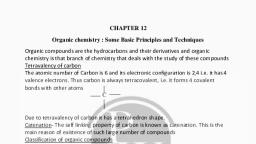
Question Bank, Organic Chemistry-I, 1. (a) What do you understand by the following terms :, (i) Organic chemistry, (ii) Organic compounds, (iii) Catenation?, [3], (b) Why are there very large number of organic compounds?, [2], Ans. (a) (i) Organic chemistry : The branch of chemistry dealing, with carbon comp-ounds, other than carbon monoxide,, carbon dioxide and carbonates, is called organic chemistry., (ii) Organic compounds : The chemical compounds containing, carbon as an element (except carbonates; carbon monoxide and, carbon dioxide) along with hydrogen, oxygen, nitrogen, sulphur,, phosphorus as auxiliary atoms are called organic compounds., (iii) Catenation : The unique property of carbon atoms to link, With the other carbon atoms to form long straight or branched, chain of any length or closed rings of any complexity is called, catenation., (b) Carbon is a unique atom which has four electrons in is outermost, shell. The four valences of carbon can be satisfied by (i) a single, covalent bond between two carbon atoms (ii) a double covalent, bond between two carbon atoms (iii) a triple covalent bond, between two carbon atoms. Furthermore, carbon atoms can form, straight chains, branched chains and closed chains. Thus, millions, of combinations are possible with carbon and other elements., Hence, there are a very large number of organic compounds., 2. Name some important natural sources of organic compounds., What is the importance of organic compounds?, [3], Ans. Following are the natural sources of organic compounds., (i) Plants (ii) Animals (iii) Coal (iv) Petroleum, Chemistry Class-X, , 1, , Question Bank
Page 2 :
Importance of organic compounds, (i) They are the source of food (such as carbohydrates, proteins,, fats, vitamins)., (ii) They provide material for clothing, such as cotton, silk and wool., (iii) They are the source of energy and fuels such as petroleum, products and coal., (iv) They are basic materials for dyes, drugs and explosives., 3. State four differences between organic and inorganic compounds. [4], Ans., Organic Compounds, , Inorganic Compounds, , (i) Only few elements such as, (i) They are the comp-ounds of all other, carbon, hydrogen, oxygen,, known elements and are much less in, nitrogen, sulphur and halogens, number than organic compounds., form vast majority of organic, compounds, (ii) They exist in solid, as well as gaseo (ii) They generally exist as solids., state., (iii) They are essentially covalent, compounds., , (iii) They are essentially electrovalent, compounds., , (iv) They have low melting point and, boiling point and are insoluble, insoluble water., , (iv) They have high melting point and, boiling point and are soluble in, water., , 4. Which of the following compounds are aliphatic compounds?, Ethyl alcohol, lead acetate, benzene, toluene, methane, ethene., Ans. Ethyl alcohol, lead acetate, methane and ethene are aliphatic, compounds., , Chemistry Class-X, , 2, , Question Bank, , [1]
Page 3 :
5. State why are not inorganic compounds grouped into series called, “homologous series”., Ans. The compounds which form homologous series differ from one, another by 14 U or CH2. As, no such difference is available in case, of inorganic compounds, therefore, they are not classified in, homologous series., 6. What do you understand by the term homologous series? Give four, characteristics of the homologous series of :, (i) Alkanols (ii) Alkanoic acids., [5], Ans. Homologous Series : The members of the same class of organic, compounds when arranged in the order of ascending molecular, mass, differ from each other by - CH2 group are called homologues., Such a series or a class of organic compounds is called homologous, series., (i) Characteristics of homologous series of Alkanols, 1. All members of this series are represented by the, general formula R—OH, where R is alkyl radical with, general formula CnH2n + 1., 2. Each member of this homologous series differs from the, next member by —CH2 group., 3. Each member of this series differs from the next member by, 14 U., 4. Due to change in the molecular mass, the physical properties, of homologues differ appreciably from other homologues., (ii) Characteristics of homologous series of Alkanoic acids, 1. All members of this series are represented by the general, formula R—COOH, where R is alkyl radical with general, formula CnH2n + 1., 2. Each member of this homologous series, differs from the, next member by —CH2 group., 3. Each member of this series differs from the next member by, 14 U., , Chemistry Class-X, , 3, , Question Bank
Page 4 :
4. Due to change in the molecular mass, the physical properties, of homologues differ appreciably from other homologues., 7. State three characteristics which remain same and two, characteristics which show variation for the members of a given, homologous series., [5], Ans. Similations :, 1. All the members have same elements., 2. All the members have same functional group (if any)., 3. All the members have same general formula., Variations :, 1. Molecular mass of each member increases by 14 U down in, series., 2. Physical properties such as melting point, boiling point,, density, etc. increase with the increase in molecular mass., 8. State the general formula of homologous series to which the, following belong., ethene, ethyne, ethane, methane, butyne, propene., [3], Ans. (i) Ethene and propene has general formula CnH2n., (ii) Ethyne and butyne has general formula CnH2n – 2., (iii) Ethane and methane has general formula CnH2n + 2., 9. With reference to butane, explain what do you understand by the, following terms :, (i) Molecular formula (ii) Condensed formula, (iii) Structural formula., [3], Ans. (i) Molecular formula : The chemical formula of a chemical, compound which tells the kind of atoms present and their, actual number in one molecule of a compound is called, molecular formula. C4H10 is the molecular formula of butane., (ii) Condensed formula : Condensed formula is a kind of structural, formula which indicates the group of atoms joined together to, each of the carbon atoms in a straight line or branched chains., CH3—CH2—CH2—CH3 is the condensed formula of butane., , Chemistry Class-X, , 4, , Question Bank
Page 5 :
(iii) Structural formula : A formula which tells the arrangement of, various atoms in one molecule of a chemical compound is, called structural formula., , is the structural formula of butane., 10. (a) Name three major classes of aliphatic hydrocarbons., (b) How do paraffins differ from unsaturated hydrocarbons?, Ans. (a) The three major classes of aliphatic hydrocarbons are :, (i) Alkanes (ii) Alkenes (iii) Alkynes., (b) In case of paraffins, all the valencies of the carbon atoms in, a molecule of a compound are satisfied by a single covalent, bond., In case of unsaturated hydrocarbons, there is a double, covalent bond (—C = C —) or a triple covalent bond, (—C ≅ C—), between at least two carbon atoms in the, molecule of a compound., 11. Give the IUPAC names; molecular formulae and condensed, formulae; general formulae and structural formulae of the, following hydrocarbons?, (i) Propane (ii) n- Butene (iii) Ethene., Ans. (i) Propane :, Molecular formula : C3H8; Condensed, formula : CH3—CH2—CH3, General formula : CnH2n + 2, Structural formula :, , Chemistry Class-X, , 5, , Question Bank, , [1], [2], , [2 each]
Page 6 :
(ii) n-Butene :, Molecular formula : C4H8; Condensed, formula : CH3 — CH = CH — CH3, General formula : CnH2n, Structural formula :, (iii) Ethene :, Molecular formula : C2H4 ; Condensed formula : CH2 = CH2, General formula : CnH2n, Structural formula :, 12. Differentiate between the molecular formula and structural formula, of an organic compound., [2], Ans., Molecular formula, (i) It indicates the actual number of, atoms in an atoms of an organic, compound., (ii) It does not show linkage of, atoms with one another with, single, double or triple bonds., , Structural formula, (i) It indicates the arrangement of, different atoms in one molecule of, an organic compound, (ii) It shows linkage of atoms with, one another with single, double, or triple bonds., , 13. Draw the structural formula of the following :, (a) marsh gas (b) ethane (c) ethylene, (d) acetylene (e) butane (f) propylene, (g) propane (h) 1-butene (i) 1-butyne, Ans., (a) Marsh gas, , (b) Ethane, , Chemistry Class-X, , 6, , Question Bank
Page 7 :
(c) Ethylene, , (d) Acetylene, , (e) Butane, , (f) Propylene, , (g) Propane, , (h) 1-Butene, , (i) 1-Butyne, 14. Why are the n-butane and isobutane are called isomers of butane, [C4H10]?, Ans. Both of them have same molecular formula, but n-butane is a, straight chain hydrocarbon, and isobutane is branched chain, hydrocarbon., , Chemistry Class-X, , 7, , Question Bank, , [1]
Page 8 :
15. What do you understand by the term isomerism? State main, characteristics of isomers., Ans. The organic compounds having same molecular formula, but, different structural formulae are called isomers and the, phenomenon is called isomerism., Characteristics., (i) Isomers belonging to same homologous series have similar, chemical properties, but differ in physical properties., (ii) The number of isomers for a given molecular formula increases, with the number of carbon atoms in the straight chain of carbon, atoms., 16. State the IUPAC names and structural formula of isomers of (a), butane (c) pentane., Ans. (a) Isomers of butane., , (b) Isomers of pentane, , Chemistry Class-X, , 8, , Question Bank
Page 11 :
Ans. (a) CnH2n + 1 . OH or R–OH, (b) CnH2n + 1 . CHO or R–CHO, (c) CnH2n+1 .COOH or R–COOH, O, ||, (d) R — C — R′, where R and R′ stand for CnH2n+1., (e) CnH2n+1 . X, where X stands for halide radical., , Chemistry Class-X, Bank, , 11, , Question