Page 1 :
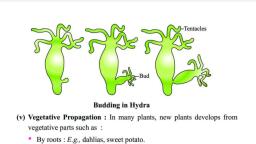
What is Vegetative Propagation?, •, •, , A mode of reproduction in plants in which a vegetative part, like the stem, root, leaves develop, into new plant under favourable conditions is called vegetative propagation., It is also considered as a type of asexual reproduction as only one parent is involved., , Natural Methods of Vegetative Propagation, , 1. From Root, Tuberous roots of sweet potato and asparagus become swollen due to storage of food. This, forms the new plants in the next season.eg-Sweet potato and Dahlia, , 2. From Stem, Underground and subaerial stems are modified for vegetative propagation., Examples-Tuber of potato is an underground stem which stores food. It has buds in the, depression called eye which can give rise to a new plant., , •, , Rhizome is an underground stem that bears buds. Ex ginger, turmeric., , •, , Bulb is a small disk-like stem surrounded by scale leaves.It is found in onion. In this, a, new plant can arise from the stem.
Page 2 :
•, , An aerial stem of grass mint and strawberry may give rise to new plant by vegetative, propagation., , 3. By leaves, Leaves of bryophyllum bear adventitious buds in the Notches in the margin of the leaf. When, leaf follows the ground beef buds grow to form the independent plant., , Artificial Methods of Vegetative Propagation, , 1. Cutting, In this method, the healthy branch having leaf Buds is planted in the moist soil. The cutting, develops roots and grows into a new plant. Example Rose, bougainvillaea, sugarcane, cactus,, grapes, Chrysanthemum etc., , 2. Layering, In this process lower branch of the plant is bent towards the ground and covered with moist, soil. The tip of the branch comes out of the soil. After some days the roots are developed. The, branch is cut and allowed to grow at a new place. Example Jasmine.

Page 3 :
3. Grafting, •, •, , Grafting is a method in which parts of two plants are joined in such a way that they, grow as one plant., Grafting is done between the two closely related dicotyledonous plants having vascular, cambia., , •, •, , The rooted plant in which grafting is performed is called the stock., The portion of other plant (bud, branch, etc.) that is grafted on to the stock is called, scion., , •, , During grafting, about 4-12 inches long scion, with all the buds intact, is placed on the, cut end of the stock and tied in such a way that the cambium of the two come in contact, with each other., The joint is covered with a layer of wax or clay to prevent the evaporation of water or, entry of pathogen. All the buds of stock must be removed., , •