Page 1 :
Reproduction, , Vegetative propagation, In vegetative propagation ,new plant are obtained from old part of plant (like stem,root,leaves),, without help of reproductive part.
Page 4 :
The brief description of cutting and grafting is given below
Page 5 :
Advantage of artificial propagation:, 1- New plant will be exactly same as parent plant with any desired character of plant., 2- new plant grown by this process need less attention., 3- many plant can be grown with same parents., 4- seedless plant can be produced.
Page 6 :
**Tissue culture--It is a collection of techniques used to maintain or grow plant cells, tissue or organ under, appropriate condition., ● This method is used to produce clones of plant in a method known as micropropagation., ● Advantage, ● It is a fast technique of growing plant., ● Plant produced are disease- free., ● Many plants can be produced in few time and take less space for growth., , Sexual reproduction:
Page 7 :
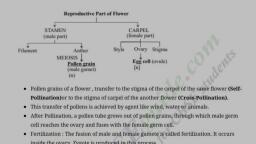
In multicellular organism with complex structure ,male gamete(sperm) and female gamete( ova), fertilise to form zygote . This method of reproduction is called sexual reproduction., Reproduction in flower:, , Receptacles: base of flower., Sepals: green leaves around the outside of flower., Petals: colorful part of flower., Stamen: male reproductive part or organ of flower. It consist of two part-1. Filament, 2. Anther( contain pollen grain or male gamete), Carpel: female reproductive part. It is consist of three part--
Page 8 :
1. Stigma-- It is terminal part of carpel which may be sticky. It help in receiving the pollen, grain during pollination., 2. Style-- it is the middle elongated part of carpel. It help in attachment of stigma to ovary., 3. Ovary-- swollen bottom part of carpel. It contain ovule having egg cell., Calyx -- collection of sepal, Corolla-- collection of petals, ( Brain trick to remember:, Syx --- "s" for sepal and "yx" from calyx., , Polla-- "p" for petal and "olla" for corolla.), , ♀️, , ♂️, , Male reproductive organ or part, -- stamen, Female reproductive part -- carpel or pistil, ,, Gamete or sex cell or germ cell-- pollen grain, Gamete or sex cell or germ cell-- ovule or egg., , ♂️, ♀️, , Pollination---Transfer of pollen grain from anther of stamen to stigma of to stigma of carpel is called, pollination., Pollination can occur in three ways:, ● By wind: also known as anemophily, Eg- grass , sugarcane, coconut, maize etc., ● By water: also knowns as hydrophily, Eg- Hydrilla, vallisneria, ● By insect: also known as entomophily, Eg-rose etc.
Page 9 :
Self pollination; pollen from stamen of flower is transferred to the stigma of same flower., Cross pollination: pollen from stamen of a flower is transferred to the stigma of different flower., Fertilisation:, After pollination fertilisation take place., It involve the uniting of male and female gamete to form zygote in ovule.
Page 12 :
Ovary develop into fruit, Ovule develop into seed., ● Germination of seed, Germination is the process by which dormant seed (inactive state) start to grow., Plumule develop into shoot and radicle develop into root.