Page 1 :
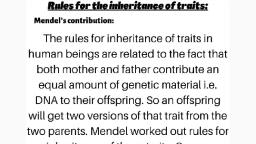
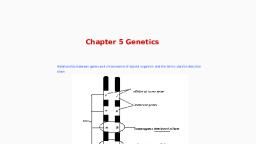
How do traits get, expressed?, , Cellular DNA is the information source for making, proteins in the cell., , A part of DNA that provides information for one particular, protein is called a gene for that protein for example; the, height of a plant depends upon the growth hormone, which is in turn controlled by the gene. If the gene is, efficient and more growth hormone is secreted the plant, will grow tall. If the gene for that particular protein gets, altered and less of it is secreted when the plant will, remain short. Both the parents contribute equally to the, DNA of next generation during sexual reproduction. They, actually contribute a copy of the same gene for example;, when tall plant is crossed with short plant the gametes, will have single gene either for tallness or for shortness., F1 generation will get one gene for tallness and other for, shortness also., , How do germ cells i.e. gametes get single set of genes, from parents who have two copies in them ?, , Each gene set is present, not as a single long thread of, DNA, but as separate independent pieces each called a, chromosome. Each cell gets two copies of the, chromosome, one from each parent. Each germ cell or, gamete has one copy of it because there is reductional, division in the sex organs at the time of formation of, gametes. When fertilization takes place normal number, of chromosomes is restored in the progeny ensuring the, stability of DNA of the species.
Page 2 :
Human Blood, Groups:, , There are four types of blood groups A, B,, AB or O. These are controlled by a gene, which is denoted by symbols IA, IB and lO, (sometimes also denoted as i). The genes, IA and IB show no dominance over each, other (they are codominant, i.e., both, expresses themselves independently). But, these both genes are dominant over the, gene IO. Therefore, blood group of a, person depends on the type of genes, present, e.g., (i) Blood group A has the, following gene types:, , IAA (Homozygous) and 1°(Heterozygous), (i) Blood group B = 18|8 and 18}O, , (iii) Blood group AB 418, , (iv) Blood group O — 11°
Page 3 :
How is the sex of a newborn, individual determined?, , Different species use different strategies for this :, , In some animals the temperature at which fertilized eggs, are kept determines whether the developing animals will, be males or females., , Some animals like snails can change sex indicating that, sex is not genetically determined., , In human beings sex of the individual is determined, genetically; means genes inherited from the parents, decide the sex of the offspring., , Sex determination in human beings:, , In human beings, all chromosomes are not paired. 22 chromosomes, are paired but one pair called sex chromosome is odd in not having a, perfect pair in males. Females have a perfect pair both represented, by XX. On the other hand males have a normal sized X but the other, is short called Y so it is shown as XY. All gametes or ova formed by, the homogenetic female are similar i.e. have X chromosome. Males, heterogenetic form two types of sperms i.e. half with X chromosome, and the other half with Y chromosome. Sex of the baby will depend, , on fertilization. There are two possibilities :, , Sex determination in human being (flow chart), , Male Female, xY XX Parents, ‘Sperms Ovum, ..¥ SJ X —— Gametes, XX xY Zygote, Female Male Off springs, , 50% 50%
Page 4 :
Autosomes:, Those chromosomes which do not, , play any role in sex determination., , Sex chromosomes:, , Those chromosomes which play a role in, , determining sex of the newborn., , If the sperm having X chromosome, fertilizes with ovum with X chromosome, then the baby will have XX chromosome, , and it will be female., , If the sperm having Y chromosome, fertilizes with ovum with X chromosome, then the baby will have XY chromosomes, , and it will be male.