Page 1 :
Kerala Class 10, , Simplified Notes, English Medium, Volume : 1, Units :, , 1. Sensations and Responses, 2. Windows of Knowledge, 3. Chemical Messages for Homeostasis, 4. Keeping Diseases Away, , Prepared by, , Rasheed Odakkal, , 2021, Copyleft
Page 2 :
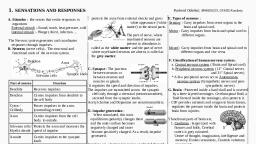
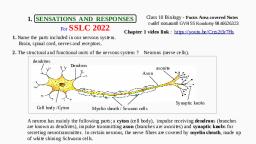
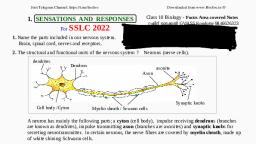
1. SENSATIONS AND RESPONSES, , Class 10 Biology, , CONTENT, • External and internal stimuli, • Neuron -structure, Impulse generation and transmission., • Types of nerve., • Central nervous system, - Brain & Spinal cord – structure and functions., - Reflex actions, • Peripheral nervous system, - Sympathetic and parasympathetic nerves, • Disorders of nervous system, - Alzheime'rs, Parkinsons & Epilepsy., QUESTIONS & ANSWERS, 1. Define stimulus., The senses that evoke responses in organisms are called stimuli. These are two types,, External stimuli :- Sound, touch, heat, chemicals, pressure, cold, radiations., Internal stimuli :- Hunger, touch, infection, pressure variation, thirst, exhaust., 2. What is the function of nervous system ?, To generate and coordinate responses according to external and internal changes., 3. Name the parts included in our nervous system., Brain, spinal cord, nerves and receptors., 4. The structural and functional units of the nervous system ?, Neurons (nerve cells)., 5. Structure of a model neuron., dendrites, , Dendron, , axonite, Axon, , Cell body /Cyton, , Synaptic knobs, Myelin sheath / Scwann cells, , A neuron has mainly the following parts; a cyton (cell body), impulse receiving dendrons (branches are, known as dendrites), impulse transmitting axon (branches are axonites) and synaptic knobs for secreting, neurotransmitter., In certain neurons, the nerve fibres are covered by myelin sheath, made up of white shining, Schwann cells., 6. The protective covering of nerve fibres (axons) ? Mention its function., Myelin sheath., • Provide nutrients and oxygen to the axon., • Accelerate impulses., • Act as an electric insulator., Myelin, • Protects the axon from external shocks., sheath, • Gives white appearance ('white matter') to the neural parts., Oligodendro, 7. In brain and spinal cord, myelin sheath is formed from a specialized cells called ………….. ?, cytes., Oligodendrocytes., 8. Differentiate between white matter and grey matter., The part of nerve, where myelinated neurons are present in abundance,is called as the white matter., The part of nerve where the cell bodies and nonmyelinated neurons are present, is called as the grey matter.
Page 3 :
9. Table showing the function of different parts of nerve cell., Part of nerve cell, , Function, , Dendrite, , Receives impulses, , Dendron, , Carries impulses from dendrite to the cell body, , Cyton / Cellbody, , Passes impulses to the axon., , Axon, , Carries impulses from the cell body to outside., , Schwann cells, , Protects the axon and increases the speed of impulse, , Axonite, , Carries impulses to the synaptic knob, , Synaptic knob, , Secretes neurotransmitter, , 10. Name the swollen ends of axon . How is it important in the transmission of impulse ?, Synaptic knobs, from which neurotransmitter secretes. The impulses are transmitted across the synaptic, cleft only through a chemical (neurotransmitter), secreted from the synaptic knobs., 11. Give example for neurotransmitter., Acetyl choline (Dopamine is another example), 12. Define synapse., The junction between neurons or between neurons and muscles or glands is known as the synapse., It helps to regulate the speed and direction of impulses. The impulses are transmitted, across the synaptic cleft only through a chemical (neurotransmitter), secreted from the, synaptic knobs., 13. The electrical messages conducted through nerves ?, Impulses, 14.How is an impulse generated ?, The difference in the distribution of ions maintains positive charge on the outer surface and negative charge, inside the plasma membrane of the receptor part of neuron. When stimulated, this ionic equilibrium, (polarity) changes there and the outer surface becomes, negatively charged and inner become, positively charged. As a result, impulse generated. This charge difference stimulates its adjacent parts, and similar changes occur there too. Thus a continuous flow of the impulse becomes possible., 15. How is the impulses transmits through the neurons ?, Impulse due to stimulus, dendrites, dendrons, cyton, synaptic knob, secretion of neurotransmitter to the synaptic cleft, dendrites, Impulse forms., , axon, axonites, Stimulation in the adjacent, , When impulses reach at the synaptic knobs, a chemical substance, known as neurotransmitter, released, in the synaptic cleft. This chemical stimulates the adjacent dendrites to form new electric impulses., 16. Name the two types of neurons ?, Sensory neurons – (carry impulses from different body parts to the brain and spinal cord), Motor neurons - ( carry impulses from the brain and spinal cord to various parts of body), 17. Define a nerve ?, A nerve is a group of axons or nerve fibres, covered by connective tissue., 18. Show different kinds of nerves with their functions in a table., Sensory nerves, Carry impulses from sense organs to the brain and, (consists of sensory neurons), spinal cord, Motor nerves, (consists of motor neurons), , Carry impulses from brain and spinal cord to different, organs, , Mixed nerves, (consists of sensory and motor neurons), , Carry impulses from brain and spinal cord to different, organs and vise versa, , Prepared by RASHEED ODAKKAL, 9846626323, GVHSS Kondotty
Page 4 :
19. How is human nervous system classified ?, Central Nervous System, , Peripheral Nervous System, , - Brain, - Spinal cord, , - Cranial nerves (12 pairs), - Spinal nerves (31 pairs), , 20. The protective measures for human brain ?, The brain is protected inside a hard skull and is covered by a three layered membrane, called the meninges., Cerebrospinal fluid,a fluid formed inside the meninges, also protects the brain., 21. The outer covering of brain and spinal cord ?, Meninges., 22. The fluid which provides nutrients and oxygen to brain tissues ?, Cerebrospinal fluid (CSF)., 23. How is the CSF form? Give its function ?, Cerebrospinal fluid is a fluid formed from the blood inside the meninges and eventually reabsorbed to, the blood. Functions of CSF are,, • CSF provides nutrients and oxygen to brain tissues., • Regulates the pressure inside the brain., • Protects brain from injuries., 24. Name the functional parts of human brain., Human brain has outer cerebrum, cerebellum and medulla oblongata and inner thalamus and hypothalamus., Cerebrum, Thalamus, Hypothalamus, Cerebellum, Medulla oblongata, , 25. Table showing different parts of brain, peculiar feature and functions of each., Part of the, brain, , Features, , Function, , Cerebrum, , The largest part of the brain with many fissures Centre of feeling senses and also the, and folds in its cortex. Cerebral cortex is seen as centre of qualities like thought,, grey matter and inner medulla as white matter. imagination, intelligence and memory., , Cerebellum, , The second largest part, seen as two flaps., , Coordinates muscular activities and, maintains equilibrium of the body., , Medulla, oblongata, , The rod shaped lower part, , Controls involuntary actions like heart, beat and breathing., , Thalamus, , The seat of cerebrum, , Acts as relay station of impulses to and, fro the cerebrum and also analyses the, impulses., , Hypothalam Seen just below the thalamus, us, 26. The largest part of human brain ?, Cerebrum., 27. The peripheral part of brain is the ----------- ., Cerebral cortex., , Plays a major role in the maintenance, of homeostasis.
Page 5 :
28. There are many fissures and folds in the cerebral cortex. What is the advantage of this ?, This is an adaptation to include more number of neurons and there by increase the efficiency of cerebrum., 29. Any mild injury to the medulla oblongata may lead to sudden death. Why ?, Medulla oblongata controls involuntary actions like heart beat and breathing. Any mild injury to medulla, oblongata results malfunctioning of breathing and heartbeat and this may lead to death., 30. A person could not walk easily after drinking alcoholic beverage. Can you say which part of his brain is, affected ?, Cerebellum, which maintains equilibrium of the body through muscular coordination., 31. After a road accident, a person lost his memory for a few days. In which part of his brain got injured ?, Cerebrum., 32. The central nerve, seen as the continuation of medulla oblongata ?, Spinal cord., 33. How is our spinal cord protected ?, Spinal cord is protected inside the vertebral column and is covered by the meninges., 34. The ------------- of the spinal cord is filled with cerebrospinal fluid., Central canal., 35. Describe the structure of our spinal cord., Spinal cord, which is the continuation of medulla oblongata, is situated with in the vertebral column and is, covered by a three layered membrane, called meninges. The outer part of spinal cord is white matter and, inner is grey matter. The central canal at its centre is filled with CSF., Spinal nerves originate from the spinal cord as dorsal root (sensory) and ventral root (motor)., Central canal (CSF), Dorsal root (sensory), , White matter, , Ventral root (motor), , Grey matter, , 36. Spinal cord : Sensory impulse : Dorsal root;, Spinal cord : Motor impulse : …................, Ventral root., 37. Mention the functions of spinal cord., • Transmitting impulses from different parts of our body to and fro the brain., • Coordinates the rapid and repeated movements during walking, running etc., • Effects certain reflex actions., 38. What do you mean by reflex action ?, Reflex actions are the accidental and involuntary responses of the body, in response to a stimulus., These are two types,, 1. Cerebral reflexes (Eg:-Blinking of eyes, sudden fright when hearing a loud noise or seeing a, snake, sneezing), 2. Spinal reflexes (Eg :- On touching hot object, the hand is withdrawn, withdrawal of the leg, when a spine pierce in to the feet), 39.The pathway of impulses in a reflex action., b, a, Reflex arc., c, 40. What are the parts that involve in a reflex arc ?, a. stimulus receiving receptor, b. sensory neuron, c. inter neuron, d. motor neuron, e. effecting muscles., , d, e, , 41. The central neuron, which converts sensory impulse in to motor impulse, is usually known as an --------- .
Page 6 :
Inter neuron., 42. Observe the flow-chart and name the process., Stimulus – Receptor – Sensory neuron – Inter neuron – Motor neuron – Muscle., (Reflex action / Reflex arc), 43. A few nerves in the peripheral nervous system that function automatically and involuntarily, is known as, ------------ ?, Autonomous nervous system., It includes sympathetic and parasympathetic nerves., 44. How the contrasting actions of Sympathetic and Parasympathetic nervous systems help to maintain the, normalcy of the physiological activities ?, Sympathetic and parasympathetics nervous system activate with or with out the endocrine gland system, involuntarily. The contrasting actions of both systems help to maintain the normalcy of the physiological, activities., Action of Sympathetic nervous systems, , Action of Parasympathetic nervous systems, , Eye, , Pupil dilates, , Pupil constricts, , Heart, , Heartbeat increases, , Heartbeat becomes normal, , Lungs, , Trachea expands, , Trachea contracts, , Liver, , Glycogen converts to glucose, , Glucose converts to glycogen, , Adrenal gland, , Hormone secretion increases, , Hormone secretion decreases, , Urinary bladder Retain normal state, , Constricts, , Salivary gland, , Production of saliva decreases, , Production of saliva increases, , Stomach, , Working decreases, , Increases, , Intestine, , Peristalsis slows down, , Peristalsis increases, , 45. List out the physiological changes that may occur when a boy facing the audience during a competition., (see the activities of the sympathetic nerves), 46. The table showing neural disorders, reason and symptoms., Disorder, , Cause, , Alzheimer's Continuous degeneration of neurons due to, the accumulation of an insoluble protein., , Symptom, , Complete loss of memory., , Parkinsons Degeneration of specific ganglia in the brain Loss of body balance. Tremor in muscles,, due to the deficiency of dopamine, flow of saliva, Epilepsy, , Discharge of irregular electrical impulses, from brain., , Fits (due to uncontrolled muscular, contractions), frothy discharge from mouth,, clenching of teeth, unconsciousness, , 47. Name a neurotransmitter, which is secreted in the brain. What will happen when the production of this, hormone cease in a person ?, Dopamine., The deficiency of dopamine may result a disease called Parkinsons., Video link of this chapter, , Part 1- https://www.youtube.com/watch?v=fTAHU3eQBRQ&t=0s, Part 2- https://www.youtube.com/watch?v=rUsbf7pulMo&t=9s, Part 3- https://www.youtube.com/watch?v=IQFZ6CBXBmE&t=17s, Focus area covered portion - https://youtu.be/Crzs2t3r7Hs, Prepared by RASHEED ODAKKAL, 9846626323, GVHSS Kondotty
Page 7 :
Class 10 Biology, , 2. WINDOWS OF KNOWLEDGE, , CONTENT, , Vision - The protective measures of eyes., - Structure of human eye, Working of eye lens,, - Photo receptors in the retina, Sense of vision., - Disorders & diseases of eyes, Hygiene of our eyes., , •, , Video link of this chapter :, Part 1- https://youtu.be/Q14Texfdi9c, , • Hearing- Structure of human ear, Auditory receptors,, , Part 2- https://youtu.be/X5RvWrwrg8U, , - Sense of hearing, Body balancing., , Part 3- https://youtu.be/377Wct4nVgA, , •, •, •, •, , Tasting - Taste receptors in the tongue, sense of tasting., Smelling - Olfactory receptors in the nose, sense of smelling., Different receptors in the skin, Sensory receptors in certain other organisms, , QUESTIONS & ANSWERS, , Sense organs, , 1. How is the feeling of senses made possible ?, Sense is possible only when impulses from sense organs reach at the brain through the sensory nerves., The ends of sensory nerve from the brain act as the receptors inside the sense organs., Photo receptors, Auditory receptors, Olfactory receptors, Taste receptors, Skin Various receptors, Receptors, , Stimulus, , Function, , Eye, , Photo receptors in the retina (Rod & Cone cells), , Light, , Vision, , Ear, , Auditory receptors in the basilar membrane, , Sound, , Hearing, , Nose, , Olfactory receptors, , Olfactory particles Smelling, , Tongue, , Taste receptors in the taste buds, , Taste particles, , Skin, , Tasting, , Receptors for heat, cold, touch, pressure and pain Heat, cold, touch, Heat, cold, touch,, pressure or pain, pressure and pain, 2. How are our eyes protected?, - Bony eye socket (orbit) - protects eye., - External eye muscles – fixes the eye ball in the orbit., - Eyelids - protect from dust and other particles., - Eyelashes - protect from dust with out obstructing vision., - Eyebrow – prevents perspiration or water reaching in to the eyes., - Tears - clean and lubricate the anterior part, washes away the dust particles and destroys germs., - Conjunctiva – secretes mucus to prevent the eye from being dry., 3. The enzyme contained in tears ?, Ans: Lysozyme., 4. Which are the 3 layers of human eye ?, a. Sclera –The outermost, strong layer, that gives shape. Its transparent anterior portion is the cornea., b.Choroid- Middle layer of blood capillaries, which supply nutrients and oxygen., Its anterior dark screen with pupil is the iris. A convex lens is placed behind the iris., c. Retina- The innermost layer on which, the image forms. The optic nerve starts from the retina., 5. The fluids filled in the chambers of eye , position and function ?, * Aqueous humor – A watery fluid seen in the aqueous chamber [between cornea and lens] , oozes, from the blood. This fluid supplies nutrients and oxygen to cornea and lens., * Vitreous humor - A jelly like fluid filled with in the vitreous chamber [between lens and retina],, helps to maintain the shape of eyeball.
Page 8 :
Aqueous chamber, , Aqueous, chamber, , --Ciliary, –ligaments, Vitreous, chamber, , Vitreous, chamber, , 6. Slightly projected transparent anterior part of the sclera ? Ans: Cornea., 7. The transparent membrane which protects the sclera, except the cornea ?, Ans: Conjunctiva., 8. The dark coloured anterior part of choroid is --------, which contains the pigment melanin. Ans: Iris., 9. The aperture at the centre of iris ?, Ans : Pupil., 10. The antagonistic muscles in the iris that regulate the size of eye pupil ?, Radial muscles (pupillary dilator) and Circular muscles (pupillary constrictor)., 11. When bright light falls, the eye pupil --------- ?, - Constricts [due to the contraction of the circular muscles], 12. The muscles, which adjust the curvature of eye lense, seen behind the iris ?, Ciliary muscles., 13. Define the power of accommodation of the eye., The capacity of the eye to change the curvature of lens depending up on the distance between the the eye, and the object by adjusting the focal length is called the power of accommodation of the eye., 14. How can our lens adjust its focal length according to the distance from objects?, [ How is power of accommodation possible?], When we look at a distant object, the ciliary muscles are in a relaxed position so as to keep the, ligaments tight. Therefore the curvature of lens decreases to fix the image on retina, [figure-1]., When we look at a near object, the ciliary muscles contract to loosen the ligaments. When ligaments, relax, the curvature of lens increases naturally ,to focus the image on retina., [figure-2]., Viewing distant, objects, , Viewing near, objects, , Ciliary muscles, , Relaxes, , Contracts, , Ligaments, , tightens, , loosen, , Curvature of lens Decreases, , Increases, , Focal length, Increases, Decreases, 15. The characteristics of images formed on retina ?., Real, Small, Inverted and Accommodated., 16. Compare and contrast between the photo receptors seen on the retina., Photoreceptor, , Containing pigment, , Function, , Related disorder, , Rod cells, , Rhodopsin, , Vision under dim light, , Night blindness, , Cone cells, , Photopsin / Iodopsin, , Vision under intense light, , Colour blindness, , Receptor region of the rod cells is rod shaped and contain the pigment rhodopsin, which will be, stimulated under dim light. Receptor region of the cone cells is cone shaped and contain the pigment, photopsin (iodopsin) which will be stimulated under intense light., Under dim light, rhodopsin dissociates to form retinal and opsin to produce impulses from rod cells., Under intense light, photopsin (iodopsin) dissociates to form retinal and opsin to produce impulses from, cone cells. The three types of cone cells (red, green & blue) provide us with colour vision.
Page 9 :
Rod cells, Cone cells, , 17. Vitamin A help us for better vision. Give reason., Retinal, the visual pigment found in the photoreceptors, is formed from vitamin A., 18. Compare between Blind spot and Yellow spot, Blind spot is a part of retina from where the optic nerve begins. No photoreceptors at this spot, hence, no vision. Yellow spot is the point of highest vision in the retina, where more cone cells seen. Images form, in and around the yellow spot., 19. Point on retina lacking vision : Blind spot ; Point of highest vision in retina : --------- ?, Yellow spot, 20. The bird, owl has no vision in day time. Why?, Owl’s retina is devoid of cone cells and hence no vision in day time., 21. Animals like cat and owl have more vision at night. Why ?, Cat and owl has more rod cells in their retina, so that they have more vision at night., 22. A kite can locate its prey even from high altitude. How is this possible ?, The eyes of kite are closer to each other and contain a large number of cone cells. Hence it has high, power of vision., 23. Flowchart of image formation in retina., Light rays from the object, Cornea, Aqueous humor / Pupil, Lens, Vitreous humor, Image on retina, 24. What are the changes occur in retina when images focus on it ? (Describe that how vision is possible.), When light rays from the object passes through cornea and pupil fall on the lens, a small, real inverted, image forms on the retina. When the image is formed under dim light, rhodopsin in the rod cells dissociate, to produce impulses and when the image is formed under intense light, photopsin in the cone cells dissociate, to produce impulses. These impulses are transmitted through the optic nerve. The brain coordinates the, images from both eyes to feel perfect vision., 25.Experience of vision - Flowchart., Image on retina, stimulation in the photo receptors, dissociation of rhodopsin / photopsin, impulses, optic nerve, coordination of images by cerebrum, perfect vision., 26. Though images of object are formed in both eyes, we can see only one object. Give reason., Cerebrum coordinates the two images and hence get a three dimensional view of the object., 27. Define binocular vision., The ability of both the eyes to focus on the same object is known as binocular vision., Binocular vision help us to get a three dimensional image of the object. This help us to calculate the, correct distance, depth, height and width of the object., 28. What is the need of closing one eye while shooting an object ?, Binocular vision help us to get a three dimensional image of the object and to calculate the correct, distance, depth, height and width of the object. But in the case of aiming an object, we need to get correct, line instead of common focus through binocular vision., 29. The condition by which certain colours cannot recognize : Colour blindness ;, Decreased vision in dim light : ------------------- ?, Ans: Night blindness., 30 .------------ and ------------- are the two conditions of eye due to the deficiency of vitamin A., Night blindness and Xerophthalmia (dry conjunctiva and cornea), 31. A few points related with the health of our eyes., • Avoid falling of bright source of light directly to the eyes. Don't look at the sun., • Avoid reading under dim light., • Do not watch TV or other screens continuously., • Frequently wash our eyes., • Include vitamin A contained items in our daily food., Prepared by Rasheed Odakkal, 9846626323
Page 10 :
32.Table which shows reason of various disorders and diseases that affect on our eyes., Disorder/Disease, , Reason or Symptom, , Remedy, , Hyper metropia, (long sight), , Due to shortened eyeball images form behind retina., Cannot see nearby objects clearly, , Convex lens, , Myopia, (short sight), , Due to elongated eyeball images form in front of retina. Concave lens, Cannot see distant objects clearly, , Night blindness, , Due to the deficiency of vitamin A, no clear vision in, dim light., , Colour blindness, , Due to the defect cone cells which detect red and green, colours and fails to detect those colours, , Xerophthalmia, , Prolonged deficiency of vitamin A results dry, conjunctiva and cornea, , Vitamin A, , Cataract, , Gradual decrease in the power of lens due to, decreasing of transparency of lens, , Surgical replacement of, lens, , Glaucoma, , Defective vision due to increased pressure when the re- Early treatment, absorption of aqueous humor obstructed, , Conjunctivitis, , Infection of bacteria or virus causes red eye with pain, , Vitamin A, , Treatment and rest, , 33.The functions of human ear ?, Ans: Hearing, body balance., 34. What are the main parts of human ear ?, Semi circular canals, Ear pinna, , 1, , Incus, Malleus, , 5, 4, , 2, Ear canal, , 10, , 9, 12, , External Ear, , Middle Ear, , 1. Ear pinna, 2. Ear canal, 3. Ear drum / Tympanum, , 4. Malleus, 5. Incus, 6. Stapes, 7. Eustachian tube, , 11, , 8, , 3, Ear drum, , Vestibule, Vestibular nerve, Auditory nerve, , Eustachean tube, , 6, , Stapes, , Cochlea, , 7, , Internal Ear, , 8. Cochlea, 9. Vestibule [Sacule, Utricle], 10. Semicircular canal, 11. Auditory nerve, 12. Vestibular nerve, 35. The safety measures to prevent dust and other particles from entering the ear are, -----------Hairs and ear wax., 36. When sound waves enter to the ear, ….......... starts to vibrate., Ans: Ear drum (tympanum), 37. The smallest bone in the human body ?, Ans: Stapes, 38. Name the bones of ear ossicles., Ans: Malleus, Incus, Stapes., They amplify sound waves 22 times and pass the vibrations from the ear drum to the oval window., 39. The tube that connects the middle ear to the pharynx ? What is its function ?, Eustachian tube. It helps to regulate the pressure inside the middle ear., 40. The structure of internal ear., The internal ear, seen inside the bony labyrinth, as membraneous labyrinth. A coiled, tube like cochlea and the vestibular apparatus (vestibule & three semicircular canals), are the parts of inner ear. The membraneous labyrinth is filled with a fluid, named, endolymph and the space between the bony and membraneous labyrinths is filled with, another fluid, named perilymph.
Page 11 :
Cochlea of the internal ear functions in hearing, while the vestibular apparatus helps to maintain body, balance through transmitting impulses to the cerebellum., 41. What are the different receptors seen inside the vestibular apparatus ?, The cluster of receptors (hair cells) seen inside the utricle and sacule of the vestibule are immersed in a, jelly substance and the sensory hair cells in the ampulla of the semicircular canals are also immersed in a, jelly substance. All these receptors (hair cells) are stimulated according to the movement of head., 42. Cochlea : Hearing ;, ------------ :Equilibrium of the body., Vestibular apparatus (Vestibule and semicircular canals), 43. The swollen end of semicircular canals., Ans: Ampulla., 44. Cochlea, : Auditory nerve : Cerebrum;, Vestibular apparatus : Vestibular nerve : ….............. ?, Ans: Cerebellum., 45. Hearing. Flowchart., Sound waves, ear pinna, ear canal, ear drum (tympanum) vibrates, ear ossicles, oval window, cochlear perilymph, endolymph, stimulation in auditory receptors of the, basilar membrane, impulse transmitted through auditory nerve, auditory centre of the brain, hearing., 46. What is the role of ear in maintaining the equilibrium of the body ? How is it possible ?, Receptors (hair cells) seen inside the ampulla of semicircular canals, sacule and utricle are stimulated, according to the movement of head. The impulses formed thus will be transmitted to the cerebellum, through the vestibular nerve. Cerebellum functions so as to maintain the equilibrium of body., 47. Why giddiness is felt when you turn round and round ?, When we turn round continuously, the endolymph inside the semicircular canals and vestibule also, moves and there will be continuous stimulation of the receptors and passing of impulses to the cerebellum., Hence cerebellum can not coordinates the muscular activities properly and we feel giddiness., 48. How do we sense taste ?, Chemoreceptors seen inside the mouth and tongue help us to detect taste. The chemoreceptors seen, inside the papillae of the tongue are called as taste buds. Smell also influences taste., 49. The different taste buds of the tongue. Ans: Sweet, salt, sour and bitter. Other tastes are created by the, brain from the primary tastes., 50. The projected structures seen on the tongue surface are known as ----------? Ans: Papillae., 51. Make a flowchart of sensing taste., Food particles, Taste receptors, dissolve in the, (taste buds) are, saliva, stimulated, 52. Recognize the figure A and B., A, , Impulses form, and transmit, through nerves, , Brain, , Experience, of taste, , B, , Ans: A. Taste bud B. Olfactory receptors., 53. How can we feel smell ?, When particles enter to the nose and disperse in the mucus, the olfactory receptors in the mucus, membrane get stimulate and the impulses reach the brain through the olfactory nerve. Brain helps in the, 54. The ability of shark to sense smell is sharp. Why?, Shark has highly sensitive olfactory receptors., 55. The largest sense organ ?, Ans: Skin., 56. The stimuli that can be received by our skin ? Ans: Heat, Touch, Pain, Cold and Pressure, 57. How skin perform as a sense organ ?, Pain, Cold, Heat, cold, touch, pressure and pain are felt by our skin. When these receptors HeatTouch, are stimulated, impulses form and reach in the cerebrum for its perception., 58. The eyes of an insect consist of a cluster of photoreceptors called --------- ?, Ommatidia., Press, 59. Housefly : Ommatidia, Planaria, : ---------- ? Ans: Eye spot., ure, 60. The special olfactory organ seen in the mouth of snake ? Ans: Jacobson's organ., 61. How is the lateral lines important to the shark ?, The receptors in the lateral lines help to detect the change in the balance the body., Rasheed Odakkal, 9846626323, GVHSS Kondotty
Page 12 :
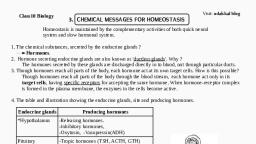
Class10 Biology, , Visit: odakkal blog, , 3. CHEMICAL MESSAGES FOR HOMEOSTASIS, , Homeostasis is maintained by the complementary activities of both quick neural, system and slow hormonal system., 1. The chemical substances, secreted by the endocrine glands ?, Hormones., 2. Hormone secreting endocrine glands are also known as 'ductless glands'. Why ?, The hormones secreted by these glands are discharged directly in to blood, not through particular ducts., 3. Though hormones reach all parts of the body, each hormone act at its own target cells. How is this possible?, Though hormones reach all parts of the body through the blood stream, each hormone act only in its, target cells, having specific receptors for accepting the same hormone. When hormone-receptor complex, is formed in the plasma membrane, the enzymes in the cells become active., 4. The table and illustration showing the endocrine glands, site and producing hormones., Endocrine glands, , Producing hormones, , *Hypothalamus, , -Releasing hormones., -Inhibitory hormones,, -Oxytosin, -Vasopressin(ADH), , Pituitary, , -Tropic hormones (TSH, ACTH, GTH), -Somatotropin (STH/Growth hormone), -Prolactin, , Pineal, , Pineal, , -Melatonin., , Parathyroid, , Thyroid, , -Thyroxine,, , Parathyroid, , -Parathormone., , Thymus, , -Thymosine., , Adrenal, , -Cortisol, -Aldosteron,, -Sex hormones, -Epinephrine (Adrenalin),, -Norepinephrine (Noradrenalin), , Pituitary, Thyroid, , -Calcitonin., , Pancreas, , -Insulin,, , Ovaries, , -Estrogen, -Progesterone., , Testes, , -Testosterone., , Thymus, Adrenal, , Pancreas, , Ovaries, Testes, , -Glucagon., Pancreas, , Alpha cells, 5. What is the normal level of glucose in blood ?, Name the hormones which maintain this rate ?, Brta cells, Islets of Langerhans, 70 – 110 mg /100 ml blood., Insulin, Glucagon., Rasheed Odakkal, GVHSS Kondotty - 9846626323, 6. How is the normal blood glucose level maintained?, This rate is maintained by the antagonistic activities of insulin and glucagon , released from Islets of, Langerhans of the pancreas., When glucose increases in blood, beta cells in the Islets of Langerhans secretes insulin. It accelerates the, process of glucose intake by the cells and conversion of the excess glucose in to glycogen., When glucose decreases in blood, alpha cells in the Islets of Langerhans secretes glucagon, which converts, glycogen and amino acids in to glucose., , 7. Islets of Langerhans : Alpha cells : Glucagon ;, Islets of Langerhans : Beta cells : …..............?, Insulin.
Page 13 :
8. The reason for --------------, (the blood glucose level more than 126mg/100ml) is the deficiency or inactivity, of the hormone insulin., Diabetes mellitus /പ്രമേഹം. (Symptom : Increased appetite and thirst and frequent urination), 9. A test to detect the presence of glucose in urine ?, Benedict Test., Take 2ml of urine in a test tube. Add 2ml of Benedict solution and heat for 2 minutes. We can understatnd, the level of glucose by observing its colour change., 10. Patients having diabetes mellitus usually takes insulin injection. Why ?, Insulin maintains the normal rate of glucose in our blood., 11. World Diabetics Day ?, A, November 14., 12. Name the endocrine glands A and B, B, shown in the figure., A- Thyroid gland, B- Parathyroid gland., 13. The chief metabolic hormone ?, Thyroxine., 14. The element needed for the proper functioning of thyroid gland ?, Iodine. (Deficiency of iodine may cause a disorder, Goitre, the abnormal growth of thyroid gland), 15. Mention the functioning of hormones secreted by thyroid gland., Thyroxine – Increases the rate of metabolism and energy production, Accelerates the growth and, development of brain in the foetal stage and infancy and also regulates growth in children., Calcitonin – Maintains the level of calcium in blood by depositing excess calcium in bones or by, preventing the mixing of calcium with blood., 16. Under secretion of thyroxine : Hypothyroidism,, Over secretion of thyroxine : …......................?, Hyperthyroidism., 17. Deficiency of thyroxine during infancy may cause ---------, stunted physical-mental growth, in children ?, Cretinism., 18. Deficiency of thyroxine in adults may cause --------- ?, Myxoedema., 19. Symptoms seen in person with myxoedema (Hypothyroidism) ?, Low metabolic rate, sluggishness, increase in body weight, hypertension and inflammation, in body tissues., 20. Symptoms seen in person having Hypothyroidism ?, High metabolic rate, rise in body temperature, excessive sweating, increased heart beat,, weight loss and emotional imbalance., 21. Give examples for the conditions due to hyperthyroidism and hypothyroidism., Hypothyroidism in children : Cretinism,, Hypothyroidism in adults : ----- ? ---Myxoedema, 22. The hormones which maintain the normal rate of calcium in our blood ?, Calcitonin of thyroid gland, Parathormone of parathyroid gland., 23. What is the normal level of calcium in blood ? How is it maintained ?, 9-11 mg /100 ml blood., When the level of calcium in blood increases, thyroid gland secretes calcitonin, which lowers the level, of calcium in blood, by depositing excess calcium in bones or by preventing the mixing of calcium with, blood (from the bones)., When the level of calcium decreases , parathyroid gland secretes parathormone, which increases, the level of calcium by helping in its re-absorption from kidneys or by preventing the deposition of calcium, in bones., 24.The endocrine gland that active during infancy ? Name its hormone ?, Thymus gland (situated below the sternum / chest bone). Secretes the hormone thymosin., 25. Thymosin is also known as the 'youth hormone'. Why ?, During infancy, thymosin helps in the maturation and activities of T-lymphocytes., 26.Name the gland that prepare our body to overcome emergencies., Adrenal.
Page 14 :
27. The outer part of adrenal gland : Cortex,, The inner part of adrenal gland : -------- ?, , medulla, Medulla., , 28. Table which shows the functions of adrenal hormones., Adrenal, Cortex, , cortex, , -Cortisol : Synthesis of glucose from protein and fat, slows down the action of defense cells., and controls inflammation and allergy., -Aldosterone : Maintains the salt-water balance and also blood pressure., -Sex hormones : Controls the development and functions of sex organs., , Adrenal -Epinephrine (Adrenalin):, Medulla -Norepinephrine :, (Noradrenalin), , Act along with the sympathetic nervous system in order to, prepare body to overcome emergency situations., , 29. Name the hormone that can be used as medicine against allergy and inflammation. Is it advisable to diabetic, patients ? Why ?, Cortisol of the adrenal gland., Since cortisol increases the synthesis of glucose, it is not advisable to diabetic patients., 30. How is epinephrine or norepinephrine prepare our body to overcome emergencies ?, When the sympathetic nervous system gets stimulated, the action of epinephrine or norepinephrine prolongs, the body activities for more time. Due to these activities we get energy to resist or withdraw ourselves from, such situations., 31. Why does the pineal gland, seen in the centre of our brain, called as a 'biological clock' ?, Melatonin, the hormone of pineal gland, helps to maintain rhythm of our daily activities like sleeping,, and waking up. So the pineal gland is called as a 'biological clock'., (Melatonin also controls the reproductive activities of organisms that have definite reproductive periods), 32.Name the bilobed gland situated just below the hypothalamus., Pituitary., 33.The hormones secreted by the anterior lobe of pituitary. Mention their functions too., • Tropic hormones., - TSH (Thyroid stimulating hormone)- Stimulates the activity of thyroid gland., - ACTH (Adreno cortico tropic hormone)- Stimulates the activity of adrenal, cortex., - GTH (Gonado tropic hormone)- Stimulates the activity of sex organs., •, STH (Somato tropic hormon /GH -Growth hormone)- Promotes the growth of the body., •, Prolactin – Production of milk., 34.Hormones which are stored in the posterior lobe of pituitary ? Their functions ?, • Oxytocin - Facilitates child birth by stimulating the contraction of smooth muscles in the uterine wall, - Facilitates lactation ., • Vasopressin - Helps in the re-absorption of water in the kidneys and thus act as Anti Diuretic, hormone (ADH). Thus, it regulates the level of water in the body., 35.Name the hormones of hypothalamus., Releasing and Inhibitory hormones (towards the anterior lobe of pituitary to stimulate hormone production)., Oxytocin and vasopressin orADH (towards the posterior lobe of pituitary), 36. How can hypothalamus control the entire endocrine system ?, Through the releasing and inhibitory hormones, hypothalamus induce the anterior lobe of pituitary to, produce various tropic hormones, which in turn stimulate certain other endocrine glands., (Releasing hormones stimulate hormones production of the pituitary, but inhibitory hormones suppress the, production of hormones from pituitary)., 37. What are the tropic hormones ?, Tropic hormones are stimulating hormones of pituitary to control the production of hormones of certain, other glands., TSH, ACTH, GTH are tropic hormones., Visit: odakkal blog
Page 15 :
38. Why is the hypothalamus considered as the ‘chief controller’ of endocrime system ?, Through the releasing and inhibitory hormones, hypothalamus induce the pituitary to produce tropic, hormones, which in turn stimulate certain other endocrine glands., 39. Name the growth disorders related to the growth hormone (somatotropin / STH) of the pituitary., Dwarfism - The condition characterised by stunted physical growth due to decreased production., Gigantism – Excessive growth of the body due to increased production of Somato Tropic Hormone., Acromegaly – Excessive growth of the bones on face, jaws and fingers due to the prolonged, production of STH even after the growth phase., 40. Mention the symptoms of acromegaly., Excessive physical growth with excessive growth of the bones on face, jaws, and fingers., 41. Describe about the reason for decreased production of urine during summer season., During summer season, the production of vasopressin(ADH) increases and there fore re-absorption of water, in the kidneys increases, to lower the quantity of urine., 42. The condition in which excess amount of urine is excreted, even in summer season, due to the insufficient, production of vasopressin, is known as ---------- ?, Diabetes insipidus ., 43. Insulin, : Diabetes mellitus : Glucose,, Vasopressin : --------?---------- : water., Diabetes insipidus., 44. Table showing sex organs, hormones and their functions.?, Sex organs, Testis, , Ovaries, , Hormones, , Functions, , Testosterone, , Controls secondary sexual characters (change in voice, growth of, hair, development of reproductive organs) and sperm production., , Estrogen, , Controls secondary sexual characters, ovulation, menstrual cycle etc., , Progesterone, , Controls ovulation, menstrual cycle and implantation of embryo in, the uterus., , 45. Hormonal disorders., , Prepared by Rasheed Odakkal, GVHSS Kondotty 9846626323, , Goitre, , Abnormal growth of thyroid lobes [bulged throat] due to iodine deficiency., , Cretinism, , Retarded physical – mental growth in children, due to hypothyroidism during early, period of growth., , Myxoedema, , Inflamed condition of body in adult due to deficiency of thyroxine., , Dwarfism, , Stunted growth of bones due to under secretion of somatotropin in children., , Gigantism, , Growing tall and heavy due to over secretion of somatotropin in children., , Acromegaly, , Excessive growth of the bones on face, jaws and fingers due to the prolonged, production of somatotropin even after the growth phase., , Diabetes mellitus The condition of excessive loss of glucose through urine due to deficiency or, inactivity of insulin., Diabetes, insipidus, , The condition of excessive loss of water through urine due to deficiency of, vasopressin /ADH., , 46. Define pheromones. How is it useful to animals ?, Pheromones are chemical substances that are secreted by certain animals to the surroundings to facilitate, communication., It help in attracting mates, informing about food, determining the path of travel, signalling dangers, help, honey bees and termites to live in colonies etc.
Page 16 :
47. Give examples of pheromones, The musk in the musk deer,, The civeton in civet cat ,, Bombycol in female silkworm ., 48. Ants can follow one after another during their trail. How is this possible ?, Because of the chemicals, pheromones, that released to their surroundings., 49. How are pheromones helpful in agricultural fields ?, Pheromone traps are used for pest control in agricultural fields., 50. How the life activities are controlled and coordinated in plants ?, Certain plant hormones (plant growth regulators) control and coordinate life activities in plants., 51. Table showing the natural plant hormones and their activities., Plant hormones, , Activities, , Auxin, , Cell growth, cell elongation, promoting terminal buds growth, fruit formation., , Cytokinin, , Cell growth, cell division, cell differentiation., , Gibberellin, , Stimulates break down of stored food to facilitate germination, sprouting of leaves, , Ethylene, , Ripening of leaves and fruits, excess amount causes dropping of leaves and fruits., , Abscisic acid, , Dormancy of embryo, dropping of ripened leaves and fruits., , 52. Name the plant hormone in gaseous form., Ethylene., 53. The uses of artificial or synthetic plant hormones in agricultural sector., Auxins, , -To prevent the dropping of premature fruits, for the sprouting of roots, and as a weedicide., , Gibberellins, , -For increasing fruit size in grapes and apple and also for preventing ripening of fruits, to assist marketing., , Ethylene, , - Used for the flowering of pineapple plants at a time and for the ripening of tomato,, lemon, orange etc., Ethyphon, a liquid chemical gets transformed into ethylene, when used in rubber trees, and it increases the production of latex., , Abscisic acid, , - Used for harvesting fruits at the same time., , 54. Give examples of situations where artificial plant hormones are applied ., Ethylene is used for the flowering of pineapple plants at a time and for the ripening of tomato, lemon,, orange etc., Ethyphon, in liquid form gets transformed into ethylene, increases the production of latex., Gibberellins are used for increasing fruit size in grapes and apple and also for preventing ripening of, frutis to assist in marketing., 55. Though artificial plant hormones are useful, its application should be with utmost care. What is your, opinion ?, True. Majority of the synthetic plant hormones are strong chemicals., Video class links of this chapter:, PART -1 : https://youtu.be/ZtbtMBeUFqs, PART -2 : https://youtu.be/Mt2aHAjAcPU, PART -3 : https://youtu.be/35TgLaBqHyk
Page 17 :
3. CHEMICAL MESSAGES FOR HOMEOSTASIS, Producing hormones, , Endocrine Glands, , Related disorder, , Functions, , 'Hypo, thalamus', , 1. Releasing hormones., 2. Inhibitory hormones,, 3. Oxytosin,, 4. Vasopressin(ADH), , Pituitary, , 1. Tropic hormones - TSH, ACTH, GTH - Stimulate thyroid, adrenal glands and sex organs., 2. STH (Growth hormone-GH), - Promotes the growth of the body., 3. Prolactin, - Production of breast milk., , -Dwarfism, Gigantism,, , Pineal, , Melatonin., , - Maintain rhythm of our daily activities, , -, , Thyroid, , 1.Thyroxine, , - Increases the rate of metabolism, energy production,, , 2. Calcitonin., , accelerates the development of brain in the foetal stage, and infancy and regulates growth in the children., - Maintains the level of calcium in blood (decreases), , - Cretinism,, Myxoedema,, Grave's disease, -, , Parathyroid, , Parathormone., , - Maintains the level of calcium in blood (increases), , -, , Thymus, , Thymosine., , - Helps in the maturation and activities of lymphocytes, , -, , Adrenal, , 1. Cortisol,, 2. Aldosteron,, 3. Sex hormones,, 4. Epinephrine / Adrenalin, 5. Norepinephrine / Noradrenalin, , - Glucose production, Prevent inflammation and allergy - Maintains the salt-water balance., Act along with the sympathetic nervous system in order to prepare the body to overcome emergency situations., -, , Pancreas, , 1. Insulin, , - Maintain the normal rate of glucose in our blood, , Ovaries, , 1. Oestrogen, 2. Progesterone., , - Growth of sex organs, ovum production, ovulation etc. - Ovulation, menstrual cycle, implantation of embryo., , Testes, , Testosterone., , - Growth of sex organs, sperm production etc. in males. -, , Pheromones, (To facilitate communication, among organisms), * Musk in the musk deer,, * Civeton in civet cat ,, * Bombycol in female silkworm, Rasheed Odakkal, GVHSS Kondotty, , 2. Glucagon., , - Stimulates pituitary to secrete hormones, - Inhibits the production of hormones from pituitary, - Facilitating child birth, ejection of breast milk, - Reduces water loss through urine, , Plant Hormones - Cell division, cell growth, cell elongation, cell differentiation growth of terminal bud, fruit, formation etc. [Inhibits the growth of roots], 1. Auxins, , 2. Cytokinins, , - Cell division, cell growth, cell elongation, cell differentiation etc., , 3. Gibberellins, , - Cell elongation, breakdown of stored food in the seed, flowering, growth of leaves,fruits, , 4.Ethylene, , - Ripening of fruits [Excess amount causes dropping of leaves or fruits], , 5. Abscisic acid - Dormancy of embryo in the seeds, dropping of leaves and fruits, wilting of leaves, flowering., , - Diabetes insipidus, , -, , Acromegaly, , -Diabetes mellitus, , Synthetic Plant, Hormones, , - NAA, IBA, 2,4-D, - Gibberellins, - Ethylene, - Ethyphon, - Abscisic acid
Page 18 :
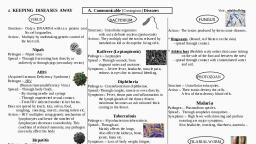
4., , KEEPING DISEASES AWAY, , CONTENT, * Communicable diseases, Pathogens, * Dengue fever, AIDS, Tuberculosis, Malaria, Filariasis, Ringworm, Athlets' foot :, – Mode of spread and symptoms., * Genetic diseases – Haemophilia, Sickle cell anaemia. Video class link of this chapter :, * Cancer., Part 1 : https://youtu.be/-qKvdUewTs8, * Life style diseases., Part 2 : https://youtu.be/0nq8LEbV4fw, * Consequences of smoking., Part 3 : https://youtu.be/zM3UAvzf1Io, * Diseases affecting domestic animals., * Plant diseases., , QUESTIONS & ANSWERS, 1. Give examples to the micro organisms that cause diseases. How do they cause diseases?, A few virus, bacteria, fungus and protozoa are examples for pathogens., *VIRUS - By undertaking the genetic control of the host cell , multiply and thus destroy the cell., * BACTERIA – They multiply through cell division and the toxins released by metabolism kill or, disrupt the living cells., * FUNGUS – The toxins produced by them cause diseases., * PROTOZOA – Their toxins destroy the cells. Some of them destroy blood cells., 2. List out some viral diseases. How are these transmitted ?, Viral diseases, , * AIDS, Ebola, * SAARS, Chickenpox, * Chikungunya, Dengue fever, * Rabies, , Mode of invasion, , - through body fluids, - through air, - through mosquitoes, - through other animals, , 3. Define AIDS ?, AIDS (Acquired Immuno Deficiency Syndrome) is a condition of a gradual decrease of immunity by the, destruction of lymphocytes by HIV (Human Immunodeficiency Virus)., Any pathogen can act in such condition, is a dreadful situation., 4. What are the ways by which HIV spreads ?, • Through body fluids., • By sharing needle and syringe used by HIV affected persons., HIV, • Through unprotected sexual contact., • From HIV infected mother to her foetus., 5. What are the precautions that can be taken against the infection of HIV ?, - Conduct HIV test before receiving blood from a donor., - Do not share needle and syringe already used by others., - Have safety in sexual relationship., 6. Name the diseases spread by the mosquitoes., Disease, Pathogen, , Vector of pathogen, , Dengue fever, , Virus, , Aedes mosquito, , Chikungunya, , Virus, , Aedes mosquito, , Malaria, , Protozoa, , Anopheles mosquito, , Filariasis, , Filarial worm, , Culex mosquito
Page 19 :
7. Point out certain preventive measures for mosquito diseases., • Avoid circumstances leading to the multiplication of the mosquitoes., • Observe 'Dry Day' once in two weeks., • Keep our surrounding neat and clean., • Practice the use of measures like mosquito net., 8. List out some bacterial diseases. How are these transmitted ?, Bacterial diseases, , * Cholera, Typhoid, * Tetanus, * Tuberculosis, * Gonorrhoea, Syphilis, * Anthrax, * Botulism, , Mode of invasion, , - through contaminated water, - through wounds, - through air, - through sexual contact, - through contact with animals, - through stale food, , 9. An air borne bacterial disease that affects mainly the lungs ? Name the pathogen., Tuberculosis. Pathogen is Mycobacterium tuberculosis., 10. Common symptoms of tuberculosis ?, Loss of body weight, fatigue and persistent cough., 11. The vaccine, ----------, is used against tuberculosis., BCG vaccine., 12. Name a bacterial disease that can be spread from cattle., Anthrax., 13. What is botulism ?, Botulism is a dangerous food poisoning due to the growth of certain bacteria in stale food., 14. Table showing fungal diseases, symptoms and mode of infection., Fungal diseases, , Symptoms, , Mode of infection, , * Ringworm, , - Round, red blisters on the skin, , - through contact, , * Athletes' foot, , - Reddish scaly rashes that cause itching on - through contact with, the sole of the foot and between the toes, contaminated water and soil, , 15. The organisms that cause malaria ?, The protozoa, 'plasmodium'., 16. The worms that cause filariasis ?, Filarial worms., 17. Comparison of mosquito spreading diseases , Malaria and Filariasis., Malaria, , Filariasis, , Pathogen, , Protozoa (plasmodium), , Filarial worms, , Vector, , Anopheles mosqitoes, , Culex mosquitoes, , Swelling in the lymph ducts in legs by the, Symptoms of High fever with shivering,, disease, profuse sweating, headache... obstruction in the flow of lymph., , 18. Define communicable (contagious) diseases., Communicable diseases are diseases caused by the invasion of pathogens and are transmitted from person to, person.
Page 20 :
19. Communicable diseases which can be affected to human beings., Disease, , Mode of spread, , Causative, , Dengue, fever, , Virus, [Dengue virus], , AIDS, , HIV, [Human, Immunodeficiency Through body, Virus], fluids, , Symptoms ലക്ഷണങ്ങള്, , Through aedes Fever, pain at joints and muscles, mosquitoes, , Blood test, single, syringe, safety in, sexual contact, BCG vaccination, , Through air, , Loss of body weight, fatigue and, persistent cough., , Ringworm Fungus, , Through, contact, , Round, red blisters on the skin, , Athletes', foot, , Fungus, , Through, contact of soil, or water, , Reddish scaly rashes that cause, itching on the sole of the foot and, between the toes, , Malaria, , Protozoa, [Plasmodium], , Through, anopheles, mosquitoes, , High fever with shivering, profuse, sweating, headache..., , Through culex, mosquitoes, , Swelling in the lymph ducts in legs by, the obstruction in the flow of lymph., , Filarial worms, , Mosquito control, , Gradual decrease of immunity., , Tuberculos Bacteria, is, [Mycobacterium, tuberculosis], , Filariasis, , Control measures, , Personal, cleanliness, , Mosquito control, , 20. Give examples for non pathogenic or non communicable diseases., Lyfestyle diseases – Cancer, Diabetics, Stroke, Fatty liver, Hypertension., Genetic diseases – Haemophilia, Sickle cell anaemia., Deficiency diseases – Anaemia, Goitre, Marasmus, Kwashiorker., Occupational diseases- Silicosis, Asbestosis, Pneumoconiasis., 21. Differentiate between anaemia and sickle cell anaemia., * Anaemia is a condition characterized by tiredness or weakness of the body and decreased oxygen transport, due to the deficiency of iron., * Due to the defect of genes, deformities occur in the sequencing of amino acids of haemoglobin, and RBCs, become sickle shaped. As a result, oxygen carrying capacity of red blood cells decreases. Such patients, , will be anaemic and weaken., 22. What is haemophilia ?, , Excessive bleeding even from small wounds as blood does not clot, due to defective synthesis of, one of the proteins that enables blood coagulation., 23. Comparison between haemophilia and sickle cell anaemia., Haemophilia, , Cause, Symptoms, , Sickle cell anaemia, , Due to the defect of genes, deformities occur in, Due to defect of genes, defective, synthesis of one of the proteins that the sequencing of amino acids of haemoglobin,, and RBCs become sickle shaped., enables blood coagulation., , Excessive bleeding even from small Oxygen carrying capacity of red blood cells, decreases. Such patients will be anaemic and, wounds as blood does not clot, weaken., , 24. World haemophilia day ?, April 17., 25. What does the figure indicate ?, Sickle cell anaemia., , RBC
Page 21 :
26. What is cancer ? What are the circumstances that lead to cancer ?, Cancer is the condition by which uncontrolled division of cells and their spread to other tissues occur., Environmental factors, smoking, radiations, viruses, hereditary factors and alterations in genetic, material may lead to the transformation of normal cells in to cancer cells., 27. How is smoking injurious to our health ?, Smokers and tobacco users are not only subjected to cancer but also affected diseases to brain, lungs and, heart. The defects include stroke, addiction to nicotine, bronchitis, emphysema, hypertension, loss of, elasticity of arteries and decreased functioning of heart., 28. Prepare slogans against the habit of smoking., • Quit smoking, it kill you ..., • Abandon the habit of smoking to prevent cancer., 29. Identify certain means of cancer treatment., Surgery, chemotherapy, radiation therapy etc., 30. ' Life style diseases are caused by our unhealthy living style'. Substantiate., The changes in food habits (synthetic food items, fast food etc) lack of physical exercise, mental stress,, bad habits like consumption of alcohol, drug abuse or smoking etc. may result life style diseases., Life style diseases, , Causes, , a Diabetes, , Deficiency or malfunction of insulin, , b Fatty liver, , Deposition of excess fat in the liver, , c Stroke, , Rupture of blood vessels or block of blood flow in brain, , d Hypertension, , Thickening of artery wall by fat deposition, , e Heart attack, , Block of blood flow due to fat deposition in the coronary arteries, , 31. The life style habits that can be adopted to prevent from heart diseases ?, • Avoid the use of fatty and salty food., • Control diabetes and hypertension., • Take measures to reduce mental stress., • Abandon the habits of smoking and alcohol consumption., • Proper exercise., 32. “Both diabetes and hypertension are silent killers”. Why ?, Diabetes and hypertension increase the risk of stroke, heart diseases or damage to kidneys. Hence, these diseases are known as the 'silent killers'., 33. Table of diseases affect the domestic animals with category of pathogens and symptoms of diseases., Foot and, Virus, mouth disease, , High fever, blisters in mouth and feet, loss of weight., , Anthrax, , Sudden fever, diarrhoea, mouth sore,, , Bacteria, , Inflammation Bacteria, of udder, , Swelling of udder, decreases milk production., , 34. List out diseases that are common in plants. Name the category of pathogen of each., Blight disease of paddy, Wilt disease of brinjal, , -Bacteria, , Mosaic disease in peas and tapioca, Bunchy top of banana - Virus, Quick wilt in pepper, Bud rot of coconut, , - Fungus