Page 1 :
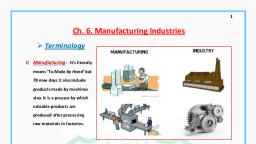
Manufacturing Industries, Classification of Manufacturing Industry, Manufacturing: Production of goods in large quantities after processing the raw materials into more, valuable products is called manufacturing., , Importance of Manufacturing, , , , , , , Manufacturing industries help in modernizing agriculture; which forms the backbone of our, economy. Apart from this, manufacturing industries also reduce the heavy dependence of, people on agricultural income. This becomes possible because of creation of new jobs in, secondary and tertiary sectors., Industrial development helps in eradication of unemployment and poverty., Export of manufactured goods expands trade and commerce and brings in much needed, foreign exchange., A country with high level of manufacturing activities becomes prosperous., , Contribution of Industry to National Economy, The share of manufacturing sector in the GDP (Gross Domestic Product) has been stagnant at 17%, over the last two decades. The total contribution of industry to the GDP is 27% out of which 10%, comes from mining, quarrying, electricity and gas., The growth of the manufacturing sector had been 7% in the last decade. Since 2003, the growth rate, has been 9 to 10% per annum. The desired growth rate over the next decade is 12%., The National Manufacturing Competitiveness Council (NMCC) has been set with the objectives of, improving productivity through proper policy interventions by the government and renewed efforts by, the industry., Industrial Location, , Some of the factors which affect the industrial location are as follows:, a., b., c., d., e., f., , Availability of raw materials, Availability of labour, Availability of capital, Availability of power, Availability of market, Infrastructure, , Sometimes, industries are located in or near cities. Cities provide markets and also provide services, like banking, insurance, transport, labour, consultants, etc. Many industries tend to come together to, make use of the advantages of an urban centre. Such centre is then called as agglomeration, economy., In the pre-independence period, most of the manufacturing units were located in places which were, near the ports, e.g. Mumbai, Kolkata, Chennai, etc. As a result, these belts developed as industrial, urban centres surrounded by huge agricultural rural hinterland., , Classification Of Industries:, On the basis of raw materials:, a. Agro Based Industries: Cotton, woolen, jute, silk textile, rubber, sugar, tea, coffee,, etc., b. Mineral Based Industries: Iron and steel, cement, aluminium, petrochemicals, etc., According to their main role:, a. Basic or Key Industries: These industries supply their products or raw materials to, manufacture other goods, e.g. iron and steel, copper smelting, aluminium smelting., b. Consumer Industries: These industries produce goods which are directly used by, consumers, e.g. sugar, paper, electronics, soap, etc., On the basis of capital investment:, a. Small Scale Industry: If the invested capital is upto Rs. one crore, then the industry is, called a small scale industry., b. Large Scale Industry: If the invested capital is more than Rs. one crore, then the, industry is called a large scale industry., On the basis of ownership:, a. Public Sector: These industries are owned and operated by government agencies, e.g. SAIL,, BHEL, ONGC, etc., b. Private Sector: These industries are owned and operated by individuals or a group of, individuals, e.g. TISCO, Reliance, Mahindra, etc.
Page 2 :
c., , Joint Sector: These industries are jointly owned by the government and individuals or a group, of individuals, e.g. Oil India Limited., d. Cooperative Sector: These industries are owned and operated by the producers or suppliers of, raw materials, workers or both. The resources are pooled by each stakeholder and profits or, losses are shared proportionately. AMUL which is milk cooperative is a good example. The, sugar industry in Maharashtra is another example., Based on the bulk and weight of raw materials and finished goods:, Heavy Industries: Iron and steel., Light Industries: Electronics, , Textile Industry, The textile industry contributes 14% to industrial production in India. In terms of employment, generation, this industry is the second largest after agriculture. 35 million persons are directly, employed in the textiles industry in India. The contribution of textiles industry to GDP is 4%. This is, the only industry in the country which is self-reliant and complete in the value chain., Cotton Textiles: Cotton textiles were traditionally produced with hand spinning and handloom, weaving techniques. Power-looms came into use after the 18th century. During the colonial period,, the competition of mill-made cloth from England destroyed the Indian textiles industry., At present, there are 1600 cotton and synthetic textile mills in India. Almost 80% of them are in the, private sector. The rest are in the public sector and cooperative sector. Additionally, there are several, thousand small factories with four to ten looms., Location of Cotton Textile Industry: This industry was earlier concentrated in the cotton belt of, Maharashtra and Gujarat. Availability of raw materials, port facilities, transport, labour, moist climate,, etc. were in favour of these locations. The industry provides a source of livelihood to farmers, cotton, boll pluckers and workers engaged in ginning, spinning, weaving, dyeing, designing, packaging,, tailoring and sewing. This industry supports many other industries; like chemical and dyes, mill, stores, packaging materials and engineering works., Spinning still continues to be centralized in Maharashtra, Gujarat and Tamil Nadu. However, weaving, is highly decentralized and there are many weaving centres in the country., Production of fabric in India by various sectors, Sector, , Share of production, , Loom age, , Mills, , 6%, , 1.33 lakh, , Power loom, , 54.17%, , 14 lakh, , Handloom, , 23%, , NA, , India exports cotton yarn to Japan. Cotton goods are also exported to USA, UK, Russia, France, East, European countries, Nepal, Singapore, Sri Lanka and African countries., At around 34 million, India has the second largest installed capacity of spindles in the world; after, China. India accounts for one fourth of the world trade in cotton yarn. However, India’s share in, garment trade in the world is only 4%. Our spinning mills are globally competitive and can use all the, fibres we produce. But the weaving, knitting and processing units cannot use much of the high quality, yarn produced in the country., Problems in cotton textile industry: Erratic power supply and obsolete machinery are the major, problems. Low output of labour and stiff competition; with the synthetic fibre are the other problems., , Jute Textiles, India is the largest producer of raw jute and jute goods in the world. It is the second largest exporter, of jute; after Bangladesh. Most of the 70 jute mills in India are located in West Bengal; mainly along, the bank of Hooghly. The jute industry is in a narrow belt which is 98 km long and 3 km wide., Location advantages of Hooghly basin: Proximity of the jute producing areas, inexpensive water, transport, good rail and road network, abundant water for processing raw jute and cheap labour from, West Bengal, Bihar, Orissa and Uttar Pradesh., The jute industry directly supports 2.61 lakh workers. It also supports 40 lakh small and marginal, farmers who are engaged in cultivation of jute and mesta., Jute industry is facing challenge from synthetic fibre and also from other competitors like Bangladesh,, Brazil, Philippines, Egypt and Thailand. But the internal demand has been rising because of, government policy of mandatory use of jute packaging. The National Jute Policy was formulated in, 2005 with an objective to increase productivity, improve quality and ensure good prices for the jute, farmers. Due to growing global concern for environment friendly and biodegradable material; the, future of jute looks bright. USA, Canada, Russia, UAE, UK and Australia are the main markets.
Page 3 :
Sugar Industry, India is the second largest producer of sugar in the world. It is the largest producer of gur and, khandsari. There are over 460 sugar mills in the country. They are spread over Uttar Pradesh, Bihar,, Maharashtra, Karnataka, Tamil Nadu, Andhra Pradesh, Gujarat, Punjab, Haryana and Madhya, Pradesh. Sixty percent mills are in UP and Bihar. This industry is seasonal and hence is more suited, to the cooperative sector., In recent years, there has been a growing tendency to shift and concentrate in the southern and, western states; especially in Maharashtra. The cane produced in this region has higher sucrose, content. The cooler climate of this region ensures a longer crushing season., Challenges for Sugar industry: Seasonal nature of industry, old and inefficient methods of, production, transport delay and the need to maximize the use of baggase are the major challenges, for this industry., , Mineral Based Industries, Iron and Steel Industry, Iron is required for making machineries for all other industries hence it is the basic industry. Due to, this, production and consumption of steel is often regarded as the index of a country’s development., India is 9th among the world crude steel producers and produces 32.8 million tons of steel. India is, the largest producer of sponge iron. But per capita consumption of steel is only 32 kg per annum., Total finished steel production in India, Year, , Production (million tonnes), , 1950 - 51 1.04, 1960 - 61 2.39, 1970 - 71 4.64, 1980 - 81 6.82, 1990 - 91 13.53, 1997 - 98 23.40, 2004 - 05 32.60, At present, there are 10 primary integrated steel plants in India. Additionally, there are many mini, steel plants in the country. SAIL (Steel Authority of India Limited) is the major public sector company, in this sector, while TISCO (Tata Iron and Steel Company) is the major private sector company in this, industry., Most of the iron and steel industries are in the Chhotanagpur plateau region. This region has plenty, of low cost iron ore, high grade raw materials, cheap labour and good connectivity through railways, and roadways., Reasons for underperformance of Iron and steel Industry in India:, a. High cost and limited availability of coking coal, b. Low productivity of labour, c. Erratic energy supply, d. Poor infrastructure, , e. Aluminium Smelting, f., , Aluminium smelting is the second most important metallurgical industry in India. Aluminium is, often turned into alloy and then used for making various products., g. There are 8 aluminium smelting plants in India, located in Orissa (NALCO and BALCO), West, Bengal, Kerala, Uttar Pradesh, Chhattisgarh, Maharashtra and Tamil Nadu. India produced, over 600 million tones of aluminium in 2004., , Chemical Industries, The chemical industry contributes about 3% to the GDP. The chemical industry of India is the third, largest in Asia and is at twelfth position in the world., Inorganic Chemicals: Sulphuric acid, nitric acid, alkalies, soda ash and caustic soda are the, inorganic chemicals. Sulphuric acid is used to manufacture fertilisers, synthetic fibres, plastics,, adhesives, paints, dye stuffs. Soda ash is used to make glass, soaps and detergents, paper, etc.
Page 4 :
Organic Chemicals: These include petrochemicals. Petrochemicals are used for manufacturing, synthetic fibres, synthetic rubber, plastics, dye-stuffs, drugs and pharmaceuticals. Organic plants are, located near oil refineries or petrochemical plants., The chemical industry is usually its own largest consumer., , Fertiliser Industry, Fertiliser industry is centred around the production of nitrogenous fertilisers, phosphatic fertilisers and, ammonium phosphate and complex fertilisers. Complex fertilisers have a combination of nitrogen (N),, phosphate (P) and potash (K). Potash is entirely imported because India does not have any reserves, of commercially viable potash or potassium compounds., India is the third largest producer of nitrogenous fertilisers. There are 57 fertiliser units which, manufacture nitrogenous and complex nitrogenous fertilisers. Out of them, 29 units manufacture urea, and 9 manufacture ammonium sulphate as by-product. There 68 small units which produce single, superphosphate., , Cement Industry, Cement industry requires bulky raw materials like limestone, silica, alumina and gypsum. There are, many cement plants in Gujarat because of proximity to ports., There are 128 large and 323 mini cement plants in India., Improvement in quality has found the Indian cement a readily available market in East Asia, Middle, East, Africa and South Asia. This industry is doing well in terms of production as well as export., , Automobile Industry, Almost all types of vehicles are manufactured in India. After liberalization in 1991, many automobile, manufacturers set up their base in India. With the launch of contemporary models, India became an, attractive market for automobiles. At present, there are 15 manufacturers of cars and multi-utility, vehicles, 9 of commercial vehicles, 14 of two and three-wheelers. Delhi, Gurgaon, Mumbai, Pune,, Chennai, Kolkata, Lucknow, Indore, Hyderabad, Jamshedpur, Bangalore, Sanand, Pantnagar, etc., are the major centres of automobile industry., , Information Technology and Electronics Industry, Bangalore is often termed as the electronic capital of India. Mumbai, Pune, Delhi, Hyderabad,, Chennai, Kolkata, Lucknow and Coimbatore are the other important centres. There are 18 software, technology parks in the country and they provide single window service and high data communication, to software experts., This industry had generated a large number of employments. Upto 31 March 2005, over one million, persons were employed in the IT industry. Because of fast growth of BPO (Business Process, Outsourcing); this sector has been a major earner of foreign exchange., , Industrial Pollution and Environmental Degradation, Air Pollution: High proportion of carbon dioxide, sulphur dioxide and carbon monoxide create air, pollution. Suspended particulate matters also create problems. Smoke is emitted from chimneys of, various factories. Some industry also pose the risk of leak of hazardous chemicals; the way it, happened during the Bhopal Gas Tragedy. Air pollution has adverse effect on human health, animals,, plants, buildings, and the atmosphere as a whole., Water Pollution: Organic and inorganic industrial wastes and effluents cause water pollution. Paper,, pulp, chemical, textile, dyeing, petroleum refineries, tanneries, etc. are the main culprits of water, pollution., Thermal Pollution of water: It occurs when hot water from factories or thermal plants is drained into, rivers and ponds before cooling. This plays havoc with the aquatic life., Radioactive Waste: Waste from nuclear power plants contains highly radioactive materials and it, needs to be properly stored. Any leakage of radioactive material can cause short term and long term, damages to humans as well as to other life forms., Noise Pollution: Noise pollution can result in constant irritation, hypertension and hearing, impairment. Factory equipments, generators, electric drills, etc. are the major sources of noise, pollution., Preventing Environmental Degradation by Industry:, , , , , , Water should be reused and recycled in the industry. This will help in minimizing the use of, freshwater., Rainwater harvesting should be promoted., Hot water and effluents should be treated before being released in rivers and ponds.