Page 1 :
CLASS X, POLITICAL SCIENCE, UNIT 3, COMPETITION AND CONTESTATION IN DEMOCRACY, NOTES, Democracy will have conflict of interests and viewpoints. These differences are often, expressed in organized ways. These groups have competitions and contestations among, themselves to capture political power in a democracy. There are different ways and, organizations through which ordinary citizen can play a role in democracy., Nepal’s popular movement of 2006:, The movement aimed at the establishment of democracy and popular control over the, government from the king., All the major political parties formed a Seven Party Alliance (SPA) and called for a 4 day, strike in Kathmandu; Maoist insurgents and various other organizations joined the general, strike., Protestors numbering 4-5 lakhs served an ultimatum to the king on April 21, 2006. On the, last day of the ultimatum on April 24, 2006, the king Gyanendra was forced to concede all, the demands., The SPA chose Girija Prasad Koirala as the new Prime Minister of the interim government., The restored Parliament met and passed laws taking away most of the powers of the king., This struggle came to be known as Nepal’s second movement for democracy. In July 2008,, king Gyanendra left the king’s palace for the establishment of a democratic republic and, constituted an assembly for drafting a constitution., India’s struggle for freedom:, The Indians had struggled against the British authoritarian regime for a long time., They had a bitter experience of subjugation and poverty., So it was but natural for the makers of the Indian Constitution to have opted for a democratic, polity., Pressure groups:, Pressure groups are organizations that attempt to influence government policies. In order to, achieve a common objective, people with common occupation, interest, aspirations come, together to form pressure groups., Sectional Interest Groups - Sectional interest groups are those pressure groups which seek, to promote the interest of a particular section or group of society. Their main concern is the, betterment and well-being of their members only. Example: trade unions, business, associations etc., Public interest group - Public or promotional interest groups are those pressure groups, which seek to promote collective rather than sectional good. Its principal concern is with, social justice and social equality. Example: a group of people fighting against bonded labour., Page | 1
Page 2 :
Movement groups:, Unlike interest groups, movements have a loose organization. A movement also attempts to, influence politics indirectly., Single issue movement - Those movements that seek to achieve a single objective within a, limited time is called a single issue movement. Example: Narmada Bachao Andolan in, India., Multi issue movement - Those movements that involve more than one issue and run for a, long term are called multi issue movement. Example: Women Movement for Empowerment., , , , , , , , , , , , , , , , How do Pressure Groups and Social movements influence politics?, They try to draw public attention and support for their goals by carrying out information, campaigning, organizing meeting etc. They try to influence the media into giving more, attention to their cause., They often organize protest activity like strikes and disruption of government programmes., Business groups often employ professional lobbyists or sponsor expensive advertisement., Some of their members may participate in official bodies and committees that advise the, government. They also seek to exert influence political parties., Sometimes pressure groups are either led or formed by leaders of political parties. Most of, the leaders of such pressure groups are usually activists and leaders of party., Sometimes political parties grow out of movements. After foreigner’s issue Asom Gana, Parishad formed a government of AGP., Is the influence of pressure groups and movements healthy?, Initially, it may appear that it is not healthy for groups that promote interest of one section to, have influence in democracy., On balance, however, pressure groups and movements have deepened democracy., Putting pressure on the rulers is not an unhealthy activity in a democracy., Where different groups function actively, no single group can dominate society., Different views and influences from different groups may lead to a balance of power., Meaning of a political party:, A political party is a group of people who come together to contest elections and hold powers, in the government. To win power in the government is its principal objective., Components of Political Parties:, A political party has three components –, (i) Leaders, (ii) The active members and, (iii) The followers., , Page | 2
Page 3 :
, , , , , , , , , , , , , , , Functions of a Political Party:, Contest Election - Political parties contest elections. The political parties fight these, elections. Contestations are mainly among the candidates put up by the political parties., Parties select their candidates in different ways., Policies and Programmes - Every political party prepares its programmes and policies, which is published in the election manifesto and distr6ibute it the people. A government is, supposed to follow the policies of the ruling party., Mould Public Opinion - Parties mould public opinion. The parties organize, educate and, discipline the electorate. The common people do not have knowledge about the political, problems. Political parties present clearly such problems to the people and create awakening, among the people. They try to mould public opinion in their favour in different ways., Form and Run Government - Parties form and run the governments. Parties recruit leaders, train them and then make them ministers to run the government in the way they like., Role in Making Laws - In making laws, parties play a decisive role. But laws are debated, and passed in the legislature. Most of the members belonging to a party are moved by the, direction of the party leader., Needs of Political Parties:, Political parties are very much needed in modern democracies because democracies cannot, exist without political parties., Without parties, government may be formed but its utility will remain ever uncertain., There will be no accountability of the government and will not be responsible to the people., Without political parties, citizens will not be united and it would be difficult for candidates to, contest elections., Political parties gather different views on various issues nad present it to the government., , Types of the Party System:, Single party system - By single party system, we mean there is only one party in a country, and the existence of other parties is not tolerated. E.g., China., Bi-party System - In the states where there are two main parties, it is called bi-party system., E.g., UK, USA., Multiparty system - If several parties compete for power to form the government, it is called, multiparty system. E.g., India, France., Two Kinds of Political Parties:, National Parties - National parties are those political parties which are present in several or, all units of the federation., State/Regional/Local Parties - Regional parties are those political parties which influence, and activities are restricted to particular states or regions., , Page | 3
Page 4 :
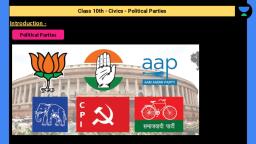
Criteria for Recognition:, National Parties - A party that secures at least six percent of total votes in Lok Sabha, elections or Assembly elections in four states and wins at least four seats in the Lok Sabha is, recognized by Election Commission of India as a National Party., State Parties - A party that secures at least six percent of the total votes in an election to the, state assembly of a state and wins at least 2 seats is recognized as a state party., , , , , , , , , , , , , , Bharatiya Janata Party (BJP):, The BJP was formed in 1980 by reviving the erstwhile Bhartiya Jana Sangh., The BJP wants to build a strong modern India drawing inspiration from India’s ancient, culture and values., Cultural nationalism ‘Hindutva’ is an important element of the party., It wants full territorial and political integration of Jammu and Kashmir with India., The symbol of BJP is Lotus., Indian National Congress (INC):, Popularly known as Congress party is one of the oldest parties in the world founded in 1885., The party sought to build a modern secular democratic republic in India under the leadership, of Jawaharlal Nehru., It supports secularism, welfare of weaker sections and minorities., It also supports new economic reforms., The symbol of congress party is Palm., , Bahujan Samaj Party (BSP):, The party was formed in 1984 and sought to represent and secure power for the Bahujan, Samaj which includes dalits, adivasis, OBCs and other religious minotities., It stands for the cause of securing the interest and welfare of the dalits and oppressed people., The symbol of BSP is elephant., , , , , , , , , , , , Communist Party of India (CPI):, Formed in 1925, it believes in Marxism-Leninism, secularism and democracy., The party is opposed to the forces of secessionism and communalism., It accepts parliamentary democracy as a means of promoting the interests of the working, class, farmers and the poor., The symbol of CPI is Ears of Corn and Sickle., Communist Party of India-Marxist (CPI-M):, The CPI-M was formed in 1964., It believes in Marxism-Leninism and it supports socialism, secularism and democracy., It opposes imperialism and communalism., The party accepts democratic elections as a useful and helpful means for economic justice in, India., The symbol of CPI-M is Hammer, Sickle and Star., Page | 4
Page 5 :
, , , , , Nationalist Congress Party (NCP):, The NCP was formed in 1999 following a split in the Congress party., The party espouses democracy, Gandhian secularism, equity, social justice and federalism., It likes that high officers in government must be occupied by natural born citizens of the, country., The symbol of NCP is Clock., , Drawbacks of political parties:, Most people tend to be very critical of political parties., They tend to blame parties for all that is wrong with our democracy and our political life., Parties have become identified with social and political divisions., *******, , Page | 5