Page 1 :
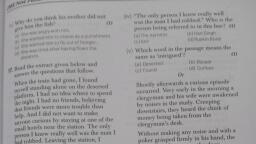
FOOTPRINTS WITHOUT FEET, MCQ's QUESTIONS., Q1- Who is the author of the story “Footprints without feet”?, A) HG Wells, B) James Herriot, C) John Keats, D) WB Butler, Q2- “THE two boys started in surprise at the fresh muddy imprints of a pair of _____”, A) bare feet, B) shoes, C) tyres, D) none of the above, Q3- He was leaving his imprints in _____, A) Paris, B) London, C) Iping, D) Canada, Q4- What is the meaning of “bewildered”?, A) perplexed, B) confused, C) puzzled, D) all of the above, Q5- Who were the boys following?, A) a scientist, B) a dog, C) a rat, D) none of the above, Q6- What was he working on?, A) making fake footprints, B) making human bodies invisible, C) making a fool of children, D) all of the above, Q7- “Brilliant scientist though he was, Griffin was rather a _____ person.”, A) lawless, B) lawful, C) good, D) rude, Q8- What did he do for revenge?, A) burned himself, B) burned the landlord, C) burned the house, D) he didn’t do anything for revenge, Q9- Griffin’s body became as transparent as _____, A) glass, B) ice, C) air, D) none of the above, Q10- What suggests that he was a homeless wanderer?, A) no clothes, B) no money, C) invisible, D) all of the above, Q11- Why was it a bad time to wander in London?, A) it was mid winter, B) he was without clothes, C) both 1 and 2, D) none of the above, Q12- Where did he find comfort in London?, A) at the inn, B) a big store, C) theatre store, D) none of the above, Q13- Where did he go next?, A) at the inn, B) a big store, C) theatre store, D) none of the above, Q14- What did he take from there?, A) food, B) wine, C) bandages, D) all of the above, Q15- How did Griffin finaly escape?, A) by hitting them, B) by taking off all his clothes, C) by running away as fast as he could, D) by hiding, Q16- Where did he go next?, A) Piping, B) Iping, C) Snowland, D) none of the above, Q17- what was an unusual event?, A) a guest at the inn during winters, B) a guest at the inn during summers, C) a guest at the inn during spring, D) nothing was unusual there, Q18- How did he justify his disinterest in having a conversation with Mrs Hall?, A) desired solitude, B) didn’t want to be disturbed during work, C) both 1 and 2, D) none of the above, Q19- What do you mean by the word “eccentric”?, A) uncommon, B) extra, C) catchy, D) none of the above, Q20- Why does Mrs Hall find the scientist eccentric?, A) he visited during off season, B) his intention was only to work, C) he looked weird, D) all of the above, Q21- Why was Mrs Hall prepared and ready to tolerate strange habits and irritable temper?, A) he had paid in advance, B) he was a scientist, C) both 1 and 2, D) none of the above, Q22- What does the first encounter tell us about Mrs Hall?, A) She is not friendly, B) She is money-minded, C) she is disinterested in her guests, D) all of the above, Q23- What is being referred to as the “strange incident” that happened in the study?, A) Griffin stealing money while being invisible, B) Griffin arriving at the inn during off season, C) Griffin pretending to be waiting for a cheque, D) none of the above, Q24- Who called the incident “an extraordinary affair”?, A) clergyman, B) clergyman’s wife, C) Mrs Hall, D) all of the above, Q25- What did she think had happened to her furniture?, A) nothing, B) the scientist had put spirits in them, C) the scientist was playing with them, D) the furniture had gone mad, Q26- What do you mean by the word “hysterics”?, A) an exaggerated reaction, B) a normal reacion, C) no reaction, D) none of the above, Q27- What caused the villagers to suspect the scientist?, A) the robery, B) the furniture incident, C) unexpected availability of cash on him, D) all of the above, Q28- “The scientist was always _____; now he became furious.”, A) patient, B) quick-tempered, C) calm, D) none of the above, Q29- What was easier said than done?, A) to see him, B) to talk to him, C) to hold him, D) none of the above, Q30- Where was the theatrical company shop situated?, A) Dury lane, B) Drury lane, C) Druy lane, D) Druri Lane