Page 1 :
1.SOME BASIC CONCEPTS OF CHEMISTRY, Chemistry is branch of science which deals with the study of matter/atom, Matter can be classified as;, , Mixtures, ✓, , Components are present in any ratio., , ✓, , Homogeneous mixture − Uniform composition throughout, , ✓, , Heterogeneous mixture − Non-uniform composition throughout, , ✓ Components can be separated by physical methods such as hand picking, filtration, crystallization, distillation, etc., Pure substances, ✓, , Fixed composition, , ✓, , Constituents cannot be separated by simple physical methods., , ✓, , Elements contain only one type of particles − atoms (example Na, K, Cu, C, Ag) or molecules (example H 2, N2, O2, F2)., , ✓, , Compounds are formed by the combination of two or more atoms of different elements. Example, water (H2O), carbon dioxide (CO2), , ✓, , Constituents of compounds cannot be separated by physical methods; they can be separated by chemical methods only., , The International System of Units (SI), ✓, , Seven base units, Base Physical Quantity, , Name of SI Unit, , Symbol for SI Unit, , Length, , metre, , m, , Mass, , kilogram, , kg, , Time, , second, , s, , Electric current, , ampere, , A, , temperature, , kelvin, , K, , Amount of substance, , mole, , mol, , candela, , cd, , Luminous intensity, , •, , Mass and Weight, Mass, , Weight, , Amount of matter present in an object, , Force exerted on an object by gravity, , Constant, irrespective of the place, , Vary from place to place due to change in gravity, , ✓, , Mass can be determined accurately by using an analytical balance., , ✓, , SI unit of mass = Kilogram (kg), , ✓, , 1 kg = 1000 g, , ✓, , 1 g = 1000 mg
Page 2 :
HEAT AND TEMPERATURE, •, , Heat is a form of energy, , •, , Temperature is the measure of heat, o, , Three scales − degree Celsius (°C) ,degree Fahrenheit (°F) and kelvin (K), , o, , SI unit = Kelvin (K), , o, , Relation between °F and °C scale, °F =, , o, , (°C) + 32, , Relation between K and °C scale, K = °C + 273.15, , o, , Negative values of temperature are possible in °C scale, but not in °F and K s, , Volume, ✓, , Amount of space occupied by an object, , ✓, , Has the units of (length)3, , ✓, , SI unit = m3, , ✓, , Often used units = dm3, L, 1 dm3 = 1000 cm3, , 1 L = 1000 mL, , ✓, , Litre is equal in size to dm3., , ✓, , Measuring devices − burette, pipette, graduated cylinder, volumetric flask, , DENSITY, ✓, , Amount of mass per unit volume, i.e., Density, , ✓, , ✓, , SI unit of density =, or kg m−3, , ✓, , Often used unit = g cm−3, , ✓, Precision, , Accuracy, , Closeness of various measurements for the same quantity, , closeness of a particular value to the true value of the result, , SIGNIFICANT FIGURES, •, , Meaningful digits which are known with certainty, , •, , Rules to determine the number of significant figures:, o All non-zero digits are significant. Example: 145 mL has three significant figures., o Zeroes preceding the first non-zero digit are not significant. Example: 0.04281 has four significant figures., o Zeroes between two non-zero digits are significant. Example: 23.007 has five significant figures., o Zeroes at the end or right of a number are significant when they are on the right side of the decimal point. Example: 0.8300 has four, significant figures., , LAWS OF CHEMICAL COMBINATIONS, Law of Conservation of Mass:((A.Lavoisier), It states that Matter can be neither created nor destroyed.
Page 3 :
Law of Definite Proportions(J.Proust), It states that given compound always contains exactly the same proportion of elements by weight., , Law of Multiple Proportions:(John Dalton), It states that if two elements can combine to form more than one compound, then the masses of one of the element that combines with, a fixed mass of the other element are in a simple whole number ratio.., , Gay Lussac’s Law of Gaseous Volumes:, It states that when gases combine to form gaseous products, they do so in a simple ratio of their volumes, , Avogadro Law:, It states that under equal conditions of temperature and pressure equal volumes of all gases, should contain equal number of molecules., Dalton’s Atomic Theory, •, , Postulates:, o, , All matter is made of very tiny indivisible particles called atoms., , o, , All the atoms of a given element are identical in mass and chemical properties, , o, , Atoms of different elements have different masses and chemical properties., , o, , Atoms combine in a fixed whole number ratio to form compounds., , o, , Atoms are neither created nor destroyed in a chemical reaction., , ., , •, , Atomic mass:, o, , The mass of an atom, , o, , One atomic mass unit (1 amu) = Mass equal to one-twelfth of the mass of one carbon-12 atom, 1 amu = 1.66056 × 10⁻²⁴ g, , o, , •, , Nowadays, ‘u’ (unified mass) has replaced ‘amu’., , Molecular Mass:, o, , Sum of the atomic masses of all the elements present in a molecule, , o, , Example − Molecular mass of CO2 = 1 × Atomic mass of carbon + 2 × Atomic mass of oxygen, = (1 × 12 u) + (2 × 16 u), = 12 u + 32 u, = 44. u
Page 4 :
Mole Concept, 1 mole of any substance can be defined as:, •, , Mass of substance containing Avogadro number of particles, , •, , One gram atomic mass of any element, , •, , One gram molecular mass of any element, , •, , 22.4 L of any gas STP, , Percentage Composition, Mass percent of an element =, EMPIRICAL FORMULA AND MOLECULAR FORMULA:, , Empirical formula, , Molecular formula, , Represents the simplest whole number ratio of various atoms, , Represents the exact number of different types of atoms, , present in a compound, , present in a compound, , Relation between empirical formula and molecular formula is Molecular Formula = Empirical Formula x n, Where n = M.M/E.F.M., Limiting reagent or limiting reactant:, o, •, , Reactant which gets completely consumed in a reaction, , Reactions in solutions, o, , Mass per cent or weight per cent (w/w%), Mass per cent of solute, , o, , Mole fraction:, If a substance ‘A’ dissolves in a substance ‘B’, then mole fraction of A, , Mole fraction of B, , nA − Number of moles of A, nB − Number of moles of B, o, , Molarity:, Number of moles of a solute in 1 L of a solution, Molarity (M) =
Page 5 :
o, , Molality:, Number of moles of solute present in 1 kg of solvent, , o, , Molality (m) =, , PREVIOUS HSE QUESTIONS AND ANSWERS, 1. Which of the following contains the maximum number of molecules?, a) 1g N2 b) 1g CO2 c) 1g H2 d) 1g NH3 (1), Ans: c) 1g H2, 2. Calculate the mass of SO3 (g) produced, if 500 g SO2 (g) reacts with 200 g O2 (g) according to the equation:, 2SO2 + O2, 2SO3 . Identify the limiting reagent., Ans:, , 2SO2 + O2, 2SO3, 128 g 32g, 160g, 128g SO2 requires 32g Oxygen for the complete reaction., So 500g SO2 requires 32x500/128 = 125g O2, Here there is 200g O2 . So SO2 is completely used up and hence it is the limiting reagent, ., 3.a) NO and NO 2 are two oxides of nitrogen., i) Which law of chemical combination is illustrated by these compounds? (1), ii) State the law., b) Calculate the mass of a magnesium atom in grams., c) What is molality?, Ans: a) i) Law of multiple proportions, ii) It states that if two elements combine to form more than one compound, the different masses of one of, the elements that combine with a fixed mass of the other element, are in small whole number ratio., b) Atomic mass of magnesium = 24g, i.e. Mass of 6.022 x 10²³, atoms of Magnesium = 24g, So, Mass of one magnesium atom = 24/(6.022x10 23) = 3.98x10⁻²³ g, c) Molarity is the no. of moles of solute present per litre of the solution, 4. Give the empirical formula of the following., C6H12O6 , C6H6 , CH3COOH, C6H6Cl6, Ans: Empirical formulae are: CH2O, CH, CH2O, CHCl.
Page 6 :
2.STRUCTURE OF ATOM, Discovery of Electron (Michael Faraday’s Cathode Ray Discharge Tube Experiment), ✓, , Cathode rays move from the cathode to the anode., , ✓, , Cathode rays have mass, , ✓, , These rays travel in a straight line, , ✓, , cathode ray are negatively charged ., , Charge to Mass Ratio of Electrons (J.J Thomson’s Experiment), J.J Thomson measured the ratio of charge (e) to the mass of an electron (me), , Charge on Electron (Millikan’s Oil Drop Experiment), Charge on an electron = − 1.6022 × 10⁻¹⁹ C, Mass of an electron, , SUB ATOMIC PARTCLES, , Name, , Symbol, , Absolute charge/C, , Mass/ kg, , Discovered by, , Electron, , e, , −1.6022 × 10⁻¹⁹, , 9.10939 × 10⁻³¹, , J.J.Thomson, , Proton, , p, , +1.6022 × 10⁻¹⁹, , 1.67262 × 10⁻²⁷, , Goldstein, , Neutron, , n, , 0, , 1.67493 × 10⁻²⁷, , Chadwick, , THOMSON’S MODEL OF ATOM, * An atom possesses a spherical shape in which the positive charge is uniformly distributed and electrons are embedded on it, , * Known as plum pudding, raisin pudding or watermelon model, Rutherford’s Alpha ray Scattering Experiment, , Experiment; Passed a narrow beam of alpha rays through a thin gold foil and, observed them with the help pf a photographic film
Page 7 :
Key points related to Ruthrford’s model of atom, Observations, , Conclusions, , Model of atom, , Drawbacks, , 1.Most of the alpha (α), , 1.Most of the space in an, , 1.There is a Positively charged mass, , 1.It cannot explain the stability of an, , particles passed through the, , atom is empty ., , called nucleus at the the centre of the, , atom ., , gold foil without deflection., , 2.There is a tiny positively, , atom, , 2.Rutherford’s model does not give, , 2.Some of the α-particles were, , charged mass at the, , 2.Electrons revolve around the nucleus,, , any idea about the the electronic, , deflected by small angles., , centre of atom, , in circular paths called orbits., , structure of the atom, , 3.Electrons and nucleus are held, , 3.It cannot explain the atomic, , together in the atom by electrostatic, , spectra, , 3.Very few of them, (1 in 20000) deflected back, , force of attraction., Atomic Number and Mass Number, * Atomic number (Z) = Number of protons in the nucleus of an atom= Number of electrons in a neutral atom, *Mass number (A) = Number of protons (Z) + Number of neutrons (n), Properties of Electromagnetic Radiation, ▪ It propagates through space in the form of waves., ▪ It travels with a velocity of light., ▪ It requires no medium for transmission, 1. Wave length (λ), ▪ The distance between two adjacent crests of troughs is called wavelength., ▪ It is denoted by the Greek letter lambda (λ), ▪ It is generally expressed in terms of Angstrom units, 2. Frequency (υ), ▪ The number of waves which pass through a given point in one second the frequency., ▪ It is denoted by the Greek letter nu (υ)., ▪ The units of frequency are cycles per second or Hertz (Hz)., 3. Wave Number, ▪ It is defined as the number of wavelengths per unit length., ▪ It is the inverse of wavelength. It is denoted by nu bar, ▪ It is expressed in cm-1 or m-1, PLANCK’S QUANTUM THEORY OF RADIATION, Main features of Planck’s quantum theory of radiation are as follows:, ✓, , Radiant energy is not emitted or absorbed in continuous manner, but discontinuously in the form of small packets of energy called quanta or, photons., , ✓, , The amount of energy (E) associated with quantum of radiation is directly proportional to frequency of light (ν)., i.e., E ∝ ν, Or, E = hν where ‘h’ is known as Planck’s constant and has the value 6.626 × 10⁻³⁴ Js., Photoelectric Effect, When radiations of a suitable frequency falls on the surface of metals having low IE ,electrons are emitted from the surface., This phenomenon is called Photoelectric effect, , LINE SPECTRUM OF HYDROGEN, If an electric discharge is passed through gaseous hydrogen, then the H 2 molecules get dissociated to produce energetically excited hydrogen atoms., These atoms emit electromagnetic radiations of discrete frequencies
Page 8 :
All the series of lines in the hydrogen spectrum can be described by the following expression:, , Where, n1 = 1, 2, …, n2 = n1 + 1, n2 + 2, …, 109,677 is called Rydberg constant for hydrogen (RH), * The first five series of lines that correspond to n1 = 1, 2, 3, 4, 5 are known as Lyman, Balmer, Paschen, Brackett and Pfund series., , Series, , n1, , n2, , Spectral Region, , Lyman, , 1, , 2,3…, , Ultraviolet, , Balmer, , 2, , 3,4…, , Visible, , Paschen, , 3, , 4,5,…, , Infrared, , Brackett, , 4, , 5,6…, , Infrared, , Pfund, , 5, , 6,7…, , Infrared, , POSTULATES FOR BOHR’S MODEL OF ATOM, ✓, , The electron revolve around the nucleus in circular paths called orbits, stationary states represented as, 1,2,3.4 etc or K,L,M,N etc, , ✓, , As long as an electron revolves in a particular orbit ,it does not gain or lose energy, , ✓, , Energy is absorbed when electron jumps from lower orbit to a higher orbit and is emitted when electron jumps from higher orbit to a lower orbit., , ✓, , Only those orbits are permitted in which the angular momentum (mvr) of the electron is an integral multiple of h/2 ii where h is the Planck’s, constant., , Angular momentum (L) of an electron in a stationary state is given by,, , Merits of Bohr model, ✓, , It can explain the stability of an atom, , ✓, , It can explain Hydrogen spectrum, , ✓, , Radii of the stationary states (rn) are given by, rn = 52.9 n2 / Z pm, , ✓, , Energy (En) of the stationary state is given by,, , RH is called Rydberg constant (= 2.18 × 10⁻¹⁸ J), ✓, , Bohr’s theory can be applied to the ions, which are similar to hydrogen atom (containing only one electron). For example − He +, Li2+, Be3+, etc., Energies and radii of the stationary states for hydrogen-like species is given by,, , pm =, , nm; Z is the atomic number
Page 9 :
Limitations/Demerits of Bohr’s Model of Atom, ✓, , Unable to explain the spectrum of multi-electron atoms (For example − helium atom which contains two electrons), , ✓, , Unable to explain splitting of spectral lines in electric field (Stark effect) or in magnetic field (Zeeman effect), , ✓, , Fails to explain Heisenberg’s Uncertainty Principle, , ✓, , Fails to explain the wave character of electrons, , Dual Behaviour of Matter/ De Broglie’s equation, ✓, , Matter, like radiation, exhibits dual behaviour (i.e., both particle and wave-like properties)., , ✓, , Electrons should have momentum as well as wavelength, just as photon has momentum as well as wavelength., , ✓, , De Broglie gives the relationship between wavelength (λ) and momentum (p) of a material particle., Where, m is the mass of the particle v is its velocity and P is its momentum, HEISENBERG’S UNCERTAINTY PRINCIPLE, It states that it is Impossible to determine the exact position and momentum of a microscopic particle like electron, simultaneously, ✓, , * Mathematically, it can be represented as, Δx × Δp =, , Or, Δx × Δ(mv) =, , Or, Δx × Δv =, Where,, Δx is the uncertainty in position Δv is the uncertainty in velocity, Δp is the uncertainty in momentum, Significance of Uncertainty Principle, ✓, , Heisenberg’s uncertainty principle rejects the existence of definite paths or trajectories of electrons and other similar particles., , ✓, , The effect of Heisenberg’s uncertainty principle on the motion of macroscopic objects is negligible, , ✓, QUANTUM MECHANICAL MODEL OF ATOM, * In the quantum mechanical model, the behaviour of microscopic particles (electrons) in a system (atom) is described by anequation known as, Schrodinger equation, which is given below:, , Where,, , = Mathematical operator known as Hamiltonian operator, , ψ = Wave function (amplitude of the electron wave), , E = Total energy of the system, , *The solutions of Schrodinger equation are called wave functions., Orbit, An orbit is a well defined circular path followed by the, revolving electron around the nucleus., , Orbital, An orbital is a region of space around the nucleus of an atom where there is the probability of, finding an electron is maximum, , It represents the planar motion of an electron (2D), , It represents the three dimensional (3D)motion of an electron around the nucleus, , The maximum number of electrons in an orbit is 2n2, , An orbital cannot accommodate more than 2 electrons., , Orbits are circular in shape, , Orbitals have different shapes., s orbitals are spherical, p orbitals are dumbbell shaped, , Concept of well-defined orbits is against Heisenberg’s, uncertainty principle, , Concept of orbital is in accordance with Heisenberg’s uncertainty principle
Page 10 :
QUANTUM NUMBERS, The principal quantum number (n), • Values are Positive integers (n = 1, 2, 3,………), • It identifies the shell, The Azimuthal quantum number (l), Also known as orbital angular momentum or subsidiary quantum number, • It identifies the subshell, • Gives the number of subshells in a shell, • For a given value of n, l can have n values, ranging from 0 to n − 1, Value for l, , 0, , 1, , 2, , 3, , 4, , Notation for sub-shell, , S, , P, , d, , f, , g, , Sub-shell notations corresponding to the given principal quantum numbers and azimuthal quantum numbers, , Principal quantum, , Azimuthal, , Sub-shell, , number (n), , quantum number, , notations, , (l), , The magnetic orbital quantum number (ml):, Gives information about the spatial orientation of the orbital with respect to the, standard set of co-ordinate axis, * For a given value of l , 2l + 1 values of ml are possible, , 1, , 0, , 1s, , 2, , 0, , 2s, , 2, , 1, , 2p, , 3, , 0, , 3s, , 3, , 1, , 3p, , 3, , 2, , 3d, , It identifies the orbital, It gives the number of orbitals in a subshell, spin quantum number (ms)., * It designates the spin of an electron., There are two orientations of an electron,: +, , and −, , or ↑(spin up) and ↓(spin, , down), , FILLING OF ORBITALS IN ATOM, Aufbau Principle, It states that the orbitals are filled in the increasing order of their energy., * The given table shows the arrangement of orbitals with increasing energy on the basis of (n + l) rule. Increasing order of the energy of the orbitals and, hence, the order of the filling of orbitals: 1s, 2s, 2p, 3s, 3p, 4s, 3d, 4p, 5s, 4d, 5p, 4f,5d, 6p, 7s,, Pauli’s Exclusion Principle, It states no two electrons in an atom can have the same set of four quantum numbers, Hund’s Rule of Maximum Multiplicity, It states that Pairing of electrons in the orbitals does not take place until each orbital in a subshell is singly occupied first, Degenerate orbitals., Orbitals of equal energy (i.e., same sub-shell) are called degenerate orbitals., , Electronic Configuration of Atoms, * Can be represented in two ways:, * s a pb dc …
Page 11 :
* Orbital diagram, , * a, b, c, …, etc. represent the number of electrons present in the sub-shell. In an orbital diagram, an electron is represented by an up arrow (↑) indicating, a positive spin, or a down arrow (↓) indicating a negative spin., * For example,, , Stability of completely filled and half-filled sub-shells, p3, p6, d5, d10, f7, etc. configurations, which are either half-filled or fully filled, are more stable., Symmetrical Distribution of Electrons, Symmetry leads to stability., The completely filled or half-filled sub-shells have symmetrical distribution of electrons in them. Hence, they are stable., Exchange Energy, Whenever two or more electrons with the same spin are present in the degenerate orbitals of a sub-shell, the stabilising effect arises., * Such electrons tend to exchange their positions and the energy released due to the exchange is called exchange energy., * If the exchange energy is maximum, then the stability is also maximum., * The number of exchanges that can take place is maximum when the sub-shell is either half-filled or completely filled., * Possible exchange for d5 configuration:, , PREVIOUS HSE QUESTIONS AND ANSWERS OF THE CHAPTER “STRUCTURE OF ATOM”, 1. Represent the orbital with quantum numbers n = 5 and l = 3., Ans: 5f, 2.The minimum value for the product of uncertainties in position and momentum of a moving microscopic, particle is equal to .........., Ans: h/4pi, 3.Name the quantum number which gives the spatial orientation of an orbital with respect to standard set of, co-ordinate axes. (1), Ans: Magnetic Quantum number, 4.What are the important observations and conclusions made by Rutherford from his alpha ray scattering, experiment? Give any two limitations of Rutherford’s nuclear model of atom. ., 5.Atomic orbitals are precisely distinguished by what are known as Quantum numbers., a) Name the four quantum numbers., b) Represent the orbitals given below:, i) n = 1, l = 0 ii) n = 2, l = 1
Page 12 :
c) The number of unpaired electrons present in Ni is ………. (Atomic number of Ni = 28), Ans: a) Principal Quantum number (n), Azimuthal Quantum number (Ɩ), Magnetic Quantum number (m) and, Spin Quantum number (s), b) (i) 1s (ii) 2p, c) 2, 6. a) Cathode rays are rays moving from cathode to anode., Give any two properties of cathode rays., b) Write the electronic configuration of Cr., c) Draw the shapes of s and p orbitals., 7.Bohr was the first to explain the structure of hydrogen atom and spectrum., a) Give the main postulates of Bohr model of atom.
Page 13 :
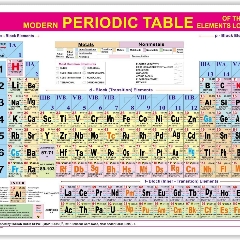
3, , CLASSIFICATION OF ELEMENTS AND, PERIODICITY IN PROPERTIES, , Triads By Johann Dobereiner in 1800, The physical and chemical properties of several groups of three elements (Triads) are similar., In each case, he noticed that the middle element of each of the Triads had an atomic weight, about half way between the atomic weights of the other two., A.E.B. de Chancourtois (1862) cylindrical table, He arranged the then known elements in order of increasing atomic weights and made a, cylindrical table of elements to display the periodic recurrence of properties., John Alexander Newlands (1865) The Law of Octaves, He arranged the elements in increasing order of their atomic weights and noted that every, eighth element had properties similar to the first element. Newlands’s Law of Octaves, seemed to be true only for elements up to calcium., Mendeleev's Periodic Law (1905), The law states that “the physical and chemical properties of elements are periodic functions of, their atomic weights”., Mendeleev's Periodic Table, Mendeleev arranged elements in horizontal rows and vertical columns of a table in order of, their increasing atomic weights in such a way that the elements with similar properties occupied, the same vertical column or group., He realized that some of the elements did not fit in with his scheme of classification if the order, of atomic weight was strictly followed. He left the gap under Aluminium and a gap under, Silicon, and called these elements Eka- Aluminium and Eka-Silicon., NOMENCLATURE OF ELEMENTS WITH ATOMIC NUMBERS > 100, , Atomic number Name, , Symbol IUPAC Name IUPAC Symbol, , 101, , Unnilunium, , Unu, , Mendelevium Md, , 102, , Unnilbium, , Unb, , Nobelium, , No, , 103, , Unniltrium, , Unt, , Lawrencium, , Lr, , 104, , Unnilquadium Unq, , Rutherfordium Rf, , 105, , Unnilpentium Unp, , Dubnium, , Db, , 106, , Unnilhexium Unh, , Seaborgium, , Sg, , 107, , Unnilseptium Uns, , Bohrium, , Bh
Page 14 :
Atomic number Name, , Symbol IUPAC Name IUPAC Symbol, , 108, , Unniloctium, , Uno, , 109, , Hassnium, , Hs, , Unnilennium Une, , Meitnerium, , Mt, , 110, , Ununnillium, , Darmstadtium Ds, , 111, , Unununnium Uuu, , Rontgenium, , Rg, , 112, , Ununbium, , Uub, , Copernicium, , Cp, , 113, , Ununtrium, , Uut, , 114, , Ununquadium Uuq, , 115, , Ununpentium Uup, , 116, , Ununhexium, , 117, , Ununseptium Uus, , 118, , Ununoctium, , Uun, , Uuh, Uuo, , MODERN PERIODIC LAW (1913) (Henry Mosely), The law states that “the physical and chemical properties of elements are periodic functions of, their atomic numbers”., Classification of periodic table, , (a) Group and Period, Vertical columns are called groups and Horizontal rows are called periods. There are 7 periods and 18, groups in modern periodic table, , (b) s, p, d and f Blocks, s-Block elements: The elements of Group 1 (alkali metals) and Group 2 (alkaline earth metals) which, have ns1 and ns2 outermost electronic configuration belong to the s-Block Elements., p-Block Elements: Elements belonging to Group 13 to 18 are called p-block elements. They have a, general electronic configuration ns2 np1-6, d-Block Elements: The elements of Group 3 to 12 are called d-block elements. They have a general, electronic configuration ns1-2 (n-1) d1-10, f-Block Elements: The elements of Lanthanoids and Actinoids are called f-block elements. They have, a general electronic configuration ns2 (n-1) d0-1 (n-2) f 1-14, , (c) Representative, Transition, Inner transition elements and Noble gases, Representative elements: Elements of group 1,2,13 to 17 are called Representative elements., Transition elements: Elements of group 3 to 12 are called transition elements., Inner transition elements: The elements of Lanthanoids and Actinoids are called Inner transition, elements.
Page 15 :
Noble gases: Elements of group 18 are called noble gases. They are stable due to the presence of ns 2, np6 configuration., , (d) Metals, Non-metals and Metalloids: Metals appear on the left side of the Periodic, Table. Non-metals are located at the top right-hand side of the Periodic Table. The elements, (e.g., silicon, germanium, arsenic, antimony and tellurium) diagonally across the Periodic, Table show properties that are characteristic of both metals and non- metals. These elements, are called Semi-metals or Metalloids., , Trends in Physical Properties, (i), , Atomic Radius, , Half of the distance between nuclei in covalently bonded diatomic molecule., Variation of Atomic radius in a periodic table, Across the period atomic radius decreases because nuclear charge increases and atomic size, decreases., Down the group atomic radius increases because nuclear charge decreases and atomic size, increases., (a), , Ionic Radius, , The ionic radii can be estimated by measuring the distances between cations and anions in ionic, crystals., Cations are smaller than their parent atoms. Anions are larger than their parent atoms., Iso electronic species, Some atoms and ions which contain the same number of electrons, we call them iso electronic, species., For example, O2- , F-, Na+, Mg2+ These have the same number of electrons (10)., (ii), , Ionization Enthalpy (IE), , It is the amount of energy required to remove an electron from an isolated gaseous atom (X) in, its ground state. The unit of ionization enthalpy is kJ mol –1. Ionization enthalpies are always, positive., → X + (g) + e –, , IE1, , X + (g) → X 2+ (g) + e -, , IE2, , X(g), , Variation of Ionisation Energy, Across the period ionisation energy increases because atomic size decreases and nuclear charge, increases. Down the group ionisation energy decreases because atomic size increases and, nuclear charge decreases.
Page 16 :
(iii), , Electron Gain Enthalpy, , It is the amount of energy liberated when an electron is added to an isolated gaseous atom (X), in its ground state. The unit of electron gain enthalpy is KJ mol –1., X(g) + e –, , → X – (g) + EA1, , Noble gases have large positive electron gain enthalpies because the electron has to enter the, next higher principal quantum level leading to a very unstable electronic configuration., Across a period, electron gain enthalpy increases, because effective nuclear charge increases, and atomic size decreases. Down the group, electron gain enthalpy decreases, because effective, nuclear charge decreases and atomic size increases., (iv), , Electronegativity, , It is defined as the tendency of atom to attract a shared pair of electrons., Variation of Electronegativity, Across a period, electronegativity increases, because effective nuclear charge increases and, atomic size decreases. Down the group, electronegativity decreases, because effective nuclear, charge decreases and atomic size increases., Questions and Answers, 1., , Second ionisation enthalpy is greater than first why?, , Ans: The second ionization enthalpy will be higher than the first ionization enthalpy because, it is more difficult to remove an electron from a positively charged ion than from a neutral, atom., 2., , The most electronegative element is _______, , Ans: Fluorine, 3., , Give the IUPAC name of the element with atomic number 117., , Ans: Ununseptium, 4., , Consider the following species N3-, O2-, F-, Na+, Mg2+, Al3+, , What is common in them?, Ans: They are isoelectronic species. (10 electrons), 5., , Match the following, A, Sodium, Oxygen, Uranium, Silver, , B, f-block, s-block, d-block, p-block, , Ans: Sodium - s-block, Oxygen - p-block, Uranium- f-block, Silver - d-block,
Page 17 :
6., , Which one has greater size: Sodium or potassium? Justify your answer?, , Ans: Potassium. Because down the group no of shells increases so atomic size increases., 7., , The first ionisation enthalpy of sodium is lower than that of Magnesium, but its second, , ionisation enthalpy is higher than that of Magnesium. Why?, Ans: Na - 1s2 2s2 2p6 3s1, Mg - 1s2 2s2 2p6 3s2, By removing one electron, Na gets stable noble gas configuration(octet).But, since the s orbital, of Mg is completely filled , removal of first electron will be difficult. So the first ionisation, enthalpy of Na is lower than that of Mg. Removal of 2nd electron from Na is difficult due to its, octet configuration but by removing 2nd electron from Mg, it gets stable noble gas, configuration. So the second ionisation enthalpy of Na is higher than that of Mg., 8., , Electron gain enthalpy of Fluorine is lower than that of Chlorine why?, , Ans: Due to small size and greater electronic repulsion in fluorine., 9., , What is meant by electron gain enthalpy? What are the factors affecting it?, , Ans: It is the heat change (enthalpy change) when an electron is added to the outer most shell, of an isolated gaseous atom. Size of the atom and nuclear charge., 10., , What is meant by electronegativity? How does electronegativity vary in the periodic, , table? Justify, Ans: It is defined as the tendency of atom to attract a shared pair of electrons., Electronegativity decreases down the group because atomic size increases and nuclear, attraction decreases. Electronegativity increases along the period due to decrease in size and, increase in nuclear charge., 11., , Account for the following, , (i), , Ionization enthalpy of Nitrogen is greater than that of Oxygen, , (ii), , Atomic radius decreases from left to right along a period, , Ans: (i)) Due to the stable half-filled electronic configuration of Nitrogen., (iii), , Along a period, the no. of shells remains the same and the nuclear charge increases, , one by one. So, the atomic radius decreases.
Page 18 :
Chemical bonding and molecular structure, Key Points, Octet rule and limitations, Polarity and dipole moments, VSEPR theory, VBT, types of bonding and Hybridisation & MOT, Hydrogen bonding, Chemical bond- The attractive force which holds together various constituent particles (atoms or, ions) in a molecule is called a chemical bond., , Octet rule, According to this , atoms can combine either by transfer of valence electron or by sharing of, valence electron in order to have an octet in their valence shell. This is known as octet rule., Limitations of octet rule (Exceptions to octet rule), 01. Formation of molecules with incomplete octet., Examples- BeCl2 and BF3 , H2., 02. Formation of molecules with expansion of octet, The octet rule is violated in compounds like PCl5, SF6 etc., where the central atom has more than, eight electrons in their valence shell., 03. Formation of compounds by Xe & Kr(Noble gases) like XeF2, KrF2, XeOF2 etc.,, 04. Formation of odd electron molecules, The atom containing odd electrons does not satisfy octet rule., eg: NO and NO2, 05. This theory does not account for the shape of molecules., , Polarity of bonds, Dipole moment (, ), • Dipole moment is defined as the product of the magnitude of charge and the distance between the, Dipole, moment, , Charge (e) X distance of, separation (d), , charges., • It is expressed in Debye units and is denoted by the symbol D., • Dipole moment is a vector quantity; i.e., has both magnitude and direction, (1 Debye = 1 x 10-18 esu.cm = 3.33564 x 10⁻³⁰ Cm), ➢ Carbon dioxide and water are both triatomic molecules. But the dipole moment of CO2 is, zero whereas that of H2O is 1.83D. Why?, This can be explained on the basis of their structures. Carbon dioxide is a linear molecule in, which the two C = O bonds are oriented in the opposite directions at an angle of 180 0. Hence the two, C = O bond dipoles cancel each other and the resultant dipole moment of CO 2 is zero. Thus, CO2 is a, non – polar molecule., O, H, O C O, H, Water molecule has a bent structure in which two O-H bonds are oriented at an angle of, 104.50 Therefore, the bond dipoles of two O-H bonds do not cancel each other and the molecule will, have a net dipole moment.
Page 19 :
➢ The dipole moment of the tetra atomic BF3 is zero while the tetra atomic NH3 molecule has, a net dipole moment of 1.49D. Why?, This suggests that BF3 molecule has a symmetrical structure in which three B-F bonds are, oriented at an angle of 1200 to one another. The three bonds lie in one plane and the dipole moments, of these bonds cancel one another giving net dipole moment equal to zero., , But NH3 molecule has a pyramidal structure. The individual bond dipole moments of three NH bonds do not cancel each other but give a resultant dipole moment., ➢ Although N-F bond is more polar than N-H bond, the dipole moment of NF3 (0.25D) is less, than that of NH3(1.49D). Why?, In NH3, the orbital dipole due to the lone pair is in the same direction as the resultant bond, dipole of the three N-H bonds, But in NF3, the resultant dipole of the three N-F bonds is in the, opposite direction as the orbital dipole due to the lone pair. Thus lone pair moment partly cancel the, resultant bond moment of N-F bonds and thus the dipole moment value is reduced.
Page 20 :
1., 2., 3., 4., 5., , II Valence shell Electron Pair Repulsion Theory (VSEPR Theory), The shape of a molecule depends upon the number of valence shell electron pairs (bonded or, non-bonded) around the central atom., Pairs of electrons in the valence shell repel one another, In order to minimise this repulsion, they stay far apart., A multiple bond is treated as a single super pair., The repulsive interaction of electron pairs decrease in the order:, Lone pair (lp) -Lone pair (lp) > Lone pair (lp) - Bond pair (bp) > Bond pair (bp) - Bond pair, (bp)
Page 21 :
III VALENCE BOND THEORY OF COVALENT BOND FORMATION, The tendency of atoms to acquire stability by lowering their potential energy is responsible, for the formation of bond between them, Orbital overlap concept of covalent bond, When two atoms approach each other, their atomic orbitals undergo partial interpenetration., This partial inter penetration of atomic orbitals is called overlapping of atomic orbitals., Types of overlapping and nature of covalent bonds, Depending upon the type of overlapping, the covalent bond may be divided into two types, (a) Sigma (σ) bond and (b) Pi (л) bond., (a) Sigma (σ) bond:, •, •, •, , This type of covalent bond is formed by the end to end overlapping of half-filled atomic orbitals, along the inter nuclear axis., The overlap is also known as head on overlap or axial overlap., Sigma bond may be formed by any one of the following types of overlapping., , (i) s-s overlapping: in this type, two half-filled s-orbitals overlap along the internuclear axis., Example, H2 is formed by the overlap of 1s orbital of one H atom with the 1s orbital of, another H atom., , (ii) s-p overlapping: It involves overlap of half, –filled s-orbital of one atom with half-filled porbital of another atom., (iii) p-p overlapping: it involves overlap of halffilled p-orbitals of two atoms along the internuclear, axis, (b) Pi (л) bond:, • This type of covalent bond is formed by the lateral, or sidewise overlap of half-filled atomic orbitals, • The atomic orbitals overlap in such a way that, their axes remain parallel to each other and, perpendicular to the inter nuclear axis., Strength of a covalent bond:- In the formation of a sigma bond, overlapping of orbitals, takes place to a large extent. Therefore, a sigma bond is stronger than a pi bond., , Concept of hybridization Introduced by Pauling., Hybridization is defined as the phenomenon of intermixing of atomic orbitals of slightly, different energies to form new set of orbitals of equivalent energies and identical shape., • The number of hybridized orbitals formed is equal to the number of orbitals that get hybridized
Page 23 :
(ii) Bond energy α BO, 1, , (iii) BO α 𝑏𝑜𝑛𝑑 𝑙𝑒𝑛𝑔𝑡ℎ, Megnetic character : If all the electrons in the molecules of a substance are paired, the substance, will be diamagnetic. On the other hand, if there are unpaired electrons in the molecule, the, substance will be paramagnetic., Molecular orbital structures of some homonuclear diatomic molecules, 1. Hydrogen molecule (H2), The MO electronic configuration of H2 molecule is 1s2., Bond order =½ (Nb - Na) = ½(2 – 0) = 1 :. Since no unpaired electron is present in the molecule, it is, diamagnetic., 2. Hydrogen molecule ion (H2+), The MO electronic structure of H+2 is 1s1, Bond order = ½(Nb - Na) = ½ (1 – 0) = ½, The presence of unpaired electron makes it paramagnetic., 3. Helium molecule He2 (hypothetical), The MO electronic configuration of helium molecule, He 2: 1s2 *1s2, Bond order, in He2 = ½ (Nb - Na), = ½(2 – 2) = 0, The zero bond order value indicates that there is no net bonding and He 2 cannot exits. So helium, is monoatomic and it is diamagnetic in nature., , 4. Nitrogen molecule (N2): The MO electronic configuration of N2 is, 1s2 *1s2 2s2 *2s2 л2p2x л2p2y 2p2z or K K 2s2 *2s2 л2p2x л2p2y 2p2z, The bond order = ½ (Nb - Na) = ½ (10 – 4) = 3
Page 25 :
2. Write the postulates of VSEPR theory., 3. Explain the shape and bond angle of NH3 molecule using VSEPR theory., 4. The electronic configuration of a molecule can give information about bond order., i)Write the molecular orbital configuration of F2 molecule., ii) Find its bond order., 5. The net dipole moment of a polyatomic molecule depends on the spatial arrangement of, various bonds in themolecule. The dipole rnoment of BF3 is zero while that of NF3 is not, zero. Justify, 6., , One-half of the difference between the number of electrons in the bonding and antibonding, molecular orbitals is called………….., , 7., 8., , Write the molecular electronic configuration of the N2 molecule., The geometry of SF6 molecule is …….., i)Tetrahedral, iii)Octahedral, , 9., , ii) Planar, iv) Trigonal bipyramidal, , i) Define the term hybridisation., , (1), , 3, , 10., 11., 12., 13., 14., 15., , ii) Explain sp hybridisation taking methane (CH4) as an example., He2 cannot exist as stable molecule. Justify this statement on the basis of bond order., Which has higher boiling point – o-nitrophenol or p-nitrophenol? Give reason., Based on bond order compare the relative stability of O2 and O22-., Write the molecular orbital configuration of the C2 molecule and calculate its bond order., Illustrate hydrogen bonding using an example., Complete the following table, Molecule, BeCl2, CH4, PCl5, SF6, H2 O, NH3, , Hybridisation, , Geometry, , No. of bonded pairs, , No. of lone pairs
Page 26 :
STATES OF MATTER, Types of vanderwall's force:- it is of three types, 1.London force or dispersion force or induced dipole-induced dipole interaction, 2.dipole-induced dipole interaction, 3.dipole dipole interaction, Gas Laws, 1.Boyle's Law:- it states that pressure of a fixed mass of a gas is inversely proportional to its, volume., ,ie , P 1/v OR P =k1*1/V, , mathematically, it can be shown as P1V1=P2V2, 2.Charle's Law:- it states that, at a given pressure, the volume of a fixed mass of a gas is, directly proportional to temperature., Ie, V T OR V= k2 *T, , Mathematically, it can be shown as V1/T1=V2/T2, 3.Gay Lussac's Law: At given volume, the presure of fixed mass of gas is directly, proportional to temperature., , Mathematically,it can be shown as P1/T1=P2/T2, 4. Avagadro's Law: At constant temperature and pressure , equal volume of all gases, contain equal number of molecules.
Page 27 :
Ideal Gas: The gas that obeys gas laws is ideal gas., Ideal Gas Equation:, according to Boyle's Law, V P-------(1), according to Charle's Law, V T-------(2), according to Gay Lussac's Law, P T ------(3), according to Avagadros Law, V n-------(4), combining the expressions 1,2 and 4 , we get, V 1/P * T * n OR V= R*n*T/P, OR, PV=nRT, PV=nRT is the ideal Gas Equation.it can also be written as PM= dRT, Here 'R' is the universal Gas constant., Numerical Values of R, R=0.0821 L atmK^-1 mol^-1, R= 0.083 L bar K^-1 mol^-1, R= 8.314 J K^-1 mol^-1, Combined Gas Law: For gases, if amount of substance (n) is alone, is constant, then, combined gas law can be used., P1V1/T1= P2V2/T2, Dalton's Law of partial pressure : The total pressure of a non-reacting gas is equal to sum of, its partial pressures., Ie, P total= PA+PB OR, Ptotal= PA*xA+PB * xB, Kinetic Theory of Gases, 1.Gases are made up of very large number of molecules. there is no force of attraction among, gas molecules., 2.The volume of a Gas molecule is negligible comparing to the total volume of the Gas., 3.Gas molecules are in a continuous random motion. During their movement, they collide, each other and also collide with the walls of the container., 4. The pressure of a Gas molecule is due to its collision with walls of container., 5.collisions are perfectly elastic., 6.The average Kinetic Energy of a gas molecule is directly proportional to its absolute, temperature., When Real Gases obey Ideal behaviour ?, At low pressure and high temperature, Why Real Gases deviates from ideal behaviour ?
Page 28 :
This is due to the two faulty assumptions in kinetic theory, they are, 1. There is no force of attraction among gas molecules., 2. The volume of a gas molecule is negligible comparing to the volume of gas., Vanderwall's Equation, (P+an^2/V^2)(V-nb)= nRT, Here 'a' and 'b' are Vanderwall's Constants. 'a' indicates the magnitude of force of, attraction among gas molecules., Compressibility Factor (Z), Z= PV/nRT, Z =1 for ideal Gas., Boyle Point (TB), The temperature at which real gas behave as ideal gas., Liquifaction of Gas, The process of converting a gas into liquid by raising the pressure and by lowering, temperature., The temperature at which the process of Liquifaction starts is critical Temperature (TC), As TC value increases, the ease of Liquifaction also increases., Vapour Pressure, The pressure exerted by the vapour on the surface of liquid, when both of them are at, equilibrium is Vapour Pressure. The vapour pressure increase on increasing the temperature., because,intermolecular attraction among liquid molecule decreases on increasing the, temperature., The temperature at which vapour pressure of liquid become atmospheric pressure is, normal boiling point. The temperature at which vapour pressure of liquid is equal to 1 bar is, Standard Boiling Point. It is found that , normal boioling point of a liquid is always greater, than standard boiling point, since 1 bar is less than 1 atm., At hill station, water boils at low temperature, since atmospheric pressure is low., Surface Tension :- Many phenomena around us related with surface Tension., Eg: 1.polishing of glass, 2.spherical shape of mercury drop, 3.Capillary action of liquid, surface tension decreases on increasing the temperature, because, intermolecular force, of attraction among liquid molecule decreases., Viscosity:- The measurement of resistance to the flow of liquid is viscosity., As temperature increases, viscosity decreases. because, the intermolecular force of, attraction decreases on increasing the temperature., In older buildings, the bottom of window glass is thicker at the bottom than at the top., Because, glass is highly viscous liquid.
Page 29 :
1., 2., 3., 4., 5., 6., 7., 8., 9., 10., , SAMPLE QUESTIONS, Derive ideal gas equation?, Write the expressions of compressibility factor? What is its value for ideal gas?, Define Boyle point?, When real gas obey ideal gas?, Write combined gas law equation?, Why real gases deviate from ideal behaviour?, ‘a’ values for gases X and Y are 343K and 298K respectively. Which gas can liquefy, first? Why?, State Boyle’s law?, How vapour pressure and surface tension vary with temperature?, The bottoms of window glasses are thicker at the top. Explain?, , Prepared by: Mohamed younus saleem, SSHSS Moorkanad
Page 30 :
6 .THERMODYNAMICS, Key points:• Isolated system,Adiabatic process, • Intensive properties,Extensive properties, • Hess’s law,Entropy,Gibb’s free energy, Thermodynamics is a branch of chemistry that deals with macroscopic system, It deals with heat changes associated with chemical reactions ., , Some Thermodynamic terms, • System– The part of the universe which is under investigation ., • Surroundings – The part of the universe other than system ,, which influences the system Boundary - The real or imaginary, separation between the system and surroundings, • System + surroundings, =Universe, , Types of systems :, • Open system – System exchanges both matter and, energy with surroundings, Example – Hot water taken in an open vessel, • Closed system – System exchanges energy but not matter with, surroundings, Example – Hot water taken in a closed vessel, • Isolated system – System exchanges neither energy nor matter, with the surroundings ., Example – Hot water taken in a thermos flask
Page 31 :
Extensive property – Property which depends upon the amount of matter, present in the system., Example – Volume , internal energy , enthalpy , entropy, Gibb’s energy, heat capacity etc, Intensive property – Property which is independent of the amount of, matter present in the system., Example – Temperature,, density refractive index etc, State of the system – The condition of the system at a particular instant of, time. It is represented by the state variables namely temperature , pressure and, volume ., State function – A function or property which depends on the initial and final, state of the system and not on the path through which the change is brought, about., Example – Temperature ,pressure,volume,internal energy , enthalpy etc, Path function – Properties or functions which depend on the path followed ., , Thermodynamic process – A process is a method by which state of a system, changes ., , 1) Isothermal process – Occurs at constant temperature . The system, exchanges heat with surroundings ., ∆𝑇 = 0 , ∆𝑞 ≠ 0, 2) Isobaric process – Occurs at constant pressure ie , ∆𝑃 = 0, 3) Isochoric process – Occurs at constant volume ie , ∆𝑉 = 0, 4)Adiabatic process – Occurs at constant heat energy . Here no heat enters, nor leaves the system from the surroundings ie , ∆𝑞 = 0, 5)Cyclic process – The process occurs in a cyclic manner . ie , the system, undergoes a series of changes and finally returns to the initial state ., ∆𝑈 = 0 , ∆𝐻 = 0, , 6)Reversible process – Every process is associated with 2 types of forces –
Page 32 :
driving force and opposing force . If the driving and opposing forces differ by a, very small quantity , the process takes place in both directions., 7 ) Irreversible process – If the driving force and opposing force differ on a, large quantity , the process takes place only in one direction ., , Internal Energy, The sum of the different types of energies like potential energy , kinetic, energy , electronic energy , translational energy etc, It is an extensive property and state function . It is denoted by U ., ∆U = U2 – U1, U1 = Initial, internal energy, U2 = Final, internal energy, Internal energy of a system can be changed by, 1) By exchanging heat between system and surrounding, 2) By doing work, , First law of thermodynamics, It states that energy can neither be created nor be destroyed but one form, can be converted to another or The total energy of an isolated system is always, constant ., Mathematical expression for first law - ∆𝑈 = 𝑞 ± 𝑊 or ∆𝑈 = 𝑞 ± 𝑃∆𝑉, Significance of ∆𝑈, ∆𝑈 = qv, Enthalpy, It is the total heat content of the system at constant pressure . It is denoted, by H . It is a state function and extensive property ., Mathematically H = U + PV . ie , ∆𝐻 = ∆𝑈 + 𝑃∆𝑉
Page 33 :
For endothermic process ∆𝐻, is positive . For exothermic, process ∆𝐻 is negative., Relation between ∆𝐻 & ∆𝑈, ∆𝐻 = ∆𝑈 + ΔngRT, Significance of ∆𝐻, ∆𝐻 = qP, , Enthalpy of a reaction, During a chemical reaction , reactants are converted to products . The, enthalpy change during a chemical reaction is called reaction enthalpy . It is, denoted by ∆rH, ∆rH = sum of enthalpies of products – sum of enthalpies of reactants, Standard enthalpy of reactions(∆rH0 ), It is the enthalpy change for a reaction when the substances are in their pure, form at 1 bar pressure. (Usually data are taken at 298K), , Hess’s law of constant heat summation:, The law states that the total enthalpy change of a reaction will be the same, whether the reaction takes place in a single step or in several steps ., Consider a reaction in which reactant A is converted to product B in a single, step . Let the enthalpy change be ∆𝐻 . Let the same reactant A be converted to, C , then D and finally to B . Let the heat changes be ∆𝐻1 , ∆𝐻2 and ∆𝐻3, According to Hess’s law ∆𝐻 = ∆𝐻1 + ∆𝐻2 + ∆𝐻3
Page 34 :
Spontaneous process – A process that takes place without the help of an, external agency. Example – All natural processes like water flowing from, high level to low level, heat flowing from hot body to cold body, burning of, fuels, evaporation of water., A spontaneous process cannot reverse its direction by its own. Spontaneous, processes are also called feasible or probable or irreversible reactions., , Non spontaneous process – A process that takes place with the help of an, external agency., Criteria For Spontaneity- Most of the reactions like burning of fuels, flowing, of heat from hot body to cold body etc are accompanied by decrease in energy., So one of the criteria for spontaneity is decrease in energy., But there are reactions like evaporation of water, melting of ice etc which, occur by itself . Here the disorder or randomness of the system increases. So, the second criteria for spontaneity is increase in disorder or randomness or, entropy., , Entropy, It is the measure of disorder or randomness of the system. It is denoted by S ., S is a state function and extensive property. So only ∆𝑆 is considered., Mathematically ∆𝑆 = qrev / T, Solid, Gas, , Liquid, Liquid, , Gas-Entropy increases, Solid-Entropy decreases, , For equilibrium entropy change = 0
Page 35 :
Entropy and spontaneity, For a spontaneous process , disorder increases ie , ∆𝑆 is positive, ∆𝑆total = ∆𝑆system + ∆𝑆surrounding, For a spontaneous process , ∆𝑆total > 0, For a non spontaneous process , ∆𝑆total < 0, Second Law of Thermodynamics, It states that the entropy of universe always increases for every spontaneous, process . So exothermic processes heat is released and disorder increases . So, entropy change is positive and the reaction is spontaneous ., , Third Law Of Thermodynamics, For a perfectly crystalline solid the entropy approaches zero when the, temperature approaches absolute zero ., Gibb’s Energy, It represents the overall criteria for spontaneity. It is denoted by G. It is a state, function and extensive property., Relation between ∆𝐺, ∆𝐻 𝑎𝑛𝑑 ∆𝑆 – Gibb’s equation, , For a rection to be spontaneous, ∆𝑮 Should be negative. Conditions for ∆𝐺 to, be negative
Page 36 :
QUESTIONS AND ANSWERS, 1 . Differentiate an isolated system from a closed system, , Ans . Isolated system – It cannot exchange energy or matter with, surroundings Closed system – It can exchange energy but not, matter with surroundings, 2 . Classify the following into extensive and intensive properties. What are, , extensive and intensive properties?, Temperature, pressure, volume, internal energy, entropy, enthalpy, Ans . Extensive property – Internal energy , Entropy ,, Enthalpy, Volume Intensive property –, Temperature , Pressure, Extensive properties – Properties which depend on the amount of matter, present in the system . Intensive properties – Properties which are, independent of the amount of matter present in the system, 3 . Write the equations for the work done for the different thermodynamic, , processes ., Hint – For adiabatic process – Wadiabatic = ∆𝑈, For irreversible process – W = −𝑃∆𝑉, For reversible process – W = -2.303nRT log V2 / V1, 4 . What is free expansion, , Ans . Expansion of gas into vacuum . P =0 , ie , W = 0, 5 . State 1st law of thermodynamics. Give its mathematical statement., , Ans . It is law of conservation of energy. It states that energy can neither, be created nor be destroyed., Mathematical statement - ∆𝑈 = 𝑞 ± 𝑊, 6 . Write the significance of internal energy change and enthalpy change., , Ans . Internal energy, change - ∆𝑈 = qv, Enthalpy change ∆𝐻= qp
Page 37 :
qv = Heat exchange at, constant pressure, qp = Heat exchanges at, constant volume, 7 . What is enthalpy of a reaction ?, , Ans . Heat change accompanying conversion of reactant to product ., Enthalpy of reaction - ∆rH = Total enthalpy of products – total enthalpy of, reactants, 8 . State and explain Hess’s law of heat summation, , Ans . The law states that the total enthalpy change of a reaction will be the, same whether the reaction takes place in a single step or in several steps ., Consider a reaction in which reactant A is converted to product B in a single, step . Let the enthalpy change be ∆𝐻 . Let the same reactant A be converted to, C , then D and finally to B . Let the heat changes be ∆𝐻1 , ∆𝐻2 and ∆𝐻3, According to Hess’s law ∆𝐻 = ∆𝐻1 + ∆𝐻2 + ∆𝐻3, 9 . What is entropy ?, , Ans . The degree of disorder or randomness . It is denoted by ∆𝑆, ∆𝑆 = qrev / T, 10 . Identify the entropy values in the, , following changes, 1 ) Ice is changed to water, 2 ) Dissolution of, ammonium chloride, 3 ) A gas adsorbed on a, solid, Ans . 1 ) ∆𝑆 − +𝑣𝑒, 2 ) ∆𝑆 − +𝑣𝑒, 3 ) ∆𝑆 − −𝑣𝑒, 11 . State 2nd law of thermodynamics
Page 38 :
Ans . It states that the entropy of universe always increases for every, spontaneous process . So exothermic processes heat is released and disorder, increases . So entropy change is positive and the reaction is spontaneous, 12 . State the 3rd law of thermodynamics, , Ans . For a perfectly crystalline solid the entropy approaches zero when the, temperature approaches absolute zero ., 13 . Write the Gibb’s equation which connects ∆𝐺 , ∆𝐻 & ∆𝑆, , Ans . ∆𝐺 = ∆𝐻 − 𝑇∆𝑆, 11 . What is a spontaneous and a non-spontaneous process ?, , Ans . Spontaneous process – A process which takes place by itself without, the help of external energy, Non spontaneous process – A process which does not take place, without the help of an external agency ., 12 . How are enthalpy and free energy related ?, , Ans . ∆𝐻 = ∆𝑈 + 𝑃∆𝑉 𝑜𝑟 ∆𝐻 = ∆𝑈 + 𝑛𝑅𝑇, 13 . How is spontaneity and Gibb’s equation related?, , Ans . For a rection to be spontaneous ∆𝐺 Should be negative., , 14
Page 39 :
EQUILIBRIUM, Key points : Equilibrium-equilibrium constant-Le chatilier’s principal-acids and bases-pHcommon ion effect-buffer solution-salt hydrolysis-solubility and solubility product, Equilibrium is a state of system in which both forward and backward reactions are taking place, with the same rate and there is no change in measurable properties like colour, concentration etc., Equilibrium is dynamic i.e. at equilibrium the reaction does not stop., Equilibrium involving physical process is called physical equilibrium. E.g. melting of ice,, evaporation of water, dissolution of solids or gases in liquids, sublimation etc, Equilibrium associated with chemical reactions is called chemical equilibrium. At equilibrium,, the concentrations of reactants and products are constant., Law of Chemical Equilibrium and Equilibrium Constant: This law was proposed by, Guldberg and Waage. It states that at constant temperature, the product of concentration of the, products to that of the reactants, in which each concentration terms is raised to a power which is, equal to the stoichiometric coefficients in the balanced chemical equation, has a constant value., For a general reaction, aA + bB ⇌ cC + dD,, Kc =, For the reaction H2 + I2, , ⇌ 2HI;, , Kc =, , [𝐶]𝑐 [𝐷]𝑑, [𝐴]𝑎 [𝐵]𝑏, , [𝐻𝐼]2, [𝐻2 ][𝐼2 ], , Equilibrium constant for gaseous reactions :, dD, , For a general reaction, aA + bB, , ⇌ cC +, , 𝑃 𝑐 𝑃𝑑, , Kp = 𝑃𝐶𝑎 𝑃𝐷𝑏, 𝐴 𝐵, , For the reaction H2(g) + I2(g) ⇌ 2HI(g) ; Kp =, Relation between Kc and Kp, , 2, 𝑃𝐻𝐼, , 𝑃𝐻2 𝑃𝐼2, , Consider a general reaction, aA + bB ⇌ cC + dD The, [𝐶]𝑐 [𝐷]𝑑, , equilibrium constant in terms of concentration for this reaction is K c= [𝐴]𝑎 [𝐵]𝑏 ……… (1), 𝑃 𝑐 𝑃𝑑, , And the equilibrium constant in terms of partial pressures is K p = 𝑃𝐶𝑎 𝑃𝐷𝑏…………(2), 𝐴 𝐵, , From equation 1 and 2 we get, , Kp = Kc.(RT)∆n, , And ∆n is the change in no. of moles of gaseous species. i.e. ∆n = (no. of moles of gaseous, products – no. of moles of gaseous reactants) Special cases: i) If ∆n = 0, then Kp = Kc ii) If ∆n >, 0, then Kp > Kc and iii) If ∆n < 0, then Kp < Kc
Page 40 :
Homogeneous and heterogeneous equilibria An equilibrium reaction in which all the reactants, and products are in the same phase is called homogeneous equilibrium., e.g. N2(g) + 3H2(g) ⇌ 2NH3(g), Equilibrium reaction in which the reactants and products are in different phases is called, heterogeneous equilibrium. e.g. CaCO3(s) ⇌ CaO(s) + CO2(g), Characteristics of Equilibrium constant The important characteristics of equilibrium constant are:, 1. Equilibrium constant is applicable only when the concentrations of the reactants and products, have attained their equilibrium state. 2. The value of equilibrium constant is independent of the, initial concentrations of reactants and products. 3. The value of equilibrium constant depends on, temperature. 4. The equilibrium constant for the reverse reaction is the reciprocal of that of the, forward reaction. 5. If for the reaction A⇌ B, the value of equilibrium constant is K, then for the, reaction nA ⇌ nB, its value is Kn ., Applications of equilibrium constant The important applications of equilibrium constant are:, 1. Prediction of the extent of a reaction Greater the value of equilibrium constant, greater will be, the concentration of products. In general, a) If Kc > 103 (i.e. Kc is very large), the reaction, proceeds nearly to completion b) If Kc < 10-3 (i.e. if Kc is very small), the reaction proceeds, rarely. c) If the value of Kc is in between 103 and 10-3 appreciable concentrations of both, reactants and products are present., 2. Prediction of the direction of the reaction By knowing the values of K c and Qc, we can predict, the direction of a reaction. The reaction quotient(Qc) is defined in the same way as the, equilibrium constant (Kc) except that the concentrations in Qc are not necessarily the equilibrium, values. For a general reaction, aA + bB ⇌ cC + dD,, [𝐶]𝑐 [𝐷]𝑑, , the reaction quotient, Qc = [𝐴]𝑎 [𝐵]𝑏, If Qc > Kc, the reaction will proceed in the direction of reactants (reverse direction). If Q c < Kc,, the reaction will proceed in the direction of products (forward direction). If Q c = Kc, the reaction, mixture is at equilibrium., 3. Calculation of equilibrium concentrations By knowing the value of equilibrium constant, we, can calculate the equilibrium concentrations of reactants and products., RELATIONSHIP BETWEEN EQUILIBRIUM CONSTANT (Kc), REACTION, QUOTIENT (Q) AND GIBBS ENERGY (G), ΔG = ΔG0 + RT lnQ, Or, ΔG0 = – RT lnKc On changing the base, we get ΔG0 = – 2.303RT logKc We know, that for a spontaneous process ΔG should be negative. So the value of Kc should be positive., Le Chatlier’s Principle. It states that whenever there is a change in concentration, pressure or, temperature of a system at equilibrium, the system will try to readjust in such a way so as to, cancel the effect of that change.
Page 41 :
Factors affecting equilibrium .1.Concentration: On increasing the concentration of reactant, or decreasing the concentration of product equilibrium shift in forward direction . On increasing, the concentration of product or decreasing the concentration of reactant equilibrium shift in, backward direction., 2.Temperature: On increasing temperature ,equilibrium shift in the direction that is, endothermic in nature .On decreasing temperature, equilibrium shift in the direction that is, exothermic in nature., 3.Pressure:On increasing pressure ,equilibrium shift in the direction that has less number of, gaseous molecules. On decreasing pressure ,equilibrium shift in the direction that has more, number of gaseous molecules., Electrolytes and non-electrolytes Electrolytes are substances which conduct electricity in, molten state or in solution state. e.g. All acids, bases and almost all salts Non- electrolytes are, substances which do not conduct electricity in molten state or in solution state. e.g. sugar, urea, etc., Electrolytes are further classified into two - strong electrolytes and weak electrolytes., Strong electrolytes are electrolytes which dissociate almost completely in aqueous solution. E.g., strong acids like HCl, HNO3, H2SO4 etc., strong bases like NaOH, KOH etc. and salts like NaCl,, KCl, Na2SO4, K2SO4, KNO3, NaNO3 etc., Electrolytes which dissociate only partially in aqueous solution are called weak electrolytes. E.g., weak acids like CH3COOH, HCOOH etc., weak bases like NH4OH etc. and some salts like, CaSO4, BaSO4 etc. A weak electrolyte dissociates only partially in aqueous solution and so an, equilibrium is formed between the ions and the unionised molecules. This type of equilibrium, involving ions in aqueous solution is called ionic equilibrium., Acid – base concepts: 1. Arrhenius concept: According to this concept acids are substances, which give hydrogen ion (H+ ) or hydronium ion (H3O + ) in aqueous solution and bases are, substances which give hydroxyl ion (OH- ) in aqueous solution.E.g acids-HCl,H2SO4,HNO3 etc, bases – NaOH, KOH etc, 2. The Bronsted – Lowry concept: According to this concept acids are proton (H+ ) donors and, bases are (H+ ) acceptors., For example in the reaction NH3(l) + H2O(l), , NH4 + (aq) + OH- (aq), , Here NH3 is a base since it accepts an H+ ion to form NH4 + and H2O is an acid since it donates, an H+ ion to form OH- ., The acid base pair that differs by only one proton is called a conjugate acid – base pair., e.g. 𝑁𝐻3(𝑙) + H2O(l), NH4 + (aq) +, Acid H2O - conjugate base H3O+, , OH- (aq) base NH3 - Conjugate acid NH4+ ,
Page 42 :
Generally, , Acid – H+ → Conjugate base, Base + H+ → Conjugate acid, , 3. Lewis concept: According to this concept acids are electron pair acceptors and bases are, electron pair donors. Substances which donate electron pair are called Lewis bases and, substances which accept electron pair are called Lewis acids. Example for Lewis acids are BF 3,, AlCl3, H+ , Co3+, Mg2+ etc. Example for Lewis bases are NH3, H2O, OH- Cl- etc., The ionization constant of water (The ionic product of water)Kw Water is a weak electrolyte, and hence it ionizes only partially as: H2O, H+ + OH, Kw = [H+ ][OH-] or, Kw = [H3O +][OH-], For pure water at 298K, [H+ ] = [OH- ] = 10-7M. Therefore, Kw = [H+ ][OH- ] = 10-7 x 10-7 = 10M2, , 14, , By knowing the concentrations of H3O + and OH- ions, we can predict the nature of an aqueous, solution. If [H3O+] > [OH-], the solution is acidic If [H3O+] < [OH-], the solution is basic If, [H3O+] = [OH-], the solution is neutral, The pH scale: pH is defined as the negative logarithm of the hydrogen ion or hydronium ion, concentration in moles per litre (i.e. molarity)., pH = - log[H+], , or, , pH = - log[H3O+], , pH >7 (basic),pH< 7 (acidic),pH = 7 (neutral), Ionisation constant of weak acids Consider a weak acid HX, which ionizes only partially, Then,, , HX(aq), , Initial concn., , c, , Eqm. concn. c(1-α), , H+ (aq) + X- (aq), 0, , 0, , cα, , cα, , The dissociation constant, Ka =, , [𝐻 + ][𝑋 − ], [𝐻𝑋], , Where Ka is the dissociation constant of the weak acid., , 𝐶𝛼 2, , 𝐶𝛼 𝐶𝛼, , Ka = (1−𝛼) for dilute solution α<<<1 so Ka = Cα2, , Ka = 𝐶(1−𝛼), Also pKa = -log Ka, , Ionisation constant of weak base Consider a weak base BOH, which ionizes only partially, Then, , BOH(aq), , B+ + OH-, , Initial concn., , c, , 0, , 0, , Eqm. concn., , c(1-α), , cα, , cα, , The dissociation constant, Kb =, , [𝐵+ ][𝑂𝐻 − ], [𝐵𝑂𝐻], , Where Kb is the dissociation constant of the weak base.
Page 43 :
𝐶𝛼 𝐶𝛼, , Kb = 𝐶(1−𝛼), , 𝐶𝛼 2, , Kb = (1−𝛼), , for dilute solution α<<<1 so Kb = Cα2, , Also pKb = -log Kb, Hydrolysis of Salts and the pH of their Solutions The interaction of salt with water is known, as salt hydrolysis., 1.The cations (e.g., Na+ , K+ , Ca2+, Ba2+, etc.) of strong bases and anions (e.g., Cl– , Br– ,, NO3 – , ClO4 – etc.) of strong acids do not get hydrolyse., So the solutions of salts formed from strong acids and bases (e.g. NaCl, KCl, NaNO3, KNO3,, Na2SO4, K2SO4 etc) are neutral i.e., their pH is 7., 2. Hydrolysis of salt of strong base and weak acid: Sodium acetate (CH3COONa), sodium, carbonate (Na2CO3), potassium cyanide (KCN) etc. are examples for such type of salts. so the, solution of such salts will be basic. i.e. pH > 7. pH of such salt solution is given by pH = 7 + ½, (pKa + log C) where C is the concentration of salt., 3. Hydrolysis of salt of weak base and strong acid: NH4Cl, NH4NO3, CuSO4 etc are examples, for such type of solutions.. So the solution is acidic pH>7. pH of such a solution is given by pH =, 7 + ½ (pKb + log C)., 4. Hydrolysis of salt of weak base and weak acid: ammonium acetate (CH3COONH4),, ammonium carbonate [(NH4)2CO3] etc. are examples for such type of salts.. So the solution, may be neutral, acidic or basic depending upon the relative strength of acid and base formed. pH, of such a solution is given by pH = 7 + ½ (pKa + pKb)., Common Ion Effect It is the suppression of the dissociation of a weak electrolyte by the, addition of a strong electrolyte containing a common ion., For e.g. consider the dissociation of acetic acid (a weak electrolyte). CH3COOH(aq) ⇌, CH3COO- (aq) + H+ (aq) dissociation of acetic acid may be suppressed by adding CH3COONa, or HCl, Buffer Solutions Solution which resists the change in pH on dilution or with the addition of, small amount of acid or alkali is called Buffer solution. There are two types of buffer solutions –, acidic buffer and basic buffer. Acidic buffer is a mixture of a weak acid and its salt with a strong, base. E.g. a mixture of acetic acid and sodium acetate acts as an acidic buffer around pH 4.75., Basic buffer is a mixture of a weak base and its salt with a strong acid. E.g. a mixture of NH4OH, and NH4Cl acts as a basic buffer around pH 9.25., Solubility Equilibrium(s) Maximum amount of substance that can be dissolved in a given, solvent at given temperature is known as solubility.Each salt has its characteristic solubility, which depends on temperature. We can classify salts on the basis of their solubility in the, following three categories.
Page 44 :
Category I, Soluble, Solubility > 0.1M, Category II, Slightly Soluble Solubility in between 0.01M and 0.1M, Category III Sparingly Soluble, Solubility < 0.01, Solubility Product Ksp . It is defined as the product of the molar concentration of ions of a, sparingly soluble salt or in a saturated solution., For a general salt AxBy, its dissociation can be denoted as: AxBy(s) + H2O ⇌ xAy+ (aq) +, yBx- (aq); Ksp =, , [𝐴𝑦+ ]𝑥 [𝐵𝑥− ]𝑦, [𝐴𝑥 𝐵𝑦 ], , e.g. Solution of barium sulphate (BaSO4), , BaSO4(s) ⇌ Ba2+ (aq) + SO42- (aq), , The, , [𝐵𝑎2+ ][𝑆𝑂42− ], , solubility product, Ksp =, , [𝐵𝑎𝑆𝑂4], , If the concentration in the above equation is not the equilibrium concentration, then K sp is given, by Qsp (ionic product). At equilibrium, Ksp = Qsp. If Ksp > Qsp, the dissolution process occurs and, if Ksp < Qsp, the precipitation of the salt occurs, QUESTION AND ANSWERS, 1. An example of Lewis acid among the following is: (A) HCl (B) NH3 (C) H2SO4 (D) BF3, Ans: (D) BF3, 2. The aqueous solutions of the ionic compounds NaCl, CH3COONa and NH4Cl show different, pH. a) Identify the acidic, basic and neutral solutions among these. b) Justify your answer. Ans:, a) Acidic – NH4Cl, basic – CH3COONa and neutral – NaCl b) NH4Cl is a salt of strong, acid HCl and weak base NH4OH. So it is acidic. CH3COONa is a salt of weak acid, CH3COOH and strong base NaOH. So it is basic. NaCl is a salt of strong acid HCl and, strong base NaOH. Since the cation of the strong base and anion of the strong acid do not, undergo hydrolysis, the solution is neutral, 3. PCl5(g) ⇌ PCl3(g) + Cl2(g) a) What happens to Kp of the above system if more chlorine is, added to the system in equilibrium. b) Give the relation between Kp and Kc in the above system., Ans: a) The reaction shifts to the backward reaction. b) Here ∆n = 3-2 = 1 So Kp = Kc.RT, 4. Common ion effect is a phenomenon based on Le-Chatlier’s principle. a) Illustrate the, common ion effect with an example. b) If the concentration of hydrogen ion in a soft drink is 3 x, 10-3 M, calculate its pH., Ans a) definition and example b) pH = -log [H+] = -log ( 3*10-3) = 2.52, 5. Salts can be classified into different categories on the basis of their solubility. a) Identify the, solubility range of sparingly soluble salts from the following: (Between 0.01 M and 0.1 M, less, than 0.01 M, greater than 0.1 M). (b) Calculate the solubility (S) of CaSO4 at 298 K, if its, solubility product constant (Ksp) at this temperature is 9 x 10 -6 .
Page 51 :
At anode electrons are generated and these electrons are moving to cathode, which is the, basis of generation of electricity in the galvanic cell., How to identify anode and cathode, The tendency of an electrode to lose or to gain electron is known as electrode potential. It, can be expressed as oxidation potential (𝐄𝐌/𝐌𝐧+ ) or reduction potential (𝐄𝐌𝐧+ /𝐌 ). Mostly, electrode potential is usually represented as reduction potential., To develop electrode potential, an element should be dissolved in a solution containing its, ions., , The electrode potential estimated under standard condition is standard electrode potential., Each element has it’s own standard reduction potential., The arrangement of elements in the order of their standard reduction potential is known as, electrochemical series or reactivity series. Most metals have –ve value of standard reduction, potential and only five metals have + value of standard reduction potential. Hydrogen has, zero value of standard reduction potential., Application of electrochemical series, 1) To predict the reactivity of element, CHEMISTRY, , Page 6
Page 53 :
Hydrogen, Key points, Preparation, properties and uses of H2, Hydrides, Hard and soft water, H2O2 and D2O, Position of hydrogen in the Periodic Table, H2 shows resemblance with alkali metals and halogens. Also shows dissimilarities. Hydrogen is, unique in its behaviour. Therefore, in the modern periodic table, it is placed separately., Resemblance of H with alkali metals, (i) Like alkali metals, hydrogen has one electron in its valence shell with ns1configuration., (ii) Like alkali metals (Na+) they form H+ ion., (iii) Like alkali metals, hydrogen shows an oxidation state of +1 in majority of its compounds., (iv) It forms binary compounds with electronegative elements such as halogens, oxygen, sulphur etc. as, alkali metals do., Resemblance of hydrogen with halogens, (i) Like halogens, Like halogens, hydrogen can accept one electron to form a monovalent hydride (H -) ion., (ii) Like halogens, hydrogen is one electron short to the corresponding noble gas configuration, (iii) In its high ionisation energy, hydrogen resembles the halogen and forms a large number of covalent, compounds., (iv) Like halogen molecules (Cl2) hydrogen molecule is also diatomic (H2)., Isotopes of Hydrogen:, There are three isotopes of hydrogen., I. Protium (ordinary hydrogen) (H): It is the most abundant isotope of hydrogen. Its nucleus contains, one proton and no neutron., II. Deuterium (heavy hydrogen, 12H or D): Its nucleus contains one proton and one neutron., III. Tritium ( 31H or T): It is the rarest isotope of hydrogen and is radioactive, it emits low energy beta, particles. Its nucleus contains one proton and two neutrons., Preparation of dihydrogen, Laboratory methods, (1) zinc react with dilute HCl forms H2, Zn + HCl → ZnCl2 + H2, (2) zinc react with aq. alkali forms H2, Zn + 2NaOH, Na2ZnO2 + H2, Commercial methods, (1) By electrolysis of acidified or alkalified water using platinum electrodes, 2H2O (l) electrolysis, acid or base 2H2(g) + O2 (g), (cathode) (anode), (2) By the electrolysis of warm aqueous Ba(OH)2 using Ni electrodes. High purity (>99.5%) H2 is, obtained by this method, (3) It is obtained as a byproduct in the manufacture of NaOH by electrolysis of brine solution (Hg cathode,, C anode), 2Na+ + 2Cl- + 2H2O, 2Na++OH− + Cl2+ H2, (4) By passing steam over hydrocarbons or coke at high temperature.
Page 54 :
CH4+H2O, , Ni/1270, , CO+3H2, water gas, , Water-gas:- A mixture of dihydrogen and carbon monoxide is called water gas (or syn gas). It is prepared, by passing steam over hydrocarbons or coke at high temperature, Water gas is also called syn gas as it is used to synthesise methanol and other organic compounds., Coal gasification:- The process of producing syn gas from coal is called coal gasification., Ni/1270, , C(s) + H2O (g), CO(g) + H2(g), Water– gas shift reaction:- The production of H2 is increased by continuous passage of steam on watergas, in presence of heated catalyst (iron chromate). The CO is oxidised to CO 2. This is called ‘water – gas shift, reaction’., , Properties of dihydrogen, (i) Physical Properties:, Dihydrogen is a colourless, tasteless, odourless water insoluble, inflammable gas, (ii) Chemical properties:, Dihydrogen is not particularly reactive because of its high bond energy. However, hydrogen forms, compounds with almost all elements at high temperature or in presence of catalysts., i. Action with O2: forms water,, Catalyst or Heat, , 2H2(g) + O2 (g), 2H2O;, ii. Action with N2 :- forms ammonia, 673K, 200 atm, Fe, , 3H2 (g) + N2 (g), 2NH3(g), iii. Hydrogenation: Addition of dihydrogen to double bonds or triple bonds present in unsaturated organic, compounds to form the corresponding saturated compounds is called hydrogenation., Preparation of Vanaspathi (Dalda), margarine., Dihydrogen is passed through unsaturated veg. oils (like cotton seed oil and groundnut) using nickel as, catalyst to form edible solid fats. This process is called hydrogenation of oil, Uses of dihydrogen, (1) Hydrogen is used in the manufacture of ammonia by Haber process, water gas, fertilizer etc., (2) It used in the hydrogenation of vegetable oils, (3) As a reducing agent., (4) It is used in the production of methanol and synthetic petrol., CO+2H2, CH3OH, (5) Liquid hydrogen is used as rocket fuel along with liquid oxygen., (6) It is used in oxy-hydrogen torch used for welding., Hydrides, The binary compounds of hydrogen with other elements are called hydrides. Hydrides are classified three, types., (i) Saline Hydrides or ionic hydrides:, The binary compounds of hydrogen with s- block elements are called saline hydrides.. Eg:- KH, NaH,, CaH2.
Page 55 :
Ionic hydrides are crystalline, nonvolatile solids with high melting and boiling points and conduct, electricity in the molten state,, BeH2 and MgH2 are polymeric in its structure., They react vigorously with water producing H2 gas., (ii) Covalent or molecular hydrides:, The binary compounds of hydrogen with p- block elements are called covalent hydrides. Eg:- HCI,, H2O, CH4, PH3 etc, Covalent hydrides are soft substance soluble in organic solvents and are poor conductors of electricity., Electron deficient hydrides ; The hydrides of group 13 (BH3, AlH3) do not have sufficient number of, electrons to form normal covalent bonds, and hence they are called electron deficient hydrides., Electron precise hydrides; Hydrides of group 14 (e.g., CH4, SiH4, GeH4 etc) contain required number of, electrons to form normal covalent bonds, and are called electron precise hydrides., Electron rich hydrides. Hydrides of group 15,16, and 17 have more electrons than required for normal, covalent bonds which are present as lone pairs and are called electron rich hydrides. Eg:- NH3, PH3, H2S,, HF, HCI etc., (iii) Interstitial hydrides (metallic hydrides), They are the binary compounds of hydrogen with d-block and f-block elements., In most of the metallic hydrides, hydrogen atoms occupy interstitial positions in the metal lattice,, hence they are called interstitial hydrides., Their compositions do not correspond to simple whole number ratio, hence are called non, stoichiometric hydride. Example, ZrH1.3, PdH0.6, VH0.05, Note: Metals like Pd, Pt etc. can take up large volumes of H2 and this property is used in hydrogen storage, and transport., WATER, Water is known as universal solvent, since they can dissolve large no. of ionic and covalent, compounds., Why ice floats in water (Structure of Ice), Ice has an ordered three dimensional hydrogen bonded structure in which each oxygen atom is, tetrahedrally surrounded by four other oxygen atoms. The resulting structure contains vacant spaces which, decreases its density. So ice floats in water., Chemical Properties of water:, (i) Amphoteric nature:Water is said to be amphoteric because it acts as a base toward acids stronger than itself and as an, acid towards bases stronger than itself., H2O(l) + HCI(aq), H3O+ + CI¯, H2O(l)+NH3(aq), NH4+ + OH(ii) Hydrolysis:, Water can dissolves many ionic compounds, however certain covalent and ionic compounds are, hydrolysed by water. Oxides, and halides of non metals. Carbides, nitrides, phosphides etc. of metals are, hydrolysed by water., SiCl4 + 2H2O, SiO2 + 4HCl, ;, Ca3N2 + 6H2O, 3Ca (OH)2 + 2NH3, P4O10 +6 H2O, 4H3PO4, (iii) Hydration : Water also has the ability to combine with some metal salts to form compounds known as, hydrates. Three types of hydrates are generally observed., (i) Coordinated hydrates:- Water molecules are coordinated to a metals ion in complex.
Page 56 :
eg: [Ni(H2O)6](NO3)2; [Li(H2O)6]CI, [Cr(H2O)6]3+ 3Cl−, (ii) Hydrogen bonded hydrates:- Water molecules are hydrogen bonded to certain oxygen containing, anions. CuSO4.5H2O contains four H2O molecules co-ordinated to cupric ion and the fifth hydrogen, bonded to sulphate ion., (iii)Interstitial hydrates:- Water molecules occupy voids or interstitial sites in the crystal lattice eg:, BaCI2.2H2O, HARD AND SOFT WATER, Water which produces lather with soap solution readily is called soft water. For example, rain water,, distilled water etc. Water which does not produce lather with soap solution readily is called hard water., eg: sea water, water from certain river., Hardness of water is due to the presence of bicarbonates, chloride and sulphates of calcium and, magnesium. The calcium and magnesium ions present in hard water from insoluble salts with soap and, prevent the formation of lather., M2+ + 2RCOO−, (R-COO)2 M, (M=Mg or Ca), (i) Temporary hardness:, This type of hardness of water is caused by the presence of bicarbonates of calcium and magnesium, dissolved in it., Temporary hardness can be removed by, i. By boiling the hard water., , , , , Mg (HCO3)2, Mg(OH)2 + CO2; Ca (HCO3)2, CaCO3 +H2O+ CO2;, ii. Clark’s process:- by adding calculated amount of lime (Ca (OH) 2), thereby Mg and Ca ions are, precipitated as insoluble carbonates., Mg(HCO3)2+2Ca(OH)2→2CaCO3+Mg(OH)2+2H2O; Ca(HCO3)2 +Ca(OH)2→2CaCO3+ 2H2O, (ii) Permanent hardness:, Permanent hardness of water is caused by the presence of chlorides and sulphates of calcium and, magnesium dissolved in it. Permanent hardness cannot be removed by boiling water., Permanent hardness of water can be removed by the following methods., (i) By adding washing soda (Na2CO3): The sample of hard water is treated with washing soda, (Na2CO3.10H2O) to convert the chlorides and sulphates of calcium and magnesium into their respective, insoluble carbonates., MgSO4 + Na2CO3→ MgCO3 + Na2SO4;, CaCI2+ Na2CO3→ CaCO3 + 2NaCI, (ii) Calgon’s method:- Calgon is sodium hexa meta phosphate (Na 6P6O18) or Na2[Na4(CN)6], when it is, added to hard water, the bivalent calcium and magnesium ions become inert and remain in solution, but, does not react with soap., (Na6P6O18) → 2Na+ + (Na4P6O18)2−, (Na4P6O18)2− +M2+ → (Na2MP6O18)2−+2Na+, (iii) Ion-exchange method (zeolite / Permutit method):In this method zeolites (sodium aluminium silicate, NaAISiO4.3H2O) exchange cations such as Ca2+, and Mg2+ ions present in hard water with Na+ ions, M2+ (aq) + 2NaZ → 2Na+ (aq) + MZ2(s) (Z stands for the anion of zeolite and M=Ca, Mg), (iv) organic ion exchanger or Synthetic resin method:
Page 58 :
(a) In acid medium:, 2KMnO4+3H2SO4+5H2O2, K2SO4+2MnSO4+8H2O+5O2, (b) In alkaline medium:, I2+H2O2 + 2OH−, 2 I− + 2H2O + O2, Storage: H2O2 is stored in plastic vessels. Pure H2O2 is an unstable liquid and it decomposes into water and, oxygen. Metals and alkali catalyse this process. Therefore, they are stored in plastic vessels, 2H2O2(1), 2H2O(l) + O2(g), Uses, (i) As a bleaching agent for textiles, wood and pulp., (ii) A dilute solution of H2O2 is used as a disinfectant. This solution is used as an antiseptic for wounds,, teeth and ears under the name perhydrol., (iii) It is used in pollution control treatment of domestic industrial effluents., Liquid H2 as fuel-Hydrogen economy., A proposed system of delivering energy using hydrogen is known as hydrogen economy. Ie,, production of power using hydrogen is called hydrogen economy., Hydrogen can replace fossil fuels in automobiles, and coal or coke in industrial processes involving, reduction. Hydrogen fuel can release more energy per unit weight of the fuel than our conventional fuels., , 1., 2., 3., 4., 5., 6., , 7., 8., 9., 10., 11., 12., 13., 14., 15., , Model question, Give the reason for temporary hardness. Suggest two method to remove temporary hardness., Give the reason for permanent hardness. Suggest two method to remove permanent hardness., Write a method to prepare H2O2., Draw the structure of H2O2., Explain the different types of covalent hydrides with suitable examples., ‘Syn gas’ is a mixture of …………….., i) CO and H2O ii) CO and H2, iii) CO2 and H2 iv) CH4 and CO, Give one reaction supporting the amphoteric nature of water., Write the names of any two electron-rich hydrides., What is ‘coal gasification’?, How is dihydrogen produced by ‘water gas shift reaction’?, D2O is generally called …………, Write any four uses of dihydrogen., Why ice floats in water?, Hydrogen peroxide is stored in plastic vessels in dark. Why?, Permanent hardness of water can be removed only by chemical methods., a) Write the name of any one salt responsible for the permanent hardness of water., b) Sodium hexametaphosphate is commercially called ……………….., c) How is sodium hexametaphosphate useful in removing the permanent hardness of water
Page 59 :
10 The s-Block Elements, ALKALI METALS, •, , Group 1 elements:, , •, , Lithium, Sodium, Potassium, Rubidium, Cesium, and Francium, , •, , Their hydroxides are alkaline in nature hence called Alkali metals, , Electronic Configuration, •, , General outer electronic configuration is ns1., , Atomic and Ionic Radii, •, , Increase with increase in atomic number (i.e., on moving down the group), , Ionization Enthalpy, •, , Low, , •, , Decreases on moving down the group, which is because of the following reasons:, , o, , Increase in size, , o, , Increase in screening of outermost electrons, , Hydration Enthalpy, Decreases on moving down the group, Physical Properties, Flame test; When the salt is made a paste with Hydrochloric acid and it is shown to the, flame then it imparts characteristic color to the flame., Reason:, After getting heat from the flame, the valence electrons get excited to higher energy level., Then they come back to ground state by emitting radiation in the visible region., Chemical Properties, Highly reactive because of, o, , large size, , o, , low ionization enthalpy, , •, , Reactivity increases down the group., , •, , Reaction with air:, Tarnish in dry air − Reason: formation of oxides and then hydroxides with, , o, moisture, o, •, , Kept in kerosene oil − Reason: highly reactive towards air and water, Reducing nature, , o, , Strong reducing agent, , o, , Li is the strongest and Na is the weakest.
Page 60 :
•, o, , Solutions in liquid Ammonia, Alkali metals Dissolves in liquid ammonia and give conducting deep blue solution, , Reason for blue colour − The ammoniated electron absorbs energy in the visible, region of light., o, , The solution is paramagnetic in nature and liberates hydrogen to form amide, , Uses, •, o, , In making useful alloys, Li − in making ‘white metal’ bearings for motor engines, Al − in making aircraft, , parts, Mg − in making armor plates, which are used in thermonuclear reaction, Cs is used in, devising photoelectric cells., •, , Reasons for anomalous behavior of lithium:, , o, , The Li atom and ion are exceptionally small in size., , o, , Li has high polarizing power., , •, , Points of difference between lithium and alkali metals, , o, , Li is harder and has high melting and boiling points., , o, , Strongest reducing agent, forms Li2O and Li3N by reacting with air, , o, , LiCl is deliquescent and crystallizes as a hydrate, LiCl. 2H 2O., , o, , LiHCO3 does not exist as solid., , •, , Li shows diagonal relationship to Mg., , •, , Points of similarities between Li and Mg, , o, , Both are harder and lighter than the other elements in the respective groups., , o, , Both react slowly with water;, , o, , oxides of both are less soluble in water;, , o, , hydroxides of both decompose on heating., , o, , Both form nitrides (Li3N and Mg3N2) by directly reacting with nitrogen., , o, , Both do not form superoxide., , •, , Reason for similarities between Li and Mg − Similar size, , Some Important Compounds of Sodium, Washing Soda or Sodium Carbonate (Na2CO3.10H2O), •, o, , Preparation, Solvay process
Page 61 :
o, Solvay process is not applied to manufacture K2CO3., Reason − KHCO3, , is soluble in water and hence, cannot be, , precipitated., Backing Soda or Sodium Hydrogen Carbonates (NaHCO3), •, , Called Baking Soda, , •, , Reason − It decomposes, producing bubbles of CO2 on heating. This is the reason why, , holes are formed in cakes or pastries and as a result, they are light and fluffy., •, , Preparation, , Alkaline earth metals, •, , Group 2 elements: Beryllium, Magnesium, Calcium, Strontium, Barium and Radium., , •, , They are called alkaline earth metals because their oxides and hydroxides are alkaline in, , nature, and their oxides are found in earth’s crust., , Anomalous Properties of Beryllium, •, , Exceptionally small size of the atom and the cation, , •, , Forms covalent compounds (due to small size and high ionisation enthalpy), , •, , Highest coordination number is four while other members exhibit six., , o, , Reason: Be has four orbitals in its valence shell while other members can use d-, , orbitals, •, , Unlike other elements, the oxides and hydroxides of Be are amphoteric in nature., , Diagonal Relationship Between Be and Al, •, , Reason: Same charge/radius ratio, , •, , Similarities:, , o, , Like Al, it is not readily attacked by acids; (Reason − presence of an oxide film on, , the surface of the metal), o, , Both dissolve in excess of alkali, giving beryllate ion [Be(OH) 4]2− and aluminate, , ion [Al(OH)4]−., o, , Like Al2Cl6, BeCl2 has a Cl− bridged polymeric structure. Both these compounds, , are Lewis acids, and are soluble in organic solvents., o, , Both form fluoro complex ions, [BeF4]2−, [AlF6]3−
Page 62 :
Some Important Compounds of Calcium, Quick Lime or Calcium Oxide (CaO), •, , Preparation:, , •, , For the completion of the reaction, CO2 is removed as soon as it is produced., Slaking of lime − the process of breaking lump of lime by adding a limited amount, , o, of water, o, •, o, , When slaked with soda, it gives solid soda lime, Uses:, For manufacturing cement, sodium carbonate from caustic soda, dye stuffs,For, , purifying sugar, Slaked Lime or Calcium Hydroxide [Ca(OH)2], •, , Preparation:, , By adding water to quick lime, , •, •, , Properties:, , o, , Lime water − clear aqueous solution of Ca(OH)2, , o, , Milk of lime − suspension of slaked lime in water, , o, , With chlorine, slaked lime gives bleaching powder, , o, o, , On passing carbon dioxide through lime water, it turns milky due to the, , formation of calcium carbonate (CaCO3), o, o, , On passing excess of CO2, calcium carbonate (CaCO3) dissolves, forming, , calcium hydrogen carbonate, , o, Calcium Carbonate (CaCO3), •, , Naturally Occurs As Limestone, Chalk, Marble, , •, , Preparation:, , o, , By passing CO2 through slaked lime, On passing excess of CO2, CaCO3 dissolves to form water-soluble calcium
Page 63 :
hydrogen carbonate., , o, , By adding aqueous solution of sodium carbonate to calcium chloride, , Plaster Of Paris or Calcium Sulphate, •, , Hemihydrate of Calcium Sulphate, , •, , Preparation:, , By heating gypsum to 393 K, , •, •, , Above 393 K, water is liberated to form anhydrous calcium sulphate (CaSO 4), known as, , ‘dead burnt plaster’., •, , Property:, , •, , On mixing with water, it forms a plastic mass which sets into a hard solid in 5 − 15, , minutes., •, , Uses:, , o, , As plaster and as building material, In surgical bandages, for setting broken and, , fractured bones For making statues, busts, and in ornamental work, Cement, •, , Also called Portland cement, , •, , Reason: Resembles the natural limestone extracted in the Isle of Portland, England, , •, , Composition of cement:, , •, , CaO = 50 − 60%,SiO2 = 20 − 25%,Al2O3 = 5 − 10%,MgO = 2 − 3%,Fe2O3 = 1 − 2%, , •, , For a good-quality cement:, , •, , The ratio of SiO2: Al2O3 = 2.5 to 4, , •, , The ratio of CaO: (SiO2 + Al2O3 + Fe2O3) = 2, , •, , Manufacture of cement:, , o, , Raw materials − limestone and clay, On strong heating, clay and lime fuse and react to form ‘Cement clinker’, ‘Cement clinker’ is mixed with 2 − 3% by weight of gypsum to form cement., , Setting of cement: On mixing with water, cement sets to give a hard solid, Reason − hydration of the molecules of the constituents and their rearrangement
Page 64 :
Reason for adding gypsum − to slow down the process of setting of the cement;, , o, , this results in sufficient hardening of the cement, Questions, 1. Give reasons for the anomalous behavior of Li. Write any four points of similarities between, Li and Mg., Ans: Li shows some anomalous properties due to; its small size and high polarizing power., . Similarities between Li and Mg:, • Both Li and Mg are harder but lighter than other elements of the respective group. They do not, form superoxide., Their bicarbonates are stable only in solution., 2. Name the commercial process used to prepare sodium carbonate and write the chemical, equations of the steps involved in it., Ans: Solvay Process., 3. Account for the following:, a) Blue colored solutions are obtained when alkali metals are dissolved in liquid ammonia., b) ' Li’ and 'Mg' show similar properties., c) Aqueous solution of Na2CO3 is alkaline., d) BeSO4 and MgSO4 are readily soluble in water., Ans: a) It is due to the formation of ammoniated electrons., b) Due to their similar size and same electronegativity., c) Carbonate part of sodium carbonate gets hydrolyzed to form OH – ion. So the aqueous solution, of Na2CO3 is alkaline., d) This is due to the greater hydration enthalpy of Be 2+ and Mg2+ ions., 4. a) Alkali metals dissolve in liquid ammonia to give blue colored solutions. Why?, b) Plaster of Paris is an important compound of calcium. i) Give the chemical formula of plaster, of Paris., ii) Identify the property of plaster of Paris which helps in plastering of broken bones., Ans: a) Alkali metals dissolve in liquid ammonia and form ammoniated electron, which absorbs, energy in the visible region and gives blue color to the solution., b) i) CaSO4. ½ H2O, ii) during Setting of plaster of Paris it expands., 5. a), , Fill in the blanks: i) The suspension of a magnesium compound in water is used as an, , antacid. The compound is ……………………… (1) ii) A mixture of calcium oxide (Quick lime), and caustic soda (NaOH) is called ……….. (1), b) When CO2 is passed through lime water it turns milky. On passing excess of CO 2, the milky, colour disappears.
Page 67 :
•, , bridged Hydrogen atoms are bonded by 3 centre 2 electron bonds., , •, , It is also called banana bond., Diborane is an electron deficient bond, , Ortho boric acid, H3BO3 is a week mono basic acid, It accepts a monoxide ion from water so act as a lewis acid ., Allotropes of Carbon, The phenomenon by which an element can exist in more than one physical state is called, allotropy., The allotropes of carbon can be either amorphous or crystalline., The important crystalline allotropes of carbon are Diamond, Graphite and fullerenes., Diamond, In diamond, each carbon atom undergoes sp³ hybridisation, Each carbon is linked to four other, carbon atoms in tetrahedral fashion., It is very difficult to break extended covalent bonding and, therefore, diamond is a hardest, substance on the earth., Rigid three- dimensional network of carbon atoms, it has very high melting point, It is used as an abrasive for sharpening hard tools., Graphite, , Graphite has a layered structure., Each Carbon atom is sp² hybridised structure., Each layer is composed of hexagonal rings of C-atoms., The electrons are de localised over the whole sheet., Electrons are mobile and, therefore, graphite conducts electricity along the sheet., Graphite cleaves easily between the layers and, therefore, it is very soft and slippery., For this reason graphite is used as a dry lubricant in machines running at high temperature., It is the thermodynamically most stable form of carbon., Fullerens
Page 68 :
spheroidal carbon-cage molecules., prepared by heating graphite in an electric arc in the presence of helium or argon., C60 molecules is named as Buckminster fullerene., The carbon atoms are sp2 hybridized., Spherical fullerens are also called bucky balls., Amorphous forms of carbon, Amorphous forms of Carbon are coal, coke, charcoal and carbon black, Carbon black is obtained by burning hydrocarbons in limited supply of air., Charcoal and coke are obtained by heating wood or coal respectively at high temperature, in the absence of air., Carbon Monoxide(CO), Properties, Direct oxidation of C in limited supply of oxygen or air yields carbon monoxide., , On commercial scale it is prepared by the passage of steam over hot coke. The, mixture of CO and H2 thus produced is known as water gas or synthesis gas., , When air is used instead of steam, a mixture of CO and N2 is produced, which is, called producer gas., , Water gas and producer gas are very important industrial fuels., CO is a colourless , odourless poisonous gas., It forms stable complex with haemoglobin called carboxy haemoglobin., Which is 300 times more stable than oxygen-haemoglobin complex., It prevents haemoglobin from carrying Oxygen and ultimately results in death., CO is powerful reducing agent. It reduces all metal oxides, Fe2O3+3CO→2Fe+3CO2, ZnO +CO→ Zn +CO2, Silicones, They are are polymeric organosilicon compounds containing Si―O―Si linkages and Si―C, bonds., They are very stable, because of the presence of strong silicon-oxygen and silicon-carbon bonds, repeating unit is (R2SiO), where R is alkyl or aryl group., Silicones may be linear, cyclic, or cross-linked polymers
Page 69 :
Preparation, When methyl chloride reacts with silicon in the presence of copper as a, catalyst at a temperature570K, various types of methyl substituted, Chloro silanes are formed., Hydrolysis of dimethyl dichloro silane i. e.,(CH3)2SiCl2 followed by, condensation polymerisation forms straight chain polymer i. e., silicone., Properties, , They are water repelling in nature., They have high thermal stability, high electric strength, resistance to oxidation and chemicals., uses, used as sealant, greases, electrical insulators and for water proofing of fabrics., Being biocompatible they are also used in surgical and cosmetic plants., Zeolites, They are aluminosilicates, Used as shape selective catalysts, used for softening hard water-gass , eg: ZSM-5, Questions, 1.Explain the structure of diborane?, 2.What is Inorganic benzene?, ( hint : Borazene), 3.Carbon monoxide is toxic why?, (hint: due to the formation of Carboxy haemoglobin), 4.Explain Silicones and their uses., ( hint: polymeric organosilicon compounds)
Page 70 :
ORGANIC CHEMISTRY : SOME BASIC, PRINCIPLES AND TECHNIQUES, Organic Compounds :Shape of carbon compounds, Note : sp orbital has 50% ‘s’ character. Thus, a, sp hybridized carbon is more electronegative, than that possessing sp2 (33% s character) or, sp3 (25% s-character)., Hybridisation influences the bond length and, bond enthalpy., , Structural Representations of Organic Compounds, 1. Complete Structural Formula, Examples:, , 2. Condensed Structural Formula, (Structural formula obtained by omitting covalent bonds and then using a subscript to indicate, the number of identical groups attached to an atom), , 3. Bond-Line Structural Formula, For example − bone-line formula of 2,3-dimethylhexane can be represented as, , Homologous Series, A group or a series of organic compounds each containing a characteristic functional group., Successive members differ from each other in molecular formula by a −CH 2 unit. Alkanes,, alkenes, alkynes, alkanoic acids, amines, etc. represent homologous series.
Page 71 :
ISOMERISM, Two or more compounds having the same molecular formula, but different properties are, called isomers, and the phenomenon is called isomerism., Structural Isomerism, Compounds having the same molecular formula, but different structures are called structural, isomers.they are four types, 1. Chain isomerism: different carbon skeletons are referred to as chain isomers. Eg, , 2. Position isomerism: differ in the position of functional group on the carbon skeleton. Eg, , 3. Functional group isomerism: differ in functional groups. Eg., Note : propanone (ketone) and propanal (aldehyde);, both have the same molecular formula C 3H6O, but, different functional groups, , 4. Metamerism: differ alkyl chains on either side of the functional group in a molecule. Eg., , Fission of a Covalent Bond, Heterolytic fission: Bond breaks in such a way that the shared pair of electrons remains, with one of the fragments forming carbocation and carbanion., A carbocation is the species having a carbon atom, possessing sextet of electrons and a positive charge., Carbocations are classified as primary, secondary and tertiary.Example:, Primary carbocation −, , (ethyl cation), , Secondary carbocation − isopropyl cation,, Tertiary carbocation − tert-butyl cation,, The order of carbocation stability is,
Page 72 :
Due to inductive and hyperconjugation effects, the alkyl groups directly attached to the, positively charged carbon stabilise the carbocations., Homolytic Cleavage: One of the electrons of the shared pair in a covalent bond goes with, each of the bonded atoms. Homolytic cleavage can be represented as,, Free radicals are the neutral species (atoms or, groups) which contain an unpaired electron., They can be classified as primary, secondary, and tertiary., The order of stability of alkyl free radicals increases as,, , Nucleophiles and Electrophiles, • A nucleophile (Nu:) is a reagent that brings an electron pair, i.e., nucleus- seeking., Such a reaction is called a nucleophilic reaction., •, , Example: Hydroxide (HO−), cyanide (CN−), carbanion, An electrophile (E+) is a reagent that takes away an electron pair, i.e., electronseeking. Such a reaction is called an electrophilic reaction., Example: Carbocation, carbonyl group, , , neutral molecules having functional groups like, , Electron Displacement Effects in Organic Compounds, 1. Inductive Effect, The polarisation of σ- bond caused by the polarisation of adjacent σ- bond is called as the, inductive effect., A. Negative inductive effect: by the presence of Electron withdrawing groups like Halogens,, nitro (-NO2), cyano (-CN), carboxy (-COOH), ester (-COOR), B. Positive inductive effect: by the presence of Electron donating groups −−− Alkyl groups, such as methyl (-CH3) and ethyl (-C2H5), Electromeric Effect, Defined as the complete transfer of a shared pair of π-electrons to one of the atoms joined by, multiple bonds on the demand of an attacking reagent.it is a temporary effect because it, shown by the organic compounds having a multiple bond (a double or triple bond) in the, presence of an attacking reagent only., Resonance Effect (or Mesoamerica Effect), Defined as the ‘polarity produced in the molecule by the interaction of two π-bonds or, between a π-bond and lone pair of electrons present on an adjacent atom.
Page 73 :
A. Positive Resonance Effect (+R Effect), Transfer of electrons to the conjugated system ie. benzene, + R effect showing groups: −, halogen,, − OH, − OR, − OCOR, − NH2, − NHR,, − NR2, − NHCOR, B. Negative Resonance Effect (− R Effect), Transfer of electrons from the conjugated system. ie. benzene, − R effect showing groups: −, COOH, − CHO, , − CN, − NO2, , Hyperconjugation ( No bond resonance), Involves the delocalisation of σ − electrons to C − H bond of an alkyl group directly attached, to an unsaturated system or to an atom with an unshared p-orbital (shown in figure), Hyperconjugation in ethyl cation:, On the basis of hyperconjugation effect, the relative stability of carbocations is, REASON: Greater the number of alkyl groups attached, , to a positively charged carbon atom, greater is the, hyperconjugation and stabilization of the cation., Methods of Purification of Organic Compounds, 1. Sublimation, • Used to separate sublimable compounds from non-sublimable compounds, • Principle: On heating, sublimable solid substances change from solid to vapour state, without passing liquid state., 2. Crystallisation, • Used for the purification of solid organic compounds, • Based on the difference in solubilities of the compound and impurities in the solvent, 3. Distillation, • Used to separate volatile liquids from non-volatile impurities.liquids having sufficient, differences in their boiling points, Example: separation of chloroform (b.p = 334 K) and aniline (b.p.= 457 K), 4. Distillation under Reduced Pressure, • Used to purify liquids having very high boiling points and those which decompose at, or below their boiling points. Eg. Used to separate glycerol from spent-lye in soap, industry
Page 74 :
5. Fractional Distillation, Used to separate the liquids of which the difference in boiling points is not too much., This technique is used to separate different fractions of crude oil in petroleum industry., 6. Steam Distillation, • Used to separate substances which are steam volatile and are immiscible with water, • Used to separate aniline from aniline-water mixture, 7. Differential Extraction, • An organic compound can be separated from its aqueous medium by shaking it with, an organic solvent in which it is more soluble than in water., 8. Chromatography, • Used to separate mixtures into their components, purify compounds, and also to test, the purity of compounds, • Two important classes − Adsorption chromatography and partition chromatography, Adsorption Chromatography, • Two main types − Column chromatography and thin layer chromatography, • Column chromatography − This technique involves separation of a mixture over a, column of adsorbent (stationary phase) packed in a glass tube., • The relative adsorption of each component of the mixture i.e., retardation factor (or Rf, value) is given by,, , Detection of Carbon and Hydrogen, • Detected by heating a compound with copper (II) oxide, • Carbon present in the compound gets oxidised to CO2, which is then tested with lime, water (lime water turns milky), • Hydrogen present in the compound is oxidised to water, which is then tested with, anhydrous copper sulphate (anhydrous copper sulphate turns blue), Detection of Other Elements (N, S, P and Halogens), Lassaigne’s Test, • Elements (N, S, P and halogens) present in the organic compound are converted from, the covalent form to the ionic form by fusing the reaction with Na metal., • NaCN, Na2S and NaX, so formed, are extracted from the fused mass by boiling it with, distilled water. The extract obtained is known as sodium fusion extract., • Test for Nitrogen (N), Sodium fusion extract is boiled with FeSO4 and sulphuric acid to form Prussian blue, colour which confirms the presence of nitrogen. Fe4[Fe(CN)6]3 is the, chemicalformulae of Prussian blue, Estimation of Carbon and Hydrogen, Carbon and hydrogen (present in the compound) gets oxidised to CO2 and water respectively.
Page 75 :
Calculations:, Mass of the organic compound = m g, Mass of H2O = m1 g, Mass of CO2 = m2 g, ∴Percentage of carbon =, And, percentage of hydrogen =, Estimation of Nitrogen- Two methods, 1. Dumas Method, When heated with CuO in an atmosphere of CO2, the nitrogen-containing organic compound, yields free nitrogen. From the volume of nitrogen we can estimate, Mass of the organic compound = m g, Volume of nitrogen at STP = V mL, ∴Percentage of nitrogen, 2. Kjeldahl’s method- here measure amount of ammonia formed from organic compound., , SAMPLE QUESTION, 1. The purification technique used for the separation of chloroform and aniline is ........., Ans: Distillation, 2. (a) What are nucleophiles? Give one example., (b) How will you detect the presence of nitrogen in a compound by Lassaigne’s test?, (c) Name any method for the estimation of nitrogen in an organic compound., Ans: Refer above notes., 3., , 4. (a) Arrange the following carbocation in the increasing order of their stability., CH3 -CH2+ , CH3+ , (CH3)3C+ , (CH3)2 CH+, Justify your answer on the basis of hyper conjugation., (b) Define homolytic bond fission., Ans: Refer above notes., 5. Differentiate homolytic cleavage from heterolytic cleavage of covalent bonds., Ans: Refer above notes., 6. Briefly explain the different types of structural isomerism shown by organic compounds, with suitable examples., Ans: Refer above notes.
Page 76 :
HYDROCARBONS, (Key Points : Alkanes – Preparation – Conformation – Alkenes – Markovnikov ruleAlkynes – Aromatic Hydrocarbons), Organic compounds containing carbon and hydrogen atoms only are called hydrocarbons., Hydrocarbons, , Saturated, Alkanes, (C-C single Bond), , Unsaturated, , Alkene, (C-C double Bond), , Alkyne, (C-C Tripple Bond), , Aromatic hydrocarbons are a special type of cyclic compounds (arenes)., ALKANES :( General Formula :, , Cn H2n+2, , ), , Preparation of alkanes, 1. From unsaturated hydrocarbons (Sebatieer & Senderen’s Reaction):, Alkenes and alkynes add Hydrogen in presence of finely divided catalysts like Ni, Pd or Pt to form alkanes., This process is called hydrogenation., , 2) Wurtz reaction:, Alkyl halides react with metallic sodium in dry ether to form alkanes. This reaction is known as Wurtz, reaction. The alkane formed contains double the number of C atoms than that present in the alkyl halide. So, this, method is used for the preparation of alkanes with even number of carbon atoms., , R-X + 2Na + X-R dry ether R-R + 2NaX, When two different alkyl halides are used, we get a mixture of alkanes., , 3) From carboxylic acids:, Kolbe’s Electrolytic method: An aqueous solution of sodium or potassium salt of a carboxylic acid on, electrolysis gives alkane containing even number of carbon atoms is formed., , R-COONa + NaOH CaO R-H + Na2 CO3
Page 77 :
Properties of Alkanes :, 1. Substitution reaction:, These are reactions in which hydrogen atom of an alkane is replaced by other atoms or atom groups., E.g. When an alkane is treated with halogen in the presence of diffused sun light or uv light, we get halo, alkane. This reaction is known as halogenations., 2. Isomerisation: n-Alkanes on heating in the presence of anhydrous aluminium chloride and hydrogen, chloride gas isomerise to branched chain alkanes., , CH3 -(CH2)4 -CH3 Anhydrous AlCl3 /HCl, CH3 -CH-CH2-CH2-CH3 + CH3 -CH2 -CH-CH2-CH3, CH3, 2-Methylpentane, , CH3, 3-Methyl pentane, , 3. Aromatization: n-Alkanes having six or more carbon atoms on heating to 773K at 10-20 atmospheric, pressure in the presence of oxides of vanadium, molybdenum or chromium supported over alumina, we get, aromatic compounds. This reaction is known as aromatization or reforming., , CH3 -(CH2)4-CH3, n-hexane, , Cr2O2or V2O5 or Mo2O3, 773K, 10-20 atm, Benzene, , Conformations of Ethane:, Staggered and Eclipsed conformation, , In eclipsed conformation, the hydrogen atoms attached to each carbon atoms are closed together as possible., Or, here the hydrogen atoms of the 2 nd carbon atoms are exactly behind that of the first. In staggered, conformation, the hydrogen atoms are far apart as possible. Any conformations between eclipsed and staggered, conformations are called skew conformations., , Staggered conformation is stabler than eclipsed form. This is because in staggered form, the electron clouds of, carbon-hydrogen bonds are very far apart. So there is minimum repulsive forces, minimum energy and, maximum stability. But in eclipsed form, the electron clouds are close to each other. So the repulsion is, maximum and the stability is minimum., , Eclipsed and staggered conformations can be represented by Sawhorse and Newman projection, formulas.
Page 78 :
(Newman Projection), , (Sawhorse projection), , ALKENES (General formula is: CnH2n), Isomerism in Alkenes, Alkenes show structural and stereo isomerism, The important structural isomerisms shown by alkenes are chain isomerism and position isomerism. The, stereo isomerism shown by alkenes is geometrical isomerism., Geometrical Isomerism:, The isomerism arising due to the difference in the spatial arrangement of atoms around carbon-carbon double, bond is called geometrical isomerism., Geometrical isomerism arising due to the restricted rotation about carbon-carbon double bond. There are two, types of geometrical isomers – cis isomer and trans isomer., Isomer in which identical atoms or groups are on the same side of the double bond is called cis isomer. If the, identical groups or atoms are on the opposite side of the double bond, it is called trans isomer., Compounds with formula YX C = C XY can show geometrical isomerism as follows:, , cis isomer, , Trans isomer, , PREPARATION OF ALKENES :, 1. From Alkyl halides:, Alkyl halides (R-X) on heating with alcoholic potash, eliminate one molecule of hydrogen halide to form, alkenes.
Page 81 :
polyethyne or polyacetylene., b) Cyclic polymerisation: Ethyne (acetylene) on passing through red hot iron tube at 873K, undergoes, cyclic polymerisation to form benzene (C 6 H 6 )., , AROMATIC HYDROCARBONS (ARENES), Aromatic compounds containing benzene ring are called benzenoid compounds and those which, do not contain benzene ring are called non-benzenoid compounds., The molecular formula of benzene is C 6 H 6 ,, , Benzene, , Preparation of Benzene, 1. Cyclic polymerisation of ethyne (acetylene) : C2H2, , Red hot iron tube, , C6H6, , 873 K, 2. Decarboxylation of aromatic acids : Sodium salt of benzoic acid on heating with sodalime gives benzene., 3. Reduction of phenol : Phenol is reduced to benzene by passing its vapours over heated zinc dust., AEROMATICITY, Huckel rule :, According to this rule, “cyclic, planar, conjugated systemscontaining (4n+2) π electrons are aromatic”. Where, n is the number of rings. n may be 1,2,3,...., For benzene n = 1, so it should contain 6 delocalised π electrons. If n = 2, the no. of delocalised π electrons, =10 and so on., Chemical Properties, Electrophilic Substitution Reactions, (Weak electrophile is replaced by a strong electrophile), The important electrophilic substitution reactions are Nitration, Sulphonation, Halogenation and, Friedel-Crafts alkylation and acylation., 1. Nitration: It is the introduction of nitro (-NO 2 ) group to a benzene ring. For this Benzene is heated with a, mixture of conc. HNO3 and conc. H2SO4 (nitrating mixture)., , 2. Sulphonation: It is the introduction of sulphonic acid (-SO 3 H) group to a benzene ring. It is carried out by, heating benzene with fuming sulphuric acid (H 2S2O 7 or oleum).
Page 82 :
3. Halogenation: It is the introduction of halo (-X) group to a benzene ring. For this benzene is treated with a, halogen (Cl 2 or Br 2 ) in presence of Lewis acids like anhydrous FeCl 3 , FeBr 3 or AlCl 3 ., , 4. Friedel-Craft’s reaction: It is the introduction of alkyl (-R) group or acyl (-CO-R) group to a benzene, ring. It is oftwo types:, a) Friedel-Craft’s Alkylation reaction: It is the introduction of alkyl (-R) group to a benzene ring., Here the reagents used are alkyl halide in presence of anhydrous AlCl 3 ., , b) Friedel-Craft’s Acylation reaction: It is the introduction of acyl (-CO-R) group to a benzene ring., Here the reagents used are acyl halide in presence of anhydrous AlCl 3 ., , 5. Benzene on treatment with excess of chlorine in the presence of anhydrous AlCl 3 in dark to form, hexachlorobenzene (C 6 Cl 6 ).
Page 83 :
Directive influence of a functional group in mono-substituted benzene:, When monosubstituted benzene undergoes further substitution, two types of products are formed - either, ortho and para products or meta product. This behaviour depends on the nature of the substituent already, present in the benzene ring. This is known as directive influence of substituents., There are two types of substituents – ortho and para directing groups and meta directing groups., , 1.Ortho and para directing groups: The groups which direct the incoming group to ortho and para positions, are called ortho and para directing groups., Example for such groups are –OH, –NH 2 , –NHR, -NHCOCH 3 , –OCH 3 , –CH3 , –C 2 H 5, etc., Generally, orho-para directing groups are activating groups, since they increases the electron density on, benzene ring. Or, they activate the benzene ring for the attack by an electrophile., 2.Meta direcing groups: The groups which direct the incoming group to meta position are called meta directing, groups. They are generally deactivating groups, since they reduces the electron density on benzene ring., Examples are –NO 2 , –CN, –CHO, –COR, –COOH, –COOR, –SO 3 H, etc., , Questions, , 1. (a) Explain Wurtz reaction., (b) Name the reaction:, , + CH3Cl, , anhydrous AlCl 3, , CH3, , 2. Draw the sawhorse representations of the eclipsed and staggered conformations of ethane? (Hint: eclipsed, & staggered structure)
Page 84 :
3. (a) CH 3 -CH=CH 2 + Hbr, , A+B, , (i)Identify A and B, (ii)Which is the major product and why?, (b) State Huckel rule of aromaticity., 4. Complete the following reactions:, i) CH 3 – Br + Na, ii)CaC 2 + H 2 O, Iii) 3CH ≡ CH, , dry ether ?, ?, , Red hot iron tube ?, 873 K, , 5. Consider the reaction between benzene and nitrating mixture., +HNO 3, , Conc. H 2 SO 4, , ?
Page 85 :
ENVIRONMENTAL CHEMISTRY, KEY POINTS:• Global warming,Acid rain, • BOD,Smog, Environmental chemistry is a science which deals with various chemical phenomena, occurring in the environment. It includes the study of sources and effects of certain specific chemical, species, Pollutants and pollution, Pollutant is a substance produced either by a natural source or by human activity which has an, adverse effect on the environment, that is, which causes environmental pollution, Atmospheric pollution, , Tropospheric pollution, , stratospheric pollution, , SOX,NOX,C,H2S,Hydrocarbons, CF2Cl2, Dust,fumes,smoke,smog….., Tropospheric pollution, Tropospheric pollution occurs due to the presence of undesirable solid or gaseous particles in the air,, the main pollutants present in the troposphere are, 1] Gaseous air pollutants: SOX,NOX,C,H2S,Hydrocarbons, 2]particulate pollutants:, Dust,fumes,smoke,smog….., 1) Gaseous air pollutants, a] oxides of sulpher [SOX], ❖, ❖, ❖, ❖, , oxides of sulphur are produced when sulphur containing fossil fuel is burnt, low concentration of SO2 causes respiratory diseases like asthma,bronchitis, high concentration of SO2 causes stiffness of flower buds which eventually fall off from plants, the presence of particulates in polluted air catalyses the oxidation of SO 2 to SO3, 2SO2(g)+O2(g)→2SO3(g), The reaction can be promoted by ozone and hydrogen peroxide, SO2(g)+O3(g)→SO3(g)+O2(g), SO2(g)+H2O2(l)→H2SO4(aq), b] oxides of Nitrogen
Page 86 :
❖ Dinitrogen(78%) and Dioxygen(21%) are the main constituents of air, ❖ In an automobile engine when fossil fuel is burnt dinitrogen and dioxygen combine to yield, nitric oxide and nitrogen dioxide, N2(g)+O2(g)→2NO(g), Then NO react with O2 to give NO2, 2NO(g)+O2(g)→2NO2(g), The rate of production of NO2 is faster when NO react with O3, NO(g)+O3(g)→NO2(g)+O2(g), ❖ Higher concentration of NO2 damage the leaves of plants and retard the rate of photosynthesis, ❖ NO2 is a lung irritant that can lead to an acute respiratory disease in children, ❖ NO2 is harmful to various textile fibres and metals, c)Hydrocarbons, ❖ These are formed by the incomplete combustion of fuel used in automobiles, ❖ Hydrocarbons are carcinogenic ie, they cause cancer, ❖ They affect plants by causing ageing,breakdown of tissues,and shedding of leaves,flowers, d)oxides of carbon, 1)carbon monoxide(CO), ➢ It is a colorless and odourless gas,highly poisonous to living beings because of its ability to, block the delivery of oxygen to the organs and tissues, ➢ It is produced as a result of incomplete combustion of carbon, ➢ CO is a automobile exhaust, ➢ It binds to haemoglobin to form carboxyhaemoglobin which is 300 times stable than, oxyhaemoglobin complex, ➢ It leads to cardiovascular disorder,headache,nervousness…., Hb.CO + O2 → Hb.O2 + CO, Hb.CO + O2 ← Hb.O2 + CO, 2)Carbon dioxide(CO2), • It released in to the atmosphere by respiration, burning of fossil fuel, and by decomposition of, limestone in cement factories…., • The increased amount of CO2 is responsible for global warming, , Global warming, Global Warming is the increase of Earth's average surface temperature due to effect of, greenhouse gases, such as carbon dioxide emissions from burning fossil fuels or from deforestation,, which trap heat that would otherwise escape from Earth. This is a type of greenhouse effect., Solar energy reaching the earth is absorbed by the earth’s surface which increases its temperature., the rest of the heat radiates back to the atmosphere. some of the heat is trapped by gases such as, CO2,CH4,O3,CFCs,and water vapour in the atmosphere. Thus , they add to the heating of the, atmosphere. This is called global warming., CO2 also trap heat as they are transparent to sunlight but not to the heat radiation, so CO 2 is the major, contributor to global warming
Page 87 :
➢ Green house : in cold places flowers ,vegetables and fruits are grown in glass covered areas, called green house, ➢ Important green house gases are CO2,CH4,NO,CFCs,O3, ➢ High global temperature increases the incidence of infectious diseases like malaria ,yellow, fever ,sleeping sickness…etc, ACID RAIN, ❖ Normally rain water has a pH of 5.6 due to the presence of H+ ions formed by the reaction of, rain water with carbon dioxide, ❖ When the PH of the rain water drops below 5.6.it is called acid rain, ❖ Oxides of nitrogen and sulphur can be blown by wind along with solid particles in the, atmosphere and finally settle down either on the ground as dry deposition or in water, fog…, 2SO2(g)+O2(g)+2H2O(l) →2H2SO4(aq), 4NO2(g)+O2(g)+2H2O(l) →4HNO3(aq), ❖ Acid rain is harmful for agriculture, trees…, ❖ Acid rain damages buildings and other structures made of stone or metal, ❖ The Taj mahal in india has been affected by acid rain, CaCO3+H2SO4 → CaSO4+H2O+CO2, 2)Particulate pollutants, ❖ These are the minute solid particles or liquid droplets in air, ❖ Different particulates are, 1)smoke : eg; cigarette smoke,smoke from burning of fossil fuel,dry leaves, 2)Dust : it is produced during crushing , grinding, and attribution of solid materials. Eg: sand, from sand blasting,cement and fly ash from factories …., 3)Mists : these are produced by particles of spray liquids and by condensation of vapours in, air. Eg: sulphuric acid mist and herbicides and insecticides…, 4)fumes :these are obtained by the condensation of vapours during, sublimation,distillation,boiling and other chemical reactions, , Smog, a)classical smog : it is a mixture of smoke,fog and SO 2 which occurs in cool humid climate,it, is a reducing mixture, b)photochemical smog : it occurs in warm,dry,and sunny climate. It is a result from the action, of sunlight on unsaturated hydrocarbons and nitrogen oxides produced by auto mobiles and, factories, NO2 (g) →NO (g)+ O(g), O(g) + O2 (g)→O3(g), NO (g) + O3 (g)→NO2(g) + O2 (g), Ozone is a toxic gas and both NO2 and O3 are strong oxidising agents and can react with the, unburnt hydrocarbons in the polluted air to produce chemicals such as, formaldehyde,acrolein,and peroxyacetyl nitrate, ➢ It causes serious health problems like headache,chest pain,dryness of the throat….etc
Page 88 :
➢ Certain plants(pinus,pyrus,vitis…) can metabolise nitrogen oxide,therefore their plantation, will reduce the effect of photochemical smog, STRATOSPHERIC POLLUTION, ❖ Formation and breakdown of ozone, ✓ O3 Protects us from the harmful UV radiations coming from the sun, ✓ O3 In the stratosphere is a product of UV radiations acting on dioxygen, O2(g) → O (g) + O (g), O(g) + O2 (g) → O3(g), ✓ Action of Freon on ozone layer, CF2Cl2 (g)→ Cl°(g) + C°F2Cl (g), Cl°(g) +O3 (g)→ClO° (g) + O2(g), ClO° (g) + O (g) →Cl° (g) + O2 (g) (Cl° are regenerated), The ozone hole, ❖ In 1980 atmospheric scientists working in Antarctica reported about depletion of ozone layer, commonly known as ozone hole., ❖ Effect of ozone depletionWith the depletion of ozone layer more UV radiations enter in to troposphere causing diseases, like skin cancer, ageing of skin…., ❖ Ozone depletion also causes sunburn, damage to fish productivity…., , Water pollution, Causes of water pollution, 1.pathogens : the most serious water pollutants are the disease causing agents called pathogens. It, include bacteria and other organisms that enter water from domestic sewage and animal excreta., Human excreta contain bacteria such as Escherichia coli and streptococcus faecalis which cause, gastrointestinal diseases, 2.organic wastes: it consist of organic matter such as leaves,grass,trash…etc. they pollute water as a, consequence of runoff. Excessive phytoplankton growth within water is also a cause of water, pollution. These wastes are biodegradable., Biological oxygen demand (BOD), The amount of oxygen required by bacteria to break down the organic matter present in a certain, volume of a sample of water is called Biochemical oxygen demand (BOD), 3. chemical pollutants- it includes all the chemicals causing pollution, , International standards for drinking water, Fluoride :for drinking purposes , water should be tested for fluoride ion concentration. Its deficiency, in drinking water is harmful to man and causes diseases such as tooth decay, Lead : drinking water gets contaminated with lead when lead pipes are used for transportation of water., The concentration above 50ppb can damage kidney,liver, Nitrate : the concentration above 50ppm can cause disease such as blue baby syndrome., , Soil pollution
Page 89 :
❖ The major cause of soil pollution is use of pesticides, ❖ Organic toxins are non biodegradable. These toxins are transferred from lower trophic level to, higher trophic level through food chain and accumulate in higher animals which causes serious, metabolic and physiological disorders., Green chemistry, It is a way of thinking and utilizing the existing knowledge and principles of chemistry and other, science to reduce the adverse impact on environment. It is the production process that would bring, about minimum pollution to the environment, Green chemistry in day to day life, 1) In dry cleaning of clothes liquefied CO2 is used instead of harmful tetra chloroethene(Cl2C =, CCl2), 2) Hydrogen peroxide is used in bleaching of clothes instead of chlorine gas, 3) In synthesis of chemicals : ethanal is now prepared by one step oxidation of ethane in the, presence of ionic catalyst in aqueous medium with an yield of 90%, (PAN=Peroxyacetyl nitrate, PCB=Polychlorinated biphenyl), Eutrophication : The reduction in concentration of dissolved oxygen in water due to the effect, of fertilizer.,