Page 1 :
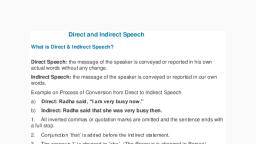
Direct, and, Indirect Speech
Page 2 :
Brief Outline, Introduction, Direct Speech, Indirect Speech, Rules for changing Direct into, Indirect Speech, • Exceptions to General Rules, • Summary, •, •, •, •
Page 3 :
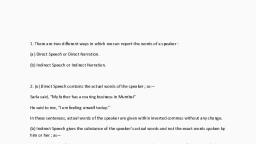
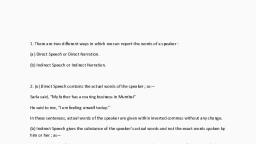
Introduction, • There are two ways by, which we may report or, narrate what a speaker said., • Direct Speech, • Indirect Speech.
Page 4 :
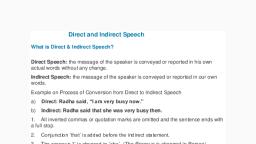
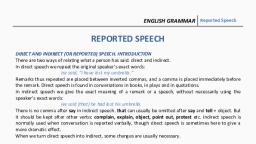
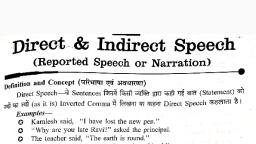
Direct Speech, • Definition: In direct speech the words, of the speaker are placed within, inverted commas., For Example:• The teacher says to me, “ You are a, good boy.”, • He said to his friend, “ I shall help you.”, • He said to me, “ I am your friend.”
Page 5 :
Cont…., • It may be noted that part of a, sentence outsides the inverted, commas is called the “Reporting, Speech” and the verb of the, reporting, speech, is, called, “Reporting Verb”., • The word within inverted commas, are said to be in the “Reported, Speech” and the verb of the, reported speech is called the
Page 6 :
Reporting, Verb, , Reported, Verb, , You said to me, “ He is my, Friend”, , Reporting, Speech, , Reported, Speech
Page 7 :
Indirect Speech, • Definition: In indirect speech the, word spoken by the speaker are not, expressed but only the meaning of the, speaker is conveyed by making some, grammatical changes., For Example:• The teacher tells me that I am a good, boy., • He told his friend that he would help
Page 8 :
RULES FOR CHANGING, DIRECT, INTO, INDIRECT SPEECH
Page 9 :
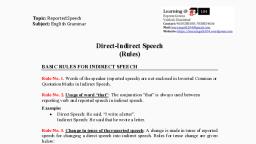
Rule 1: If the reporting verb is in the past, tense, the tenses inside the quotation marks, changes into their corresponding past tenses., Direct Speech, , • Simple present tense, • Present continuous, tense, • Present perfect tense, • Simple Past tense, • Past continuous tense, • Past perfect tense, • Future tense, , Indirect Speech, , Simple past tense, Past continuous tense, Past perfect tense, Past perfect tense, Past perfect, continuous tense, • No Change, • Future conditional, tense, •, •, •, •, •
Page 10 :
Rule 2: If the reporting verb is in the, present or future tense, the tense of the, verb within the quotes observes no, change in indirect speech., For Example:1. Shalini Says, “I write a letter, everyday.” (Direct), Shalini says that she writes a letter, everyday. (Indirect), 2. She says to me, “I am unwell.” (Direct), She tells me that she is unwell (Indirect)
Page 11 :
Rule 3: The first and Second person in, the direct speech should become third, person indirect speech, For Example:-, , 1. He said, “I watched a film.” (Direct), He said that he had watched a film., (Indirect), 2. She said to the audience, “ You are, patient.” (Direct), She said to the audience that they, were patient. (Indirect)
Page 12 :
Rule 4: If the speech to be converted in, , the form of a statement, the conjunction, ‘that’ is used after the reporting verb in, indirect speech., For Example:• Seema said, “I am unwell.” (Direct), • Seema said that she was unwell., (Indirect)
Page 13 :
Rule 5: If the person addressed to,, reports the speech, the second person, in the direct speech becomes the first, person in indirect speech., For Example:1. He said, “You are a liar.” (Direct), He said that I was a liar. (Indirect), 2. My teacher said to me, “ You have done, well in the paper.” (Direct), My teacher said to me that I had done, well in paper. (Indirect)
Page 14 :
Rule 6: Words expressing nearness in, time and place are generally change, into words expressing distance., For Example:1. She said, “I will come here now.”, (Direct), She said that she would come there then., (Indirect), 2. He said, “ I visited the temple, yesterday.” (Direct), He said that he had visited the temple
Page 15 :
Changes in time and place words, Direct Speech, , •, •, •, •, •, •, •, , Now, This, These, Here, Ago, Thus, Today/ tomorrow, , • Yesterday/last night, • Next week/year, • Last week/year, , Indirect Speech, , Then, That, Those, There, Before, So, That day/The next day,, following day, • The day before, the, previous day/The night, before, •, •, •, •, •, •, •, , • The following week/ Year, • The previous week/ Year
Page 16 :
Rule 7: When a question is reported in, direct speech the reporting verb is, change into ‘asked’ , ‘enquired.’, For Example:-, , 1. Mother said, “ Where are you, going?”, (Direct), Mother enquired where I was, going., (Indirect), 2. She said, “ What is his problem?”, (Direct)
Page 17 :
Rule 8: If the question is being reported, in a yes/no answer type, then if or, whether is used after the reporting verb., For Example:, 1. He said, “ Are you happy?” (Direct), He asked if I was happy. (Indirect), 2. She asked him, “ Will you stay?”, (Direct), She asked him whether he would, stay.
Page 18 :
Rule 9: If a command is being reported,, the reporting verb changes into ‘told’,, ‘ordered’, ‘commanded.’, For Example:1. Rishi said to Preeti, “ Do as I say.”, (Direct), Rishi ordered Preeti to do as he said., (Indirect), 2. She asked him, “ Will you stay?”, (Direct)