Notes of bhuvana, English Language English Pedagogy.pdf - Study Material
Page 1 :
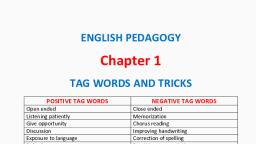
ENGLISH PEDAGOGY, , Chapter 1, TAG WORDS AND TRICKS, POSITIVE TAG WORDS, Open ended, Listening patiently, Give opportunity, Discussion, Exposure to language, Role play, Functional approach, Use of words from context in the text, Interact, Meaning making, Using language in different situation, , NEGATIVE TAG WORDS, Close ended, Memorization, Chorus reading, Improving handwriting, Correction of spelling, Practicing pronunciation, Only, Imitate, Completing syllabus, Learn grammatical rules, , Function of language, 1. Expressive function: Language helps one to bring out pent up feelings through, which one can evoke desirable feelings among readers/listeners., 2. Informative function: We can pass on information to others only through, language., 3. Communicative function: Sharing of ideas in a society is called communication., For communication, language is the first requirement., 4. Directive function: Language is a means of giving direction to others., 5. Interaction function: Language is not one–way communication but two-ways, communication.
Page 2 :
6. Evolutionary function: Literature is the mirror of the society. Any advancement of, the society basically its language development., 7. Preservation function: Man can preserve his knowledge, observations and, experiences in the written form.
Page 3 :
Chapter 2, Learning and acquisition, , Language environment is the basic factor which distinguishes learning and, acquisition. Home language is acquired in a natural way. Children’s motivation is, most important for language learning., , Multilingualism
Page 4 :
The first important aspect of language proficiency is conversational fluency which, includes commonly used limited vocabulary and simple grammatical construction, (BICS). The second one is discreet language skills which deals with the rule governed, aspects of a language and the third one is academic language proficiency, involving less, commonly used vocabulary, complex syntax and abstract expressions (CALPS)., BICS(Basic interpersonal communication skill) and CALP( Cognitive and academic, language proficiency) are acronyms coined by Jim Cummins to refer to general, conversational fluency, BICS and academic fluency, CALP in a language. So if you are, able to hold general talk in a language your BICS is strong and if you are able to study, and write different types of text for academic purposes, your CALP is strong. Students, can speak in their own language and can be a mix of words from more than one, language. Children can learn many language., , SOME BASIC & IMPORTANT FACTS, , , , , , , , , , , , , , , , , Total letters in English are 26 but phonemes are 44., English has 24 consonant sounds including th, ch., According to NCF-2005 English is Global language., According Article 343 (official language Act) English is associate official, language., Content words are lexical words., The rise and fall of tone is known as Inotation., Sight words: Reader recognizes and find meaningful on sight without a, complicated analysis., Active vocabulary means that is used frequently., Dipthongs are double Vowel sound., Cloze test: missing word test., Few examples of children’s book (literature of children): Alice’s adventures, in Wonderland, Myths and Legends, The very Hungary Caterpillar, The, hobbit, Tales of Heroes of History, Black Beauty, Treasure Island and other, picture books etc,, CCE- level of competencies achieved. It is process oriented., Questions based on textbook are only given to know students, comprehension., For maximum participation of students we use communicative approach.
Page 5 :
Chapter 3, LANGAUGE LEARNING, , Stages of language learning, 1. Acquisition: The person learns a new task., 2. Fluency/Proficiency: The person learns to perform the new task to a higher, degree of accuracy., 3. Maintenance: The person is able to perform the task independently even after, teaching has ended., 4. Generalisation: The person learns to generalise the learned skills/tasks to other, situations or environments. He is able to perform the tasks in situations other the, ones in which he had learnt them., 5. Adaptation: The person applies a previously-learned skill in a new area of, application without direct instruction or guidance., , Learning Styles in a Diverse Classroom, Auditory learners prefer to receive ideas and information by hearing them., Visual learners prefer to receive information by seeing it. Iconic mode of learning, (based on the system of using images and diagram) is effective, Kinaesthetic-Tactile learners tend to learn best via movement and touch. These, students are often labelled ‘hyperactive’ because they tend to move around a great, deal.
Page 6 :
Chapter 4, LANGAUGE SKILLS, Language skills, , Teaching Listening, Listening is the very basic and important skill of all language skills. We say, LSRW skills, when we refer language skills. The order in the LSRW is not randomly fixed, but, scientifically proved., Three main kinds of listening materials that can be used for teaching listening , authentic listening materials recorded listening materials live-listening materials, , Authentic Materials for Listening Class, Authentic listening materials are recorded live. The language that is used, not, rehearsed. It is not aimed at any specified level of the learners. So, it is difficult for the, beginners. Examples for authentic listening materials are, cricket commentary,, announcement at the railway station.
Page 7 :
Recorded Listening Materials, Unlike Authentic Listening Materials, Recorded Listening Materials have been prepared, with specific aim and for specific set of learners. These listening materials are, supported by worksheets. The students have to solve the worksheets on listening, script. For example, in CBSE - course A Interactive in English is supported by two audio cassettes., These types of cassettes or CDs are called Recorded Listening Materials., , Live Listening Materials, The teacher himself may be speaking the piece. As the teacher himself asking the piece,, he can approach to the listening activity with keeping the level of the students in his, mind. If he is not blessed with good pronunciation and other pre-requisites, it is better, for him and his students, not to take up Live Listening Material on his own., , Selective Listening, Approach to language learning should be shifted from 'eye' to 'ear' as language is, essentially a motor-auditory phenomenon., General Principles of Selective Listening:, , , , , , , It should start from the very moment one first hears a language., Listen for only one feature at a time., Listen successively to all the features of a language., Preference of listening should be in a logical order., Concentrate on the difficult part of the language., , Listening Situations, Interactive, Non-interactive, Speaking Skill
Page 8 :
Interactive, Partially interactive, Non-interactive, , Stages of listening, Pre listening: when we are preparing students to listen., While listening: It is the stage where students listen and do a task. The main, features are listening for gist, listening for details and making inference., Post listening: It is the stage when task is given beyond the listening text and, use it as a springboard for further language practice. It can help students, notice some of the difference between spoken language and written language., We can also ask where they find difficulty in listening., , Teaching Reading, Reading is a complex skill involving a number of simultaneous operations. In India,, English is taught as a second language mainly on academic grounds. Moreover, it is a, 'library language'. As a library language, it helps a student in India to get an access into, the modern scientific and technological world., , The Process of Reading, Recognition stage: The learners simply recognise a spoken word in its written form., Spelling and pronunciation will be difficult if the script of the mother and english., Structuring stage: At this stage the learners is able to identify the grammatical, relationships of the items and thereby understands the structural meaning of the, grammatical units., Interpretation stage: The learners are able to distinguish between a “statement of, fact” and a “statement of opinion”. He is able to understand the mood of the, characters and the purpose of the author. As the learners are able to analyse and the, content beyond the lexical meaning, it is called interpretation stage., , Types of reading
Page 9 :
Intensive Reading: Intensive reading is aimed at mastering the structures and, vocabulary apart from reading for comprehension. The intensive reading has some, prerequisites like, the readers should be able identify the words and sentences spoken, orally and acquire sufficient speed in reading., Extensive Reading: The two main themes of extensive reading are reading for, pleasure and reading for information. Extensive readers facilitate passive vocabulary in, the learners. And it also consolidates active vocabulary., Scanning: Scanning means reading through the passage in order to search for a, specific item or piece of information. This skill therefore also involves the ability to, reject or pass over irrelevant information., Skimming: Reading over the surface of a piece of writing or glancing rapidly though a, text to find out its general content, central ideas or gist is called skimming. Skimming is, a reading skill that helps on deciding whether the book would be useful for the purpose, of his study. In skimming, you allow your eyes to travel vertically or in zigzag manner to, pick up some important points. Skimming depends on speed and comprehension., Loud Reading: Loud reading helps to acquire correct pronunciation. The teacher has, to be wary in correcting the wrong pronunciation immediately and give a drill of correct, pronunciation to the whole class., Silent Reading: In silent reading there is no movement of the lips or the tongue., Along with the ability to read aloud, pupils should be introduced to silent reading. The, importance of silent reading may be judged from the fact that most of the reading, done by an adult is on this nature. The pace of reading in silent reading is more than, the pace of loud reading., , Types of Comprehension, Global Comprehension: Global comprehension is the understanding, of a longer text in its totality. We often read a longer text, a story or a novel, for example, for pleasure and not necessarily for minute details. It is a, fluency activity, mainly involving the reader to be able to respond to a piece, of text in a general sense
Page 10 :
Local Comprehension: Local comprehension is the skill of reading a, piece of text closely or intensely for the purpose of extracting specific, information from the text. This skill is referred to as intensive reading skill, , Inferential Comprehension: In the context of reading, inferring, means making use of syntactic, logical and cultural clues to discover the, meaning of unknown elements. If these are words, then word formation and, derivation will also play an important part., , Extrapolative Comprehension: The term ‘extrapolative’ draws from, the verb extrapolate in the present context means to use facts already, known for something in the future. Extrapolating information is a much, higher ability than either locating information or drawing inferences because, it goes to the level of applying information in another context or situation., This situation may be outside the text but the text will provide you with a, springboard to make use of the information, , Methods of Teaching Reading, i) The Alphabet method: This is the oldest method where the pupils are made to, memorise the names of letters of the alphabet in their sequential order. For example,, ee ei tee -> eat, etc. The sequence of this method is letter-word-phrase-sentence., ii) The Phonic or Syllabic Method: This method is considered an improved version of, the alphabet method. In alphabet method, the emphasis is given on the names of the, letters, whereas in phonic method, the emphasis is given on the sounds each of them, represents. This method is easy for the beginners. But it has its limitations in later, stages. It is mainly because English is not a Phonetic language., iii) The Whole-Word Method: "The word is taken as the minimum meaningful unit. In, this method the learner is taught to read each word as a word-picture. Photographic, memory is promoted. The popular Look-and-say method of teaching reading at the, beginning stages is based on this method
Page 11 :
iv) The Sentence Method: Minimum teaching unit is the sentence, not the word, as in, the case of Whole-Word method. This is based on the psycholinguistic principle of, taking the sentence as the minimum unit of thought. The sentence method relies, heavily on the principle of situational teaching., v) The Story Method: To give the situational learning, the teacher tells a story. He then, presents sentences connected with the story. The story method regards the entire, story as the unit of thought., vi) An Eclectic Method: Effective teaching of prose does not rely on any one method., Different occasions require different methods. So, the teacher should meticulously be, incorporating all methods for effective teaching of prose. A) 1 the methods lie on a, scale which extends from single letters to the entire story., , Reading subskills, 1. Visualizing (making mental pictures about the text), 2. Making connections (linking the text to their own experiences,, other texts or real-world stories), , 3. Making inferences or "reading between the lines" (own, interpretations), , 4. Forming opinions, 5. Making predictions, 6. Retelling or summarizing, 7. Synthesizing, , SQ3R Technique, Survey: Survey means, the rapid glancing over the book that the reader intends to, read, for assessing the book. It is like the trial run done on the rails before the original, train is run. Surveying as a technique is applied in reading also.
Page 12 :
Question: The next step is questioning. Questions are asked on the headings and, subheadings in order to reaffirm the need for reading the text., Read: They would have understood something of the text from the survey he, conducted on the book and the questioning that he made on the headings and, subheadings. The next stage is whilereading stage. While going through the text he will, now understand the main points and concentrate on the illustration that will, supplement his understanding better. With proper surveying and questioning, now, he, will even be able to anticipate what may come next., Recite: The reader tells whatever he learnt to others. It may to his classmates. It is, also called peer teaching. Reciting facilitates better recalling and a powerful means for, retention., Review: Review is the last step in SQ3R technique of reading. Review means, periodical revision of the things that are learnt. Anything that is neglected is bound to, be away from the mind of the people., , Writing, “It is the problem creating and solving skill.” –Flower and hayes, 1. Controlled: here students is given practice on one aspect of writing while other, aspect remain fixed. How to write or what to write is fixed. For example fill in, the blanks., 2. Guided writing: it is a type of writing in which the teacher provides the situation, and helps the class to prepare it. The teacher provides feedback and direction, and expension of ideas of learner. For example write the story with given cues., 3. Free and creative writing: The development from controlled writing to free and, creative writing is a major development in the learners’ use of language. It is a, shift from grammatical competence to communicative competence. guided or, controlled writing has a high amount of focus on the knowledge of grammar,, punctuation, spelling and handwriting among other. This focus is referred to here, as ‘grammatical competence’. The shift to ‘communicative competence’ implies
Page 13 :
that most free and creative writing activities have communication as a goal. It is, last stage of writing.
Page 14 :
Chapter 5, METHODS AND APPROACHES, , Approaches to the teaching, Edward Anthony identify the three levels of conceptualization and organisation:, approach, method and technique. The three terms are related to each other, hierarchically. An approach describes the nature of the subject and a view point of, various aspects. Method is originated from approach. It is is concerned with and, orderly presentation of language to student. Technique is implementation which place, in actual classroom. Approach is the level at which assumptions and belief about, language and language learning are specified. Method is the level at which theory is put, into practice and the order in which the content will be presented. Technique is the, level at which classroom procedure are described., , SOS approach: situational language teaching, It is also known as Structural approach, new approach, aural-oral approach. It focus, more on speech than reading and writing., Focuses on:, Selection (choosing grammatical and lexical content)., Gradation (organising and sequencing of the content)., Presentation (practice of an item in a course)., Three stages
Page 15 :
Receiving knowledge, Memorizing it by repetition, Using it in practice to the extent that it becomes personal skill and the habit., Feature of SOS approach, Speech is the basis of language teaching. New language items and vocabulary items, are presented orally before they are presented in the written form., The language item which are commonly used by native speakers in their day-to-day, language are selected for teaching., The items are also graded according to their usefulness, fluency and teachability., Reading and writing are based on item which have already been introduced and, practiced orally., Limitations of SOS approach, Since importance is given to repetition, mistake would lead to habit formation., Creativity and uniqueness of individual are neglected., No active learning as learner is required simply to listen and repeat what teacher, says., , Communicative approach (CLT), The second language learners need to learn to face the real world and real life, situations. It emphasizes on learning to communicate through interaction in the target, language., Principles and characteristics of communicative learning teaching, Language is a system of expression of meaning., The primary function of language is for interaction and communication., Language learning is a natural process., Error are natural part of learning and over a period of time that take care of, themselves., Language learning happens when language is used with purpose., Teaching activities used in classroom, Role play, Interviews
Page 16 :
, , , , , Language games, Group discussion, Narrating an event, Writing report, , Advantages, , , , , , Emphasize on language practice., Active participation of students., Enable them to become fluent speakers., Using language for real purpose., , Limitation, Mother tongue has no place., Rigid process, when information gap is created in classroom the activity may become unrealistic, and impractical., , Eclectic approach, , , , , , Larsen- Freeman and Mellow use the term principled eclecticism., It involves use of a variety of language learning activities., Based on a number of theories., Teacher decide what approach is adequate according to lesson and learners., , Advantages of eclectic approach, Safety: the use of variety of ideas and procedure from different existing approach, and methods will increase the chance of learning taking place., Interest: different techniques old learner attention., Diversity: different learning context required different methodologies., Flexibility: it gives opportunity to teacher to plan a lesson in a unique way., , Grammar translation method (GTM), Traditional way of teaching Latin and Greek., The grammar rules are are explained first and then example are given so it is a, deductive learning.
Page 17 :
, , , , , , Emphasize own learning to read and write., Medium of instruction is mother tongue., No provision for oral use of language., High level of accuracy were emphasized., Vocabulary items were presented in the form of bilingual list to be memorized., , Advantages, Economical and time saving, It provide clarity of new and difficult word., Use of mother tongue., Limitations, Fails to provide a great deal of comprehensible input., Listening and speaking skills are not developed., All word and phrases have no English equivalent., Rules are learn by heart so they cannot use it naturally., It can only be claimed that grammar translation focus is entirely on form, not, meaning, No possibility of habit formation., Students are not active., , Methods to language teaching, Direct method, Direct method is the result of failure of grammar translation method., Natural or reformed method., Principles, 1. Oral practice. The direct gives importance to speech. English is taught through, english only. Students are given sufficient practice in listening to the language and then, speaking it. Oral practice helps the students to associate with the objects and ideas for, which they stand., 2. Restrain the mother tongue. The students are taught by showing the real objects or, performing actions or by suitable illustration in context. This makes them to think in, english and they learn to respond in english.
Page 18 :
3. The sentence is the unit of speech. No single in english has a single meaning. All the, words have connotative meanings. In direct method meanings are taught contextually., 4. Grammar is taught inductively. Inductive method of teaching grammar is always, good for the learners, as it makes the learners to frame the rules from the language, they learn. So, they are able comprehend the language well and frame the rules of the, language better., 5. Opportunities to learn new vocabulary. New words are chosen after careful, selection and gradation and they are taught at definite stages through spoken, language. So, the students learn more vocabulary., Advantages, , , , , , , , It is a natural method., Fluency of speech is guaranteed., It develops pronouncing skill., Supports in written work., Promotes the study of literature., Accommodates audio-visual aids., , Disadvantages, , , , , , , It is not a complete method., It requires competent teachers., It demands linguistically qualitative students., Non-availability of proper aids., Over-crowded classes., , Dr. West method, Doctor West taught English in India for number of years. He recommended an, emphasis on reading. He produced a list of 2000 most frequently used word from a list, of 10 million word. This list is called as general service list(GSL) of English words. he, further divided this list into six levels and developed reading books called new method, readers., Features, Possibility of devising technique of language learning gear two specific purposes in, this case of reading objective.
Page 19 :
Application for vocabulary control to second language text as a meaning of better, grading text., The introduction of technique of rapid reading to foreign language classroom., He felt that Indian students are required to concentrate on loud reading on top of, practicing silent reading., , Total physical response (TPR), , , , , , , , This method is developed by James Asher., It is based on coordination of language and physical moment., Based on three hypothesis, First the language is learnt primarily by listening., Second language learning must engage right hemisphere of the brain., Third the learning language should not involve any stress, , Features, Students are not forced to speak, Majority of class time is spent on listening comprehension; the ultimate goal of the, method is to develop oral fluency., Lessons are organised around verbs., Students learn the meaning of the command which they hear by direct observation., Teacher issue novel combination of words for student., This type of lesson uses a variety of realia (real objects as teaching aids), poster and, props., Advantages, Active participation of students., It is good for kinesthetic learner., it is simple method and do not require a great deal of preparation on the part of, teacher., Class size is not a problem., Good for dyslexic child., Limitation, Only suitable for beginning students., Teacher has old right on inputs given to student.
Page 20 :
No opportunity to express., , Audio lingual method, The audio-lingual method or army method is a style of teaching used in teaching, foreign languages. This method was emerged at the time of World War II. It is almost, equal to direct method as the foreign language is taught directly. This method, considers LSRW as the logical sequence by the learner should learn the language., Practice in all the four language skills is given prominence, as it will lead to habit, formation., Features, Dialogue memorization, Repetition drill: students repeat the teacher’s model as accurately and as quickly as, possible to learn the line of the dialogue., Transformation drill: the teacher gives students a certain kind of sequence pattern, students are asked to transform a sentence into a negative sentence., Question and answer drill, Advantages, , , , , , , All the four skills are developed in meticulous manner., Teaching of vocabulary is made effective by use of visual AIDS., Universally accepted pronunciation and proper structure are required., The basic principle is to be functional and easy for a larger group., Based on theory of language learning., , Limitations, Learner is expected to be active but involvement is mechanical., Mental process is not involved in the learning., The approach believes that errors should be prevented by presenting the material in, small steps., The method is almost guided learning as it is dominated by teacher., A balance importance is not given to all the skills., , Language immersion method
Page 21 :
it is developed in Canada to provide Canada's majority group Englishspeaking students with opportunities to learn Canada's other official, language, French. Students are taught a second language exclusively, throught he medium of the second language. Immersion has proven an, effective successor to previous language teaching approaches of traditional, grammar translation methods and the audiolingual methods of the 1960s, and communicative methods of the 1970s. The central characteristic of, immersion is the teaching of language content and culture in combination,, without the use of the student's first language. Students are taught a, language they initially don't understand throught he use of a variety of, context clues provided by the teacher. Language is taught through non, printed material. Immersion language teachers provided ideally at least half, a day (partial immersion) for students in the language they are targeted to, learn and often students receive a full day (total immersion). Immersion, programs do not ask the student to forget their first language and as, teachers are usually themselves bilingual they tend to be more empathetic, to the student's difficulties in learning a second language., , Bilingual method, It is the combination of grammar translation method and direct method. The learners, knowledge of mother tongue is utilized for learning the target language. Learners are, encouraged to speak in English only., Principles, Restricted use of mother tongue., Intensive practice of pattern., Introduction of reading and writing after pattern practice., Advantages, , , , , , The use of mother tongue saves a lot of time and promote quick understanding., Time saving., It promotes fluency because there is stress on speech and pattern practice., Suitable for all type of school rural and urban.
Page 22 :
It makes use of the linguistic habits already acquired by the pupil in the process of, learning his mother tongue., Limitation, , , , , , Untrained teacher use this method as translation method., There is possible of confusion in the feature of two languages., There is no correspondence between thought and expression., The use of mother tongue spoils the continuity and fluency of language., , Suggestopedia, Suggestopedia considered to be the strangest of the so-called humanistic approaches., It was originally developed in 1970 by bulgarian educator Georgi Lozanov. It is based on, power of suggestion in the learning. Music is Central to this method. Suggestopedia, makes use of music a comfortable and relaxing environment. He cleans that about 200, to 240 new words maybe introduced each lesson., Features, Learning is facilitated in an environment that is as comfortable as possible, featuring, soft cushioned seating and dim lighting., Peripheral learning is encourage through the presence in the learning environment, of poster and decoration featuring the target language and various grammatical, information., Music and drama are integrated into the learning process as often as possible., Advantages, Students are encouraged to be child-like. The encourage to assume new roles and, names in the target language in order to become more suggestible., Music is played softly in the background to increase mental relaxation and potential., Students work from lengthy dialogues in target language., Limitations, Homework is limited., Errors are tolerated, , Silent way
Page 23 :
This method is created by Caleb Gattegno. It is usually regarded as an alternative, language teaching method. It was introduced in 1963 in his book teaching foreign, language in the school: The silent way., Features, , , , , , Silence is used as a tool to achieve this goal., Based on learner autonomy and active student participation., Translation and rotary petition are avoided, Evaluation is carried out by observation only., , Task-based language teaching (TBLT), Task-based language teaching (TBLT) is an educational framework for the theory and, practice of teaching second or foreign languages. It is based on a constellation of ideas, issuing from philosophy of education, theories of second language acquisition,, empirical findings on effective instructional techniques, and the exigencies of language, learning in contemporary society., Advantages, It removes the passivity in the minds of the learners and act as a motivational for, learning more., It is more student centered, allows for more meaningful communication, and often, provides for practical extra linguistic skill building., The tasks are likely to be familiar to the students (eg. Visiting the doctor), students, are more likely to be engaged, which may further motivate them in their language, learning., Voluntarily forward to do more activities that facilitate language learning., , Activity based learning (ABL), Activity-based learning (ABL) as defined by prince (2004) is a learning method in which, students are engaged in the learning processes., Features, It uses child-friendly educational aids to foster self-learning and allows a child to, study according to his/her aptitude and skill.
Page 24 :
Self learning materials (SLM) comprising attractively designed study cards for english,, hindi, maths, science and social science., The child takes up an exam card only after completing all the milestones in a subject., , Remedial Teaching Strategies, Individualised Educational Programme (IEP), Peer Support Programme, Reward Scheme, Handling Pupils’ Behaviour Problems, , Top down and bottom up approaches, There have been mainly two basic approaches under which all theories can be put,, bottom up and top down. Bottom up approach puts emphasis on the mastery of the, script( sounds, letters, words etc.) as here, the assumption is that meaning lies in the, text whereas top-down approach stresses on enriching the oral language, experiences, of the world/background knowledge of the reader which are very much required in, making meaning of any text and ends with letter, words and sentences.
Page 25 :
Chapter 6, BRANCHES OF LANGUAGE, , LINGUISTICS, Phoneme: smallest unit of sound in a language., Morpheme: smallest unit of meaning in a language., Phonetics: Study of the production & perception of speech sounds of, language & how these sounds are, articulated and how the hearer perceives them., Phonology: It study of the sound patterns of a language., Morphology: It studies word formation and structure & how words are put, together from their smaller parts., Syntax: It is the study of sentence structure & attempts to describe what is, grammatical in a particular language in term of rules., Semantics: is the study of meaning, how we represent the meaning of a, word in our mind., Pragmatics: It is the study of the social.
Page 29 :
Chapter 7, TEACHING LEARNING MATERIAL, , Teaching learning material and textbooks, Authentic material, , , , , , , Data produced for real life communication purposes., May contain false start and incomplete sentences., Useful for improving the communicative aspect of language, For example spoken: TV commercials, films, radio talks, interview, Written recipes, articles, train timetables, advertisements, poems., , Non authentic material, They are specially designed for learning purposes., The language used in them is artificial. They contain well formed sentences all the, time., They are useful for teaching grammar., For example: textbooks, big books, charts, flashcards etc, , Big books
Page 30 :
Story books for young learners of English published by popular children book, publishers., Contain colourful picture illustrations and simple sentences., Story is divided into scenes and each scene with the story thread in one or two, sentence will be given on each page., Large size compared to the text books and notebooks hence they are called big, books., , Broad categories of academic standards:, Listening and responding, Hearing is physiological activity., Listening is a cognitive process., Meaning is attached to hearing when we listen to something., Listening comprehension is getting the gist of what is listen to., Listening and responding includes thinking about what is being listened to. In oral or, written form., , Reading comprehension, Getting meaning., Understanding a given text., Develops our knowledge of the language., , Conventions of writing, Writing is expression of oneself freely by following accepted written symbol., Include format, punctuation marks, paragraph writing etc., , Grammatical awareness, The teaching of grammar plays an important role.
Page 31 :
It contains tenses, structures, preposition etc., Grammar should not be told directly in primary level., It should be acquired by children in non conscious way., , Vocabulary, Associating object and actions with words., The reading and writing vocabulary are attend through education., , Creative expression, Two types: oral and written, Child main use variety of sentences for expression to express their feeling thoughts, likes and dislikes etc.
Page 32 :
CHAPTER 8, LANGUAGE LEARNING THEORIES, Two main theories of language learning are Cognitive Theory of Language Learning and, Behaviorist Theory of Language Learning., Cognitivist Theory, Cognitivists argue that a child learns the language by its mental capacity which is, naturally got., If the child has a strong mental ability, then, it is bound to acquire better, language skills., Behaviourist Theory, Behaviourists believe that the language is a habit., Only through habit formation a language can be learnt., When the child has the privilege of acquisition-rich-environment, then the child, automatically learns the language., , Noam Chomsky, Founder of structural grammar( gap filling exercise) and the theory of universal, grammar. According to him every child has an innate language acquisition device (LAD), that he uses for universal grammar.
Page 33 :
Theories of Reading
Page 34 :
THE PEDAGOGY OF COMPREHENSIBLE INPUT, The Input Hypothesis introduced by Stephen Krashen has been one of a number of, hypotheses concerning the causes of the language acquisition. In Krashen’s point of, view, ‘language acquisition’ is more powerful and essential than ‘language learning’,, and learners are able to acquire language only by understanding language containing, linguistic features one step beyond their present level of knowledge or, “comprehensible input”. A number of researches and theorists have, however,, questioned this hypothesis and expressed their observations about the explanatory, value of comprehensible input to language acquisition. It consist the natural order, hypothesis, the input hypothesis and the acquisition learning hypothesis., , WHOLE LANGUAGE APPROACH, Whole language approach is a philosophy of language learning. Whole language, approach is based on the belief that all children can learn language if they acquire it, through the environment which has meaningful and whole language. This means that, the language of the classroom must have elements of narrative that we find in the, world outside. This means that we do not begin with bits of language like the alphabet, or lists of words but with stories, poems and conversation.
Page 35 :
CHAPTER 9, ASSESMENT, QUESTIONING TECHNIQUES, 1. Closed ended: it invite genrally one word or one sentence answer. They are, popular as icebreaker question in group situation. Useful for warming up group, discussion, getting a quick answer., 2. Open ended: it require a little more thought and generally encourage wider, discussion and elaboration. Useful for critical and creative discussion., 3. Probing question: probing questions are usually a series of questions that dig, deeper and provide a fuller picture. Useful for gaining clarification and, encouraging others to tell you more information about a subject., 4. Leading questions: these questions are designed to lead the respondent towards, a certain desired positive or negative route. Leading question could also involve, an appeal at the end that designed to coerce the respondent into agreeing with, the speaker. Useful for building positive discussion or steering a conversation, towards an outcome that serve your interest., 5. Loaded question: This type of question seems straightforward and closed ended, question but with a twist. They contain an assumption about respondent. They, are famously used by lawyers and journalists to trick their interviewee. Useful for, discovering facts about someone who would otherwise be reluctant to offer up, the information., 6. Funnel questions: It is the series of questions like meeting to someone and first, started with close ended questions and then open ended question. Or vice versa., Useful for building relationships, discovering very specific information., 7. Recall and process: it require the recipient to remember a fact. These types of, question used to test the respondent’s depth of knowledge about a particular, topic. Useful in interviews., 8. Rhetorical question: these types of questions don’t require an answer. They are, just a statement. These types of questions are often used by coaches or public
Page 36 :
speakers for effect to get the audience thinking and agreeing. Useful for building, engagement during speech.
Page 37 :
CHAPTER 10, NCF, NCF FACTS ABOUT ENGLISH PEDAGOGY, (PRIMARY), Language learning progresses naturally with exposure and use of language., Language learning becomes meaningful when it is connected with the immediate, environment of children., The English language is generally taught and learnt as a second language in India, in, varied contexts and resources., At the primary stage, the teacher would need to factor in the pace of learning of, children and the opportunities of exposure to English that they may have in their home, and school environment., Broadly, the curricular expectation of English language learning is the attainment of a, basic proficiency for meaningful communication., While the use of home language need not be punished or penalized, particularly in, Classes I and II, progression towards more use of English needs to be encouraged., The teacher needs to focus on providing learning opportunities to all learners,, including the differently-abled and the disadvantaged, and ensure an inclusive, environment., Based on the curricular expectations for English language learning at the Primary, Stage, a set of Learning Outcomes for each class has been developed., Teaching letters of the alphabet in isolation, or memorization without understanding,, is to be avoided., Reading corners/class libraries may be developed to provide children relevant,, illustrated and age-appropriate children’s literature in English/home language., The teacher should observe children for assessment when they are engaged in, activities keeping in mind differently-abled children as well., Errors should be viewed as attempts/stages of learning language.
Page 38 :
The teacher should facilitate stress-free correction through exposure to language, input by through story-telling, input rich environment, and above all, providing a, congenial atmosphere., The focus should be on developing interpersonal communication skills in English, and, more importantly, a sensitivity towards languages and cultures other than their own., In most places, children do not have exposure to English outside the classroom. So,, teacher’s proficiency in spoken English is essential., Students may listen to English and process the new language, before they actually, communicate in English., , Expectations To Primary Students, Acquire the skills of listening, speaking, reading, writing and thinking in an integrated, manner., Develop interpersonal communication skills., Attain basic proficiency like, developing ability to express one’s thoughts orally and in, writing in a meaningful way in English language., Interpret and understand instructions and polite forms of expression and respond, meaningfully both orally and in writing., Develop reference skills both printed and electronic mode., Acquire varied range of vocabulary; understand increased complexity of sentence, structures both in reading and writing., Express an awareness of social and environmental issues., Read and interpret critically the texts in different contexts– including verbal (including, Braille) and pictorial mode., , NCF FACTS ABOUT ENGLISH PEDAGOGY (UPPER, PRIMARY), Language learning progresses naturally with exposure and use of language in, meaningful contexts., Learner needs to notice and use language in and outside the classroom in order to, become a proficient user of language., English language is taught and learnt as a second language in varied contexts and, resources for teaching-learning in terms of the proficiency of English language teacher,, materials (textbook and other supplementary materials), English language environment, in the school and so on.
Page 39 :
Language learning is meaningful when it is connected with the immediate, environment of children., The activities / tasks in the textbook and the tasks carried out by the teacher need to, take into consideration the lived-in experiences of learners., The English language learning outcomes are intended to be achieved by every child so, as to enable them to be proficient users of language in real life situations., Broadly, the goals of language learning which could be achieved include: Attainment, of basic proficiency in language for effective communication and development of, language for knowledge acquisition. i.e. using language as a tool for learning the, content subjects., However teacher should follow flexibility, consider the pace of learning of children, and opportunities of learning English at home and in school., The learning outcomes are listed keeping in view that they are not restrictive or, limited; they are the launching pads for developing skills and competencies in learners, of English language in classes VI, VII and VIII., Teachers may add activities to achieve the outcomes., Pedagogical Processes are also given along with the Learing Outcomes to emphasise, the process of learning, and active participation of learners., The suggested activities/exercises are to scafold the process of language acquisition., This is mainly to support teachers to create learning opportunities for the learners., The teacher should observe children for assessment when they are engaged in, activities keeping in mind differently-abled children as well., Assessment should be an integral part of the teaching-learning process and not a year, end examination only., , Expectations To Upper Primary Students, Acquire the ability to listen and respond orally and in writing/Lip reads where, necessary., Speak about self, simple experiences; report events to peers, accurately and, appropriately make connections and draw inferences., Recite poems, dialogues; speak and write language chunks (phrases, sentences from, stories, plays, speeches, etc.), Understand the central idea and locate details in the text (familiar and unfamiliar)., Use his/her critical/thinking faculty to read between the lines and go beyond the text., Comprehend and uses the form and functions of grammar in context., Write coherently and with a sense of audience (formal and informal)
Page 40 :
Write simple messages, invitations, short paragraphs, letter (formal and informal),, applications, personal diary, dialogue from story and story from a dialogue/conversation, in English and in Braille, Engage in creative writing e.g. Composition of poems, jokes, short stories, etc., Develop sensitivity towards their culture and heritage, aspects of contemporary life,, gender, and social inequality



 Learn better on this topic