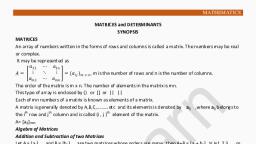
Page 1 :
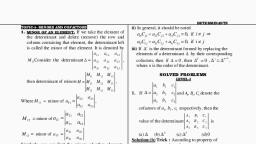
5,8. Determinant of a Matrix, , If A = [a;] be a square matrix of order n, then the determinant of [a,] of order n, is called the, determinant of the square matrix A, denoted by | A |. ,, , & /’ Singular and non-singular matrix. A square matrix A is said to be singular or non-singular, 1, , 365 =7+#0, , 21, according as | A | = 0 or # 0. For example, | 3 i is a non-singular matrix since, , |, , , , , , 2 3, , whereas 4 is a singular matrix since, , 6 6, , , , Adjoint of a Matrix, , IfA = [ay] be a square matrix of order n and A, represents the cofactor of the element a,, in, the determinant | A |, then the transpose of [A,] is called the adjoint of A and is denoted by adj A., , ayy a\2 wise An, Qn, Ag save Ap,, Thus, if A= | cccsce sscoss adecen seanes , then the matrix formed by the cofactors of the elements, , Apt Fug ivvees Gn, , Por, Bigg 000 Bix por sitagy sauce , sonia A : a A wna, injAjis| 71° ” 2” | ‘The transpose of this matrix is adj A= |” 7. ", Ay Any Ann f Ain “Aon vane! Ann, , Note: If A and B are nonsingular matrices of the same order, then, (adj AB) = (adj B) (adj A)
Page 2 :
nverse of a Matrix, , If A be a square matrix of order n and there exists another Square matrix B of the same order, such that A - B = B - A= I where J is the unit matrix of order n, then B is called the inverse of A, , and is denoted by A7!. Thus by definition,, AA! = ATA=I, When the inverse of A exists, then A is said to be invertible., , \ Sf Inverse of a matrix in terms of its adjoint, , According to the definition, If A is an invertible matrix, then, , AA = ATA=I (1), Also, we have, A (adj A) = (adj A)A=|A|I, = I, or a {rape | = [aia Js =] .. (2), , From (1) and (2) it is obvious that, , 1 :, AAT=A (ra°64 | and A! A= fue, , [A, , |A], , either of which lead to, , , , whi, sees Bigs: the inverse of a Square matrix A in terms of its adjoint.
Page 3 :
So 5 Se, 5.9. Elementary Transformations, , In matrix algebra, there are many occasions in which we want to perform certain transfor., mation on given matrix and change to another matrix. The following six transformations — three, corresponding with rows and three with columns are known as elementary transformations., , (i) Interchange of any two rows or columns, , These are denoted by R, <> R, (or C,o C,) or R;, y (oF C,,) when the ith row (or column) is, , interchanged with the jth row ‘(or column)., For example,, 0-2 3 45 6 465, A-5 GER Re gy 3) Ger 19 43° 9, 78 9 789 79 8, (ii) Multiplication of the ith row (or the ith column) by a non-zero number k., , These are denoted by R, — &R, (or C; — kC,) or R; (A) (or C, (&)., For example,, s ‘ Ri 2R, Fe : C33 be ‘, 3 4 3 4 9 4, , (iii) Addition of k times the jth row (or column) to the ith row (or column)., , These are denoted respectively by, R, + R, + AR, and C, > C, + C or R; (k) and C, (&)., , , , , , For example,, 1 3] Re Rot2R. fl 3] GG +36 spd 6 =, 45 “16 Il i6 29, , When applied to rows, the elementary operations are known as row operations and when apPlied to columns, they are known as column operations.
Page 4 :
Elementary Matrices, , A square matrix obtained from a unit 'miatrix-b, transformations is called an elementary matrix., , Examples of such elementary matrices are, , y arly one of the elementary row or column, , 080.11 [140.0]71 5 ‘6, 01 0110 4 ollo 10, e=g 10 0/0 0 1}/]0 01, , For the first elementary matrix, we have C, < C,; for the second, R, > 4R, while for the, third, we have C, > C, + 5C,., , Equivalent Matrix, , Two matrices A and B of the same order are said to be equivalent, if one is obtained from, other by a sequence of elementary transformations. If the sequence be elementary row transformations alone, then one is said to be row equivalent to the other. Similarly, if the sequence, , be elementary column transformations alone, then one is said to be column equivalent to the, other., , Matrix inversion by elementary transformation, Let A be a non-singular square matrix of order n. Thus, A can be written as A =I Ae’ ()).
Page 5 :
ae es, Then A can be reduced to the identity matrix I, by performing a sequences of elementary row op., , erations on A of the left-hand side and on I, of right-hand side till (1) is reduces to I, = BA. Then, B is the inverse of A., , Thus, if a square matrix A be reduced to the identity matrix by a sequence of row operations,, , then the same sequence of row operations applied to the identity matrix will give A~ 1 the inverse, of A. |, , Solved Examples, , Example 24. By using elementary row transformations, find the inverse of the matrix, , a=|) 2], “eT, , Solution. We have A=ILA, 1-112 1 0, sa] > [of, 1 2 1 0, IS 4 = Be 1 A applying R, > R, — 3R,, 1 0 7 -2, ; A = [_ 3 | A applying R, > R, — 2R,, 7 -2 sie “etwioe, Therefore, Al = _ 5 A] :