Notes of bb, chem Hsslive-xii-chemistry-quick-notes-based-on-scert-focus-area.pdf - Study Material
Page 1 :
SECOND YEAR HIGHER SECONDARY EXAMINATION, FOCUS AREA Notes of All Chapters in CHEMISTRY, 1. THE SOLID STATE, Classification of solids, , Crystalline solids, Long range order, , Amorphous solids, Only short range order, , Definite characteristic geometrical, shape, Definite m.p, Definite, Give regular cleavage on cutting, , No definite Geometrical, shape, No definite m.p, Not definite, Give irregular cleavage on, cutting, Pseudo solids, Isotropic in nature, , Hs, sli, , Properties, Orderly, arrangement of, particles, Geometrical shape, , ve, ., , in, , On the basis of orderly arrangement of particles, solids can be classified into two – Crystalline solids, and Amorphous solids, 1. Crystalline solids:, Solids having long range order are called crystalline solids. Or, these are solids in which the particles, have a well ordered arrangement throughout the solid., E.g.: Quartz, Diamond, Graphite, fullerene, NaCl, CuSO4.5H2O, ice, naphthalene, SiC etc., 2. Amorphous solids:, Solids having only short range order are called amorphous solids. Or, these are solids in which the, ordered arrangement of particles is only at some portions of the solid., E.g.: Plastic, Glass (quartz glass), Rubber, amorphous silica, coal, charcoal, coke, PVC, Teflon etc., Like liquids amorphous solids have a tendency to flow, though very slowly. Therefore, sometimes, these are also called pseudo solids or super cooled liquids., Glass panes fixed to windows or doors of old buildings are slightly thicker at the bottom than at the, top. This is because the glass flows down very slowly and makes the bottom portion slightly thicker., Amorphous solids on heating become crystalline at some temperature. Some glass objects from, ancient civilizations are found to become milky in appearance due to some crystallization., Differences between Crystalline solids and Amorphous solids, , Melting point, Heat of fusion, Mode of cleavage, , Nature, True solids, Isotropy/anisotropy Anisotropic in nature, , Anisotropic and isotropic substances, Solids in which the physical properties like electrical conductance, refractive index etc are different, when measured in different directions are said to be anisotropic in nature. This is due to the different, arrangement of particles in different directions. Crystalline solids are anisotropic., Solids in which the physical properties are same along any direction are said to be isotropic in nature., This is due to the irregular arrangement of particles along different directions. Amorphous solids are, isotropic., +2 CHEMISTRY - Focus Area Notes Prepared by Anil Kumar K L, GHSS Ashtamudi, Kollam, , Page 1
Page 2 :
Hs, sli, , ve, ., , in, , Crystal lattice, The regular three dimensional arrangements of constituent particles of a crystal in space is called, crystal lattice or space lattice., Each point (atom, ion or molecule) in a lattice is called lattice point or lattice site. The significance of lattice, points is that when they are joined by straight lines, we get the geometry of the crystal., There are only 14 possible three dimensional lattices. These are called Bravais Lattices., Unit cell, A unit cell is the building block of a crystal. Or, it is the smallest portion of a crystal lattice which,, when repeated in three dimension to generate an entire lattice., A unit cell is characterised by its edge lengths (a, b and c) and angle between the edges – α (between, b and c), β (between a and c) and γ (between a and b). Thus a unit cell is characterised by 6 parameters – a,, b, c, α, β and γ., Classification of Unit cells, Unit cells are broadly divided into 2 based on the position of particles - primitive and centred unit cells., 1. Primitive Unit Cells:, Here the constituent particles are present only at the corners of the unit cell., 2. Centred Unit Cells:, Here the constituent particles are present at the corners and some other positions of the unit cell., These are of three types:, i. Body-centred unit cells: particles are present at the body centre and at the corners of the, unit cell., ii. Face-centred unit cells: particles are present at the centre of each faces and at the corners, of the unit cell., iii. End-centred unit cells: particles are present at the centre of any two opposite faces and at, the corners of the unit cell., Seven types of crystal systems and their possible variations, Crystal Systems Possible, Edge lengths, Axial angles, Examples, variations, Cubic, Primitive,, a=b=c, α = β = γ = 900 NaCl, Zinc, body-centred,, blende, Cu, face-centred, Tetragonal, Primitive,, a =b ≠ c, α = β = γ = 900 White tin, TiO2,, body-centred, SnO2, CaSO4, 0, Orthorhombic, Primitive,, a≠b≠c, α = β = γ = 90, Rhombic, body-centred,, sulphur, KNO3,, BaSO4, face-centred,, end-centred, Hexagonal, Primitive, a=b≠c, α = β = 900, γ Graphite, ZnO,, =1200, CdS, 0, Rhombohedral, Primitive, a=b=c, α = β= γ ≠ 90, Calcite(CaCO3),, or trigonal, HgS (Cinnabar), Monoclinic, Primitive,, a≠b≠c, α = γ = 900,, Monoclinic, end-centred, β ≠ 900, sulphur,, Na2SO4.10H2O, Triclinic, Primitive, a≠b≠c, α ≠ β ≠ γ ≠ 900 K2Cr2O7, H3BO3,, CuSO4.5H2O, +2 CHEMISTRY - Focus Area Notes Prepared by Anil Kumar K L, GHSS Ashtamudi, Kollam, , Page 2
Page 3 :
Calculation of Number of atoms in a unit cell (z), , Hs, sli, , ve, ., , in, , Primitive cubic (Simple Cubic) unit cell:, Here atoms are present only at the corners of the cube. Each corner atom is shared by 8 unit cells., Therefore, contribution to one unit cell = 1/8, Since each unit cell has 8 atoms at the corners, total number of atoms in one unit cell = 8×1/8 = 1, So for a primitive (simple cubic) unit cell, z = 1, Body-centred cubic (bcc) unit cell:, Here the particles are present at the corners of the cube and also one atom at the body centre., The number of atoms at the corner = 8×1/8 = 1, The atom present at the centre of the body is not shared by other atoms., So the number of atoms at the body-centre = 1, Therefore, total number of atoms in the unit cell = 1+1=2, So, for a bcc, z = 2, Face-centred cubic (fcc) unit cell:, Here the atoms are present at the corners and also at the centre of each faces. Each corner atom is, shared by 8 unit cells and each face centre atom is shared by 2 unit cells., Number of corner atoms = 8×1/8 = 1, Number of face-centre atoms = 6×1/2 = 3, Therefore, total number of atoms = 1+3 = 4, So, for an fcc, z = 4, Close packing in solids, Solids are three dimensional and the 3 D structure can be obtained by the following three steps:, 1. Close packing in One Dimensions, Here the spheres (particles) are arranged in a row touching each other. In this arrangement each sphere, is in contact with 2 adjacent spheres. Therefore, co-ordination number of each sphere is 2., 2. Close packing in Two Dimensions, Here the spheres are arranged in two directions – length-wise and breadth-wise. This can be done in two, different ways., i. Square close packing in two dimensions: Here each sphere is in contact with four adjacent spheres., So the co-ordination number of each sphere is 4., ii. Hexagonal close packing in two dimensions: Here each sphere is in contact with six adjacent, spheres. So the co-ordination number of each sphere is 6., , Square close packing, , Hexagonal close packing, , +2 CHEMISTRY - Focus Area Notes Prepared by Anil Kumar K L, GHSS Ashtamudi, Kollam, , Page 3
Page 4 :
In 2D close packing, hexagonal close packing is more efficient since the maximum space is occupied by, spheres., , Hs, sli, , ve, ., , in, , 3. Three Dimensional close packing, Here the particles are arranged in layers. This can be possible in two ways., i. Three dimensional close packing from two dimensional square close-packed layers:, Here the spheres of the each layer are placed exactly above those of the lower layer. In this, arrangement, all the layers are identical. So if we call the first layer as A, then all the layers are of ‘A’, type. So this arrangement forms AAA….. type pattern. The lattice thus generated is the simple cubic, lattice and its unit cell is the primitive cubic unit cell., ii., Three dimensional close packing from two dimensional hexagonal close-packed layers:, Here the first layer is arranged as hexagonal manner. The second layer is placed above the, depressions of the first layer. On placing the second layer there arises two types of voids (vacant spaces), above the second layer – tetrahedral voids and octahedral voids. Thus when we place the third layer, over the second there are two possibilities:, Covering tetrahedral voids: Here the spheres of the third layer are placed above the, tetrahedral voids of the second layer. In this arrangement, the spheres of the 3rd layer are vertically, above those of the 1st layer. Similarly the 4th layer is a repetition of the 1st layer. This will form the, pattern ABAB…… This type of close packing is called Hexagonal close packing (hcp) in three dimensions., This type of arrangement is found in metals like Mg, Zn etc., Covering octahedral voids: Here the spheres of the third layer are placed above the, octahedral voids of the second layer. In this arrangement, the 1st, 2nd nad 3rd layers are different. But, the 4th layer is identical to the 1st layer, the 5th layer to the 2nd layer and so on. This will form the, pattern ABCABC…… This type of close packing is called cubic close packing (ccp) or face-centred, cubic(fcc) packing in three dimensions. This type of arrangement is found in metals like Cu, Ag etc., , Both hcp and ccp are equally efficient since 74% of the available space is occupied by spheres., Co-ordination Number, In a close packed arrangement the number of nearest neighbours with which a given sphere is in, contact is called the co-ordination number of that sphere. In both hcp and ccp, co-ordination number in both, hcp and ccp is 12., Interstitial voids, The vacant space in close packed arrangement is called voids. These are of two types- tetrahedral, voids and octahedral voids., +2 CHEMISTRY - Focus Area Notes Prepared by Anil Kumar K L, GHSS Ashtamudi, Kollam, , Page 4
Page 5 :
in, , Tetrahedral void: A void surrounded by four spheres in tetrahedral position is called tetrahedral void. In a, close packed arrangement the number of tetrahedral voids is double the number of spheres, i.e. there are, two tetrahedral voids per sphere., Octahedral voids: A void surrounded by six spheres in octahedral position is called octahedral void. In a, close packed arrangement the number of octahedral voids is equal to the number of spheres, i.e. there is, only one octahedral void per sphere., If there are N close packed spheres,, The number of tetrahedral voids = 2N and, The number of octahedral voids = N, , Hs, sli, , ve, ., , Formula of a compound and the number of voids filled, By knowing the close packed structure and the no. of voids filled, we can find out the formula of the, compound as follows:, Q1. Atoms of element B form hcp lattice and those of the element A occupy 2/3rd of tetrahedral voids. What, is the formula of the compound formed by the elements A and B?, Ans: Here the B atoms form hcp and A atoms occupy 2/3rd of tetrahedral voids., Let the number of B atoms be x., We know that in a close packed structure, no. of tetrahedral voids = 2 x no. of close packed spheres = 2x., No. of A atoms = 2/3 x no. of tetrahedral voids = 2/3 x 2x = 4/3 x, Ratio between A and B atoms = 4/3 x : x = 4 : 3, Formula of the compound = A4B3., , Imperfections in solids, , The deviation from the regular orderly arrangement of particles of a crystal is termed as, imperfections or crystal defects. The crystal defects are broadly classified into two – point defects and line, defects., The defect around a point or an atom in a crystal is termed as point defect. If the defect extends, along a line, it is termed as line defect., Point defects, Point defects can be classified into three types: Stoichiometric defects, Non-stoichiometric defects, and Impurity defects., 1. Stoichiometric defects: Defects that do not change the stoichiometric ratio of a compound is, termed as Stoichiometric defects (intrinsic or thermodynamic defects)., In ionic solids, there are two types of stoichiometric defects - Schottky defect and Frenkel defect., i. Schottky defect: The defect arising due to the missing of equal number of anions and cations from, the lattice site is called Schottky defect. It is shown by ionic solids in which the anionic and cationic sizes are, almost equal. Due to this defect the density of the solid decreases., E.g. for compounds which can show Schottky defect are NaCl, KCl, CsCl, AgBr etc., ii. Frenkel defect: The defect arising due to the misplacing of a cation from the lattice site to the, interstitial site is called Frenkel defect. It is also called dislocation defect. This type of defect is shown by, ionic solids in which cationic size is smaller than anionic size. This defect does not change the density of the, solid. E.g. ZnS, AgCl, AgBr, AgI etc., +2 CHEMISTRY - Focus Area Notes Prepared by Anil Kumar K L, GHSS Ashtamudi, Kollam, , Page 5
Page 6 :
AgBr can show both Schottky and Frenkel defects., , Schottky Defect, Differences between Schottly and Frenkel Defects, , Frenkel Defect, It is the misplacing of a cation from the lattice site to, the interstitial site, Shown by ionic compounds in which size of cation is, smaller than size of anion, Density does not change, , in, , Schottky Defect, It is the missing of equal number of anions and, cations from the lattice site, Shown by ionic compounds in which size of anion is, almost equal to size of cation, Density of the solid decreases, , Frenkel Defect, , Hs, sli, , ve, ., , b), Non-Stoichiometric defects: These are point defects which change the stoichiometry of a solid., These defects are of two types:, i) Metal excess defect and ii) Metal deficiency defect, i) Metal excess Defect: Here the no. of cations is greater than the number of anions. This arises in two ways:, •, Metal excess defect due to anionic vacancies: Here some of the anions are missing from the lattice, site. The electrical neutrality is maintained by occupying electrons in the anionic sites. These electrons are, called f-centres because they give colour to the crystal., This defect is shown by alkali metal halides. For example when NaCl is heated in an atmosphere of, sodium vapour, some sodium atoms are deposited at the surface of the crystal. The Cl- ions diffuse to the, surface of the crystal and combines with Na atom to form NaCl., Na + ClNaCl + eThe electron so formed diffuse into the crystal and occupies the anion vacancy. These electrons, absorb light energy and get excited. As a result the crystal becomes yellow in colour. So the colour is due to, the formation of f-centres. Similarly, excess of Li makes LiCl crystals pink and excess of K makes KCl crystals, violet., •, Metal excess defect due to extra cations at interstitial sites: Here some cations occupy the interstitial, sites. The electrical neutrality is maintained by occupying some electrons in adjacent interstitial sites., E.g. When ZnO crystals are heated, the white coloured crystals becomes yellow. This is because on heating,, the crystal loses oxygen as follows:, ZnO, Zn2+ + ½ O2 + 2eThe Zn ions now move to the interstitial sites and the electrons to neighbouring interstitial sites., , Metal excess Defect, due to anion vacancy, , Metal excess Defect, due to extra cation, , +2 CHEMISTRY - Focus Area Notes Prepared by Anil Kumar K L, GHSS Ashtamudi, Kollam, , Page 6
Page 7 :
ii) Metal deficiency Defect:, Here some cations are missing from the lattice site. Electrical neutrality is maintained by attaining, higher oxidation state by some cations. This is commonly shown by transition metal compounds E.g. FeO., , in, , Metal Deficiency defect, Impurity Defect, c) Impurity Defects: It is the defect arising due to the presence of foreign particles in a crystal., E.g. when molten NaCl is crystallised in presence of small amount of SrCl2, some Na+ ions are replaced by Sr2+, ions and some cationic vacancies are formed. The no. of cationic vacancies produced is equal to the number, of Sr2+ ions. Another example is a solid solution of CdCl2 and AgCl., , Properties of solids, , Hs, sli, , ve, ., , 1) Electrical properties: Based on the electrical conductivity, solids are classified into three types:, i. Conductors: They are solids which allow the passage of electricity through them. Their conductivity, ranges from 104 to 107 ohm-1m-1., ii. Semi-conductors: They are solids which allow the passage of electricity only partially. Their conductivity, ranges from 104 to 10-6 ohm-1m-1., iii. Insulators: They are solids which do not allow the passage of electricity through them. Their conductivity, ranges from 10-10 to 10-20 ohm-1m-1., Conduction of Electricity in metals, semi-conductors and insulators - Band Model, According to this model, in metal there are two types of bands – valence band and conduction band., Valence band is the lower energy electron occupied band and conduction band is the higher energy, unoccupied band., In metals, the valence band is either partially filled or it is overlapped with the conduction band. So, electron can easily flow from the valence band to the conduction band., In semi-conductors, there is a small energy gap between the valence band and conduction band and, only a few electrons can enter into the conduction band. So they conduct only partially., In insulators, the gap between the valence band and the conduction band is large and so they do not, conduct electricity., , Small, energy gap, , Partially, filled band, Metals, , Overlapped, bands, , Semiconductor, s, , Forbidden, energy gap, (large), , Insulators, , +2 CHEMISTRY - Focus Area Notes Prepared by Anil Kumar K L, GHSS Ashtamudi, Kollam, , Page 7
Page 8 :
Conduction of Electricity in semi-conductors, , in, , The conductivity of semi-conductors can be increased by adding some impurity. This process is called, doping. Doping can be done by the addition of either electron rich impurity or electron deficit impurity., When a group 14 element (like Si or Ge) is doped with a group 15 element (like P or As) four, electrons are used for the formation of covalent bonds and the fifth electron becomes free. The presence of, this delocalised electron increases the conductivity and these types of semi-conductors are called n-type, semiconductor., When a group 14 element (like Si or Ge) is doped with a group 13 element (like B, Al, or Ga), three, electrons are used for the formation of covalent bonds and the fourth valence electron is missing. This, creates an electron hole which increases the conductivity of the semi-conductor. Such type of, semiconductors are called p-type semiconductors., , 2) Magnetic properties, , Hs, sli, , ve, ., , Based on the magnetic properties, solids can be classified into five types., 1. Diamagnetic Substances: These are weakly repelled by a magnetic field. They contain only paired, electrons., E.g.: H2O, NaCl, Benzene (C6H6), 2. Paramagnetic Substances: They are weakly attracted by a magnetic field. They contain one or more, unpaired electrons. They are temporary magnets. They lose their magnetism in the absence of, external magnetic field., Eg: O2, Cu2+, Fe3+, Cr3+ etc., 3. Ferromagnetic Substances: They are very strongly attracted by a, magnetic field and can be permanently magnetised. When, a ferromagnetic substance is placed in an external magnetic field,, all the magnetic moments (domains) are aligned in only one direction., This alignment does not change even when the magnetic field is, removed and so they become permanent magnets., ,, Eg: Fe, Co, Ni, Gd (Gadolinium), CrO2 etc., 4. Anti-ferromagnetic Substances: Here the magnetic moments are, oppositively oriented and cancel each other. So they have no net, magnetic moment., Eg: MnO, 5. Ferrimagnetic Substances: Here the domains are arranged in opposite, directions but in unequal numbers. They are weakly attracted by a, magnetic field and have a net magnetic moment., Eg: Fe3O4 (magnetite) and ferrites like MgFe2O4, ZnFe2O4 etc., , 2. SOLUTIONS, Solutions are homogeneous mixtures containing two or more components. Solutions containing only, two components are called binary solutions. These components are called solvent and solute. Generally, the, component that is present in larger quantity is called solvent. The substance which is dissolved is called, solute and the substance in which solute is dissolved is called solvent. Solvent determines the physical state, of the solution., +2 CHEMISTRY - Focus Area Notes Prepared by Anil Kumar K L, GHSS Ashtamudi, Kollam, , Page 8
Page 9 :
ve, ., , Hs, sli, , Vapour pressure, (p), , in, , SOLUBILITY, Solubility of a substance is its maximum amount that can be dissolved in a specified amount of, solvent. It depends upon the nature of solute and solvent, temperature and pressure., Solubility of a Gas in a Liquid, Solubility of gases in liquids is greatly affected by pressure and temperature. The solubility of a gas, increases with increase of pressure., Henry’s Law, The relation between pressure and solubility of a gas in a liquid was first given by Henry, which is, known as Henry’s law. “The law states that at a constant temperature, the solubility of a gas in a liquid is, directly proportional to the pressure of the gas”., Or, “the partial pressure of the gas in vapour phase (p) is proportional to the mole fraction of the gas, (x) in the solution” and is expressed as:, p = KH x, Here KH is the Henry’s law constant. The value of KH depends on the nature of the gas and, temperature. As the value of KH increases, the solubility of the gas in the liquid decreases., A graph of partial pressure (p) of the gas against mole fraction (x) of the gas in solution is a straight, line as follows. The slope of the graph gives the value of KH., , Mole fraction (x), As the temperature increases solubility of a gas in a liquid decreases. It is due to this reason that, aquatic species are more comfortable in cold waters rather than in warm waters., Applications of Henry’s law, 1. In the preparation of soda water, the bottle is sealed at high pressure., 2. A condition known as Bends in Scuba divers., 3. A medical condition known as Anoxia in people living at high altitudes or climbers., Effect of Temperature: Since the dissolution of a gas in liquid is an exothermic process, solubility decreases, with increase in temperature., , Vapour Pressure of Liquid-Liquid Solutions – Raoult’s Law, The relationship between the vapour pressure and mole fraction of solute in a solution was first, given by F.M Raoult and it is known as Raoult’s Law. It states that for a solution of volatile liquids, the, partial vapour pressure of each component in the solution is directly proportional to its mole fraction., Mathematical form of Raoult’s law, For a binary solution of two volatile liquids 1 and 2, for component 1, p1 = p10x1, and for component 2, p2 = p20x2, Where p1 and p2 are the partial vapour pressures of the components 1 and 2 respectively and p10 and p20are, the vapour pressures of the pure components 1 & 2 respectively. x1 and x2 are the mole fractions of the, respective components., +2 CHEMISTRY - Focus Area Notes Prepared by Anil Kumar K L, GHSS Ashtamudi, Kollam, , Page 9
Page 10 :
in, , The total vapour pressure, ptotal = p1 + p2, Substituting the values of p1 and p2, we get, ptotal = x1 p10 + x2 p20, = (1 – x2) p10 + x2 p20, Or, ptotal = p10 + (p20 – p10) x2, Graphical representation, Plots of p1 or p2 against the mole fractions x1 and x2 give straight lines (I and II). Similarly the plot of ptotal, versus x2 (line III) is also linear., , Hs, sli, , ve, ., , The composition of vapour phase in equilibrium with the solution is determined from the partial, pressures of the components. If y1 and y2 are the mole fractions of the components 1 and 2 respectively in, the vapour phase then, using Dalton’s law of partial pressures:, p1 = y1 ptotal and p2 = y2 ptotal, Ideal and non-ideal solutions, Liquid – liquid solutions can be classified into ideal and non-ideal solutions on the basis of Raoult’s law., 1. Ideal solutions:, These are solutions which obey Raoult’s law over the entire range of concentration. For such, solutions, the enthalpy of mixing (∆H mix) of the pure components is zero and also volume of mixing (∆V mix), is zero. i.e. for an ideal solution,, P1 = P10x1, P2 = P20x2, ∆H mix = 0 and ∆V mix = 0, In ideal solutions, the solute-solute interactions and solvent-solvent interactions are nearly equal to, solute-solvent interaction., A perfectly ideal solution is rare. But some solutions are nearly ideal in behaviour., E.g. solutions of n-hexane and n-heptane, bromoethane and chloroethane, benzene and toluene etc., 2. Non-ideal solutions:, These are solutions which do not obey Raoult’s law over the entire range of concentration. The vapour, pressure of such a solution is either higher or lower than that predicted by Raoult’s law. If it is higher, the, solution exhibits positive deviation and if it is lower, it exhibits negative deviation from Raoult’s law. The, plots of vapour pressure against mole fractions for such solutions are as follows:, , +2 CHEMISTRY - Focus Area Notes Prepared by Anil Kumar K L, GHSS Ashtamudi, Kollam, , Page 10
Page 11 :
in, , In the case of positive deviation from Raoult’s law, the solute-solvent interactions are weaker than, solute-solute and solvent-solvent interactions. So more molecules are escaped to vapour phase and hence, the vapour pressure of the solution increases., E.g. solutions of ethanol and acetone, acetone and CS2, acetone and CCl4 etc., In case of negative deviation from Raoult’s law, the solute-solvent interactions are stronger than, solute-solute interaction and solvent-solvent interaction. So number of molecules escaped to vapour phase, decreases and hence the vapour pressure of the solution decreases., E.g. solution of phenol and aniline, chloroform and acetone etc., Azeotropes, They are binary mixtures having the same composition in liquid phase and vapour phase and boil at a, constant temperature. For such solutions, it is not possible to separate the components by fractional, distillation. There are two types of azeotropes: minimum boiling azeotrope and maximum boiling azeotrope., The solutions which show a large positive deviation from Raoult’s law form minimum boiling, azeotrope at a particular composition. E.g. 95% ethanol solution by volume., The solutions which show large negative deviation from Raoult’s law form maximum boiling, azeotrope at a particular composition. E.g. a mixture of 68% Nitric acid and 32% water by mass forms a, maximum boiling azeotrope at 393.5 K., , ve, ., , COLLIGATIVE PROPERTIES AND DETERMINATION OF MOLARMASS, , Hs, sli, , The properties which depend only on the number of solute particles and not on their nature are, called Colligative properties. The important colligative properties are:, i), Relative lowering of Vapour pressure, ii), Elevation of Boiling point, iii), Depression of Freezing point and, iv), Osmotic Pressure., 1. Relative lowering of Vapour Pressure, When a non-volatile solute is added to a pure solvent, the vapour pressure (V.P) of the resulting, solution is lower than that of the pure solvent. The difference between the vapour pressure of pure, solvent and that of the solution is called lowering of vapour pressure (∆P)., For a binary solution containing a non-volatile solute 2 dissolved in a solvent 1, the relative lowering, of vapour pressure (∆P/P10) is given by, ∆P = w2 x M1, P10 w1 x M2, Where P10 is the vapour pressure of pure solvent, w1 is the mass of the solvent, w2 is the mass of the, solute, M1 is the molar masses of solvent and M2 is that of the solute respectively. ∆P is the lowering of, vapour pressure of the solvent which is given by ∆P = P10 – P1, Where P1 is the vapour pressure of the solution., 2. Elevation of Boiling Point (∆Tb), Boiling point of a liquid is the temperature at which its vapour pressure becomes equal to the, atmospheric pressure., When a non-volatile solute is added to a pure solvent, the boiling point of the resulting solution is, always greater than that of the pure solvent. The difference between the boiling point of solution (∆Tb) and, that of the pure solvent (Tb0) is called elevation of boiling point (Tb)., i.e. ∆Tb = Boiling point of solution – Boiling point of pure solvent, Or, ∆Tb = Tb – Tb0, If we plot a graph between the vapour pressure and temperature, we get the following graphs for the, pure solvent and the solution., +2 CHEMISTRY - Focus Area Notes Prepared by Anil Kumar K L, GHSS Ashtamudi, Kollam, , Page 11
Page 12 :
Hs, sli, , ve, ., , in, , For dilute solutions, the elevation of boiling point is directly proportional to molality (m)., i.e. ∆Tb α m, or, ∆Tb = Kb.m, Where Kb is a constant called Boiling Point Elevation Constant or Molal Elevation Constant or Ebullioscopic, Constant. It is defined as the elevation of boiling point for 1 molal solution., The unit of Kb is K kg/mol. For water, Kb = 0.52K kg/mol., But molality m = w2 x 1000, M2 x w1, Therefore, ∆Tb = Kb. w2 x 1000, M2.w1, Or,, ∆Tb = 1000Kb.w2, w1.M2, Where w1 = mass of solvent, w2 = mass of solute, M2 = molar mass of solute. By using this equation, we can, calculate the molar mass of unknown solute., 3. Depression of Freezing point (∆Tf), Freezing point is the temperature at which the solid phase and liquid phase of a substance has the, same vapour pressure., When a non-volatile solute is added to a pure solvent, the freezing point of the resulting solution is, always less than that of the pure solvent. The difference between the freezing point (f.p) of pure solvent, (Tf0)and that of the solution (Tf) is called depression of freezing point (∆Tf)., i.e. ∆Tf = Tf0 - Tf, The vapour pressure – Temperature graph representing the freezing point of pure solvent and, solution is as follows:, , +2 CHEMISTRY - Focus Area Notes Prepared by Anil Kumar K L, GHSS Ashtamudi, Kollam, , Page 12
Page 13 :
Hs, sli, , ve, ., , in, , For dilute solutions, it is found that the depression of freezing point (∆Tf) is directly proportional to, molality (m) of the solution., Thus ∆Tf α m, Or, ∆Tf = Kf.m, Where Kf is a constant called Freezing Point Depression Constant or Molal Depression Constant or, Cryoscopic Constant. It is defined as the depression of freezing point for 1 molal solution. The unit of Kf is K, kg/mol. For water, Kf = 1.86 K kg/mol., We know that molality m = w2 x 1000, M2 x w1, Therefore, ∆Tf = Kf. w2 x 1000, M2.w1, Or,, ∆Tf = 1000Kf.w2, w1.M2, 4. Osmosis and Osmotic Pressure, Osmosis is the process of flow of solvent molecules from pure solvent to solution through a semipermeable membrane. Or, it is the flow of solvent molecules from lower concentration side to a higher, concentration side through a semi-permeable membrane (SPM)., A membrane that allows the passage of solvent molecules only is called a semi-permeable membrane., E.g. egg membrane, all animal and plant membrane. Cellulose acetate is an example for artificial SPM., Osmotic pressure is defined as the excess pressure that must be applied on solution side to stop, osmosis. Or, it is the pressure that just stops the flow of solvent molecules. It is denoted by π. It is a, colligative property, since it depends on the number of solute molecules and not on their nature., For dilute solutions, osmotic pressure is proportional to the molarity (C) and temperature (T)., i.e. π = CRT, Here R is the universal gas constant. (R= 0.0821 Latm/K/mol or R = 0.083Lbar/K/mol)., But C = n2/V, the concentration of the solution., Therefore, π = n2.RT, V, Or, πV = n2RT, Or, πV = w2RT, M2, Where V is the volume of the solution, w2 is the mass of solute and M2 is the molar mass of solute., Thus by knowing all other values, we can calculate the molar mass of the unknown solute by the equation:, M2 = w2RT, πV, Advantages of osmotic pressure measurement over other colligative property measurement, 1. Osmotic pressure measurement can be done at room temperature., 2. Here molarity of the solution is used instead of molality, which can be determined easily., 3. The magnitude of osmotic pressure is large even for very dilute solutions., 4. This method can be used for the determination of molar masses of Biomolecules (which are generally not, stable at higher temperatures) and for polymers (which have poor solubility)., Examples for osmosis:, a) Raw mango placed in concentrated salt solution loses water and shrink., b) Wilted flowers revive when placed in fresh water, c) Blood cells collapse when suspended in saline water., d) The preservation of meat by salting and fruits by adding sugar protect against bacterial action. Through, the process of osmosis, a bacterium on salted meat or candid fruit loses water, shrinks and dies., +2 CHEMISTRY - Focus Area Notes Prepared by Anil Kumar K L, GHSS Ashtamudi, Kollam, , Page 13
Page 14 :
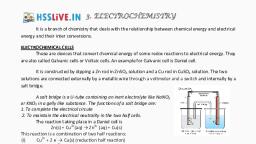
in, , Isotonic, hypertonic and hypotonic solutions, Two solutions having same osmotic pressure at a given temperature are called isotonic solutions., When such solutions are separated by a semi-permeable membrane, no osmosis occurs., For e.g. our blood cells are isotonic with 0.9% (mass/volume) sodium chloride solution, called normal, saline solution. So it is safe to inject intravenously., A solution having higher osmotic pressure than another is called hypertonic solution. While a solution, having lower osmotic pressure than another is called hypotonic solution., If we place our blood cells in a solution containing more than 0.9% (mass/volume) sodium chloride, solution, water will flow out of the cells and they would shrink. On the other hand, if they are placed in a, solution containing less than 0.9% (mass/volume) NaCl, water will flow into the cells and they would swell., Reverse osmosis and water purification, The direction of osmosis can be reversed if a pressure larger than the osmotic pressure is applied to, the solution side. Now the pure solvent flows out of the solution through the semi permeable membrane., This phenomenon is called reverse osmosis and is used in desalination of sea water., , 3. ELECTROCHEMISTRY, , Hs, sli, , ve, ., , It is a branch of chemistry that deals with the relationship between chemical energy and electrical, energy and their inter conversions., Nernst Equation, Nernst proposed an equation to relate the electrode potential of an electrode (or, emf of a cell) with, the electrolytic concentration., a) Nernst equation connecting electrode potential and electrolytic concentration:, For the electrode reaction:, Mn+(aq) + ne- –→ M(s), The Nernst equation is:, Eel. = E0el. – 0.0591 log 1/[M n+] at 298K, n, 0, Where E is the standard electrode potential, n is the number of electrons involved in the cell, reaction and [M n+] is the concentration of the species, M n+., b) Nernst equation connecting emf of a cell and electrolytic concentration:, For a general electrochemical reaction of the type:, a A + bB ⎯⎯ ne-⎯→ cC + dD, Nernst equation at 298K can be written as:, Ecell = E0cell – 0.0591 log [C]c[D]d, n, [A]a[B]b, Nernst equation for Daniel Cell, For Daniel cell, the electrode reactions are:, Cu2+ + 2 e- → Cu(s) (cathode), Zn(s) → Zn2+ + 2 e- (anode), The electrode potentials are given as, For Cathode:, E(Cu2+/Cu) = E0(Cu2+/Cu) - RT ln 1/[Cu2+], 2F, 2+, 0 2+, For anode:, E(Zn /Zn) = E (Zn /Zn) - RT ln 1/[Zn2+], 2F, , +2 CHEMISTRY - Focus Area Notes Prepared by Anil Kumar K L, GHSS Ashtamudi, Kollam, , Page 14
Page 15 :
Ecell = E(Cu2+/Cu) - E(Zn2+/Zn), = {E0(Cu2+/Cu) – RT ln 1/[Cu2+]} – {E0(Zn2+/Zn) – RT ln 1/[Zn2+]}, 2F, 2F, = [E0(Cu2+/Cu) – E0(Zn2+/Zn) ] – RT ln [Zn2+], 2F, [Cu2+], 0, 2+, Or,, Ecell = E cell – RT ln [Zn ], 2F, [Cu2+], On changing the base of logarithm, we get, Ecell = E0cell – 2.303RT log [Zn2+], 2F, [Cu2+], On substituting the values of R (8.314 JK–1 mol–1), F (96500 C mol–1) at 298K, the above equation becomes,, Ecell = E0cell – 0.0591 log [Zn2+], 2, [Cu2+], , in, , The cell potential,, , Hs, sli, , ve, ., , Conductivity (ƙ) and Molar conductivity (λm), Conductivity is the conductance of a conductor having unit length and unit area of cross-section. Its unit is, ohm-1 m-1 or mho m-1 or Sm-1., Molar conductivity is the conductivity of 1 mole of an electrolytic solution kept between two electrodes, with unit area of cross section and at a distance of unit length. Its unit is Ω-1cm2 mol-1 or S cm2 mol-1., Variation of conductivity and Molar conductivity with concentration (dilution), Both conductivity and molar conductivity change with the concentration of the electrolyte. For both, strong and weak electrolytes, conductivity always decreases with dilution. This is because conductivity is the, conductance of unit volume of electrolytic solution. As dilution increases, the number of ions per unit volume, decreases and hence the conductivity decreases., For both strong and weak electrolytes, the molar conductivity increases with dilution (or decrease, with increase in concentration), due to different reasons., For strong electrolytes, as dilution increases, the force of attraction between the ions decreases and, hence the ionic mobility increases. So molar conductivity increases. When dilution reaches maximum or, concentration approaches zero, the molar conductivity becomes maximum and it is called the limiting molar, conductivity (λ0m)., The variation of λm for strong and weak electrolytes is shown in the following graphs:, λ0m, , Strong electrolyte, , λm, , Weak electrolyte, , √c, , Batteries, A battery is basically a galvanic cell in which the chemical energy of a redox reaction is converted to, electrical energy. They are of mainly 2 types – primary batteries and secondary batteries., a) Primary cells:, These are cells which cannot be recharged or reused. Here the reaction occurs only once (i.e. the cell, +2 CHEMISTRY - Focus Area Notes Prepared by Anil Kumar K L, GHSS Ashtamudi, Kollam, , Page 15
Page 16 :
b) Secondary cells, , ve, ., , in, , reaction is irreversible)., E.g. Dry cell, mercury button cell etc., 1. Dry Cell, It is a compact form of Leclanche cell. It consists of a zinc container as anode and a carbon (graphite), rod surrounded by powdered manganese dioxide (MnO2) and carbon as cathode. The space between the, electrodes is filled by a moist paste of ammonium chloride (NH4Cl) and zinc chloride (ZnCl2). The electrode, reactions are:, Anode: Zn(s) → Zn2+ + 2e–, Cathode: MnO2+ NH4++ e–→ MnO(OH) + NH3, Ammonia produced in this reaction forms a complex with Zn2+ and thus corrodes the cell. The cell has a, potential of nearly 1.5 V., 2. Mercury cell, Here the anode is zinc – mercury amalgam and cathode is a paste of HgO and carbon. The electrolyte is a, paste of KOH and ZnO. The electrode reactions are:, Anode reaction: Zn(Hg) + 2OH– → ZnO(s) + H2O + 2e–, Cathode reaction: HgO + H2O + 2e– → Hg(l ) + 2OH–, The overall reaction is : Zn(Hg) + HgO(s) → ZnO(s) + Hg(l ), The cell has a constant potential of 1.35 V since the overall reaction does not involve any ion in solution., , Hs, sli, , A secondary cell can be recharged and reused again and again. Here the cell reaction can be reversed, by passing current through it in the opposite direction. The most important secondary cell is lead storage, cell, which is used in automobiles and invertors., It consists of lead as anode and a grid of lead packed with lead dioxide (PbO2) as the cathode. The, electrolyte is 38% H2SO4 solution., The overall cell reaction is: Pb(s)+PbO2(s)+2H2SO4(aq) → 2PbSO4(s) + 2H2O(l), On charging the battery, the reaction is reversed and PbSO4(s) on anode and cathode is converted into Pb, and PbO2, respectively., Another example for a secondary cell is nickel – cadmium cell., Fuel cells, These are galvanic cells which convert the energy of combustion of fuels like hydrogen, methane,, methanol, etc. directly into electrical energy., One example for fuel cell is Hydrogen – Oxygen fuel cell. Here hydrogen and oxygen are bubbled, through porous carbon electrodes into concentrated aqueous sodium hydroxide solution., The electrode reactions are:, Cathode: O2(g) + 2H2O(l ) + 4e–→4OH–(aq), Anode: 2H2 (g) + 4OH–(aq) → 4H2O(l) + 4e–, Overall reaction is: 2H2(g) + O2(g) ⎯→ 2 H2O(l ), Advantages of Fuel cells, 1. The cell works continuously as long as the reactants are supplied., 2. It has higher efficiency as compared to other conventional cells., 3. It is eco-friendly (i.e. pollution free) since water is the only product formed., 4. Water obtained from H2 – O2 fuel cell can be used for drinking., Corrosion: It is the process of formation of oxide or other compounds of a metal on its surface by the action, of air, water-vapour, CO2 etc. Some common examples are: The rusting of iron, tarnishing of silver,, formation of green coating on copper and bronze (verdigris) etc., , +2 CHEMISTRY - Focus Area Notes Prepared by Anil Kumar K L, GHSS Ashtamudi, Kollam, , Page 16
Page 17 :
Most familiar example for corrosion is rusting of iron. It occurs in presence of water and air. It is a redox, reaction. Here the iron is first oxidised to ferrous (Fe2+), then to ferric ions (Fe3+) and finally to hydrated ferric, oxide (Fe2O3. x H2O), which is called rust. The electrode reactions are:, Anode reaction: 2 Fe (s)→2 Fe2+ + 4 e–, Cathode reaction: O2(g) + 4 H+(aq) + 4 e– ⎯→ 2 H2O (l ), Overall reaction: 2Fe(s) + O2(g) + 4H+(aq) → 2Fe2 +(aq)+ 2 H2O (l), , in, , Methods to prevent corrosion, 1. By coating the metal surface with paint, varnish etc., 2. By coating the metal surface with another electropositive metal like zinc, magnesium etc. The coating, of metal with zinc is called galvanisation and the resulting iron is called galvanized iron., 3. By coating with anti-rust solution., 4. An electrochemical method is to provide a sacrificial electrode of another metal (like Mg, Zn, etc.), which corrodes itself but saves the object (sacrificial protection)., , 4. CHEMICAL KINETICS, , Hs, sli, , ve, ., , The branch of Chemistry that deals with the rate of chemical reaction, factors affecting the rate and, the mechanism of a reaction is called Chemical Kinetics., Rate of a chemical reaction, The rate of a chemical reaction is the change in concentration of any one of the reactant or product, in unit time. Or, it is the rate of decrease in concentration of any one of the reactant or the rate of increase, in concentration of any one of the product., Factors affecting rate of a reaction, The important factors which affect the rate of a chemical reaction are:, 1. Nature of the reactants, 2. Concentration of the reactants, 3. Temperature, 4. Pressure (for gaseous reaction only), 5. Effect of catalyst, 6. Influence of radiation, Dependence of Rate of reaction on concentration – Rate law, The rate of a reaction is directly proportional to the concentration of reactants., Thus for a general reaction, aA + bB → cC + dD,, Rate α [A]x[B]y, Or,, r = k [A]x[B]y (where x and y may or may not be equal to a and b), This expression is known as rate law or rate equation. Thus rate law is a “mathematical equation, relating the rate of a chemical reaction and concentration of reactants.”, In the above equation ‘k’ is a constant called rate constant. It is defined as the rate of the reaction, when the concentration of each of the reactants is unity., Order of reaction, Order is the sum of the powers of the concentration terms of the reactants in the rate law. It is an, experimental quantity. It can have the values 0,1,2,3,…… or a fraction. It is applicable to both elementary, and complex reactions., For a general reaction, aA + bB → cC + dD; r = k[A]x[B]y, Order of the reaction = x + y, , +2 CHEMISTRY - Focus Area Notes Prepared by Anil Kumar K L, GHSS Ashtamudi, Kollam, , Page 17
Page 18 :
Hs, sli, , ve, ., , in, , If the order of a reaction is zero, it is called zero order reaction, if it is one, it is called first order reaction, if it, is two, it is called second order reaction and so on., Molecularity of a reaction, It is the total number of reacting species collides simultaneously in a chemical reaction. It is a, theoretical quantity. It cannot be zero or fractional. It can have values 1,2,3 etc. it is applicable only to, elementary reactions., If the molecularity of a reaction is 1, it is called unimolecular reaction., If the molecularity of a reaction is 2, it is called bimolecular reaction., Differences between Order and Molecularity of a reaction, Order, Molecularity, 1. It is the sum of the powers of the concentration terms in It is the total number of reactant species, the rate law expression, collide simultaneously in a chemical reaction, 2. It is an experimental quantity, It is a theoretical quantity, 3. It can be zero or fractional, It cannot be zero or fractional, 4. It is applicable to both elementary and complex reactions It is applicable only to elementary reactions, Elementary and complex reactions, A reaction that takes place in a single step is called elementary reaction. While a reaction that occurs, in more than one step is called a complex reaction. In a complex reaction one of the steps is slower than the, other steps and this step is called the rate determining step (rds). The overall rate of the reaction is, controlled by this slowest step. The sequence of steps by which a chemical reaction occurs is called the, mechanism of the reaction., Unit of Rate constant, Different ordered reactions have different units for k., For an nth order reaction, unit of k = (mol/L)1-ns-1, The units of rate constant for different ordered reactions are:, Reaction, , Order, , Zero order reaction, First order reaction, Second order reaction, , 0, 1, 2, , Unit of rate, constant, Mol L-1s-1, s-1, Mol-1L s-1, , Integrated Rate law Equation for a First order reaction, In first order reaction, the rate of the reaction is proportional to the concentration of the reactant. For such, reactions, the integrated rate equation is:, k= 2.303 log [R]0, t, [R], If we plot a graph between ln[R] against time, we get straight line graph as follows:, , +2 CHEMISTRY - Focus Area Notes Prepared by Anil Kumar K L, GHSS Ashtamudi, Kollam, , Page 18
Page 19 :
Hs, sli, , ve, ., , in, , Examples for 1st order reactions are:, 1. Hydrogenation of ethene., 2. All natural and artificial radioactive decay., Half life of a reaction (t1/2), The half-life of a reaction is the time taken for concentration of a reactant is reduced to one half of, its initial concentration. Or, it is the time taken for half of a reaction to complete. It is represented as t1/2., 1. Half life of a first order reaction, For a first order reaction, half life is given by:, t1/2 = 0.693, k, Thus for a first order reaction, half-life period is constant. i.e., it is independent of initial concentration of, the reacting species., Pseudo first order reaction, These are reactions which appear to follow higher order but actually follow first order kinetics., e.g. 1. Hydrolysis of ester (ethyl acetate), CH3COOC2H5 + H2O H+, CH3COOH + C2H5OH; r = k [CH3COOC2H5], 2. Inversion of cane sugar, C12H22O11 + H2O, H+, C6H12O6 + C6H12O6; r = k [C12H22O11], Cane sugar, Glucose, Fructose, Rate of reaction and Temperature, Most of the chemical reactions are accelerated by increase in temperature. It is found that for a, chemical reaction, when the temperature is increased by 10°, the rate of the reaction and the rate constant, is nearly doubled., The temperature dependence of the rate of a chemical reaction can be explained by Arrhenius, equation. The equation is:, k = A e - Ea /RT ……………………………….. (1), Where k is the rate constant, A is a constant called the Arrhenius parameter, R is the universal gas constant,, Ea is activation energy and T is the absolute temperature., The logarithmic form of Arrhenius equation is:, ln k = – Ea + ln A, RT, Or, log K = -Ea + log A, 2.303RT, If we plot a graph between ln k against 1/T, we get a straight line with slope = – Ea/R and the yintercept ln A. From this Arrhenius parameters Ea and A can be determined., , +2 CHEMISTRY - Focus Area Notes Prepared by Anil Kumar K L, GHSS Ashtamudi, Kollam, , Page 19
Page 20 :
Calculation of activation energy by knowing the rate constants at two different temperatures, , ve, ., , in, , If k1 and k2 are rate constants at temperatures T1 and T2 respectively, then, logk2/k1 = Ea [T2 – T1], 2.303R T1.T2, From this equation we can calculate the value of activation energy (Ea), by knowing all other values., Effect of Catalyst, A catalyst is a substance which alters the rate of a reaction without itself undergoing any permanent, chemical change. A catalyst increases the rate of a chemical reaction by providing an alternate pathway or, reaction mechanism by reducing the activation energy between reactants and products., , Hs, sli, , 5. SURFACE CHEMISTRY, , It is the branch of chemistry that deals with the study of nature of surfaces and the different, processes taking place at the surface. The important surface phenomena are adsorption, corrosion,, electrode process, heterogeneous catalysis, dissolution etc., ADSORPTION, It is the process of concentration or accumulation of a substance on the surface of another, substance. The substance which is adsorbed is called adsorbate and the substance whose surface on which, adsorption takes place is called adsorbent. The commonly used adsorbents are charcoal, silica gel, alumina, gel, clay, colloids, metals in finely divided state etc., Adsorption is a surface phenomenon. Some examples of adsorption are:, 1. Powdered charcoal adsorbs gases like H2, O2, CO, Cl2, NH3, SO2 etc., 2. Silica gel adsorbs moisture, 3. Animal charcoal adsorbs colouring material from sugar solutions, Desorption: The process of removal of an adsorbed substance from the surface of adsorbent is called, desorption. i.e. it is the reverse of adsorption., Distinction between adsorption and absorption, In adsorption, the substance is concentrated only at the surface while in absorption, the substance is, uniformly distributed throughout the bulk of the solid. So adsorption is a surface phenomenon while, absorption is a bulk phenomenon., Sorption: If adsorption and absorption occur simultaneously, the process is called sorption., +2 CHEMISTRY - Focus Area Notes Prepared by Anil Kumar K L, GHSS Ashtamudi, Kollam, , Page 20
Page 21 :
Heat of adsorption (Enthalpy of Adsorption): The amount of heat evolved when 1 mole of an adsorbate is, adsorbed on an adsorbent is called heat of adsorption., Types of adsorption, Depending on the force of attraction between adsorbent and adsorbate, adsorption is of two types –, physical adsorption or physisorption and chemical adsorption or chemisorption., If the force of attraction between adsorbent and adsorbate is weak van der Waals force, it is called, physical adsorption or physisorption or van der Waals adsorption., If the force of attraction between adsorbent and adsorbate is chemical bond, it is called chemical, adsorption or chemisorption or activated adsorption., Distinction between physisorption and chemisorption, , Nature of layer, , Chemisorption, Strong chemical bond, Highly specific, Irreversible, Gases which can react with the, adsorbent show chemisorption, , in, , 8, , 1, 2, 3, 4, , Physisorption, Weak van der Waals force, Not specific, Reversible, Easily liquefiable gases (e.g. CO2, HCl,, NH3 etc) are easily adsorbed than, permanent gases (e.g. H2, N2, O2 etc), Low (20-40 kJ/mol), Occurs at low temperature, No appreciable activation energy is, needed, Multimolecular layer of adsorption, occurs, , ve, ., , 5, 6, 7, , Properties, Force of attraction, Specificity, Reversibility, Extend of, adsorption and, nature of gas, Heat of adsorption, Temperature, Activation energy, , High (80-240kJ/mol), Occurs at high temperature, High activation energy is required, Only unimolecular layer of adsorption, occurs, , Hs, sli, , Adsorption Isotherms, An equation or a graph relating the extent of adsorption and pressure at constant temperature is, known as adsorption isotherm., Freundlich adsorption isotherm:, Freundlich gave an empirical relationship between the quantity of gas adsorbed by unit mass of solid, adsorbent and pressure, at a particular temperature. The relationship can be expressed by the following, equation:, x/m = k.P1/n (where n > 1), where x is the mass of the gas adsorbed, m is the mass of the adsorbent, k and n are constants. The, above relationship can be represented in the form of a graph as follows:, From the graph it is clear that x/m (extend of adsorption) increases with, pressure upto a certain pressure called saturation pressure (Ps) and, after that it becomes constant., If we take logarithm of the above equation, we get, x/m, log x/m = logk + 1/n logP, If we plot log x/m against log P, we get a straight line graph., The value of 1/n in Freundlich isotherm ranges from 0 to 1, When 1/n = 0, x/m = a constant. i.e. the adsorption is independent of pressure., P, When 1/n = 1, x/m = k.p, the adsorption varies linearly with pressure., Freundlich adsorption isotherm failed to explain adsorption at very high pressures., +2 CHEMISTRY - Focus Area Notes Prepared by Anil Kumar K L, GHSS Ashtamudi, Kollam, , Ps, , Page 21
Page 22 :
in, , Applications of adsorption, The important applications of adsorption are:, 1. Production of high vacuum: For the complete evacuation of a vessel, activated charcoal is used., 2. Gas masks: The poisonous gases in coal mines can be removed by using gas masks containing, activated charcoal., 3. Control of humidity: Silica and aluminium gels are used as adsorbents for removing moisture and, controlling humidity., 4. Animal charcoal is used for the purification of cane sugar solution., 5. Adsorption finds application in heterogeneous catalysis., 6. A mixture of noble gases can be separated by adsorption on coconut charcoal at different, temperatures., 7. In curing diseases: A number of drugs are used to kill germs by getting adsorbed on them., 8. In froth floatation process for the purification of sulphide ores in metallurgy., 9. Adsorption indicators like eosin, fluorescein etc. are used in volumetric analysis., 10. Chromatographic analysis for the separation of a mixture is based on adsorption., , CATALYSIS, , Hs, sli, , ve, ., , A catalyst is a substance that changes the rate of a chemical reaction without undergoing any, permanent chemical change by itself. The process of changing the rate of a chemical reaction by a catalyst is, known as Catalysis., Eg: MnO2 (Manganese dioxide) acts as a catalyst in the decomposition of KClO3 (Potassium chlorate), 2KClO3, 2KCl + 3 O2, Promoters and poisons, Promoters are substances that enhance the activity of a catalyst while poisons decrease the activity, of a catalyst., For example, in Haber’s process for the manufacture of ammonia, molybdenum (Mo) acts as a promoter for, the catalyst iron., N2 +3H2, Fe/Mo, 2NH3, Homogenous and Heterogeneous Catalysis, Homogeneous Catalysis: It is a catalytic process in which the reactants and the catalyst are in the same, state., e.g.: 2SO2 (g) + O2 (g) NO (g), 2SO3 (g) [Lead chamber process], Heterogeneous catalysis: It is a catalytic process in which the reactants and the catalyst are in different, states., E.g.: 2SO2(g) + O2(g) V2O5(s), 2SO3(g) [Contact Process], N2(g) +3H2 (g), Fe(s), 2NH3 [Haber Process], Adsorption Theory of Heterogeneous Catalysis, This theory explains the mechanism of heterogeneous catalysis and involves five steps:, (i) Diffusion of reactants to the surface of the catalyst., (ii) Adsorption of reactant molecules on the surface of the catalyst., (iii) Occurrence of chemical reaction on the catalyst’s surface through formation of an intermediate., (iv) Desorption of reaction products from the catalyst surface., (v) Diffusion of reaction products away from the catalyst’s surface., Important features of solid catalysts, 1. Activity: It is the ability of a catalyst to increase the rate of a chemical reaction., e.g.: H2 reacts with O2 to form H2O in presence of Platinum (Pt) catalyst. In absence of Pt, the reaction does, not occurs., 2H2 + O2, Pt, 2 H2O, +2 CHEMISTRY - Focus Area Notes Prepared by Anil Kumar K L, GHSS Ashtamudi, Kollam, , Page 22
Page 23 :
Hs, sli, , ve, ., , in, , 2. Selectivity: It is the ability of a catalyst to direct a chemical reaction to a particular product., e.g.: CO reacts with H2 to form different products based on the nature of the catalyst., i) CO + 3H2 Ni, CH4 + H2O, ii) CO + 2H2 Cu/ZnO-Cr2O3 CH3OH, iii) CO + H2, Cu, HCHO, Shape-Selective Catalysis by Zeolites, The catalytic reaction that depends upon the pore structure of the catalyst and the size of the, reactant and product molecules is called shape-selective catalysis. E.g. zeolites, Zeolites have honey comb-like structures. They are contain Al–O–Si framework. They are used as, catalysts in petrochemical industries., An important zeolite catalyst used in the petroleum industry is ZSM-5. It converts alcohols directly, into gasoline (petrol) by dehydrating them to give a mixture of hydrocarbons., Enzyme Catalysis, Enzymes are nitrogenous organic compounds which catalyse the different reactions taking place in, living bodies. Or, enzymes are also called biochemical catalysts. The process by which an enzyme catalyses a, reaction is known as enzyme catalysis or biochemical catalysis., Some examples are:, Enzymatic reaction, Enzyme, cane sugar to glucose and fructose, Invertase, glucose to ethyl alcohol and carbon, Zymase, dioxide, starch to maltose, Diastase, Characteristics of enzyme catalysis, The important characteristics of enzyme catalysis are:, 1. Enzymes are highly specific in nature., 2. Enzyme activity is highly efficient., 3. The enzyme activity is maximum at a particular temperature called optimum temperature (298310K)., 4. The enzyme activity is maximum at a particular pH called optimum pH (5-7)., 5. The enzymatic activity is increased in the presence of certain substances, known as co-enzymes., 6. Enzymes activity is inhibited or poisoned by the presence of certain substances., , THE COLLOIDAL STATE, , Colloid is an intermediate state between true solution and suspension. Here the particle size is in, between 1 nm and 1000nm. The particles do not settle down under the influence of gravity. They cannot be, filtered by ordinary filter paper, but can be filtered by ultra filters. They are heterogeneous and translucent., Colloids are heterogeneous systems containing two phases – dispersed phase and dispersion, medium. The substance which is dispersed (distributed) is called dispersed phase and the medium in which, the particles are dispersed is called dispersion medium., e.g.: In starch solution, starch is the dispersed phase and water is the dispersion medium., Classification colloids, 1. Based on the dispersion medium, colloids are classified as aerosol (if the dispersion medium is air),, hydrosol (if the dispersion medium is water), alcosol (if the dispersion medium is alcohol) etc., 2. Based on the physical state of dispersed phase and the dispersion medium, Depending upon physical state of the dispersed phase and the dispersion medium, there are eight, types of colloidal systems., +2 CHEMISTRY - Focus Area Notes Prepared by Anil Kumar K L, GHSS Ashtamudi, Kollam, , Page 23
Page 24 :
Dispersed, Phase, Solid, , Dispersion, medium, Solid, , Solid, Solid, Liquid, Liquid, Liquid, , Liquid, Gas, Solid, Liquid, Gas, , Type of colloid, , Examples, , Solid Sol, , Some coloured glasses and gem, stones, Paints, Cell fluids, Smoke, dust, Cheese, butter, jellies, Milk, hair cream, cod liver oil, Fog, mist, cloud, insecticide sprays, , Hs, sli, , ve, ., , in, , Sol, Aerosol of solid, Gel, Emulsion, Aerosol of, liquid, Gas, Solid, Solid foam, Pumice stone, foam rubber, Gas, Liquid, Foam, Froth, whipped cream, soap lather, 3. Based on the attraction between the dispersed phase and the dispersion medium, colloids are of two, types: lyophilic (solvent loving) and lyophobic (solvent hating). If the force of attraction between dispersed, phase and dispersion medium is strong, it is called lyophilic sol., e.g. gum, gelatin, starch, rubber etc in suitable dispersion medium., If the force of attraction between dispersed phase and dispersion medium is weak, it is called, lyophobic sol., e.g. Arsenic sulphide (As2S3) sol, sulpher sol and metal sols like gold sol, silver sol etc., Differences between lyophilic and lyophobic sols, Properties, Lyophilic sol, Lyophobic sol, Force of, Strong, Weak, attraction, Preparation Can be easily prepared by mixing the dispersed, Some special methods are used for the, phase with the dispersion medium, preparation, Reversibility Reversible (i.e. they can be easily separated and, irreversible, remixed), Stability, Self stabilized, Less stable and requires some stabilizing, agent, Coagulation large amount of electrolyte is required for, Only small amount of electrolyte is, coagulation, required., 4. Based on the nature of particles:, Based on this, colloids are of three types – Multimolecular colloids, Macro molecular colloids and, Associated colloids., 1. Multimolecular colloids: They contain an aggregate of atoms or molecules having dimension < 1nm., These particles are bind together by weak van der Waal’s force of attraction and form particles of colloidal, dimension., e.g. Arsenic sulphide (As2S3) sol, sulpher sol and metal sols like gold sol, silver sol etc., 2. Macromolecular colloids: Macromolecules (Polymers) in suitable solvents form solutions in which, the size of the particle is in the colloidal range. Such systems are called macromolecular colloids., Example: solutions of starch, cellulose, proteins, enzymes, polythene, nylon, polystyrene, synthetic rubber,, etc. in suitable dispersion medium., 3. Associated colloids: These are substances which behave as normal strong electrolytes at low, concentrations, but as colloids at higher concentrations. They are also called micelles., The formation of micelles takes place only above a particular temperature called Kraft temperature (Tk) and, above a particular concentration called critical micelle concentration (CMC)., +2 CHEMISTRY - Focus Area Notes Prepared by Anil Kumar K L, GHSS Ashtamudi, Kollam, , Page 24
Page 25 :
Hs, sli, , ve, ., , in, , Surface active agents such as soaps and synthetic detergents are examples for micelles. These colloids have, both lyophobic and lyophilic parts., Cleansing action of soaps, The cleansing action of soap is due to micelle formation. The soap molecules form micelle around the, oil droplet in such a way that hydrophobic part is in the oil droplet and hydrophilic part projects out. The, hydrophilic end interacts with water, and so the oil droplets are pulled in water and removed from the dirty, surface. Thus soap helps in emulsification and washing away of oils and fats., Preparation of colloids, Some of the methods used for the preparation of colloids are:, a) Chemical methods:, Colloidal solutions can be prepared by chemical reactions like oxidation, reduction, double decomposition,, hydrolysis etc., 3S(sol) + 2H2O, 1. Oxidation: SO2 + 2H2S, 2. Reduction:2AuCl3 + 3HCHO + 3H2O, 2Au(sol) + 3HCOOH + 6HCl, 3. Hydrolysis: FeCl3 + 3H2O, Fe(OH)3 (sol) + 3HCl, 4. Double decomposition: As2O3 + 3H2S, As2S3(sol) + 3H2O, b) Electrical disintegration (Bredig’s arc method):, This method is used for the preparation of metal sols like Ag, Au, Pt etc. The metal whose sol is to be, prepared is taken in the form of two rods and it is kept in suitable dispersion medium containing small, amount of electrolyte. The whole arrangement is kept in an ice bath. When high voltage is passed through, the metal, the intense heat produced vapourises the metal, which then condensed to form particles of, colloidal dimension., , c) Peptization:, The process of conversion of a freshly prepared precipitate into a colloidal sol by shaking it with, suitable dispersion medium in the presence of small amount of electrolyte is called peptization. The, electrolyte added is called peptizing agent., Purification of colloids, The colloidal solution prepared contains excess amount of electrolyte and some other soluble impurities., Some methods used for purification of colloids are:, 1. Dialysis: Here the sol particles are taken in a parchment or cellophane bag and it is suspended in a, running stream of water. The impurities are diffused through the membrane and the sol particles are left, behind. These particles are then suspended in suitable dispersion medium so as to get a colloidal dispersion., The speed of dialysis can be increased by using hot water instead of cold water. Then the process is, known as hot water dialysis., The speed of dialysis can also be increased by dipping two electrodes and passing electricity. Then the, process is known as electrodialysis., 2. Ultrafiltration: Here the colloidal particles are filtered using ultrafilter paper. The sol particles are, retained on the filter paper while the impurities and the electrolyte are passed through it. When these sol, particles are suspended in suitable dispersion medium, we get a colloidal solution., +2 CHEMISTRY - Focus Area Notes Prepared by Anil Kumar K L, GHSS Ashtamudi, Kollam, , Page 25
Page 26 :
Hs, sli, , ve, ., , in, , Properties of colloids, 1. Tyndall effect: When a light beam is passed through a colloidal solution, we can see the path of the, light beam. This phenomenon is known as Tyndall effect. It is due to the scattering of light beam by, the colloidal particles. The visible path is called tyndall cone., Tyndall effect is observed only when the following conditions are satisfied:, (i) The diameter of the dispersed particles is much larger than the wavelength of the light used., (ii) The refractive indices of the dispersed phase and the dispersion medium differ greatly in magnitude., True solutions do not show tyndall effect since the size of particles are very small so that they cannot, scatter the light beam. Thus tyndall effect is used to distinguish a colloidal solution from a true solution., Ultramicroscope used to see the colloidal particles works on the principle of tyndall effect., 2. Brownian movement, In colloids, the particles of dispersion medium are in a state of continuous zig-zag motion. This motion, was first observed by Robert Brown and it is known as Brownian movement. It is independent of the nature, of the colloidal particles but depends on the size of the particles and viscosity of the solution. Smaller the, size and lesser the viscosity of the medium, faster is the motion., Brownian movement is due to the unbalanced bombardment of particles of the dispersed phase by the, particles of dispersion medium. It is responsible for the stability of colloids., 3. Charge on colloidal particles:, Colloidal particles always carry an electric charge. For a given colloidal solution, the nature of the charge, is the same on all the particles., Positively charged sol, Negatively charged sol, Hydrated metallic oxides like Fe2O3.xH2O, Al2O3.xH2O,, Metal sols (e.g. Cu sol, Ag sol, Au sol), CrO3.xH2O etc., Basic dyes (e.g. methylene blue), Metallic sulphides (e.g. As2S3, CdS etc), Haemoglobin in blood, Acid dyes (e.g. eosin, congo red etc.), Metal oxides (TiO2), Sols of starch, gum, gelatin, clay, charcoal, etc., Due to the positive or negative charge in the sol particles, they attract the counter ions (opposite, ions) from the medium. Thus a double layer of opposite charges is formed. This is known as Helmholtz, electrical double layer. The layer in which the ions are directly adsorbed to the sol particles is termed as, fixed layer. The second layer is mobile and is termed as diffused layer., Due to the opposite charges on the fixed and diffused layers, there arises a potential difference, between these layers. This potential difference between the fixed layer and the diffused layer of opposite, charges is called the electrokinetic potential or zeta potential., 4. Electrophoresis:, Since colloidal particles carry charge, they move under the influence of an electric field. This movement, of colloidal particles is called electrophoresis. The positively charged sol particles move towards cathode, (cataphoresis) and the negatively charged particles move towards the anode (anaphoresis)., If the movement of the sol particles is prevented by some suitable method, the particles of, dispersion medium itself move under the presence of electric field. This migration is termed as electroosmosis., 5. Coagulation (precipitation or flocculation), The process of settling of colloidal particles is called coagulation or precipitation of the sol. This can be, done by different ways - by electrophoresis, by mixing two oppositely charged sols, by continuous dialysis,, by boiling, by the addition of electrolyte., +2 CHEMISTRY - Focus Area Notes Prepared by Anil Kumar K L, GHSS Ashtamudi, Kollam, , Page 26
Page 27 :
Hs, sli, , ve, ., , in, , When an electrolyte is added to the sol, the ions carrying opposite charge to that of the sol neutralize, the charge and causes precipitation. The ion of the electrolyte which causes the precipitation is called the, coagulating ion or the flocculating ion. A negatively charged ion causes the precipitation of positively, charged sol and vice versa., Hardy – Schulze rule: The rule states that the greater the valency of the coagulating ion, the greater will be, the coagulating power., Thus for the coagulation of a negative sol like As2S3, the flocculating power of the +ve ions is of the, order:, Al3+ > Ba2+ > Na+, Similarly for a +ve sol like ferric hydroxide, the flocculating power of the counter ion is of the order:, [Fe(CN)6]4- > PO43- > SO42- > ClCoagulating value: The minimum concentration of an electrolyte in millimoles per litre required for the, coagulation of a sol within 2 hours is called coagulating value. The smaller the coagulating value, the higher, will be the coagulation power., EMULSIONS, These are colloidal solutions in which a liquid is dispersed in another liquid. Generally one of the two, liquids is water. There are two types of emulsions: 1. Oil in water (O/W) type and 2. Water in oil (W/O) type, In oil in water type emulsion, oil is the dispersed phase and water is the dispersion medium., E.g. milk. In milk, the liquid fat is dispensed in water, In water in oil type emulsion, water is the dispersed phase and oil is the dispersion medium. E.g. butter, and cream., An emulsion obtained by mixing oil with water or water with oil is not stable. In order to prepare a, stable emulsion, a third substance called emulsifying agent is added., The common emulsifying agents for O/W emulsions are proteins, gums, natural and synthetic soaps,, etc., and for W/O, heavy metal salts of fatty acids, long chain alcohols, lampblack, etc., , 6. GENERAL PRINCIPLES AND PROCESS OF, ISOLATION OF ELEMENTS, Minerals and Ores: The metallic compounds present in the earth crust are called minerals. All minerals, cannot be used for the extraction of metals. A mineral from which a metal can be extracted conveniently, and profitably is called ore., For e.g. Bauxite is the ore of Aluminium, Haematite (Fe2O3), Magnetite (Fe3O4), iron pyrites (FeS2) etc., are the ores of iron and copper pyrites (CuFeS2), Malachite [CuCO3.Cu(OH)2], Cuprite (Cu2O) etc. are the ores, of copper., The process of extraction of a metal from its ore is called metallurgy. The various steps involved in, metallurgy are concentration of the ore, extraction of the metals from the concentrated ore and refining or, purification of the crude metal., i) Concentration of the ore, The removal of impurities from the ore is called concentration of the ore. The impurities present in the, ore are called gangue. Depending on the nature of the impurities, any one of the following methods can be, used., a) Hydraulic washing: This method is used when the gangue is lighter than the ore. The powdered ore is, washed in a stream of water. The lighter gangue particles are washed away leaving behind the ore, particles., +2 CHEMISTRY - Focus Area Notes Prepared by Anil Kumar K L, GHSS Ashtamudi, Kollam, , Page 27
Page 28 :
Hs, sli, , ve, ., , in, , b) Magnetic separation: This method is used when either the ore or the gangue is magnetic. The, powdered ore is carried on a conveyer belt which passes over a magnetic roller. The magnetic, materials are collected near the magnetic roller but the non-magnetic materials are dumped away, from the roller., c) Froth floatation: This method is used for the concentration of the sulphide ores. In this process, a, suspension of the powdered ore is made with water. To this collectors (e.g. pine oil, fatty acid,, xanthates etc.) and froth stabilizers (e.g. cresols, aniline etc.) are added. The mineral particles, become wet by oils while the gangue particles by water. On Agitating the mixture by passing air,, froth is formed which carries the mineral particles. The froth is skimmed off and dried to get the ore, particles., This method can be used to separate two sulphide ores by using depressants. For e.g. in the, case of an ore containing ZnS and PbS, the depressant used is NaCN. It selectively prevents ZnS from, coming to the froth but allows PbS to come with the froth., d) Leaching: This method is used when the ore is soluble in some suitable solvent. Here the powdered, ore is treated with a suitable solvent in which ore particles alone dissolve. The impurities left, undissolved are removed by filtration and the ore is recovered by precipitation., e.g. Purification of Bauxite:, Here the powdered ore is treated with a concentrated solution of NaOH at 473 – 523 K and 35 – 36, bar pressure. Alumina (Al2O3) dissolves in NaOH to form sodium aluminate leaving behind the, impurities., Al2O3 (s) + 2NaOH(aq) + 3H2O(l) → 2Na[Al(OH) 4](aq), The aluminate in solution is neutralised by passing CO2 gas and hydrated Al2O3 is precipitated. The, solution is seeded with freshly prepared hydrated Al2O3 which induces the precipitation., 2Na[Al(OH)4](aq) + CO2(g) → Al2O3.xH2O(s) + 2NaHCO3 (aq), The hydrated alumina is filtered, dried and heated to give back pure alumina (Al2O3)., Al2O3.xH2O(s) 1470 K Al2O3 (s) + xH2O(g), ii), Extraction of crude metal from concentrated ore, It involves the following steps:, 1) Conversion to oxide and 2) Reduction of the oxide to metal, 1) Conversion to oxide, Since oxide ores can easily reduced, the sulphides and carbonate ores are first converted to, corresponding oxides. It can be done by calcinations or roasting., i) Calcination: Here the oxide is heated in the absence of air or in limited supply of air. It is used for, the conversion of hydroxide and carbonate ores to oxide ore., e.g. Fe2O3.xH2O(s), ∆, Fe2O3 (s) + xH2O(g), ZnCO3 (s) ∆, ZnO(s) + CO2(g), ii) Roasting: Here the ore is heated in a regular supply of air below the melting point of the metal., This method is used for the conversion of sulphide ores to oxide ore., 2ZnS + 3O2 → 2ZnO + 2SO2, 2PbS + 3O2 → 2PbO + 2SO2, 2) Reduction of the oxide to metal, It involves heating the metal oxide with suitable reducing agents like C, CO or another metal. The, reducing agent combines with the oxygen of the metal oxide., MxOy + yC → xM + y CO, iii) Refining of the metal, The process of removal of impurities from the the extracted metal is called refining of the metal. The, important methods used for refining are:, +2 CHEMISTRY - Focus Area Notes Prepared by Anil Kumar K L, GHSS Ashtamudi, Kollam, , Page 28
Page 29 :
Hs, sli, , ve, ., , in, , i) Distillation: This method is used for metals having low boiling point like Zn, mercury (Hg) etc., Here the impure metal is evaporated to obtain the pure metal as distillate., ii) Liquation: It is used for metals with low melting point like tin (Sn). Here the impure metal is, melted on a sloping surface of a furnace. In this way it is separated from higher melting impurities., iii) Electrolytic refining: e.g. Refining of copper, Here the impure copper rod is taken as the anode and a pure copper strip is used as the cathode., Acidified solution of CuSO4 is used as the electrolyte. During electrolysis, the impure copper is oxidized to, Cu2+ at anode and Cu is deposited at the cathode., The electrode reactions are:, Anode: Cu → Cu2+ + 2 e–, Cathode: Cu2+ + 2e– → Cu, The impurities are settled down below the anode as anode mud., iv) Zone refining: This method is based on the principle that the impurities are more soluble in, the melt than in the solid state of the metal. Here the metal rod is heated with a circular mobile heater from, one end to the other. The process is repeated several times so that the impurities get concentrated in one, end. This end is cut off. This method is very useful for the preparation of extra pure germanium, silicon,, boron, gallium and indium which are used as semiconductors., v) Vapour phase refining:, In order to use this method there are two requirements:, (i) The metal should form a volatile compound with an available reagent,, (ii) The volatile compound should be easily decomposable, so that the recovery is easy., Examples are:, a), Mond’s process for Refining Nickel: In this process, nickel is heated in a stream of carbon, monoxide forming a volatile complex, nickel tetracarbonyl:, Ni + 4CO 330 - 350K Ni(CO)4, It is then decomposed to Ni and CO by heating at very high temperature., Ni(CO)4 450 – 470 K Ni + 4CO, b) van Arkel Method for Refining Zirconium or Titanium: Here the crude metal is, heated in an evacuated vessel with iodine. The metal forms it volatile iodide., Zr + 2I2 → ZrI4, The metal iodide is decomposed electrically by using a tungsten filament, electrically, heated to about 1800K. The pure metal is thus deposited on the filament., ZrI4 → Zr + 2I2, Ellingham Diagram, The graphical representation of Gibbs energy vs Temperature was first given by H.J.T.Ellingham and, these graphs are known as Ellingham Diagram. It helps to select the reducing agent in the reduction of, oxides. These diagrams help us in predicting the feasibility of thermal reduction of an ore. Here we couple, two reactions – oxidation of the reducing agent and reduction of the metal oxide. If the total ΔG for the, coupled reaction is negative, the overall reaction will be feasible., Ellingham diagram normally consists of plots of ΔG0 vs T for the formation of oxides of elements i.e., for, the reaction,, 2xM(s) + O2(g) → 2MxO(s), In this reaction, the no. of gaseous species decrease from left to right. This results in a –ve value of ΔS. So, the sign of the second term in Gibbs equation (ΔG = ΔH – TΔS) changes to positive. The result is +ve slope in, the curve., In Ellingham diagram, there is a point (temperature) at which the ΔG values for the two reactions, (oxidation & reduction) are equal. The difference in the ΔG values after that point determines whether the, +2 CHEMISTRY - Focus Area Notes Prepared by Anil Kumar K L, GHSS Ashtamudi, Kollam, , Page 29
Page 30 :
in, , reduction process is feasible or not. If the difference is large negative, the reduction of the oxide of the, upper line is feasible by the element represented by the lower line., , Hs, sli, , ve, ., , Extraction of some metals, 1) Extraction of Iron: Iron is mainly extracted from Haematite (Fe2O3) and Magnetite (Fe3O4)., The ore is concentrated by magnetic separation and then it is calcined or roasted to remove water and to, decompose carbonates. Then the ore is mixed with lime stone (CaCO3) and coke (C) and fed into a blast, furnace from its top. Simultaneously a blast of air is passed from bottom of the furnace. Here the oxide is, reduced to the metal., In presence of hot air blast, burning of coke takes place and the temperature is raised to about 2200K., C(s) + ½ O2 (g) → CO (g) + heat, The CO and heat moves to upper part of the furnace and combines with the iron oxides and reduce them, to iron., 3Fe2O3 + CO → 2 Fe3O4 + CO2, Fe3O4 + 4 CO → 3Fe + 4 CO2, One of the main reduction steps in this process is: FeO + C → Fe + CO., This reaction is the combination of the following two simpler reactions., FeO → Fe + ½ O2, C + ½ O2 → CO, In Ellingham diagram, at temperatures above 1073K, the C,CO line comes below the Fe,FeO line. So in this, range, coke will be reducing the FeO and will itself be oxidised to CO., At higher temperature range in the blast furnace, lime stone (CaCO3) is decomposed to CaO. It, combines with silicate impurity of the ore to form slag., CaCO3, CaO + CO2, CaO + SiO2, CaSiO3, (flux) (gangue), (slag), The slag is in molten state and separates out from iron. The iron obtained from blast furnace is called, pig iron. It contains about 4% C and smaller amounts of impurities (e.g. S, P, Si, Mn etc.), When pig iron is melted with scrap iron and coke in presence of hot air blast, cast iron is formed. It is, extremely hard and brittle,, Wrought iron or malleable iron is the purest form of commercial iron. It is prepared from cast iron by, oxidizing impurities in a reverberatory furnace lined with haematite. This heamatite oxidises C to CO., Fe2O3 + 3C, 2Fe + 3CO, +2 CHEMISTRY - Focus Area Notes Prepared by Anil Kumar K L, GHSS Ashtamudi, Kollam, , Page 30
Page 31 :
ve, ., , in, , Here haematite is added as a flux., Flux, gangue and slag: The impurities present in the ore are called gangue. The gangue is removed during, the extraction of the metal by adding some chemical substances called flux. The flux combines with gangue, to form an easily fusible substance called slag., If the gangue is acidic, the flux used is basic in nature and vice versa., E.g. for acidic flux are SiO2, P2O5 etc. and e.g. for basic flux are CaO, MgO etc., e.g. CaO + SiO2, Ca SiO3, (Flux) (Gangue), (Slag), 2) Extraction of Aluminium - Hall-Heroult process, Aluminium is extracted by Hall-Heroult process. Here the purified Al2O3 is mixed with Na3AlF6, (cryolite) or CaF2 (to lower the melting point and to increase the conductivity) and is eletrolysed., Cathode: Carbon lined steel vessel. Anode: Graphite rods., During electrolysis Al2O3 is reduced to Al by carbon., 2Al2O3 + 3C → 4Al + 3CO2, The oxygen liberated at anode reacts with the carbon of anode producing CO and CO2., The electrolytic reactions are:, Cathode: Al3+ (melt) + 3e– → Al (l), Anode: C(s) + O2– (melt) → CO(g) + 2e–, C(s) + 2O2– (melt) → CO2 (g) + 4e–, , 7. THE P-BLOCK ELEMENTS, , Hs, sli, , The elements in which the last electron enters in the valence p-sub shell are called the p-block, elements. They include elements of the groups 13 to 18. Their general outer electronic configuration is, ns2np1-6 (except He which has 1s2 configuration).They includes metals, non-metals and metalloids., Ammonia, Preparation: In laboratory, ammonia is obtained by treating ammonium salts with caustic soda or lime., 2NH4Cl + Ca(OH)2 → 2NH3 + 2H2O + CaCl2, (NH4)2 SO4 + 2NaOH → 2NH3 + 2H2O + Na2SO4, On a large scale, ammonia is manufactured by Haber’s process., N2(g) + 3H2(g) → 2NH3(g), In accordance with Le Chatelier’s principle, high pressure of about 200 atm, a temperature of about, 700 K and the catalyst such as iron oxide with small amounts of K2O and Al2O3 are employed to increase the, rate of this reaction., Properties, Ammonia is a colourless gas with a pungent smell. It is highly soluble in water because of its ability to, form inter molecular hydrogen bond with water. Liquid ammonia has high melting and boiling points, because of inter molecular hydrogen., The ammonia molecule has a trigonal pyramidal geometry., It has three bond pairs and one lone pair of electrons as shown in the structure., , Its aqueous solution is weakly basic due to the formation of OH– ions., NH3(g) + H2O(l) → NH4+ (aq) + OH– (aq), +2 CHEMISTRY - Focus Area Notes Prepared by Anil Kumar K L, GHSS Ashtamudi, Kollam, , Page 31
Page 32 :
ve, ., , in, , The presence of a lone pair of electrons on the nitrogen atom of the ammonia molecule makes it a, Lewis base. It donates the electron pair and forms complex compounds which find applications in detection, of metal ions such as Cu2+, Ag+:, Cu2+ (aq) + 4NH3(aq) → [Cu(NH3)4]2+(aq), (blue), (deep blue), Uses: Ammonia is used to produce various nitrogenous fertilizers and in the manufacture of nitric acid., Liquid ammonia is used as a refrigerant., Nitric Acid: It is the most important oxoacid of Nitrogen., Manufacture: Ostwald’s process., It involves three steps:, 1. The catalytic oxidation of NH3 by atmospheric oxygen in presence of platinum/ rhodium gauge (wire), catalyst., 4 NH3(g) + 5 O2(g) Pt/Rh gauge catalyst, 500K & 9 bar 4NO(g) + 6 H2O(g), 2. The nitric oxide is converted to NO2, 2NO(g) + O2(g), 2 NO2 (g), 3. Absorption of nitrogen dioxide in water to get nitric acid, 3 NO2(g) + H2O(l), 2 HNO3(aq) + NO(g), Properties: it is a colourless liquid. In the gaseous state, HNO3 exists as a planar molecule with the structure, as shown., , Hs, sli, , In aqueous solution, nitric acid behaves as a strong acid giving hydronium and nitrate ions., HNO3(aq) + H2O(l) → H3O+(aq) + NO3– (aq), Concentrated nitric acid is a strong oxidising agent and attacks most metals except noble metals such, as gold and platinum. The products of oxidation depend upon the concentration of the acid, temperature, and the nature of the material undergoing oxidation., 3Cu + 8 HNO3(dilute) → 3Cu(NO3)2 + 2NO + 4H2O, Cu + 4HNO3(conc.) → Cu(NO3)2 + 2NO2 + 2H2O, Some metals (e.g., Cr, Al) do not dissolve in concentrated nitric acid because of the formation of a, passive film of oxide on the surface., Concentrated nitric acid also oxidises non–metals and their compounds. Iodine is oxidised to iodic, acid, carbon to carbon dioxide etc., I2 + 10HNO3 → 2HIO3 + 10 NO2 + 4H2O, C + 4HNO3 → CO2 + 2H2O + 4NO2, Brown Ring Test: It is a test used for the detection of nitrates. It is carried out by adding dilute ferrous, sulphate solution to an aqueous solution containing nitrate ion, and then carefully adding concentrated, sulphuric acid along the sides of the test tube. A brown ring at the interface between the solution and, sulphuric acid layer indicate the presence of nitrate ion in solution., NO3- + 3Fe2+ + 4H+ → NO + 3Fe3+ + 2H2O, [Fe (H2O)6 ]2 + NO → [Fe (H2O)5 (NO)]2+ + H2O, (brown), Uses: 1) The major use of nitric acid is in the manufacture of ammonium nitrate for fertilizers and other, nitrates for use in explosives and pyrotechnics., +2 CHEMISTRY - Focus Area Notes Prepared by Anil Kumar K L, GHSS Ashtamudi, Kollam, , Page 32
Page 33 :
in, , 2) It is also used for the preparation of nitroglycerin, trinitrotoluene and other organic nitro compounds., 3) It is used for the pickling of stainless steel, etching of metals and as an oxidiser in rocket fuels., Phosphorus Halides, Phosphorus forms two types of halides, PX3 and PX5, Phosphorus Trichloride (PCl3), Preparation: It is obtained by passing dry chlorine gas over heated white phosphorus., P4 + 6Cl2 → 4PCl3, It is a colourless oily liquid. It fumes in moist air because it hydrolyses in the presence of moisture and form, PCl3 + 3H2O → H3PO3 + 3HCl, HCl(g)., Structure: It has a pyramidal shape as shown, in which phosphorus is sp3 hybridized, , Hs, sli, , ve, ., , Phosphorus Pentachloride (PCl5), Preparation, It is prepared by the reaction of white phosphorus with excess of dry chlorine., P4 + 10Cl2 → 4PCl5, Properties, PCl5 is an yellowish white powder. It also fumes in moist air because it hydrolyses in the presence of, moisture and form HCl(g)., PCl5 + 3H2O → H3PO4 + 3HCl, Structure:, In gaseous and liquid phases, it has a trigonal bipyramidal structure. The three equatorial P–Cl bonds, are equivalent, while the two axial bonds are longer than equatorial bonds. This is due to the fact that the, axial bond pairs suffer more repulsion as compared to equatorial bond pairs., , Sulphuric Acid: It is the most important oxoacid of sulphur., Manufacture: Contact Process, It involves three steps:, ( i) Burning of sulphur or sulphide ores in air to generate SO2., 2SO2 + O2 → 2SO3, (ii) Conversion of SO2 to SO3 by the reaction with oxygen in the presence of a catalyst (V2O5), 2 SO2 + O2 → 2 SO3, (iii) Absorption of SO3 in H2SO4 to give Oleum (H2S2O7). Dilution of oleum with water gives H2SO4 of the, desired concentration., SO3 + H2SO4 → H2S2O7, Properties, Sulphuric acid is a colourless, dense, oily liquid. It dissolves in water with the evolution of a large, quantity of heat. Hence, for diluting the acid, the concentrated acid must be added slowly into water with, constant stirring., The chemical reactions of sulphuric acid are as a result of the following characteristics:, (a) low volatility, +2 CHEMISTRY - Focus Area Notes Prepared by Anil Kumar K L, GHSS Ashtamudi, Kollam, , Page 33
Page 34 :
AX3, AX5, AX7, , Hs, sli, , ve, ., , in, , (b) strong acidic character, (c) strong affinity for water and, (d) ability to act as an oxidising agent., It is dibasic acid and forms two series of salts- normal sulphates and acid sulphates, Because of its low volatility sulphuric acid can be used for the manufacture of more volatile acids from their, corresponding salts., 2 MX + H2SO4 → 2 HX + M2SO4 (where X = F, Cl, NO3 etc. and M is a metal), Concentrated sulphuric acid is a strong dehydrating agent and drying agent. Many wet gases can be dried by, passing them through sulphuric acid. Sulphuric acid removes water from organic compounds, e.g.: C12H22O11 + H2SO4 → 12C + 11H2O, Hot concentrated sulphuric acid is a moderately strong oxidising agent. It oxidises both metals and nonmetals and the acid itself reduces to SO2., Cu + 2 H2SO4(conc.) → CuSO4 + SO 2 + 2H 2O, 3S + 2H 2SO4(conc.) → 3SO2 + 2H2O, Uses: The important uses of Sulphuric acid are:, 1) In the manufacture of fertilizers 2) in petroleum refining 3) in the manufacture of pigments, paints and, dyestuff intermediates 4) in detergent industry 5) in metallurgical applications 6) as electrolyte in storage, batteries 7) in the manufacture of nitrocellulose products and 8) as a laboratory reagent., Interhalogen Compounds, When two different halogens react with each other, interhalogen compounds are formed. They can be, assigned general compositions as AX, AX3, AX5 and AX7, where both A and X are halogens. A is larger and, more electropositive than X. As the size of the central atom (A) increases, the stability of the compound, also increases., Preparation, The interhalogen compounds can be prepared by the direct combination or by the action of halogen on, lower interhalogen compounds., Cl2 + F2 437K 2ClF, I2 + 3Cl2, 2ICl3, (equal volume), (excess), Properties, These are all covalent molecules and are diamagnetic in nature. They are volatile solids or liquids, except CIF which is a gas at 298 K. Their physical properties are intermediate between those of, constituent halogens. The interhalogen compounds are more reactive than halogens (except fluorine)., This is because A–X bond in interhalogens is weaker than X–X bond in halogens except F–F bond., The types of inter halogen compounds and their structures are as follows:, Type, Examples, Structure, AX, ClF, BrF, IF, BrCl, BrI, Linear, ClF3, BrF3, IF3, ICl3, IBr3 etc., ClF5, BrF5, IF5, IF7, , Bent T-shaped, Square, pyramidal, Pentagonal, bipyramidal, , Uses: 1) These compounds can be used as non aqueous solvents., 2) Interhalogen compounds are very useful fluorinating agents., Group 18 Elements – Xenon Halides, Xe combines with fluorine and form XeF2, XeF4 and XeF6. Their preparation and structure are as follows:, +2 CHEMISTRY - Focus Area Notes Prepared by Anil Kumar K L, GHSS Ashtamudi, Kollam, , Page 34
Page 35 :
in, , Xe (g) + F2 (g) 673K & 1bar XeF2(s), (xenon in excess), Xe (g) + 2F2 (g) 873K & 7 bar XeF4(s), (1:5 ratio), Xe (g) + 3F2 (g) 573K & 60-70bar XeF6(s), (1:20 ratio), XeF2 and XeF4 have linear and square planar structures respectively. XeF6 has seven electron pairs (6, bonding pairs and one lone pair) and thus, have a distorted octahedral structure, , 8. The d and f Block Elements, , Hs, sli, , ve, ., , Elements from 3rd group to 12th group in the Modern Periodic table are called d-block elements. In, these elements their last electron enters in the penultimate d- sub shell. They are placed in between s-block, and p-block elements. They show a regular transition from the highly electropositive metals of s-block, elements to the less electropositive p-block elements. So they are called transition elements., Some properties of these elements are:, 1. Magnetic Properties, Transition metals show mainly two types of magnetic properties- paramagnetism and diamagnetism., Some transition metals also show ferromagnetism which is an extreme case of paramagnetism., Paramagnetism arises from the presence of unpaired electrons. For the compounds of 1st row, transition elements, there is only spin magnetic moment and it is determined by the spin only formula:, µs = √n(n+2) where n is the no. of unpaired electrons and µs is the spin only magnetic moment in the, unit of Bohr Magneton (B.M)., The magnetic moment increases with increase in no. of unpaired e-s. Thus the observed magnetic, moment gives an idea about the no. of unpaired e-s present in the atom or ion., 2. Formation of coloured ions or compounds, Most of the Transition metals ions or compounds are coloured. This is because of the presence of, partially filled d orbitals., In aqueous solution most of the Transition metal ions are coloured since water molecules act as the, ligands., Among Ti2+ and Ti4+, Ti2+ is coloured while Ti4+ is colourless. This is because Ti4+ has no partially filled d, orbitals., Ti4+ - [Ar] 3d0, Ti2+ - [Ar] 3d2, +, Similarly among Cu and Cu2+, Cu2+ is coloured while Cu+ is colourless. This is due to the lack, (absence) of partially filled d orbitals in Cu+., 3. Formation of Complexes, Transition metals form a large no. of complexes. This is due to:, 1. Comparatively smaller size, 2. High ionic charge, +2 CHEMISTRY - Focus Area Notes Prepared by Anil Kumar K L, GHSS Ashtamudi, Kollam, , Page 35
Page 38 :
ve, ., , in, , Reason: It is due to the poor shielding effect of f orbital electrons. In lanthanides, as the atomic number, increases, the nuclear charge increases one by one and the electrons are added to the anti-penultimate f, subshell. Due to its diffused shape, f orbitals have poor shielding effect. So the nucleus can attract the outer, most electrons strongly and hence the size decreases., Consequences:, 1) Due to Lanthanide Contraction the 2nd and 3rd row transition series elements have similar radii. For, example Zirconium and Hafnium have similar atomic radii.( Zr – 160pm and Hf -159pm)., 2) Lanthanides have similar physical properties and they occur together in nature. So their isolation is, difficult., Some Applications of d- and f- Block elements, Iron and steels are the most important construction materials., TiO is used in the pigment industry., Zn, Ni, Cd and MnO2 are used in battery cells., As catalyst in different reactions., E.g.V2O5 is used as a catalyst for the oxidation of SO2 in the manufacture of sulphuric acid., TiCl4 with Al(CH3)3 forms the basis of the Ziegler catalysts used in the manufacture of polythene., Iron catalysts are used in the Haber process for the production of ammonia from N2/H2 mixtures. Ni,, Pd and Pt are used as catalyst in hydrogenation reactions., In the Wacker process the oxidation o, f ethyne to ethanal is catalysed by PdCl2., Ag salts are used in the photographic industry., , 9. CO-ORDINATION COMPOUNDS, , Hs, sli, , These are compounds in which a metal atom/ion is surrounded by a group of anions or neutral, molecules. The metal atom/ion is called central atom/ion and the neutral molecules or anions are called, ligands. The central atom/ion should contain vacant orbitals and the ligand should contain one or more, lone pairs of electrons. The central metal atom or ion and ligands form a co-ordination entity., A ligand that binds to the central atom/ ion through a single donor atom is said to be unidentate ligand., E.g.: Cl-, Br-, I-, OH-, H2O, NH3, CN-, NC-, SCN- etc., A ligand that binds to the central atom through two donor atoms is called a bidentate ligand. E.g.:, Ethane-1,2-diamine or ethylenediamine (H2NCH2CH2NH2) notated as ‘en’ and oxalate ion (C2O42–)., A ligand that binds to the central atom through more than two donor atoms is called polydentate ligand., E.g.: Ethylenediamine tetraacetate ion (EDTA4–) is an important hexadentate ligand., The total number of ligand donor atoms to which the metal is directly bonded is called the co-ordination, number of the metal atom/ion., IUPAC Nomenclature of Co-ordination Compounds, The following rules are used while naming co-ordination compounds:, (i) The cation is named first in both positively and negatively charged co-ordination entities., (ii) The ligands are named in alphabetical order before the name of the central atom/ion., (iii) Names of the anionic ligands end in –o, those of neutral and cationic ligands are the same except ‘aqua’, for H2O, ‘ammine’ for NH3, ‘carbonyl’ for CO and ‘nitrosyl’ for NO., (iv) Prefixes mono, di, tri, etc., are used to indicate the number of individual ligands in the co-ordination, entity. When the names of the ligands include a numerical prefix, then the terms bis (for 2 such ligands), tris, (for 3), tetrakis (for 4) are used. Here the name of the ligand is placed in simple bracket., (v) Oxidation state of the metal is indicated by Roman numeral in simple bracket., (vi) If the complex ion is a cation, the central atom is named same as the element. If the complex ion is an, anion, the name of the metal ends with the suffix –ate. For example ferrate for iron, cobaltate for cobalt,, +2 CHEMISTRY - Focus Area Notes Prepared by Anil Kumar K L, GHSS Ashtamudi, Kollam, , Page 38
Page 39 :
zincate for Zn etc., (vii) The neutral complex molecule is named similar to that of the cationic complex., , Isomerism in Co-ordination Compounds, Compounds having the same molecular formula but different structural formula or spatial, arrangement of atoms are called isomers and the phenomenon is called isomerism., The isomerism shown by co-ordination compounds are broadly divided into two – structural, isomerism and stereo isomerism., , I), , Structural Isomerism, , II), , Stereoisomerism, , ve, ., , in, , These are isomers which differ in the structural arrangement of ligands around the central atom. They, are of four types:, 1) Ionisation Isomerism: It arises due to the inter change of ions between the inside and outside of coordination sphere. They give different types of ions in aqueous solution., An example is [Co(NH3)5SO4]Br and [Co(NH3)5Br]SO4., 2) Linkage isomerism: It arises in a co-ordination compound containing ambidentate ligand, which can bind, to the central atom through more than one donor atoms. E.g. in the complex [Co(NH3)5(ONO)]Cl2, the, nitrite ligand is bound through oxygen (–ONO), and in [Co(NH3)5(NO2)]Cl2 the nitrite ligand is bound, through nitrogen (–NO2) atom., 3) Co-ordination Isomerism: If both anionic and cationic parts are complexes, the isomerism arises due to, the interchange of ligands between cationic and anionic entities. This type of isomerism is called coordination isomerism. An example is [Co(NH3)6][Cr(CN)6] and [Cr(NH3)6][Co(CN)6]., 4) Solvate isomerism: It arises due to the difference in the no. of solvent molecules which are directly, bonded to the metal ion as ligand. It is also known as ‘hydrate isomerism’ if water is the solvent. An, example is [Cr(H2O)6]Cl3 and [Cr(H2O)5Cl]Cl2.H2O., , Hs, sli, , These are isomers which differ only in the spatial arrangement of ligands around the central atom. They, have same atom to atom bond. These are of two types:, (i) Geometrical isomerism (ii) Optical isomerism, i) Geometrical Isomerism: This type of isomerism arises due to the difference in the arrangements of, the ligands around the central atom. It is mainly found in co-ordination complexes with co-ordination, numbers 4 (square planar complexes) and 6 (octahedral complexes)., Geometrical isomer in which the same ligands are on the same side of the central metal atom is called cis, isomer and the isomer in which the same ligands are on the opposite side is called trans isomer., Square planar complexes with formula [MX2L2] (X and L are unidentate ligands) can show this isomerism., E.g.: [Pt (NH3)2Cl2], , Octahedral complexes with formula [MX2L4] can also show this type of isomerism., e.g.: [Co(NH3)4Cl2]+, , +2 CHEMISTRY - Focus Area Notes Prepared by Anil Kumar K L, GHSS Ashtamudi, Kollam, , Page 39
Page 40 :
This type of isomerism also arises when bidentate ligands (L – L) are present in complexes with, formula [MX2(L – L)2] e.g.: [Co (en)2Cl2]+, , ve, ., , in, , Fac-mer isomerism: It is a type of geometrical isomerism occurs in octahedral co-ordination entities of the, type [Ma3b3]. If similar ligands occupy three adjacent positions of an octahedral face, it is called facial (fac), isomer. When the positions are around the meridian of the octahedron, it is called meridional (mer) isomer., Eg. [Co(NH3)3(NO2)3]., , Hs, sli, , ii), Optical Isomerism: Optical isomers are mirror images that cannot be superimposed on one another., These are also called enantiomers., There are two forms of optical isomers - dextro (d) and laevo (l)., In a co-ordination entity of the type [PtCl2(en)2]+, only the cis-isomer shows optical activity. The, trans- isomer has a plane of symmetry and is optically inactive., , Magnetic Properties of Co-ordination Compounds, By knowing the magnetic moment, we can predict the geometry of complexes. For e.g. [Mn(CN)6]3–, has magnetic moment of two unpaired electrons while [MnCl6] 3– has a paramagnetic moment of four, unpaired electrons. [Fe(CN) 6] 3– has magnetic moment of a single unpaired electron while [FeF6] 3– has a, paramagnetic moment of five unpaired electrons. [CoF6]3– is paramagnetic with four unpaired electrons, while [Co(C2O4) 3] 3– is diamagnetic. This is because [Mn(CN) 6] 3–, [Fe(CN) 6] 3– and [Co(C2O4) 3] 3– are inner, orbital complexes involving d2sp3 hybridisation. While [MnCl6] 3–, [FeF6] 3– and [CoF6] 3– are outer orbital, complexes involving sp3d2 hybridisation and are paramagnetic., Application of Co-ordination Complexes, 1. In Qualitative & Quantitative Analysis: Ni2+ is detected and estimated by the formation of a complex, with Dimethyl Glyoxime (DMG). The brown ring test for the detection of nitrate ion is due to the, formation of the brown complex [Fe(H2O)5NO]2+., +2 CHEMISTRY - Focus Area Notes Prepared by Anil Kumar K L, GHSS Ashtamudi, Kollam, , Page 40
Page 41 :
2. In water treatment: The Hardness of water is estimated by simple titration with Na2EDTA (sodium salt, of EDTA). The hardness of water can be removed by the formation of a complex with calgon., 3. In Metallurgy for the extraction of some metals like Ag & Au and for refining of metal like Ni., 4. Biological Applications: Chlorophyll, is a co-ordination compound of magnesium, Haemoglobin, is a coordination compound of iron and Vitamin B12 is a co-ordination compound of cobalt., 5. In Catalysis: Co-ordination compounds are used as catalysts for many industrial processes., 6. In electroplating, 7. In Photography, 8. In medicine: Cis-platin is used for the treatment of cancer. EDTA is used in the treatment of lead, poisoning., , 10. HALOALKANES AND HALOARENES, , II), , Hs, sli, , ve, ., , in, , These are compounds containing halogen atoms attached to an alkyl or aryl group. The general, representation of haloalkanes is R-X and that of haloarenes is Ar-X [where X = F, Cl, Br, I]., Methods of preparation, I), From alcohols:, a) By the action of concentrated halogen acids on alcohols in presence of anhydrous ZnCl2 as catalyst., R-OH + HX an. ZnCl2 R-X + H2O, b) Alkyl chlorides are obtained by the action of PCl3, PCl5 or SOCl2 with alcohols., 3R-OH + PCl3, 3 R-Cl + H3PO3, R-OH + PCl5, R-Cl + POCl3 + HCl, R-OH + SOCl2, R-Cl + SO2 + HCl, Among these methods, the reaction with thionyl chloride (SOCl2) is preferred, since the, byproducts are gases and are easily escaped from the reaction medium., For the preparation of alkyl bromides and iodides, alcohols are treated with bromine or iodine, in presence of red phosphorus, since PBr3 and PI3 are unstable., R-OH, X2/Red P, R-X, (where X2 = Br2 or I2), From Hydrocarbons, a) Free radical halogenation:, Alkanes react with chlorine or bromine in presence of sunlight; we get a mixture of mono, di and, polyhaloalkanes. For e.g. when methane is chlorinated in presence of sunlight (uv light), we get a mixture, of 4 products namely monochloromethane (methyl chloride, CH3-Cl), dichloromethane (methylene, chloride, CH2Cl2), trichloromethane (chloroform, CHCl3) and tetrachloromethane (carbon, tetrachloride, CCl4)., CH4 + Cl2, uv light or heat CH3Cl + CH2Cl2 + CHCl3 + CCl4, b) Electrophilic substitution: Benzene or its derivatives when heated with Cl2 or Br2 in, presence of iron or Lewis acids like anhydrous FeCl3 (ferric chloride) or AlCl3, we get aryl chlorides or, bromides., , +2 CHEMISTRY - Focus Area Notes Prepared by Anil Kumar K L, GHSS Ashtamudi, Kollam, , Page 41
Page 44 :
2. Substitution nucleophilic unimolecular (SN1):, SN1 reaction occurs in two steps. In the first step, the C—X bond undergoes slow cleavage to produce a, carbocation and a halide ion. In the second step, the carbocation is attacked by the nucleophile to form the, product. Here first step is the slowest and reversible. So it is the rate determining step. Since this step, contains only one reactant, it follows first order kinetics., E.g.: The reaction between tert-butyl bromide and hydroxide ion to give tert-butyl alcohol., , ve, ., , in, , This reaction occurs in two steps. In step I, the polarised C—Br bond undergoes slow cleavage to produce, a carbocation and a bromide ion. The carbocation thus formed is then attacked by nucleophile in step II to, form the product., , Hs, sli, , Thus in SN1 reaction, there is an intermediate called carbocation. The greater the stability of the, carbocation, the greater will be the rate of the reaction., The order of reactivity of alkyl halides towards SN1 reaction is: 30 > 20 > 10., In the case of optically active compounds, the SN1 reaction proceeds through retention of configuration., Differences between SN1 and SN2 reactions, , SN1 Reaction, Proceeds in 2 steps, An intermediate (carbocation) is formed, Order of the reaction is 1, For optically active compounds, the reaction, proceeds through retention of configuration., The order of reactivity of alkyl halide is 30 > 20 > 10, , SN2 Reaction, Proceeds in a single step, No intermediate is formed, Order is 2, For optically active compounds, the reaction, proceeds through inversion of configuration., The order of reactivity of alkyl halide is 10 > 20 > 30, , Reactions of Haloarenes - Electrophilic substitution reactions, Halo group is an ortho-para directing group. So the incoming electrophile enters at these positions., i) Halogenation: Haloalkanes react with chlorine in presence of anhydrous ferric chloride to form odichlorobenzene and p-dichlorobenzene., , +2 CHEMISTRY - Focus Area Notes Prepared by Anil Kumar K L, GHSS Ashtamudi, Kollam, , Page 44
Page 46 :
11., , ALCOHOLS, PHENOLS AND ETHERS, , These are compounds containing C – O single bond. The functional group present in alcohols and phenols is, –OH (hydroxyl) group and that present in ethers is –O – group (oxy group)., , Preparation of Alcohols, , in, , 1. From alkenes:, i) By acid catalysed hydration: Alkenes react with water in the presence of acid as catalyst to form, alcohols. In the case of unsymmetrical alkenes, the addition reaction takes place in accordance with, Markovnikov’s rule., , Hs, sli, , ve, ., , ii) By hydroboration–oxidation reaction: Addition of diborane followed by oxidation using hydrogen, peroxide in presence of alkali is called Hydroboration-oxidation reaction., Alkenes add diborane to give trialkyl boranes which on oxidation by H2O2 in the presence of, aqueous sodium hydroxide to form alcohols. The net reaction is the addition of a water molecule to the, alkene in a way opposite to the Markovnikov’s rule., , 2. From carbonyl compounds, i) Reduction: Carbonyl compounds (aldehydes and ketones) when reduced using lithium aluminium, hydride (LiAlH4) or sodium borohydride (NaBH4) or on catalytic hydrogenation (using finely divided, metal such as platinum, palladium or nickel), we get alcohols. Aldehydes give primary alcohols and, ketones give secondary alcohols., R-CHO + [H] LiAlH4 R-CH2OH, R2CO + [H] LiAlH4, R2CH-OH, ii) By reduction of carboxylic acids and esters: Carboxylic acids are reduced to primary alcohols by, treating with LiAlH4., R-COOH i) LiAlH4, R-CH2OH, ii) H2O, Commercially, acids are reduced to alcohols by converting them to the esters followed by their, reduction using hydrogen in the presence of catalyst (catalytic hydrogenation)., , +2 CHEMISTRY - Focus Area Notes Prepared by Anil Kumar K L, GHSS Ashtamudi, Kollam, , Page 46
Page 48 :
2. Dehydration: On heating with Conc. H2SO4 or H3PO4, alcohols undergo dehydration (removal of, a molecule of water) to form alkenes. Catalysts such as anhydrous zinc chloride or alumina can also be used, for dehydaration., , The relative ease of dehydration of alcohols follows the order: Tertiary > Secondary > Primary., For example ethanol undergoes dehydration by heating it with concentrated H2SO4 at 443 K, we get ethene., , Chemical Reactions of Phenols, , ve, ., , in, , Secondary and tertiary alcohols are dehydrated under milder conditions., , Hs, sli, , 1. Nitration of Phenol: Phenol reacts with Conc. Nitric acid to give an yellow precipitate of 2,4,6trinitrophenol commonly called picric acid., , For the preparation of ortho and para nitrophenols, phenol is treated with dil. HNO3 at low temperature., , The ortho and para isomers can be separated by steam distillation. o-Nitrophenol is steam volatile due to, intramolecular hydrogen bonding while p-nitrophenol is less volatile due to intermolecular hydrogen, bonding which causes the association of molecules., 2. Reimer-Tiemann reaction: Phenol when treated with chloroform in the presence of NaOH, followed by, acidification, we get salycylaldehyde (o-hydroxybenzaldehyde). This reaction is known as Reimer - Tiemann, reaction., , +2 CHEMISTRY - Focus Area Notes Prepared by Anil Kumar K L, GHSS Ashtamudi, Kollam, , Page 48
Page 49 :
Commercially Important Alcohols – Ethanol, , Hs, sli, , ve, ., , in, , Ethanol is commonly known as spirit or grain alcohol. It is obtained commercially by the fermentation of, sugar. The sugar in molasses, sugarcane or fruits like grapes is converted to glucose and fructose, in the, presence of an enzyme, invertase. Glucose and fructose undergo fermentation in the presence of another, enzyme, zymase to give ethanol and carbondioxide. Both the enzymes invertase and zymase are produced, by yeast., C6H12O6 + C6H12O6, C12H22O11 + H2O Invertase, Sucrose, Glucose Fructose, C6H12O6 Zymase 2C2H5OH + 2 CO2, Ethanol, Fermentation takes place in anaerobic conditions i.e. in absence of air. If air gets into fermentation, mixture, the oxygen of air oxidises ethanol to ethanoic acid (acetic acid), which destroys the taste of alcohol., Ethanol is a colourless liquid. It is used as a solvent in paint industry and in the preparation of a large, number of carbon compounds., The commercial alcohol is made unfit for drinking by mixing it with some copper sulphate (to give it a, colour) and pyridine (a foul smelling liquid). It is known as denaturation of alcohol and the resulting alcohol, is known as denatured spirit., Now Ethanol is manufactured by the hydration of ethene., CH2=CH2 + H2O H+ CH3-CH2-OH, Preparation of Ethers, 1. Williamson synthesis:, Alkyl halide reacts with sodium alkoxide to form ether. This reaction is known as Williamson synthesis., R-X + R’-ONa → R-O-R’ + NaX, CH3-CH2-Br + CH3-ONa, CH3-CH2-O-CH3 + NaBr, Ethyl bromide Sod. methoxide, Ethyl methyl ether (Methoxyethane), Ethers containing secondary and tertiary alkyl groups can also be prepared by this method. For this, the alkyl, halide used should be primary and the alkoxide should be secondary or tertiary. For example for the, preparation of tert-butyl methyl ether, methyl bromide should be treated with sodium tert-butoxide., , If we use tert-butyl bromide and sodium methoxide, dehydrohalogenation occurs and the product formed is, alkene (2-methylpropene)., , Aromatic ethers can also be prepared by Williamson synthesis., For this, sodium phenoxide should be treated with an alkyl halide., , +2 CHEMISTRY - Focus Area Notes Prepared by Anil Kumar K L, GHSS Ashtamudi, Kollam, , Page 49
Page 59 :
C6H5N2+Cl- + KCN CuCN, C6H5-CN + N2 + HCl, If cuprous halide is replaced by copper powder, the reaction is called Gattemann’s reaction., C6H5N2+Cl- + HX, Cu, C6H5-X + N2 + CuCl, Reactions involving retention of diazo group, Coupling reactions: When benzene diazonium chloride is treated with phenol or aniline, the para, position of is coupled with the diazonium salt to form p-hydroxyazobenzene or p-aminoazobenzene. This, type of reaction is known as coupling reaction. This is an example of electrophilic substitution reaction., , Benzenediazonium chloride, , Aniline, , p-hydroxyazobenzene, , in, , Phenol, , p-aminoazobenzene, , ve, ., , Benzenediazonium chloride, , 14. BIOMOLECULES, , Hs, sli, , The molecules present in living system like carbohydrates, proteins, nucleic acids, lipids, vitamins etc., which are essential for the growth and maintenance of our body are called Biomolecules., Carbohydrates, These are the hydrates of carbon and most of them have a general formula Cx(H2O)y. They can be, defined as polyhydroxy aldehydes or ketones or the compounds which produce such units on hydrolysis., Some of the carbohydrates are crystalline, water soluble and sweet in taste. They are called sugars., Carbohydrates which are not crystalline, water insoluble and have no sweet taste are called non-sugars., Carbohydrates are also called ‘Saccharides’., Classification of carbohydrates, I), Based on their behaviour on hydrolysis:, Based on this, carbohydrates are classified into three types:, 1) Monosaccharides: These are carbohydrates which cannot be hydrolysed into simpler units of, polyhydroxyaldehydes or ketones. E.g. glucose, fructose, ribose, galactose etc., 2) Oligosaccharides: These are carbohydrates which give two to ten monosaccharide units on, hydrolysis. They are further classified as disaccharides, trisaccharides, tetrasaccharides etc. E.g. Sucrose,, maltose, lactose., Sucrose on hydrolysis gives one molecule each of glucose and fructose, maltose gives two molecules of, glucose while lactose gives one molecule each of glucose and galactose., 3) Polysaccharides: These are carbohydrates which give a large number of monosaccharide units on, hydrolysis. E.g. starch, cellulose, glycogen etc., II), Based on their reducing character:, Based on this, carbohydrates are of two types – reducing sugar and non-reducing sugar., Carbohydrates which contain free aldehydic or ketonic groups are called reducing sugars, while those, which do not contain free aldehydic or ketonic group are called non-reducing sugars. All monosaccharides, are reducing sugars. Disaccharides like maltose and lactose are reducing while sucrose is non-reducing., +2 CHEMISTRY - Focus Area Notes Prepared by Anil Kumar K L, GHSS Ashtamudi, Kollam, , Page 59
Page 60 :
Hs, sli, , ve, ., , in, , III) Based on the functional group and no. of carbon atoms: A monosaccharide containing an aldehyde, group is known as aldose, while a monosaccharide containing a ketonic group is known as ketose., Monosaccharides containing 3 carbon atoms are called triose, 4 carbon atoms are called tetrose etc., Preparation of glucose, From sucrose (Cane sugar): If sucrose is boiled with dilute HCl or H2SO4 in alcoholic solution, glucose and, fructose are obtained in equal amounts., C12H22O11 + H2O ⎯⎯⎯→ C6H12O6 + C6H12O6, Glycosidic Linkage, During the formation of a disaccharide or polysaccharide, the monosaccharide units are joined together, through C-O-C linkage. Such a linkage is called glycosidic linkage., Invert Sugar, Cane sugar (sucrose) on hydrolysis gives an equimolar mixture of D(+)glucose and D(-)fructose., C12H22O11 + H2O →, C6H12O6, +, C6H12O6, 0, Sucrose, D(+)Glucose (+52.5 ) D(-)Fructose (-92.40), Sucrose is dextro rotatory (+) but the net optical rotation of the product formed after hydrolysis is, laevo (-). So the process is called inversion of cane sugar and the product formed is called invert sugar., Starch:, Starch is the main storage polysaccharide of plants. It is a polymer of α-D-glucose and consists of two, components— Amylose and Amylopectin., Amylose is water soluble component which constitutes about 15-20% of starch. It is a linear polymer, of α-D-(+)-glucose units., Amylopectin is insoluble in water and constitutes about 80- 85% of starch. It is a branched chain, polymer of α-D-glucose units., Glycogen: The carbohydrates are stored in animal body as glycogen. It is also known as animal starch, because its structure is similar to amylopectin., Denaturation of Protein:, When a protein is subjected to physical change (like change in temperature) or chemical change (like, change in pH), it loses the biological activities. This process is called denaturation of protein. During, denaturation, primary structure of protein does not change, but secondary and tertiary structures are, destroyed., E.g. coagulation egg white on boiling, curding of milk etc., Nucleic acids:, They are long chain polymers of nucleotides and are responsible for transmission of heredity. These, are of two types – deoxyribonucleic acid (DNA) and ribonucleic acid (RNA)., Nucleic acid contains a pentose sugar, phosphoric acid unit and a nitrogen base. In DNA, the pentose, sugar is β–D-2-deoxy ribose, while in RNA, it is β–D-ribose., DNA contains 4 bases – Adenine (A), Guanine (G), Cytosine (C) and Thymine (T). [A, G, C &T], while RNA, contains the bases Adenine (A), Guanine (G), Cytosine (C) and Uracil (U). [A, G, C & U], The pentose sugar combines with the base to form nucleoside, which combines with the phosphoric, acid group to form nucleotide. The nucleotide units combine to form nucleic acid., Differences between DNA and RNA, DNA, RNA, DNA is double stranded, RNA is single stranded, The pentose sugar is deoxy ribose The pentose sugar is ribose, The nitrogen bases are Adenine,, The nitrogen bases are Adenine,, Guanine, Cytosine and Thymine., Guanine, Cytosine and Uracil., +2 CHEMISTRY - Focus Area Notes Prepared by Anil Kumar K L, GHSS Ashtamudi, Kollam, , Page 60
Page 61 :
15. POLYMERS, , ve, ., , in, , Polymers are very large molecules having high molar mass and are formed by the combination of a, large number of simple molecules called monomers. The process of formation of polymers from respective, monomers is called polymerisation., Classification Based on Source: Based on this, polymers are classified into three:, 1. Natural polymers: These polymers are found in plants and animals. Examples are proteins, cellulose,, starch, natural fibres and natural rubber., 2. Semi-synthetic polymers: Cellulose derivatives such as cellulose acetate (rayon) and cellulose nitrate, are the examples of this category., 3. Synthetic polymers: These are man-made polymers. E.g. plastics like polythene, poly styrene, PVC, etc. Synthetic fibres like nylon 6,6 and synthetic rubbers like Buna – S., Addition polymers:, These are polymers formed by addition polymerisation reaction. Here the monomer molecules are, unsaturated (i.e they contain double or triple bonds). Addition polymers are now known as chain growth, polymers. E.g. polythene, polypropene, polystyrene, polyvinyl chloride etc., 1. Polythene (Polyethene): It is obtained by the polymerisation of ethene., , Hs, sli, , There are two types of polythene – Low density polythene and high density polythene, i), Low density polythene (LDP): It is obtained by the polymerisation of ethene under high pressure, of 1000 to 2000 atmospheres at a temperature of 350 to 570 K in the presence of an organic peroxide, (catalyst). It is used in the insulation of electricity carrying wires and manufacture of squeeze bottles, toys, and flexible pipes., ii) High density polythene (HDP): It is formed when the polymerisation of ethene takes place in the, presence of a catalyst such as triethylaluminium and titanium tetrachloride (Ziegler-Natta catalyst) at a, temperature of 333 K to 343 K and under a pressure of 6-7 atmospheres., It is used for manufacturing buckets, dustbins, bottles, pipes, etc., 2. Teflon: It is manufactured by heating tetrafluoroethene in presence of a catalyst at high pressures., , It is used in making oil seals and gaskets and also for making non – stick cooking pans., 3. Polyvinyl chloride (PVC): It is obtained by the polymerisation of Vinyl chloride., n CH2 = CH-Cl, Polymerisation, [-CH2 – CH-]n, Cl, It is used for making pipes, rain coat, vinyl flooring etc., 4. Polystyrene: It is obtained by the polymerisation of Styrene. [C6H5-CH=CH2], n C6H5-CH=CH2 Polymerisation [-CH = CH2 –]n, C6H5, Condensation polymers:, These are polymers formed by condensation polymerisation reaction. In this polymerisation reaction,, the elimination of small molecules such as water, alcohol, hydrogen chloride, etc take place. Here the, monomers should be bifunctional or polyfunctional. Condensation polymers are now known as step growth, polymers., E.g. Nylon- 6,6, Nylon- 6, terylene, glyptal etc., +2 CHEMISTRY - Focus Area Notes Prepared by Anil Kumar K L, GHSS Ashtamudi, Kollam, , Page 61
Page 63 :
16. CHEMISTRY IN EVERYDAY LIFE, , Hs, sli, , ve, ., , in, , Antacid: Over production of acid in the stomach causes irritation and pain. The chemicals used to, reduce the acidity in stomach are called antacids. E.g. NaHCO3, metal hydroxides, ranitidine etc., Neurologically Active Drugs: Tranquilizers and analgesics are neurologically active drugs., Tranquilizers are a class of chemical compounds used for the treatment of stress, and mild or, even severe mental diseases. These relieve anxiety, stress, irritability or excitement by inducing a, sense of well-being. They are essential component of sleeping pills., E.g. Iproniazid, phenelzine (nardil), chlordiazepoxide, meprobamate, Equanil, derivatives of, barbituric acid like veronal, amytal, nembutal, luminal and seconal. Iproniazid, phenelzine are used as, anti-depressant drugs., Analgesics reduce or abolish pain without causing impairment of consciousness, mental, confusion etc. These are classified into two:, (i), Non-narcotic (non-addictive) analgesics:, These groups of drugs are antipyretics and analgesics. They give immediate relief from pain, and fever and prevent platelet coagulation. They abolish (remove) the cause of pain., E.g. aspirin, paracetamol, novalgin etc., (ii), Narcotic analgesics:, These are sleep inducing analgesics. They help to relieve the feeling of pain, but they do not, remove the cause of pain. E.g. morphine, heroin, codeine etc., Anti microbials: Antiseptics and disinfectants are the chemicals which kill or prevent the growth of, microorganisms., Antiseptics can be applied to the living tissues such as wounds, cuts, ulcers and diseased skin, surfaces. Examples are furacine, soframicine, tincture of iodine, bithional, dettol etc., Disinfectants are applied to inanimate objects such as floors, drainage system, instruments,, etc. Cl2, SO2 etc. in very low concentration are disinfectant., Some substance can act both as an antiseptic and disinfectant at different concentrations. For, example 0.2% solution of phenol is an antiseptic, while its one percent solution is disinfectant., +++++++++++++++++++++++++++++++++++++++++++++++++++++++++++++++++++++, , +2 CHEMISTRY - Focus Area Notes Prepared by Anil Kumar K L, GHSS Ashtamudi, Kollam, , Page 63



 Learn better on this topic