Page 1 :
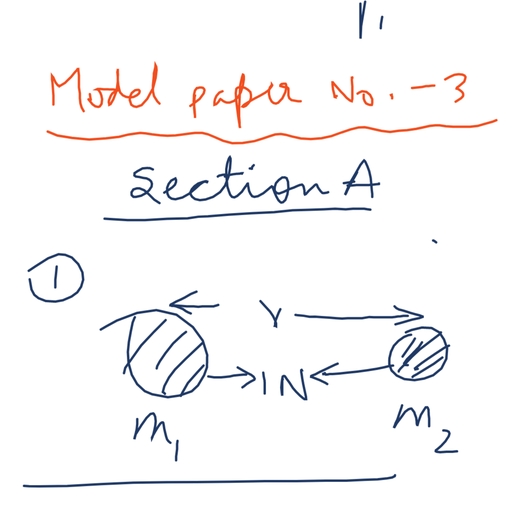
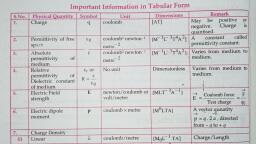
Definition of Coulomb, , The force between two point charges q, and 92 at separation ‘r’ in vacuum or air is, , , , r._! hn, 4n & 2, If gy = 92 = 1 coulomb, r = 1 m, then force F = A re 9 x 10? newton., TM Eq, , Thus, 1 coulomb is the charge which when placed at a distance of 1 metre from an equal and, similar charge in vacuum (or air) will repel it with a force of 9 x 10? newton., , , , By principle of atomicity of charge g = ne, we have, , ie Hig 1-0 coulomb, , 5 ——— = 6-25 x10", € 16x10 = coulomb, , Thus, 1 coulomb is the charge that is produced by removal of6-25 x 107 5 electrons from a neutral body., , Coulomb (C) is quite a big unit, therefore, in practice microcoulomb (uC) is used as the unit of, charge., ING = 10 ac :, Derived Unit of Charge : Ina conductor the rate of flow of charge is called the current. In SI system, the unit of current is ampere, which is fundamental unit, abrreviated as ‘A’, charge flowing (q), time (t ), a charge, g = current (i) x time (¢ ) |, Thus, the derived unit of charge is ampere x second and its dimensional formula is [AT]., Accordingly, 1 coulomb is the charge which when flowing in a conductor for 1 second causes a, current of 1 ampere., Relation of Coulomb with Other Units of Charge : In CGS system there are two units of charge :, (i) Electrostatic unit of charge (or esu of charge). This unit is also called stat coulomb., 1 coulomb = 3 x 10? stat coulomb, , (ii) Electromagnetic unit of charge denoted by emu of char :, 1 emu of charge = 10 coulomb = 3 x 10°~ stat coulomb, , Le. current, i=, , In atomic and nuclear physics the unit of charge is taken electronic charge unit; it is denoted by ‘e’., 1e=4-8x10~!° esu of charge = 1-6 x 10⁷}? coulomb, , Dielectric and Dielectric Constant: Every matter is formed of atoms. Each atom is neutral,, containing a positively charged nucleus and negatively charged electrons circulating around the, nucleus. If the electrons are well bound by nucleus, so that they cannot escape from it, then the, substance remains neutral and is called a dielectric. Thus a dielectric is a substance which contains no free, charge carriers. The examples of dielectrics are pure water, wood, glass, paper, mica, etc., , When two charges are placed in some other medium in place of vacuum or air, the force between, , e charges is effectively reduced and is given by ue, , Fnedium ee, , (3), , where ¢ is called the absolute permittivity of medium.