Page 1 :
ADDITIONAL QUESTIONS, Extract-Based Questions, Read the following extracts carefully and answer the questions that follow., , 1., , And who art thou? said I to the, , soft-falling shower,, , Which, strange to tell, gave me an answer, as here translated:, I am the Poem of Earth, said the voice of the, rain, (a) Who is T' in the first line?, Ans., , (b), , In the first line, T is referred to the poet., What does the rain call itself?, , Ans. The rains calls itself the poem of Earth., (c) Why is the rain calling itself as the poem of Earth'?, Ans. The rain is calling itself as 'the poem of Earth' because it is an integral part of the, earth., , (d) What does 'thou' mean?, Ans. Thou', , means, , 'you'., , (e) Why is the answer being 'translated' by the poet?, Ans. The answer is being translated by the poet, so that the common people can, understand what the rain is saying., , 2. Eternal I rise impalpable out of the land and the bottomless sea,, , Upward to heaven, whence, vaguely form'd, altogether changed, and yet the same, , (a) What does the use of word 'eternal' indicate here?, Ans. The word 'eternal' indicates the continuous process of rain which is everlasting., (b) From where does T rise and where does it go?, Ans. 'I rises from the land in the form of water vapour and goes to the sky., (c) Which word in the above stanza means the same as 'in a way that is uncertain,, indefinite or unclear'?, Ans. Vaguely' means the same as 'in a way that is uncertain, indefinite or unclear'., , (d) Which poetic device has been used in 'the bottomless sea'?, Ans. Hyperbole has been used in the bottomless sea'., , (e) What do you, , understand, , by 'altogether changed, and yet the same'?, , the basic, Ans. Here, the poet means that although the form of the rain changes, yet, component of all these forms is water
Page 2 :
Tdescend to, And all that, , lave the, in them, , droughts, atomies, dust-layers of the globe,, , without, , me were, , seeds, , only, latent, unborn:, , (a) With what purpose does the rain, descend from the sky?, Ans. The rain descends from the sky in order, to give life to the, , famine-stricken lands., , (b) How does the rain, The rain, , help, , helps, , Ans. The seeds, , areas, , and wash the, , the seeds?, , the seeds to, germinate and grow into, (c) What is latent and unborn?, , Ans., , dry, , a new, , lite., , latent and unborn., (d) Why are seeds latent?, are, , Ans. Seeds are latent because of lack of water which is needed for them to germinate and, form a new plant., (e) What is referred as 'them' here?, Ans. Here, 'them' refers to all the components of the nature i.e., flora and fauna., 4. And forever, by day and night, I give back life to my own origin,, , And make pure and beautify it:, (a) In what way does the rain help its place of origin?, Ans. The rain helps its place of origin by providing water to the drought-stricken areas, and by washing away impurities from the earth., , (b) What is the importance of the word "forever'?, Ans. The word 'forever' points to the everlasting features of natural elements, , (c) Which word is the opposite of 'end', , in the above stanza?, , Ans. The opposite of 'end' in the above stanza is 'origin'., 'And forever,, (d) What idea do you form by the phrase, Ans., , (e), Ans., , And forever,, , by day and night', , Who is referred, , Here,, , 'T' is, , as, , means, , by day and night'?, , continuously without any, , rest or, , break., , T' here?, , referred to the rain., , its birth-place, after fulfillment, wandering, 5. (For song, issuing from, love returns.), Reck'd or unreckd, duly with, , (a) Why, , are, , the above lines put within brackets?, , Ans. The above lines are put within brackets because they are a general observation by, the poet about the course of a song., what does this phrase mean?, (b) 'Reck'd or unreck'd',, Ans. Reck'd or unreck'd means whether cared for or not cared for (praised or criticised)., does the song return?, (c) Where, , Ans. The song returns to the place of its origin i.e., it comes back to the singer (poet)., , d) Which two natural components have been compared in the above lines?, , Ans. Rain and song have been compared in the above lines.
Page 3 :
SHORT ANSWER QUESTIONS-I, 1., , Ans., 2., , Why, , (20-30 WORDS, , does the poet get, , surprised when he gets an answer from, surprised when he gets an answer from the rain,, , The poet gets, and caiinot speak., , What, , answer, , the rain?, because it is, , does the rain, , give back to the poet?, Ans. The rain answers to the poet's, question by telling him that it is the, Is involved in a continuous, process of going up and coming down., 3. How does the rain, justify its claim I am the Poem of Earth'?, Ans., , 4., , Ans., , The rain calls itself the Poem of Earth because the, poem rendered, task of bringing joy,, happiness, and life to ts readers., Why does the rain call itself, , vapour rises to the sky, condenses and forms clouds which, aware of its, presence, the process remains invisible to us., , Ans., , 6., , Ans., , 7., Ans., , by, , the poet has the, , What, , rain. Though we, the rain has called, , cause, , Hence,, , itself impalpable'., 5., , Poem of Earth and, , 'impalpable'?, , The, are, , inanimate, , happens when it rains after a long hot spell?, , After a long hot spell, when it rains, all the dust, that has accumulated, washed away, giving a new fresh look to nature., Latent seeds get a life by rain., , on, , Earth gets, , Explain., , The seeds lying on Earth, require, seeds start germinating and, , change, , Why, , germinate and take shape. When it rains, the, the form of saplings., , water to, , is rain essential for Earth?, , into, , Without rain, Earth will remain, parched, droughts will follow and the dust-layers will, not be washed, away. There will be nothing to quench the thirst of the, plants and trees,, , and their seeds will die., 8., , Ans., 9., , Ans., , 10., , What is the cloud's, birthplace? How does it go upward to heaven?, The cloud's birthplace is the water bodies like, rivers,, and, Water vapours, being lighter than air, rise to the sky and take on strangeponds in seas., shapes the form of clouds., How does the rain describe herself in the, poem "The Voice of the Rain'?, The rain describes herselfin the, poem as the "POEM OF EARTH" which, gives happiness, to, everything and quenches the thirst and relishes the drought-prone areas., On what does the 'rain descend'?, , Ans. The rain descends on, droughts, atoms and dust, falls on everything that is on the earth., , SHORT ANSWER QUESTIONS-II, 1., , Ans., , Describe the, Water, Earth., , particles on the surface of the earth., , It, , (40-50 WORDS), , ending cycle of rain., rises unperceived in the form of, vapour from land and water bodies on the, It goes up, takes the form, of a cloud, changes its shape and falls down on Earth, never
Page 4 :
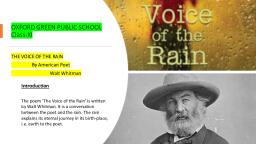
the form, , .ol water, , drops, , bathe the small dust, particles, land and sea. The, sky from rivers, oceans and seas after it rains on Earth. water, do you think the poet, 2. Why, says the phrase 'reck'd or unreck'd'?, Rek'd and unreck d stand for reckoned and unreckoned. The words literally mean, cared and uncared, respectively. The poet says the phrase to, emphasise the fact that, when the rain falls on Earth, we sometimes notice it and, sometimes to where it started, Ignore, it. But even it it is left uncared for, it completes its destiny and returns completely, n, , to, , hen 1eturns back to the, , from., , 3., , Behind the apparent simplicity, the poem hides a deep meaning'. What exactly does, the poem convey to the reader?, , Ans., , The poem conveys that like a poem, the rain is also everlasting and has an unbreakable, chain of lite cycle. It rises from the earth, and comes back to it. The, song also originates, birth, wanders, here and there, whether heeded to or not, returns with, ts, , place,, from, love to its own origin., , 4. Justify the title of the poem The Voice of the Rain'., Ans., , The Voice of the Rain' is an imaginative conversation between the poet and the rain in, , which the poet is trying to point out that the rain does have a voice and even compares, it with a song. The poet sees the rain as an entity with a voice that is indispensable for, , the survival of the earth. Therefore, the title of the poem is justly chosen by the poet., , 5. How is the life cycle of clouds?, Ans. Clouds are nothing but water in the form of gas. The scorching sun turns the water on, land and sea into vapour. The water vapours rise upwards like dark clouds and float in, the sky. Finally, the clouds again return to their birthplace in the form of rain., , LONG ANSWER QUESTIONS, 1., , Ans., , (100-120 wORDS), , Summarise the poem "The Voice of the Rain' in your own words., rain. In the poem, he, narrates a conversation he had with the falling drops of, The, , poet, on which the rain replies by calling itself 'the poem of, asks the rain, "And who art thou?, how it rises unnoticeably (as vapour) out of the land, Earth.' Moreover, the rain defines, where it converts into clouds. After that, it falls back to, and sea, and floats up to heaven,, land. This allows the seeds to grow into something, Earth to refresh the drought-tilled, Further, the poet equates the role of the poet in making this, necessary and beautiful., as a song). He also writes that this 'song' is born from, 'song' (poet refers to the poem, it leaves the poet's soul and then it changes form. But it is the, the poet's heart. Besides,, and eventualy, returns to the poet as love from the readers., same at its core, central idea of the poem?, 2. What is the, of the poem The voice of the Rain' is that both rain and poetry hold., Ans. The central idea, on, the earth. Ihe rain originates from the bottom of the sea. In, a significant position, lt, and from there, it falls down on the earth, the form of water vapour, TISEs to the sky, ilourish., T, his, to exist, poem signifies the eternal role that the rainand, and helps the life, the various elements of Earth. The rain, plays in nurturing. quencning and puritying, 1ts, returns the favour to Place or origin from where it rises unseen from the depths of£, firom the land. The rain itself is explaining to the poet about its origin., the water and, , r k and its cyclic movement. A comparison has also been drawn between rain and, , music as both of them make the world livelier and return to their place of origin afte, fulfilling their purpose.
Page 5 :
hidden message, h e poem "The Voice of the, Earth. Describe the importance of rain, in your own words, Rain' gives, , Ans., , all, , porta?it, but rain, , know, the three, , essentials, , element of nature is, , the, , water., , are water,, , for survival, We, , that, , raln 1s essential, , a, , get water, , food and, , in different, , forms, , air., , OI, , for, , The, , mos, precipitation, , most beneficial, ol, all, Ran helps in harvesting our crops that give us food to eat. Without rain, no crops Would, , 8row, air, , is, , and we, , of, , would, , clean, because, , types, , precipitatuon., , perish. Also, falling showers, , we, , need clean air, , to, , remove, , the dust in the, , air,, , making our, , breathe., , Rainwater plays a key role in creating the dimate of certain areas. Its presence in the, , atmosphere provides replenishment of the mnoisture in cloud systems., The most well-known and most important effect of rainwater is to provide us with the, , drink. Without rain, there would be no life., Rain is an eternal process benefiting mankind. Contrast it with human life which is, water to, , 4., , short-lived on this Earth. Should we disturb these eternal elements of nature?, , ns. The poem, The Voice of the Rain' beautifully shows the continuous procesS of rain, which sounds like music, , to, , human, , ears, as, , it fulfills, , our, , needs., , It is an ever-going process which sustains human life and, provides, air and green cover. On the other hand, human lives are mortal. We, , with food, pure, come on this Earth, this planet. Moreover., us, , for a short period and then depart without leaving any mark on, human beings, for their greed and selfish motives, indulge in destructive activities, which, may disturb these eternal processes of nature., We must learn, , lesson from nature, that it we want peacetul co-existence, we, need not, disturb the balance of nature, otherwise the whole of humanity will be in, danger. WNe, must learn a lesson from such eternal, processes and do something good for humanity, at large., 5., , s., , a, , Natural elements, such as air and rain make, equally. Comment on class distinction and, creation., Man's existence, , on, , no, , discrimination and bless, evervone, , inequality,, , this Earth is short-lived, but, , which is, , even in this, , a, , totally human, m, , short span,, , he has heen, responsible for many wrong doings against other human beings. God has cre, everyone as equal. But it is very unfortunate that man has divided this societ, , basis of class, caste and other factors., , he, , Man must learn from the elements of nature which provide us tresh air, food and a s, r,, without making any distinction. But in human society, class and caste distinctions, exist, and inequalities prevail in large numbers. It is high time that man must le, lessons from nature and adopt universal brotherhood for the betterment of our socir
Page 6 :
DDITIONAL QUESTIONS, A, , D, , ptract-Based Questions, ad, , Read, , the, , following, , extracts, , carefully, , did my childhood go?, 1. When, Was it the day I ceased to be, , and, , answer, , the, , questions that follow., , eleven,, , Was it the time I realised that Hell and Heaven,, Could not be found in Geography,, , And therefore could not be,, , Was that the day!, , (a), , childhoodP, At what age does the poet think that he has lost his, the age of eleven., thinks that he has lost his childhood after he crossed, The, , poet, (b) What did the poet realise?, Heaven, Ans. The poet realised that Hell and, , Ans., , cannot, , be found in any geographical, , places., , the above stanza?, What is the poet curious to know in, when did his childhood go., Ans. The poet is curious to know, that Hell and Heaven were imaginary places?, (d) How did the poet conclude, there is, and Heaven were imaginary places because, Ans. The poet concluded that Hell, books., or Heaven in any geographical, Hell, like, of, mention, places, no, this poetic device been used?, 'antithesis'? In which line has, is, What, (e), a sentence, it is called antithesis., are used together in, words, two, opposite, When, Ans., 'Hell and Heaven'., used in the third line of the stanza, This poetic device has been, , (c), , -, , 2. When did my childhood go?, adults, Was it the time I realised that, , were, , not, , all they seemed to be,, , They talked of love and preached, , of love,, , But did not act so lovingly., , Was that the day!, , Literature |141
Page 7 :
(a) What does the poet realise?, Ans. The poet realises that the adults, , Why, , (b), , a r e not, , what, , they, , seem, , to, , be., , is the poet confused?, , Ans. The poet is confused because he does not seem to understand when h, , he lost, , childhood., , (c) Explain, 'But did not act so lovingly., Ans., , It means that adults talk about love but their actions are not loving., , (d) What does the poet think about adults?, Ans., , adults are full of hypocrisy., (e) What does the poet think about the preaching and practice of adults?, , According to the poet,, , Ans. The poet thinks that the, 3. When did my childhood, go?, Was it when I found, my mind, , To, , use, , whichever way, , I, , preaching and practice of adults are contradictory, , was, , really mine,, , choose,, , Producing thoughts that were not those of other people,, , But my own, and mine alone, Was that the day!, , (a), , Explain, 'my mind was really mine., , Ans. It, , that the poet's mind was not, influenced by others., (b) What does the poet realise?, Ans. The poet realises that, his mind is his and he has, his own, (c) What do you think is the most, individuality., important, towards, step, adulthood?, Ans. Having an, mind, free from any outside, step towards adulthood., influence, is the most important, (d) How did the realisation of, being the master of his own mind, Ans. The realisation of, being the master of his own mind made help the poet?, the poet, (e) How has the poet become, self-confident., now?, Ans. The poet has, gained, in, means, , independent, , independent, individuality, , independent., , 4., , his own, , thoughts. Thus,, , Where did my childhood, g0?, , It went to some, , forgotten place,, , That's hidden in an infant's, face,, That's all I know., , (a) What is the poet curious to know in, the above stanza?, Ans. The poet is curious to, know where did his childhood, go., (b) Where did the, childhood, , Ans. The, , poet's, , poet's childhood, , go?, , went to some, , forgotten, , or, , unknown, , nlace., , he became
Page 8 :
ere, , (c, , does the, , The oet, , Ans., , poet think that his childhood, , thinks that his childhood, is hidden, , e), , in, , hidden?, , infant's, , face, line of the above, stanza indicate?, The tirst line indicates a shift in the, thoughts of a growing child., which poetic device has been used in the second line of the stanza?, , What, does the first, at does, , d, , is, , an, , Personitication has been used in the second line of the stanza., Ans., , RT ANSWER QUESTIONS-, , (20-30WORDS), , what different possibilities, according to the poet, are instrumental in cessation of, childhood?, , There are various poSsibilities lhike growth in terms of years, rationalism, realisation of, Ans., , the falsehood and hypocrisy of the adult world., , type of poem is 'Childhood'?, 'Childhood' by Markus Natten is a subjective poem. At the beginning of each stanza,, Natten constantly asks himself, "When did my childhood go?" He is confused about, , 2. What, Ans., , when he ceased to be a child., , 3. What does the poet realise at the end of the poem?, Ans. The poet comes to the conclusion that his childhood has gone to some forgotten place., The recollection of it has faded away with the passage of time., , 4. What did the poet realise when he crossed the age of eleven y, Ans., , Hell and Heaven did, When the poet crossed the age of eleven years, he realised that, not exist. They cannot be located in any geography books., , 5. How did the poet conclude that Hell and Heaven were imaginary places?, Heaven were imaginary places because Geography, Ans. The poet concluded that Hell and, is no mention of places like Hell or Heaven in, books contain names of places, but there, , these books., the poet when he was a child?, He, the adults as an epitome of love and sincerity., Ans. As a child, the poet considered all, ones., loved, their, and they were ready to do anything for, believed that their love was true, of being grown-up?, 7. How does the poet describe the process, and analytical point of view in, critical, 6. How did adults, , seem, , to, , thinking, , The process of being grown-up develops, decisions on his own., rationalised and capable of taking, the, makes, person, It, the person., childhood?, o n his loss of, 8, How does the poet repent, Childhood cannot be, his childhood's disappearance., Ans. He expresses c o n c e r n over, of hypocrisy, bitter reality and, aloof from the world, life, o, u, r, regained. It keeps, , Ans., , materialism., , Heaven stand for?, What does the Hell and, that fascinates small children. These, the world of imagination, Ans. Hell and Heaven stand for, mind that helps the person escape from, imaginative, our, the, product of, are nothing but, , ,, , reality., 10., ins., , the, What is the mood of, , poet in this poem?, , beginning, however in the end, seems to be melancholic in the, the, mood, poet, c, h, i, l, d, h, o o d was hidden in the face of ar, The, of, his, he finds out that, when, relieved, the poet feels
Page 9 :
SHORT ANSWER QUEST, What is the poem, , 1., , 'Childhood', , about?, , Natten., childhood. He wonders, about, the moment, Marcus, Childhood' is written by, , Ans., , the world is, , not, , poet thinks over hi., innocence and realised., l also, , the, , what heseemed it, , to, , In this, when, hepoem,, lost he, , when his thoughts changed, be. He recalls, , anc, , him., , around, hypocrisy of the people, 'Childhood'?, about in the poem, 2. What is the poet talking, lost his childhooe, the age when he, realise, to, is trying, So he keeps saying, Ans. In the poem Childhood', the poet, understand the worldly things., to, mature, enough, when he became, childhood is gone to some, realises that his, finally, He, childhood, go?", "When did my, infant's face., forgotten place, that is hidden in an, and their nature?, 3. What does the poem tell us about human beings, and love. As, innocence, purity, softness, Ans. According to the poet, childhood symbolises, a child grows up, these qualities start receding. Man adheres to lying, shrewdness,, realises, , the, , Cunningness and, , hypocrisy. Adults preach about truth and honesty,, , but, , they themselves, , practise hatred and lying., 4., , Bring out the hypocrisy that the adults exhibit with regard to love., , Ans. As the poet grew up, he could understand the double standards followed by adults., , He realised that though adults preached of love and talked of love, their behaviour, was totally different and full of manipulation. They were all hypocrites who behaved, differently from the way they talked., 5., , What did the poet notice about independent thinking? How important was this, , discovery?, Ans. The poet discovered that he was different from others and could think, independently., He could have his own opinions without getting influenced by anyone else. This, discovery was very important to him as it revealed to him his abilities for independent, thinking and decision taking., 6., , What is the poet trying to convey when he says that childhood is hidden, in, face?, , Ans. The poet says that, , an, , infant is, , really, , innocent, , as it, , fool others. The poet brings out this tact by, adults, who are manipulative and hypocrites. As, his childlike innocence fades away., to, , 7., Ans., , 8., Ans., , According to Markus Natten, when does a, , trusts, , an, , infant's, , everyone and does, , not try, , contrasting, a, , person, , child become, , it with the, , develops, , an, , behaviour of, rational thoughts,, , adult?, , Becoming an adult is a complex proces which is associated with physical,, mental and, social development. A child becomes an adult when he is able to, live his own life and, take care of his responsibilities, individually. He also develops his own thought process., using which, he can form his own beliefs and opinions., What is the poet's feeling towards his childhood?, The poet regards childhood as a period of innocence. A child, sincerely feels that he, is free from all evils and that, there is, a, Hell, a, and, Heaven., A child, really, knows n o, hypocrisy. There is no difference between his thoughts and actions. In short, childhood, is a state of innocence and, of heart., purity
Page 10 :
the poem expose man and, present him in his true colours?, i tO the poct, childh0od symbolises, innocence, purity, softness and, love. As, child grOws up, these qualities start receding. Man, eres to, lying,, and, shrewdness,, .ieess, hypocrisy. Adults preach about love and honesty, but, they themselves, hatred aand lyig. The, simplicity and honesty of childhood, the, daes, , 9. H o, , Ans, , P r a i s e, , evaporates, , nient man crOsses the threshold of innocent childhood., , mom, , 10., Ans., , according, , to the, , is involved in the, process of growing up?, saperson grows up, he becomes a rationalist, an egoist and a, He accepts, hypocrite., aothing that is not logical. He loses faith in God. He does not believe, in Hell or Heaven., , what,, , He, , poet,, , becomes very conscious of his self. He, , wants to, , follow his, , own, , desires and ideas. He, , becomes an egoist. He talks of love and preaches of love, but actually does not show, , love in his actions. In short, he loses all the innocence of his childhood in the process of, 8rowing up., , 1ONG ANSWER QUESTIONS, ., , (100-120 WORDS), , How does the poem explain childhood? What is so special about childhood? How are, , children different from adults?, Ans. The poet regards childhood as a period of heavenly innocence. A child sincerely feels, at there is God above. He is free from all earthly evils. He believes that there is really, , a Heaven and a Hell. He is truly religious in his soul. A child knows no hypocrisy. He, , always means what he says. There is no difference between his thoughts and actions. A, child is free from any sense of ego. He does not think himself to be different from or, superior to others., , Childhood symbolises innocence, purity, softness and love. As a child grows, these, qualities start receding. Man becomes impure, cunning, shrewd and hypocrite. Grown-, , ups become blatant iars. They talk of love but practise hatred. They preach brotherhood, of mankind but perpetuate hatred and killing. Simplicity and honesty evaporate intoa, thin air, the moment man crosses the threshold of innocent childhood., , 2. Write a brief summary of the poem Childhood'., Ans. The poet ponders deeply upon the spiritual questions of life and ultimately, realises, , the fact that his childhood days were finally gone down into the past of eternity for, good and would never return. Childhood would now only remain in his memories. He, , wonders if the end of his childhood was the day he ceased to be eleven years old; the, time when he realised that Heaven and Hell are not real places because they could not, be located in any geography books and never could be., The poet also realises that adults were not all they seemed to be. They talk of love, but, practise hatred., , In the poem 'Childhood, the poet is trying to realise the age when he lost his childhood:, , when he became mature enough to understand the worldly things. So, he keeps asking., , "When did my childhood go?". He finally realises that his childhood is gone to some, forgotten place, , that is hidden in, , an, , infant's face., , 3. What is the central idea of the poem, Ans. In this poem, the poet thinks deeply over the question of his lost childhood. Childhood, is a stage of innocence in which thechild believes others and loves unconditionally. The, Childhood'?, , noet has tried to identify some stages ot his liie when his thoughts and perceptions of, , the world changed. The poem deseribes the first step to maturity or loss of childhood
Page 11 :
when, , one, , is able, , to, , think, , logically, , bv others, gettng inllhuen ed, , Is, , also, , and rationally. Forming, a, , sign ol, , or, , maturity, , in o u r, , o n e s own, , opinion, , and, , not, , loss of childhood., , sOCiety,, , where, , prevalent, The poem also hints at the hvpocrisv, do not like each other., they, reality,, be nice to each other, but in, , people, , pretend to, , of, , adults, alsn, regarding the, Markus Natten, though showing disapproval, and individuality. Do you, that of independent thinking, raises a very important point,, what we are? Elaborate in, and individuality make us, that, thinking, independent, agree, behaviour, , of the poem 'Childhood'., As a child, one is not able, is a step towards adulthood., thinking, independent, Ofcourse,, influenced and directed by, one's thinking is always, to make one's own decisions and, between truth and imagination, adults. A child is so innocent that he cannot distinguish, Moreover, it is, is influenced by others, it has no individuality., As a child's, the, , context, , thinking, , fickle-mindedness. Independent thinking makes, manipulations which lead to, us what we are. It shapes our personality and we are known among people through, , prone, what, Tt, , to, , our, , mind thinks and what decisions, , we want, , to, , we, , take., , stay away from evil people, who try, , seltish purposes, then, , to, , only independent thinking can, , influence our thoughts for their, help us. We cannot claim to be an, , individual, if we cannot take decisions ourselves., 6. What is the greatest loss to the poet?, , 5., , ., , The poet has discussed a lot about the different losses he faces while he is growing up., Through this poenm, Markus Natten raises moral questions about the education, immoral, behaviour of the adults and the respect of one's individuality and independence. He, confesses that the greatest loss is of losing innocence in childhood. The poet laments the, loss of the innocence he had as a child. He regarded childhood as an importantstage in, , the process of growing up. He believed that when he turned twelve, Hell and Heaven,, as he had been told, did not exist. He reasoned through his ideas and came to his own, conclusions. He lost confidence in people and began to be a bit more cynical. Towards, the end, the poet has one hope that he could see his childhood being manifested into, , some other infant. He is happy that he could see his childhood, though he would not, be able to experience it any more., , Compare and contrast between childhood and adulthood, as mentioned in the poem., Human life is full of experiences. It is divided into a number of phases. Markus Natten, is a great philosophical poet who has tried to explore thee philosophy of life. He has, discussed about two most important phases of man - childhood and adulthood-in the, , poem. He has distinctly brought out the ditlerence between the two., , He says that childhood is the best part of one's life. It is also the most important stage., Innocence is the most integral part of it. The child is dependent on his parents for, everything. He believes in what is said ortaught to him. He is irrational and unbiased., , He does not follow philosophies of life. He is limited to his knowledge gained by books., The next stage discussed is the adulthood. As the child enters into this stage, a number, rationale. He becomes free and self-dependent., creeps into him. He becomes, , changes, of, He seeks for, , philosophical knowledge. He also becomes hypocrite. There is a lot of, difference between his words and his actions. T hus, We can clearly see that there is a lot, , of difference between these, , two, , stages of human, , life i.e.,, , childhood and adulthood.