Page 1 :
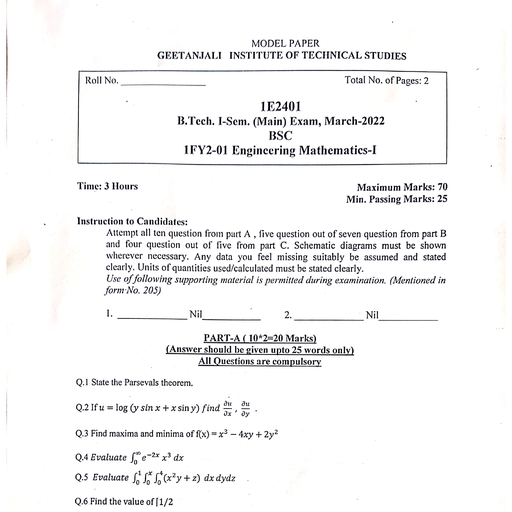
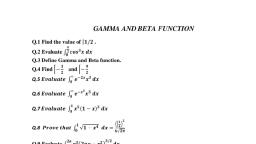
MODEL PAPER, GEETANJALI INSTITUTE OF TECHNICAL STUDIES, , , , , , Roll No. Total No. of Pages: 2, , 1E2401, B.Tech. I-Sem. (Main) Exam, March-2022, BSC, 1FY2-01 Engineering Mathematics-I, , , , , , Time: 3 Hours Maximum Marks: 70, Min. Passing Marks: 25, , Instruction to Candidates:, , Attempt all ten question from part A , five question out of seven question from part B, and four question out of five from part C. Schematic diagrams must be shown wherever, necessary. Any data you feel missing suitably be assumed and stated clearly. Units of, quantities used/calculated must be stated clearly., , Use of following supporting material is permitted during examination. (Mentioned in, , form No. 205), , 1. Nil 2 Nil, , PART-A (10*2=20 Marks), (Answer should be given upto 25 words only), , All Questions are compulsor, , Q.1 State the Parsevals theorem., , A z du du, Q.2 If u = log (y sinx + x sin y) find oe’ dy, Q.3 Find maxima and minima of f(x) = x? — 4xy + 2y?, , Q4 Evaluate Sp e* x8 dx, , Q.5 Evaluate So i Spey +z) dx dydz, , Q.6 Find the value of [1/2, , Q7 Evaluate [? cos*x dx, , Q8 If f(x,y, Zz) = 2x?y — y3z’, then find grad f at the point (1,—2,-1)., , Q9 Write the formula for surface and volume for solid of revoluation about y — axis, , Q.10 Find V(x? y + 23x + y?z?), , ()
Page 2 :
MODEL PAPER, GEETANJALI INSTITUTE OF TECHNICAL STUDIES, , PART-B(5*4=20 Marks), (Analytic/Problem solving questions), Attempts any five questions, , Q.1Find half range cosine series for f(x) =2x-1,0<x<1, , Q.2 Expand e* cos y near the point (1, 4) by Taylor’stheorem., , Q.3 Find the maxima and minima of f(x,y) = x3y2(1—x —y), , co 4, Q.4 Evaluate J, peak, Q.5 Prove that V7f(r) = f(r) + =f), , Q6Ifa = («+ 2y+az)i + (bx —3y—z)j + (4x + cy + 2z)k. Find a,b,c. So that @ is, irrotational. Find also its scalar potential., Q.7 Evaluate the following integral by change to polar co — ordinate, , g aa Fy? dxdy, , PART-C( 3*10=30 Marks), , ( Descriptive/Analytic/Problem solving/Design Questions), Attempt any three questions, , Q1 find the surface and volume of solid formed by revolving the astroid xo + yi =, 2, , a3 about the x — axis, , Q2(a)Evaluate {,° (ee Pm dx dy by changing to the polar coordinates., , (b) Find the volume of the greatest rectangular parallelepiped inscribed in the ellipsoid whose, 2, , wo ye, equation is 5+ iapta= 1., , Q.3 Find the Fourier series of the function f(x) = x + x? in the internal (- 7,7) and show that, me 1 1, gruitgt gt, Q4 Verify Green's theorem forf, [Gey + y*)dx + x*dy],where c is bounded by y = x and y =, x., Q5 (a) Find div (r"7 ), Where F = xt + yf + zk andr? = x? + y? + 2?, Hence show that r'r will be solenodial if n = -3., , (b) Find the values of the constants, a, b, c so that the directional derivative of, o= axy” + byz + cz?x? at (1, 2, -1) has a maximum of magnitude 64 in a direction parallel to the zaxis., , (2)