Page 1 :
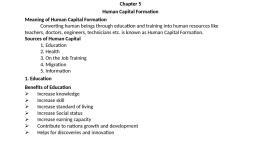
EXTREME EDUCATION, MCQ-HUMAN CAPITAL FORMATION., , Q1. Human capital refers to the stock of ____ of a nation at a point of time, a. Exports items, b. Imports items, c. Skill and expertise, d. None of these, Q2. ____ is the process of acquiring and increasing the number of persons, who have the skill, education and experience which are essential for the, economic and political development of a country., a. Human capital formation, b. Physical capital formation, c. Financial capital formation, d. Both a and b, Q3. Sources of human capital formation involve, a. Expenditure on education, b. Expenditure on health, c. Migration, d. All of these, Q4. ____ is known as the ability to read and write., a. Education, b. Human capital, c. Literacy, d. Human development, Q5. As per census 2011, the literacy rate in rural India is about, a. 72%, b. 45%, c. 69%, d. 56%, Q6. What is the percentage of Female literacy in India?, a. 66%, b. 81%, c. 89%, d. 70%
Page 2 :
Q7. Migration of skilled manpower to developed countries of the world is, known as, a. Migration, b. Human capital, c. Brain drain, d. Decentralization, Q8. Merit of human capital formation includes, a. Improves technical knowledge, b. Enlarges the size of business, c. Increases cost of production, d. Changes social outlooks, Q9. ____ is not an indicator of education level?, a. Years of schooling, b. Life expectancy, c. Teacher-pupil ratio, d. Enrollment rate, Q10. Expenditure per student in _______ education is higher than that of, elementary., a. Secondary, b. Primary, c. Tertiary, d. None of these, Q11. _______ is the prime funding authority for university education., a. LPG, b. UGL, c. UPSC, d. UGC, Q12. India has the potential to become a leading _______ economy., a. Capital based, b. Youth based, c. Knowledge-based, d. All of these, Q13. Higher-income causes building of high level of ________ capital., a. Physical, b. Human, c. Financial, d. None of these, Q14. Human capital considers education and health as a means to increase
Page 3 :
_________, a. Publicity, b. Population, c. Private powers, d. Productivity, Q15. Economic growth means ________ in real national income of a country, a. Increase, b. Decrease, c. No change, d. Zero, Q16. ________ capital is completely mobile between countries., a. Physical, b. Human, c. Financial, d. None of these, Q17. _______ is the reason for the rural-urban migration in India., a. Over population, b. Unemployment, c. Higher infant mortality rate, d. Childhood marriages, Q18. Individuals invest in education with the objective of increasing their, future ________, a. Friends, b. Income, c. Family, d. All of these, Q19. Human capital formation is a _______ process., a. Physical, b. Social, c. Chemical, d. Long, Q20. Role of on-the-job training doesn’t include, a. Eradicates inequality, b. Encourages innovation, c. Promotes modern methods, d. Enhances productivity
Page 4 :
Q21. What was the average youth literacy rate in 2015?, a. 89.5 percent, b. 74 percent, c. 88 percent, d. 95.5 percent, Q22. In which year Right to Education Act was enacted?, a. 2008, b. 2009, c. 2010, d. 2012, Q23. What percent of GDP was invested in education in the year 1952?, a. 7.92 percent, b. 11.7 percent, c. 0.64 percent, d. 3.31 percent, Q24. What was the share of education in total government expenditure in, 2014?, a. 7.92 percent, b. 15.7 percent, c. 0.64 percent, d. 3.31 percent, Q25. Which level of education takes a major share of total education, expenditure in India?, a. Elementary, b. Secondary, c. Higher, d. Tertiary, Q26. Which of the following institute comes under the health sector?, a. NCERT, b. UGC, c. AICTE, d. ICMR, Q27. _____ five year plan recognizes the importance of human capital?, a. Seventh, b. Sixth, c. Tenth, d. First, Q28. ______ capital is tangible and can be sold in the Market
Page 5 :
a. Human, b. Physical, c. Service, d. None of these, Q29. _____ organisation enforces the rules and regulations regarding, technical education, a. NCERT, b. AICTE, c. ICMR, d. UGC, Q30. Institutions providing elementary education have increased up to ______, times, a. Four, b. Five, c. Six, d. Seven